Cooperstown: One of Best American Small Towns

May 9, 2015
Cooperstown, New York

Cooperstown, New York

AARP (American Association of Retired People) has now picked Cooperstown, NY as No. 8 on its list of America’s Best small Towns under the 30,000 full-time population mark. In these study findings, they don’t exactly recommend any of these listed places as future home prospects for retirees, but as places that have much to offer visitors in the way of education, beauty, cultural uniqueness. great dining, and affordable fun.

As one-time, but going-back-someday visitor in Cooperstown, and as a Deep Blue Level lover of baseball and its history, I would love to live there full-time, but my dear wife doesn’t want to live anywhere it gets that cold, and stays that cold, throughout the long northeastern American winters. And, who knows? I’m a native Texan and have never even seen a snow that lasted 24 hours. – Maybe, at age 77, I might have a little trouble finding the right end of a snow shovel long enough to do us much good under blizzard conditions, anyway, but then – people don’t shovel snow during blizzards, do they?

We were there briefly with other family members in June of 1994. I recall asking one of the baseball memorabilia shopkeepers what he did during the winter? “inventory” was his one-word answer. So, maybe my little sweetheart is right this time. Maybe, I would not like the long periods of snowbound enclosure either, but I’m still not sure. – Has anyone ever been snowbound inside the National Baseball Library? – That fate sounds like a cool way to be imprisoned for a while – to me, anyway.

Short of moving there. Maybe I can just go spend the summer there sometime, even if I have to go alone. That would be the Dream Summer of my life, as I now think about things. Just taking a few slow contemplative weeks living in the heart of baseball’s Valhalla would do me just fine.

On the only previous dawn I ever spent in Cooperstown back in 1994, we were saying in a place called “The Shortstop Hotel” on Main Street, very close to the Hall of Fame. I was so excited to be there that I awoke before the sun and quietly dressed to walk around by myself without waking anyone else in the family.

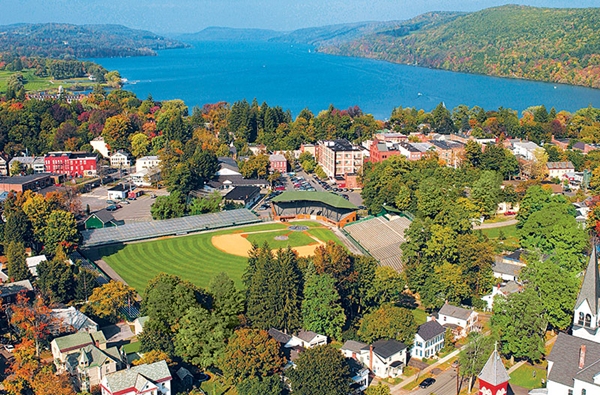
When I hit the streets and started walking Main Street in the quiet darkness, among the orderly placement of those old style street lights, I could not help but be reminded of how much it made me think of Bedford Falls in that wonderful old Frank Capra movie from 1946, “It’s a Wonderful Life”. After a while of much sauntering, I was attracted to the sound of some noise down the way. Lo and behold, I stumbled upon Doubleday Field, only minutes away from dawn. A ground crew was there to do some work and get the field ready for some kind of amateur game that was on the docket for that afternoon. I asked if it would be OK to enter and just walk in and take a seat for the sunrise. Those guys had no problem with that request – and so I did just that on the home plate first base side – I found a seat in the empty stands – and I sat back in a state of gifted waiting – in full anticipation of what I was about to see as the darkness lifted. I had not counted on anything on this spiritual level in my first-and-only-time experience of Cooperstown. and here it was – unfolding for me suddenly, like Christmas in June.

As the sun rose on Doubleday Field that summer pre-dawn morning, I was the only one sitting in the stands to salute its arrival. The changing of the light, as it streaked and glowed in orange color variations in the eastern sky behind the outfield walls, was simply magnificent. And the higher the sun rose in the sky, the more the rustic civil beauty of bungalows nestled among the tall evergreens there shown forth in settled glory, as light rays trickled more strongly through the parting spaces between the leaves, almost inviting me to pay attention to the towering church steeple that completed this scene, and at the same iconic field ushered into perpetual service and celebration in 1939 with the help of people like Honus Wagner, Cy Young and the one and only George Herman “Babe” Ruth.

“Where is Norman Rockwell when you really need his company?” Or so I thought.

Cooperstown, as far as small towns with much to offer, you will always be Number One with people like me. And I am only one of the millions you could not handle, should we all decide to move in with you at the same time because of what was long ago built into your already most beautiful depiction of the early American Dream by the game of baseball.

Better we all visit, one by one, and get down to Doubleday Field before the sun rises, individually or in small company, in the hope that some other kind soul will be there to help us begin our visit to the Baseball Hall of Fame with this kind of sublime half hour of sunrise meditation.

____________________

Here’s the AARP “America’s Best Small Towns” description of Cooperstown and the link to their piece on all ten towns with populations under 30,000 that they recommend:

America’s Best Small Towns: No. 8, Cooperstown, New York

“Founded in 1786, this town is filled with stately homes and civic structures — but most know it best as the location of the National Baseball Hall of Fame and Museum. But this isn’t just a destination for sports lovers: Cultural attractions include the Cooperstown Chamber Music Festival, the annual Glimmerglass Opera season and the Fenimore Art Museum. Outdoorsy types, meanwhile, can enjoy golfing at Leatherstocking Golf Course, boating on Otsego Lake and hiking in Glimmerglass State Park. Beer lovers shouldn’t pass up a chance to tour the esteemed Brewery Ommegang, which produces Belgian-style brews and hosts a Belgian food-and-drink festival on its grounds every August. For dining, highlights include the global-inspired menu at the Alex & Ika Restaurant and the waterfront views at Lake Front Restaurant and Bar.”

~ excerpt from America’s Best Small Towns by Michael Alan Connelly, Abbey Chase, Fodor’s Travel

Full Story Link:

http://travel.aarp.org/articles-tips/articles/info-07-2014/best-small-towns-america-photo.html?cmp=NLC-WBLTR-DSO-NMCTRL-050815-TS1-TRAVEL-593658&encparam=Wueocu2B5p71a0XxeCsVXV8HRwoCIA4EVR0NIn9wSQo=#slide1

____________________

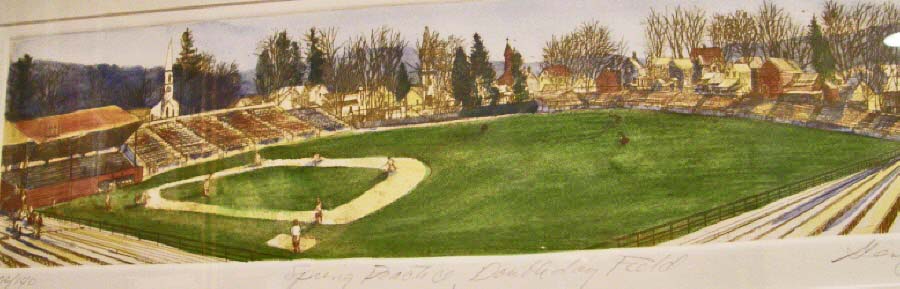
    Double Day Field     Cooperstown, New York     By Deborah Geurtze

Double Day Field
Cooperstown, New York
By Deborah Geurtze

We were out of town all day today, Saturday, May 9th, so I just came in to find this wonderful “Rockwellian” landscape of Doubleday Field by artist Deborah Geurtze, with a crucible note from baseball friend and fellow SABR member Bill Hickman. Art and narrative both are deserving as this late inclusion into the Doubleday Field-focused column. Thanks, Bill Hickman for all you do the good in the name of baseball!

“Your mentioning Norman Rockwell in your column today prompted me to send you the attached.  The artist wasn’t Rockwell, of course, but instead was Deborah Geurtze.   This print sits above my computer, along with another one of hers which shows the front entrance to Doubleday Field.  Perhaps this will give you another good memory of your day at the field with the church steeple in the background.  Deborah Geurtze was located in Cooperstown at the time I purchased her prints, although I acquired them at craft shows elsewhere.

“The photo is askew because I was trying to avoid the reflection of lights in the room off the glass covering the print.
“Much enjoyed your description of Cooperstown.  It’s a terrific place, and I’d love to return there again.  Been there twice.  I salute you for getting up and seeing the sunrise at the field.  What a terrific experience to enjoy!”
~ Bill Hickman, May 9, 2015
____________________

The 1933 Houston Buffs

May 8, 2015
The 1933 Houston Buffs from an online photo find by John Watkine, SABR

The 1933 Houston Buffs
from an online photo find by
John Watkins, SABR

____________________

Thank you, John Watkins, for providing the visual that made this column desirable. Even if the figures appear smaller in the photo size we are forced to use here, we shall begin with your identification of the players and two club executives featured in this picture from old Buff Stadium in Houston:

“1933 Houston Buffs

Front Row, L-R: Mike Cvengros (P), Bill Beckmann (P), Gene Moore (OF), Ernie Parker (OF), Tommy West (C).
Middle Row, L-R: George Payne (P), Ken O’Dea (C), Carey Selph (Manager), Ival Goodman (OF), George Binder (SS), Ed Hock (3B).
Back Row, L-R: Fred Ankenman (President), Stan Keyes (OF), Oscar Fuhr (P), Ed Greer (P), Robert Kalbitz (1B), Albert Fisher (P), Andy French (Secretary).”

– John Watkins, SABR (and great-nephew of Watty Watkins, the famous former Houston Buff and St. Louis Cardinal).

____________________

The 1933 Houston Buffs were a nifty little ball club. They simply ran into the Shaughnessy Playoffs and the hazard of losing everything in a short series down period. Ever hear of that happening since 1933?

The ’33 Buffs posted some pretty fair individual marks. Playing manager 2nd baseman Carey Selph played in 149 games, led the Buffs with 184 hits, 40 doubles and a .310 batting average.

Outfielder Gene Moore led the Buffs with 13 homers. His .299 batting average and 38 doubles were second highest on the club among players who were on the roster for most of the season and who regularly played. It was the ’33 Buffs’ pitching, speed and defense, however, plus the do-as-I-do leadership modeling of Manger Selph that propelled the club to a first place finish in the Texas League with a record of 94 wins, 67 losses and a .623 winning percentage.

Their pitching strength included Ed Greer (22-10, 2.75), former Pittsburgh Pirate Mike Cvengros ( 21-11, 2.38), veteran ace George Payne (19-11, 2.56), Bill Beckmann (14-11, 2.75) and Elmer Hanson (8-2, 1.96).

The Buffs were well represented on the postseason 1933 Texas League All Star team: Houston members included: Jimmy O’Dea (.269 BA), one of two catchers; Carey Selph, 2nd Base; George Binder (.235 BA), shortstop; and Ed Greer, pitcher.

Among 1933 Texas League statistical leaders, Ed “Bear Tracks” Greer tied another for most pitching wins with 22, and pitcher Mike Cvengros owned the league’s lowest earned run average at 2.38.

Unfortunately for the 1st place 1932 Houston Buffs, they fell in three games to the 4th place San Antonio Missions in the first round of the post-season playoffs, as the 2nd place Galveston Buccaneers were eliminating the 3rd Dallas Steers, 3 games to 2. San Antonio went on to defeat Galveston, 4 games to 2 in the finals for the 1933 Texas League championship pennant before going on to a six game loss to the New Orleans Saints of the Southern Association in the Dixie Series.

Anatomy of 20 Wins Pitcher for 102-Loss Club

May 7, 2015
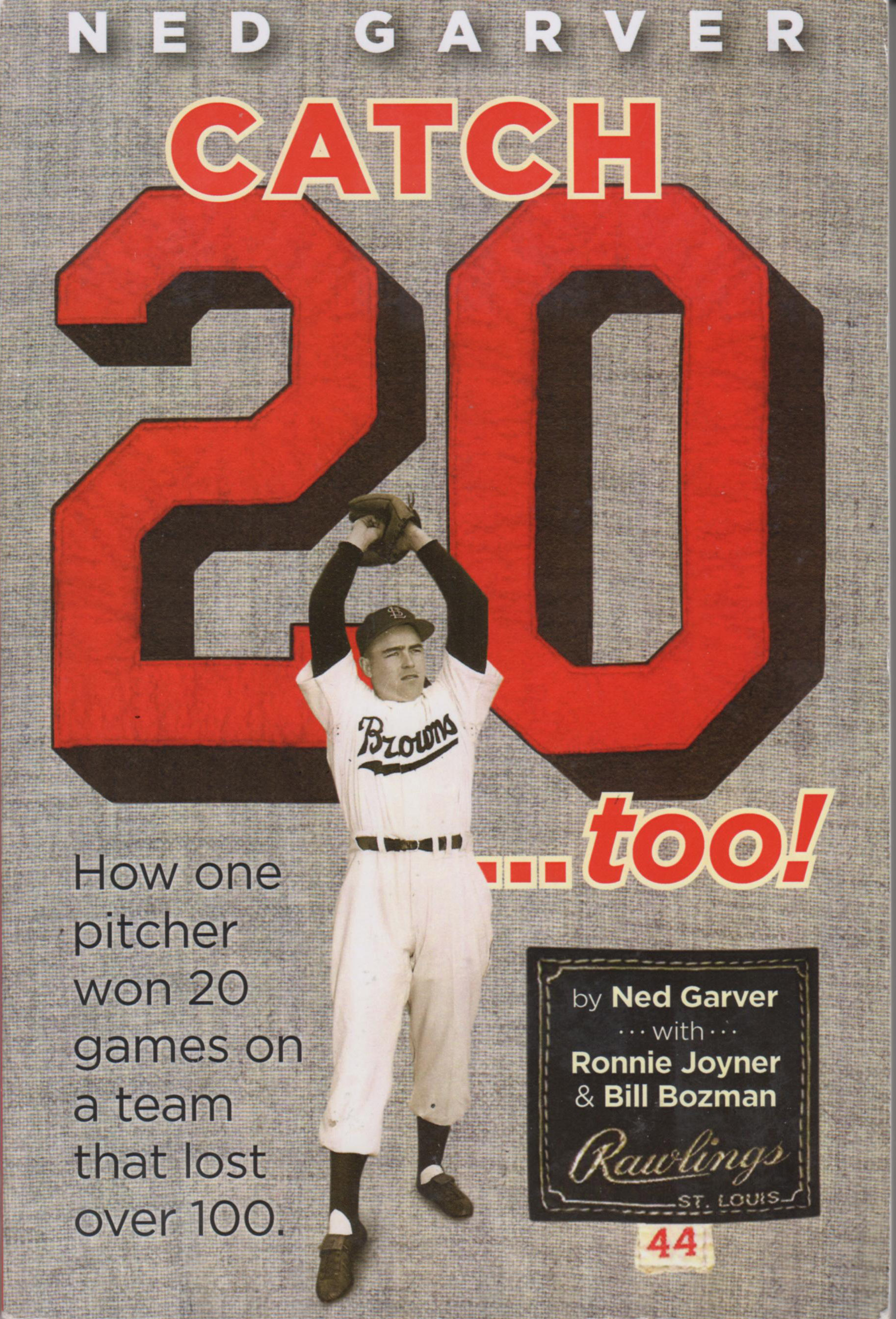
Book Order Information: Autographed Copy “Ned Garver: Catch 20…Too” for $25: http://thestlbrowns.blogspot.com/2013/12/ned-garver-catch-22.html

Book Order Information:
Autographed Copy “Ned Garver: Catch 20…Too” for $25:
http://thestlbrowns.blogspot.com/2013/12/ned-garver-catch-22.html

As we noted in our column on former pitcher Ned Garver, he won 20 games for the last place St. Louis Browns over the course of a 154-game schedule in the eight-club 1951 American League. Garver’s final record for that remarkable season was a final record of 20 wins, 12 losses, an E.R.A. of 3.73, over 30 starts, 3 relief appearances, an AL leading 24 complete games, and a total of 246.0 innings pitched.

Garver’s club, the 1951 St. Louis Browns, finished the season in eighth and last place with a record of 52 wins, 102 losses, and a full 46 games behind the AL and eventual World Series Champion New York Yankees.

It was a season marked by the exploits of super promoter-owner Bill Veeck to boost the horrendous attendance at Sportsman’s Park in St. Louis by the few remaining fans of the American League’s most chronic historical loser with all kinds of gimmicky evenings like “Fans Management Night” when Veeck set up a color card system behind the Browns’ third base home team dugout and allowed a group of fans there to vote on certain game-time decisions, like – should a runner at first attempt to steal second base or not – by flashing th designated stop or go cards. Nothing really helped. Even the surprise insertion of 3 feet, 7 inch little person Eddie Gaedel into their lineup as a batter in a home game played against the Detroit Tigers on August 19, 1951 failed to motivate larger future crowds to come out see the same old losing Browns. By season’s end, the Browns game attendance closed at 293,790.

Ironically, the great legitimate attraction that could have been better exploited for marketing purposes, right handed pitcher Ned Garver, sort of flew by under the radar on his compelling flight into baseball destiny as a man who end the season with 20 wins for a 102 game losing last place club.

To understand how that worked better, you must read Ned Garver’s second book, “Ned Garver: Catch 20…Too” (2013) that he wrote with baseball researcher-historians, Ronnie Joyner and Bill Bozman. Short of that far more dynamic presentation by Garver on how it happened, here is our linkage anatomy of each winning game box score from Baseball Almanac for Ned Garver in 1951 and, if you check each box score carefully, you will be able to see how many games that Garver lost in between victories – and please note too – that last win number 20 came in the last game of the 1951 season.

Of course, I’m pretty sure you’ve already heard what club owner Bill Veeck supposedly told Ned Garver hen the latter tried to parlay his very good season into a raise for 1952. Veeck turned him down. But why?

According to Bill Veeck’s often quoted words to Ned Garver, after acknowledging that Garver had pitched brilliantly  in 1951, Veeck supposedly added, but, “we could have finished last without you!”

Box Score Anatomy, Ned Garver: 20 Wins for the 102-Loss St. Louis Browns in 1951:

Win # 1: April 21, Browns 9 – Indians 1 (Garver Record 1-1) (Browns Record 1-3)

http://www.baseball-almanac.com/box-scores/boxscore.php?boxid=195104210CLE

Win # 2: April 25, Browns 7 – White Sox 4 (Garver Record 2-1) (Browns Record 2-7)

http://www.baseball-almanac.com/box-scores/boxscore.php?boxid=195104252CHA

Win # 3: April 29, Browns 6 – Indians 3 (Garver Record 3-1) (Browns Record 3-8)

http://www.baseball-almanac.com/box-scores/boxscore.php?boxid=195104291SLA

Win # 4: May 13, Browns 13 – Tigers 10 (Garver Record 4-2) (Browns Record 6-18)

http://www.baseball-almanac.com/box-scores/boxscore.php?boxid=195105131SLA

Win # 5: May 15, Browns 11 – Athletics 8 (Garver Record 5-2) (Browns Record 7-19)

http://www.baseball-almanac.com/box-scores/boxscore.php?boxid=195105150PHA

Win # 6: May 27, Browns 8 – Tigers 3 (Garver Record 6-3) (Browns Record 11-25)

http://www.baseball-almanac.com/box-scores/boxscore.php?boxid=195105272DET

Win # 7: June 1, Browns 4 – Red Sox 0 (Garver Record 7-3) (Browns Record 12-29)

http://www.baseball-almanac.com/box-scores/boxscore.php?boxid=195106010SLA

Win # 8: June 5, Browns 10 – Athletics 1 (Garver Record 8-3) (Browns Record 14-32)

http://www.baseball-almanac.com/box-scores/boxscore.php?boxid=195106050SLA

Win # 9: June 10, Browns 10 – Senators 9 (Garver Record 9-3) (Browns Record 17-33)

http://www.baseball-almanac.com/box-scores/boxscore.php?boxid=195106101SLA

Win # 10: July 1, Browns 3 – White Sox 1 (Garver Record 10-4) (Browns Record 21-47)

http://www.baseball-almanac.com/box-scores/boxscore.php?boxid=195107012CHA

Win # 11: July 6, Browns 4 – White Sox 1 (Garver Record 11-4) (Browns Record 22-50)

http://www.baseball-almanac.com/box-scores/boxscore.php?boxid=195107062SLA

Win # 12: July 15, Browns 3 – Red Sox 1 (Garver Record 12-4) (Browns Record 24-55)

http://www.baseball-almanac.com/box-scores/boxscore.php?boxid=195107151SLA

Win # 13: July 25, Browns 5 – Athletics 4 (Garver Record 13-5) (Browns Record 28-52)

http://www.baseball-almanac.com/box-scores/boxscore.php?boxid=195107250PHA

Win # 14: August 10, Browns 4 – Tigers 2 (Garver Record 14-6) (Browns Record 34-73)

http://www.baseball-almanac.com/box-scores/boxscore.php?boxid=195108100DET

Win # 15: August 24, Browns 5 – Athletics 3 (Garver Record 15-8) (Browns Record 38-81)

http://www.baseball-almanac.com/box-scores/boxscore.php?boxid=195108240SLA

Win # 16: September 7, Browns 4 – Indians 2 (Garver Record 16-11) (Browns Record 41-90)

http://www.baseball-almanac.com/box-scores/boxscore.php?boxid=195109071SLA

Win # 17: September 18, Browns 3 – Senators  2 (Garver Record 17-12) (Browns Record 46-97)

http://www.baseball-almanac.com/box-scores/boxscore.php?boxid=195109182WS1

Win # 18: September 22, Browns 5 – White Sox 1  (Garver Record 18-12) (Browns Record 48-98)

http://www.baseball-almanac.com/box-scores/boxscore.php?boxid=195109220CHA

Win # 19: September 26, Browns 7 – Tigers 1  (Garver Record 19-12) (Browns Record 50-99)

http://www.baseball-almanac.com/box-scores/boxscore.php?boxid=195109260SLA

Win # 20: September 30, Browns 9 – White Sox 5  (Garver Record 20-12) (Browns Record 52-102)

http://www.baseball-almanac.com/box-scores/boxscore.php?boxid=195109300SLA

That’s it. Ned Garver’s 20 victories in 1951 included 5 wins over the Chicago White Sox, 4 wins each over the Detroit Tigers and Philadelphia Athletics, three wins over the Cleveland Indians, and 2 wins each over the Boston Red Sox and the Washington Senators. – The only team to escape Garver’s grasp in the winner’s circle in 1951, who else, were the New York Yankees.

First Sweep and Streak in Houston MLB History

May 6, 2015
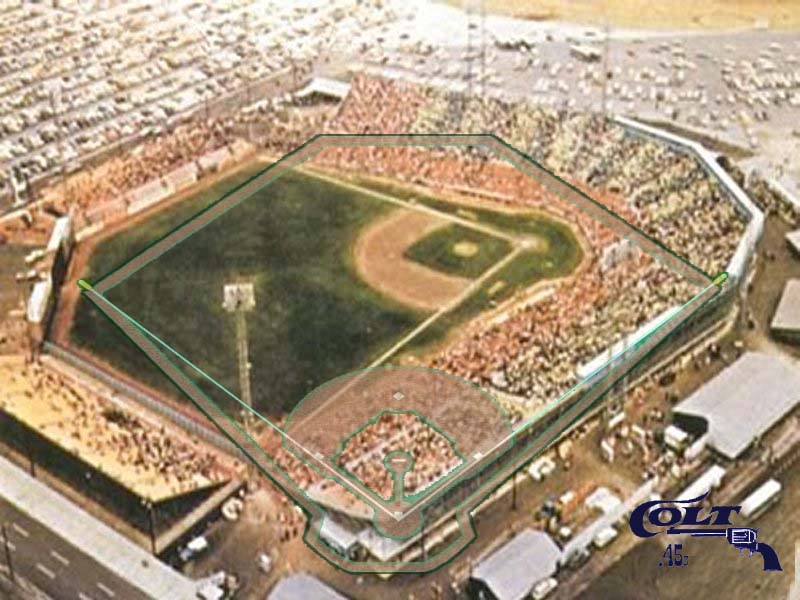
Houston's First MLB Sweep and Winning Streak Came Early at Colt stadium In April 1962.

Houston’s First MLB Sweep and Winning Streak Came Early at Colt stadium In April 1962.

It didn’t take long. Nor did it last long, But it happened right off the bat in Houston’s MLB history.

From April 10 through April 12, 1962, Houston began its major league history with a three-game sweep of the Chicago Cubs in Houston at a temporary home on the parking lot of the property that would also become the future location of the Harris County Domed Stadium, or, as we know it today – the Astrodome, “Eighth Wonder of the World!”

April 10th: Houston Colt .45s 11- Chicago Cubs 2.

The Astros won their opener on April 10th, 11-2, behind the 3-hit bats of Bob Aspromonte and Roman Mejias and the 2-hit wands of Al Spangler and Hal Smith. Aspromonte recorded the first hit and run in Houston MLB history, among other firsts that are always only there once for a short while at the start of any new franchise expansion club’s history. And Mejias nailed with great power the first and third home runs in club history. In between, Hal Smith hit the second HR that Houston ever earned credit for achieving in an official game.

Of course, it was only the first game, but that’s all it took for Houston to have racked up their first double-digit run and hit game at the same earliest possible time. Add their two errors to the list and the “Houstons” also had achieved their first negative note of the defensive side as well.

Little lefty Bobby Shantz was the first starter, first winner, first strike out recorder, first pitcher to issue  a walk, and so much of the other fairly meaningless records that are always there for first-game participants to bag. Among these, are two that are joined together by one unique common thread: Shantz faced future Hall of Famer Lou Brock as the first batter to ever hit against Houston in a big league game. Shantz also surrendered the first homer in Houston history to future Hall of Famer Ernie Banks in the seventh inning, on his way to pitching the first complete game in Houston MLB history.

Most of the other “firsts” are discoverable from the box scores of these three games and the ones that follow at this link to the Baseball Almanac record page of the 1962 Houston Colt. 45s’ first season:

(To stay on the Houston page, simply click on the date of each game for a look at the box score. If you click on the opponent club’s name, the site will take you to that team’s season long journey of record.)

http://www.baseball-almanac.com/teamstats/schedule.php?y=1962&t=HO1

April 11th: Houston Colt .45s 2 – Chicago Cubs 0.

Lefty Hal Woodeshick started and pitched the first eight innings for the 2nd win in both history and the three game streak. By working the ninth in relief, Turk Farrell recorded both the first save as he also became the first right-handed pitcher to take the mound for a Houston big league club. Farrell got the first save in history – as winning pitcher Woodeschick and Farrell combined for the first shutout in Houston MLB history.

See how extraneous, if not downright tedious, this sort of early record-keeping quickly becomes? It almost rises to the level of fingernails on the chalkboard, unless your baseball mind OCD patterns are simply out the gate and not likely coming back in this lifetime.

April 12th: Houston Colt .45s 2 – Chicago Cubs 0.

Dean Stone pitched this second consecutive 2-0 shutout by himself, becoming the first right-handed starter in club history, the first right-handed complete game pitcher, and the first pitcher of either hand to pitch a complete game shutout for Houston.

Doing it again by the same score in the third and final game of their home series with the Cubs, the Houston Colt .45s shut the door successfully on their first series sweep in history – while expanding their record club winning streak to three games, a feat that allowed Houston one more sunrise as the only club in big league history to go undefeated as the only team in big league history to never have lost a big league regulation season game. – Wow!

Alas, Houston would not be the first club in big league history to be deluded by their success against the Cubs into thinking that greatness against all was near at hand. The club would suffer their first loss the next day in Philadelphia by 3-2 and go on from there to finish the season as the 8th place club in the 10-team National League with a record of 64 wins and 96 losses. The only teams they bettered in that first season were the 9th place Cubs and the 10th place Mets.

Forty-three years later, in 2005, the Houston “Astros” – as they were soon enough renamed in 1965 – would finally win a National League pennant and make it to a World Series against the Chicago White Sox. A return trip to the World Series still leaves the door open for our club’s first recorded game win at that level.

Those of us who have followed Houston in person forever are hoping that 2015 and the club’s recent 10-game winning streak are a sign of hope that our next return to the World Series will not take so long as the first one did.

Buffs Win ’47 Dixie Series over Mobile in Six

May 5, 2015
With 2 outs and two strikes on him in the bottom of the 9th of Games Six of the 1947 Dixie Series, Hal Epps spiked a single between shor and second that scored Billy Costa from 2nd base for 1-0 Buffs' Dixie series win.

With 2 outs and two strikes on him in the bottom of the 9th of Game Six of the 1947 Dixie Series, Hal Epps spiked a single between short and second that scored Billy Costa from 2nd base for 1-0 Series win at Buff Stadium.

____________________

Houston Buffs Win Dixie Title

Houston, Oct. 3 (AP) – Hal Epps, veteran center fielder, slipped a single between short and second after two were out here (Buff Stadium) in the ninth tonight to give the Houston Buffaloes of the Texas League 1-0 shutout over the Mobile Bears in the deciding (sixth) game of the Dixie Series.

Epps’ second single of the night climaxed an uphill battle for the Buffs in a mound duel between Clarence Beers of Houston and Frank Laga of Mobile.

Beers permitted four singles, permitting only one to reach second base and retiring twenty in order from the second inning to two outs in the eighth.

Laga, prior to retiring after one out in the ninth in favor of Paul Minner, had allowed three singles, but had issued 10 walks.

Solly Hemus started off the Houston ninth by popping out to Third Baseman Bill Hart and Laga then walked Billy Costa and Eddie Knoblauch,

Minner came in to relieve Laga and immediately struck out Stan Benjamin.

Epps took a two-strike count and then hit the sizzler that scored Costa from second with the winning score.

The victory enabled the Buffs to win their first Dixie (Series) championship. After taking the first game here last week, Houston then dropped two to the Bears before coming back to take three straight to finish with a four games to two record. *

~ Lubbock (TX) Morning Avalanche, Saturday, October 4, 1947, P. 8.

* Proof again that we must never believe everything we read in the newspapers. The 1947 Dixie Series victory was not the first, as reported here by the Morning Avalanche. Houston’s 1947 win was  its second championship in this annual competition between the pennant winners of he Texas League and the Southern Association (1920-1958). Houston won its first appearance n 1928 in six games over the Birmingham Barons, before then losing in seven games to the 1931 Birmingham club – and then falling to the 1940 Nashville Vols in five games prior to their second Dixie win in the ’47 Series.

Dixie Series losses by Houston in 1951 to the Birmingham Bears in six, and then to the 1954 Atlanta Crackers in seven, moved the Buffs’ post-season mark in the Classic to two wins and four losses.

Back-to-back six game Dixie Series wins over the Atlanta Crackers in 1956 and 1957 leveled the Houston Buffs’ all-time record in this post-season classic at four wins and four losses. The Dixie Series ceased to exist after 1958, a non-pennant year for the Houston AA Texas League club. The Houston Buffs moved up to the American Association for three final seasons of AAA-level  minor league ball (1959-61) before dissolving in favor of Houston’s entry into the big leagues in 1962.

For much more detail on Houston’s record in the Dixie Series  from 1928 through 1957, you owe it to yourself to pick up a copy of “Houston Baseball: The Early Years, 1861-1961” (By The Larry Dierker Chapter of SABR, 2014), available for sale through Barnes and Noble, Amazon, and other major book sales outlets.

____________________

Will Instant Replay Call Reversals Help or Hurt?

May 4, 2015
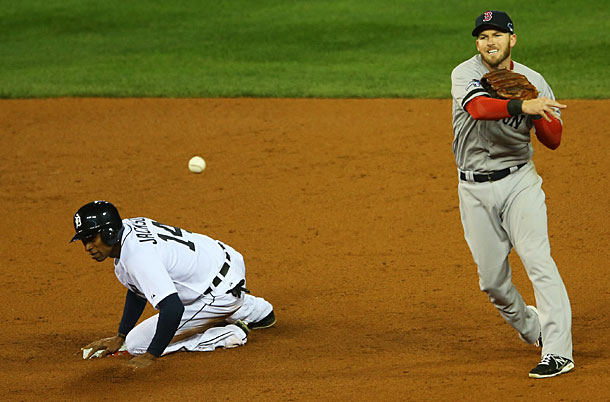
It's even harder to tell from still shots, but it makes you wonder how close the second baseman here was to the base when he tagged it for the force on the runner now sliding in.

It’s even harder to tell from still shots, but it makes you wonder how close the second baseman here was to the base when he tagged it for the force on the runner now sliding in.

Thank you, Mark Wernick for the SABR e-mail you sent about an hour ago. It frames the essence of this column:

____________________

From Mark Wernick, SABR Member …

Brad Miller hit an RBI triple in the third for Seattle’s first run.  He later tried to score on a fly by Seth Smith to right fielder George Springer,  and was originally ruled safe. The Astros challenged, and the replay showed he was tagged out before touching the plate.
“We’re going to check on it, but we were told that when a foot is hovering over the plate, it’s the same as touching it,” Seattle manager Lloyd McClendon said. “We’ll see what they say about this rule, but it is what it is.”
When a foot is hovering over the plate, it’s the same as touching it
I’m sure that frequently was the call back in the day before instant replay challenges,  much like the phantom tag used to be an out most of the time.  However,  I can’t recall ever reading specific language in the rule book saying such could be the case.  Please enlighten me if that language was/is there.
Things are going to be a lot different in the era of overturned rulings based on instant replay.  For example,  look for the number of ejections to go way down,  as well as the number of long angry tirades disputing calls.  Will this development add to,  or subtract from,  our appreciation of the game?
____________________

Like Mark Wernick, I cannot recall any “casting foot shadow” rule language that qualifies “close” being good enough for an out call, although we all know the rule-bypass-winks we had to freeze on everyone’s faces to put up with all those phantom tags at second on the double play forever prior to instant replay.

I can only think that instant replay will continue to improve and correct many calls from human error. This will be easier to accept over time as umpires, managers and players alike become more accustomed to the regularity of call reversals by a technology that should be superior to the unrecordable one-perspective decision of a highly trained human being who still cannot overcome the limitations of human frailty under close play circumstances.

Once it stops being a man versus machine challenge to the egos of umpires, it stands to reason that the technology becomes the ally of the umpire under all those previously heated encounters that were a matter of ego – and totally irreversible.

Now even the umpire can come to say, “Well, if you disagree, let’s let the replay people check it out and see what they think.”

Expanded use of instant replay gets my vote as a great aid to the game. As technology and our ability to use it well increases, it can only help the game improve. It doesn’t take much time for a serious review and I do not mind time spent on making the game better, anyway.

If we want to save time, go back to the things are now being tried. Cut down on the wastes that don’t matter – like batters stepping away from the plate to scratch themselves or pick their ears and noses..

Fewer fights. Fewer protests. More accurate calls. And, hopefully, no more going home from a game that your team just lost on a phantom foot contact of second base on a game-ending double play. And those are just some of the bigger rewards from the use of instant replay on the horizon, as I see them.

What do you think?

The Wizards of Odds

May 3, 2015

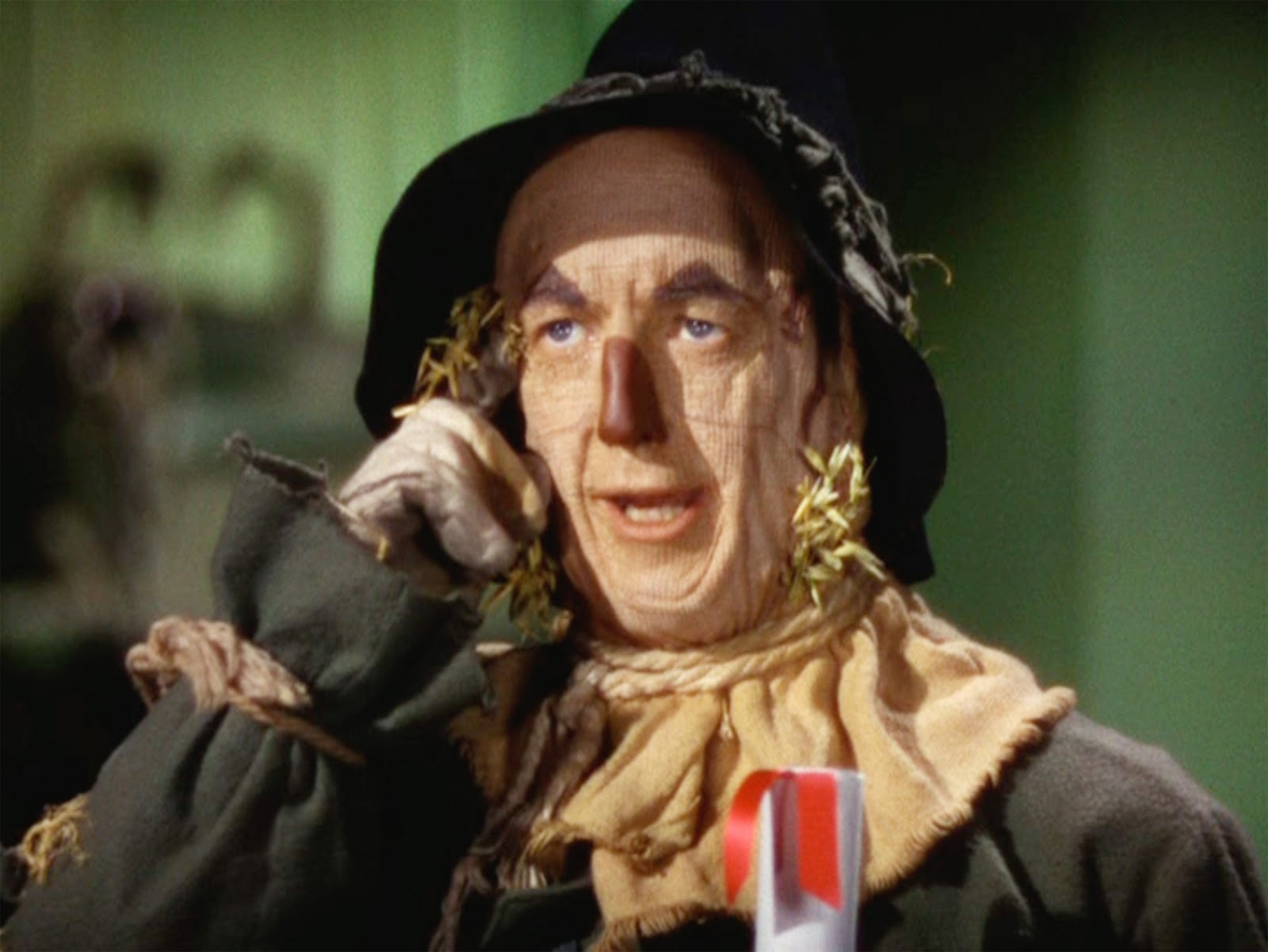
“Even with a brain, I doubt I could seen the Astros jumping out to a 17-7 record and a 6 game lead in the 2015 AL West race!”

The Wizards of Odds

By Bill McCurdy (2015)

(I actually wrote this two years ago, but forgot about it until today. So, I updated it to include Chicago in the mix, and, yes – in case it’s not obvious, the lyrics are singable to the Scarecrow’s lamentation, “If I Only Had A Brain”.)

I could research this for hours

Confirming batting powers

Consulting with my brain


And my head I’d be scratchin’

While my thoughts were busy hatchin’

On the SABR baseball train.


I’d unravel any riddle

For any individ’le

From Mexico to Spain


With these thoughts – I’d be thinkin’

I can be Bill James or Lincoln

If I only had a brain


Oh, I – would tell you why – K’s are three and walks are four

I could think of things I never thunk before

I’d do the math – and think some more


I will not be just a Selig

My head with ceiling peeling

My heart all full of pain


I will dance and be merry

Life will be a ding-a-derry

On the SABR baseball train


(Shift gears here on the melody after these three lines of shouted dialogue.)


“ So – where are we going, this summer and next? To Oz? – To Oz! No Sir! – No Maam! – We were off to Philadelphia in 2013! – Then to Houston in 2014 ! – Now to Chicago in 2015!! – Allright! – Pick ‘em up! – And move ‘em on!”


WE’RE OFF TO SEE THE WIZARDS,

THE WONDERFUL WIZARDS OF ODDS!

OF BATTED BALLS AND GREAT PITCH CALLS

THE GREATEST THAT BASEBALL COULD DO BECAUSE,


…. OUR SABR OWNS – THE WIZARDS,

THE WONDERFUL WIZARDS OF ODDS!

Ned Garver: Old School Viewpoints

May 3, 2015

CATCH-20-TOO

As most of you know, Ned Garver won 20 games and lost 12 for the 1951 St. Louis Browns – who themselves finished eighth and last in the American League, 46 games behind the 1951 pennant winning, dynastic New York Yankees with a club record of only 52 wins against 102 defeats. Here are few quotes from his second book that well characterize Garver the man and spirit of those times:

Growing Up near Ney Ohio as a Farm Boy Fan of the Detroit Tigers

“When I was a kid, we would usually pick a day to go to Detroit when the Tigers were going to play a double-header. We’d get p in the middle of the night and milk the cows and get the rest of the chores done so we could take off in time to get to the ballpark when they opened the gates. We would get there early so we could watch batting practice, infield practice and the whole shebang. My mother would send a wicker basket with things to eat. Between games we ate what she sent because we didn’t have the extra money to buy food at the park. I’m sure that today the ballparks don’t allow you to bring in baskets of food, but that’s the way we did it back then (during the 1930s).”

Hotel Amenities in 1940s Class D Ball

“No doubt the hotel accommodations in (1944) Class D Ball, which is what Newark was, often left a lot to be desired. Once we were staying at a hotel in Zanesville, Ohio.  We didn’t have single rooms, of course, because we each had a roommate. My roommate at that time was our catcher, Cy Koppa. This particular time the room was very small and the bed was three-quarter sized. Two pretty big guys trying to sleep in a three-quarter sized bed meant that we had to sleep on our sides in order to both stay in that bed. It also meant that we became very close friends.”

Complete Games

In 1951, Ned Garver led the AL with 24 complete games in his 30 starts, pitching 246 innings on a season that also included three relief appearances.

“(Robin Roberts once told me that) ‘I pitch three hundred innings a year, and I get paid more because I pitch three hundred innings a year, so I throw a lot in the spring to make my arm strong.’ That made a lot of sense to me, and it became my philosophy, too. In order to get your arm strong, you need to throw a lot – not rest it a lot.”

Satchel Paige, Who Joined Garver with the Browns in 1951

“Over the years, Satchel and I became very good friends. I was fascinated by his knowledge of pitching. He knew more about attacking a hitter from the pitcher’s mound than anybody I ever saw or knew, and he had exceptional stuff. … After I got to Detroit, Charlie Gehringer was our general manager. Charlley had been a hero of mine when I was a kid, so I enjoyed the opportunity to get to know him better. He had been with Bob Feller on an All-Star team that that toured/barnstormed with Satchel and his team. So, I asked Charlie, ‘You played on that All-Star team with Bob Feller that played against Satchel Paige, so you hit against Satchel when we was pretty much in his prime. Just how good was satchel Paige?’ Charley said, ‘I never hit against anybody better.’ ”

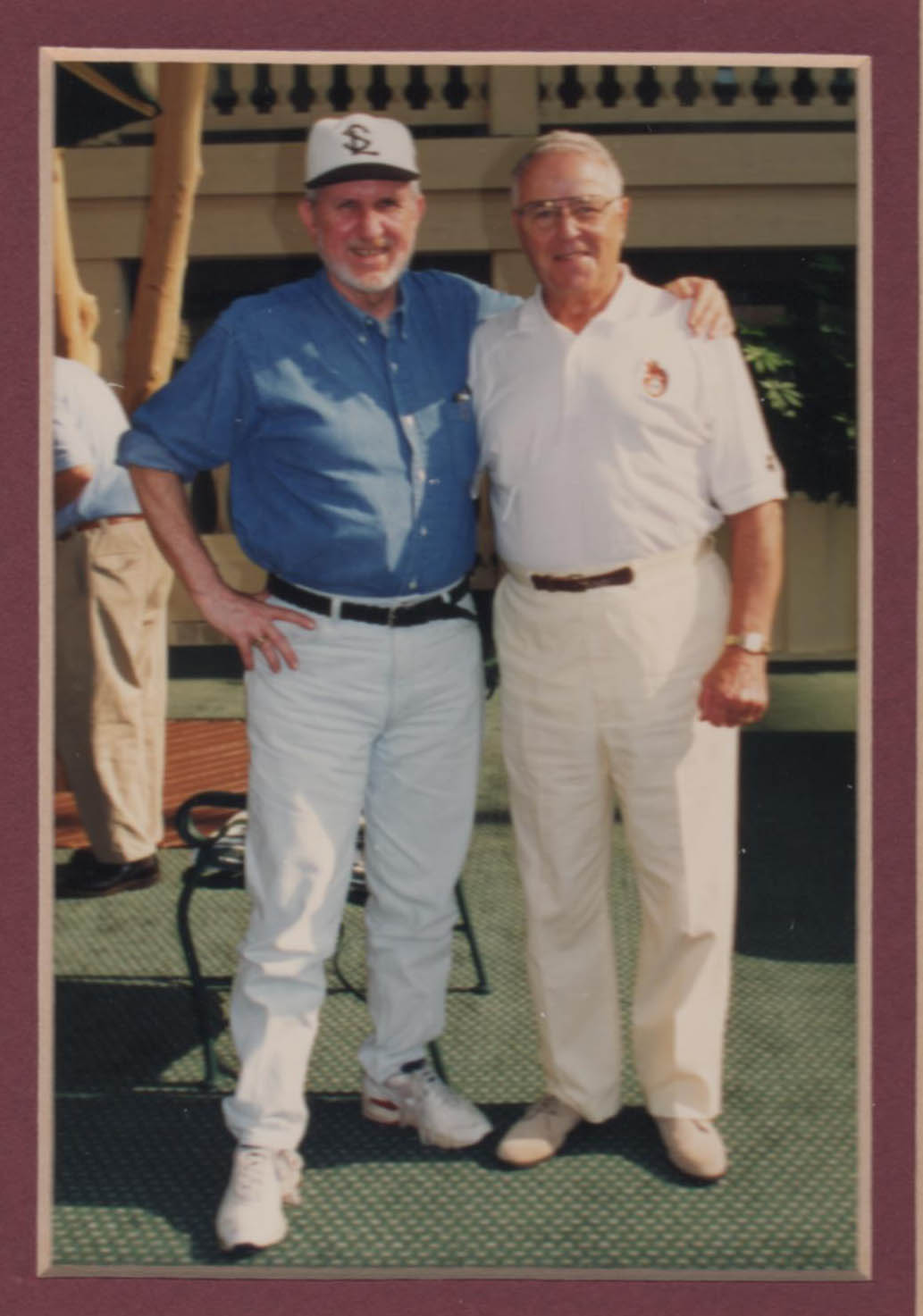
Bill McCurdy and Ned Garver St. Louis, 1996

Bill McCurdy and Ned Garver
St. Louis, 1996

Garver’s Two Biggest Baseball Moments

“Its tempting to say that the biggest thing was seeing our first baseman, Hank Arft, scoop up a grounder and step on the bag for the final out in my 20th win – and I’ve said that to many people. But, really, the biggest thing was watching the ball I hit go over the Sealy Mattress sign in left-center (at Sportsman’s Park) in the fourth inning for a solo home run to to break a 4-4 tie. I knew then that I would not give up that lead – and I didn’t. That’s where the game was won.”

Link to Baseball Almanac Box Score of Garver’s 20th ’51 Win

http://www.baseball-almanac.com/box-scores/boxscore.php?boxid=195109300SLA

Autographed Copy “Ned Garver: Catch 20…Too” for $25:

http://thestlbrowns.blogspot.com/2013/12/ned-garver-catch-22.html

Bill Gilbert: Are the Houston Astros Back?

May 2, 2015
Bill Gilbert is a veteran member of SABR, a respected and exceptional baseball data analyst, and a free lance reporter for The Pecan Park Eagle.

Bill Gilbert is a veteran member of SABR, a respected and exceptional baseball data analyst, and a free lance reporter for The Pecan Park Eagle.

Are the Houston Astros Back?

By Bill Gilbert

The Houston Astros completed the month of April with a 7-game winning streak and a record of 15-7, their best opening month since 1986 when they finished on top in the NL Western Division. They lead the American League West Division by four games. The big question now is if it will last. This is a big departure from the last four seasons when the team was basically out of contention in April while they were rebuilding.

Some improvement was expected this year after the 19-game improvement in 2014. However, the fast start this year, particularly the 8-1 record on a tough 9-game West Coast road trip was certainly not expected. In the past 4 years, the Astros have consistently been near the bottom in most hitting, pitching and fielding categories. This year they are closer to the top. The club is averaging 4.68 runs per game, well above the major league average of 4.27. The team batting average of .238 is below the major league average of .250, but the team slugging average of .411 is above the MLB average of .390. The Astros are tied for third in the majors in home runs and first in stolen bases.

As impressive as the hitting numbers are, the pitching has been even better. One of the big questions this year was whether Dallas Keuchel and Collin McHugh could repeat the success they had last year That question was answered in April when the Astros won all nine games that were started by these two pitchers. The rest of the rotation is a concern, but the bullpen has been much better. The staff ERA of 3.04 ranks first in the American League and the WHIP (walks plus hits per innings pitched) is the best in the major leagues.  Opponents have scored only 3.41 runs per game against the Astros who enjoy a 28-run differential versus their opponents.

Defense, another weak spot during the rebuilding phase, has also improved as the Astros rank near the top in fielding average and defensive runs saved.

Individually, there were some bright spots as well as some disappointments. Jose Altuve is having an even better year than his monster year in 2014, batting .367 with an on-base percentage of .400 and a slugging average of .500 while leading the club with 16 RBIs from the leadoff position. A very pleasant surprise has been center fielder, Jake Marisnick, playing great defense and batting .379 with a slugging average of .621. Shortstop, Jed Lowrie, also played well, batting .300 but will miss at least two months with a thumb injury that required surgery. New third baseman, Luis Valbuena, led the club in home runs in April with five.

The missing link has been the power bats in the middle of the lineup. George Springer (.200), Evan Gattis (.164) and Chris Carter (.160) all started slowly and combined for only seven home runs in April with 86 strikeouts. Hopefully, they will heat up to offset any loss of offense due to the Lowrie’s injury and any cooling off from Altuve and Marisnick.

The Astros lead the league in striking out by a wide margin which is not surprising after picking up Gattis and Colby Rasmus to add to an already strikeout-prone lineup. They are on pace to collect 1546 strikeouts which would break the Major League record of 1535 set by the Astros in 2013. What is surprising is that the team is tied for second in the major leagues in drawing walks.

There are some interesting things to watch for in the months ahead. Will the success on the recent road trip result in the fan base starting to return to Minute Maid Park? Will Marwin Gonzales and Jonathon Villar be able to fill the hole at shortstop in Lowrie’s absence or will the Astros bring up super prospect, 20-year old, Carlos Correa from Class Double A, Corpus Christi, where he is batting .385? Will the club make some moves to strengthen the back end of the starting rotation?

It should be an interesting season.

Bill Gilbert

billcgilbert@sbcglobal.net

May 1, 2015

Seems Like Old Times: May 6, 1921

May 2, 2015
Galveston Daily News May 6, 1921 Courtesy of Darrell Pittman

Galveston Daily News
May 6, 1921
Courtesy of Darrell Pittman


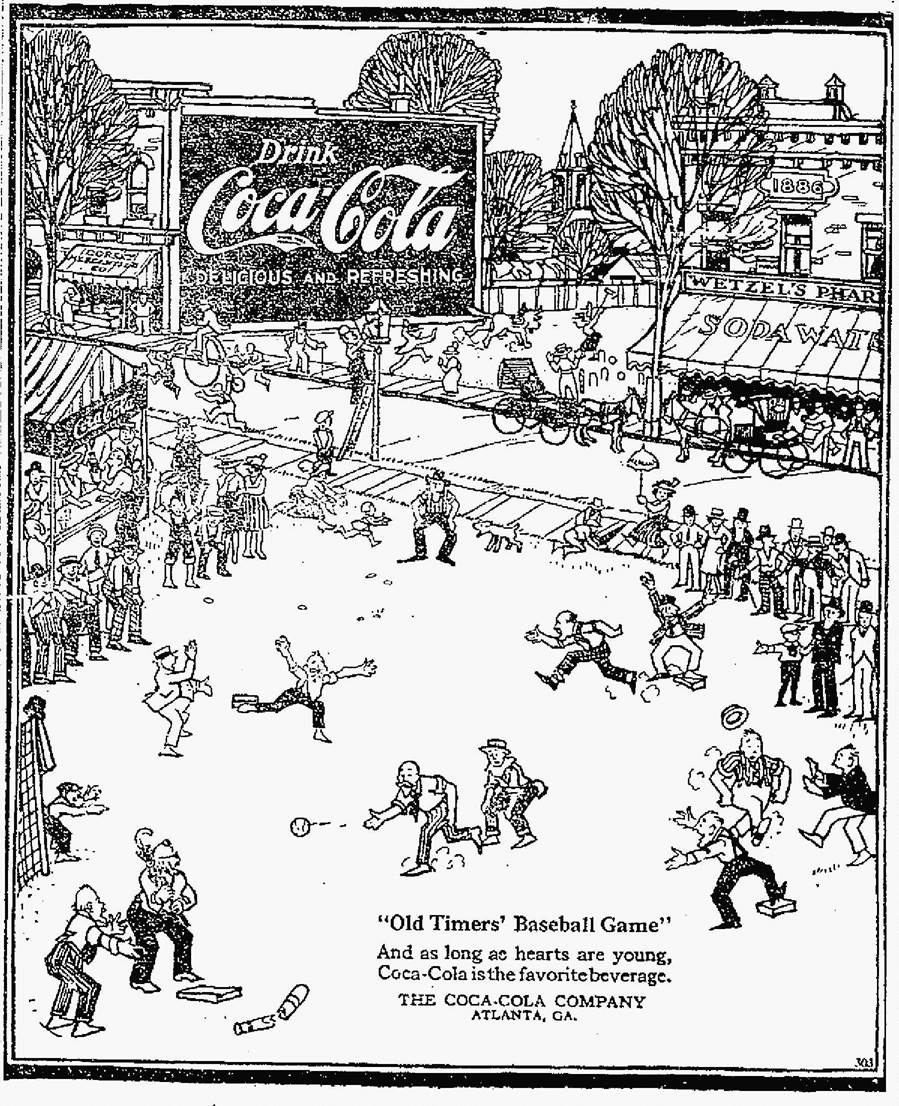
E-Mails from our good friend Darrell Pittman on this particular day of the week are like a baseball version of Friday Night Nights. They light up the skies of a Houston spring weekend end night with bright memories from our Texas baseball past – memories of events and characterizations that are older than even the oldest of us who are still around today. That cartoon of the old timers’ baseball game from the Galveston Daily News of May 6, 1921 was in the nostalgic style of Norman Rockwell before most Americans even knew who that young illustrator ever was – or someday would be. – Coca-Cola, of course, began an early tug upon American heart strings and has never let go.


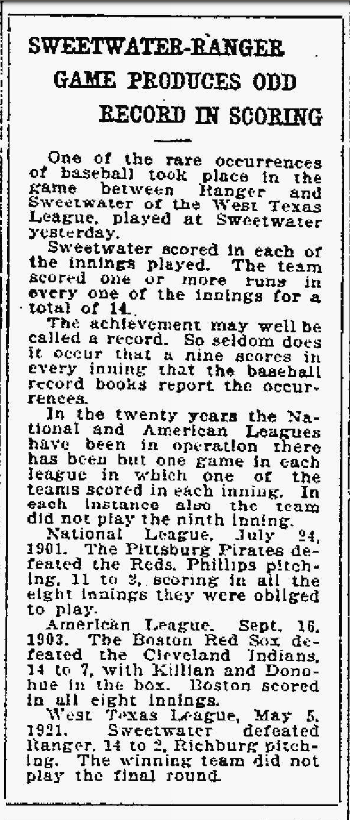
Galveston Daily News May 6, 1921 Courtesy of Darrell Pittman

Galveston Daily News
May 6, 1921
Courtesy of Darrell Pittman


The Pecan Park Eagle has no immediate update data on how often the “team scores in every inning of the game” phenomenon that Sweetwater pulled off against Ranger in 1921 has been repeated in the past 95 years, but it is just interesting always to note that the baseball community’s interest in noting and recording the most arcane of statistical accomplishments apparently has been around forever. This May 6. 1921 report even notes their sense of awe over the fact this same accomplishment has occurred through this early date in modern history only once in the American and National Leagues in their first two decades of post-season competition with each other.

Have a nice weekend, everybody!