Rule Change Kills Stat Comparisons Over Time

June 26, 2015
'HEY! IF I WALK THIS RUN HOME HOME, DON'T CHARGE ME WITH NO ERROR! - GIVE THE ERROR TO THE MANAGER WHO PUT ME IN THE GAME IN THE FIRST PLACE!

‘HEY! IF I WALK THIS RUN HOME, DON’T CHARGE ME WITH NO ERROR! – GIVE THE ERROR TO THE MANAGER WHO PUT ME IN THE GAME IN THE FIRST PLACE!” ~ WILL FERRELL

Galveston Daily News June 28, 1888 Submitted by Research Associate Darrell Pittman

Galveston Daily News
June 28, 1888
Submitted by Research Associate Darrell Pittman

______________________________

(STORY CLIP RECAP): A NEW RULE

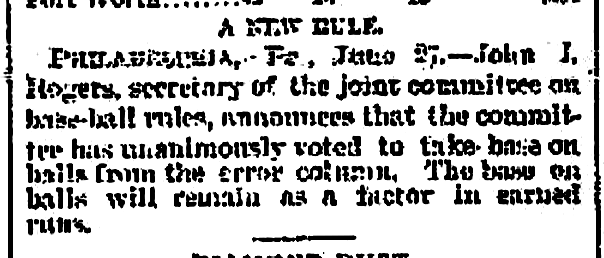
Philadelphia, Pa., June 27. – John J. Rogers, secretary pf the tthe joint committee on base-ball rules, announces that the committee has unanimously voted to take base on balls from the error column. The base on balls will remain as a factor in earned runs.

~ Galveston Daily News, June 28, 1888

______________________________

It’s an old winnable argument that we cannot fairly or accurately compare players from one generation to another based upon statistical performances due to changes in the rules that have governed the playing of the game differently from one era to another – and with no no worse examples than any comparison from recent years to the performances of players from the 19th century – when many of the rules were really quite different.

Today’s note on an 1888 rules change on the scoring of walks thatnoted in the Galveston Daily News on June 28th of that year is an excellent case-making example.

Can you imagine a pitcher today with control problems being charged errors for every walk? If the rules governing runs that score after an inning should have ended applied back in early 1888, a wild pitcher could have built a terrible fielding average, but also complied an E.R.A. approaching 0.00 with a landslide of his own B.O.B./errors opening the door for every run that scored would be correctly noted after three walks as “unearned”. Or something like that!

Wonder how they scored “intentional walks” back in 1887, if, indeed, they even engaged in that kind of intellectual mentoring of the game back in the day. If they did, (tongue in check here), would an intellectual walk have been charged to the pitcher as an error, but then reassigned to the manager s an error, if the strategy didn’t work out?

Lucky for those of us living in 2015, the rules governing baseball work pretty darn well today, don’t you think? Now, if we could only reach a universal agreement on the DH rule – and resolve how much scratching and wedgy-rearrangement time batters and pitchers need between pitches, everything might move even closer to Norman Rockwell perfect.

GO ASTROS! BEAT THE YANKEES!

eagle

Lawyers: No Wonder Things Are So Screwed Up

June 25, 2015
George Wharton Pepper was the big legal bat for Organized Baseball in the 1921 Anti-Trust Act violation suit posted by Federal League interests in 1921.

George Wharton Pepper was the big legal bat for Organized Baseball in the  Anti-Trust Act violation suit posted by Federal League interests in 1920.

Question: How would you describe a 50-seat bus load of lawyers going off a 500-foot cliff at 80 MPH into the ocean below with 47 seats occupied with these legal eagles?

Answer: The picture described within the question is nothing less than an example of “conspicuous waste”.

Don’t get me wrong. Lawyer guys like Tony Cavender and a few others are some of my best friends and favorite people, but I like oysters too. And some of them have made me awfully sick over the years.

The problem with lawyers is the way they put their legal thoughts into written form as either laws or court room arguments and judicial decisions. By the time that we. the people feel the pain from the gobbledygook the lawyers have written, it is so disconnected from its legal source that we really aren’t sure what just hit us.

And why? Most of the time it’s because people who write in legalese, the language of lawyers, write within their own special context of complexity, trickery, obfuscation, and boredom. For most of us lay people, legalese is too complicated to understand, too boring to keep our interest, or too easy to miss the real meaning in the fine print that is the true intention of the document in the first place. Sort of like the guy who bought a group health insurance policy, but did not find out until he needed to use it that the whole group had to get sick at the same time with the same diagnosis for it to be of any benefit to any single subscriber. – Yes, it was in the fine print of Section 341.4 of Exemption Instances listed in the Benefits Manual Discovery Appendix from the start. The now-out-of-luck sick guy should have read that hard-to-find part before he signed up.

Check out this article that researcher/friend  Darrell Pittman sent me this morning. It’s by a fellow named Gary Hailey and it appears here as “Anatomy of a Murder: The Federal League and the Courts, Part 4.” The earlier parts are traceable through article-internal links provided by the material site.

Anatomy of a Murder: The Federal League and the Courts, Part 4 | Our Game

Before you get lost or tired of reading, please note that Organized Baseball was not given an “exemption” from the federal Anti-Trust Act by these proceedings. What they received was a favorable ruling that baseball, the game, was an event that took place from the first pitch of each contest and then ended with the last out of each separate game. Therefore, baseball did not cross state lines to qualify as interstate commerce, even though it was necessary to transfer players and their equipment across state lines to play each of these separate, but complete games.

How laughable and/or politically biased was that ruling? The whole specious argument falls away with one question: If each individual “game” was all that mattered, why did Organized Baseball bother to keep standings of who won the most games in a singe season and then pair the two clubs with the best records from each league in this annual thing they called “The World Series”?

____________________

Try to pay attention to the language used by Organized Baseball attorney George Wharton Pepper in describing his appeal strategy for arguing against the suit by Federal League interests that “OB” was operating in violation of the federal Sherman Anti-Trust Act governing interstate commerce:

I raised at every opportunity the objection that a spontaneous output of human activity is not in its nature commerce, that therefore Organized Baseball cannot be interstate commerce; and that, it not being commerce among the states, the federal statute could have no application….

… [T]he case came on for argument … on October 15th [, 1920]. I mention the date because of the coincidence that on the same day there was being played the final game in the [Dodgers vs. Indians] World Series of that year ….

. . . Counsel for the Federal League made the grave mistake of minimizing the real point in the case (the question, namely whether interstate commerce was involved) and sought to inflame the passions of the Court by a vehement attack upon the evils of [Organized Baseball], a few of which were real and many, as I thought, imaginary. I argued with much earnestness the proposition that personal effort not related to production is not a subject of commerce; that the attempt to secure all the skilled service needed for professional baseball is not an attempt to monopolize commerce or any part of it; and that Organized Baseball, not being commerce, and therefore not interstate commerce, does not come within the scope of the prohibitions of the Sherman [Antitrust] Act.

____________________

As a fairly direct aside, we must also ask: Is it in any wonder that the funds most of us have  invested in Social Security over our lifetimes were diverted by Congress for other purposes without us ever knowing about it until after our investments in retirement had been reclassified as an “entitlement” program” of the federal government?

Think about it. And have a nice day, anyway!

The Root Causes of Power Hitting

June 24, 2015
Galveston Daily News June 26, 1921 Submitted by Darrell Pittman

Galveston Daily News
June 26, 1921
Submitted by Darrell Pittman

It wasn’t the baseball world’s imagination. Hitting really did change back in the 1920s from the small-ball, pitching and defense game it always had been prior to Babe Ruth’s 1919 29 HR breakout year while he was still with Boston and not yet totally clean of his original identity as a pitcher.

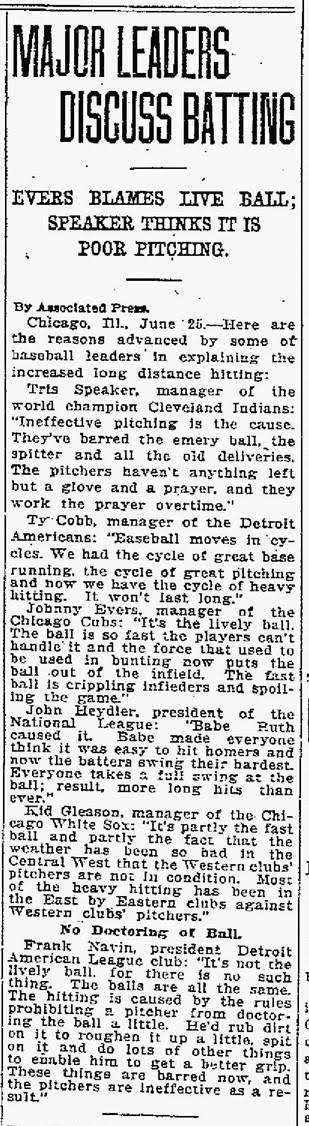
It is still interesting to read a piece from 1921 in which some of the most prominent baseball of their day, including two of the greatest hitters of all time, collectively pick away at nailing all or most of the major factors behind this change – while also – offering a few thoughts that had nothing or little to do with it.

Hopefully, you are able to read the article from the above included scan of its contents.

Going down the column, we are able to see that Tris Speaker jumped upon one of the big contributions to higher, more powerful batting stats by 1921. Prior to the 1920 season, MLB’s elimination of the spitball by all but the 17 grandfathered pitchers whose careers were built around that moist delivery, plus new rules against other substance additive and ball scuffing approaches to pitching had been banned. Advantage: Hitters.

Ty Cobb may have been the world’s greatest hitter for average, but his mistaken application of life’s cyclical patterns to hitting in baseball was – well, way off base. Cobb thought that “heavy hitting” was simply another cycle, like superior base running, that would recede in time. Boy, was Tyrus wrong this time. “Once Hitters Learn to Attack – They Never Go Back!” New superior hitting with power? It was here to stay. Advantage: Hitters.

Former Cubs infield star Johnny Evers blamed the new lively ball as the big culprit. In effect, he saw the ball as too hot and quick to handle as it tore through the infield. From a second baseman’s perspective, it’s easy to see why Evers got stuck on the ball itself. He was right, of course, it simply wasn’t the ball alone, as Mr. Speaker already has pointed out. And Evers was unable to see one of life’s big variables that always figures into the introduction of any new factor that requires adaptation by us humans. Younger infielders would grow up with a game that included baseballs that moved much faster than the old dead ball from the “Tinker-to_Evers-to-Chance”  era of the century’s first decade. The young ones would perceive the ball as moving at a “normal” speed. They would also have better gloves and fields to play upon as the whole game adapted to a faster pace. Nevertheless, faster ball speed also belongs in the same column. Advantage: Hitters. And that’s taking nothing away from the fact that a contemporary club like the Houston Astros don’t start a rookie like Carlos Correa at shortstop in the hopes of him becoming another Joe Tinker or Honus Wagner. – Defensively, they expect him to be far better – and he probably already is.

1921 National President John Heydler nailed the two-word answer which most people probably jump upon like a frog on a June Bug when he threw out the name “Babe Ruth” and, in so doing, he would have been right, but simply incomplete. The elimination of trick pitches and the introduction of the lively ball were all Ruth needed to almost personally make power ball the name of the game. If the 1920’s were the Emerald City birthplace of power hitting in the Ozville of baseball, then Babe Ruth was the wizard himself. The Arrival of Babe Ruth? Advantage: Hitters.

Detroit Tigers President Frank Navin, the last of our visible commentators from the 1921 article, spoke in support of Tris Speaker’s diagnosis that the recent serious restrictions upon what pitchers could do to a baseball before they threw it as a pitch was big. In fact, it may have been the biggest factor in that first season of change. With pitchers scrambling for new ways to ply their trade in 1921, that first season had to be pretty rough upon them. Navin apparently was standing in the owner’s party line of denial, however, when he offered the opinion that there was no such thing as the “live ball” and he obviously had yet to see his Tigers sufficiently bludgeoned enough by Babe Ruth and the Yankees nearing mid-season in 1921 to get the point that his man Cobb no longer represented the future of baseball. Again, the pitching rules change? Advantage: Hitters.

The Uncovered Big Factor

This one’s been written about ad nauseum. To no one’s surprise today, it wasn’t covered in this article from the 1921 era itself. In 1921, the eight banned Chicago Black Sox were in their first season of lifetime excommunications from the game of baseball. Baseball people weren’t exactly prone to open discussion of what the 1919 World Series Fix Scandal might do to the American public’s support of the game, but there wasn’t much question that owners wanted to move away from the event as quickly as possible and that Commissioner Landis’s pre-1921 season suspension and August 21, 1921 eternal banning of the eight Black Sox players had as much or more to do with proving to the fans that “good had triumphed over evil” as it did that all of these men were equally deserving of that same death knell upon their baseball careers. As McGwire and Sosa would do again with power to help baseball fog fan memories of the disgusting 1994 season, it now had become Babe Ruth’s role in 1921 to blast his way into the hearts and minds of all fans as the greatest hero of the new power game.

And Back to the Future of Our Fondest Astros Wishes

Now, if we can only get our 2015 Astros to grow as a few great hitting for average, base-running fools setting the table for our several “hit-or-sit” power guys, maybe we can have the kind of club that every franchise publicly says they hope to be: The 2015 World Series Champions of Major league Baseball. Oh, yeah, as we also wrote the other day. we also still will need two guys to either step up or move into the starting rotation as superior starters and quality inning burners.

Have a nice day!

eagle

Prior to the 1920 season

Jimerson Shines at June 2015 SABR Meeting

June 23, 2015

“You never know how strong you can be, until being strong is the only choice you have left.”
~ Tupac Shakur

The June 2015 meeting of the Larry Dierker SABR Chapter in Houston last night, 6/22/15, at the Spaghetti Western Restaurant on Shepherd was both cozy and cool. Tony Cavender delivered an excellent book reviews of Charles Leehrsen’s new work, “Ty Cobb: A Terrible Beauty”, as a serious attempt to extract the true great baseball star from some of the most prejudicial things that have been written previously about him, and Bob Dorrill and Mike McCroskey both spoke about the upcoming award of $3,500 in college scholarship assistance that has been made possible by the sale of our 2014 chapter publication, “Houston Baseball: The Early Years, 1861-1961.”

Mike McCroskey presented a clever July 4th themed trivia quiz, one that eventually was won by one of “the usual suspects” in baseball trivia wonder, Greg Lucas.

Mike McCroskey also related a tale (I think) of his 1992 trip to the induction of Roger Clemens into the Texas Baseball Hall of Fame., a year which also included the induction of Houston Buff 1951 slugger, Jerry Witte. (My apologies, Mike, if memory mis-serves here, but like many of the stories you tell, I walked away with the same old “second-guess” question: “Did Mike say he did that – or did he say someone else did that?” Please forgive me, Mike,  and feel free to write a corrective comment., as you wish.

We also learned by photo distribution from meeting program chairman Jim Kruez that SABR member Tom White was once a “star pitcher” for Vanderbilt University back in the day. Like the fabled Clark Kent of comic book fame, mild-mannered Tom White looked quite a bit like “Superman” in those photos. He was quite fit in appearance and all dressed out in killer baseball duds from back in the day.

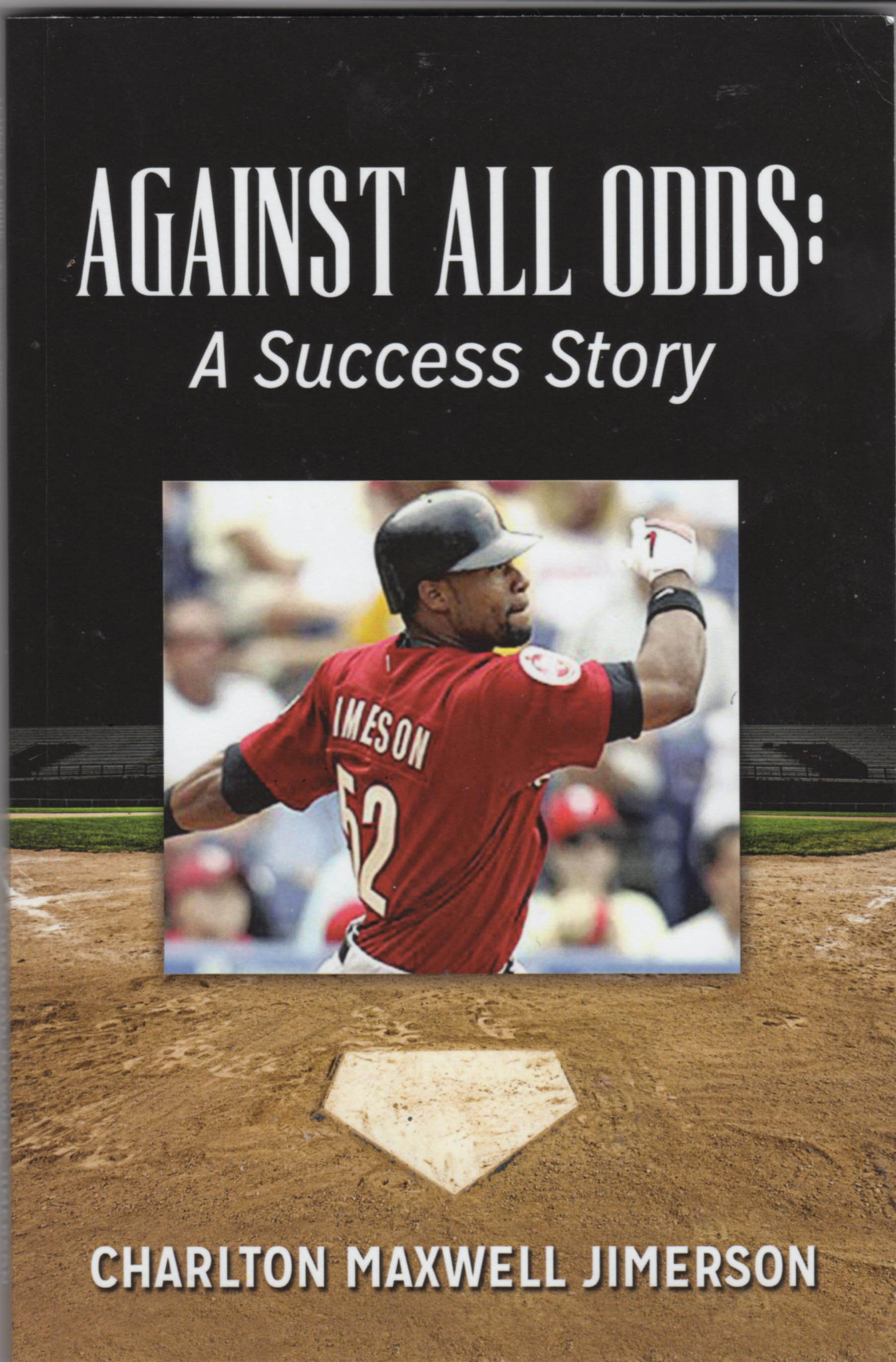
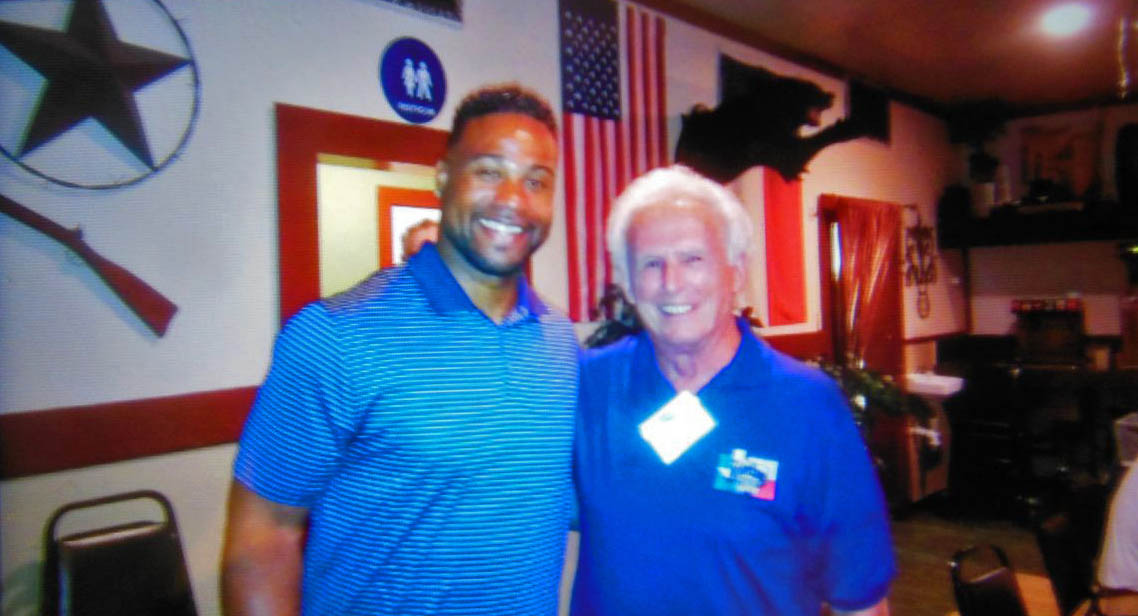
The highlight of the evening was our lead-off man speaker, former Houston 2005-06 Astros outfielder,  Charlton Maxwell Jimerson.

The 35-year old Jimerson’s story is about the obstacles he had to overcome with the help of life’s healing forces (sometimes referenced by others as “The Grace of God”) working through other to achieve the success in life he has attained “against all odds.”  Jimerson credits his older only sister Lanette as the real parent of his childhood, the one who helped him master the waters of living, first with two drug-involved parents on the streets of Oakland, California and then with a helter-skelter single mom who was still drugging and moving out of necessity from one crummy lace to the next. Sister Lanette was Charlton’s guiding light to the fire that lived within him for something better in life than his two older brothers were reaching from the chaotic “take it, if you can get your hands on it” lifestyle that awaited so many “parent-less”  young black males on the inner city streets of America.

A talent for baseball was Jimerson’s vehicle to a destiny that goes far beyond the game itself. Had he not had this baseball this talent, he may have found a way to make it anyway, but that is an unanswerable question. It’s not what happened.

“Against All Odds”, the book, is about that struggle, challenge and victory in the life of Charlton Maxwell Jimerson, a still young man with great eloquence as someone who speaks deeply from his soul about the gifts that have become his road of life feast in ways that go far beyond the fact that he used his baseball talent to almost earn the college degree from Miami University that he now is completing at the University of Houston; that he wrote his name into the MLB record books when he homered in his first MLB time at bat as a pinch hitter for Roger Clemens; that he now faces a strong corporate future for his talent with numbers; that everything good for him is unfolding in Houston, the place that has grown into his home town since his days with the Astros; and that he will always have his memories of those two national collegiate baseball championships as a player for Miami, and the brief, however limited service time he spent as a one-inning defensive player for the 2005 only Astros pennant winner. And pile on the Clemens-pinch-homer in his first MLB time at bat the next season, and all of the great learning time he sent in the company of mentors like Jackie Moore, Phil Garner, and Tony Gwynn – just to name a few. – How much help does one guy need to get the key to the biggest city that life has to offer – the one that serves up self-respect in the truest meaning of that phrase?

http://www.baseball-almanac.com/box-scores/boxscore.php?boxid=200609040PHI

Former Astro outfielder Charlton Jimerson and former Astro President Tal Smith shared a happy reunion at the Spaghetti Western June 22, 2015 meeting of SABR in Houston.

Former Astro outfielder Charlton Jimerson and former Astro President Tal Smith shared a happy reunion at the Spaghetti Western Restaurant June 22, 2015 meeting of SABR in Houston.

In our view, SABR member Chris Chestnut asked Charlton Jimerson the question of the evening that opened the most light on this likeable young man’s character and basis for succeeding “against all odds”.

Chris Chestnut asked: “Charlton, when you are talking to young people today, what do you tell them you think is important for them to know?”

“I just tell them to remember that every decision they make and act upon is going to have consequences in their lives,” Jimerson answered, as he went on weaving his own mental trail of explaining what he meant.

We’ll have to put it in our own words: “Nothing we decide to do, or not do, comes free. In time, short time or long, everything we act upon. or fail to act upon, results in either a “ticket” to more choices – or a “ticket” to some place in which our choices are reduced to few, if any – to none.  In the end game, we get as much freedom in life as we are willing to take responsibility for having because, like the two sides of the same coin, freedom and responsibility are the inseparable partners of the same entity. “

At the still tender age of 35, we get the impression from his own words that Charlton Maxwell Jimerson understands everything we just expressed in our italicized expression of this ancient wisdom .

That impression is sustained by Jimerson’s decision to again quote Tupac Shakur at the conclusion of his last page book acknowledgements as a way of taking responsibility for the freedom he had given himself to write and name his memoir:

“This is the realest shit I ever wrote, against all odds.” – Tupac Shakur

God Bless Charlton! – God Bless Tupac! – And may God Bless us all!

eagle

The .500 Win % Clubs Near 2015 MLB Mid-Season

June 22, 2015
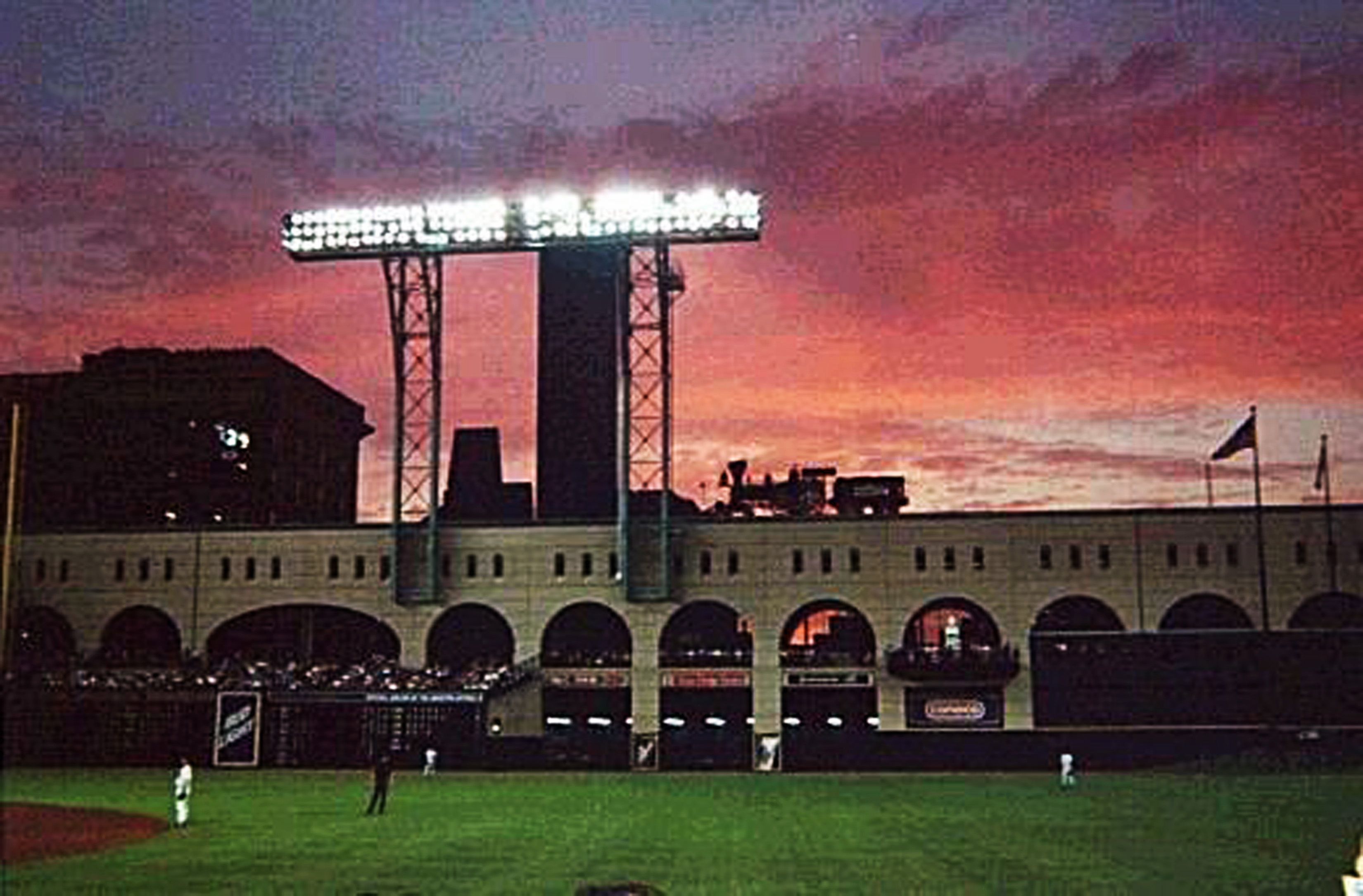
Put that big flag pole from Tal's Hill somewhere! - We need a place to be reminded of either World Series Champions flag - or else - the flag pole itself to remind us of our last  World Series win!

Put that big flag pole from Tal’s Hill somewhere! – We need a place to be reminded of either our World Series Champions flag – or else – the flag pole itself to remind us of our last World Series win!

Nearing mid-season by about a rough dozen games per team, we wake up on Monday, June 22, 2015 to find that 18 0f the 30 MLB clubs are playing .500 ball or better.

10 of the 18 “winning” clubs are American League members; 8, of course, are National League pennant contenders.

Things often change during the second hard stretch in the season schedule, but the probability remains that most of the ten playoff clubs (3 division winners in each league and 2 wild cards in each league that will have to sudden death each other to reach the first round of 4 team series competition in each league on the way to determining the World Series representatives for both the AL and NL groups will mostly come from 18 clubs shown here.

The six MLB division leaders are shown in bold types below, but none, not even the Cardinals, have insurmountable division leads that guarantee anything in the second half of the season. As per usual, injuries, the presence or absence of quality inning starters, the fatigue upon relief staffs when the starters falter, defense, consistent strategic hitting, luck, and the good or poor management of each club’s strengths and weaknesses down the stretch will prove again to be the major difference-makers as to which club ultimately survives as the last standing winner in October:

POS TEAM LEAGUE /DIV’N W L PCT GB
1 CARDINALS NL C 45 24 .652
2 ROYALS AL C 39 27 .591 4.5
3 ASTROS AL W 41 30 .577 5.0
4 PIRATES NL C 39 30 .565 6.0
5 RAYS AL E 40 31 .563 6.0
6 DODGERS NL W 39 31 .557 6.5
7 CUBS NL C 37 30 .552 7.0
8 YANKEES AL E 38 31 .551 7.0
9 TWINS AL C 37 32 .536 8.0
10 GIANTS NL W 38 33 .535 8.0
11 t RANGERS AL W 37 33 .529 8.5
11 t NATIONALS NL E 37 33 .529 8.5
13 ORIOLES AL E 36 33 .522 9.0
14 BLUE JAYS AL E 37 34 .521 9.0
15 TIGERS AL C 35 34 .5072 10.0
16 METS NL E 36 35 .5070 10.0
17 t BRAVES NL E 35 35 .500 10.5
17 t ANGELS AL W 35 35 .500 10.5

As to where the Houston Astros now stand as a winning prospect, we of The Pecan Park Eagle are still not sold on how the club will fare over the whole season. We believe in the strategy at play, but, after all these years of living and dying in Houston with what can happen late in the season, the proof remains in the October pudding.

We love the addition of Carlos Correa at shortstop and the storming weekly improvement in hitting from George Springer, and we do like the power bop that threads it way through the lineup. We simply don’t think we can hold up for a whole season without the acquisition of another quality starter, the proven coming of age of a guy like Lance McCullers and, hopefully, one of the others, plus strategic hitting that also comes from players who also hit for average. For now, as we saw in Sunday’s game at Seattle, Houston’s strategic hitting seems too reliant upon the long ball from one of our “hit or sit” ball crushers. Is there anyone out there who really believes Luis Valbuena could become the first AL HR leader with 40 to 50 dingers on the year and still fail to reach .200 as a season batting average?

Let’s remember too. – The Astros are doing a lot this year, so far, without the much bigger bat that Jose Altuve brought to the plate last year. We hope that he gets past the current hamstring sideline with a sudden discovery of his old batting champion magic of 2014. Altuve, Springer and Correa hitting on all cylinders at the top of the lineup could be just the combo tonic we need for strategic hitting that included savvy on the base paths running and some table-setting in Houston like we’ve never seen for the big boppers hitting behind them.

We are fans of Jeff Luhnow’s rebuilding strategy and have become big managerial fans of Astros mentor A.J. Hinch in a very short time of paying him any attention. I personally think that he and his staff have done a great job to date of managing the strengths and weakness of the club, but we also know that the wear and tear on pitching may be hard to conceal in the second half, if we cannot add quality to the starting rotation by the trading deadline. Harris, Sipp, and Qualls already are showing some fatigue and, if McHugh slips further as a starter, we are going to need more than one new quality guy up front.

That’s our Astros nutshell for the morning and there’s still ample reason to hope for good things. – Winning it all, however, would sure taste better in October than all of the soup that some writers will make with the theme of how much improvement the Astros made in 2015 as opposed to actually winning anything that mattered.

We think we can speak for many ancient Houston Astros fans when we say this: “Our days of dining contentedly on “consolation custard” are over!”

If you don’t believe us, check the turnstiles.

eagle

Who My Dad Was To Me When I Was Very Young

June 21, 2015
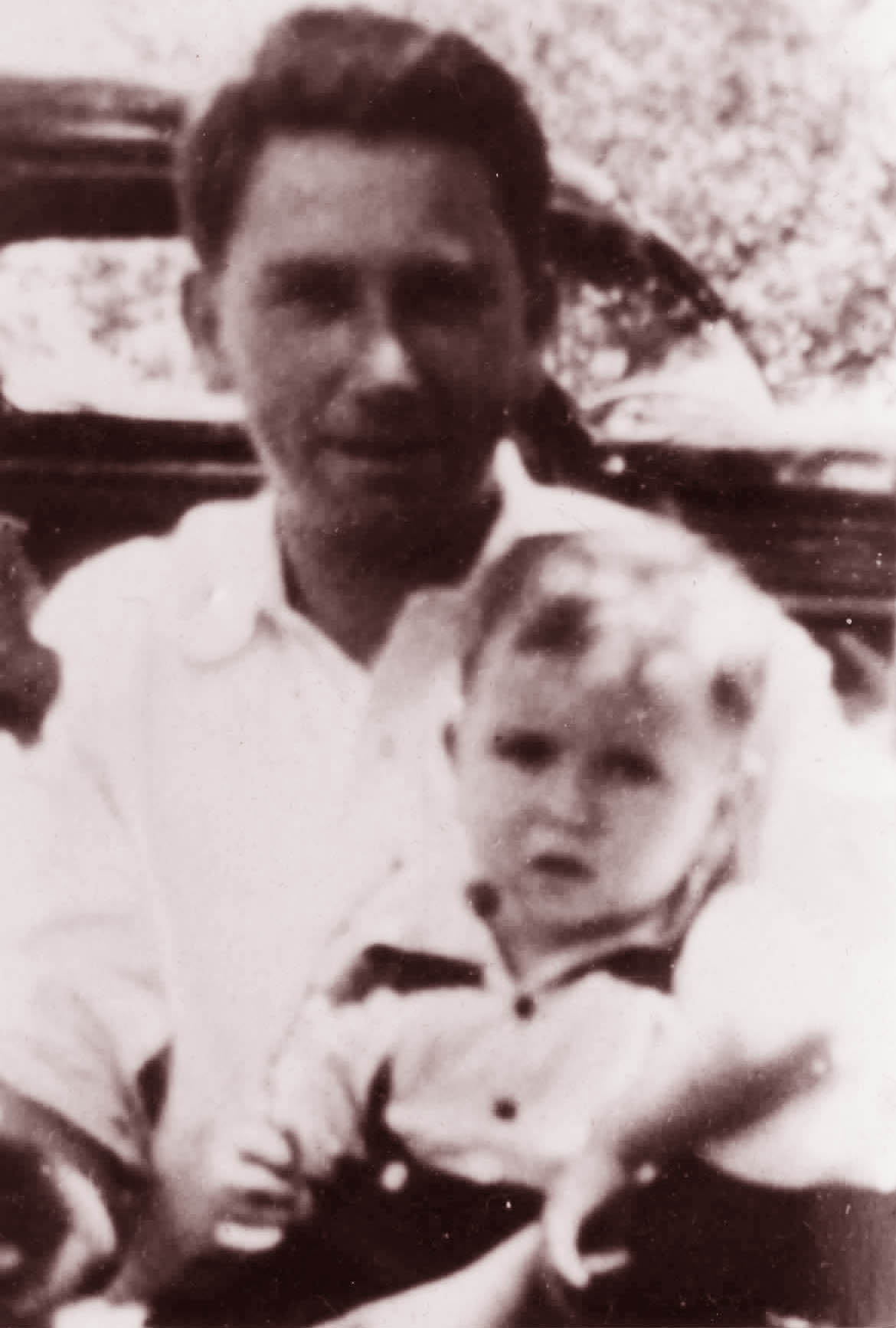
Dad and Me 1939

Dad and Me
1939

Who My Dad Was To Me When I Was Very Young

1) He was the guy who stood tall in my first vivid memory of anything back in 1939, before I was even two years old, On a Sunday visit to see my Mom’s folks in San Antonio, my Uncle Albert fell from a tall tree in my grandparents’ back yard, but his neck caught in a limb fork and he was left hanging there, with his arms and legs dangling in desperation. I’ll never forget Uncle Albert’s scary moaning in the heat of danger. As a young teenager himself, at that time, he had put himself in a deadly spot, but that’s certainly not an analysis I was capable of making back on that day. All I could do is be scared for him.

The next part of this special first memory was seeing my dad tearing off his shoes and racing to that tree for a quick climb of his own. He brought Uncle Albert down under his arm, safe from death on that day. Mom and my grandma were both what I now recognize as hysterical, but my brief trauma memory ends with my visions of Uncle Albert staggering around the yard and spitting up. Even at that tender age, however, I did recognize that he was safe because of my dad.

2) He was the guy who took me to my first baseball game at the Bee County Fair Grounds in Beeville, Texas in the summer of 1941. At age three, I saw Dad in uniform for Beeville as the right fielder, even though I had no idea what was I was viewing at the time from the right field grandstands where Mom sat and I walked constantly up and down the wooden seat planks. I do remember one of his teammates yelling, “You’re the baby, Bill,” when he came to bat the first time, but I have no memory of what he did. My only game action memory of Dad that day was seeing him field what I now understand was a one-bounce base hit to right field and then seeing Dad throw the ball to what I only much later knew as second base.

3) On Sunday, December 7, 1941, my dad was the guy who told me to go out the kitchen door to play in our backyard. Other family and friends were showing up to listen to the radio with Mom and Dad, but it made no sense to me. At 24 days short of my fourth birthday, it made no sense to me, but the departure from our normal Sunday schedule from that time was strong enough to register as a memory of mystery and curiosity.

4) Sometime in the summer of 1942, once I was beginning to get the idea that we were now “at war” with some people who didn’t like us, I followed the lead of some older kids in our Beeville neighborhood and went out into our dirt grade streets to look for metal we might collect on “Scrap Iron Day” in our town. I remember finally getting tired of digging empty holes with my little play shovel. I laid down in the road beside our house, trying to  make sense of why some other people could hate us so much that they wanted to kill us. – I called upon the only person that Mom and Dad already had told me had the answer to everything and just laid flat on my back, looking up at the cotton candy clouds of summer that drifted overhead. “God,” I asked, “if you are up there behind those clouds today, could you please tell me why these people from far away want to kill everybody in Beeville?”

About that time, I heard Dad’s shrill lip-whistle to come on inside for Saturday lunch. I always obeyed Dad, even though this time he had interrupted an important conversation I was having with God. I told Dad that I hoped God didn’t get his feelings hurt because I had not waited for his answer to my question. “It’s like I’ve been telling you, Billy,” Dad said, “God is everywhere. You can finish that talk with God after lunch when you are laying down to take your nap.”

5) On my fifth birthday, December 31, 1942, Dad moved the entire McCurdy family, which now included my one-year old brother, John Carroll McCurdy, to Houston. Dad had been disqualified for military service for medical reasons, but he still wanted to contribute to the war effort and he had taken a welding job at the Brown Shipyard in the Ship Channel area. We checked into the Alamo Courts Motel on South Main upon our twilight arrival in Houston from our auto trip from Beeville. Shortly thereafter, that same day, Dad took us to Prince’s Drive Inn at South Main and OST for our official new and forever Houstonian baptisms. I turned out to be the only “Born Again Houstonian” who has remained that “saved” – and I probably owe my lifelong loyalty of 72 years as a faithful adopted son of our great city to the Prince’s special burger sauce.

6) When I was seven, Dad was the guy who moved our family from renter status in the Heights to home ownership at 6646 Japonica Street in the Pecan Park neighborhood of the Houston Southeast End in January 1945. Across the street was the little city-owned sandlot that would become the principal shaper of so many childhood memories and dreams about a hopeful tomorrow. Thanks for the good move, Dad.

7) When I was nine, Dad took me and my five year old brother John to see the 1947 Houston Buffs play baseball at beautiful old Buffalo Stadium on Cullen Blvd., near the University of Houston. What a game-changer move in my life that one came to be. It turned on a switch that will never go out.

My love of the game has shaped any other worthwhile thing I’ve ever tried to do, whether I got there or not. Like baseball, life is an even longer season of rolling, often uneven success and intermittent morale assaulting disappointment. But totally like baseball, we have to hang in there in life and always fight back for the fulfillment of dreams that stir our souls. Whether we ever get there in some worldly self-measurable way is not the point. The points are – “hang in there and keep fighting back until you breathe your last.”  – Anything less is death itself.

Thanks, Dad, for everything, from early on. Everything I ever learned about fighting back, and adapting to new circumstances for the sake of love, I first learned from you!

Happy Father’s Day, William Oscar McCurdy ll !

eagle

1920: Daring Texas Pilot Leaps into History

June 20, 2015

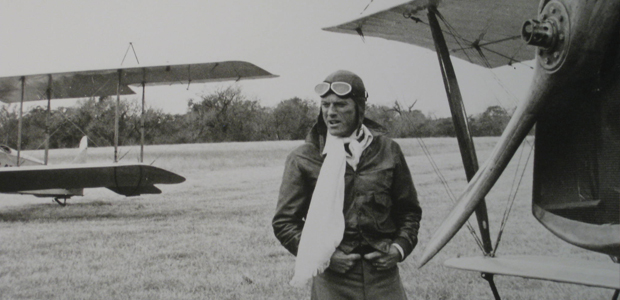
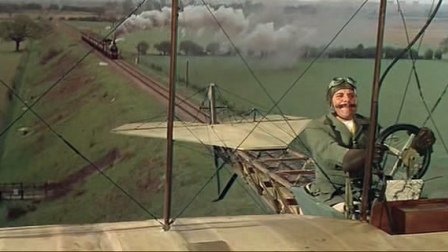
After you read the following story, which of these two actors would you have cast, when they were in their primes, to the movie role of “Wild Bill Long” from San Antonio, Texas: (Feel free to submit your own choice for an even better casting!)

Movie Role Candidate #1: ROBERT REDFORD

Movie Role Candidate #1:
ROBERT REDFORD

MOVIE ROLE CANDIDATE #2: TERRY THOMAS

Movie Role Candidate #2:
TERRY THOMAS

*****************************

Daring Pilot Fires Plane and Leaps to Safety in Parachute

For the first time in the history of aviation, a pilot yesterday deliberately set fire to his airplane, leaped from the blazing machine with a parachute and landed unscathed.

William Long of San Antonio, alias Wild Bill, taker of long chances in the ethereal blue, did the feat, while the longest crowd that ever thronged the beach front in breathless suspense. Ten seconds after the birdman trusted himself to the problematical safety of the parachute, the plane’s gasoline tank exploded and tore to pieces all that remained of the ship as it plunged into the gulf. Wild Bill. suspended beneath the slant umbrella, drifted inshore at the mercy of a smart sea breeze and landed on the roof of a house four blocks from the seawall. He climbed down, a smile all over his smoke-blackened features, turned over the chute to bystanders and went swimming.

The affair was a free attraction obtained by the Galveston Beach Association and the Galveston Commercial Association for the benefit of visitors to the beach.

~ Galveston Daily News, June 20, 1920, Page 2.

******************************

In the absence of high definition, high speed digital moving picture photography back in 1921, The Pecan Park Eagle congratulates The Galveston Daily News for assigning an excellent descriptive writer to the job of covering this awesome daredevil stunt from the early years of manned flight.

Given the cost of aircraft sacrifice that made this act the feat it needed to be, we have to presume that there was no repeat of the same performance on the same weekend, if ever.

Thank you again, Darrell Pittman, for sending along this wonderful early example of “America’s Got Talent” and splendid descriptive coverage.

eagleOne additional post-column publication thought about this event and date and their place in history: Since there were no prohibitive laws or “green movement” groups around in 1920 to stop a city from incorporating the “intentional” sinking of a flying vessel loaded with exploding hydrocarbon fuels on board a winged vessel as the central part of their plan to entertain the general public, perhaps, we may want to speciously designate June 20, 1920 and Galveston, Texas as the birthdate and birthplace of global warming.

Not So Famous Poorly Chosen Words

June 19, 2015

“And what did Pablo Sandoval do when he left the dugout to go to the bathroom in the middle of a game, Matt Lauer?”

Not So Famous Poorly Chosen Words

1) Matt Lauer, Today Show, NBC-TV, Friday, June 19, 2015: Leading into a light story he was about to report on Boston Red Sox third baseman Pablo Sandoval leaving the dugout to text women in the clubhouse during the game, Today Show host Matt Lauer reported this big news to the nation and three anchor colleagues sitting with him at the news desk as he spoke in this form:

“Later, (after getting a hit earlier in the game), during the seventh inning, he (Pablo Sandoval) left the dugout to go into the clubhouse to use the bathroom, and – do you know what he did? … No, not that!”

Note: Way to go, Matt! Whenever a player leaves the clubhouse to use the bathroom, the fans always want to know if it was for Number One, Number Two or some combination of both basic needs. If it was for Number Two, however, please spare us the gradiently differential data on how things went down.

2) A local Los Angeles radio station flash news report on a robbery arrest , sometime in the 1950s: “The arrest was made by Sargent Tom Williams, a defective of the Los Angeles Police Farce.”

3) Richard Nixon, speaking publicly at the Grand Opening of the LBJ Presidential Library in Austin after being shown with the much larger LBJ as the host was physically moving his Republican guest with pushes and pulls through the different public rooms: “A short while ago, as President Johnson was throwing me around the library …”

4) In 1972, with the initiation of federal revenue sharing with cities for the support of certain local projects, many Houstonians were wondering what then Mayor Fred Hofheinz was going to call this new program by name so that they could then submit bids for assistance or make recommendations on how the money was to be spent. Your humble writer here submitted a written suggestion for what we felt was an appropriate program name, but we never heard from the mayor, one way or another, in any active form. The fact that we never heard from the mayor at all about anything after this suggestion was our answer. We wonder why? All we said was, “Why don’t you call our local federal revenue sharing program by a name that everyone will recognize? Call it ‘Preparation H’.”

5) Years and years and years and years ago – before I was ever, ever, ever, ever married, a girl friend and I drove over to Matamoras, Mexico to do a little shopping in the market and then have dinner. On our way out of the hotel, my key chain broke and I hurriedly picked up the several items that had fallen to the floor and stuffed them in my pocket. We had a great morning. My girl friend bought a colorful little handmade bowl. We decided to place the turista purchase in the trunk of the car before lunch, but we found the trunk door partially unhinged when we got back to our parking space, I figured I had just failed to close it properly when we checked into the motel the previous evening. I closed it hard this time and we then went on from there to enjoy a great (what else?) Mexican food dinner at a little cafe near the square. The open, then solidly closed trunk would simply soon prove to be one more of the quirky circumstances that combined that fine day to set us up for an unforgettable experience.

On the our way back into the USA, we were stopped by US customs as part of a random check and pulled aside. And here came my time to misspeak again.

Customs Officer: “Do you have anything in your trunk to declare, sir?”

Yours Truly: “Just a little pot, Officer.”

Customs Officer: “Oh really? – Well, I think you had better open the trunk and let me see for myself.”

Yours Truly: “It’s not that kind of pot, Officer! I didn’t mean to …”

Customs Officer: “Just open your trunk, sir!”

Yours Truly: (now fumbling nervously for my trunk key in the handful of loose keys I had pulled from my pocket. It wasn’t there.)

Customs Officer: “Which one is it?”

Yours Truly: “It’s none of these, Officer! Would you believe my key chain broke as we were leaving the motel in Brownsville? – It’s got to be there – on the floor somewhere.”

Customs Officer: “Pull over, Sir! – You guys are in for a long afternoon!”

Indeed we were. Of course, this was fifty years ago  and things were slightly different then. With no cell phones, and no answer to a call for friends who were staying at the same Holiday Inn, US Customs allowed us to squirm for a couple of hours in our search for someone who could find and bring us the trunk key. Allowing one of us to go get it by taxi was never an option. Neither of us were going anywhere. And one other officer kept inferring that they could get that trunk door of my 1964 Ford Falcon open very quickly in their own way, if I didn’t come up with a key pretty soon.

What happened next probably wouldn’t happen today. The customs officer who stopped us finally walked over to us as the delay time crawled up to nearly three hours and handed me the ignition key to my car. “Look, young man, (yes, they used to call me that), we’ve been watching both of you pretty carefully for quite a while now, and you’ve both done a pretty good job of convincing us that you aren’t trying to smuggle dope by convincing us that you are just a couple of dumb ass tourists who would plant drugs in your own car trunk, then make dumb statements to us, and then spend the rest of the afternoon being good actors. – You guys are not acting. This was the dumbest thing I ever seen at this crossing. Now get out of here, – go find that damn trunk key,  – and never come back to Mexico without it! – Have you got that?”

Yours Truly: “Yes, Sir.”

Nuf sed. One of these days I may run out of self-flagellation stories from my youthful naivete and my apparently honest-to-a-fault need to keep telling them.

T.G.I.F – And GO ASTROS – Win ‘Em All this weekend and leave the Mariners “Sleepless in Seattle!”

The Indelibility of Seat-Carved Words

June 18, 2015

10_14_07-039

Tick-Tock Goes the Clock of Life

Last Friday morning was one of those days for the serendipity of quirky chain-linking events that sometimes leads, at least, to good material for an unusual column, but one that also bears some kind of more far-reaching effect that we simply are unable to fathom in the present moment.

I had gone to the Astrodome that morning to spend time with Jimmy Wynn as he helped a fellow named Steve Archer host a “seat stand sale” to the hundreds who came to the property that day to pick up souvenir seats from the Astrodome they had purchased earlier.

It was a big crowd of Astro fans who all brought with them their memories and affections for both the Astrodome and Jimmy Wynn, the only one there on Friday, June 12, 2015 who actually had played in that first Astrodome baseball game of a little more than fifty years ago on April 9, 1965.

Jimmy Wynn and the Astrodome. Both remain among us as living iconic symbols of Houston’s earlier commitment to all of the great unfolding promises of tomorrow. Many also chose to purchase autographed copies of “Toy Cannon”, the book that Jimmy Wynn and I wrote on his life back in 2010. And almost all of the fans who approached Jimmy thanked him for some special memory they still bore with them as a joy from his playing days in these latter years of us all.

Here comes the serendipity chain:

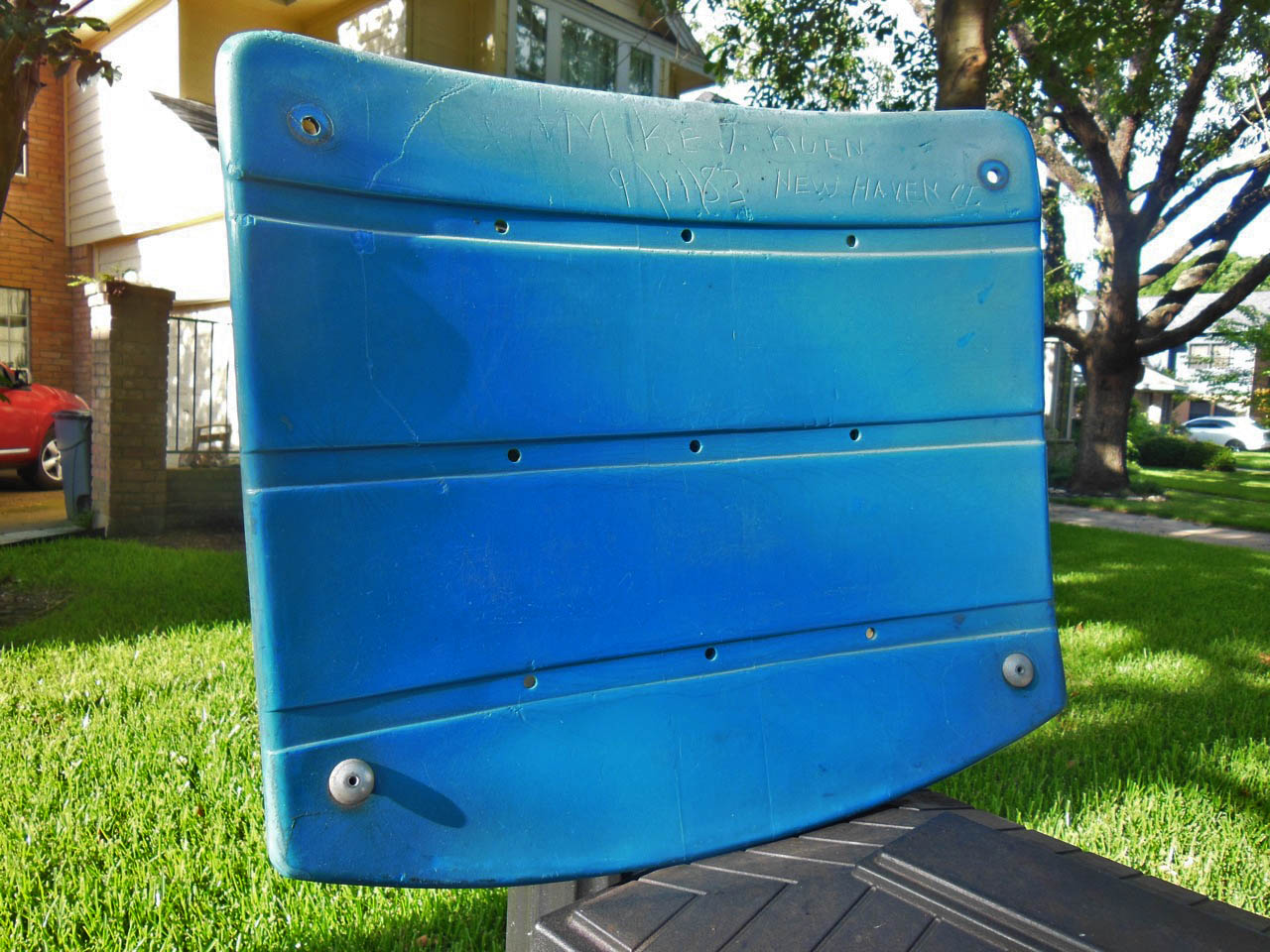
At the end of a long hot morning, Jimmy and Marie Wynn, and yours truly, prepared to leave. Before we left, however, among other things, Steve Archer, one of the nicest guys you could ever hope to meet, gave Jimmy Wynn a couple of seat panels that had come from the demolition of the original Yankee Stadium. It was pretty obvious from their more modern look and plastic materiality that these panels had come from the 1976 renovations and were not from the 1923 original seat installations.

Bingo!

Jimmy Wynn gave one of the seat covers to me as we were leaving – and one to take as his gift to Bob Dorrill. It’s simply the kind of guy that Jimmy Wynn is. I took Bob’s Yankee Stadium seat panel to him that night when we met in Sugar Land for our Houston Babies game against the Katy Combine at Constellation Field.

Bingo again!
Astrodome Seats 03

Astrodome Seats 01

Astrodome Seats 02

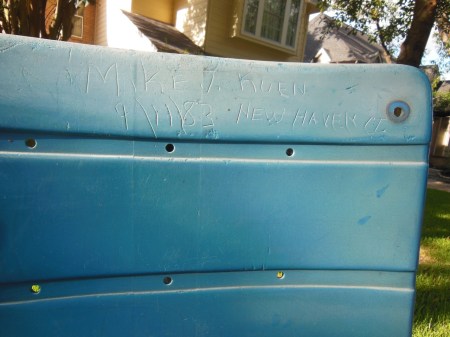
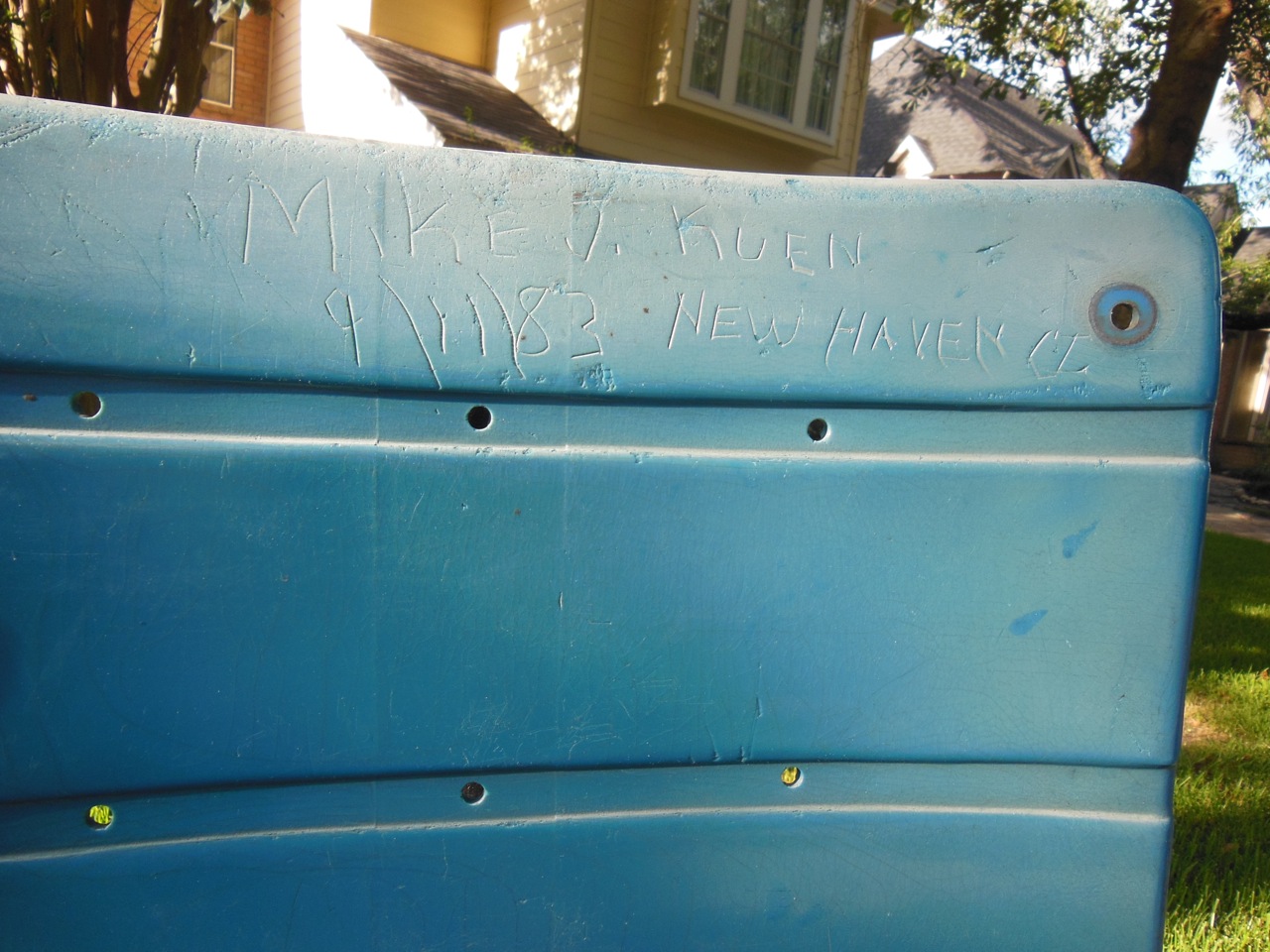
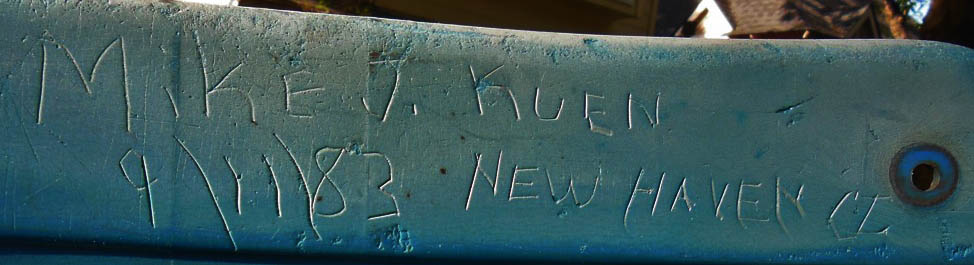
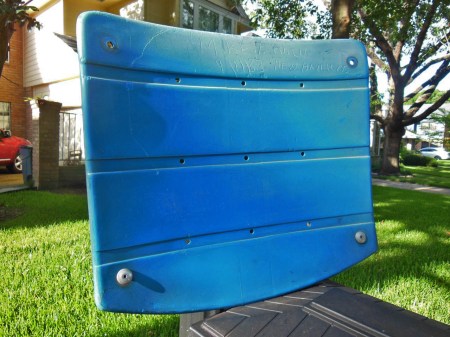
The seat panel I kept contained some deeply etched graffiti. The inscribed words in the above featured close up photo of them should be pretty clear, but they read as follows: “Mike J Kuen …. 9\11\83 …. New Haven CT”.

Eureka!

Remember Abraham Lincoln’s famous words from the Gettysburg Address? “The world will little note, nor long remember what we say here, but it can never forget what they did here.” Abe wasn’t thinking about Yankee Stadium at the time. Had he been aware of certain things to come, Abe would have known that thoughts carved into biodegradability-resistant material, no matter how mundane and banal, could remain unforgettable to all who saw them for a period of time approaching eternity.

Germination of The Plan.

With the enlisted help of friend and fellow researcher Darrell Pittman, we set out to try and find out if the same “Mike J Kuen” were still around today to be reminded of his past actions. We figured the risk rewards of this research were worth the effort. It figured to have been the act of a teenager or some other immature person who had long since outgrown the need and outlived the statute of limitations on prosecution for misdemeanor vandalism.

If it turned out to be someone who had graduated from carving plastic to carving people, we figured on pulling a quick “feet, don’t fail me now” retreat in abandonment of all further research.

We didn’t get far, so far.

Darrell found some contact numbers for a guy we located in Connecticut that we think, but do not know for sure, who may be our guy, but my attempts yesterday, and again today by phone fell way short of contact. Like many people today, this guy uses his voice mail to screen calls. Last night I got no response to my requests for a call back. Same today. It probably sounded like a prank or a lead in pitch to some kind of scam from a stranger in Texas with a larger plan – when all it really was, and is, was an attempt to let our true “Mike J Kuen” know that, however, slight it may have been, that his carved words into the history of Yankee  Stadium had not been forgotten.

Today I invited our subject to either call or correspond by e-mail, if, in fact, he was the one we have been seeking – and I plainly told him that I, in return, would send him digital copies of the stadium panel photos shown here. I also promised the man that I would not attempt to reach him again, if I did not hear further from him directly in response to today’s invitation.

It’s probably just as well that the search ends this way. Some people have a need for either forgetting or not wanting to recall the miscreant acts of their earlier adolescent lives – and, who knows, – maybe this just isn’t our guy and he doesn’t want the nuisance of dealing with something that lands on his voice mail completely foreign and unexpected.

I still can’t help but feel from this experience and that I would have made a lousy Sam Spade.

The serendipitous remains of this experience.

Barring further developments that we do not yet see, the Yankee Stadium seat panel etchings are just a reminder that many of us, as kids, did a few things in rebellion once upon a time in the course of growing up. We simply didn’t carve them into plastic, as one “Mike J Kuen” once did, for some stranger to pull out of the trunk of memories thirty-two years later from a buried past and ask questions about.

“Think Before You Ink” all you great young graffiti artists out there! You may be writing on something that you will live to regret memorializing some thirty years from now.

Analog Report, June 18, 2015.

We just heard from Bob Dorrill, the other eventual “stadium seat” recipient in this two-panel Yankee Stadium story. Bob spoke with Steve Archer today, to thank him, I’m sure. According to Bob Dorrill, Steve Archer confirmed that the panels we each received, indeed, are seat bottoms, not seat backs. Archer said the legs of some 2,000 seats were stolen some time ago, making the restoration of each complete former seat impossible.

Just another possible reason to support why the real “Mike J. Kuen”, whomever he may actually be, will not want to talk publicly about his inscription for the ages. He had carved his name into a part of Yankee Stadium that normally supports the human posterior – and he probably had to work between his own legs for several innings to get it there into the seat in the legible form it now remains.
American League All Stars of 1921

June 17, 2015
Galveston News AL All Star Picks June 19, 1921 Submiited by Darrell Pitman

Galveston News AL All Star Picks
June 19, 1921
Submitted by Darrell Pittman

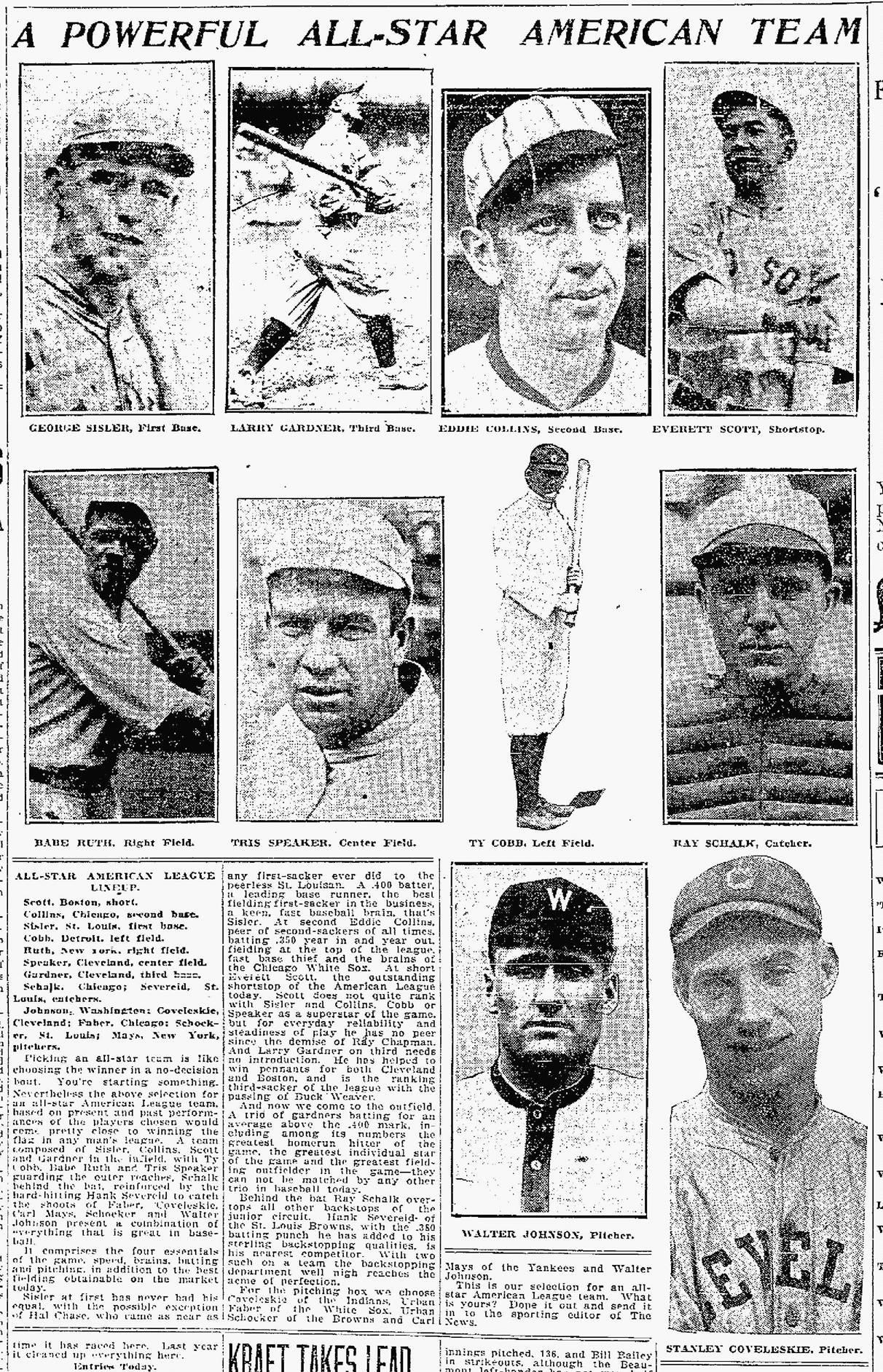
OK, It’s 1921. There won’t be an MLB All Star Game for another twelve years, but so what? Baseball fans and writers have been picking league all stars by position from the earliest oozings of organized baseball and this early offering is no exception of one considered judgment. It doesn’t mean that everyone from that era would have been totally in agreement, but I “gotta” tell you, I wouldn’t have minded going to managerial war against the National League with these guys as my offensive cannons, defensive shields, and throwing arms of mass destruction.

Here’s my starting lineup, based upon each player’s 1921 stats:

1) George Sisler, 1st Base (,371 BA, 18 3BH, 12 HR, 104 RB1, 35 SB), St. Louis Browns

2) Ty Cobb, LF (.389 BA, 197 Hits, 37 2BH, 22 SB, 101 RBI) Detroit Tigers

3) Tris Speaker, CF (..362 BA, 183 Hits, 52 2BH), Cleveland Indians

4) Babe Ruth, RF (.378 BA, 204 Hits, 177 R, 168 RBI, 39 2BH, 59 HR), New York Yankees

5) Eddie Collins, 2nd Base (.337 BA, 38 3BH, 3 HR), Chicago White Sox

6) Larry Gardner, 3rd Base (.319 BA, 187 Hits, 32 2BH, 120 RBI), Boston Red Sox

7) Everett Scott, SS (.262 BA, 151 Hits), Boston Red Sox

8) Ray Schalk, Catcher (.252 BA, 0 HR, 47 RBI), Chicago White Sox

9) Stan Coveleski, RH Pitcher (23-13, 3.37 ERA, 99 K) Cleveland Indians

Closer, if needed: Walter Johnson, RH Pitcher (17-14,  3.51 ERA, 143 K, Washington Senators