The Curse and Dem Bums in a Nutshell

October 24, 2018


The Red Sox and Dodgers are each colorfully infamous for their associations with two of baseball’s most unforgettable litany lines (i.e., please note: we said “litany’ lines ~ not “Nittany Lions.”).

Because Red Sox owner Harry Frazee sold Babe Ruth to the soon-to-be-hated-even more Yankees prior to the 1920 season, the Boston American League club would not win another World Series until the 21st century after winning five of the first fourteen they played under the new World Series format that started in 1903.

It’s right there in the record, gaping back at the reader with all the green-with-envy and orange-with-anger Boston Irish eyes that fed annually upon the idea of “The Curse of the Bambino” for all of the seasons beyond 1918 that their team couldn’t even get back to a World Series until 1946 ~ but only to incur the next level of the curse ~ coming close in the Series 4 more times, once in only four of the six remaining 20th century decades, but only to lose painfully each time. ~ Remember Bill Buckner in 1986?

Then the Red Sox got their splits together in the 21st century and broke “the curse” in 2004, and twice more since, with a good chance of doing it again this year, 2018, based upon their relentless destruction of the Dodgers in Game One of last night’s opener.

The Dodgers, “‘Dem Bums” from their almost always getting beat up Brooklyn days are another story. They pretty much made hapless losing and painful last game crumbling an art form ~ and with considerable help from the Yankees ~ Except for 1955, Brooklyn fans ended every damned season screaming loud into the those bitter last game nights ~ “Wait’ll Next Year!”

Once they moved to Los Angeles, the Dodgers started getting to the World Series more often on a win-some/lose-some basis, but now they are battling a 30-year absence from winning their last one.

Astros Nation appreciates the thrilling challenge that the Dodgers gave our Houston club last year. Our Game Five Astros victory at home was one for the ages and a Game Seven Houston closer win in LA was one we shall cherish forever.

We also knew that the Dodgers have that kind of losing in their baseball DNA and that “Wait Until Next Year” came quickly to their minds, if not their lips, when the deed was done.

Now “Wait’ll Next Year” has become the Astros’ 2018 season swan song. We are hoping it’s available to us only on a short-term rental basis.

Here are the World Series bottom lines for both the Red Sox and the Dodgers. See for yourself. The agony and the ecstasy is all laid out here for your own experience with its indelible baseball lore presence in fact.


Boston Red Sox Franchise World Series Record

YEAR S#-F# RED SOX OPPPONENT W-L-W%
1903 01-01 W 5-3 > PGH PIRATES 1-0, 1.000
1904 No World Series
1912 08-02 W 4-3 > NY GIANTS 2-0, 1.000
1915 11-03 W 4-1 > PHI ATHLETICS 3-0, 1.000
1916 12-04 W 4-1 > BRK ROBINS 4-0, 1.000
1918 14-05 W 4-2 > CHI CUBS 5-0, 1.000
1946 42-06 L 3-4 < SL CARDINALS 5-1,   .833
1967 63-07 L 3-4 < SL CARDINALS 5-2,   .714
1975 71-08 L 3-4 < CIN REDS 5-3,   .625
1986 82-09 L 3-4 < NY METS 5-4,   .556
1994 No World Series
2004 99-10 W 4-0 > SL CARDINALS 6-4,   .600
2007 102-11 W 4-0 > COL ROCKIES 7-4,   .636
2013 108-12 W 4-2 > SL CARDINALS 8-4,   .667

Header Notes:

S#-F# = Word Series & Franchise Sequential Numbers as actual events. No World Series took place in either 1904 or 1994. The franchise always has been located in Boston and has played in the World Series as the Red Sox since 1912. They won, however, as the “Boston Americans” in the 1903 start of it all.

What about the 19th century championships?

Our accounting for World Series history begins with the 20th century modern era that began in 1903. We are mindful of the 19th century baseball championships and no denigration of those accomplishments is intended. Baseball simply lacked the stability to organize anything that had much chance of lasting longer than a given team’s immediate direct interest in playing in such a game. The losers simply walked away and the league had no shared partnership that could sustain all team support, even during the bad years that some clubs might be having.

1903 was the start of the time in which 16 stable franchises started for the first time what has continued through today as the same process that 16 founders and 14 expansion franchise brothers that survived over time continue to make happen. In 2018, MLB is still playing annually for the same clearly named World Series Championship on a prescribed annual basis. Nothing like that ever happened until the 20th century.

Even in the 20th century movement, baseball had to survive the Giants’ refusal to play Boston in the 1904 Series that didn’t happen. McGraw and company apparently were afraid of losing, but these actions prodded MLB into fighting for a total commitment that would not allow a single club, from 1905 forward, to refuse the honor of representing their league in The Series. It would be their honor and their responsibility to play the World Series.

And that’s the codicil rule that separated the 20th century World Series effort from anything that happened in the 19th century. McGraw and the Giants might have been allowed to bully baseball into killing the 1903 World Series effort as someone always did in some way during the 19th century period, but, this time, baseball stopped the bully. So, in the end, baseball did not really have a World Series plan in place until the 1905 games were played, as we said earlier, as a matter of honor and responsibility.

And that’s my shortest route to why I prefer to start anything I do on the World Series from the 1903 effort forward ~ and that’s no denigration of the earlier era. 19th century baseball people simply were either too powerless or unable to see what was holding them back from a World Series plan that could hope to survive.


Brooklyn/Los Angeles Dodgers Franchise World Series Record 

YEAR S#-F# BROOKLYN OPPONENT W-L-W%
1916 12-01 L 1-4 < BOS RED SOX 0-1, .000
1920 16-02 L 2-5 < CLE INDIANS 0-2, .000
1941 37-03 L 1-4 < NY YANKEES 0-3, .000
1947 43-04 L 3-4 < NY YANKEES 0-4, .000
1949 45-05 L 1-4 < NY YANKEES 0-5, .000
1952 48-06 L 3-4 < NY YANKEES 0-6, .000
1953 49-07 L 2-4 < NY YANKEES 0-7, .000
1955 51-08 W 4-3 > NY YANKEES 1-7, .125
1956 52-09 L 3-4 < NY YANKEES 1-8, .111
LOS ANGELES
1959 55-10 W 4-2 > CHI WHITE SOX 2-8, .200
1963 59-11 W 4-0 > NY YANKEES 3-8, .273
1965 61-12 W 4-3 > MIN TWINS 4-8, .333
1966 62-13 L 0-4 < BAL ORIOLES 4-9, .308
1974 70-14 L 1-4 < OAK ATHLETICS 4-10, .286
1977 73-15 L 2-4 < NY YANKEES 4-11, .267
1978 74-16 L 2-4 < NY YANKEES 4-12, .250
1981 77-17 W 4-2 > NY YANKEES 5-12, .294
1988 84-18 W 4-1 > OAK ATHLETICS 6-12, .333
1994 No World Series
2017 112-19 L 3-4 < HOU ASTROS 6-13, .316


********************

Bill McCurdy

Principal Writer, Editor, Publisher

The Pecan Park Eagle
 

Baseball Reliquary News and Notes

October 23, 2018

Episode-181-Summer-of-68-690x630

Introduction ~

Those of you traveling to Los Angeles later this week for the continuation of the World Series need to take note that The Baseball Reliquary will be offering a free historical program in nearby Pasadena CA on Thursday and Saturday that Director Terry Cannon will be outlining for you in the following message ~ as he also extends to each of you a hearty invitation to join in the fun, and attend, if you can make either presentation date.

The Baseball Reliquary is our west coast heartbeat for serious ~ and sometimes lighthearted serious preservation of even those arcane events that bring comedy to the “business” of honoring the history of the game. For a fuller hold on what we’re talking about here, read the whole article before you click the links that Terry Cannon also has provided within his text.

Also, regardless of where you live, give some thought to supporting the work of TBR by signing on with Terry as a new contributing member. Simply contact Terry Cannon by phone or e-mail that he has provided for us in his message today.

Thank you. ~ And enjoy. ~ Bill McCurdy ~ The Pecan Park Eagle publisher ~ And Baseball Reliquary Member.

Baseball Reliquary News and Notes

By Terry Cannon

TIM WENDEL PROGRAMS ON OCTOBER 25 & 27

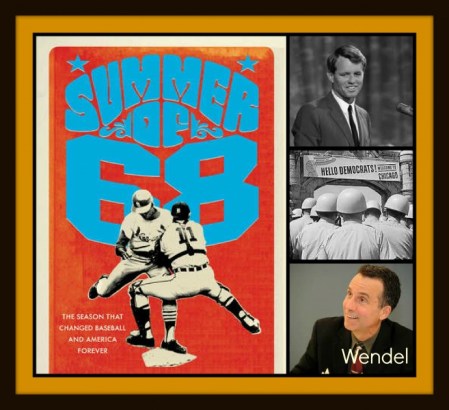
This coming week, the Baseball Reliquary will host two programs with Tim Wendel, author of “Summer of ’68: The Season That Changed Baseball – and America – Forever.” Tim will be visiting Southern California from his home in Vienna, Virginia. The first program will be on Thursday, October 25, at 7:00 p.m. at Villalobos Hall, 13507 Earlham Drive, on the campus of Whittier College. This free program will be co-sponsored by the Institute for Baseball Studies. Parking on campus is free after 5:00 p.m., and we recommend parking in the lot on the corner of Painter Avenue and Earlham Drive, as it is right next door to Villalobos Hall. While you are on campus, make sure to visit the Wardman Library, as the Institute for Baseball Studies and the Baseball Reliquary are presenting an exhibition, “Bad Moon Rising: Baseball and the Summer of ’68,” based on Tim Wendel’s book. The library is open until midnight on Thursday, in case you’d like to view the exhibition immediately following Tim’s presentation at Villalobos Hall.

If you can’t attend Thursday’s program, the Baseball Reliquary is hosting a second visit with Tim Wendel on Saturday, October 27, at 2:00 p.m. at the Allendale Branch Library, 1130 S. Marengo Ave., Pasadena.

Both programs will feature a discussion and book signing. Tim will present a slide show of images related to the 1968 baseball season. Copies of “Summer of ‘68” will be available for purchase for $15 each. We are pleased to attach the news releases for both events. As we look forward to the 2018 World Series, these  programs offer a great opportunity for us to reflect back on the 50th anniversary of a World Series for the ages – one which capped an extraordinary and unforgettable season.

NEW BASEBALL RELIQUARY DOCUMENTARY

We are pleased to share the link to Mike Plante’s 24-minute documentary, “This is The Baseball Reliquary,” which features Tomas Benitez, Joe Price, Greg Jezewski, Ben Sakoguchi, and others. Also included are excerpts from acceptance remarks by Shrine of the Eternals inductees Dock Ellis, Jim Bouton, and Pam Postema. A producer and director, Mike Plante is also the senior short film programmer for the Sundance Film Festival. The documentary features an original soundtrack by Nicholas Brawley. We think you’ll enjoy this “inside” look at the Baseball Reliquary in all its peripatetic glory.

https://vimeo.com/283514815

BASEBALL RELIQUARY LAUNCHES YOUTUBE CHANNEL

The Baseball Reliquary recently launched its own YouTube channel, with the purpose of uploading a variety of video material from its extensive archives, much of which has never before been seen. Thanks to documentary filmmaker Mike Plante and to Baseball Reliquary Webmaster Loren Roberts, several videos are now available for viewing, and we will be uploading more footage in the coming weeks and months as it is digitized.

http://bit.ly/baseballreliquaryyoutube

Current highlights include two comedy benefits for the Baseball Reliquary, from 2002 and 2005, both featuring all-star rosters of performers and comedians including the likes of Thom Sharp, Jack Riley, Jay Johnstone, Fred Willard, Ronnie Schell, Wayne Federman, John Caponera, George Wendt, Greg Proops, Dom Irrera, and many others.

Here are the links to two of the most memorable events in the history of the Baseball Reliquary:

https://www.youtube.com/watch?v=47gCQE10LgE

https://www.youtube.com/watch?v=lCj4KTzyT1Q

Sincerely,
Terry Cannon
Executive Director
The Baseball Reliquary
www.baseballreliquary.org

e-mail: terymar@earthlink.net
phone: (626) 791-7647


********************

Bill McCurdy

Principal Writer, Editor, Publisher

The Pecan Park Eagle


An Early Hispanic Texas League Star

October 22, 2018

Leo “Najo” Alaniz
Early 20th Century
Mexican-American Baseball Pioneer

The best quick study of Leo Alaniz’s family history and life-in-baseball story is available on Wikipedia. A deeper treatment is most probably available in “Baseball’s First Mexican-American Star: The Amazing Story of Leo Najo“, written in 2008 by Noe Torres. 

********************

Excerpt from Wikipedia ….

Early Life

Leo Najo was born Leonardo Alanis on February 17, 1899 in the small town of La Lajilla, located in the municipality of Doctor Coss in Nuevo LeónMexico. When Najo was 10, his mother moved the family to the nearby town of Mission, Texas, where she purchased a small tavern and operated it successfully for many years afterward. Najo lived in Mission for the rest of his life. The family’s financial stability allowed the youth to spend much of his time playing the relatively new game of baseball, which was very popular along the Texas-Mexico border at the start of the 20th century.[3]

In the early 1920s, Najo and several other young men in Mission formed a town semi-pro team, the Mission 30-30s, named after the Winchester Model 1894 rifle, which was popularly known as the 30-30 rifle. The 30-30s became a baseball institution in Mission, existing until the mid-1960s. A number of famous South Texans besides Najo played on the 30-30s team, including future Dallas Cowboys coach Tom Landry and future U.S. Congressman Kika de la Garza.[3]

Because playing semi-pro ball in Mission was only bringing in about $6 per week, Najo also played for other South Texas teams, including the Milmo Bank team of Laredo, Texas. Najo also played with some of the very earliest organized teams in Mexico, including the Cuauhtemoc Brewery team of Monterrey in 1922. The Cuauhtemocs are viewed by baseball historians as an important early Mexican franchise and a forerunner of the highly successful Sultanes de Monterrey in the modern Mexican League.[4]

It was during Najo’s early, semi-pro playing days that he began using “Najo” as his playing name. Relatives believe the name derived from the Spanish word for rabbit, “conejo”, given to Najo by fans because of his fast base running.[3]

Because of his natural speed and catching ability, Najo mostly played center field, although he often played the other outfield positions and, rarely, the infield. In addition to being an above-average hitter (.321 lifetime batting average), Najo excelled at drawing walks and stealing bases, and he was often the team’s leadoff hitter. In his twenties, he stood 5-foot-9 and weighed 144 pounds.[3]

The Transition to Professional Baseball

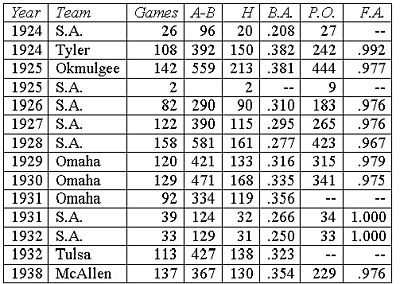
During the early 1920s, Najo’s Milmo Bank team occasionally traveled to San Antonio, Texas for games against semi-pro teams there. During one of these visits, Najo was “discovered” by a scout with the San Antonio Bears of the Class A Texas League. He was signed in December 1923 and played his first pro game on April 16, 1924 at San Antonio’s League Park, leading off and playing right field for the Bears against the Galveston Sand Crabs. By his participation in that game, he became one of the first Mexicans to play U.S. professional baseball. Baseball historians also believe Najo was the first Mexican to play in the Texas League, which was established in 1888.[3]

Later in 1924, forced to reduce their roster, the San Antonio Bears “lent” Najo to the Class D Tyler, Texas Trojans, where he led the team to the championship of the East Texas League, finishing third in the league in batting and earning a .992 fielding average. Najo received recognition for his fast base running and acrobatic catches in the outfield.[3]

Najo played almost the entire 1925 season on loan from San Antonio to the Class C Okmulgee, Oklahoma Drillers of the Western Association. He played in 142 games, mostly at center field, hit 34 home runs, made 213 hits, and compiled a .381 batting average. After the season, league president J. Warren Seabough told the Chicago Daily Tribune, “Leo Najo … is one of the greatest players of all time in the Western Association.”[3]

The White Sox Tryout Experience

Following Najo’s success with the Okmulgee Drillers, the Chicago White Sox drafted him in the winter of 1925, and thus he became, most historians agree, the first Mexican player ever taken by a major league team. A November 8, 1925 Washington Post article refers to Najo as “one of the greatest baseball players of all time.”[3]

He appeared in a number of spring training games for the White Sox in 1926, seven years before Mel Almada officially became the first Mexican player to earn a regular roster spot in the U.S. major leagues. According to newspaper accounts of the day, Judge Kenesaw Mountain Landis, baseball’s first commissioner, watched Najo play in exhibition games in 1926. Decades later, in 1973, another baseball commissioner, Bowie Kuhn, attended Najo’s induction into the Salón de la Fama del Beisbol Profesional de México in Monterrey.[3]

Najo’s spring training statistics indicate that he played well enough to make the major league team. However, on the final day of spring training, Najo was released to the San Antonio Bears. The Chicago Daily Tribune reported, “The Sox squad was cut down by one today when Najo … was shipped to the San Antonio club to which he has been released outright. There are others tonight awaiting the signal to move.”[3]

Although the exact reason for his dismissal remains a mystery, Najo’s family suspects that the decision was due, at least in part, to racial prejudice among the major league players and team officials. The White Sox attempted to portray Najo, who was of dark complexion and spoke limited English, as a native American (“Chief Najo”) due to prevailing racism against Mexicans. Najo family members say that, although he remained upbeat and dedicated to his love of baseball, racial prejudice did adversely affect his career.[3]

Minor League Record of Leo “Najo” Alaniz

400px-Najo-stats

A Link to the Full Wikipedia Article

https://en.wikipedia.org/wiki/Leo_Najo

********************

Link to 2008 Biography by Noe Torres

**********

What an amazing life ~ by a talented man ~ and one flying under the general awareness radar all these years from the kind of recognition that he deserves for the playing opportunity cause of so-called “browns” in organized baseball.

Most of us will never live long enough to see the welcome day that is now coming. It is a day that will take the rainbow all the way out of the mix for those who need to use biological discrimination as leverage for personal or smaller group power by one racial group over all others.

Cocoa America. ~ The Day is Coming. ~ It is already well on the way.

And, thank you, ~ Jackie Robinson, Leo “Najo” Alaniz (or Alanis), and all others who have contributed to the coming of Cocoa MLB.


********************

Bill McCurdy

Principal Writer, Editor, Publisher

The Pecan Park Eagle

Serendipity in Astrodome Scoreboard Film Link

October 21, 2018

Chester Charge ~
Led the Momentum Storm of Support for the Houston Astros at their brand new 1965 Astrodome home.

None of who grew up with it will ever forget the gigantic animated scoreboard at the Astrodome that wrote the soundtrack to our game experience inside the great sports hall. As naive as we all were back in the 1960s to the changes that were coming our way via the computer, the Internet and social media over the course of the later 20th and early 21st centuries, it was impressive enough to us earlier ones that we had this little electronic cast of supportive animated characters that had come to life to boom and spread adrenalin-loaded smiles ~ and a winning attitude ~ to the faces and spirits of all Astro fans in the place ~ on any given game day.

No wonder the Astrodome so quickly came to be advertised and known as “The Eighth Wonder of the World.” It did ~ because it was ~ in 1965 ~ the most out-of-mind-and-body human way to experience a baseball game that the world had ever seen.

It also is a little serendipitous that I write these particular thoughts this morning. It was only yesterday that our good friend and wonderful Pecan Park Eagle article contributor, Maxwell Kates, sent me this link to a YouTube film that held so many of those wonderful animated moments. I knew immediately that I had to share it with al of you. It’s only 10-15 minutes in length, but that’s enough time to get a really good “inside the dome” look at that era, even as to how formally so many of the fans dressed back in the day.

My biggest surprise was a little more personal.

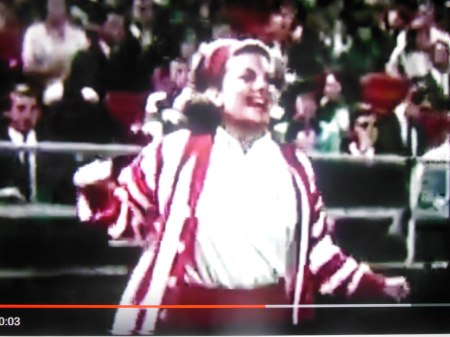
Laura Foster, UH Cheerleader, 1965
Married former UH football player Richard Kirtley in 1967
(I was in the wedding party ~ The Pecan Park Eagle.)

Suddenly I found myself looking at Laura Foster, a good friend, and the widow of another good friend and fraternity brother from an earlier period at UH, the late Dick Kirtley. In the clip, Laura was leading a rally for Cougar support on the sidelines as a UH Cheerleader. I was a member of the Richard and Laura Foster Kirtley wedding party in Friendswood during the summer of 1967.

A double-thanks, Max, for sending us this link. It’s especially important to me and some special people in my life, and we all thank you very much.

Plus, it’s simply a great ride through the precious-to-Houston early period of the Astrodome. And for that treasure, we wish to extend our thanks to people like Wayne Chandler, Tal Smith, Jimmy Wynn, and Larry Dierker. You are all special members of our baseball legacy gift from Judge Roy Hofheinz and the rest of the baseball gods.

Here’s the YouTube Link. And make sure you turn on the sound and expand the picture to “full screen” for the best way to experience this particular little travel back into another era of Houston baseball time.

***********************

Bill McCurdy

Principal Writer, Editor, Publisher

The Pecan Park Eagle
 

ALCS Done ~ And Some Canine Fun

October 20, 2018


“Wish I Were With You Tonight!” ~ Babe McCurdy (1979) *


* Wish you were here tonight too, Babe!

As things played out in the ALCS 2018 Pennant Series over the past week, the Houston Astros lost to the better team over that period of time, the Boston Red Sox.

Here’s how our younger dog, a Poodle named Hope, and three of their neighborhood buds reacted this morning a short while after we asked our older dog, a Dachshund named Pluto, to break the news to his sister and the rest of them about Game 5’s bitter end last night to the Astros’ dream of repeating as World Champions in 2018.

“Yes, Pluto, the loss to Boston means the Astros won’t be going back to the World Series this year. Could you please help us find a way to break the news to your sister, Hope, and to your neighborhood buds who haven’t heard?”


“Mom and Dad! Help! Pluto’s teasing me! He says the Astros’ loss to the Red Sox means they are gone ~ and that, if they are gone, I’m gone too ~ because Dad always said that our hope goes wherever the Astros go!” ~ Hope McCurdy


“I’ll never be the same. And playing ball won’t be any fun either ~ not now, not for a long time. or maybe not even for forever ~ or even as late as next season ~ whichever comes first!” ~ Phideaux Faraday


“I tried to warn the young Houston couple who took me home from the shelter last winter in my native Chicago not to do it, if they were baseball fans, but they didn’t get my drift. My peeing all over their car tires was supposed to be a warning!” ~ Tinker E. Chance


“Bow! Wow! (All other words fail).” ~ Perry Mason


All is not lost, all of you human and canine caretakers of the game. Today was another day and tomorrow is yet another. Each one is taking us closer to spring training 2019 and the start of the next baseball season. In the meanwhile, we shall all just have to catch a piggy back ride on the fortunes and fates of the Red Sox and the one NL team, Dodgers or Brewers, that survives to face them in the 2018 World Series.

Our canine friends bear the real burden here. They are the ones left to keep looking for clearer ways to communicate with humans about their own thoughts and needs. All I know is ~ any canine custodian who doesn’t understand that big tongue slapping kiss in the face at the least expected times probably shouldn’t even be sharing quarters with a real live heathy, ready-to-love-you dog.

Either way, that’s probably something each Astros player could probably use right now from their own special animal ~ a great big tongue-splashing kiss in the face from their own dogs and these words from us fans:

Thank you, Astros, for another beautiful season of all out effort and baseball excitement. We love you! We still support you! And we shall never abandon you! Not if we are real Astro fans, and neither shall we ever leave you to face serious disappointment alone! ~ It’s like the old song says, “Our Love is Here To Stay!”

(And that’s as close as I shall ever come to a great big sloppy canine tongue love-kiss in the face for the great game of baseball. ~ I don’t kiss ballplayers on the mouth.)


********************

Bill McCurdy

Principal Writer, Editor, Publisher

The Pecan Park Eagle


Baseball as Life Strikes Again

October 18, 2018

Pecan-Park-Eagle-W - 1_edited-1

If you read the comment codicils of clarification to MLB Rule 3:16 on fan interference (see last night’s game time post in The Pecan Park Eagle entitled fan interference call revisited  ~ you will see that its necessary appended language addresses the issue as to where the ball-pursuing fielder’s total right to have exclusive contact with the ball ends, and another region begins.

The fielder’s ball pursuit rights are total on the field of play, but, “No interference (call) shall be allowed when a fielder reaches over a fence, railing, rope or into a stand to catch a ball. He (the fielder) does so at his own risk. However, should a spectator reach out on the playing field side of such fence, railing or rope, and plainly prevent the fielder from catching the ball, then the batsman should be called out for the spectator’s interference.”

The facts contained in last night’s play by Betts on Altuve’s stolen homer speak loudly and clearly in support of the fact that any contact between the Red Sox fielder and the hands, gloves and arms of the fans occurred a conservative 2 to 3 feet inside the stands from the yellow rail line that makes any ball that either hits or passes over it a HR at that exact moment in time ~ no matter where it then goes from the percussive consequences of contact between people and objects on the seating interior side of the yellow line.

The best video is even more convincing, if possible, of the fact that Betts is reaching over the line and into the stands in his attempt to catch the ball. He was definitely in that “at his own risk” region. It was never a case of him looking up to catch a descending fly ball when, suddenly, crazed fans reached over the line and knocked the ball from his grasp. See the photo again below and please also read the script beneath it that we also included last night:

“No interference shall be allowed when a fielder reaches over a fence, railing, rope or into a stand to catch a ball. He does so at his own risk.”
__________
Note the man on the left. His left hand is holding the yellow rail that marks the spot where the field of play ends and the stands begin. Then not eth deeper stands site to where the ball is landing. The NY “out” call should’ve been a HR for Altuve.

If you read some of the other direct reports from Astros players and their reactions to the call, they boil down to a state of outrage ~ and worse, in my opinion. It was outrage over an unjust deficit that fueled their emotional state from the first inning forward ~ and certainly not a state of mind they needed in the crucial game that Game Four turned out to be. ~ And all because some anonymous joker(s) in the NY replay review crew either lacked an understanding of the rule or the guts to enforce it accordingly.

I liked Gary Sheffield’s comments as a member of the TV pre and post game broadcast crew. To paraphrase here, Sheffield put it this way: “Why aren’t we given the names of these people in the replay booth. The field umpires have been taking responsibility and blame for their calls on the field forever. Why are we allowing these people in the replay decisions to get away with sloughing off explanations or revealing who the are?”

Sheffield didn’t say the following, but he had to have been thinking something like it. ~ Why was someone who either did not look closely at the visual evidence logically ~ and/or else ~ did not understand the importance of how the rule changes once it goes beyond a railing in this kind of case?

Oh, well! ~ Baseball as Life strikes again!

How often in life do we get to experience the sting of disappointment and unfairness ~ and still find the energy to pick ourselves up and keep moving in the right direction ~ in spite of our frustration and disappointment?

Well, here we are again, Astros fans ~ at the same baseball street corner we mostly all visited together last as Astros fans, for sure, in 1979, 1980, 1986, 1998, 2004, 2005, and 2016.

In spite of my emphatic call of yesterday that Game Four was to be a “must-win” situation for the Astros, I will now take Game Five with Mr. Verlander on the mound as our connection to the hope that miracles still happen. After all, the Red Sox just won three in a row over the Astros. ~ Let’s get behind Justin for a big win in Game Five ~ and hope the baseball gods will then aid Cole and Keuchel to pitch us to cool and calm victories in Games Six and Seven at Fenway Park this coming Saturday and Sunday.

Let’s get it now, people! ~ Some of us don’t have another 25 to 30 years to wait for a second Houston Astros World Series ring.

Go Astros! ~ Take Game Four!


********************

Bill McCurdy

Principal Writer, Editor, Publisher

The Pecan Park Eagle
Fan Interference Call Revisited

October 18, 2018

“No interference shall be allowed when a fielder reaches over a fence, railing, rope or into a stand to catch a ball. He does so at his own risk.”
__________
Note the man on the lower far right. His left hand is holding the yellow rail that marks the spot where the field of play ends and the stands begin. Then note the deeper stands site to where the ball is landing near his palm up right hand. The NY “out” call should’ve been ruled a HR for Altuve. Fielder Betts was in the fans area at his own risk. (Bottom of 1st, ALCS Game 4, 2018)


“Rule 3.16 Comment: There is a difference between a ball which has been thrown or batted into the stands, touching a spectator thereby being out of play even though it rebounds onto the field and a spectator going onto the field or reaching over, under or through a barrier and touching a ball in play or touching or otherwise interfering with a player. In the latter case it is clearly intentional and shall be dealt with as intentional interference as in Rule 3.15. Batter and runners shall be placed where in the umpire’s judgment they would have been had the interference not occurred.

“No interference shall be allowed when a fielder reaches over a fence, railing, rope or into a stand to catch a ball. He does so at his own risk. However, should a spectator reach out on the playing field side of such fence, railing or rope, and plainly prevent the fielder from catching the ball, then the batsman should be called out for the spectator’s interference.”


********************

Bill McCurdy

Principal Writer, Editor, Publisher

The Pecan Park Eagle
Astros Win in Game 4 a Must

October 17, 2018


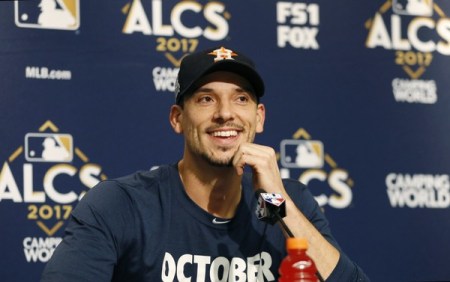
Charley Morton’s Salt?
When he reigns, zeroes pour.


It’s the early morning after ALCS Game Three and the collapse of the Astros at home in almost every imaginable way yesterday afternoon at Minute Maid Park.

What do you get when your now proclaimed closer comes into a game with the boys trailing 3-2 going into the 8th? You get two base runners; then you get two more by the HBP route; then you get a home run; and what’s the damage to the score as a result? The Red Sox get one run forced in by the second hit batter; then they get four more runs on a grand slam by Jackie Bradley, Jr. ~ and the famous shaking head words of closer Roberto Osuna that we’ve all heard before from countless others and shall surely continue to hear in every corner of baseball every time a pitcher ~ especially an alleged star ~ has a meltdown at a critical moment in the game.

“It was just one of those things! One of those bells that now and then rings! Just one of those things! And, hey! You know what? That is just one of those things. It’s pretty near the same thing the Astros did to the Red Sox in Game One with a 4-run spot in the 9th, converting a 3-2 Astros lead into a what appeared to be a 7-2 final score romp. This time, the Sox pasted their 5-run spot to their own 3-2 late lead ~ killing again hometown hope ~ and making this final score another blow-away mark of 8-2, visitors.

Charlie Morton needs to be on and the Astros need to win Game Four tonight. It’s not a mathematically “must win” situation, but the closest thing to it on the probability scale. An Astros loss tonight would mean that the Astros would then have to win all three of the possible games they have left with the Red Sox to take the AL pennant and advance to the World Series. And that would set up the following scenario:

If Boston wins Game 4 tonight, they lead Houston, 3 wins to 1, needing one more win.

Thursday @ MMP, Game 5: Astros must win behind Justin Verlander;

Friday: travel day

Saturday @ Fenway, Game 6: Astros must win behind a more relaxed Gerrit Cole;

Sunday @ Fenway, Game 7: Astros must win behind either the presumed starter, Dallas Keuchel, or possibly Lance McCullers, Jr. This one has several ways of getting ugly, now and next year, especially, if manager Hinch decides to not risk Keuchel and his “bad early run giveaway” syndrome with everything on the line. ~ And how much security is there that McCullers might come out with another night of low-in-the-dirt pitches that only get stopped by the backstop of the stadium.

Let’s hope Morton and the Astros can take Game Four ~ and we sure wouldn’t mind if one of the Astros big run-scoring innings could also come early for a change. a 5-run spot of their own in the first inning should be something of a support cushion to Morton that helped the situation. Our Astros starters have had to pitch all year in the hope that the Astros would get enough runs after they had been lifted to win the game. With a little more early run support, this team might have had two to three “20-game winners.”

At any rate, the next 24 hours will provide us with the real-time answers as to how dead or alive the Astros really are. Let’s hope for the best.


********************

Bill McCurdy

Principal Writer, Editor, Publisher

The Pecan Park Eagle

How Astros-Analytics Improves Good Pitchers

October 16, 2018

“I never had any analytics training, but I still nailed ’em!”
~ Liam McCurdy


Going into Game Three of the ALCS battle between the Astros and Red Sox, national writer Dave Sheinin wrote this best article I’ve seen, so far, on how the Astros use analytics to help their good pitchers ~ the ones that are both open and physically/mentally able to use this kind of re-directional/or more specific mechanical change or movement emphasis coaching to improve their pitching performance records and game score results from “good” to “excellent”.

The more I read of Sheinin’s October 15th article in The Washington Post, the more I realized that I had not read anyone else attempt to explain this process, if at all, until now. Then, when I read a few of the coverage comments that readers left at the digital version of this story, that I was not alone. Most baseball people apparently don’t really understand how analytics is not simply a tool for selecting players from the same potentials group categories. It’s also a dynamic process for fine-tuning or tweaking some people into even higher levels of achievement that exist for them.

Thank you, Bill Hickman, for advising me of this exciting piece. I’ll be watching Game Three of the ALCS now with an even better and more realistic perception of what I’m seeing from the Astros pitching staff.

Here’s the link. Please read it for yourself at the earliest opportunity:

https://www.washingtonpost.com/sports/2018/10/15/magic-dust-spin-rates-buy-in-how-astros-make-good-pitchers-even-better/?utm_term=.77c5176065f0

And GO, ASTROS! ~ Let’s go get ’em in Game 3!


********************

Bill McCurdy

Principal Writer, Editor, Publisher

The Pecan Park Eagle

Game 2: Bouncing Balls and Ice Water Veins

October 15, 2018

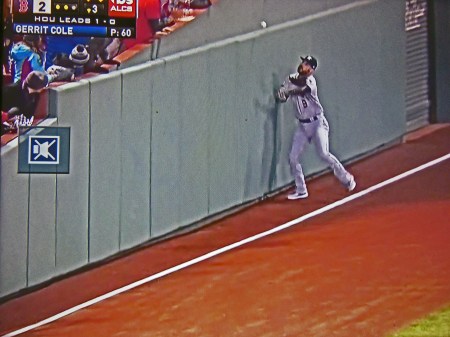
Game 2: Jackie Bradley, Jr.’s 3-RBI double in the 3rd bounced off the fence above the 310 sign and was headed back toward home as Marwin Gonzalez flew into pursuit mode.

Game 2: Next the ball makes a carom bounce off the side wall as Marwin observes from below.

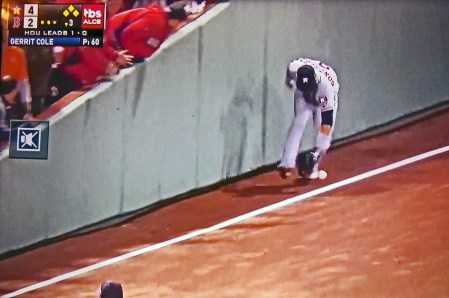
Game 2: Now the ball makes a rapid descent landing on its way to a bounce roll as Marwin continues the chase.

Game 2: Marwin finally catches up to the crazy bouncing ball and makes a beeline throw home, but too late. All 3 Boston runners have scored on the biggest hit of the game and Boston now leads 5-4. It is a lead they did not surrender.


The Boston Red Sox squared the ALCS at Fenway last night at 1-1 by scoring a 7-5 win over the Houston Astros. In so doing, they became the first team in 2018 to score five runs on Astros starter Gerrit Cole. Jackie Bradley, Jr. recorded the decisive blow with a two-out, bases-loaded double in the third inning that pulled the Sox from 2-4 down to 5-4 up. It was a lead they would never relinquish and it would hold up as the biggest bounce-of-the-ball difference-maker of the night, although ball bounces would also aid Mookie Betts and his involvement twice in the other two runs the Red Sox would score in this Sunday eve Game Two donnybrook. In the 7th, Betts would advance two bases to score from 2nd on separate passed balls charged to Astros catcher Martin Maldonado. Each PB was vastly aided by wild hard throws in the dirt by pitcher Lance McCullers that simply got through the catcher. Either way you divide the blame, Betts’ scamper home made it 6-4 Boston. Betts also doubled home Rafael Devers in the eighth to make it 7-4 Sox.  The Astros score once more in the 9th on back to back doubles by Springer and Altuve, but a long drive to left by Bregman fell about three feet short of another tally and six feet shy of miraculous two-out tie. It was an end-of-game fly ball out instead.

The Only Cure for Baptism Under Fire in Baseball is Ice Water in Your Veins

Yesterday, we neglected to mention the ice-water factor as a key big game ingredient. No matter how good a player you are, you have to play with the heart of someone who also has ice water running through your veins. What happened with Cole yesterday wasn’t his fault. It just happened, no doubt, from him being on the biggest stage of his life for the first time, something he’s always wanted, and even the reason he asked Pittsburgh to work out a deal last winter that sent him to Houston. The young man wanted to win his own World Series title ring with a club that still has an excellent chance of repeating.

Remember the old wisdom: “Be careful what you wish for, you just may get it.”

Of course, Cole was nervous. And once all that adrenaline kicks in, it affects almost everything athletically we normally are able to do. That throwing error Cole made on the easy throw to first base is the perfect example. After the game, Cole admitted as much. His heart was almost beating like a tom-tom inside his jersey.

I’m betting he will be his old ice water self the next time. Whether he gets there by prayer or meditation or focus on baseball mechanics only, it’s that important. And even then, sometimes it just hits people differently, but in my own experience ~ and my experience working with people who have blown job interviews over nervousness, the worst cases are the ones involving people who think too much.

If you’ve ever played football, you may have been one of those people who felt nervous until the kick off. Then, once you made physical conflict on the field and dug into playing one rapidly finishing play after another, the nervousness went away. That’s because football doesn’t give you time beyond the physical action to do any extra analytical thinking. On the other hand, the start of a baseball game isn’t the end of thinking. That mental part is just beginning, especially for pitchers, the only player on the field who is guaranteed to be in involved in every play.

My advice? Stay grounded in the moment. Focus on the mechanics of your position. Know what the probable play is going to be if the ball is hit to you. Allow your manager and coaches to do the analytical stuff. Just do your job. Know where the cut off man is, if need be, and make sure you hit him, if said need arises.

OK, Astros, you can still end the need for a return to Boston with a three-game sweep at home. ~ Go get ’em!


********************

Bill McCurdy

Principal Writer, Editor, Publisher

The Pecan Park Eagle