Archive for the ‘Uncategorized’ Category

Cobb-Lajoie 1910 Controversy Lives On.

November 9, 2015
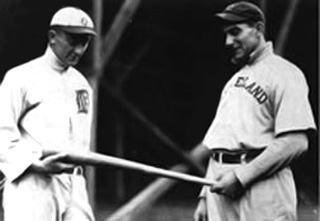
Ty Cobb (L) and Napoleon Lajoie engaged in the most heated and controversial batting title race back in 1910.

Ty Cobb (L) and Napoleon Lajoie engaged in the most heated and controversial batting title race back in 1910.

The 1910 American League batting average championship race between Napoleon Lajoie of the Cleveland Naps and Ty Cobb of the Detroit Tigers has to be the most controversial one in baseball history. It became such a heated and public attention grabbing contest that the Chalmers Automobile Company decided to jump into all the free advertising this baseball fire had inspired by announcing that they were going to give one of their brand new cutting edge cars to the eventual winner. And that move simply turned up the flame to “high.”

Across the nation, most of the “good guy” fan support fell all over Nap Lajoie like gravy on potatoes. Ty Cobb was too much the hated “bad guy” for his snarling and mean-spirited temperament on and off the field to ever become a national baseball hero to all of us hoi pa loi fans of the national pastime. Yes, our people existed even then – back in the day.

The thing – the race – festered with conflict and controversy for most of the 1910 season.

Better late than never, the most controversial event occurred on the last day of the season – with Cleveland and Lajoie playing a final day doubleheader against the Browns and not much on the line for either Detroit or Cleveland in the pennant race. The Tigers were already locked into 3rd place, en route to an 18 games back finish behind the pennant-winning Philadelphia Athletics. The Cleveland Naps were in a tight second division race with the Chicago White Sox and would finish a half game ahead of them for 5th place. Like all water, the Browns had long since found their familiar place at the bottom of the AL standings and would close the season with 107 losses and a 57-game distance deficit to the record of the Athletic league champs.

It was the perfect setting for ethically challenged manager Jack O’Connor of the Browns to do more than simply cheer for Nap Lajoie, his favorite in the batting title race. Both Lajoie and Cobb entered the last day of the season in the knowledge that a big day at the plate for either man could be the difference-maker. But Cobb was not going to be an active part of it. He sat out the previous game and also would do so on the last day. Support for Lajoie and hatred for Cobb had a wide-open opportunity just sitting there plotting against him in St. Louis.

Here’s where the math accuracy and ethics of several human figures get as fuzzy as the events and the reporting of them for that day by others over the years could possibly be.

A Wikipedia Report explains it this way:

____________________

Controversy

At the start of the final day of the 1910 season, Ty Cobb of the Detroit Tigers held a slim lead in the race for the American League batting title, just a few percentage points ahead of the Cleveland NapsNap Lajoie. While Cobb did not play in the Tigers’ final two games of the season,[1] Lajoie played in two successive games on the last day of the season for the Cleveland Naps.

Because Cobb did not have a plate appearance, his batting average did not change finishing with an average of .38507. However, Lajoie hit safely eight times in the Naps’ doubleheader against the St. Louis Browns. With eight hits in eight at-bats, Lajoie finished the season with a .384 batting average (227 hits in 591 at bats). ……..

Aftermath

Browns’ manager Jack O’Connor had ordered rookie third baseman Red Corriden to play on the outfield grass. This all but conceded a hit for any ball Lajoie bunted. Lajoie’s final at-bat resulted in a wild throw to first base, which was scored as an error. After news broke of the scandal, a writer for the St. Louis Post claimed: “All St. Louis is up in arms over the deplorable spectacle, conceived in stupidity and executed in jealousy.” The issue was brought to American League president Ban Johnson, who declared all batting averages official, and Cobb the champion (.385069 to .384095). The Chalmers people, however, awarded automobiles to both Cobb and Lajoie (essentially declaring a tie). ……….

Modern Revision

In 1978, Pete Palmer discovered a discrepancy in Cobb’s career hit total, and the story was broken by The Sporting News in April 1981.[2] Initially recorded at 4,191 (still the total on MLB.com), researchers say that a Detroit Tigers box score was counted twice in the season-ending calculations. The statisticians gave Cobb an extra 2-for-3. Not only did this credit Cobb with two non-existent hits, it also raised his 1910 batting average from .383 to .385. As Lajoie is credited with a .384 average for the 1910 season, the revised figure would have cost Cobb one of his 12 batting titles and reduced his career average to .366.

O’Connor and coach Harry Howell, who tried to bribe the official scorer to change the error to a hit, were banned from baseball for their role in the affair.[3] The ensuing mathematical mess was described by one writer as follows: “It could be said that 1910 produced two bogus leading batting averages, and one questionable champion.”[4] ……….

https://en.wikipedia.org/wiki/1910_Chalmers_Award

____________________

Had the 1978 discovery that Cobb had been accidentally double credited for one “2 for 3” game in 1910 been accepted as the new measurement for the 1910 batting title, it would have reduced his batting average to .383 and given the batting title to Lajoie, but that late discovery did not change a posthumous battle title award from Cobb (.383) to Lajoie (.384) for 1910. Baseball Reference.com does now show these “correct” averages at their site for both men, but it respects the will of MLB to continue giving Cobb the bold type credit as 1910 AL batting champion, even though Lajoie now is featured with the higher batting average figure in the book of records.

Those eight Lajoie “hits” in the 1910 last day doubleheader at St. Louis, and how at least six of them were set up as “gimme” bunt single gifts from Jack O’Connor of the Browns, hardly earn Nap Lajoie much sympathy in 2015 for the legitimacy of his own figures for that 1910 season.

____________________

eagle-0range

The Merkle Bonehead Play Revisited

November 7, 2015
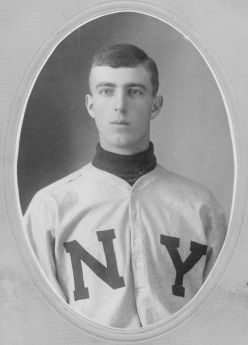
Fred Merkle, 1B Ne w York Giants 1907-1916

Fred Merkle, 1B
Ne w York Giants
1907-1916

The infamous Merkle play. As they went into play at the Polo Grounds on September 23, 1908, the New York Giants and the Chicago Cubs were involved in a tight three club race for the pennant with the Pittsburgh Pirates and were all set to play a big game each other for first place. Little did anyone know when they started to play that afternoon that they were about to be partners in the most controversial game conclusion in baseball history – one that would prove at season’s end to be a total reversal of fortune and misfortune for the visiting Cubs and homie Giants. The Cubs would end up winning the 1908 NL flag by a single game – a single game that always will be traced back to a “bonehead” play by a 19 year old Giants rookie name Fred Merkle, the cunning baseball rules acuity of Cubs second baseman Johnny Evers, the already primed to the particulars courage of future Hall of Fame umpire Hank O’Day and his partner Bob Emslie to stand up for rule that technically had the power to reduce the as-game-played outcome of a 2-1 Giants win and convert it into a 1-1 tie with a need for a total replay because of its importance to the pennant race.

For those who don’t know, here’s what happened:

The game was tied at 1-1 in the bottom of the ninth, but the Giants had the potential winning run on third base in the presence of Moose McCormick and rookie Fred Merkle running at first. Merkle had been a lineup substitution this day due to an injury to the club’s veteran first base man, Fred Tenney. Merkle had not played much for the Giants prior to this date, but he had played long enough to know that the home team fans were a rowdy bunch that loved to storm the field after big Giant wins and pummel their congratulatory slaps across the backs of Giant players as they made their trotting run all the way to their field exit door in deep center field. Merkle “got it” as to why his mates hustled as soon as possible to get off the field. They all wanted to exit before the often drunken fan crowds swelled to block any hope of escaping the pain of celebratory contact.

When Giants batter Al Bridwell then hit the first pitch from the Cubs’ Jack Pfeister up the middle for an apparent clean walk-off single, McCormick tipped toed home from third with run and a 2-1 Giants victory. The Giants fan roar quickly converted to a vista of legs by the thousand as they lifted over grandstand boundary rails and began their joyful trek unto the field. As he ran to second base, rookie Merkle could somehow see, sense, or know that his teammates already were making their bee-lines to that faraway center field exit door. After he ran about half way to second on the batted ball, he decided it best to save as much dalliance time as possible. He simply took a hard right turn from his next base destiny (Why bother? The game’s over, right?) and run hard to field exit with everyone else.

Small problem for Merkle. The crafty Cub second sacker Johnny Evers was watching the whole thing and – based upon what he had seen before in other games – and as recently as a Cubs game in Pittsburgh in which he watched a Pirates player escape with the same short cut on the rules, Evers apprised umpire O’Day, even that recently, what he planned to do, if he saw that kind of play go against the rules and his club again, and he even went over the rule with the official without knowing that the two of them would soon enough be reunited in another game situation in which it would occur in a very high stakes situation.

Official rule 4.09 states that “A run is not scored if the runner advances to home base during a play in which the third out is made … by any runner being forced out”. And even though most players knew the rule, they simply had formed a cultural “wink” and looked the other way on hits that soared into the outfield and out of normal infield play reach. They simply ignored without protest that base runners who peeled away without actually sanctifying a safe hit by removing all force out possibilities at second or third was somehow OK.

It’s one of  the oldest rules in human behavior. People don’t obey laws that aren’t enforced. If that happens often enough, people start to treat that law as though as it either did not exist or had been repealed. And, as all good lawyers know, laws that are ignored, but still exist on the books, are sometimes useful in advancing the causes of their clients.

Johnny Evers was a baseball “lawyer” of the first order – and his clients were the Chicago Cubs, including himself. And that was the insider reaction within the man – as soon as the Giants “apparently” won the game on Bridwell’s hit. Evers knew instantly – and on the solid soil of knowing a neglected rule that clearly states that the Giants had not scored because young Mr. Merkle had not done what he needed to do to eliminate the force out possibility. – Merkle had not completed the business of running to second base and touching the bag. That’s all it would have taken. Had he done so on that fateful day in 1908, had he continued on to touch second base, he would be no more famous today than Al Bridwell, the man he robbed of a hit and game-winning RBI in a game that, as all such “bonehead” plays will do, had gone so far eventually as to “merkle” the Giants out of the 1908 NL pennant.

Sadly, there were no smart phones with video and still photo cameras back in the day. Everything that happened at game’s end is the product of conflicting, not-always-honest reporting by players and fans. The following version is our best guess of what we can know after all these years. – As soon as Evers spotted Merkle bugging away from his required trip to second, he started yelling and waving to center fielder Solly Hofman to throw him the ball. It was a move that did not go unnoticed by Giants pitcher Joe McGinnity, who just happened to have been coaching at first at game’s end. As he crossed onto the field to leave too, McGinnity had a good view of Merkle cutting away from his run to second and he knew exactly what Evers had in mind when he covered second anyway and yelled for the ball.

Pacing his run toward Evers. McGinnity got there in time to intercept the throw from Hofman. After that action, it gets really fuzzy as to what actually happened to the real game ball. A most popular report was that McGinnity threw the game ball into the stands and that it was captured by a fan. Some said that the fan kept the ball. Others said that Evers either retrieved the ball from the fan – or else, just got another ball and called it the game ball. There many other variants, including an Evers statement at one time that there was no interception – and that he caught the ball directly from Hofman and stepped on second base for the sake of establishing grounds for a Merkle force out and a negation of the McCormick run, the Bridwell single, and the Giants 2-1 win.

The only assured fact was that Merkle had not finished his run to second, but even he panicked at a later moment by briefly claiming that he had touched second base – in spite of all the eyewitness testimony to the fact he had not. Merkle quickly retracted. His “lying” was more a case of panic in the face of the fact that his life now had been altered into a notorious event for which he would always be signatured beyond anything else he might do. – In a real way, Fred Merkle was a much earlier baseball version of Bill Buckner.

Manager McGraw tried to help Merkle convert his contention into truth that night by having him return to the Polo Grounds and run again in the dark from first to second for an unmistakable touching of the bag. That way, by McGraw’s shifty mind as a mental reservationist, Fred Merkle could always be truthful when he answered “yes” to the following question: “Back on September 23, 1908, in the Polo Grounds, did you run all the way from first to second and actually touch the bag?”

Once Evers made the second base touch himself with “a ball,” and as described in one report on Wikipedia, “Umpires Emslie and O’Day hurriedly consulted and O’Day, who saw the play from home plate, ruled that Merkle had not touched second base, and on that basis Emslie ruled him out on a force and O’Day ruled that the run did not score.

Because the Giants had now vacated the scene of pandemonium on the field and the growing darkness, the game was declared a 1-1 tie, and home plate umpire Hank O’Day filed this report letter to National League President Harry C. Pulliam:

New York, Sept 23/08
Harry C. Pulliam, Esq.
Pres. Nat. League

Dear sir,

In the game to-day at New York between New York and the Chicago Club. In the last half of the 9th inning, the score was a tie 1–1. New York was at the Bat, with two Men out, McCormick of N. York on 3rd Base and Merkle of N. York on 1st Base; Bridwell was at the Bat and hit a clean single Base-Hit to Center Field. Merkle did not run the Ball out; he started toward 2nd Base, but on getting half way there he turned and ran down the field toward the Club House. The Ball was fielded in to 2nd Base for a Chgo. Man to make the play, when McGinnity ran from the Coacher’s Box out in the Field to 2nd Base and interfered with the Play being made. Emslie, who said he did not watch Merkle, asked me if Merkle touched 2nd Base. I said he did not. Then Emslie called Merkle out, and I would not allow McCormick’s Run to score. The Game at the end of the 9th inning was 1–1. The People ran out on the Field. I did not ask to have the Field cleared, as it was too dark to continue play.

Yours respt.
(signed)

Henry O’Day

NL President Harry Pulliam upheld the decision that the game was a tie and he also ruled that it must be replayed because of its importance to the pennant race. It was not replayed until a day after the season ended on October 7, 1908 with the Giants and Cubs tied for first place with records of 98 and 55.

The following day, October 8, 1908, the Cubs and the Giants squared off at the Polo Grounds for the critical make-up game that had been necessitated by the Merkle “bonehead play” that led to them having both a win and the outright NL  pennant taken away. The Cubs finished the injury by winning the playoff game, 4-2.

Had there been no “Merkle bonehead play”, the Cubs would not have “1908” as their memorial measuring point for a 107-year old hex on World Series championships on the Chicago north side. They would’ve had to reference “1907” as the starting gate on their 108-year old hex.

The Giants, of course, were outraged with Pulliam. And it only worsened when it came home in reality that the Merkle game and the one-game loss of the pennant to the Cubs had been the easy-for-them to see reason that they had been deprived of a pennant and the chance for another World Series title.

The Giants never recovered from their resentment of Pulliam. When Pulliam later died of suicide from a bullet to the brain, Giants manager John McGraw joked that he didn’t think a bullet to the brain could have even harmed Pulliam. The Giants also were the only NL club to neither send condolences nor a representative to the deceased league president’s funeral.

Baseball makes for some strange bedfellows. Twelve years after the Merkle incident, Johnny Evers served as a Giants coach under McGraw. Underneath all the enmity that resulted from Evers primary role in their 1908 pennant loss, McGraw must have formed a deeper bond with the meaner side of the man that many called “the Human Crab”. Narcissists often fall into love or partnership with those are mirror images of themselves.

Hank O’Day later made in to the Hall of Fame as an umpire, but, in addition to his role in the 1908 Merkle game, O’Day may be best recalled as the only man in history to have been a baseball umpire, a baseball manager, and a baseball player. Given that scope, its no small wonder that he was a man who understood how important it is in baseball to “touch all the bases”.

One more irony. By the 1920 time that Johnny Evers now signed on as a coach for the New York Giants, Fred Merkle was now playing ball for the Chicago Cubs.

As for Fred Merkle, the man, he was a bright, honorable and good guy who never quite forgave himself for his 1908 base running mistake, but he also lived in hate for the word “bonehead” in negative references to that play, his assumed lack of intelligence, or his character. After a 16-year MLB career (1907-1920, 1925-26), Merkle retired as a player with a nice .273 career batting average.

Forty something plus years beyond 1908, into the early 1950s, Merkle returned to The Polo Grounds for a reunion and received a standing ovation and wild cheers from the now grown children and grand children whose family elders had seen him play back in the first decade of the 20th century. Their reception of him brought Merkle silently to tears. “I never thought the fans would ever be that forgiving,” Fred Merkle added, as though he expected those around him to be in need of an explanation for his emotional reaction.

Fred Merkle sounds like a very good man, but one of those unfortunate souls who becomes negatively labeled for life on the basis of one thing that happened in one day of his life.

Wouldn’t it be great fun to send some of our modern game coverage people back there to that day with their latest HD multiple cameras and actually travel to 9/28/1908 with the intention of covering that post-game retrieved baseball/bag-tag melodrama sequence? And if they could actually document what happened to the actual game ball, wouldn’t it be great also to know what ever became of that arcane little now famous artifact from baseball history? –  My guess is that it got played to death by kids on the streets and sidewalks of New York, but who knows, it may be molding away somewhere, anonymously forgotten in some ancient Bronx attic or basement.

____________________

eagle-0range

A Better College Football Playoff Format

November 6, 2015
a modest proposal for change ~ The Pecan Park Eagle

a modest proposal for change
~ The Pecan Park Eagle

A Never Simple Suggestion for How the NCAA Division 1 of College Football Could Stage an Even Truer, More Lucrative Playoff System Without Much Additional Distraction to the Already Intense Academic Studies of Its Student Athletes. ~ Call it “The Great Eight Path to January Joy!”

Here’s the Q&A answer to who, why, what, when, and where:

  1. Question: Who makes up the tournament field? Answer: The eight best teams at season’s end shall be selected by the same committee format that now anoints only four schools for the tournament.
  2. Question: Why 8 instead of 4 teams? Answer: Because 4 committee selections already  has proved better than the 2 that often dissatisfied many during the long period of the BCS process,  8 will we twice as good as 4 was in the elimination of unbeaten teams with a good case for unhappiness, if they are left. Baylor and TCU, the abandoned babies of 2014, would have a place to go in this new twice-as-big field. No plan for rating and selecting the best college teams by anything less than head-to-head competition will eliminate all unhappiness, but a field of eight makes it far less likely that some undefeated team with a strong opponent schedule will be left out there to whine.
  3. Questions: What will it take to expand from 4 to 8 tournament clubs? Answer: It will require (a) better use of the  4 major bowls every post-season as the hosts of the tournaments first round; (2) the movement of two other bowls into mid-January as hosts of the two semi-final round games; and the continuation into a national collegiate championship game at a host city and venue that is chosen by a site selection committee a few years earlier than the actual event, much as the NFL picks their Super Bowl locations now.
  4. Question: What about the when and where aspects? Answer: Those were covered inclusively in the first three Q and A’s.

Bones and Marrow Details. Using the Top 25 List system now being generated by the selection committee for its field of 4, the final week list of the committee’s top 8 clubs would make up the field.

Using a rotating system among the four major bowls for determining who gets the #1 seed in Round One, a typical schedule for all three rounds would look like the following:

Round One: January 1st (New Years Day, every year)

Seed #1 versus Seed #8 at the Rose Bowl

Seed # 2 versus Seed # 7 at the Orange Bowl

Seed # 3 versus Seed # 6 at the Sugar Bowl

Seed # 4 versus Seed # 5 at the Fiesta Bowl

____________________

Round Two: January 15th

Seeds 1-8 winner versus Seeds 4-5 winner at the Cotton Bowl (for example)

Seeds 2-7 winner versus Seeds 3-6 winner at the Gator Bowl (for example)

____________________

Round Three National Championship Game: January 29th (at variably selected site)

A championship game between the two winners of the Round Two match-ups.

____________________

Hangnail Points to Planners: The New Years Day first round date would be firm. The other rounds could be adjusted a day or two, either way, depending upon whatever is practical and possible. Planners would try to make sure that all is completed prior to February 1st, but the Championship Game would avoid playing on any direct date that was in competition with the NFL Super Bowl.

If the bigger bowls have an ego-hissy over traditionally smaller money bowls getting two second round games, then don’t bury the idea or yourself in that sand trap. Bid Round Two out to cities as you did Round Three.

To those who claim this plan will be too negative a factor upon the student athletes’ grade point averages, tell them to keep track over the first five years to see what the effect is upon any reduction in the student athlete graduation rate as a direct result. We aren’t exactly cranking out valedictorians and Rhodes scholars with our current use of student athletes as it is. If the colleges want to go back to the days in which real students actually try out for their various school sports teams with a chance to actually make it, I’m down with that road too. In the meanwhile, let’s stop denigrating the young athletes who are pursued by the schools for their playing abilities – and either pay them for their hard work – or do everything we can to make sure that athletics do not actually prevent them from doing their intellectual best in class. I don’t see this playoff system making things any worse for student athletes than they already are.

That’s it. No need to complicate it further.

____________________

eagle-0range

Bill Gilbert: MLB Playoff Observations, Part 3

November 5, 2015
Astros analyst Bill Gilbert takes his third look at the recently concluded 2015 MLB League Playoffs and World Series.

Astros analyst Bill Gilbert takes his third look at the recently concluded 2015 MLB League Playoffs and World Series.

MLB Playoff Observations, Part 3

By Bill Gilbert

~ Keep the line moving. The Royals had the uncanny ability in all three series to string together several hits with a mistake by their opponents to score 3-5 runs in an inning without a home run.

~ The Royals hit only 2 home runs (both solos) in their 5 game series win over the Mets.

~ Will other clubs try to copy the Royals’ style of play?

~ Will the Royals’ success result in revised thinking about the value of not striking out?

~ Tony Bennett’s voice appears to be a thing of the past.

billcgilbert@sbcglobal.net

_______________________

 Pecan Park Eagle Comments

Bill Gilbert’s questions about the value of all clubs reexamining the Kansas City philosophy about putting the ball in play with fewer strikeouts makes sense for all clubs, but it will have to be only a long-term dream for those teams that already find themselves tied to expensive multi-year deals with HR crushers of the fan-and-sit-a-lot genre.

As for Tony Bennett, for mercy’s sake, we heard him too, but let’s remember – the man hit age 89 this past August 3rd! A lot of people still alive at his age can’t even get out of the house, let alone, carry a tune in a bucket. – He’s still one of the great icons of American popular song interpretation – as long as he stays with the tunes of limited middle note range– and also, to his credit and good sense, he wasn’t even trying to handle the difficult range of the Star Spangled Banner prior to Game 5, but he still had trouble with the easier range of “America the Beautiful.”

God Bless You, Tony! – You are still great when you sing “Blue Velvet” with KD Lang, “Body and Soul” with the late Amy Winehouse, or “The Lady is a Tramp” with Lady Gaga!

If proof is needed, check out those three Tony Bennett duets by listening to them at these links:

If an ad appears, just press the “skip ad” option and you go straight to what is still the most beautiful music in the world.

 Blue Velvethttps://www.youtube.com/watch?v=e3i2F7eKoKQ

 Body and Soulhttps://www.youtube.com/watch?v=_OFMkCeP6ok

 The Lady is a Tramphttps://www.youtube.com/watch?v=ZPAmDULCVrU

____________________

eagle-0range

Famous Movie Lines Applied to Sports

November 4, 2015
Once Upon a Time They Were ..... Baseball's Children of the Night!

Once Upon a Time
They Were …..
Baseball’s Children of the Night!

A friend of mine named Pat Flynn recently sent me a clip from the American Film Institute that features its version of the 100 best quotes over the first hundred years of talking movies. It’s an enjoyment unto itself and you may view it from here through the following link:

The Pecan Park Eagle thinks it also has a lot to offer as a reservoir of quotes that would easily fit right into certain active situations in sports these days, if we first, simply thought about it this morning and allowed the “right words” to find “the right sports character” to say them again in a situation that is appropriate to some current sports issue or topic. (Got it? …. Fair enough.)

We didn’t actually use the YouTube collection, per se, but we knew all of those they offered, and probably will end up here not bringing anything into the mix that isn’t there, but it could happen. We also reserve the right to modify the famous, at times, for a better fit into the situation.

OK, here we go. First comes the quote and source in bold type. Then to the sports situation it is now applied:

  1. “Make him an offer he can’t refuse.” (“The Godfather”) ~ UH Cougar Football fans to the University of Houston regarding the future contract of Head Coach Tom Herman out there on Cullen Boulevard.
  2. “We’re gonna need a bigger boat! (“Jaws”) ~ After hearing the above demands of UH football fans, the UH Chief Financial Officer begins his Funds-for-Herman report to the Board of Regents with the aforementioned statement.
  3. “I want you to go to their windows and yell, ‘I’m mad as hell – and I’m not going to take it anymore!’ ” (“Network) ~ Houston Chronicle writer Jerome Solomon to Houston’s NFL Texans fans after the team drafts yet another easily injured defensive player and passes on prospects that could grow into the franchise quarterback they have never had.
  4. “We rob banks! (“Bonnie and Clyde”) ~ The MLB Players Union succinctly reveals the philosophy that guides the demands of star players with celestial season stats for quarter million dollar, five-year contracts.
  5. “I’m not a bad man. I’m just a bad wizard.” (“Wizard of Oz”) ~ NFL Texans GM Rick Smith tries to explain himself to the “mad as hell” fans who protest the club’s lack of success over his ten-year tenure at the helm.
  6. “The stuff that dreams are made of.” ~ (“The Maltese Falcon”) ~ Even though they fell short this time in their pursuit of a World Series championship, Astros manager A.J. Hinch explains to his club what the 2015 season meant to him while the team is still on the road to hopefully, actually getting there.
  7. “I’ll have what she’s having.” ~ (“When Harry Met Sally”) ~ In mixed envy and admiration for her sister’s accomplishments, tennis star Venus Williams places her breakfast order after listening to her star tennis sister Serena Williams place her own.
  8. “Every time I play golf, I always wear a suit with two pair of pants. – That’s in case I get a hole in one.” (old W.C. Fields movie) ~ Self-effacing humor on the golf circuit becomes more common for Tiger Woods these days as he borrows the old line from Fields to show the world that – since he cannot seem to get back to what he was on the performance level – that he will try to become a little more easy-going and likable.
  9. “I have a feeling we’re not in Kansas anymore!” – (“The Wizard of Oz”) ~“And I have feeling we’re not going back to Kansas anymore!” ~ New York Mets manager Terry Collins, after Game 5 of the 2015 World Series in New York.
  10. “Of all the gin joints in all the world, she has to walk into mine!” ~ (“Casablanca”) ~ In reference to ex-QB Rob Mallett, Texans head coach Bill O’Brien says, “Of all the clubhouses in all of the NFL, he has to walk into mine!”)
  11. “You talkin’ to me? – You talkin’ to me? – You talkin’ to ME? … Well, … I’m the only one here!” (“Taxi Driver”) ~ Luke Gregerson of the Houston Astros says it as his response to our question about what its like to be a part of the club’s late inning relief pitching hope.
  12. “Here’s another fine mess you’ve gotten me into!” – (a trademark comment by Oliver Hardy to Stan Laurel in almost all of their 1930 comic movies and shorts.) ~ It is also a thought (if not a comment) in the mind of Astros closer Luke Gregerson when he takes over a 2015 late inning bad pitching situation from Chad Qualls, Will Harris, or Pat Neshek.
  13. “There’s no place like home! – There’s no place like home! – There’s no place like home!” (“Wizard of Oz”) ~ A choral group recitation by the entire 2015 Houston Astros club.
  14. “Listen to them! – Children of the night! – What music they make! (“Dracula”, in response to howls from the woods at midnight) ~ New York Yankees manager Casey Stengel in response to the sounds of Mickey Mantle, Billy Martin, and Whitey Ford returning to the club’s hotel about 2:30 AM on any given night in the early 1950s they played together as teammates.

Enough for now. With more time, we could go on forever. But it’s probably just as well we do not test attentions spans any further.

Have a nice day, Everybody!

____________________

eagle-0range

Duke Duped By Miami “Moon”

November 3, 2015
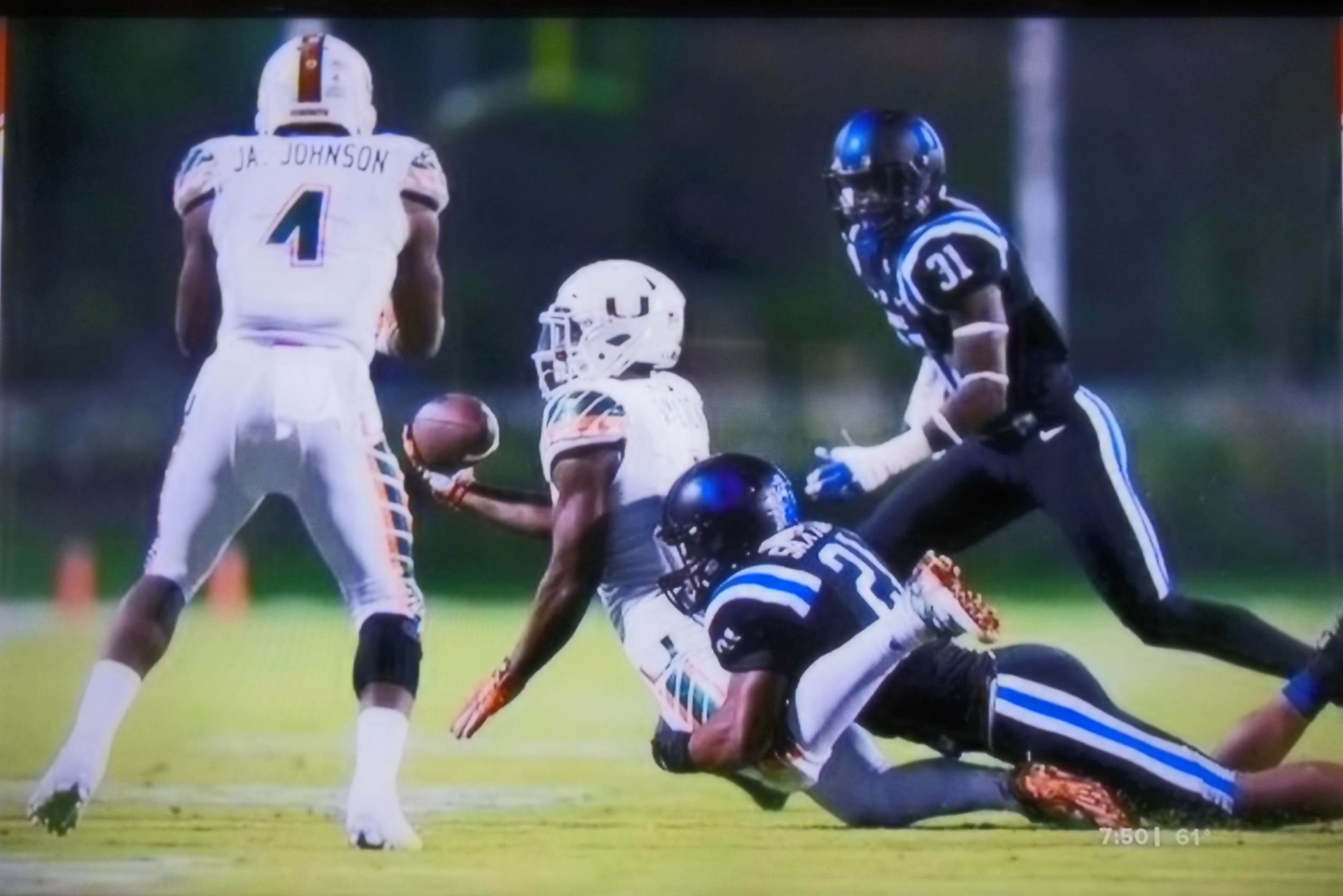
On the 4th of 8 laterals that gave Miami a 30-27 last play kick off return TD against ranked Duke, the runner was down before he released the ball, but the bold as daylight fact was missed by the refs, even with the help of replay. Unfairly or not, Miami won the game, 30-27.

On the 4th of 8 laterals that gave Miami U. a last play kick off return TD against ranked Duke last Saturday, the runner was down before he released the ball, but that bold as daylight fact was missed by the refs, even with replay help. Miami “won” the game, 30-27, and there will be no outcome reversal.

With about seven seconds to go in last Saturday’s home game on the Duke campus, the Blue Devils scored to take a 27-24 lead in what appeared to be a win over the University of Miami Hurricanes that would preserve their national ranking once they ran out the clock on the ensuing kickoff by containing a last play miracle.

Didn’t happen. Miracles do. But so does egregious human error.

Miami managed to pull off an eight lateral delay of defeat on the deep kick off that eventually resulted in one of their speedier guys, with blockers, getting away down the left sideline and going all the way for a 30-27 last play shocking win by the Hurricanes. In the 49 seconds of actual time it took to both execute the play and justice, Miami had made college football look more like a run-out-the-clock basketball game of keep-away by a team playing for the last shot. And indeed it was Miami that got the last “nothing-but-net” shot as Duke’s only harvest was the loss of the game and their national ranking.

A video replay assessment of nine minutes duration put a temporary choke hold on Miami ecstasy, but, when the decision came in from the two referees who reviewed the “tape” (or digitally recorded moving in high definition clarity picture, if you prefer) the now cliche words hit the Duke people and their fans like thousands of simultaneous bee stings: “The ruling on the field stands. Touchdown Miami. Game Over.”

How this ruling remained unaffected by the still shot featured here in the eyes of the referees is beyond many of us, but that’s the way it played out. We could talk all day about the possibilities of human error: the restrictive perception factor which keeps some people from ever reversing their first opinions; and the unconscious and conscious effect of bias possibility – and it still wouldn’t change anything from the way the rules currently work in most sports.

The referees who called the game each have been suspended for two games as a result of their “miss” on this picture and other arguable examples, but there is no recourse for Duke getting the outcome reversed or their ranking restored. Miami gets to keep the win, perhaps as some consolation for the fact that a week earlier, they had lost a game by 58-0 for their worst defeat in history. That one also got their head coach fired.

As for Duke? Duke gets that long perpendicular to the ground tunnel that remains when a tall building manager removes an elevator for maintenance or repair.

Our full sympathy and commiseration goes out to Tal Smith, one of the finest people to ever graduate from Duke University. Tal, we know you may have seen it all on both sides of the agony and ecstasy continuum, especially in baseball, but that kind of thing that happened to Duke last weekend is something we are hoping to never see again. It even cheapens the victory for the judgment-anointed winner.

____________________

eagle-0range

Terry Collins on Broadway with “Harvey”

November 2, 2015

Harvey

Preface. In 1944, a profoundly funny play called “Harvey” by Mary Chase became a major hit on Broadway. Most of us who do remember it, however, caught the laughter hops it produced from the 1950 black and white movie version, starring Jimmy Stewart. In greatly over-simplified terms, it’s the story of an eccentric middle aged man named Elwood P. Dowd who lives with his two older sisters. Dowd spends his time walking around town meeting strangers, handing each of them his card, and inviting them to dinner. He also does not fail to miss many bars along the way of his daily social jaunts. – The sisters are growing more embarrassed and frightened by the day from their brother’s behavior, especially since the time that Elwood brought home his bosom buddy, Harvey, who also happens to be a Randy Johnson height white rabbit that no one else can see. – See the movie for more. – The memory of that earlier Harvey simply forced the muses to throw a question at me as I awakened this morning. – “What about Mets manager Terry Collins’s experience with another big guy named “Harvey” in Game Five and the ninth inning managerial meltdown? Bearing in mind the need to do some integration of the movie/play and World Series plots, here’s the CliffsNotes version of how it may be playing out today – when Terry Collins and his own BFF version of Harvey drop into a Broadway bar to talk over what happened last night – and they run into a newsman with questions of his own:

Scene: Broadway Dive Bar, 2662 Broadway, New York, NY 10025; Tuesday, Nov. 2, 2015, 1:19 PM EST. Mets Manager Terry Collins and Mets Pitcher Matt Harvey quietly file into the bar and slip into a booth that appears to offer privacy and good talking space. As they order a couple of beers, they are getting ready for an elbows on the table, eyeball-to-eyeball discussion of Harvey’s winning pressure on Collins last night to stay in the game in the 9th, rather than yield to Mets closer JeurysFamilia, and their slightly different disappointment over the results. – Before they even get started, another man quickly and quietly hustles all the way across the saloon to introduce himself. He want to join them “for a moment”, but when neither budge, he simply pulls a chair loose from the nearest table and seats himself at the entry head of the booth in a way that says “I’m butting in here, whether you want me or not. Harvey’s face reddens and his right hand seems to be forming a fist. Collins senses Harvey’s building ire and counters by smiling broadly to the man as his right hand also reaches out to calm Harvey with an “easy does it” touch upon his left wrist. The intruder’s name is Charlie Willis, an AP sports assignment writer. Willis had stopped in the Broadway Dive for a “nooner” before grabbing a cab to JFK. He was still babbling from the enjoyment of his own good luck and the adrenaline it had produced when Collins brought discussion to a head. We’ll cover the rest of the story in dialogue exchange:

COLLINS: “Look, Charlie, Matt and I have things to discuss. Let’s go for A quick rap here. What do you want?”

WILLIS: “Not much. And everything. – I’m wanting to know today what America wants to know: We really get why you let Harvey here talk you into not going with Familia in the 9th. He had been the ‘Dark Knight’ for eight strong innings and had earned the right to give it a go – and yeah – we could see from the TV dugout shouts that he was telling you that he was NOT coming out. – Man alive, Terry! – No foul! No fault! – You went along with him! – And why not? Harvey had pitched his heart out! And Familia already had blown two saves in the World Series. What a bummer that would have been – had you pulled Harvey after eight – and then Familia went out there and did sooner what he end up doing anyway – blown his third save!

COLLINS: “Have one of my cards, Charlie. Perhaps, you can come to dinner at my house some soon – when we can talk about this some more.”

WILLIS (noting the growing face of anger in Harvey): “How come he doesn’t talk, Terry? He talked pretty loud in the Mets dugout in the eighth about staying in the game.”

COLLINS: “Harvey does most of his talking with his arm, Charlie. – When he starts talking in loud words, you better listen. – Cause then he goes from there to talking with his fists. – But, you’re not going do that today, are you, friend? – (Harvey shakes his head ‘no’.) – Oh, by the way, Charlie, you never took my card. – Take it. I have plenty more. I could even give you a few extras, if you think you might want to give them to your friends and family too.”

WILLIS (silently taking a handful of cards as he braces to ask his central question): “I’ll get out of your hair, Terry, but please allow me to ask the question that even Harold Reynolds couldn’t answer last night on FOX. …”

COLLINS (smiling agreeably): “You actually know Harold Reynolds, Charlie? – I’m impressed! Please take him one of my cards – and one for Joe Buck too!”

WILLIS: “Sure thing, Terry. – Uh … where was I? Oh yes … my main question – and Harold Reynold’s main question too – Once you did run Harvey here back out there in the 9th – and he walked Lorenzo Cain – WHY did you not take him out THEN? – You didn’t. You left him in there to give up that run scoring double over the left fielder’s head to dangerous hitter Eric Hosmer – who then turned out to be the guy that tied the game with that gutsy run home from third after Wright made the play to first. Look! – We all know its a “What If” now, but, had you pulled Harvey after the walk to Cain, Familia might have been able to even force a double play – as the Mets go on to win, 2-0, and are in Kansas City by now, getting ready for Game 6 tomorrow – and you are not stuck here in a Manhattan bar talking with a guy like me.”

COLLINS (smiling broadly, speaking calmly): “Here’s my explanation, Charlie, and that’s all I’m going to say. When I stop talking for ten seconds, that’s when I want you to just get up and walk out of here.  – Fair enough?”

WILLIS: “Fair Enough!”

COLLINS: “Years ago my mother used to say to me, she’d say, “In this world, Terrence, you must be” — she always called me Terrence — “In this world, Terrence, you must be – oh so smart – or oh so pleasant.” Well, for years I was smart. – Then I really got smart and started being more and more pleasant.

Aside from the fact that everyone who still saw me as smart is now gone as a  result of last night, I recommend pleasant over smart. It’s a much calmer state of mind.  And you may quote me.”

____________________

harvey2

Exploring the K/AB Stat and Its Value

October 31, 2015
Greg Lucas One of those baseball experts who understands that you have to ask the right questions to get the right answers.

Greg Lucas
One of those baseball experts who understands that you have to ask the right questions to get the right answers.

MLB batters have been striking out more often per season ever since Babe Ruth, the lively ball, reachable outfield fences, and the roar of the crowd at the turnstiles taught the owners back in the 1920’s that baseball fans like to have their adrenaline glands pumped to empty during some dramatic point at the old ball game.

Now, in 2015, some of us are asking more often: “Do we really want to pay good money (And what money isn’t good, Mr. Capone?) to watch more and more guys who seem only capable of either crushing the ball out of the ballpark once in a while as they increasingly take their place on the bench more often by the strikeout route 30 to 4o percent of the time without ever putting the ball in play?

The dead ball era hitting philosophy was “get your bat on the ball and put it in play.” Any batted ball has a chance of becoming the hitter’s ticket to first by obvious placement of its landing in the field, human error, or ground, weather, and light of day or night factors. A called or swinging strike three simply sends the batter back to the dugout with nothing. In a play on the wisdom of dead ball hitting master, Wee Willie Keeler, it must be said: “You can’t hit ’em where they ain’t if you don’t hit ’em at all!”

As the Kansas City Royals showed the Houston Astros in the top of the 8th in Game 4 of their ALDS rally win, several balls put in play in succession can produce enough hits and a lucky break tough error that will rescue your club from a 4-run deficit and deliver a win that leads to a series victory to a pennant to a World Series that they this morning lead, two games to one.

Greg Lucas inspired this column when he wrote the following comment to the column we titled as “The Not So Magnificent Seven Astros” with a focus on the club’s 2015 players who each struck out 100 times or more during the 2015 season. Our most general question was: How many of these guys do we want back? Most of them hit home runs pretty well, but all but one had terrible batting averages – and, as we tried to show with our K/AB percentage averaging, very high strike out (K) averages based upon the number of times each struck out, divided by the same number of official times at bat we use to calculate “batting averages (BA)” for the season.

I simply figured that if our ancient romance with a player’s “BA” could tell us that “.200” is the land of the miserable mendozas of swat, that “.300” is the gate to great hitting, and that “.400” is the portal to the gods with golden batting eyes, that a strike out average per times at bat might tell us something too.

The following comment by Greg Lucas brought into focus a better way to examine the value of the “KA” as a measure of value to productive offensive assessment:

“I like this story and wonder what an acceptable level for a K avg. would be. Gattis at .210 might be acceptable and even Valbuena’s .244 is not awful. Would a number equal to an acceptable batting average be the guideline–as too high. Interesting to compare with some good hitters who also K a lot.” – Greg Lucas, commenting on the column titled as “The Not So Magnificent Seven Astros”

The Not So Magnificent Seven Astros

Stirred by Greg Lucas’s suggestions, I decided this morning to do a “KA” check on the 2015 MLB Season’s Top Ten Hitters to see what we might develop as an initial crude reading on what an acceptable KA might be for the best hitters for average this season. Here’s what I found by base data search and KA calculation for each (KA = # of strikeouts, divided by official times at bat , same as the route we take in figuring a player’s “BA”.)

You may see that data for the seven free swinging Astros at the other column link. The data for the Ten Best 2015 MLB  Hitters for Average is easy to read in the following table:

#   Name AL/NL At Bat   Hits   HR   K   BA   KA
1 Miguel Cabrera AL 429 145 18 77 .338 .180
2 Dee Gordon NL 615 205 4 91 .333 .148
3 Bryce Harper NL 521 172 42 131 .330 .251
4 P. Goldschmidt NL 567 182 33 151 .321 .266
5 Xander Bogaerts AL 613 196 7 101 .320 .165
6 Buster Posey NL 557 177 19 52 .319 .093
7 A.J. Pollock NL 609 192 20 89 .315 .146
8 Yunel Escobar NL 535 168 9 70 .314 .131
9 Joey Votto NL 545 171 29 135 .314 .248
10 Jose Altuve AL 638 200 15 67 .313 .105

To me, the general conclusions from above are these:

  1. The best hitters for average with low HR totals will post KA figures below .200.
  2. The amazing Buster Posey posted a .319 A with 19 HR and an incredible KA of only .093
  3. Paul Goldschmidt marked the highest KA of .266 among the best hitter group, even though he struck out 151 times.
  4. A KA of .300 or higher in the inverse value world of strikeout assessment to value of hitters is counterproductive to the goal of winning.
  5. The higher the KA goes in its approach to the inversely valued .400 mark, the more it says that the player has no real place in the big leagues because it is saying, loud and clear that – 40% of the time, this player isn’t even putting the ball in play as a possible hit or luck factor factor help to his club.

That’s what we see, but what do you think? Should baseball pay more attention to the relativity of player’s KA to his value to the end of winning? Or should we just relax in the glowing wonder of how far the balls go when he finally does hit one – in spite of the fact that he seems to be climbing toward the possibility of sitting down as an out nearly half the time he comes to bat?

Addendum, 11/01/15.

An excellent first reader comment from Mike McCroskey yesterday hastens me to add his words and my reply to the body of this column on my reason for limiting the “KA” exploration to official times at bat:

Mike McCroskey Comment: I should think total at bats including walks and HBP would make a more accurate K per plate appearance statistic. For example Cabrera had a total of 80 walks and HBP’s; and Goldschmidt had 120, which would lower his average K per plate appearance quite a bit. Haven’t looked up Posey’s totals yet, but his would be even more impressi

  • Pecan Park Eagle Response: Mike – You are right. Measuring the K that way would give us a more accurate stat of it per plate appearance, but I was trying to focus on it in the same two-variable way we compute the BA. – (How many times in his official times at bat does a man get a hit? – How many times in his official times at bat does he strike out? – And how do they inversely compare?)This is about how often the K prevents a batter from putting the ball in play? – And not about how the K effects a player’s OBP by the way the pitcher throws to him?

    Although, I will concede – the effect of a KA on a higher or lower OBP looks like worthy data too.

  • I might add this morning that the McCroskey suggestion would also give us a better picture of how much a batter’s record as a slugger or HR hitter draws more or less walks as a result. Keeping in mind all the while that a big factor in drawing walks is not up to the pitcher’s control or intent. Some batters, for better and worse, simply don’t seem to let walks happen. On the “better” side, the low walk ratio will include some of the best contact hitters who can get their bats on almost anything thrown at them, putting balls in play for hits and outs with error possibility instead of the walk. On the “worse” side, are all those guys, sluggers and all, who simply cannot resist swinging at bad pitches and missing, even if it costs them a walk and a trip to first base.

The McCroskey suggestion is not a better one than the KA formula, or vice versa. They are simply different suggestions. Our “KA” is about how much the “K” affects a batter’s failure rate at putting the ball in play. McCroskey’s suggestions goes to a ratio look at how much the “K” affects a player’s on base percentage.

____________________

eagle-0range

Pleasant Dreams On Halloween

October 31, 2015

Halloween 2015 01

Pleasant dreams on Halloween. And, whatever you do, don’t think of the 2013 season while you are falling asleep. Freddy Krueger may be listening and bring your nightmare back to life as a reality, with the help of Michael Meyers using his long sharp knife to cut off all possible avenues of escape.

Coming off an exciting return to MLB as a competitive club this season has been a big plus for the City of Houston and Houston Astros fans everywhere. It has been an affirmation that GM Jeff Luhnow’s plan is really working – and it even has landed on the predicted and often mentioned timeline of 2015 as the date we could expect to see progress. And we even got see progress beyond anyone’s wildest dreams as the Astros simply didn’t stop at returning to the winning side of the schedule. They jumped out to take first place in the AL West, holding it most of the year until a September decline left them grabbing the second wild card spot and rallied to advance into the ALDS round against the Kansas City Royals.

The Astros came up a dominant relief arm short in the top of the 8th of Game 4, losing a 4-run lead that could have elevated them that same day to the ALCS and – who knows what, from there? They might have taken the AL pennant and be playing the New York Mets in the World Series right now, but as we either know by now, or should, the clock doesn’t wind on what might have been. Things are what they are, and we may as well settle for the blessing that progress – substantial progress – was made this season in the gritty, grinding everyday business of the Astros returning to the highest competitive level in baseball without soaking the payroll with fat cat talents who never – or rarely – seem ready to live up to the performance level of what we now expect of them as gazillionaires.  They just seem to take the money and coast – or to become regulars at big events featuring the wide spectrum of culturally anointed ones who ride the clouds above those of us who make up the Hoi Pal Loi realm of everyday life.

Thanks for sparing us the weight of that elevated perspective, so far, Mr. Crane. Let’s just hope that our new success doesn’t evolve into a baseball world remake of “Who Wants to be a Millionaire?” – There would be no suspense. We all know that we need the better talents to become handsome millionaires for the Astros to finally return to the World Series and win the thing – but we, the fans,  nor can you, afford to underwrite a baseball battalion of billionaires.

Hope you do the best for us Astros fans as possible without crossing the unmarked Rubicon that leads us beyond the Land Of Common Sense. If that should happen again, this time in Houston, maybe it’s time for our American culture to finally re-examine the role that all professional and highly competitive collegiate sports have come to play in our lives. If we cannot afford the price, and only the biggest of spenders have a reasonable shot at winning in any given competitive sport, why are we spending all this money, time, and energy watching  talented super rich athletes “win for us.” We may be trying to fill a hole inside ourselves that cannot be filled by others – no matter how much damn money we pay them to “win one for the Gipper.”

Here’s my hope and belief.

As long as there are baseball players like Jimmy Wynn, Jerry Witte, Larry Miggins, Larry Dierker, Frank Mancuso, Solly Hemus, Craig Biggio, Derek Jeter, Yogi Berra, George Brett, Red Munger, Jim Basso, Roy Sievers, Don Lenhardt, J.W. Porter, Jose Altuve, Carlos Correa, Stan Musial, Ned Garver, Deacon Jones, and Gary Gaetti, just to name a few; and for as long as there are baseball people like Gene Elston, Bob Brown, Tal Smith, Bill Gilbert, Greg Lucas, Bob Dorrill, Mickey Herskowitz, Marie Mahoney, Sam Quintero, Bill Borst, Fred Heger, Bud Kane, Erv Fischer, Allen Russell, Paula Homan, Tom Keefe, Red Hayworth, Ira Liebman, Darrell Pittman, Marsha Franty, Peggy Dorrill, Bob Hulsey, Rick Bush, Tom Hunter, and the late Arthur Richman, also only naming some, I will happily follow baseball. These are the kinds of people who keep the spirit of baseball within me what it was when it filled every pour in my body and soul, acting as the visceral fountain of joy during my childhood sandlot days in the Houston east end neighborhood of Pecan Park.

Trick or Treat, Baseball Fans! – Spring will be here before we all know it!

____________________

eagle-0range

The Not So Magnificent Seven Astros

October 30, 2015

strike-out2

The following chart shows only the seven Houston Astros who struck out at least 100 times during the 2015 regular season. All but one of the tabular charted categories should be familiar to all. The “KA” column was added to reflect the percentage of times a player struck out over the season during his total official times at bat – and does not include “ball-in-play” credit he deserves to receive with more time to add that data from the sacrifice fly list. What we have here is enough to make the point in this column with data that we all mostly know in our gut from watching the team this year.

We don’t have enough guys in the everyday lineup who are capable of putting the ball in play without striking out too much of the time. We all know that’s what beat the Astros in the top of the 8th of Game 4 in the ALDS. The KC Royals put the ball in play against a pitching staff with no great skill at preventing a flood of good contact hitters.

Bottom Line: If a club strikes out a lot, they are not putting the ball in play often enough to get more hits and chances for hits, defensive player errors, lucky bounces and glove skims, or mistaken positioning on the field. Such a “hit or miss and sit” club will also not reap the benefits of lucky bounces or other advantages available courtesy of physical laws governing mass, energy, movement, and speed.

Here are the seven members of the 2016 Houston Astros’ “hit or miss and sit” club:

The Seven 100 Plus “K” Players: 2015 Houston Astros

#   Name   K   KA   AB   H   BA   HR
1 Colby Rasmus 154 .357 432 103 .238 25
2 Chris Carter 151 .386 391 78 .199 24
3 Evan Gattis 119 .210 566 139 .246 27
4 Jason Castro 115 .341 337 71 .211 11
5 George Springer 109 .281 388 107 .276 16
6 Luis Valbuena 106 .244 434 97 .224 25
7 Jake Marisnick 105 .310 339 80 .236 9

Chris Carter compiled a club-leading “KA” of .386. – Think about that. – It says he came close to “not putting the ball in play” almost 40% of the time he was charged with an official time at bat in 2015. – Are the 24 home runs that Carter hit worth the time he spent in the lineup as either a first baseman – or an occasional designated hitter – while also batting only .199?

Who do the 2016 Astros  keep from this group? Except for the tremendously talented, youthful upside prospects for future production and the current contract cost control that comes with George Springer, and as much as I do like Colby Rasmus and Jake Marisnick for their defensive skills and outfield position flexibility, and Evan Gattis for his RBI threat and lower KA of .210, none of these other guys help as with the need for more contact hitters who get on base more often – nor do they fill the need for 1st and 3rd basemen in 2016 who are closer in quality to the guys we have in the middle infield spots.

Another problem – Dallas Keuchel says he would love to team with Jason Castro as his battery mate for many successful years to come. That’s great, but at what cost will that be to the basic dead spot that Castro is proving to be in the Astros daily lineup?

Luis Valbuena is a good fielding streaky home run hitter with a .224 batting average, but, at .244, he bears the second best KA among the seven members of today’s club of seven. His batting average is far too low for either a contending club’s corner infielder spots and the team also loses base runners and scoring opportunities during the non-hitting phases of his streaks.

What do you think? And please let us hear from you in the comment section.

____________________

eagle-0range