Archive for the ‘Uncategorized’ Category

Jerry Witte: A Man of Love and Loyalty!

September 16, 2009

HBF - WITTE 1B

Yesterday I wrote about the three major villains of my Houston Buffs during the post World War II years. I also pointed out that all or any of the three bad guys, Russ Burns, Les Fleming, or Joe Frazier, could’ve been wiped clean of that dark designation had they simply done one thing – that is, to have signed or been traded to the Buffs for the sake of finishing their careers as Houston Hometown Heroes. – It didn’t happen, not with these three guys.

There was a fourth villain in this group, however, and he was far worse than all of the others because of his prodigious ability to slam monster-like Ruthian home runs, blows that exploded local hope like one of those mushroom cloudy atomic bombs we’d all witnessed in wild-eyed fear in the movie theatre newsreels.
And his name was Jerry Witte.
Jerry Witte had cracked out 46 homers at Toledo in 1946. The “46 in ’46” had landed him a late season call up by the parent club St. Louis Browns, but that didn’t work out too well for Jerry at age 31. After another bad start with the Browns in’47, Jerry found himself back at AAA Toledo for the balance of the season.
After the ’47 season, Witte was dealt to the Red Sox, who assigned his contract to their AAA Louisville club. Owner Dick Burnett of the Dallas Eagles then acquired Jerry Witte as one of the veteran bonecrushing players he pulled together for his ’49 Dallas Eagles.
The ’49 Eagles broke fast from the gate, crumbling every foe that came up on the schedule until a couple of things began to happen. – Their veteran players ran out of gas – and their pitchers failed miserably. The club of villains fell miserably Still, in 1949, Jerry Witte crushed 50 home runs in the Texas League and, to me at least, it seemed as though he hit them all against our Houston Buffs. Our ’49 Buffs had little hope, anyway, but what they did have was quickly stomped into the dirt beneath the grass at Buff Stadium by a predictable barrage of homers that flew off the bat of the slugging right handed hitting first baseman.
After the ’49 season, Dallas sold the contract of JerryWitte to the St. Louis Cardinals, who in turn then assigned the former Eagle AAA Rochester. Due to an overstocking of younger first basemen at Rochester and Witte’s desire to play in a warmer climate, Jerry was reassigned to play for the ’50 Buffs on June 11, 1950. As I said in the 2003 book on his life and career that we wrote together, “A Kid From St. Louis,” learning in the Houston Post the next morning  that Jerry Witte was now a Houston Buff was roughly the emotional equivalent to me of learning that Darth Vader suddenly had been dealt to the forces of the light. My favorite enemy had been instantly transformed into my biggest life hero.
Jerry Witte and I wouldn’t really connect personally until the September 1995 Last Round Up of the Houston Buffs, but we quickly made up time for all the years we lost.  Jerry Witte and his wonderful wife Mary are both gone now, but I shall both love and miss each of them forever. They were like second parents to me – and their seven lovely daughters became like seven sisters, as well. There’s nothing I would not do for any of them, if it were  in my power. They are all just such good souls – the kind we need more of in our harvest of American people.
Jerry and Mary Witte were both down-to-earth midwesterners who retired in Houston after Jerry’s three seasons with the Buffs (1950-52). All seven of their lovely daughters are quite accomplished people professionally, but all have retained that basic one-two punch of integrity that once flowed so readily from their mom and dad: (1) say what you mean, and (2) do what you say.
May the memory and the values of Jerry and Mary Witte live on forever in the middle of our everyday lives. Such is the stuff of real heroes – that the practice of love for and loyalty to others always outweighs all ambitions to use other people for selfish  personal gain. You don’t befriend people because of how useful they may be to you. You befriend people because it’s the right way to be – in a world where heroes really aren’t just determined by the names on their uniforms, but by the actions of the people who wear them.

The Villains of Buff Stadium.

September 15, 2009

BG Russ BurnsFirst of all, allow me to make one fact perfectly clear. I love Lance Berkman as a baseball player, and especially as a Houston Astros baseball player. He’s one of our guys, one of our Houston heroes in a game of local loyalty that cries out for the constant presence of both good guys and bad guys.
That being said, and on some visceral level that takes me all the way back to my East End childhood days at Buff Stadium, I can’t stand the way Lance turns every runner who reaches first base into the opportunity for a little informal union hall meeting at the company rec room bar. Every time he smiles and starts a congenial conversation with one of “the enemy,” I wonder how that is registering with the kids who watch the game. Are we now giving the kids the idea that friendship, good sportsmanship, and nurturing the enemy are more important than holding our  opponents in contempt and winning the game? If so, what’s baseball and the world in general coming to?

Maybe things are just changing. When I was a kid at Buff Stadium in post WWII Houston (and on the sandlots too), we needed the other team to be our enemy, while we were playing the game, at least, and sometimes for slightly longer periods. We needed to see the Buffs as “the good guys” and the other team as “the bad guys.” It just made the play a little more exciting when we could see winning the game as the triumph of good over evil, and of justice prevailing over inequity. Lance’s fetish for fraternizing with players from the other team, and he’s not the only Astro who does it, just makes me feel, even at my advanced age, that the whole gang from both sides is going out for pizza after the game.

It’s a bell that doesn’t ring well in my baseball head – and I don’t think I’m alone in that regard. I don’t think Commissioner Bud Selig likes it either. I’ll always feel that the sight of Barry Bonds running out to carry Tori Hunter off the field after the latter robbed the former of a home run with an unreal All Star Game catch a few years ago was one of the flashpoints on Selig taking steps to make the All Star Game more competitive. I don’t like the steps he took, but I think I do understand why he took them.

During my baseball salad days, three names stand out as the Trinity of Villainy among Buff foes. All three men shared in common the facts that none of them ever played for Houston – and that all three men played for at least two other Texas League clubs at variable points in their baseball careers. We never found ourselves beyond their threat in Houston – and we also suffered some disappointing summer nights because one, or another, or the other managed to come to bat in the 7th, 8th, or 9th inning and typically crack something like a three-run homer to steal a beautifully pitched winning game away from the likes of Buff pitchers Al Papai, Octavio Rubert, or Vinegar Bend Mizell. It was very tough when that would happen to my 10 to 12 year old psyche.  Anytime that  any of the bad guys crashed an unanswered late inning home run, I’d start to feel sick. First I’d go home madder than a young buffalo bull (and mind you, this was back in days prior to our social concern about the availability of children’s ental health services) and just lay there in bed for hours, wide awake, listening to the monotonous roar of the attic fan and seeing that homer fly over the wall again in my mind, every time I closed my eyes.

BG Joe Frazier

I finally had a coach who picked up on this tendency in me. He taught me what we in Houston have all heard Craig Biggio say 10,000 times during his career: “When the game’s over, you just have to put it behind you and move on. There’ll be another game tomorrow.”

That worked for me, but it’s important to note what Coach Frank Veselka did not say. He did not say – Don’t worry about it. It doesn’t really matter who wins.

Of course it matters who wins! Otherwise, why play the game it all? And it does matter how you play the game. We all have to learn how to not go nuts when we lose.

The three bad guys who almost drove me nuts by their late inning hits (usually home runs) against the Buffs were Russ Burns, (BR/TR, OF) who played for Beaumont, Tulsa, Dallas, and Ohlaoma City; Les Fleming (BL/TL, 1B) who played for Beaumont, Dallas, and Shreveport;  and Joe “Snake” or “Cobra Joe” Frazier (BL/TL, 1B) who played for Oklahoma City and San Antonio.

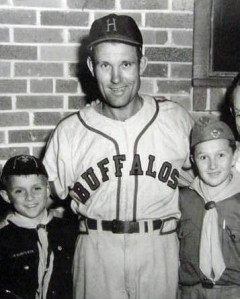
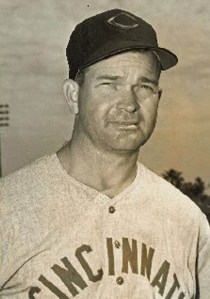
Thanks to fellow SABR colleague Bill Hickman, I now have a photo Russ Burns (far right). Do you see how mean he looks. I felt he lived to put the hurt on Houston.                             BG Russ Burns 2

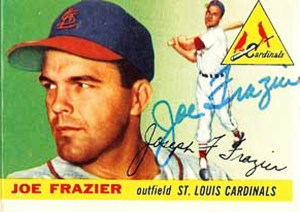
BG Les Fleming Les Fleming, as you can readily see from the old Cleveland cap he is wearing (far left), got some big league time with the Indians. He sort of looked like the Bluto/Brutus character from the Popeye cartoons. In fact, I think that’s why I became a big Popeye fan as a kid. When Popeye was beating up Bluto for Olive Oyl, I felt he was also beating up on Les Fleming for all of us Buffs fans. – The third guy, however, was unquestionably my most hated Buffs bad guy enemy. Joe Frazier approached the plate in the late innings pretty much in the style that his nickname suggests. He just slithered up there as Buff fans hissed their contempt for his presence on our turf.
Hisses from the fans didn’t bother Joe Frazier. He was just as coldblooded in the clutch as his nickname suggests. And he was pretty darn effective when it came to finding that right field wall in time to put the big hurt on our Buffs at the absolutely worst moment.

If you want more details on these three careers, check out each of these men at Baseball Reference.Com:

RussBurns: http://www.baseball-reference.com/minors/player.cgi?id=burns-001rus

LesFleming: http://www.baseball-reference.com/players/f/flemile01.shtml

JoeFrazier: http://www.baseball-reference.com/players/f/frazijo01.shtml

The only thing that any of these men could’ve done to escape my memory of each as villains would have been to end up their playing careers on the roster of the Houston Buffs. None ever did. I guess they had no “good guy” blood in them.

That being said, I’m wondering if any of you today have any players you consider to be, or to have been, villains of our Houston Astros. If so, I wish you would leave a comment about them in the reply section that follows this posted article.

Thanks. And have a good day. Unless you are an enemy.

Al Hollingsworth: Fiery Manager of the ’51 Buffs!

September 14, 2009

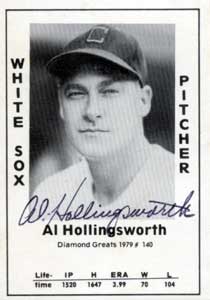
Al Hollingsworth 001’51 Houston Buffs Manager Al Hollingsworth wasn’t exactly your shy and retiring type. When something happened on the field that caused Al to take exception with an umpire’s ruling, Buff fans could count on Hollingsworth to walk (or rage) out of the dugout and go make his own personal opinion abundantly clear to the men in blue.
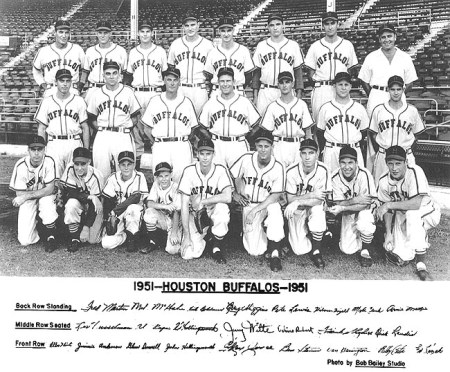
Sometimes Al got to go home for the rest of the night after one of these discussions. Other times he caught luck and got to stay and watch the rest of the game. Either way, he could be counted on to return to the Buffs’ bench from one of these meetings with a mouthful of shredded blue gabardine pants seat fabric hanging from his snarling teeth.

At age 13, I think I heard every single word for the first time that you’re never supposed to say in anger (or any other time, for that matter) falling, or belching with fire, from the lips of Al Hollingsworth at Buff Stadium at variable points during the 1951 season at Buff Stadium.  Man! Could old Al ever “cuss up a storm” at the drop of a hat – and every umpire’s call against the Buffs in a tight game situation was just such a falling of the old fedora!

Buffs 1951

The ’51 Buffs responded pretty well to their fiery leader. They ran away with the Texas League straightaway championship with a 99-61 record that was good enough for a 13.5 game lead over the second place San Antonio Missions. Then they whacked the fourth place  Beaumont Roughnecks, 4-2 in games, in the first round of the playoffs before polishing off San Antonio in the full championship round by a four-game sweep.

The Buffs then lost the Dixies Series in six games to the Birmingham Barons, but the reasons for that loss went more to injuries and the unavailablity of star lefty Vinegar Bend Mizell due to a mysterious stomach ailment than anything else, including the temperament of their skipper. It must be conceded that Al’s temper was helped to the explosion point  by the presence of rival Texas League manager Bobby Bragan at the home opener in Birmingham, which also happens to have been Bragan’s home town in the off-season back then.

One of the local Birmingham writers asked Bobby Bragan if he felt the Buffs were a pretty good team. Bobby’s answer flowed along the lines that the Buffs “ought to be good. The Cardinals pretty much put all their AAA talent in AA Houston this year. (Here it comes!) – Any manager could win the Texas League pennant with that kind of talent stacked in his favor.”

From what I heard from Jery Witte, one of his former players, Al Hollingsworth really went through the roof when he read the words of his always testy rival mentor Bragan.  I have a pretty good idea of what Big Al most likely said about the comment, but I won’t write it out here. If you weren’t raised in a glass bubble, you can probably figure it out for yourself.

Al Hollingsworth 003

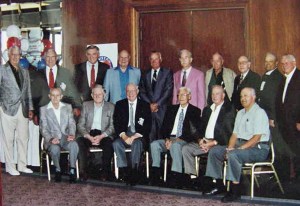
I never got to meet Al Hollingsworth personally until the Last Round Up of the Houston Buffs at the Westin Galleria on Sunday, September 24, 1995. By this time, Al Hollingsworth was 87 years old, physically frail, and living in retirement in Austin. He was quiet, polite, gracious, delightful to be around, and really thrilled to be in the presence of his former players, old baseball buddies, and former Buffs President Allen Russell – even if it were just for that one final time.  (If you can see him. that’s Al in the front row, 3rd  from the right). Of the old Buffs shown in this photo, only three remain alive in September 2006. Those would be Larry Miggins (3rd from left, top row), Solly Hemus (3rd from left, top row), and Russell Rac (far right, top row).

Al Hollingsworth passed away at home the following spring at age 88. The date was April 28, 1996.

Al Hollingworth had an active playing career that spanned from 1928 to 1947.  His best minor league season as a lefthanded pitcher was 1941, when he went 21-9 with a 3.17 ERA for AAA Sacramento. He was 70-104 with a 3.99 ERA over eleven seasons in the majors (1935-40, 1942-46) with the Reds, Phillies, Dodgers, Senators, Browns, and White Sox. He was a member of the 1944 St. Louis Browns, the only club in that franchise’s history to reach the World Series.

Al Hollingsworth managed the Buffs from 1951 through the middle of the 1953 season when he was replaced by Dixie Walker. In spite of his human frailties with temper, he was a “man’s man” manager who handled the development of young pitching prospects very well. His most exemplary student? Look no further than Wilmer “Vinegar Bend” Mizell, the kid from Alabama that started out as the touted lefty version of the great Dizzy Dean. He didn’t make it to that level, of course, but that was no fault of the great teacher he had at Houston.

God bless you, Vinegar Bend, and all the other Buffs of the Last Round Up, Al Hollingsworth! I will always treasure that day of the reunion as one of my grandest baseball memories.

WINNING THE BIG ONE: IN COLLEGE FOOTBALL, IT’S THE CALL OF THE WILD!

September 13, 2009

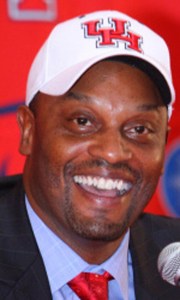
UH 091209 004When my University of Houston Cougars roared back on the road yesterday to defeat the No. 5 ranked Oklahoma State Cowboys, 45-35, in their own house, I wondered how long it would take for us to hear from the wolves of other universities who may be interested now  in hiring away our gifted second year head coach, Kevin Sumlin.
It didn’t take long to find that I’m not the only one close to UH who had the same thought. Call it our “Cougar Insecurity,” or what have you, but two of my alumni buddies also called me independently sfter the game to discuss our shared joy in the victory, but also to express our need to protect our coach as much as possible from the wolves who represent the BCS perennial loser schools. After all, if a school like Baylor could rip away a good coach like Art Briles from our grasp, what are the odds that a school with an even better football pedigree might choose to go after a greater, far more innovative and disciplined coach like Keven Sumlin?

Writer Richard Justice referred to that possibility this morning in his column about UH’s signature “We’re Back!” win over their first Top Ten foe in twenty-five years.” He wrote about how centrally important having the right coach is to reaching that level an accomplishment.

“UH has found one of those special coaches in (Kevin) Sumlin, and now it’s a matter of holding on to him. UH should be aggressive, not reactive.” Justice wrote.  “Sign him. Now. Offer him 1o years or 15 years or whatever he wants.”  Check out Richard Justice’s whole column on UH winning like a champion at the folllowing site:

http://www.chron.com/disp/story.mpl/sports/justice/6616109.html

I hope that UH is able to offer Kevn Sumlin an attractive extention to his current contract – and I will hope even more that he turns out to be a man who, like the great Bill Yeoman, just falls in love with the idea of staying at UH as a career, through thick and thin.

My loyalties go way back to 1946, when UH played its first season of college football. We’re talking now about a kid who hung on the radio listening to UH defeat Dayton in the 1951 Salad Bowl that they played briefly over in Arizona back in the day. As far as my joy was concerned in 1951, we may as well have won the Rose Bowl. I was just sorry we never had the chance to turn running back Gene Shannon loose on the field against the likes of Ohio State and USC. I could go on, but I think you get the idea. That early connection was helped by the same fact that helped me bond with Houston Buffs baseball. I grew up fairly near both Buff Stadium and the UH campus. Other thanUH 091209 001 a brief time in high school, when I flirted impractically with the idea of going to Notre Dame, UH was always my school. I was going to have to work to get through college and UH was the one school back then that seemed to cater to students in my circumstance. And it worked for me too.

At any rate, the bond I have with UH is both ancient and unbreakable in all things academic and athletic. I’m sorry that our UH joy from yesterday had to come at the expense of OSU because I have a good friend who went to school there and I also think the 2009 Cowboys do have a really good team. That being said, if feels too dadgum Cougar-partial-good to ignore this rainy Sunday morning after in Houston.

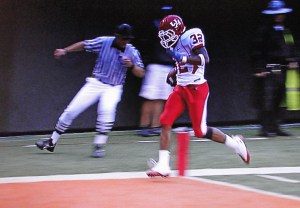
That’s Cougar defender Jamal Robinson (in the above 2nd photo) scoring on a 26-yard interception play in the closing minutes of the game at Stillwater, Oklahoma yesterday. It was the proverbial “daggar to the heart” of Oklahoma State hope for one more comeback.

Next up in two weeks? The Texas Tech Red Raiders at Robertson Stadium in Houston! ~ Eat ‘Em Up, COOGS!

“Little Joe” Presko: The Vertically Variable Buff!

September 11, 2009

Joe Presko 001 “Little Joe” Presko didn’t have much trouble with his height while he was toiling in vain as a righhanded starting pitcher for the hapless 1950 Houston Buffs. The Buffs made it all the way to the Texas League cellar that year in spite of people like “Little Joe” and his 16-16 record with the 3.14 ERA. Joe also hit with some authority for the ’50 Buffs, slamming 3 HR on the season, a rare feat for any Houston pitcher back in the day. All the while he was here, however, Presko’s reported height and weight  stood firm at a constantly reported 5’9″ and 165 lbs.  Iconic Buffs radio announcer Loel Passe even called him “Little Joe” – and that description sure worked for me. At age 12 during the 1950 season, I noticed that Presko was one of the few Buffs who stood barely taller than me. I only reached 5’11” at full growth, eventually, but I achieved most of that height very early.
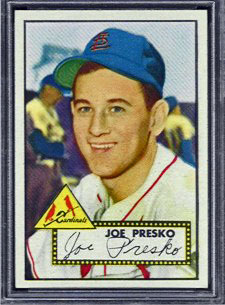
By the time Joe Presko reached the big leagues in 1951, we started reading these occasional reports from national and St. Louis sources that he was six feet tall. I had to wonder a little in private amusement over these reports if major league baseball really did bring about that kind of three-inch growth spurt in a man who was due to turn 23 on October 7, 1951? I don’t know. Baseball Almanac continues to report 6’0″ as Joe Presko’s height while other Internet sites list him variably at 5’9″ or 5’10”.

Regardless of the height mystery, the true baseball measurement of Joe Presko was about his ability as a cool and steady little pitcher who handled game pressure with an ability to pitch smart with finesse. Over the course of six years and 390.2 innings pitched in the big leagues with the St. Louis Cardinals (1951-54)  and Detroit Tigers ((1957-58), Presko only struck out 202 batters, but he also only walked 188.

Signed by the Cardinals at age 19 out of his Kansas City, Missouri home town, Presko complied a 16-8, 2.70 ERA record for Class C St. Joseph in 1948. He followed that good work with a 14-9, 3.18 ERA mark with the 1949 Class A Omaha team. That background brought Joe Presko to Class AA Houston for the 1950 season.

Joe Presko 004Presko enjoyed his best season in the big leagues in his rookie 1951 year. He won 7, lost 4, and posted a 3.45 ERA over 12 starts and 3 relief jobs. In his four seasons with the Cardinals, he won 24 and lost 36. His two seasons with Detroit would later add only one win and one loss to his career MLB record.
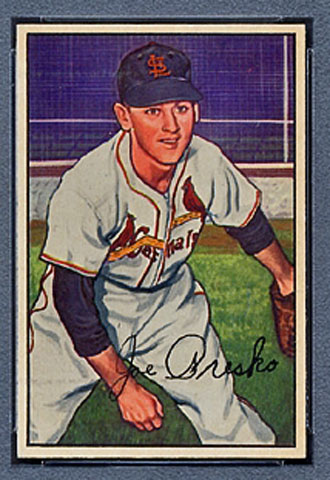
Joe Presko 003 Joe Presko pitched one more minor league season following his last year as a major leaguer with the 1958 Tigers. He pitched for two AAA clubs in that 1959 season. He was 4-5 at Charleston and 0-3 at Toronto.
After baseball, Joe Presko returned to Kansas City. He stayed close to baseball for years there as a coach in the American Legion baseball program. Future big league pitching star David Cone was one of the kids that Joe Presko coached in Legion ball.

Litte Joe Presko will be 81 in less than a month. As an old fan from his 1950 Houston season, I just want to say this much: “Joe, the real long and short of it is this. – Your abilities were good enough to buy you six years in the big leagues. That’s more major league time than most aspiring ballplayers ever see. I also want to add this thought from the still vivid  memory of your once 12-year old fan. – Thanks for making the 1950 Buff season a little less painful. Whenever you took the mound at Buff Stadium, we Buff fans, at least, knew that we had a chance to win. Hope you are well – and Godspeed to you and yours!”

George Payne: An Oldie But Goodie!

September 10, 2009

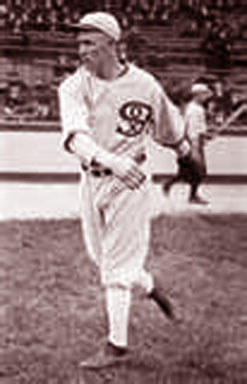
George PayneHB 001 DIZZY DEAN The great 1931 Houston Buffs will always be remembered as the club that served as Dizzy Dean’s showcase and launching pad to his Hall of Famous baseball career with the fabulous Gashouse Gang, the 1934 St. Louis Cardinals. Dean (far left) posted a 26-10 record with a lights out 1.57 ERA with the ’31 Buffs.

Far fewer, if any, fans remember another fellow who picthed pretty well for the ’31 Buffs, a guy who went by the name of George Payne (shown at the far right in the White Sox uniform). All George Payne did for the ’31 Buffs was rack up a 23-13 record with a 2.75 ERA. So, based alone upon what the stats alone tell us, what’s the big difference between the famous Dean and the forgotten Payne? Not much.

If we look closer at the papers from that era, we won’t have to look far to find all the ink that writers were giving to young Dizzy Dean’s incredible stuff and his brassy attitude about all the great things we was going to accomplish in baseball – and all of this praise and braggadocio was flowing about and from a guy was still only 21 (DOB: 01-16-10) when the Buffs wrapped up the ’31 season.

The 5’11’, 172 lb. righthanded George Payne, by contrast, was 42 years old (DOB: 05-23-89 in Mount Vernon, Kentucky) by the time the 1931 season concluded. In fact, everything George Washington Payne accomplished in the minor leagues were all done as an older player. Why he got such a late start, I have no idea without conducting further research.

My minor league records here at home only go back consistently to 1922. As a result, I’d have to do further external source study to be able to even tell you exactly when Payne started his minor league baseball career. I do know that he broke into the big leagues for his only exposure at that level on May 8, 1920, just fifteen days prior to his 31st birthday. He pitched only 29.3 innings in relief for the ’20 White Sox, compiling a season/MLB personal record of 1-1, with a 5.46 ERA.

My records next pick up George Payne as a pitcher for Class A Little Rock in 1922, where he compilds a mediocre record of 5-6, with a 4.36 ERA.  Over the next eight seasons, however, Payne is in double digits for the win column every time, reaching twenty-plus wins in half of those years. A 28-12 record with Wichita Falls in 1929 eventually lands Payne with Houston in 1930, via a short early stay in the spring with Indianapolis. George Payne went 13-10, with a 3.51 ERA, for the ’30 Buffs. Following his 23-win year in 1931, Payne worked three more years for Houston (1932-34), winning 18, 19, and 13 games. He won 15 and lost 7 for his last double digit win year at Class C Sringfield in 1935. After laying out during the 1936 season, Payne returned for eight more wins over three final years in the lower minors (1937-38, 1940) before hanging ’em up for good at age 51.

George Payne passed away on January 24, 1959 at his hometown of Bellflower, California. He was 70 years old and deserving of respect and some acknowledgement for his accomplishments as a pretty fair country minor league pitcher back in the 1920s and 1930s. He must’ve had some good stuff, but I can’t begin to tell you what he threw or how good he was on pitch command. I just know that he ended up with a pretty impressive bottom line in the win/loss columns. As for being there, I wasn’t. Even I’m not old enough to have been an eyewitness to the 1931 Texas League Champion Houston Buffs.

If you’re a baseball fan, nevertheless, and you’ve never heard of George Payne prior to today, your memory of his name and the accomplishments listed here will do fine. In fact, it will produce more recognition justice for George Payne than the wall of baseball  history has given to him up til now.

ADDENDUM FROM A VALUED CONTRIBUTOR: Tony Cavender, a good frriend and fellow member of the Larry Dierker Chapter of SABR (Society for American Baseball Research) sent me an article response e-mail that contained information that really neeeds to be added to the George Payne story. – First, I want to say to Tony, and all others, any time you have something to contribute to any of my articles, go ahead and add it as a comment in the section that follows each post. It will be most welcomed!

Here’s what Ton Cavender wanted us to further know about George Payne, based upon data available at the SABR website:

“George Payne won 348 games in the minors, and collected 307 hits in his long minor league career.  He was able to play through the Depression, which must have been a motivator.  I’ll bet that Casey Stengel encountered a lot of guys like this when he started playing ball for Kankakee.”

Thanks, Tony!

Octavio Rubert: A Cubano Cut Above Most Others Today!

September 9, 2009

octavio rubertBy the time the young man from Sancti Spiritus, Cuba arrived here  in 1951 as a member of the Houston Buffs pitching staff, the 26 year old righthander was already drawing favorable comparisons to the  great big league Cuban hurler of the 1920s, Adolfo Luque of the Cincinnati Reds. Rubert had stormed onto the scene in 1946, going 13-6 with a 1.72 ERA for  the Class C West Palm Beach club. – He then bettered that mark with the same team in 1947 by pumping his record up to 23-12 1ith a 1.76 ERA.  Want more? Rubert went over to Class C Tampa in 1948 and pulled off a 22-7 record with a 2.11 ERA.

The next three seasons sometimes happen to international players who pitch twelve months a year. Rubert spent most of his winters pitching well for Almendares in his native Cuba, but that also meant that his arm also tired or experienced injury that briefly limited his state side service during “our” baseball season. After going only 2-0 consecutively as a reliever in limited action for the AAA Rochester Redwings in 1948-49, Rubert moved down to Houston after the season was underway in 1949 to go 3-10 with a 4.68 ERA for the AA Buffs. Based on his 10.13 ERA at Rochester in 1949, I’d say this move was more of a “find his right level” transfer than it was due to any arm problems. Still, he had to be tired. At age 24, he’d been pitching all year over the course of his enire walking, breathing, ballplaying life.

Octavio found his level in 1950, going 17-8 with a 3.07 ERA for Class A Omaha – and stirring the anticipation of his return to the Buffs in 1951. He did not disappoint.

Rubert posted a 19-5, 2.28 ERA for the “blow ’em all away” 19651 Texas League Champion Houston Buffs, second only in wins to Al Papai at 23-9, 2.44 ERA mark. It was a starting rotation that also included Vinegar Bend Mizell (16-14, 1.96), Freddy Martin (15-11, 2.55), and spot starter/reliever Mike Clark (10-7, 2.78) Throw in the big support bats of first basemann Jerry WItte (38 HR) and Larry Miggins (28 HR) and you walk over to the competition oven with most of the marinated ingredients for a championship year in the Texas League. – And, of yeah, and let’s not forget third baseman Eddie Kazak (.304) and knuckleballing reliever Dick Bokelmann (10-2, 0.73 ERA) for a little extra spice.

Mike Clark That’s “Black Mike” Clark and the bust of Eddie Kazak showing up in this cropping from a team photo – and they were just two of the guys who helped Octavio Rubert and the ’51 Buffs make their day in the baseball sun a mostly happy one. The party was only spoiled by Houston’s six-game loss to Birmingham in the Dixie Series. Our excuse? A mysterious stomach illness hospitalized Vinegar Bend Mizell and made him unavailable for the Buffs’ Series cause at crunch time.
Octavio Rubert had good stuff and good command, but he never got to pitch in the big leagues, probably for the ususal reasons – an  abundant supply of options controlled completely by the clubs through the reserve clause and a baseball cultural attitude of the time  that predominantly played out by the clubs as “we’ll use the guys who eventually are good, strong, and ucky enough to not get hurt trying too hard.” Survival of the fittest, and the luckiest, was the rule.

Octavio Rubert ran out of steam and luck after 1951. He became a hittable pitcher. He won only 22 more minor league games over the next four seasons and was out of baseball after 1955. Years later, his native country still celebrated his home cooking days. Octavio Rubert was admitted to the Cuban Baseball Hall of Fame in 1997.

SWEEPS R SWEET!

September 8, 2009

MMP 090409 005

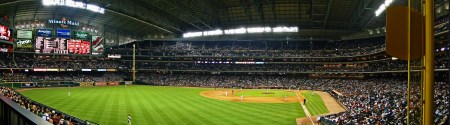
Sweeps ARE sweet – even when the fruits of harvest arrive too late to bake a Word Series level cherry pie! It still tastes good to savor the good times in the middle of a baseball season in Houston that mostly has offered little more than mediocre to bad. We’ll take whatever rain of good fortune that wants to fall our way in the middle of a drought year that has been as dry of long term credibility in winning as I am able to lately remember.

On Labor Day Monday, the Houston Astros completed a long weekend of stunning results against the defending World Champion Philadelphia Phillies by rallying in the bottom of the 7th inning for two runs and a 4-3 victory. It proved to be the fourth straight win over the Phils and a minor, but irritating hitch in the Philly plans to wrap up the National League East as soon as possible. At a time the Phils were falling in four, their primary division rivals, #2 Florida and #3 Atlanta were both falling too – and the Braves were going down for the fifth time in a row, to leave Atlanta 8 games back with 25 games to go. Florida sits at 6 back of the Phils with 25 to go. The Phillies could’ve put both their division rivals on almost total flatline status by sweeping the going-nowhere-in-the-NLC Astros over the weekend, but they did not. The Astros are now in 3rd place in the National League Central, but in spite of the sweet dextrosity of their weekend windfall, they remain 14 games back of the NLC division-leading St. Louis Cardinals with only 25 games to go.

Let’s stay with the sweet for a few minutes longer.

Friday night’s 7-0 bombing of the Phils made the Astros look like a world class winner – with starter Wandy Rodriguez appearing as the second coming of a lefthanded Cy Young – or perhaps, more accurately, a modern day Rube Waddell. Saturday night’s 5-4 two-out walk-off Astros win reminded us why we weren’t that broken up in Houston over the club’s trade of closer Brad Lidge to Philadelphia following the 2007 season. When Kazuo Matsui banged out that that two-out game winning single with the bases loaded in the bottom of the 9th, it just reminded us of our own past heartaches with the affable Mr. Lidge in the close-it-out-or-die role for Houston. Sunday afternoon’s 4-3 rally win allowed us to renew hope in the future of rookie hurler Bud Norris and also in the pulse of Houston hitters to rally late for a second consecutive game. Then Labor Day afternoon’s completion of the four-game sweep, this time by another 4-3 count, took the cake, even if we couldn’t have cherry pie. Back to back doubles in the bottom of the 7th yesterday by Miguel Tejada and Hunter Pence off Phillies reliever Chan Ho Park tied the game at 3-3. When the Astros then loaded the bases off Park, Michael Bourn, the National Leaue stolen bases leader, and the main guy we got for Lidge in the post-2007 trade, stood in there and worked Park for an eight-pitch walk to force in what proved to be the winning run in a second straight 4-3 Astros win over the 2008 champs.

How sweet it is! – And let’s not forget Hunter Pence either! “Mr. Enthusiasm” cranked a key double in yesterday’s game – and he also banged out three home runs in the Phillies series. There’s room to float hope again. We simply must have the patience as fans to go through a little (dirty word next) rebuilding with younger players to turn all this sweet stuff into the ingredients over time that bake into that long awaited cherry pie of a World Series championship. Anything less than a full understanding of that ancient Branch Rickey formula for big league baseball success will eventually burn the Astros at every further shortcut move they attempt to take.

MMP 090709 001

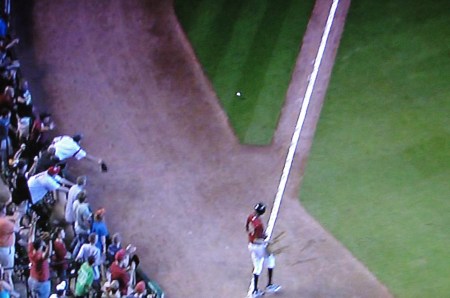
Check out our second photo from Monday on this one. I did see one thing yesterday that slightly rained on my indoors victory parade on Labor Day. A lot of you already know where I’m going with this point because of my constant references to it over the years. That is the inexcusable issue of fans interfering with fair balls hit down the line – or with balls hit to the outfield short of the rail or fences, where some fans reach over the rail or fences and above the field of play to try and catch the ball as a souvenir. Suddenly a long fly ball out becomes a home run. This tempting move happens most often  near the left field Crawford Boxes, but it happens in right field too.

Check out the two idiots in the photo trying to get their hands on Pence’s game-tying double in the 7th. As it turned out, they didn’t come close – and Pence did reach 2nd base, anyway, the same place he would’ve been had either fan managed to touch the ball on its clear flight down the right field line as a fair ball. The point is about what fan interference may often give or take away. Sometimes it will result in a player being given a double when he only would’ve had a single, had the fielder been allowed to deal with the ball and without obstruction. At other times, a crazy bounce in the corner may produce a triple that will then be reduced to a double by fan interference.

I say come down hard on these ball-chasing fools. Throw them out of the ballpark. I get why that doesn’t happen, but Mr. McLane would be doing the rest of us a big favor, if he would have them escorted out of the ballpark – even if they did fulfill Mr. McLane’s understandable fears and never come back. There are still quite a few of us who go to the games to watch baseball – not to watch ball chasers, tee shirts being shot into the stands with slingshots, or games of ring toss in the stands between innings. I could better tolerate the attention-span revival games for younger fans, if we could just get rid of the ball-chasing cretins who put themselves into the game by interfering with balls in play.

Former Buffs – Movin’ On Up!

September 7, 2009

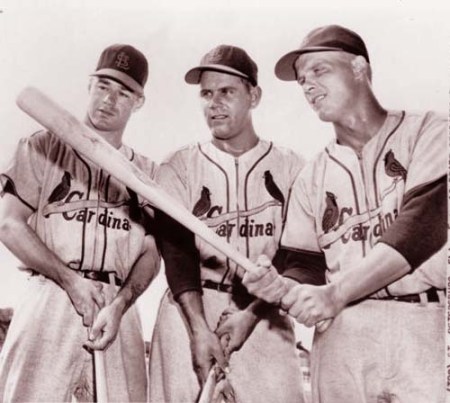
Three BuffsThe goal of every young and upcoming Houston Buff from 1923 through 1958 was to play well enough in the Texas League to either move up the following season to AAA ball, or even better, to do so well that that they went straight on up to the roster of the St. Louis Cardinals. I’m bracketing the era as 1923 through 1958 for one simple reason: That’s the time period in Buffs history in which the Cardinals either controlled or owned the futures of all ballplayers who passed through Houston professional baseball.
In our featured photo, shortstop Don Blasingame (far left), outfielder Russell Rac (center), and outfielder Rip Repulski (far right) were certainly no variants from that common aspirational goal. In this picture, from what most likely is the spring of 1955, the three eager Buffs shown here pause together for their own “raring-to-go” pictorial on baseball ambition. Two of the three young men shown here would play on to see that dream come true.

Three Buffs BlasingameThree Buffs Repulski

Don Blasingame enjoyed a 12-year MLB career (1955-66) as a middle infielder for the the Cardinals, Giants, Reds, Senators, and Athletics, one that was highlighted by a 1961 World Series appearance with the Reds. Rip Repulski hit .269 with 106 homers over nine seasons (1953-61) with the Cardinals, Phillies, Dodgers, and Red Sox.

Three Buffs Rac2 The third man, Russell Rac, never got a single time at bat in the big leagues in spite of some pretty good hitting and fielding success with the Buffs in seven of his eleven season (1948-58) all minor league career. He began in Houston in 1948 – and he left as a Buff ten years later with a .312 season average, 12 homers, and 71 runs batted in for 1958. Few, if any, other players spent as many seasons as an active member of the Houston Buffs roster. Russell Rac went back to Galveston and into business from baseball following the 1958 season, where he continues to live in retirement as a man whose heart still belongs to baseball.

Once upon a time, Russell Rac also had a moment in Latin American winter ball that few hitters ever have, anywhere. He hit four home runs in a single game. I know he did because he told me he did once at a baseball dinner reception and I have no reason to doubt the word of this very good man. If I can ever recapture the details of where, when, and for whom he performed this rarest of baseball feats, I promise to report the whole story here on WordPress.Com in a fresh article about what had to be the most amazing day in the career of former Houston Buff Russell Rac.

Russell Rac was certainly good enough over time to have earned an opportunity to play in the big leagues, but the breaks simply weren’t there for him in the crowded talent pipeline that once was the St. Louis Cardinals farm system – and during an era in which there were only sixteen major league clubs, not the thirty separate organizations that exist today.

Many of the older players who remain with us from the 1940s and 1950s will tell you. – You had be both good and lucky to make it to the big leagues back in the day. – You also had to play hurt. A former Houston Buff, the late Jim Basso, once put it to me this way: “You take a day off to heal a sore arm or a leg cramp back then and some other guy’s going to be wearing your jock strap and sitting at your locker when you come back!”

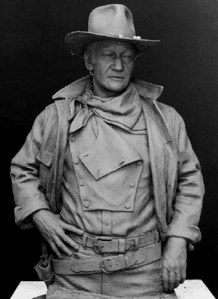
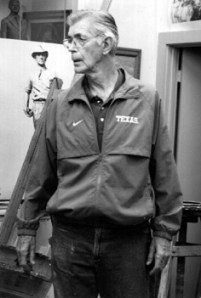
Another former player from the Dodger organization, Larry (now Lawrence) Ludtke, told me the same thing in these words: “I pitched for the big club down in Florida until my arm fell off. When it finally didn’t heal, I just had to look for another line of work. That’s how things were back then. You tell them your arm hurt back then and they would just look behind you in line to the next guy and holler out, ‘Next!’ ” Ludtke may have caught his career break right there in 1956 when a damaged arm forced him off the pitching mound and out of baseball. He went on from there to become Lawrence Ludtke, a Houston-based, world renowned sculptor.

Ludtke 2 Ludtke 1

God’s Grace through serendipity works things out in it’s own curious, but always amazing way – and that’s a truth that lands on all of us, not just professional baseball players. We only need open eyes to see it working in all things. If we don’t see it, it’s just because we are still in the painful lessons tunnel and haven’t yet come to the light on the other side of whatever the big obstacle mountain may be.

ASTROS 7 – PHILLIES 0: HOPE FLOATS!

September 5, 2009

MMP 090409 002
Friday, September 4, 2009 proved to be a night of reminders. Reminders of how much we all appeciate having three Astros reach the 300-career home run mark in the same season. Reminders of what it’s like to get timely team hitting and longball power working together for the sake of victory in the same game. Reminders of how much easier it is to win baseball games when your starting pitcher can throw 110 pitches over seven full innings against the defending World Champions while giving up no runs. Reminders that beyond-decent relief results over two innings of goose-egg work by two different pitchers in the same game is something we needed to have a lot more often in 2009. Reminders of decent, if not exceptional, defensive play in the field. Reminders of how much smarter the manager looks whwen everything comes together for a 7-0 victory to start off the long Labor Day Weekend!

Who could ask for anything more? Well, we, the fans, could. We could ask for more of what it takes to get the kind of results we saw last night at Minute Maid Park.  We’re just not going to see it often enough over the balance of this year to do the team any good in the current pennant race.  For one thing, Wandy Rodriguez or Roy Oswalt can’t pitch every game from here on out. For another, it’s way too late, except for the statistical posssibility that still flaps out there on the line  like a tattered rag of hope in the breeze of temporal despair. With 28 games left to play, the Astros are in 4th place in the National League Central and a full 15 games behind the division-leading St. Louis Cardinals. For yet another thing here, the Astros aren’t looking at a one off-season fix that is going to dig them out of the doldrums they’ve found as an older, probably overpaid legion of malaise-prone underachievers who give lip service only to all the right things people say about “team” as they take care of their own separate and individual businesses and generally take baseball coaching or advice from no one.

Maybe they do listen to Manager Cecil Cooper and his staff. How should I really know? I’m not there in the clubhouse with them. My thought are simply conjectural.

MMP 090409 004

All I really know is that we need more than two reliable starting pitchers – and that we don’t need any more end-of-the-line “Johnny Paychecks” whose best years are either behind them or now all gone. Those guys are good at selling general managers on hope from the past. i.e., “If I can recover from this injury, if I can be 80% of the pitcher I used to be, just look at the bargain you will be getting for the price I’m asking.”

Yeah. Right. And I’ve got some beachfront property on Bolivar that I want to sell you too. (Well, at least, it was on Bolivar. Most of it’s now located in Chambers County, but it offers a great view from Galveston Bay’s eastern shore.)

The second thing we don’t need are additional long term contracts for position players. These guys are another potential group of “Johnny Paycheck” performers. That’s about all I know on that one too. Again, what do I possibly know? Maybe guys with long-term money just get better with age.

I do think that the new attention-to-youth direction taken by Drayton McLane, Tal Smith, and Ed Wade toward rebuilding the farm system is the way to go. If we just develop a wide and deeply talented minor league personnel pipeline, the club will survive the loss of those few who eventually choose to go elsewhere and, if we can keep that system up and growing, the Houston Astros should remain consistently close to winning every season.

As for how we get this done, that has to be up to the people who know the baseball business from the inside out that Drayton McLane has hired to get the job done. Period.

Sidebar: Lance Berkman, Carlos Lee, and Ivan Rodriguez were all honored prior to Friday night’s game for having each hit their 300th career home runs during the 2009 season. Berkman;s totals, of course, have all been achived as an Astro; the totals for Lee and Rodriquez were attained with several teams; and Rodriquez is now departed from Houston and back with his original club, the Texas Rangers.

The beautiful artwork see below is the work of the magnificent sports artist, Opie Otterstad. Large framed copies were presented to bo both Berkman and Lee by Astros Baseball President Tal Smith and Astros General Manager Ed Wade prior to the game. What follows here are the front and back of an 8×10 copy handed out to fans at the gate.

CLUB 300 001

The achievement by the three Astros was a first. It is now the only instance in major league baseball history in which three players from the same club each it their 300th career home run for te same club during the same season. Ivan “Pudge” Rodriquez did it first, hitting his 300th off RHP of the Chicago Cubs at Wrigley Field on SUnday, May 17, 2009. Next came Lance Berkman, who parked his Number 300 homer off RHP Jon Garland of the Arizona Diamondbacks at Chase Field in Phoenix on Saturday, June 13, 2009. Finally came Carlos Lee, who blasted Homer # 300 of his career off RHP Claudio Vargas of the Milwaukee Brewers at Minute Mark on August 8, 2009. Congratulations to The Three Amigos for their monumental record accomplishment!

Have a nice and safe Labor Day Weekend, everybody!

MMP 090409 005