Archive for the ‘Uncategorized’ Category

June 30: Landmark Variety Fair Closes Doors at Day’s End

June 30, 2010

Summer clouds reflect for the last time today off the window of a store that has been open to the kids and young at heart of Houston since 1948.

Today, June 30, 2010, is the last day for business in the 61 plus year life of the Variety Fair Five and Dime Store at 2415 Rice Boulevard in the Village Shopping Center west of Rice University.

The rent’s getting too high for the store to keep running on a business model that’s been outdated for the sale of children’s toys for at least half the time the store has been open. That fact alone, however, cannot possibly tell it all. It just measures the end game dollar epitaph on Variety Fair. What began and lived on as an incredibly inspired and loving gift to all from a shining soul named Benny Klinger is now gone forever at the close of Wednesday business for the most basic of business reasons. Stores that lose money eventually close their doors. This door-closing simply took sixty-one and some odd number of extra months years to get here.

So, what hasc kept Variety Fair open all this time? Today is the last opportunity to sort of, maybe, find out for yourself, first-hand.

If you’ve never been there before, or you haven’t been there in a long time, you owe it to yourself to drop by the store today, if at all possible. Take the kids and grandkids with you too. They will never again see anything real along these same Variety Fair merchandising lines in their lifetime. That’s for sure.
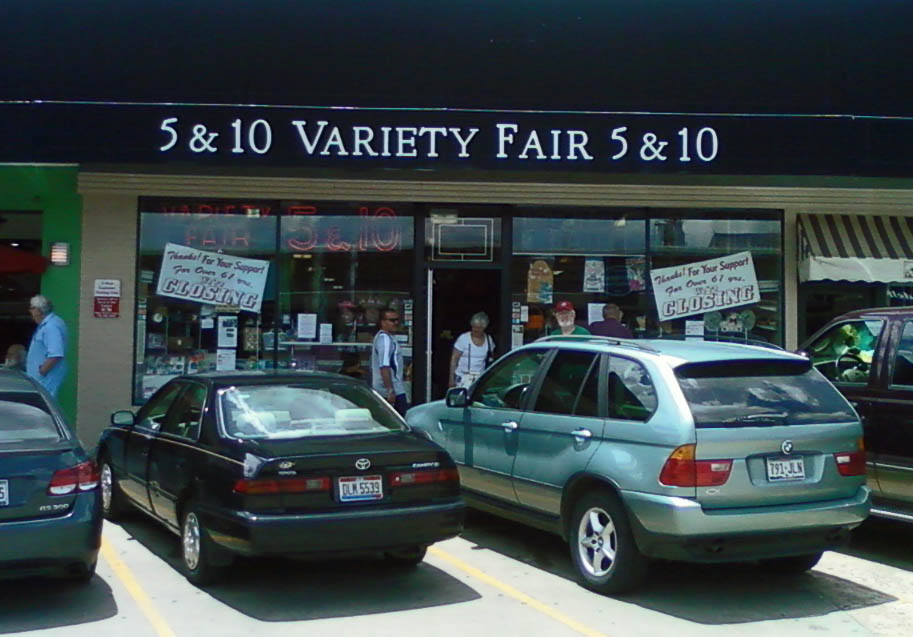
There's plenty of angle storefront parking within two blocks either way of Variety Fair. Everything in the store is for sale at 50% off its normal low price.

To those who don’t look too deeply at what happened at Variety Fair for over six decades, what they see may seem to be a perplexing case of chaos triumphing over order. Cheap toy merchandise is piled high and deep in stalls and shelves all over the place. There are no computer records of what is in stock. There aren’t even any computers. You simply have to turn things over on the shelves to discover what may be underneath – or look for the general theme of toys in the area you may be searching. Pretty soon you snap to how easy it is to find the Halloween gift section apart from the Christmas toy area.
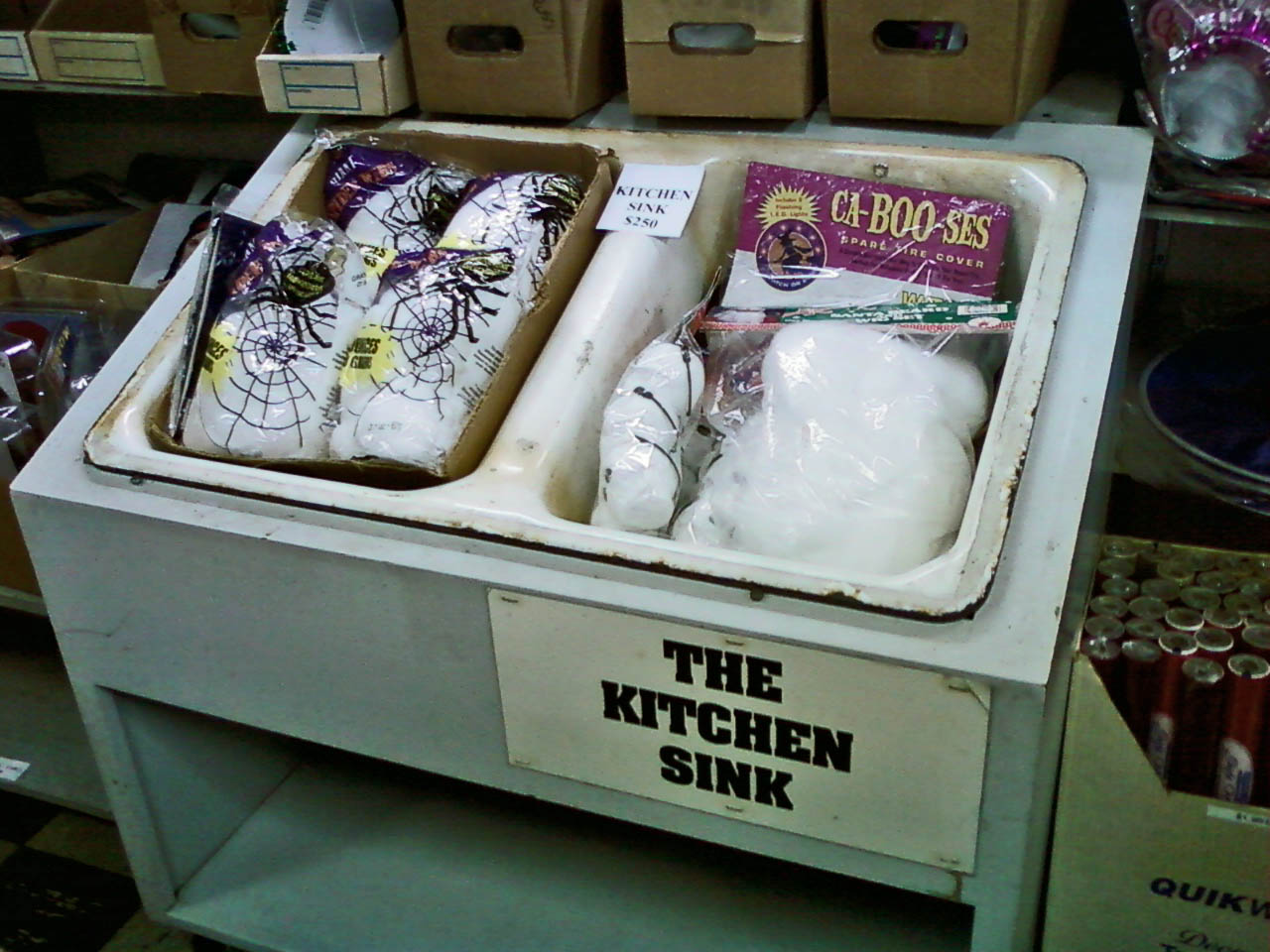
Even the kitchen sink is for sale today!

You will be able to shop in air-conditioned comfort with your neighbors.
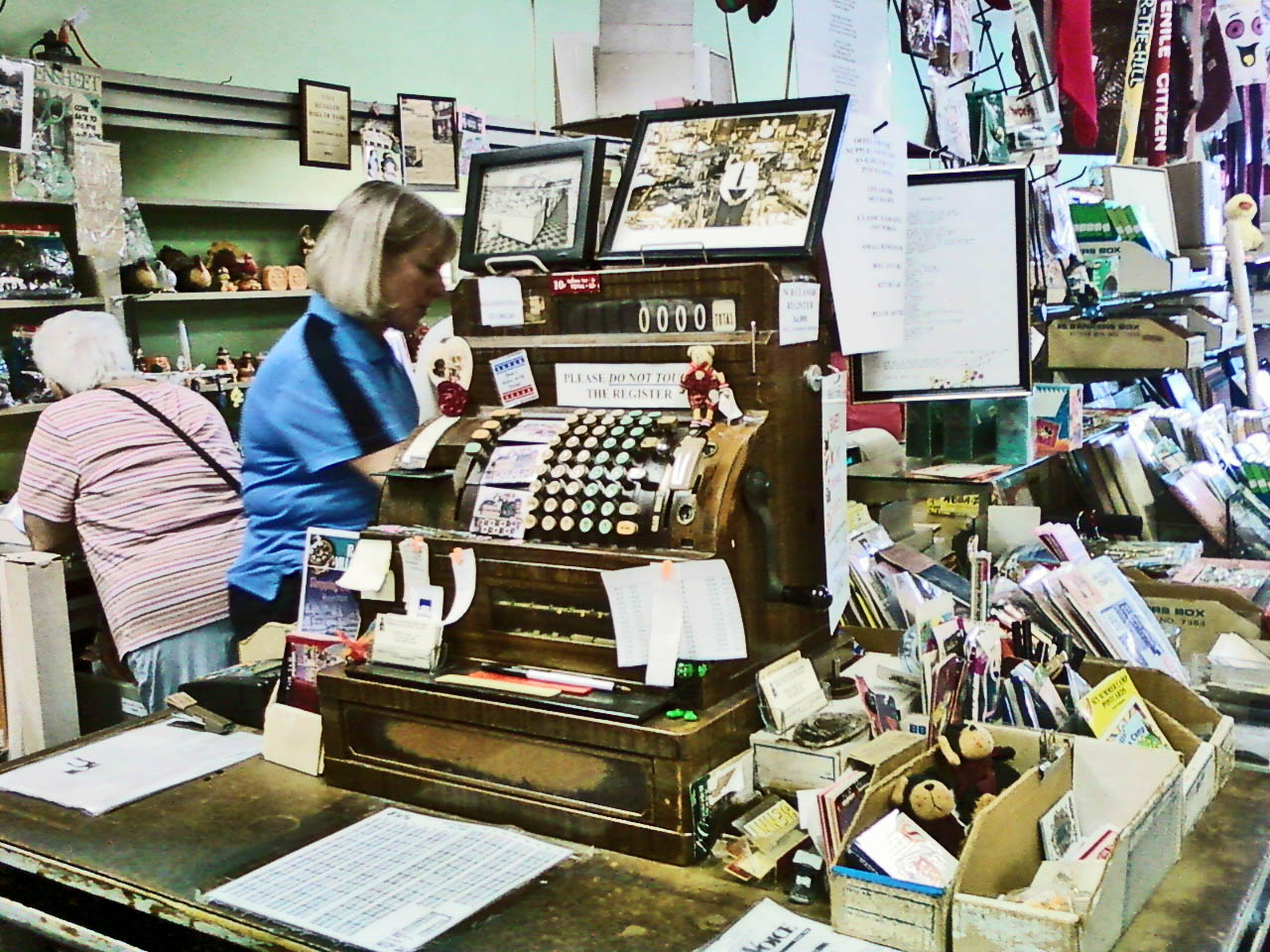
When your shopping is done, the family will ring up your sale at this classic cash register. You will get a written receipt from a handy nearby adding machine. That's Benny's daughter and store owner Cathy Irby in blue ringing up a customer as this photo was taken, as were all others here, on June 29th.

As a kid, I didn’t grow up in the Village area. My only trip here came about 1949, when I was 11 and my brother John was 7. Our mom had brought us to Variety Fair by car for a look-see visit that one time because she had some other shopping business in the Village that day. My memory of this trip was not so much tied to Variety Fair. These kinds of stores were a dime a dozen back in the late 1940s. No. My recollection was tied to the nice man who ran the store. He made us laugh and feel good about ourselves. He made us glad that we had dropped in to just look around and say hello.

That man was Benny Klinger.

Ask Benny Klinger if he was having a nice day and you would get this kind of answer: "I always have a nice day. Got it worked out with the man upstairs. There's a little 4x4 square of blue sky that travels over my head all day, no matter where I walk. It never rains on my parade. Now, don't you think you deserve the same deal? If so, I'll put in a good word for you. In the meanwhile, maybe you will find something here in the store that will help make the sun shine a little brighter until the real thing comes along!"

You just don’t meet a Benny Klinger everyday. In all the times as an adult that I “just dropped in” to the store near Christmas time and kid birthdays, I know that I was also stopping by for a dose of Benny. He knew how to reach everybody with something good, positive, loving, and giving – whether you bought anything or not. When Benny Klinger passed away in 1998, I felt a great personal loss – and I was simply one his thousands of customers, not some central character in his daily life.
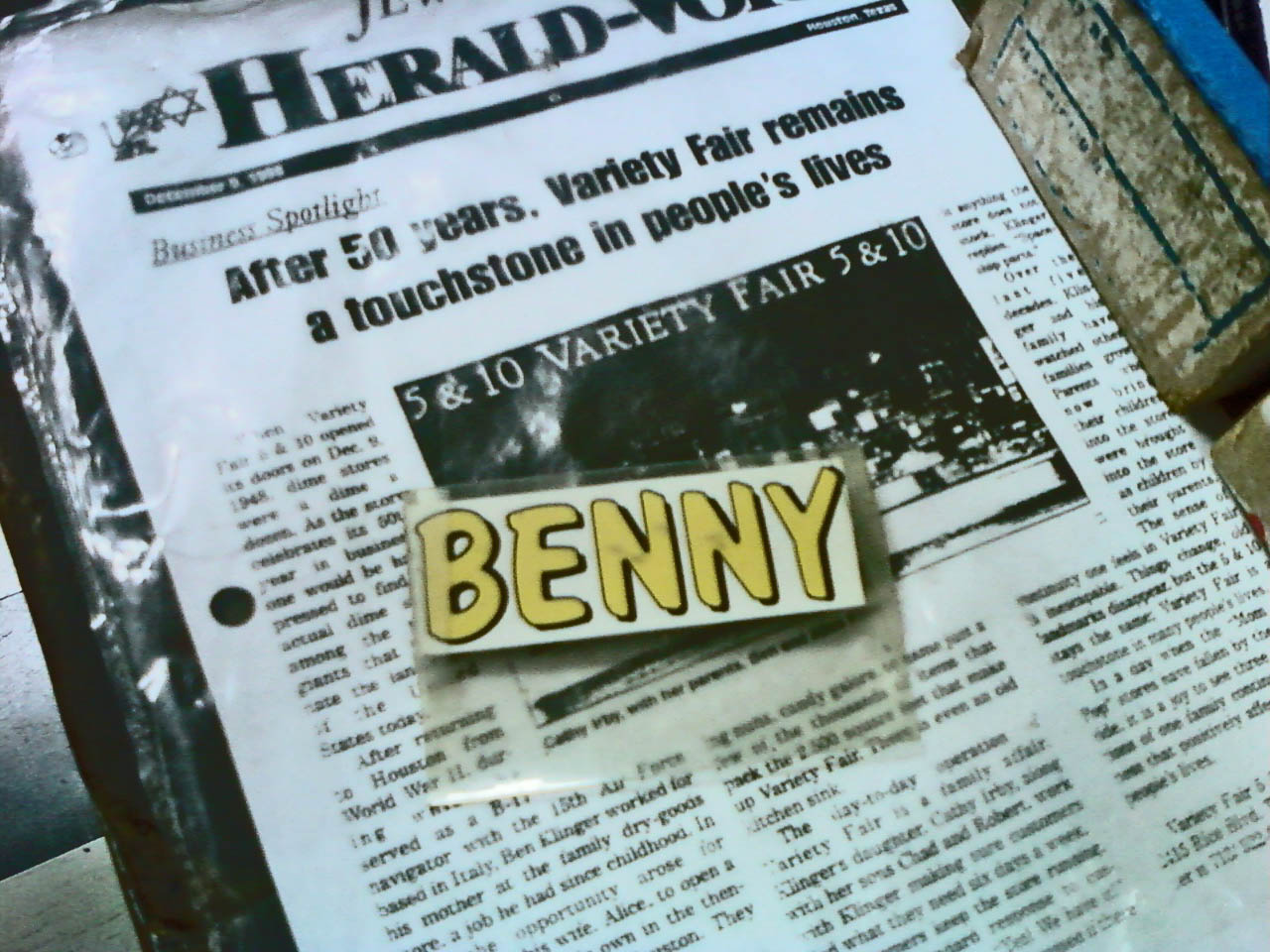
Benny's working name tag has remained by the register since he put it there on his last store day in 1998. If he could only come back and put it on again today, the store wouldn't have to close, but that isn't going to happen. Is it?

There are physical reminders of Benny throughout Variety Fair. Even if there were not, his ghost would still find you. My grown son Neal and I went to Variety Fair for our last trip there yesterday. We both left the store feeling better about everything. We also left with a few last chance souvenirs of the man and the store.
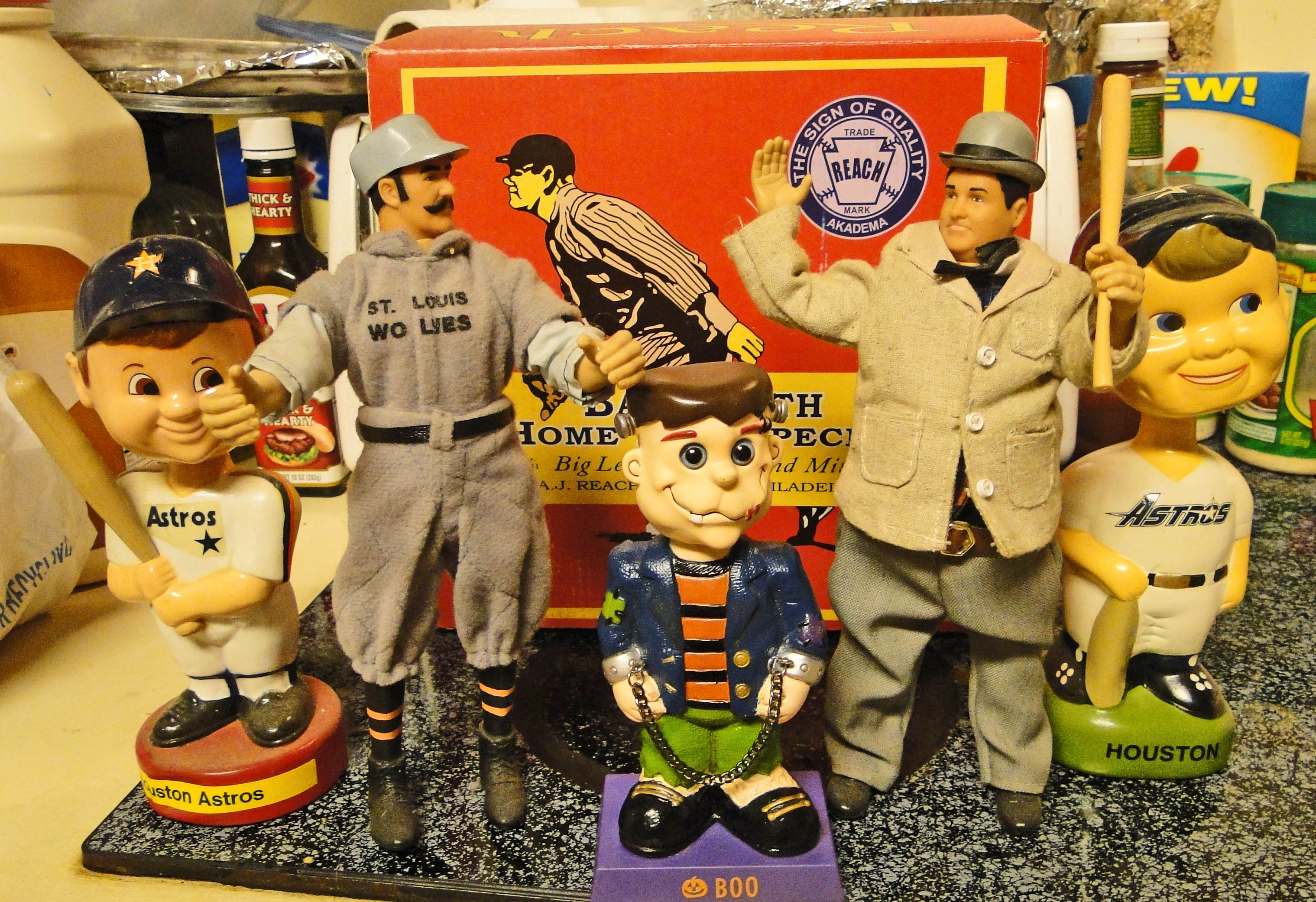
On our last trip to Variety Fair, we bought some toys for the kids in our lives, and I bought this little Frankenstein bobble head, just in case we decide to recreate "Abbott & Costello Meet Frankenstein" in our home baseball museum. Unfortunately, Frankie's tied up in another role for now. He's playing the part of the 2010 baseball season in our summer recreation of "Berkman & Lee Meet Frankenstein."
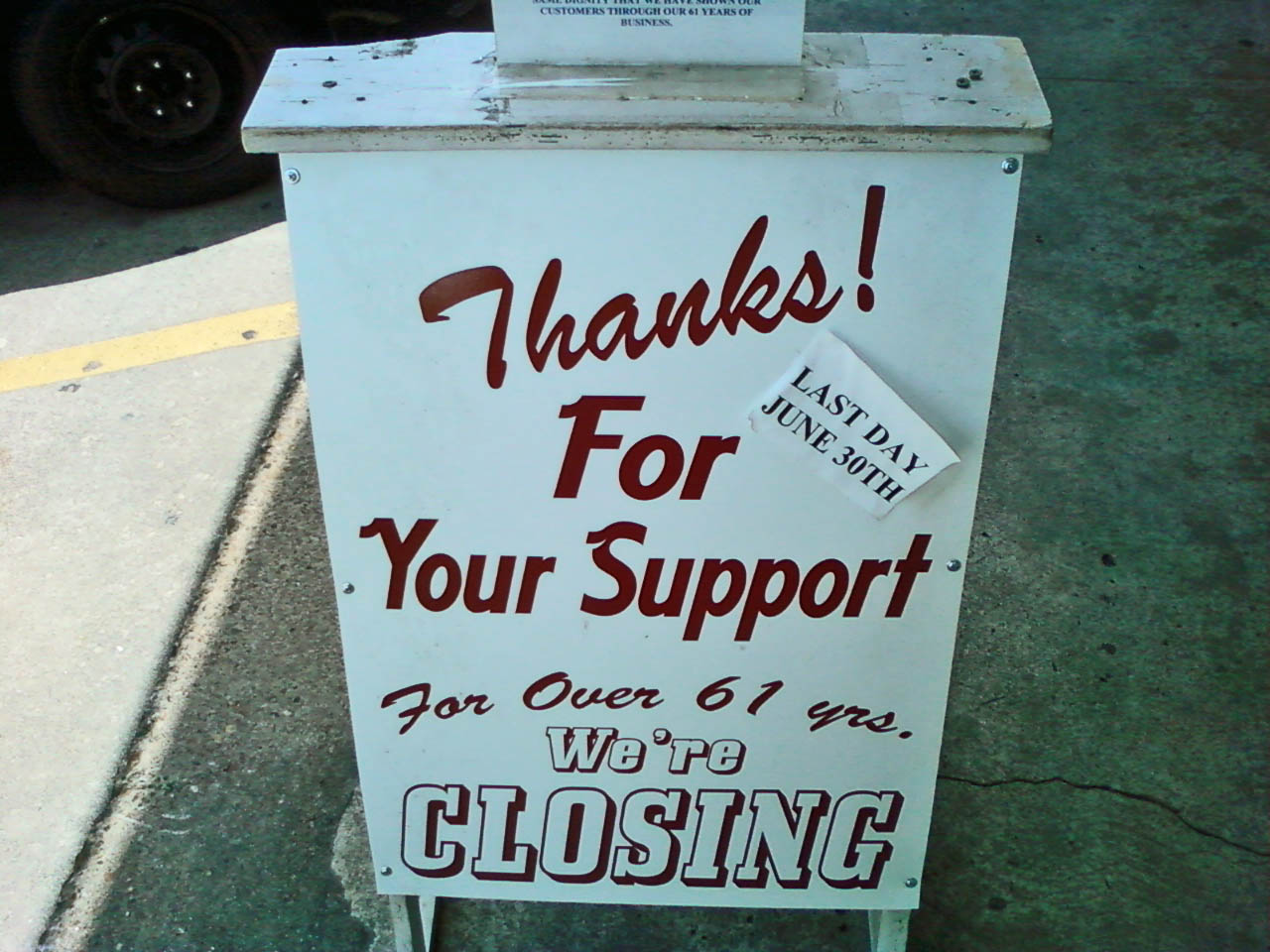
Thank you, Benny Klinger! And now that you are where you are, please don't forget to put in a good word for the rest of us!

Variety Fair is not the triumph of chaos over order. It is the victory of love over money. And that is why the place lasted for as long as it did.
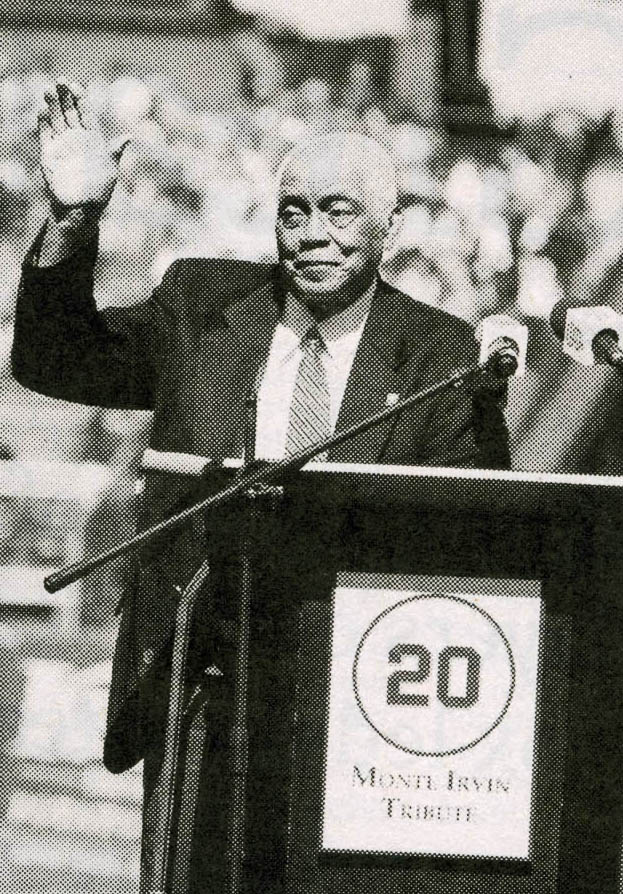
Monte Irvin’s #20: In Case You Haven’t Heard…

June 29, 2010

Photo by Tony Avelar: Associated Press

In case you haven’t heard, Houston resident and Larry Dierker SABR Chapter member Monte Irvin picked up a nice little honor last weekend on the west coast. The also Baseball Hall of Fame inductee from 1973 had another much deserved honor come his way on Saturday, June 26, 2010 at AT&T Park in San Francisco when the home town Giants retired his number 20 from the days Irvin used it during the franchise’s long tenure at the Polo Grounds in New York. Monte Irvin never played for the Giants in San Francisco, In fact, he retired as a player after the 1956 season – and that ws a full two years before the Giants played their first game in San Francisco.

The Giants’ list of retired numbers includes a classy ad tasteful blend of players from both their terms in New York and San Francisco. The addition of Monte Irvin in 2010 just made it even classier, but he’s in fine company among the other New York men: pitcher Christy Mathewson and manager John McGraw are both there from the pre-numbered jersey era as Giants of greatest honor. They are accompanied in that special company of former New York Giants by first baseman Bill Terry (#3), outfielder Mel Ott (#4), and pitcher Carl Hubbell (#11). Monte Irvin (#20) now takes his rightful place among the former New Yorkers. Willie Mays (#24 – Did I really need to tell you that one?) is the only honored former Giant who played with the club in both New York and San Francisco, but great play on the bay would produce other from 1958 forward in San Francisco. The SF members include pitcher Juan Marichal (#27), first baseman Orlando Cepeda (#30), pitcher Gaylord Perry (#36), and first baseman Willie McCovey (#44). Jackie Robinson (#42), of course, is there as the universally retired number by all major league teams.

The Giants group of honored former players all share this fact in common: They are each, one and all together, inducted members of the National Baseball Hall of Fame in Cooperstown, New York. The cream doesn’t rise any higher in this bottle. Cooperstown is the jar of baseball greatness – or should be. And Monte Irvin most certainly is. Great then. Great now. Great forever.

Our Houston SABR chapter has been twice privileged to host Monte Irvin for Minute Maid Park board room meetings and wonderful lectures and discussions of Monte Irvin’s life and times in baseball. At age 91, Monte talks freely, informatively, and often humorously about the old days of Negro League baseball, about how he might have become the man to have broken the color line, and about the time that a young Fidel Castro tried out as a pitcher to play for his Cuban winter league club.

“Castro didn’t make it. He was too wild and we had to let him go,” Irvin told us at his last Houston SABR appearance. “”Of course, then he (Castro) went off to the mountains from there and became a dictator. … If we had only known that he wanted to be a dictator, we could have kept him with us and made him into an umpire.”

At his number retirement ceremony in San Francisco, Monte expressed his appreciation in the strongest terms of gratitude. ” Now I feel my life in baseball is complete,” Irvin told the sellout crowd prior to the Giants game against the visiting Boston Red Sox.

At 91, Monte Irvin is alert and upbeat about baseball and life in general. As an optimist of the first order, Monte showed his metal to the nth degree when we tried to throw a SABR birthday party for him on his natal day last February 25th. “Let’s do it next year,” Monte pled. “I just want to take it easy this time around.”

God Bless you, Monte Irvin. And thank you for being an important member of our Houston baseball community.

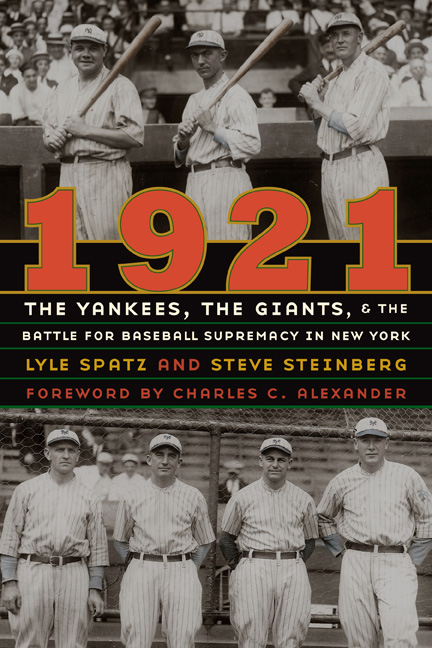
Book Review: “1921”

June 28, 2010

When I ordered “1921” by Lyle Spatz and Steve Steinberg, my first motives were tied to my curiosity about how the book handled the relationship between New York Giants Manager John McGraw and old-time family friend of my father, Curt Walker. I had always heard that McGraw thought highly of Walker. When I grew old enough, I wondered why McGraw had dealt a talented young guy like Curt Walker away to the Phillies, even if it were for Irish Meusel.

I learned the answer to that one and much more. What a great read this book turned out to be.

“1921” is about a great transitional year in baseball history, one that reflects consciously on those times as a greater symbol of all the change going on in American culture at the same time. It was a battle between the old Giants of John McGraw and the young Yankees of Babe Ruth for the heart of New York; it was a period of struggle for baseball’s credibility with the fans over the harm done by the Chicago Black Sox scandal; and it was a death rattle battle between the old small-ball kings of the dead ball era and the power-game circus that had been awakened by the bat of George Herman “Babe” Ruth.

1921 also was the year following the season that baseball ostensibly introduced a new livelier ball. Some still argue that nothing along those lines actually happened, but that doesn’t alter the fact that the “old apple” was now leaving the yard at a record pace by 1921, and largely off the bat of a former foster kid from St. Mary’s School in Baltimore. Add to the performance changes the fact that, by 1921, baseball and its major league umpires had really clamped down upon trick pitch artists and the use of scuffed baseballs in big league games. In brief, everything was happening on the side of making things better for hitters and worse for pitchers.

The competition between the Giants and Yankees also cranked up higher due to the fact the two clubs used the same Polo Grounds venue for their home field. When the tenant Yankees began to out-draw the landlord Giants, the latter finally gave the former their eviction notice and the race was on for the American Leaguers to build a new home. Using the hope that fed on the new troughs of income that grew from the feats of the Babe, the Yankees acquired some reasonably priced land just across the East River in the Bronx from the Polo Grounds. Then they started working on the place that will always be remembered as “The House That Ruth Built,” the original Yankee Stadium. The new just-across-the-bridge ballpark would be ready for the Yankees’ start of the 1923 season.

It didn’t matter what the Giants did. The Jazz Age light was lit in 1921 and the Prohibition Era Party boys, the power-bound New York Yankees, were leading the way to a new kind of rebellious national fascination with sensory excess and athletic achievement by the talented few. The fact that few of the flapper-era Yankees lived to see a ripe old age is not too surprising to those who study such things in this more health-conscious, actuarial age of the early 21st century. Dr. Oz would have gone nuts as the team physician for the 1921-29 Yankees.

“1921” pays good reference attention to what was going on in America during this great season and the authors do a fine job of giving us a good detail track on how game outcomes, injuries, deals, and personnel changes effected the pennant races. Casey Stengel joined the Giants in a deal with the Pirates, putting him in a position to play against the very club that will years later elevate him to the Hall of Fame as their manager.

I also learned that McGraw acquired the rookie Curt Walker from the same Georgia minor league club that launched Ty Cobb to the majors – and that Curt came with scouting recommendations that placed him ahead of Cobb at the same early stage of development.

Walker came to the Giants late in the 1920 season from Augusta of the Class C Sally League for the purchase price of $7,000. Ty Cobb had been purchased from the same club by the Detroit Tigers in 1905 for $700.

In New York, Walker quickly earned McGraw’s praise as a complete young ballplayer as he did all things well while filling in for the injured future Hall of Fame right fielder, Ross Youngs, who, like Curt Walker, was another native Texas son.

McGraw finally traded Curt Walker and catcher Butch Henline to the Phillies in the early summer of 1921. He sent the boys there, along with $30,000 cash, in exchange for disgruntled Phillies outfield star Irish Meusel. Meusel was at the top of his game in 1921  and he went on to be a key factor in the success of the Giants that season. Curt Walker was a part of the “give something to get something” price that Meusel cost the Giants. That point is clear to me now.

The Giants would go on to defeat the Yankees in the 1921 World Series, but the Yankees would turn it around by taking the 1922 World Series for their first big win of all time. The next year, 1923, the Yankees moved to Yankee Stadium. You don’t need me to tell you what happened from there.

“1921” is a well-researched and well-written book. I give it my full recommendation as an important new work in the chronicles of baseball history.

Baseball’s Biggest Losers

June 27, 2010

Back in the day when eight-team leagues times two were The Big Leagues, we had to hope for a pennant race in the National circuit that would keep fans excited until the winner faced off against the New York Yankees in the World Series. With some exceptions, it seems that the Yankees usually had the American League pennant wrapped up by the All Star Break. It may not have happened to the nth degree that way, but it happened often enough to have implanted that global memory in eye and ear witness brains like mine. All those “Damn Yankees” did back then was win!

Short of time and good ideas this morning, I thought it would be interesting to take a look through the glass darkly at the biggest losers in the 2010 season, via their records, to determine who might be involved in an inverse pennant race. In this little slice of fantasy, the two worst teams in each league get to play in the World Series of Losers – with the loser of that one taking the title as Baseball’s Biggest Loser.

It’s a very simple competition, but this year, our Houston Astros are very much involved in the thick of all competition. Here are the biggest competitors, as of the morning this is written, Sunday, June 27, 2010:

BASEBALL’S BIGGEST LOSER RACE, 2010

AMERICAN LEAGUE

1. Baltimore Orioles (22-52, .297)

2. Cleveland Indians (26-47, .356) 4.5 games behind

3. Kansas City Royals (31-44, .413) 8.5 games behind

4. Seattle Mariners (31-43) .419) 9 games behind

NATIONAL LEAGUE

1. Pittsburgh Pirates (25-49, .338)

2t Arizona Diamondbacks (29-46, .387) 3.5 games behind

2t Houston Astros (29-46, .387) 3.5 games behind

4. Chicago Cubs (32-42, .432) 7 games behind

Have a fun Sunday, everybody. If you are a fan of any of the above listed clubs, just don’t look through the dark glass for too long. Dwelling on the negative has the same effect upon the general population as the mention of “1908” does upon Chicago Cubs fans. It generates an existential panic that eventually institutionalizes itself in the heart of the beholder.

Jason Castro Looks Like Real Thing

June 26, 2010

Jason Castro, Catcher, Houston Astros

It may take him a while to take over the identity recognition in the general culture from that other “Jason Castro” fall-out musician from American Idol, but our guy should be able to do just fine building an early good name for himself in the big leagues as a first class catcher.

Born June 18, 1987 in Castro Valley, California, near San Francisco, the 6’3″ , 210 pound 23-year old jewel in his club’s minor league prospect crown has joined the Astros playing roster.

He’s only played the three-game San Francisco Giants series at home at this writing, but he has impressed on all levels for a rookie. His first ten at bats have produced three base hits, including his first major league homer; he bagged his first two gunner kills on attempted steals of second; he received “props” from the great Roy Oswalt for calling a near flawless game in their first work together as an Astros battery; he showed a field presence in responding to the media that simply oozes with intelligence and emotional maturity; and he paraded a physical athleticism is his ordinary movements that all add up as further evidence that we are looking at a real ballplayer out there on the field – one who can catch, throw, and hit the ball with any other of his position as one of the sweetest lefty swingers I’ve seen in  a very long time.

We concede the fact that nothing quick is rarely the whole picture on the long trail of one man’s playing career – and that time holds the answers on the final judgment of Jason Castro as a major league catcher, What we can see now, however, is that he seems to have the mental and physical tools for getting there and playing well for a very long time.

The Giants series was especially enjoyable on TV due to the presence of Castro’s parents in the stands at Minute Maid Park for each of his first three games. The Stanford graduate and his Bay Area family got to enjoy breaking into the big time in a series played against the club they all had followed throughout Jason’s childhood years.

There was no doubt about the current placement of the Castro family allegiance. It’s now with the Houston Astros, of course. When Jason Castro hit his first major league home run in Game Two, both parents lept to their feet to cheer uproariously. By the time Castro rounded third, heading for home, his mom had gone through laughter, tears, smiles, and shouts – and she was now busily preparing to snap a photo of her kiddo as he touched home plate in the middle of his Astros teammate reception committee.

Only a mother knows how to give full expression to the word “love” for her own child – no matter how old that kid may be.

Props also need to extend to Astros General Manager Ed Wade and his new scouting crew on this one too. Their first major draft pick, Jason Castro,  looks like a winner at this point, even if any evaluation of him this early appears as meaningful as polishing the apple that already shines. The signs are good that this one will keep on shining.

Intelligence and ability are a great results combination when they work together and not against each other – and Jason Castro has both working in the right direction from the git-go because of his emotional humility and a performance presence that belies his lack of actual big experience.

Now we just have to watch how experience serves him – and how he adjusts to the adjustments that big league pitchers, especially, will make to him over these first couple of years.

My guess is that Castro has the ability to put himself in contention for “Rookie of the Year” honors, but he may have started too late in 2010 to have much chance to do much other than use up his rookie status in a way that makes him ineligible for the honor in 2011.

That’s OK. There are plenty of other honors waiting down the road that this young man is capable of earning on his own over time.

As a Houston Astros fan, I’m just happy that Jason Castro is our heir apparent catcher of the future and that, as of the just concluded Giants series, the future is now.

Go get some more of these guys, Ed Wade!

Remember Korea

June 25, 2010

foot-soldiering on another lonely, dangerous road in the "forgotten war"

Korea today is still remembered in irony as “the forgotten war,” the three-year “police conflict” between the good democratic forces of the west and the evil communist forces of the east that transpired after the close of World War II and prior to the start of our complex policy unraveling in Viet Nam.

On June 25, 1950, sixty full years ago this morning, North Korea invaded South Korea, threatening to take over the western-organized democracy of South Korea and spreading the totalitarian dictates of the communist world upon another nation of free people. The long-story-short version of what happened next is that the United States and UN Allies got involved in an official “police action” that would thwart these ambitions and eventually draw the two nations into a peace agreement that would split the two nations at the 38th parallel for as long as that agreement could be defended.

The 1953 “cease fire” phase of this agreement still involves the US and international supervision some sixty years later. There never was a peace agreement, just an unholy cessation of conflict that could still flare up again today if the North Koreans ever think a blink on our side means weakness. In 2010, South Korea thrives as a western economy with an elevated standard of living while North Korea starves under the heavy hand of dictator Kim Jong Il and his failed communist economy. By no vote of the people, the North Koreans are a nation that can afford to pursue nuclear weapons, but one that also cannot feed or provide meaningful jobs for its population.

1950 now seems like a lifetime ago because, for me, it was. I remember the day the war broke out. The Houston Press covered the news in bold type headlines that scared the bejabbers out of all of us on the sandlot. Back then, we braced for the big atomic bomb war about as often as the newspapers could come up with another scary warning. And this was no warning. This was war.

At age 12, I was pretty much resigned to the idea that I was only about six years away from being there, or somewhere like Korea, by the time I reached 18. It didn’t happen in my case, but I simply missed the crisis points for being called later – and something else happened to get in the way.

When I tried to go into the army voluntarily through the ROTC in college, I twice failed the hearing exam when I went up for contract. That result was one of the strange disappointments of my early adult life. I wanted to serve in the military, but I was rejected for reasons of physical well-being. By the time I might have been called to Viet Nam, I was considered too old to be called into the infantry without a bill of perfect health. As a result, I became one of those still young Americans who wasn’t burning flags in protest to Viet Nam, but I wasn’t out there putting his life on the line in a foreign country either. Instead, I was home, down in the trenches with those working with gangs and the violently disturbed on the streets of New Orleans. It was a different kind of war. It just didn’t feel the same to me, but that’s not important at all beyond my own nose.

My point today is simple and it is important: Remember Korea. Remember all who have served in the military, especially those who still serve to this day in the mine fields of conflict that are Iraq and Afghanistan. If it were not for our brave younger people, none of us would be free to debate whether our borders are worth defending or not. And it wouldn’t matter one iota what Arizona is doing or not doing to either defend America or offend those who want to come here on their own without regard for our southern border.

Thank you especially, Korean vets. It’s about time America fully remembered and honored what you people did for the rest of back in the early ’50s.

In The Big Inning …

June 24, 2010

In The Big Inning ...

In the beginning, God created the heavens and the earth so that people would have a place to play His great Gift to humankind, the game of baseball.

Now the earth was formless and empty, darkness was over the surface of the deep, and the Spirit of God was hovering over the waters. He knew that it was going to be very hard for fielders to follow and catch high fly balls in games played under these circumstances.

Problem solved. God said, “Let there be light,” and there was light.

God saw that the light was good, and he separated the light from the darkness. Man saw that light contained a built-in profit motive, After quickly organizing energy and utility companies who would provide light to consumers for a fee, man separated his kind into those who came to baseball games as players, and those who came to baseball games as fans. Players were paid a salary based upon their abilities to play and the power of their agents to shake down team owners for big bucks over time. Fans were separated into those who could variably afford tickets – and those who could not afford tickets at all. Those who could afford tickets would be rewarded with variably good seats in the light, based upon their abilities to pay. Those fans who could not afford tickets would be left outside in the darkness.

God called the light “day,” and the darkness he called “night.” And there was evening, and there was morning on the first day. Baseball team owners saw that most of humanity worked during the light of day and slept in the darkness of night. And so those men who owned teams said, “Let there be artificial light to brighten the darkness and make baseball game attendance by fans preferable to sleep once the sun goes down.”

And God said, “Let there be an expanse between the waters to separate water from water.” And the team owners-appointed Commissioner of Baseball said, “Let there either be a territorial expanse between the regional waters of differing teams for marketing purposes – or let there be a retailing contract among all teams that will charge fans for even writing our copyrighted team names on their tee shirts with a magic marker.”

So God made the expanse and separated the water under the expanse from the water above it. And it was so. So the Commissioner of Baseball too made the commercial expanse happen by collectively grouping all the waters of product marketing profit together so that all conceivable revenue streams flowed through his hands. And it was so self-serving.

And God continued through His steps of Heavenly Creation for six full days. And on the seventh day, He rested. And the Commissioner of Baseball has continued through his always-growing steps of revenue stream development, as he has from the beginning until now. And he never rests.

And that’s the gospel truth.

Houston Sports Museum: A Few Notes

June 23, 2010

80 36" steel buffalo medallions rimmed Buff/Busch Stadium from 1928 to 1961.

The Houston Sports Museum enjoyed a nice open house crowd last Saturday at their location on the site of Buff Stadium last Saturday, June 19th. According to Curator Tom Kennedy, a good time was had by all during the 12:30 PM – 1:30 PM meet and greet autograph session with baseball figures from all segments of Houston’s baseball history. Jack Schultea was there representing Houstonians who went on to play pro ball. Larry Miggins attended as a former Buff from the 1940s and 1950s, but he also played a short while with the parent St. Louis Cardinals club – and he is now a member in good standing of SABR, the Society for American Baseball Research. J.C. Hartman was on hand as a transitional figure. Hartman was one of the few last Buffs who also then played for the new major league Houston Colt .45s. – Carl Warwick, a pinch-hitting hero with the St. Louis Cardinals in the 1964 World Series, also came as a former Colt .45. And all these guys were accompanied by former Houston Astro Jose Cruz, current Houston Astro Michael Bourn, and former Buff/Colt .45/ Astro Hall of Fame announcer Gene Elston. – What a lineup!  – What a crowd! – What a day! – And what an opportunity for Houston to keep its history honored and growing.

Support Fingers: Here’s the catch, folks – and hopefully all of us who love baseball history can do our part to support the program. For the museum to succeed over time, the Finger Furniture store that preserves and protects it on this most special site of our minor league heritage must succeed in the retail sales market in this singular store location on the Gulf Freeway at Cullen. I probably don’t have to tell you how competitive the furniture business is in Houston. – For now, all we can do is think first of Finger’s when we need a furniture purchase – and spread the word to our friends as well. Store owner Rodney Finger has earned at least a “first look” Mulligan from all Houston baseball fans when it comes to that next furniture purchase. Please keep Finger’s in mind.

Museum Donations: As a result of the little publicity I’ve given to the Houston Sports Museum, a woman up in Livingston has contacted me about donating her father’s scrapbook to the museum. Her dad was an outfielder named D.L. “Country” Smith and he played with the Houston Buffs for a short while back in the late 1930s. He also took the time along the way to put together a scrapbook with photos and letters from Branch Rickey and former Buffs President Fred Ankenman. I’ve put the family in touch with Tom Kennedy for further exploration.

Those Buffalo Medallions:

This profile was my earliest and most lasting image of Buff Stadium.

The buffalo medallions that once rimmed the exterior walls at Buff Stadium came up again as part of HSM Curator Tom Kennedy’s talk to our Houston Chapter of SABR earlier this month. The eighty (80) thirty-six (36) inches in diameter medallions were the jewels in the royal crown of Houston baseball’s beautiful ballpark in the East End. A couple of these beauties now reside at the Houston Sports Museum as steely strong reminders of Houston’s thick and lasting baseball heritage.

Check the top photo here and you will see the configuration of how these medallions outlined the ballpark. Imagine the impression they made on the nine-year old kid that was me when I saw them for the first time in 1947. They were like magnets to me. Once in their presence, I couldn’t wait to get back. I was addicted to baseball from before I even heard the first crack of the bat.

It was an addiction from which I’ve never even tried to recover.

1926 Minor League Team Names

June 22, 2010

In the long view of things, nobody can trust a cannibal.

One of my small time amusements drills from early childhood has evolved around the breakfast table study of team nicknames in Texas high school football and minor league baseball. Do you remember when the Houston newspapers used to publish the scores from all the Friday high school football games on Saturday mornings each fall? You would get to thrill at the news of a score like “Happy 21 – Comfort 6” and then fill in the rest with your imagination. There wasn’t room or sufficient probable interest in the hundreds of game stories involved, but everybody in the Texas newspaper reading market got the scores.

Minor league baseball wasn’t quite as easy to cover or as focused in the local papers. Oh, we got the scores and the standings of all the doings going on in most places in the state, but you really had to read The Sporting News to see the weekly reports from all over the minor league world. There were simply too many leagues across the nation to keep up all the activity beyond our Texas borders in a Houston, Dallas, or San Antonio newspaper.

This morning I ran across an Ebbets Field Flannels ad for a 1926 Longview Cannibals jersey that sent me spinning through the Minor League Baseball Encyclopedia for a reckoning with other off-the-wall or politically incorrect team nicknames from that same season.

Beyond the salad-bowl-dismissive Longview crew, and they were a club that was good enough to eat their way to the Class D East Texas League championship, I came up with nine more nicknames from that single season to complete my favorite mascot list for 1926:

(2) and (3)  I had to go with the Wheeling Stogies of the Class C Middle Atlantic League and the Tampa Smokers of the Class D Florida State League. Wheeling finished in the cellar of an 8-team league and Tampa came in 4th in the same sized conferation. Smoking was cool in 1926, but it didn’t win you any championships if there wasn’t a breath of talent on your roster.

(4) The Wilson Bugs sound like a club that was ready to go scampering to their dugout to keep from getting stomped each hot summer night, but these little bat and ball wielding insect-types were not all that bad, slithering and slimming their way to a second place finish in the 1926 Class B Virginia League.

(5) The Springfield Midgets accepted the vertical challenge of a pennant race, fighting their way all they up to the top of the Class C Western Association title in 1926. It would be another quarter century before one of their literal kind would stand up, if not tall, as a batter in a big league game. The player-height discrimination line would be broken, if only for a single time at bat, when midget (or “vertically challenged,” if you prefer) Eddie Gaedel went to bat for the St. Louis Browns on August 19, 1951. Excluding the arguably sized Freddie Patek, no other midget or midget-marginal players have again made it to the big leagues, but their kind did OK at Springfield in 1926.

(6) The New Haven Profs should have been a brainy bunch. They managed to get tenured into 2nd place in the Class A Eastern League, but they weren’t all that smart. They got beat out by the Rubes from Providence for the EL pennant. Somewhere back then, there simply had to be a season-ending headline that read something like “RUBES PICK YALE LOCK ON PENNANT AS PROFS WALK!” Or something like that.

(7) The Palestine Pals cuddled up to Lady Victory often enough to finish 2nd in a six-team Class D Texas Association low priority pennant race – but that’s OK. If it’s your team and town, it’s the World Series.

(8) The Salem Witches didn’t start out as such, but the wizard of poor home attendance robbed the Lowell Highwaymen of the opportunity for playing an entire season. Transformed into the Witches of Salem, the former boys of Lowell found that their magic could not make up for low talent. The pot-boilers finished 6th in the eight-team Class B New England League.

(9) The Wichita Izzies raised more questions than they answered from the cellar of the eight-team, Class B Western Association. What is an “Izzy”, anyway? Based on their 1926 showing, we may only conclude with any certainty that an Izzy is something that other clubs wiped their feet upon on their ways to better fates.

(10) The Durham Bulls are my guys. They only took 3rd place in the seven-club 1926 Class C Piedmont League, but they were the pre-legendary Bulls, for gosh sakes. The Bulls would live on to become the very personification of our most romantic notions about minor league baseball in the old days.

Anyway, that’s it for me and minor league team nicknames from 1926. There are so many ways to slice this pie. And they are all fun, if your heart is into this sort of thing. If it’s not, that’s OK too. You can always go read about oil spills, health care, unrepentant terrorists, LA Laker victory parades, the announcement that Jennifer Lopez is now available as a wedding singer for 2 mil a pop, and the fact that China just passed the USA as the world’s leading manufacturing nation.

Did I ever go into my thoughts on why baseball is important to our American psyche? Oh yeah. I think I just did.

Famous Last Words in Court

June 21, 2010

"Nothing personal, Mr. Smith, but are you still beating your wife?"

We have my old friend and fellow classmate from St. Thomas High School, Vito Schlabra, to thank for today’s wonderful look at unfortunate statements in court – and mainly by the interrogating attorneys. I’ve never seen so many examples of legal incompetence, or outright second-banana joke set-up comments by lawyers, in one collection until now. I suppose we shall have to wait for all the BP trials to come to top any of these citations, but these will do for now – on a Monday morning that my Astros-fan heart is far too numbed and broken to wade directly back into a discussion of baseball in the wake of an otherwise pleasant Father’s Day weekend.

Hope you enjoy the background clattering sound of the following documentation on famous last words in court. It’s mostly the sound of barrister words choking on the damage they are doing to their sender’s own credibility at the bar.

According to Vito Schlabra, these are all quotes from a book called “Disorder in the American Courts.” They are things people actually have said in court, word for word, taken down and now published by court reporters that had the torment of staying calm while these exchanges were actually taking place.

With apologies to everyone from Oliver Wendell Holmes to Johnnie Cochran to Perry Mason, here are the chosen few we shall feature here:

ATTORNEY:  What was the first thing your husband said to you that morning?

WITNESS:  He said, ‘Where am I, Cathy?’

ATTORNEY:  And why did that upset you?

WITNESS:  My name is Susan!

____________________________________________

ATTORNEY:  What gear were you in at the moment of the impact?

WITNESS:  Gucci sweats and Reeboks.

____________________________________________

ATTORNEY:  Are you sexually active?

WITNESS:  No, I just lie there.

____________________________________________

ATTORNEY:  This myasthenia gravis, does it affect your memory at all?

WITNESS:  Yes.

ATTORNEY:  And in what ways does it affect your memory?

WITNESS:  I forget.

ATTORNEY:  You forget?  Can you give us an example of something you forgot?

__________________________________________

ATTORNEY:  Do you know if your daughter has ever been involved in voodoo?

WITNESS:  We both do.

ATTORNEY:  Voodoo?

WITNESS:  We do.

ATTORNEY:  You do?

WITNESS:  Yes, voodoo.

____________________________________________

ATTORNEY:  Now doctor, isn’t it true that when a person dies in his sleep, he doesn’t know about it until the next morning?

WITNESS:  Did you actually pass the bar exam?

____________________________________

ATTORNEY:  The youngest son , the 20-year-old , how old is he?

WITNESS:  He’s 20, much like your IQ.

___________________________________________

ATTORNEY:  Were you present when your picture was taken?

WITNESS:  Are you shitting me?

________________________________________

ATTORNEY:  So the date of conception (of the baby) was August 8th?

WITNESS:  Yes.

ATTORNEY:  And what were you doing at that time?

WITNESS:  Getting laid.

____________________________________________

ATTORNEY:  She had three children, right?

WITNESS:  Yes.

ATTORNEY:  How many were boys?

WITNESS: None.

ATTORNEY:  Were there any girls?

WITNESS:  Your Honour, I think I need a different attorney.  Can I get a new attorney?

___________________________________________

ATTORNEY:  How was your first marriage terminated?

WITNESS:  By death.

ATTORNEY:  And by whose death was it terminated?

WITNESS:  Take a guess.

___________________________________________

ATTORNEY:  Can you describe the individual?

WITNESS:  He was about medium height and had a beard.

ATTORNEY:  Was this a male or a female?

WITNESS:  Unless the Circus was in town I’m going with male.

_____________________________________

ATTORNEY:  Is your appearance here this morning pursuant to a deposition notice which I sent to your attorney?

WITNESS:  No, this is how I dress when I go to work.

______________________________________

ATTORNEY:  Doctor, how many of your autopsies have you performed on dead people?

WITNESS:  All of them.  The live ones put up too much of a fight.

________________________________________

ATTORNEY:  ALL your responses MUST be oral, OK?  What school did you go to?

WITNESS:  Oral.

_________________________________________

ATTORNEY:  Do you recall the time that you examined the body?

WITNESS:  The autopsy started around 8:30 PM.

ATTORNEY:  And Mr. Denton was dead at the time?

WITNESS:  If not, he was by the time I finished.

___________________________________________

ATTORNEY:  Are you qualified to give a urine sample?

WITNESS:  Are you qualified to ask that question?

______________________________________

And last:

ATTORNEY:  Doctor, before you performed the autopsy, did you check for a pulse?

WITNESS:  No.

ATTORNEY:  Did you check for blood pressure?

WITNESS:  No.

ATTORNEY:  Did you check for breathing?

WITNESS:  No.

ATTORNEY:  So, then it is possible that the patient was alive when you began the autopsy?

WITNESS:  No.

ATTORNEY:  How can you be so sure, Doctor?

WITNESS:  Because his brain was sitting on my desk in a jar.

ATTORNEY:  I see, but could the patient have still been alive, nevertheless?

WITNESS:  Yes, it is possible that he could have been alive and practicing law.

________________________________

The content and temper of all these court transcripts reminds me of the terrific routine that the late comedian Don Adams used to portray on TV – and pretty much in style with his original Maxwell Smart character – only casting himself as an attorney apart from the Get Smart series.

It went something like this:

Attorney Adams: “Your Honor – for the past forty-five minutes, I have sat here idly while my opponent has stood before you in this worthy court of law and made a total ass of himself. – Now it’s my turn.”

Have a groovy Monday, everybody. – Just watch what you say to people in important situations. – It doesn’t have to be your turn.