Archive for the ‘Uncategorized’ Category

The 1949 Baseball Season: King James Version

July 9, 2010
Back in the spring of 1949, in a parallel universe to our own. free agency in baseball had been a reality since the end of World War II in 1945, which fortunately concluded in that similar world as it did in our ours. The Allies whipped the Axis forces and restored a form of freedom to many parts of the governing world. In the process, the spirit of the war also liberated professional baseball players from the tyranny of the reserved clause.

Time: 1949; Place: A Parallel Universe; Event: Ted Williams & Stan Musial discuss their plans for playing together as teammates with a few other new faces on the roster of the 1949 St. Louis Cardinals.

“If baseball players can go overseas and fight for their country in wartime,” pinko-socialist pundit and labor advocate Henry Wallace shouted to Congress, “the least we can do in Congress is to revoke the reserve clause and give them all the right to choose where they will work as ball players in peacetime!”

And so it was written. In that parallel version of our God-Blessed America, on Flag Day, June 14, 1945, President Harry S. Truman signed into law a bill from Congress that killed the reserve clause and gave unrestricted free agency to professional baseball players.

Not much happened among the old school ball players until March 2,1949, when the Boston Red Sox met the St. Louis Cardinals in an early spring training game played at this universe’s base for the Cardinals in St. Petersburg, Florida. Everything changed that day.

Unsigned by the Red Sox, but working out with the club on his own nickel, pending contract resolution with Boston, slugger Ted Williams and Cardinal great Stan Musial suddenly announced that the man some called “The Thumper” would stage a thirty minute radio show over station KMOX is St. Louis from the Cardinal clubhouse after the game.

The purpose of the broadcast, according to a spokesman for Ted Williams, would be to announce his decision about his plans for the 1949 season. Had Williams worked things out with the Red Sox? Or would he be making plans to play elsewhere, …. as in, perhaps, …. St. Louis, maybe?

The press and all the world was told that they would have to wait for the “decision broadcast” over KMOX that was being beamed to a national audience.

The decision came forth about twenty minutes deep into the radio broadcast. It came on the heels of a seemingly endless stream of “Holy Cow” possibilities expressed over the air by the show’s host and sole monologist, Harry Caray. Listeners were ready for anything, but more Harry opinions.

With a smiling Stan Musial sitting quietly to his left, Ted Williams moved dead-panned closer to the mike that had been shoved in his general direction by Caray. The following is a verbatim account of  what happened next:

Harry Caray: “Well. Ted, America’s been holding its collective breath out there. Can you tell us what this business is all about? More exactly, can you tell us what this decision is all about that made it so important that you had to use up my post-game after show time just to do it?”

Ted Williams: “Sorry. Harry, but sometimes things happen in baseball that are even more important that anything you have to say. I’ll make it brief since our time is short. – After much thought, I have decided not to return to the Boston Red Sox for an eighth season. Instead, I will be taking my talents to Missouri to play for the St. Louis Cardinals, along with my friend Stan Musial here, plus George Kell of the Tigers and Warren Spahn of the Braves, who have both also chosen to sign with the Cardinals for the 1949 season. – All three of us new Cards want a World Series ring – and we think we may be able to make a difference here by joining hands with Stan and a bunch of guys that already know how to win the big one.

Harry Caray: “Holy Cow! That’s wonderful, Ted! Are you worried at all about how badly the fans back in Boston may react now, especially in light of the fact that they’ve already lost Spahnie to us from their National League club! Holy Cow!”

Ted Williams: “Spit on ’em, Harry! I gave those GD Boston fans all I had for seven seasons! They ought to be grateful I stayed as long as I did. I also gave my all to the war effort. Now it’s time to think about me and I want a GD World Series ring. I don’t give a flying-flip where I win it – just as long as I win it in my playing lifetime.”

Harry Caray: “Do you think you owe the fans anything, Ted, even an apology for leaving Boston?”

Ted Williams: “I don’t owe the fans a damn thing, Harry! I gave ’em my best – and half the time, they didn’t even appreciate that! Fans don’t get it. We ballplayers play to win for ourselves. We don’t play to win for them – or out of some loyalty to the community. – Hell, if this were about loyalty, I’d still be out there in the PCL playing for my hometown San Diego Padres!”

Harry Caray: “If it’s not about loyalty, Teddy, how do you explain the guy sitting next to you? Around here, the love and loyalty that exists between Stan Musial and the city and fans of St. Louis is a two-way, can’t-pry-it-apart street in every direction! Explain that phenomenon for me, Ted.

Ted Williams: “I won’t even try, trickster, except to say that any guy born in a place named Donut-Hole, PA is capable of doing just about anything. St. Louis is damn lucky to have him – just as they will be doubly lucky to have the both of us and Kell in the same everyday lineup and Spahnie pitching every fourth day. – Now, if you don’t mind, I need to break this off and go grab some shut-eye. I’ve got a big fishing trip planned for tomorrow!”

Harry Caray: “But, Ted, I only want to ….”

Ted Williams: “PATOOEY!!!!” (Ted Williams spits on the floor as he off-handedly shakes Musial’s hand and rises to abruptly take leave of the clubhouse broadcast setting.)

Of course, these events did not unfold in our universe, but they might have had an interesting impact upon the 1949 pennant races and World Series outcomes, had they unfolded. In our reality, the 1949 St. Louis Cardinals finished second to the Brooklyn Dodgers in the National with a 96-58 record. They were only one game back of Brooklyn, who went on from there to lose a seven-game World Series to the New York Yankees in the first year of new Yankee manager Casey Stengel. – Stan Musial hit .338 with 36 homers and a league-leading hit total of 207 for the ’49 Cards.

In our 1949 reality universe, Ted Williams of the Red Sox batted .343 with 43 homers and AL leading totals of 150 runs scored and 159 runs batted in. – Third baseman George Kell of the Tigers led the AL in batting with an average of .343. – Pitcher Warren Spahn of the Braves led the NL with 21 wins and 151 strikeouts.

Hmmm! Do you think, maybe, the 1949 St. Louis Cardinals might have had a chance at the World Series crown had the King James version of the universe unfolded as described in this little fantasy piece? And if they had won it all, would victory have tasted as sweet to the Cardinal fans as any of their previous dramatic victories to this 1949 point in history?

To me, the saddest part of the Lebron James decision was the fact that he never even came close to thanking the fans of Cleveland for their support of him. He talked profusely about how much he gave to Cleveland, but none at all about what Cleveland had given to him.

James was all “me, me, me” and “I gotta do this for me. – I gotta win a championship somewhere!” in his “decision telecast.”  He also stated that he didn’t think fans understood how important winning it all was to players.

Maybe not, King James, but maybe the fans of Cleveland really do understand more about loyalty than you do. It’s far deeper than a word you may have tattooed to your chest. It’s a personal decision to care about some goal or commitment to others, or  cause,  that is much greater in value and far beyond the culmination of your personal satisfactions or desires to be recognized as an NBA champion.

Once upon a time, baseball players like Stan Musial and Jackie Robinson understood what I’m writing here to the “nth” degree. You just happened to be a man of this generation – a player who doesn’t get it and never will.

Believe me or not, LeBron James, if you had decided to stay with Cleveland and then never ever won an NBA ring during your career, your legacy would have been greater than it could ever be now. It doesn’t matter if you win rings at Miami, and then at Chicago, and then at New York, and then in LA.

The question, “Who did you win them for” has already been answered. You won them for yourself; you sure didn’t win them for the fans. The fans didn’t even deserve a word of thanks when you packed your bags and took your “loyalty-tattoed” chest off to South Beach. Are the fans of Miami really supposed to buy into the bull that you are really playing for them? Or are they just supposed to put out the ticket and souvenir money, shut up, and simply be adoringly grateful that you brought your wondrous talents to South Florida?

Good Luck, King James!

Astros Sweep Pirates

July 8, 2010

"She'll be comin' round the mountain when she comes!"

(The following lyrics work to the tune of “Comin’ Round the Mountain:”) *

Chorus One:

If we played the Pittsburgh Pirates every day!

If we played the Pittsburgh Pirates every day!

We could glide right to a pennant!

With the Astros sure to win it!

If we played the Pittsburgh Pirates every day!

Chorus Two:

If old Lance could hit ’em twice a bit more often!

If old Lance could hit ’em twice a bit more often!

We could let our hard hearts soften,

‘Stead of shopping for a coffin!

If old Lance could hit ’em twice a bit more often!

Chorus Three:

If sweet Roy could throw those goose eggs every time!

If sweet Roy could throw those goose eggs every time!

He’d be through with Astro-costin’,

‘Cause he’d soon be up at Boston!

If sweet Roy could throw those goose eggs every time!

—————————————————————–

*Indulge me, folks. This sort of word-rambling is my favorite remaining avenue of celebratory expression.

The Houston Buffs’ Cubs Years, 1959-61

July 8, 2010

Future Hall of Famer Billy Williams played LF and batted .323 with 26 HR for the 1960 Houston Buffs.

By the time the Houston Buffs settled into their last three years of minor league baseball from 1959 to 1961, the dye had been cast that the city’s real future now rested in the major leagues as one of the new expansion clubs. When former St. Louis baseball great Marty Marion and his group of independent investors then purchased the minor league franchise and ballpark of the Houston Buffs from the St. Louis Cardinals after the 1958 season, it most likely took place with a view toward a future that far surpassed their immediate plans to move the ball club up to the next level with the AAA American Association from the AA Texas League.

The Marion group worked out a minor league player supply group with the Chicago Cubs and agreed to start playing in the American Association in 1959 as the AAA affiliate of the Chicago North Siders. For all the Cardinal fans of the Houston area, the change resulted in quite a culture jolt. No longer would the Buffs be wearing the Cardinal red and deep Navy blue trim of the vaunted and cherished St. Louis NL club.

When the 1959 Buffs took the field on Opening Day 1959, they did so in the Powder blue caps, lettering, and trim on the Cloud white uniforms that were the style of the Chicago Cubs. Even though we Buff  fans were told that these guys on the field were our Buffs, and we knew they were, part of our fan souls kept waiting for the “real Buffs” to show up in their Cardinal red gear. It took us a while to adjust. After all, the Buffs had been a Cardinal farm club from the early 1920s. That nearly four decades of Cardinal influence was extremely powerful.

Those three final years of the Houston Buffs were mostly forgettable on the field. Playing first under Rube Walker and then again under former Buffs manager Del Wilber, the 1959 Buffs finished dead last in the five-team American Association West Division with a horrendous record of 58-104. Houston fans seized upon an obvious conclusion: “Buffs, you say? I don’t think so! These guys not only dress like the Cubs! They play like them too!”

The 1959 roster did contain some notables. Future Houston Colt .45 Pidge Browne broke in at first base with a .261 batting average and 12 homers. Former Browns outfielder Jim Delsing played regularly at a low performance level (.233 BA, 4 HR). Delsing is best remembered as the guy who pinch ran for Eddie Gaedel after the little vertically challenged batter (midget) walked in his only plate appearance for the St. Louis Browns on August 19, 1951. – Dave Hoskins, the black pitcher who broke the color line in the Texas League with Dallas back in 1952, also spent a little time pitching for the Buffs as part of his twilight song in baseball.

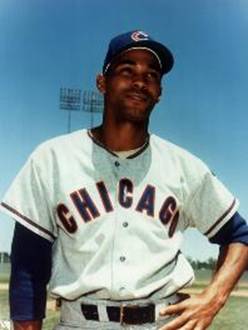
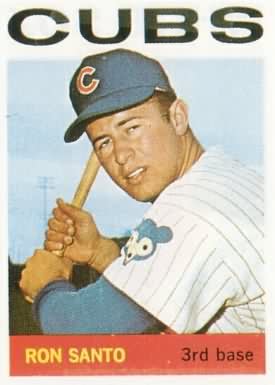
1960 was the season for memorable names during the Buffs’ Cubs years. Billy Williams played left field for the club, batting .323 with 26 homers on his last minor league stop on the way to his Hall of Fame major league career with the Cubs. Ron Santo played third base in 1960, hitting .268 with 7 homers. The ’60 club also included outfielder Sweet Lou Johnson (.289, 12 HR), outfielder-manager Enos Slaughter (.289, 1 HR in 58 times at bat), plus pitchers Mo Drabowsky (5-0, 0.90) and Dick Ellsworth (2-0, 0.86). The 1960 club did much better, finishing 3rd in  now eight-club circuit, but they lost in the first round of the playoffs for the league championship.

Ron Santo and Billy Williams were the best of the Buffs-Cubs years.

The 1961 last edition of the Houston Buffs went through four managers: Grady Hatton, Fred Martin, Lou Klein. and Harry Craft. Interesting! The Buffs’ last manager, Harry Craft, would also become the first manager of the new major league Houston Colt .45s in 1962.

First baseman Pidge Browne (.250, 9 HR in 62 games) and shortstop J.C. Hartman (.259, 6 HR) both played well enough to join manager Craft on the first voyage of 1962 Colt .45s. The club also included another future Houston major leaguer. Dave Giusti (2-0, 3.00 in 3 games) also pitched a few innings for the last Buffs.

In spite of their 73-77 fourth place record, the 1961 Buffs celebrated their last season by advancing to the finals of the American Association playoffs before losing the crown in six games to second place Louisville.

The big story of the Cubs years, however, was not what happened on the field, but how the Marion group ownership may have affected the future identity of Houston’s major league club. Here’s how I understand it as one who was not intimately involved in the process of the franchise award. I do invite Mickey Herskowitz to weigh in here on this matter as a comment on this column. I would love to see us get it right as we can for history:

The competition between the groups of Roy Hofheinz and Marty Marion for the new major league franchise was heated and unfriendly. When Hofheinz and the Houston Sports Association got the bid from the National League (and I’ve always surmised that HSA was the only group that a serious chance), the Marion group mde HSA pay through the nose for Buff Stadium and the club’s AAA territorial rights.

It’s my understanding from several sources that Hofheinz was so embittered by the Marion group “hold up” that this experience was all he needed to settle a decision that he probably would have made anyway: (1) the new Houston NL club wold not use Buff Stadium while they were awaiting the completion of the new domed stadium off OST and Main. They would build a temporary field there that would allow fans to watch the domed stadium as it progressed under construction. (2) The major league club would not be known as the Houston Buffs, even though there was strong popular sentiment in town for keeping the revered name of the club that had meant Houston baseball from the early years of the 20th century.

Had Marion’s group been awarded, the new NL franchise, I think they would have kept the “Houston Buffs” identity at the major league level, but I have no idea what their stadium plans might have included. I have always thought that the domed stadium plan was always anchored only to the HSA group. More light on all these details is needed.

At any rate, the three years of the Buff’s Cubs era are fairly forgettable on the field. I still can’t believe those guys in the Cubs-look-a-like uniforms really were real Buffs.

Any comments or questions on what really happened between the Hofheinz and Marion groups are most welcome, but please leave them here as public replies – not as private e-mails to me. Everybody needs a chance to get involved in this quagmire.

Astros Sign McCurdy

July 7, 2010

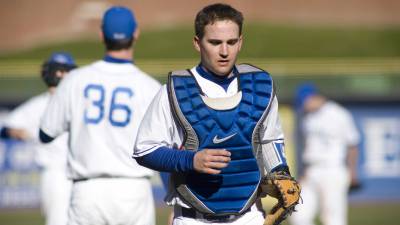
Ryan McCurdy is from Duke University. If he makes it all the way to the top, he will become only the second McCurdy in history to reach the major leagues of baseball.

The Houston Astros have signed a McCurdy! No, not this one. In spite of current circumstances, the club isn’t that desperate for playing talent. Their guy is named Ryan McCurdy, a 22-year old catcher out of Duke University. The (BR/TR) 5’10”, 175 pound young man is the same height and about twenty pounds heavier than I was at that age. He was born in Tampa, Florida in a general area of the country where I have a few scattered McCurdy relatives, but no known connection to this young man beyond the facts that we are both baseball guys, both the same height, and three days off from each other on our natal birthday celebrations. Ryan was born on 12/28/87. I was born on  12/31 – just a tad bit earlier in 1937.

If Ryan McCurdy makes it the top, he will become only the second McCurdy to make it to the big leagues. The other was Harry McCurdy, also a catcher, who had some pretty good years with the Houston Buffs (1924-25) and in the majors with the Cardinals, White Sox, Phillies, and Reds. Harry batted .361 in a full season for the 1925 Buffs and .282 over his ten seasons in the bigs (1922-23, 26-28, 30-34). After his retirement, Harry McCurdy made his home in Houston and served for many years as the Principal of Hogg Junior High School in the Heights. We used to get his calls all the time at our house from parents trying to locate Harry for conferences.

Harry McCurdy, Catcher

We weren’t related to Harry McCurdy either, but we did  have one possible relative, also on the McCurdy side, to make it to the big leagues. My late dad always claimed that we were related to Bob Myrick, who went 3-6, 3.48 as a right-handed pitcher for the New York Mets from 1976-78. I never met Bob Myrick nor really tried to determine if we were distant cousins from the family’s earlier days in Mississippi because it just didn’t matter to me, but I do have to admit: I hope the Ryan McCurdy kid makes it, even if he’s no relation. After all, there haven’t been many of our name to get there before Ryan – and that one was a catcher too.

I don’t know much about the player Ryan McCurdy beyond the facts that he enjoyed an outstanding high school hitting career and that he played college ball at Duke University. Like Mr. Castro’s Stanford, Duke s no dumping ground for dummies. I wouldn’t mind seeing the Astros put in a spot where they have to choose between, or else, platoon, two catchers from Stanford and Duke.

Ryan McCurdy, Catcher, Greeneville {TN) Astros

If Ryan McCurdy is going to make it as a serious challenger at catcher for the Houston Astros someday, like all our other young guys, he’s going to need time to develop on the vine. The direction that Ed Wade is taking now is a good one: With enough talent in the minor league orchards, the big club doesn’t have to pick the few good ones too soon for the longtime greater good.

Young McCurdy isn’t exactly off to a blazing start. He’s one single for nine times at bat in his first few games as an Appalachian Rookie Leaguer. At least, they gave him a good uniform digit to wear. The number “3” doesn’t carry with it the burden of too much expectation, does it? Of course, at catcher, I think the expectation load is much heavier if the club assigns number “8” to your back!

Good Luck, Ryan McCurdy! You can bet for sure that I will be pulling for you!

The Fruits & Nutts All Stars

July 6, 2010

The Fruits & Nutts All Star Team! ... What? You can't find Darryl Strawberry in there somewhere?

Pardon me, folks. It seems the summer heat, the collapse of the Astros, and a Fourth of July weekend discovery (the hard way) that we need a new roof at the old homestead before the next flood rain blows in (and that just “ain’t” going to happen in time, based on the weather casts) has me thinking even more steadily on the light side of things for subject matter here. Having a water leak at home, I find, is a little like having BP in charge of the weather: You know you are going to keep on getting polluted again, but you can’t always predict when and how bad it’s going to be this time.

At any rate, I’m falling back this morning on my eternal pursuit of new (at least, to me) All Star teams from baseball history that are based more on theme name than actual performance merit. Today, I’d like to present a club I’ve never tried to assemble at any previous moment of baseball madness. I call these guys The Fruits & Nutts All Stars:

Bob Lemon would have been our best choice for pitcher, but the team needed his bat and glove at shortstop.

Pitcher: Russell Peach. This nifty little lefty posted a 10-2 record with a 1.74 ERA for two minor league clubs in Bluefield and Miami back in 1973. Although Peach never cobblered his way to the big time, he was sweet on the mound while he lasted.

Catcher: Joe Cherry. I picked this rube straight off the lower minor league vine from 1964. Cherry busted out a .306 average with 9 HR at two sites that year. His work at Sarasota and Lynchburg never carried him to the top because nobody else ever picked him to go that high.

1st Base: Johnny Nutt. Crop scarcity ruled at first base. When I could find no fruits to fill this bowl, I had to take an outfielder named “Nutt” and place him on the spot in the hope that he will be one of those pasture ball chasers who can also stretch, scoop, and grab at the biggest out bag on the field. Johnny Nutt hit .281  with only a single HR for Oklahoma City way back in 1919. We will have to hope he can stretch it.

2nd Base: Jacob Almond. This Jake’s the real deal. We plucked him from the 1944 Class D ball roster of Albermarle as the only “legit” second base choice available – or at least, that we could find. Almond brings the nutty flavor of a Class D ball .244 batting average to the lineup.

3rd Base: Harold Apple. We had to go way out on a limb for this pick. A right-handed pitcher with a 5-2 record and a 1.83 ERA for AA York back in 1963, we resisted the temptation to leave him on the hill as a back up to Peach because our need for a guy at the hot corner was greater. Apple goes to third base with a .196 batting averages, a lot of doubt, and our sincere best wishes and highest unfounded hopes.

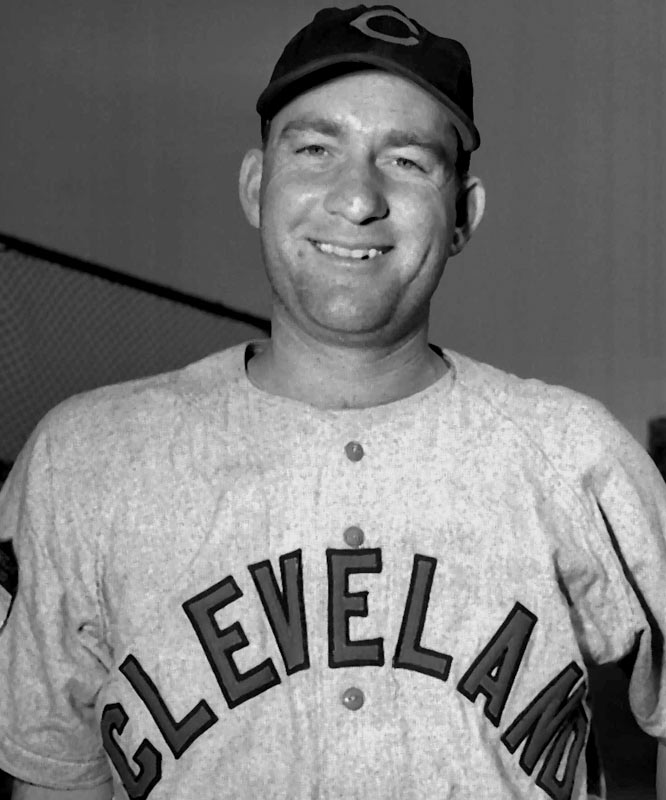
Shortstop: Bob Lemon. I know. We may be really nuts for placing one of the greatest pitches in baseball history at shortstop. Maybe all we need is to let Bob pitch as the remedy for so many weaknesses and sins at every other spot in the lineup basket, but we didn’t play the hand that way. Lemon was 23-7 with a 2.72 ERA for the 1954 AL Champion Cleveland indians, but we have him down to play at short – where he batted .300 in 1939 for Springfield and New Orleans.

Guess who bats clean up on this dazzling squad?

LF: Jim Lemon. One can never really squeeze too many Lemons into a Fruits & Nutts All Star team lineup – and most especially if one is slugging Jim Lemon, our choice for left field. We are taking Jim for his 1960 season with Washington, a year in which he hit .269 while banging out 38 HR too. GO BIG JIM!

CF: Nick Orange. On paper, Orange reads like a well-rounded lead-off hitter. We drafted Nick for his 1940 .353 BA with Class D Johnstown in the hope that his fantasy production for our F&N club could actually surpass all the things he once failed to do in reality beyond 1940. Nick’s early record reads like one of the “might-have-been” boys from the World War II years.

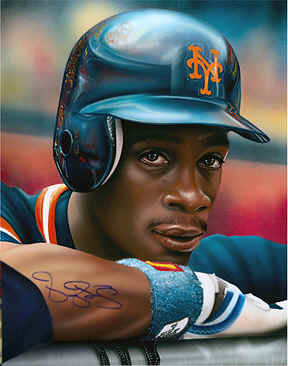
RF: Darryl Strawberry. What can I tell you that you don’t already know? The guy’s power numbers jump off the record book page as one the great “might-have-been” players of all time. We are taking Darryl for his 1988 year and the .269 BA with 39 HR he cranked out for the New York Mets. Sadly, Darryl Strawberry was not among those almost greats whose career was halted by war. The only war that ever stopped Darryl was the personal one that dominated what should have been his most productive years.

But, hey! The purpose of this exercise was not to dissect the psyche of Darryl Strawberry, but to present the starting (and finishing) position roster for the Fruits & Nutts All Stars as an exercise in playful diversion from tougher topics. Hope you can hang with this healthy bowl of fiber-worthy warriors.

Pardon me, but the skies just darkened outside. Looks like it’s going to rain.

The All Star Game: The Hype is in the Name itself

July 5, 2010

Guess who hit the first home run in All Star Game history back in 1933? Hint: He had a reputation for the compulsive pursuit of food, drink, women, and some of the mightiest home runs ever swatted by an unofficial sultan of same.

When Chicago Tribune sports editor Arch Ward came up with the idea for an annual All Star Game to be played between the very best players of the American and National Leagues, it’s doubtful he foresaw the mutations that would change the game from one that players and fans in 1933 really cared about to the watered down event it has become today in 2010.

America changed. So did baseball. Television and population increase were at the heart of it all, but, of course, things never are quite that simple. The spread and growth of new people with new interests over the years has allowed baseball to move teams, expand the number of major league franchises, and to pitch its game to the public far  differently – but this market momentum has all taken place in the middle of a much greater and far more diversified competition from other sports and other new leisure-time attractions.

Net effect? With almost twice the number of clubs that existed in 1933 (30 now to 16 then), the Baseball All Star Game has become less of a “best players in baseball” contest and more of a “most popular players from each team” competition.

As an Astros fan, I’m happy that our great defensive center fielder, Michael Bourn, got selected as our team representative, but that fact doesn’t cause me to vacate the belief that there are a number of other guys from other clubs out there who are far more deserving this year than our .260-hitting Astros guy. As good as he is, I don’t even think that Michael Bourn is actually better than pitcher Roy Oswalt at this point in his MLB career. I just think that Oswalt’s poor W-L record from poor hitting support has made him a less popular choice than Bourn, plus the NL does have some good pitchers out there with records that make them more deserving, but I think you get my point, anyway.

The All Star Game is what it is. It’s a break in the pennant race and a chance for fans to watch an exhibition game between some of the best and just about all of the most popular players from each of thirty major league teams. Plus, the home run hitting contest conducted the night prior to the game is still fun to watch as a friendly father-son/daughter playground activity.

It’s just too bad that the outcome of this meaningless recess from the school of pennant race reality has to determine something as important as home team advantage in the World Series!

Commissioner Bud Selig says he made the change in the interest of helping the players and fans care more about the outcome of the All Star Game.

Oh really, Mr. Selig? Is that what you were thinking?

If so, well then – how about making the runner-up in the home run hitting contest seal the deal by kissing the posterior of the winner at home plate during the trophy presentation? An incentive to win built on that level might even get Mark McGwire to come out of retirement to take on all those sluggers from that House of Representatives steroid investigation committee in a special home run hitting contest between him and them only!

And the McGwire-Effect would really make about as much sense as the All Star Game winner does as the determining factor on home field advantage in the World Series.

The Freedom Coin of the USA

July 4, 2010

Happy Fourth of July, Everyone!

This year, my thoughts turn to a subject that I’ve used for years in my work with adolescents – and that’s what I like to call “The Freedom Coin.” It’s a very simple idea, but it was at the heart of our Declaration of Independence and Bill of Rights just as much as it is the big lesson about “growing up.” It’s so important, in fact, that we may as well put it as it is: No one grows up until they are prepared to accept responsibility for the consequences of their own freely chosen actions or inactions.

And there it is in one gulp – a living definition of The Freedom Coin:

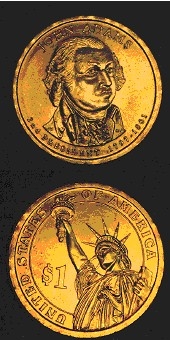
“Freedom” is simply one face of an inseparably two-sided coin. The other side also has a name – and that name is “Responsibility.”

In life, both as individuals and as a nation, we get as much freedom as we are willing to take responsibility for using.

When we fail to grasp this simple, but not-always-easy-or-convenient-to-live-by concept of The Freedom Coin, we are like the teenager who wants to use the car, but who also wants mom or dad to pay for any tickets or jail bonds that may result from a night on the town.

“I demand my rights!” It’s a statement in our beautiful USA that we hear often these days. In fact, we even hear it from people who are here in this country illegally – and we hear it because it’s always true. All of us – every living human being on this good earth – has a right to decent treatment from others as a fellow human being. It’s just that the cry for rights simply begs off the question that is always raised by The Freedom Coin: Are you willing to take responsibility for your own behavior in regard to this right you seek? Or do you simply want the keys to the car while someone else pays for the gas?

It’s too bad the Founding Fathers did not also write a corresponding Bill of Responsibilities to go with their fine effort on the Bill of Rights. It would’ve been tougher, but definitely possible. Otherwise, the Bill of Rights would not have been important as a statement of basic freedoms that we value in America. As freedoms, each statement in the Bill of Rights, even if their costs are totally unstated or merely implied,  also carries with it certain inseparable responsibilities as the other sides of each rights coin on the list.

Imagine our USA as a nation where all the adults lived by a full grasp of The Freedom Coin. It will never happen, except in a perfect world, because the real world is totally over-run with greedy folks, rampant sociopathy, and others who are simply dedicated to remaining emotional children for the rest of their lives. It’s still fun to play with the idea of a nation where our leaders, at least, grasped and lived by a working model  of the inseparable relationship between freedom and responsibility in their personal actions.

Imagine a nation where …

… politicians placed the good of the people ahead of personal gain;

… captains of industry pursued healthy profits, but drew the line on decisions that put corporate gain ahead of the welfare of their employees and the communities they purportedly served;

… moral leaders possessed an ability to say “no” sometimes to the temptation of using certain human misery causes as simply their stepping-stone paths to personal attention and power on the national level;

… children were always more than another redundant  bi-product of sexual promiscuity;

… moms and dads really tried to work out their issues rather than divorcing each other  and going off  to repeat similarly unworkable hellhole fates with “new” partners; and, finally,

… baseball hired a commissioner who finally said: “From now on to the crack of doom, there will be no designated hitters; and all future World Series games will be played in the daytime so the kids can watch them too.”

Ah, yes! – The good old Freedom Coin! It never goes away, whether we pick it up or not. I’d like to pick up The Coin, on the content level, anyway, by adding it to a new supercharged and enhanced version of the Pledge of Allegiance. The new Pledge would read like the following as my way of wishing all of you a Most Happy and Safe Fourth of July Celebration 2010:

I pledge Allegiance to the Flag,

Of the United States of America,

And to the Republic,

For which it Stands,

One Nation,

Under God,

Indivisible,

With Liberty and Justice,

Freedom and Responsibility,

For All.

Baseball Item Searches: Basic Rules of the Road

July 3, 2010

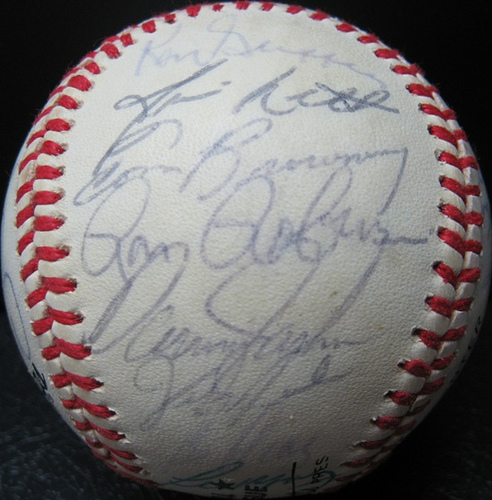
Golden Rule: Never trace over fading signatures with a new pen to make them easier to read. You have just destroyed the historical/commercial value of the item when you have done so.

What’s the difference between a collectible and an artifact? It’s all in the eye and the motivation of the beholder. If you keep something of history because it has commercial value, or you simply like gathering items into your own control, it’s a collectible. If you search for, find, and save an item because you know it is important to history, and your further search from there is for a place where it will be protected and put to use by historians and the interested public, it’s an artifact.

Both are important concepts to a better understanding of our own motivations. The word “artifact” just sounds nobler than collectible because it is. All artifacts may also be viewed as collectibles, but not all collectibles have much to any value as artifacts of history. For example, the ball that Babe Ruth hit for his 60th home run in 1927 is clearly an artifact that might have become one of the uniquely revered and traded collectible items in the world. Fortunately, however, the Ruth #60 homer ball is in safekeeping and on display at the National Baseball Hall of Fame in Cooperstown, New York as one of the unique artifacts in baseball history.

In recent years, baseball card companies have seized upon the addiction-seed and consumer-need for uniqueness that runs rampant among collectors. As a result, these companies have produced an ironic stream of “limited edition” cards, and always for “a few dollars more” in price above the normal “see-em-everyday” cards that everyone else buys at a cheap rate. These rarer baseball cards will likely never be collectibles on the level of the famous 1909 Honus Wagner cards, unless someone wants to start a museum dedicated to the dual history of greed and compulsion.

Some things stand out that collectors and researchers need to keep in mind when they are searching for those true dual-identity collectibles and artifacts in all those attic trunks out there,  somewhere. Here are a few of the big ones:

(1.) Carpe Diem: Go into the search with as much knowledge as you can bring to the table, but never put off an open opportunity to search because you think you aren’t ready. That special old dusty trunk in your grandmother’s attic may not be there later when you think you are ready. Check it out now – before someone else throws it out or hauls it away.

(2) The Golden Rule: If you run across an old baseball, or any other item, with faded signatures, do NOT trace over these original writings with a fresh ballpoint pen or marker point. The artifactual and collectible value of these items is destroyed from the moment that anyone works them over with a new pen.

(3) Handling: Use cloth gloves when handling old items, especially anything that is highly sensitive to chemical reaction with oils from the skin. Be careful where you touch items. Keep your bare hands off signed balls as much as possible and never put your fingers on the front side of photos. Common sense is the major rule here, but remember the gloves. They will save you a lot of heartache that cannot always be undone.

(4) Storage: Keep old items out of the sunlight, especially items that have been signed. The sunlight, and even the artificial light of a home or office, will eat up the color in the item faster than you can ever imagine. Put your collectibles/artifacts in a sock drawer or safe deposit box until they are either supplied with protective light ray covers or relocated to a professionally curated museum storage environment. Cooler temperatures are also better for items that are being stored. Never leave them in one of those hothouse storage rooms that get up to 120 degrees in the shade during the summertime.

(5) Appraisals: Get your items appraised as collectibles and artifacts. That may or may not require you to seek the counsel of more than one expert. As per usual, experts in the commercial collectible field may or may not be aware of an item’s value as an artifact of history – and an expert on history may or may not be aware of an item’s commercial value.

(6) Insurance: If you have homeowner’s insurance, explore the cost of adding an itemized list of valuable items to your policy.  Make sure you have photographed and described each item for insurance purposes – and placed your own copy of the list in either a safe deposit box or a secure separate location from your residence.

(7) Make a Record: Write down what you know about the item you are keeping, including how you came to control it. Make sure the record is placed in storage with the item. If something happens to you, the item cannot speak for itself. Make sure your record includes some affirmation of your will for the item in the event of your own demise. Even our close family members and friends may not know our minds as to the disposition of our collections unless we have spelled out our intentions for them somewhere. Very expensive items should be included in one’s official will.

Those are the basics. Other tips are most welcomed here as comments on this article.

Houston Monarch Photos Now Available at Library

July 2, 2010

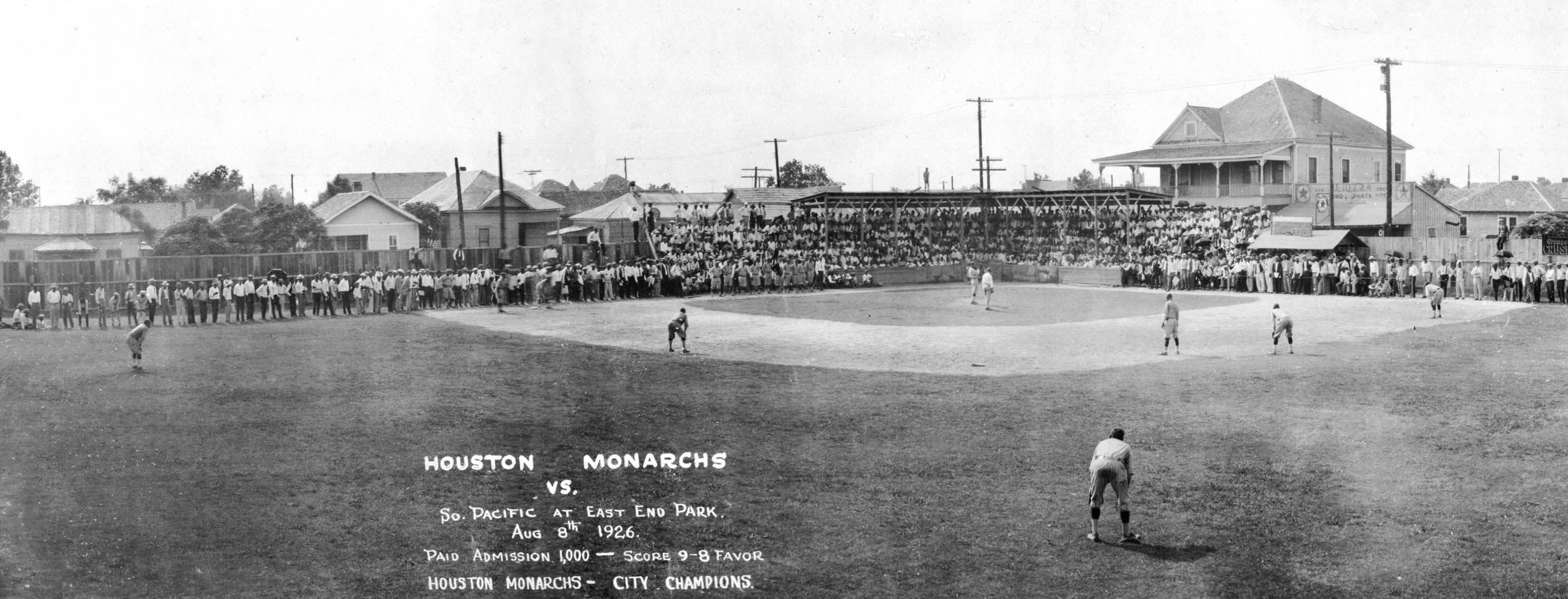
At East End Park in August 1926, the Houston Monarchs defeated Southern Pacific for the City Championship in Negro League Baseball. (Compliments of Houston Metropolitan Research Center, Houston Public Library – All the photos used in this column.)

When Frank Liuzza died suddenly of heart failure on January 2, 2010, many of us lost a good friend, but the greater potential loss fell upon the City of Houston. You see, Frank’s father and uncle, John and James Liuzza, had been the Fathers of Negro League Baseball in Houston with the 1924 founding of the Houston Monarchs, a team that would come to be known as the Houston Black Buffs in the 1930s. The entire operation lived on to about 1954, when racial integration brought about the end of the talent flow through the previously all black baseball leagues across America. By the 1950s, even the Negro League clubs were integrating in self-defense, employing a few white players for the sake of filling out their rosters.

It was left upon the shoulders of young Frank Liuzza to shut down the operation that his family once  started and sustained through the hard times of segregation and economic depression. In that less sentimental era, few artifacts were preserved for history. To our limited knowledge, no Monarch or Black Buff uniforms were preserved. No equipment was spared. And hardly any names or records of the player had been saved by the Liuzza family or the media.

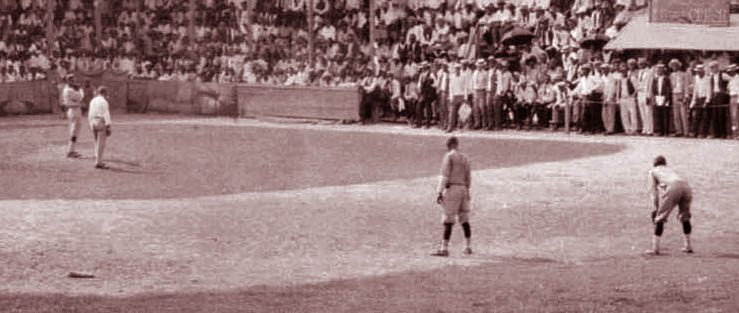
A closer crop view from the panorama shows that the championship game date was August 8, 1926 and that 1,000 fans showed up to watch the Houston Monarchs defeat Southern Pacific, 9-8. That two-story place behind the main grandstand was the Liuzza family home.

AUGUST 8, 1926, EAST END PARK, HOUSTON: We are not really sure which team is batting in this segment from the panorama, but check out the runner’s lead off second base. Also note that the umpire appears to be calling balls and strikes from behind the pitcher.

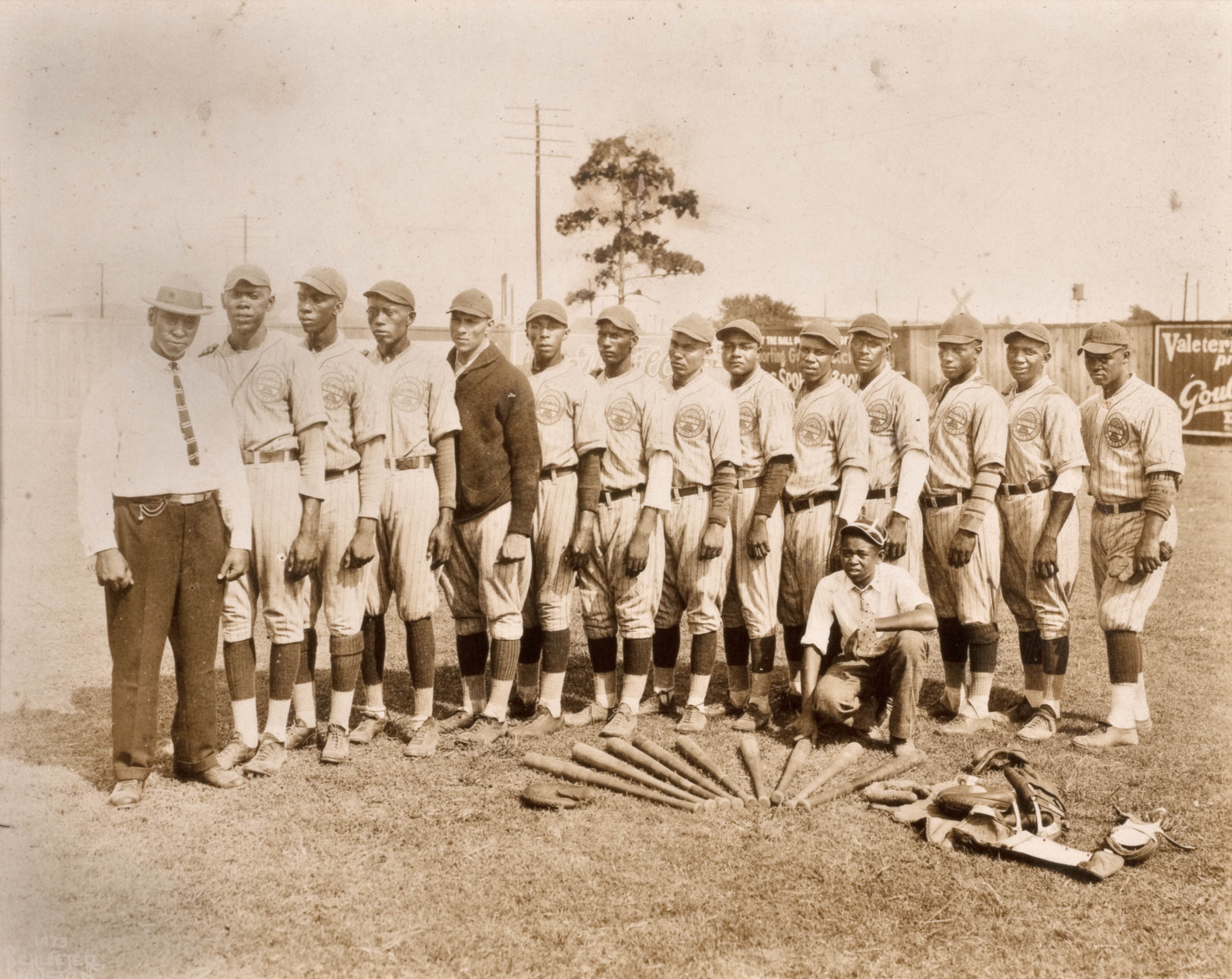
What did survive was precious. The three main photos on display in this article might have been lost to the public forever, had it not been for the will of Frank Liuzza and the willingness of his loving widow, Dr. Sue Hepler-Liuzza, to follow through with a donation that now makes them available to those who research and write for history at the downtown Houston Public Library.

Thank you forever, Dr. Hepler-Liuzza. Houston is fortunate that you brought your big Chicago heart with you when you moved here years ago. I will always celebrate the fact that we have shared a close friendship over the course of our entire adult lives – from Tulane in New Orleans to black baseball in Houston – and always made the best of it. Even if we don’t see each other that often, I shall always consider you to be one of my closest friends in the world. Shared interest and affinity make for some broad and deep bonds, even when frequent physical contact doesn’t happen. Got me on that?

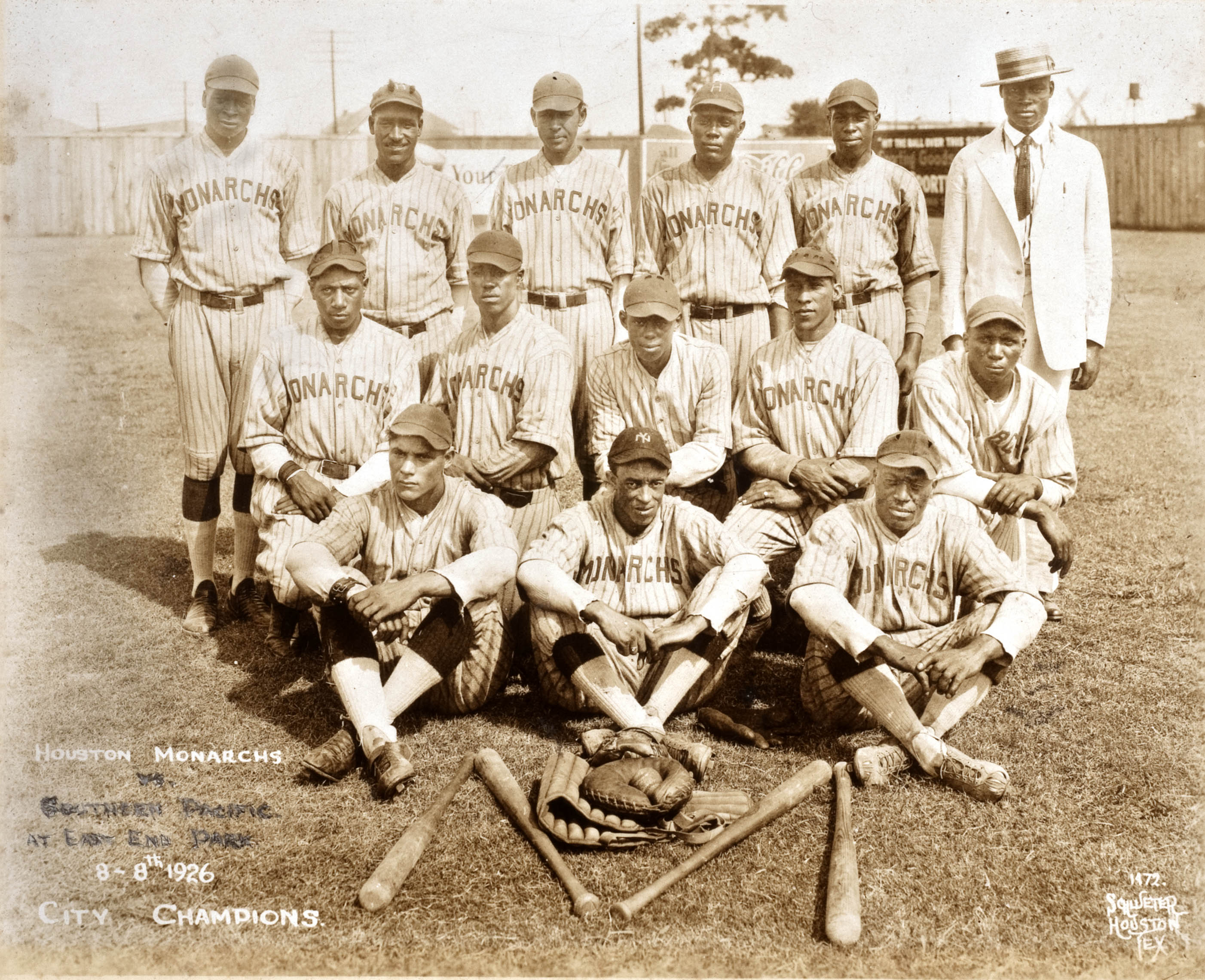
The 1926 City of Houston Champion Houston Monarchs and their only manager for 30 years, Mr. Arthur Lee Williams. None of the players in this photo are currently identifiable.

Photo purchase for framing and use in publications is now available to those who may be interested in any of these three works. Contact the Director of Photographic Collections, Mr. Joe Draut, at the downtown library for further details. The phone number for Mr. Draut is 713-213-1391.

It’s a shame that records of individual player identities have been lost over time, but, at least, we now have these photos for comparison to others we may find buried by accident in the pages of Houston’s newspaper past. Of course, if you recognize anyone in either of the two team photos shown here, please pass that information on to Mr. Draut or me. One of my ongoing jobs, by avocation, is filling in the cracks of lost history, however small, wherever possible. Now, if you happen to still have a uniform that your great-grandfather wore, please step forward and make that precious item known to the history of Houston Negro League baseball history as well. This isn’t about money. It’s about the records of those old Monarch players as contributions to our local culture and its history. And that’s much bigger than the almighty dollar.

Somebody connected to the Negro League Past in Houston needs to speak up. For now, we hardly even know the players’ names, let alone their batting averages and pitching records. And that fact, my friends, is a bloody, crying shame.

Southern Pacific lost to the Houston Monarchs on that hot day in August 1926 at East End Park on Clines, just off Clinton Drive, in the near east area close to downtown in the Fifth Ward. Even the name of the SP manager hs failed to survive over time.

Houston’s early record in historical preservation wasn’t too good, but we do have a number of groups and individuals in town now working to put together all the shattered pieces of it that were torn down in the past to build literal and figurative parking lots on our landscape.

We could always use more people in the search. More time. More money. And more caring. It’s a fight that needs to go on forever, whether we are talking about the histories of our many varied Houston sub-cultures, anciently forgotten baseball players, decimated architecture, churches of large and small impact upon the everyday lives of Houstonians, entertainment venues, or businesses that saved or spurred the local economy in the past. The era for simply tearing something old down and putting up another new  strip shopping center needs some brakes.

Think about looking around for what you might do in behalf of historical preservation and go after it. This great city both deserves and needs your help. Think about what’s in your attic, or better yet, your grandmother’s attic. Check these places out. And never throw away an old box that’s been collecting dust and cobwebs for a hundred years without checking out its contents first. The contemporary “experts” who advocate that people remove the clutter from their lives by simply throwing old boxes away un-inspected for the sake of order are not historians.

Take responsibility for inspecting what you may have stored in boxes for years. And, hey, if you run across an old “Monarch” uniform, keep it, but tell somebody about it after you’ve secured it somewhere else and have now identified it for what it is. Then throw the other stuff out. If you’re not real sure what’s valuable, go through your stuff with someone who may be able to help you make the call on certain items. Then toss the other “junk” away.

End of soap box address. For today, anyway. I’m going to have to do a whole article on sports artifact searches in the near future.

Watty Watkins: Houston Sandlotter Made It Big

July 1, 2010

George "Watty" Watkins, OF, BL/TR HT: 6'1" WT: 175 Lbs

Born in Freestone County, Texas on June 4, 1900, but mostly raised on the sandlots of Houston, George “Watty” Watkins turned out to be one of our local boys who really made good.

Breaking in with Marshall and Houston in 1925, Watty played for Austin, Houston, and Beaumont over the next couple of years before earning the starting job as center fielder for the 1928 Houston Buffs in that very special year. The Buffs took the Texas League pennant and Dixie Series championship in 1928 and, even more importantly, it all took place in the first season of their splendid new home in the East End – in the place we Houstonians all came to know and love as Buff Stadium.

Watkins hit .306 with 177 hits, 32 doubles, 21 triples, and 14 homers for the 1928 Buffs, as he also established himself as a killer defensive player in the large central pasture of old Buff Stadium. An even more powerful year with Rochester in 1929 (,337 BA, 20 HR) earned Watty a promotion to the 1930 parent St. Louis Cardinals.

Watkins went “lights on bright” in 1930, hitting .373 and playing  a big role in the St. Louis pennant victory. The Cards went on to a 4-2 loss to the Philadelphia A’s in the 1930 World Series, but talent would rematch the clubs in the 1931 Classic. It would be the bat of Watty Watkins, including a home run, that fired a Game Seven victory for all the marbles this time. Watty Watkins was King of the World when he came home to Houston that winter.

After hitting .312 with the 1932 Cardinals, Watty dropped to .278 in 1933 and was dealt to the New York Giants prior t the 1934 season, thus, sadly missing the cardinal emergence as the Gashouse Gang.

Faltering offensive production for  the Giants in 1934, the Phillies in 1935, and the Phillies-Dodgers in 1936 ended the big league career of Watty Watkins. In spite of the fact that his last four big league seasons played out like the post-midnight segment of Cinderella’s big evening, questions about Watty’s playing health over that period of time may possibly explain his sudden offensive drop off the cliff. It was an era of poor diagnostics and few good choices on medical corrections. Combine that state of medical science in what passed back then for sports medicine – and mix that again with a “shut-up-and-play” personality like George “Watty” Watkins – and we have a formula for an unexplained flat tire on the highway to baseball greatness.

Watty wasn’t quite ready to hang ’em up after the 1936 season. He came back to play 100 games for his hometown Houston Buffs. He batted a most respectable .273, but here’s the more telling story of his lost power ability. Of his 105 Buff hits in 1937, Watkins collected only 21 double doubles and 4 triples with 0 (nada) homers. By the time I was born on December 31, 1937, Watty Watkins was about three months past the date of his last trip to the plate as a professional baseball player.

As a kid growing up in Houston, the echo of his name from the writings and words of the men who witnessed his play as fans or covered his play as reporters reached my ears long before I ever had the presence of mind to look into this background on my own.

George Watkins stayed active in the Houston baseball community until his death in Houston on June 1, 1970, just three days short of his 70th birthday. He was buried at the Broyles Chapel Cemetery in Palestine, Texas.

The rest of the story goes on from here. The other day, I received a wonderful e-mail message from a fellow named John Watkins, who introduced himself to me as the great-nephew of George “Watty” Watkins. John also sent me a scanned copy of the original program from the opening of the initial Houston Sports Museum back in the 1960s. Watkins had learned about me from one of my Pecan Park Eagle articles on the reopening of the museum at Finger’s.

I would especially like to invite John Watkins to comment further here on his great-uncle. Watty Watkins was one of the best all-time Buffs and he had one of the hottest starts in major league history. I’m sure we could all benefit from John’s family view on this great former Buff and Cardinal.