Archive for the ‘Uncategorized’ Category

The Ghost of Abner Doubleday

April 6, 2011

Abner Doubleday the Mystic appears to have been far more interested in Hinduism than he ever was in baseball. In fact, we have plenty of history that ties him to the former and nothing really credible at all that connects him to the latter.

Abner Doubleday did a lot of things in his life, but, as all informed students of the game now fully understand, inventing baseball wasn’t one of them. As a distinguished officer in the Union Army during the Civil War, it was actually Doubleday who ordered the first return cannon-shot on the Confederates who came and fired the first preemptive volley on the American forces at Fort Sumter, South Carolina.

Much later, Abner Doubleday served with the post-war occupation army in Galveston, Texas, when he took over in November 1866 as Major General of the Union forces stationed in the island city. He also served in Galveston as Assistant Director of the Freedman’s Bureau until August 1, 1867. During this time, on April 21, 1867, the 31st anniversary of the The Battle of San Jacinto for Texas Independence, the occasion was celebrated at the Battlegrounds with a game of base ball won by the Houston Stonewalls over the Galveston Robert E. Lees by a score of 35-2.

Although it’s always been rumored that the Galveston club included some Union soldier-players, it’s hard to see how these men could bring themselves to either play, or be accepted by, a team calling themselves the “Robert E. Lees.” If they did, it was a public relations move to top all others in the post-war South. Of course, if the Union boys did play a part in that 35-2 smothering that Galveston took from Houston that day, it may have set things back a step or too as well.

At any rate, there is no surviving evidence that Abner Doubleday even knew about the San Jacinto Day game of 1867, let alone, actually attended or participated.

After the war, Doubleday was living in San Francisco in 1870 when he applied for a patent to build the first railed street car service in the United States. When Doubleday was reassigned by the Army Recruiting Service from the bay area, he sold his cable car rights to the people who actually built the first such service in San Francisco.

On the spiritual side, Doubleday became active in the American Theosophical Society after a later move to New Jersey. In 1878, he became the group’s leader after the two founders moved to India for further study. The group held that their purpose was to explore and find the root threads that connect all religions, but they were heavily influenced, as was Doubleday too, apparently, by a lot of beliefs that come from Hinduism.

Doubleday understood and believed in both karma and reincarnation. If that were the case, it’s too bad he wasn’t also, at least, an avid baseball fan. Karma would have helped him understand the Chicago Cubs. Reincarnation (which, as I understand things, is about “keep doing things until you get it right”) could have helped him understand all of the Brooklyn Dodger World Series matches with the New York Yankees.

Oh well. Count me among those who don’t mind that baseball made a temporary mistake in naming Doubleday and Cooperstown as the inventor and birthplace of baseball. What a beautiful setting that place really is. If baseball was not invented there, as the experts and evidence now shows that it was not, I’m just one of those who agree that it should have been.

Baseball: A Matter of Time

April 5, 2011


"Hitting is timing. The pitcher's job is to upset the hitter's timing." - Warren Spahn.


For a game that isn’t governed by the clock, baseball is endlessly effected from start to finish by the way players handle the timing of just about everything thing they do. Even batters work beyond the wisdom of Mr. Spahn to upset the timing of pitchers too. A good hitter may sometimes take a certain hittable pitch for a strike in a non-critical situation in the hope that his decision will make its way into the pitcher’s book on what to throw the batter at a later time. When that strategy works and the batter then delivers with a key hit, we must fairly conclude that batter, indeed, has upset the pitcher’s  timing on when and where and to whom he throws that last hit-bound pitch.

Mr. Spahn’s statement, of course, comes up on every pitch. If a batter is thinking fastball, up and in, and the pitcher throws him a curve, low and away, or a change-up that left the hand looking just like a fastball at its release point, the chances are strong that the batter’s timing will be way off any chance of hitting the actual pitch delivered.

A pitcher who can do that sort of thing often enough will keep the batter’s club off the ball’s sweet spot marriage of objects often enough to make pitching look like a piece of cake or a walk in the park. In the old days, when pitchers like Spahnie were allowed to finish what they started, one of the great joys was watching the innings roll by as a succession of pop flies, easy grounders, and occasional strike outs. Warren Spahn was on his game, upsetting the timing of the batters he faced, and well on his way to winning again.

Beyond the pitcher-batter cat-and-mouse game on timing, look at all the other ways it comes up in baseball. Take base runners, for example. Good base stealers aren’t all speed, although no one can deny the importance of fast feet. Quickness enters into the picture too, along with a runner’s ability to note facts like how much of a lead he can get off a certain pitcher, how the catcher watches and throws, how many precise steps are open to him on a lead from any base, how’s the running soil he has to travel. All these considerations and other go into the runner’s timing on an attempted steal – and they are probably 90% of the timing differential between safe and out.

On defense, fielder positioning is absolutely key to the timing on all “make-the-0ut” plays. “In or out” and “left or right” are the cross-hair choices on where each fielder is going to play every pitch in every game situation. Connie Mack, the fifty year manager of the old Philadelphia A’s, was an obsessive proponent of these micromanagement points throughout each game. If Mack did not think a fielder was handling that function, he would be up on the dugout steps, signaling the changes he wanted from a fielder with a rolled-up scorecard.

The less range possessed by a fielder, the more important ii is that he starts out standing nearest the spot of greatest batted ball probability. The timing on a Carlos Lee catch, for example, is helped a lot by how easy it is for him to be where he needs to be when the ball comes down from the sky. Because of his limited foot speed, the balls that Lee cannot reach often make him appear to have no range at all. I’m not here t argue that point, just to note that the better you are at anticipating the flight plan of the batted ball, the easier its going to be to cover your range deficiencies.

Now, Joe DiMaggio, for example, was noted for his graceful timing on long run catches. That quality, I think, goes back to Joe D’s uncanny ability to position himself in personal range to the space he would need to cover over the area where the ball was most likely to fly. Things like moving a couple of steps left on right-handed batters hitting against a fastball pitcher were second nature to the great DiMaggio. His shifts got a lot more subtle and complex than simply that one single example – and on every pitch too.

Timing is everything, but on defense, it starts with positioning.

Corner infielders position themselves to defend against all kinds of hitting possibilities on balls hit though the infield. Late in a close game, they may defend against the extra base hit down the line to the potential sacrifice of their positioning on bunts or singles slapped through the wider holes that now exist between their spots and the middle infielders. The middle infielders make their own positioning adjustments too. Play for the double play? Get the out at first? Defend against the hit? All these questions and more go into the positioning decisions that will influence an infielder’s timing on the play that actually unfolds.

And the whole time this is all happening, the pitcher and catcher are quietly thinking: “What can we do on the next pitch to upset the timing on what this guy at bat thinks is going to happen next?”

Speaking of timing, the Houston Astros play their 2011 home opening game this coming Friday night, April 8th. It can’t come soon enough. In fact, it may already be coming too late to spill unadulterated springtime hope all over us longterm Houston fans. As with timing in the actual playing of the game, positioning is critical to the instillation of fresh season hope – and starting off the new year 0 and 3 in Philadelphia isn’t exactly expansive to the range needed for reaching anything close to great expectations for a 2011 playoff berth in Houston.


Those Saturday Serial Days

April 4, 2011

Batman (The Original) 1943

For me, it all started with original Batman serial in 1943. At age five, I could walk about six blocks each Saturday from out little rental duplex on Pecore Street, cross Studewood Avenue by myself, and then make my way straight into the old Studewood Theatre for the weekly showing of “Batman” and transfixation into another world – the world of Gotham City and the original caped crusader’s war on crime and evil.

All I had to do was see that little winged bat introduction logo featured here as I simultaneously tuned my ears to the slow-droning classical-like musical introduction and my voyage to this other land of cliff-hanging action would begin in earnest. For about fifteen minutes each Saturday, for fifteen weeks in a row, the battle between good and evil would play out before the believing eyes and ears of all the faithful who came to cheer Batman and Robin, the Boy Wonder, as they chased down the bad guys and fought with all their might to protect America and our “American way of life.”

Since the original “Batman” was made during World War II, the arch villain here was a Japanese gentleman named “Dr. Daka,” played by American actor J. Carrol Naish, who portrayed the “bad guy” role  with his eyes taped into an Asian slant in the most offensive way by 21st century standards. As little kids, we didn’t care. All we cared about was that Batman existed to protect us from all harm. The fact that the fight scenes often pushed Batman’s eyes away from the viewing slots in his hooded mask, making it easier for the bad guys to knock him out, was lost upon us back then. We just knew that our hero would always find a way to prevail in the end. I had to see the serial again as an adult to see how all the sight line imperfections of our hero’s costume would have made finding the quickest way to the bathroom difficult enough – and actually fighting almost impossible.

Other serials came our way as WWII ended. After my family moved to Pecan Park in the East End in 1945, all my Saturday movie fare attentions shifted to the Avalon Theatre on 75th, just north of the Lawndale intersection.

All serials followed this course: (1) much fist-fighting and car chasing; (2) a lot of gun-shooting with no concern for bystander safety; (3) little attention to technical details. For example, one rocket ship had an adjustment spot on the flight lever that was marked as “take off;” (4) There was a good chance that one of the principle bad guys was going to be played by an actor named Roy Barcroft; (4) fpr 11 to 14 weeks, the serial hero, and/or his girl friend, would be left hanging near certain death at the end of each mid-story chapter; and, (5) in the end, the bad guys would be vanquished, destroyed, wiped out, and killed in ways that they each major villain so richly deserved.

Here are a few of my other favorite serials from back in the day:

The Purple Monster Strikes (1945)

The Purple Monster Strikes (1945). Roy Barcroft stars as a man from Mars who comes to Earth to learn more about jet engine technology. The Martians want to take over our planet, but they don’t know how to build a plane or a rocket ship that can take off again once it lands the first time. The science deficiency of the Martians is pretty fishy. These are the same Martians who already have invented a little box called ” the distance eliminator,” a device that allows them to understand and speak any language to which they are exposed. – And these same brilliant beings don’t how to build an aircraft that can take off again once it lands?

In the end, the Purple Monster’s plans for world domination literally blow him to smithereens.

Serial Social Note: Linda Stirling plays the hero’s girl friend, a role she often plays in these duels between good and evil.

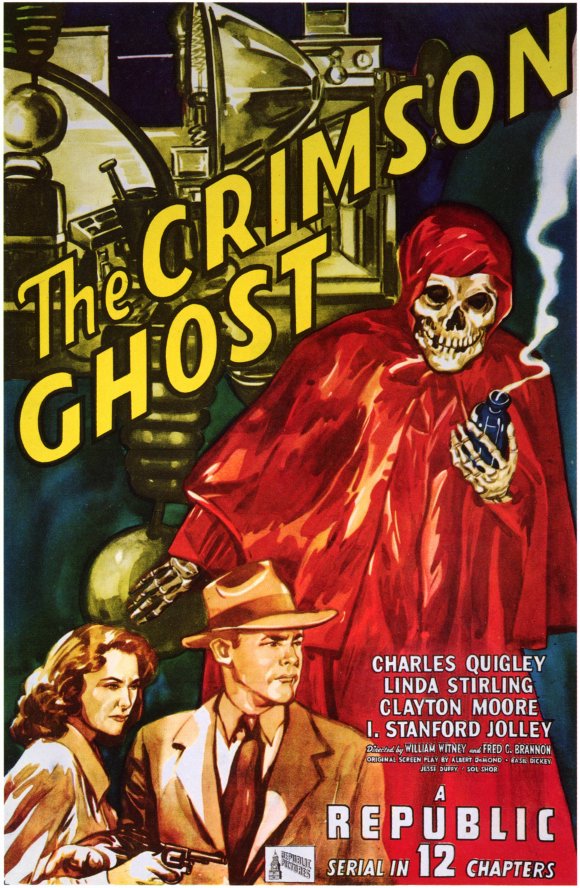
The Crimson Ghost (1946)

The Crimson Ghost (1946). Linda Stirling returns as the hero’s girl friend and Lone Ranger star Clayton Moore appears as an absolute two-dimensional psychopath who will do whatever the evil Crimson Ghost tells him to do if it serves their goal of building a nuclear bomb they can use to take over the world. In the end, of course, the evil professor who scares the cra-zap out of people with his blatant grabs for power is destroyed – as is the socially irredeemable “Ash,” played by the aforementioned Clayton Moore.

King of the Rocket Men (1949)

King of the Rocket Men (1949). Tris Coffin did a great job as the “Rocket Man.” Saving the world from communism and the evil people who wanted to destroy freedom-loving nations  with the atomic bomb was as ongoing struggle for all the big and little superheroes of the late 1940s.

As kids, we loved how quick and easy it was Rocket Man to find and reach all the crime scenes that kept popping up over the fifteen week course of this serial. We also could not quite figure out how Rocket Man was able to use his rocket-firing flight suit without burning the part of his anatomy that is so critical to sitting down for dinner at the end of the day,

The best answer we could logically discern? Aluminum underwear.

As I’ve sort of written in my other earlier brushes with the movie serials memory, these little open-ended stories were part of the suspension bridge that threaded the childhood years for many of us who grew up in the years following World War II. What we derived from this exposure, for better or worse, is a much longer subject for another day, but I now only look back on it in my own life as a time of joy.

Life was was simpler then. Or so it seemed.

When Do We Start Being Real Fans?

April 3, 2011

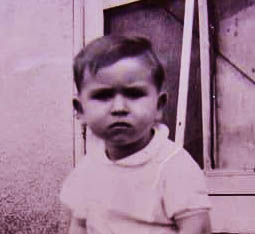
Very Young Houston Buff

Don’t let the worried look fool you. I wasn’t quite old enough in the adjacent picture to care what happened with the Houston Buffs the night before, but I can’t imagine what else might have been on my young worried mind when this ancient photo of me was taken. In fact, I chose to use this photo this morning because the expression pretty well characterizes in my most personal way of showing disappointment how a real fan reacts to the loss of his team.

When the Astros dropped that Opening Day beauty in the ninth inning at Philadelphia by 5-4 on Friday, the expression seen here is exactly how I felt about it. The outside of me may have also have looked the same, but there was no one else at home to see me at three o’clock on an end of the work week afternoon – and I sure wasn’t looking in any mirrors.

I did call a friend to vent my frustration. I told him that Friday’s Opening Day “disappointer” (to dabble in Dubya’s creative use of language) was exactly the reason I held off caring all spring about the outcome of games until the regular season started. There’s no need to take a roller coaster ride on the W/L line until the games actually matter.

Then a game like Friday follows – and it’s now been followed by the Wandy Waste that took the mound in our behalf on Saturday.

Am I disappointed? You bet I am. Should I be surprised? I shouldn’t be. Will I continue to care? Yes, I can’t help but care. For better or worse, this is my team – our Houston team. Maybe that’s not a particularly smart way to be, but we’re talking here about what it takes to be a real fan. The subject has nothing to do with intellect. In fact, as an IQ test, most fans would probably fail if our decisions to follow our clubs in spite of the facts was the test of our otherwise sometimes useful brains.

As fans, and especially in the spring, we tend to allow our wishes to fill the cup of good hope with the fluidity of optimism until it overflows and covers all the major  shortcomings of our clubs. I think we do that because real fans are constantly trying to protect themselves from the hard  emotional pain of reality that our teams may sometimes have a bad year, a bad decade, or even a bad century or so, where they don’t play so well. Still, we always know that caring about what happens to our teams is essential to the status of being a real fan – and to accomplish that end, we have to protect ourselves from disappointment with the harsher side of reality as much as possible.

Unfortunately, Friday’s game for Astros fans was probably the last kind of reality-dose that we needed this early in the season. In spite of all our cliche “blow it out your ear” capacities for writing off an Opening Day loss as simply a sad start to a long season that overflows also with hope for rallies and turnarounds down the road, the way the Astros lost Friday turned and twisted the knife on our worst fears: Starter Brett Myers pitches well enough to win and our power-challenged line-up manages to punch out enough singles and one triple by the speedy Michael Bourn to give the Astros a 4-0 lead over one of the best clubs in baseball and a game we should have squeezed dry into the win column, but, oh no. Closer Brandon Lyons comes into the 9th and gives it all away on three runs from six singles and it’s back to the ugly fear we all harbor: We may be good enough to hang tight in some games, but we eventually will get blown away by a lack of power hitting and a relief staff that cannot hold leads.

Nothing happened on Saturday to assuage those fears. In fact, all Saturday did was open the door on the other bigger, even more abysmal fear that we do not want to acknowledge – and that’s simply this: Sometimes, and maybe too often, the starter will just get blasted and the Astros will be out of it from the git-go.

So, in the middle of all this actual “help, the season has started” angst, what’s the answer to our question: When do we start being real fans?

Well, I think it’s more of a process than a date certain. We just ooze our way into becoming real fans, day by day, as we risk more caring about the outcome of our club’s games and daily goings-on. When are we there? I’d day it’s when our “happily or unhappily ever after” capacity for caring binds us individually into supporting our team over time, through thick and thin – and  even when excessive losing pushes us full bore into a dedicated pattern of reality-avoidance – and also onto a belief level that dictates that we will never give up – ever – even if our club has not won a World Series since 1908.

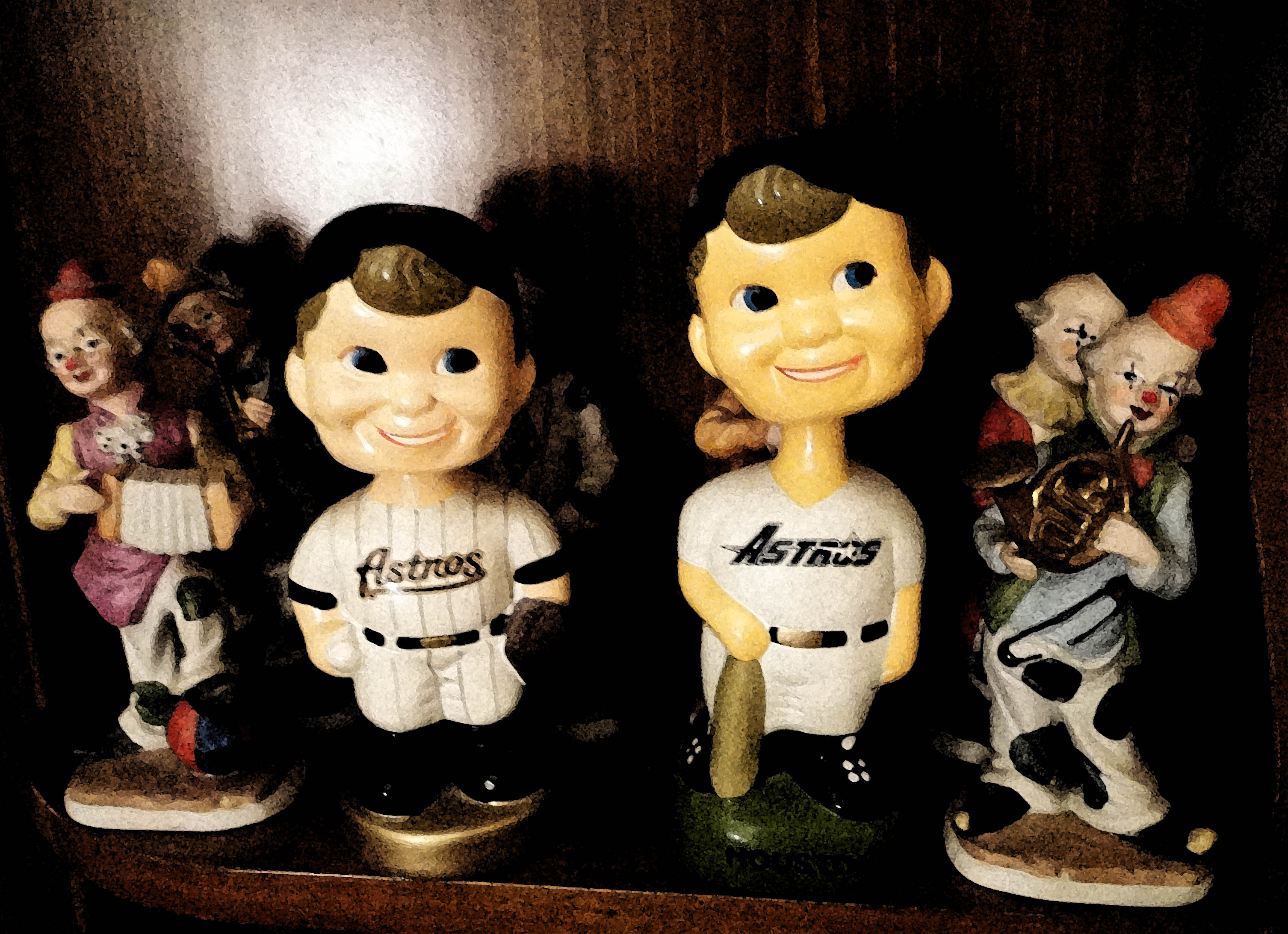
Speaking of Toys in the Attic

April 2, 2011


Our Hearts Connected Through the Joy of Baseball.


How long has it been since you’ve smelled the leather of a really old baseball glove? First dry? Then, with lubricating oil applied?

Do you remember how it felt to take a soft leather glove, or hard leather one too, if you were ever lucky enough to be breaking in a new glove, and, just to feel better about the formation or preservation of a glove “pocket,” you stuck an old baseball in it and then fastened it shut overnight with the aid of some very large rubber bands – or even string?

Those were the days, my friend.

Mix in the sandlot textures of the following day. You take that pampered baby glove and ball out to the sandlot, awaiting the inevitable summer morning assembly of players who will soon come clattering through their front screen door homes to join you on Eagle Field – or wherever it was you happened to play.

Not a mental care in the world stirred to spoil the ascending light and feel of an early June day in the Houston East End. Standing on the sandlot turf, banging around the weathered soil in the naked home plate area, picking up the sweet scent of freshly cut grass from the twilight hours of the night before, there are no thoughts about income taxes, the price of gasoline, the competitive industries of the Chinese government, the threat of terrorism, or the dangers of  stranger predation.

We were just were there. Prepped only for joy in non intellectual terms. We were baseballers. All day baseballers. Just make room for the game and watch us go at it.


Speaking of Toys in the Attic ...


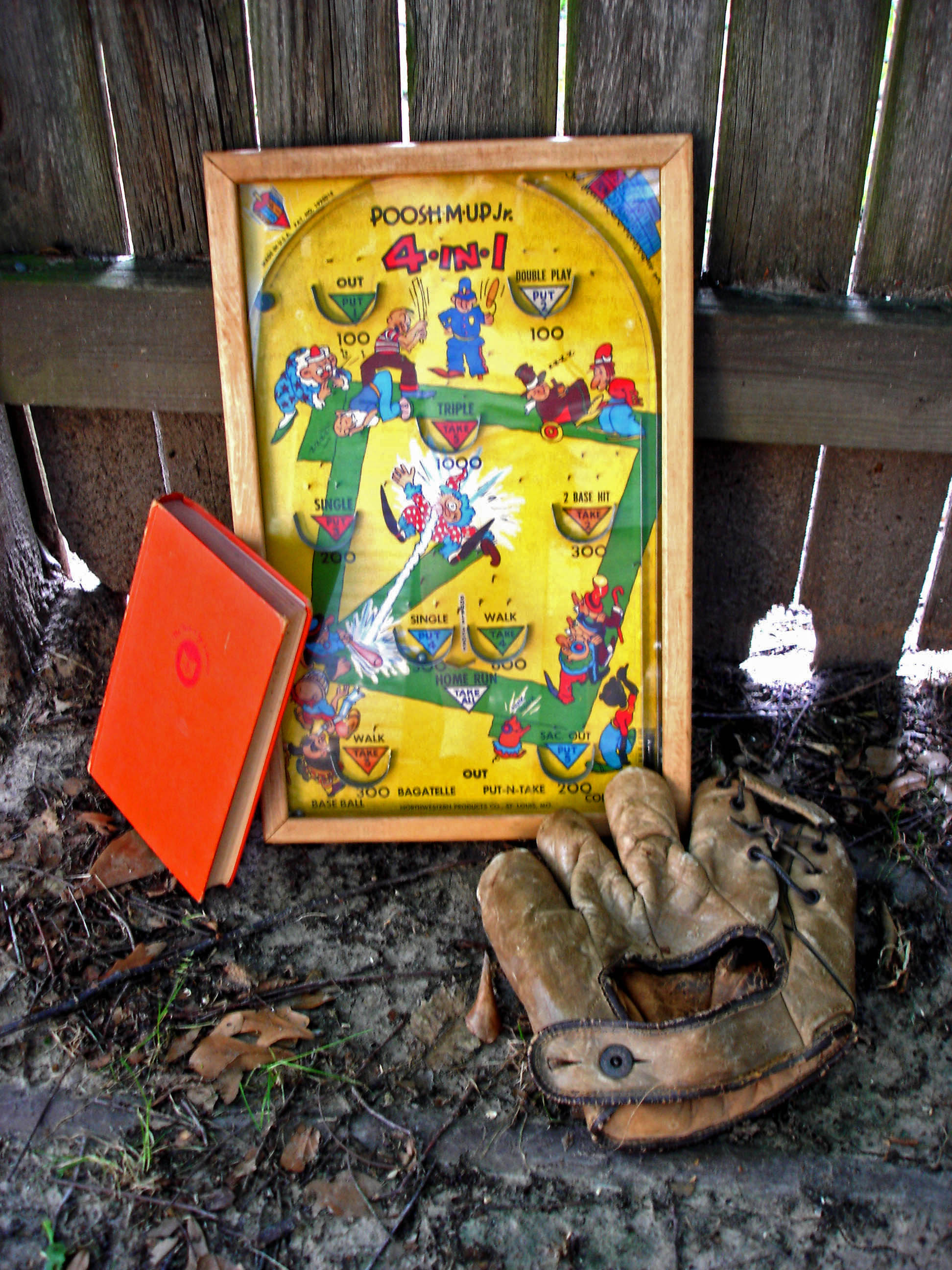
The stuff of those days included our personal items, like old gloves, an occasional baseball board or pinball game, and maybe even a baseball book or two. We weren’t exactly library hounds in those days, but we were literate – and we saw reading as something beyond an activity forced upon us by schools. Reading could take us to worlds that were otherwise beyond our reach. And that little book in the photo at left is just such an example. “Teenage Baseball Stories” was one of the first books I ever owned about baseball. What’s pictured here is the actual book That I’ve had since I was very young – along side an exact copy of the pinball baseball game I used to play in my room during the awful “heat of the day” polio threat hours during which we were kept back from playing ball outside in the summer of 1950. The featured glove in the photo is also a latter-day flea market find, but a pretty accurate version of the same glove that Dad gave me to use on the sandlot a few thousand summers ago.

Sadly, the original glove got discarded years ago. Dad gave. And Dad took away. He seemed to have a compulsive need to throw away or give away anything that was not currently in use by the family. So, after I got a little job and earned enough money to buy a new Rawlings Playmaker, the old glove that resembled the one in our picture here just quietly disappeared.

Back then, the preservation of these old artifacts wasn’t all that important to me either. In fact, all I had, or didn’t have, was extraneous to the joy of the sandlot and my comfortable fit into the  kid culture that thrived in Houston, and all over America, I presume, in the late 1940s and early 1950s.

We sometimes had our differences, and we sometimes duked it out over bad blood issues, but, other than the time our kids from Japonica-Myrtle got into a brief pipe gun war with the Kernel Street kids over control of Eagle Field, we most often settled things in less threatening ways and moved on. My dad put a fast end to the pipe gun war, making us work things out through a game of baseball, which we easily won.

There was just something more tactile and definite about the way we lived in the East End of Houston back in the years that immediately followed World War II. For one thing, many of our fathers were coming back from the second great war and getting started on their own treks into the “American Way of Life.”

Baseball was still America’s Pastime back then too. The NFL would need television to put it on the sports map – and hardly anyone we knew had ever heard anything about the NBA. That was a game for girls shooting two-handed push-em-up or underhand-lob shots.

Segregation and bigotry still ruled Houston in those post WWII days, but even that level of mandated ignorance had little power over the modeling influence that the new back major leaguers were building in the minds of even some of us southern white kids. My big league all star team from that era included: Robin Roberts (R) and Warren Spahn (L); Roy Campanella, c; Stan Musial, 1b; Jackie Robinson, 2b; George Kell, 3b; Phil Rizzuto, ss; Ted Williams, lf; Duke Snider, cf; and Ralph Kiner, rf. – Ralph was no right fielder, but I had to put him somewhere. The “Pirate Prince of Punch”  or the “Bucco Baron of Blast” was too good for his era to leave out.

Bob Boyd would become the first black athlete to integrate a Houston sports team when he joined the Houston Buffs in May 1954. From that active point forward, Houston would be on its way to shedding away the kinds of earlier stupidity, but these changes would also signal the start of organized kid sports programs and movement toward a culture in which both parents worked and single mom families became common.

The days of summer ease and kid life on the sandlot were drawing to a close. They slipped through our fingers quietly, before we even saw it coming and read the implications for lost spontaneity to the generations that came after us. Sometime, by the late 1950s in some places and by the early 1960s in others, the sandlot slipped silently away as an American institution.

Too bad. Their loss is greater than those who have missed the sandlot will ever imagine. All we have left are our ancient memories and a few toys in the attic that our parents could not find in time to discard.


Good Egg Lance Goes 2 for 4 in Cards Opener

April 1, 2011

Good Egg Berkman

Lance Berkman is now the starting right fielder for the St. Louis Cardinals and the number 5 hitter in their lineup, backing up # 3 man, Prince Albert Pujols at first, and # 4 guy, Matt Holliday in left. How perversely the world does turn over all the days of our lives in this ongoing soap opera of major league baseball. Thank God we Astros fans did not have to go through this sort of thing with Jeff Bagwell or Craig Biggio. I’ll never forget how it felt in 1974, going to the Astrodome and seeing Jimmy Wynn there for the first time – as a Los Angeles Dodger. I was happy for Jimmy and the resurgence that the Astros trade for pitcher Claude Osteen produced in his career, but I felt the loss that thousands of other Astros fans felt. Now, to a lesser degree for some of us, and to a greater degree for others of us, we get to go through it again in 2011 over the returns to town of Lance Berkman with the Cardinals and Roy Oswalt with the Phillies.

Lance Berkman got started on the right foot offensively yesterday in the Cardinals’ home opening 5-3 loss to the San Diego Padres in eleven innings. He collected two singles in four official trips and scored one of the Cardinal runs. I have no take on how he did in right field, but I presume that side of his game went acceptably. There was no note of it in the brief Houston Chronicle report and the box score reveals that former Cubs second baseman, Ryan Theriot, now playing shortstop for the Cards, made the only error of the game.

We will just have to play through whatever happens and deal with it. The guys we have now are our 2011 Astros, for better or worse. And we would not have certain younger players with greater upsides had we not dealt away Berkman and Oswalt. Go. Happ! Go Wallace! (Just to name the two most prominent Astros newbies.)

All I can add is that life sometimes drops small favors upon us. Aren’t you glad, as an Astros fan, that we did not have inter-league play back in 1989 during Nolan Ryan’s first season as a Texas Ranger? Think that might have heated up interest in the now deadly dull annual competition between the Astros and Rangers for the Silver Boot Award?

Welcome back to Houston, Good Egg Lance! We’ll try not to scramble you too much while you’re back in town.

Cubs Curse and The Stockholm Syndrome

March 31, 2011

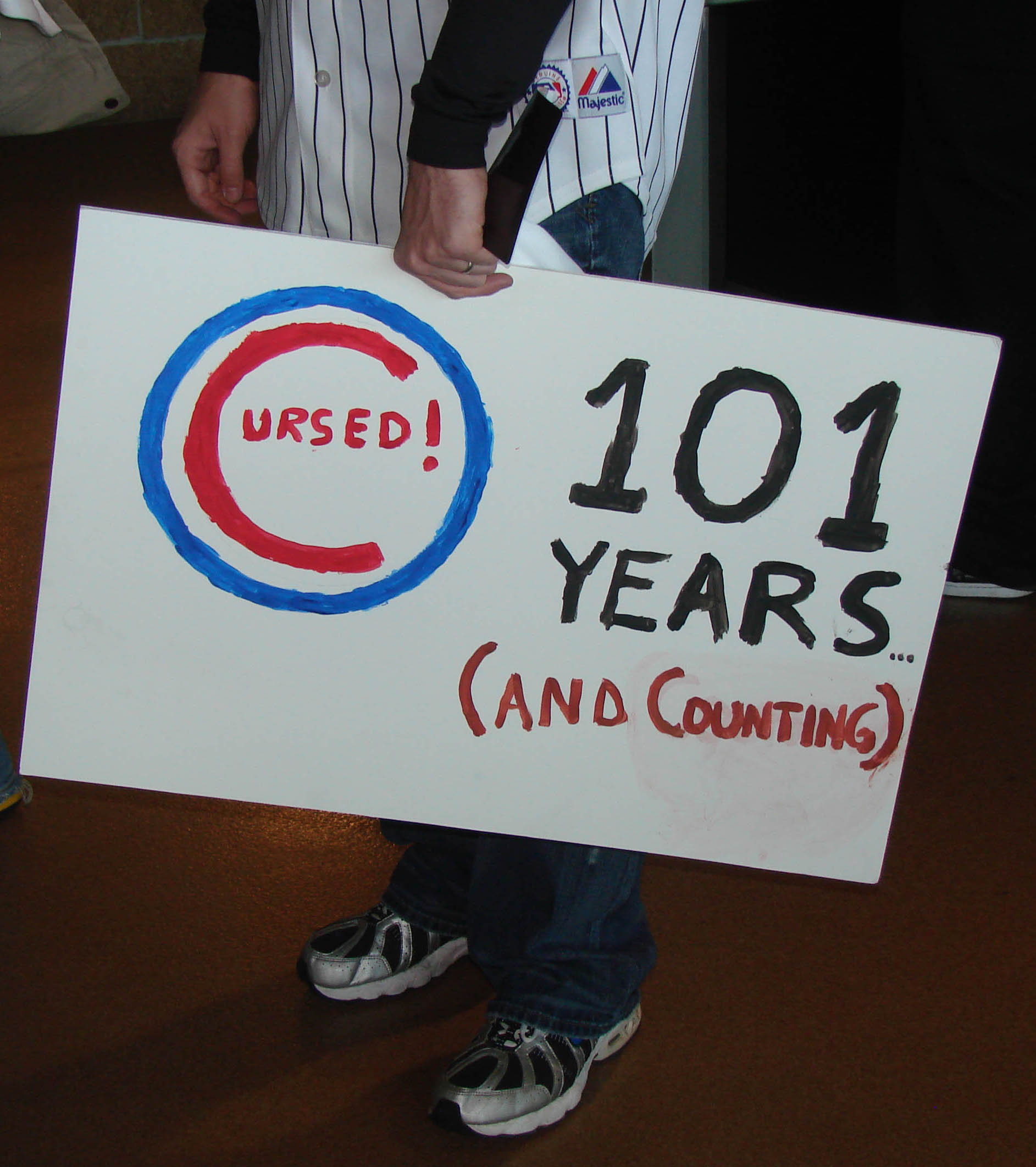
This photo was taken at Minute Maid Park in 2009. Now it's 103 years and counting since the last Chicago Cubs team won a World Series in 1908 - and sixty-six years since the Cubs last played in a World Series back in 1945.

They keep on losing, but still they come. 2011 will be no different. The Chicago Cubs shall continue to take their lumps at Wrigley Field and all the other arenas of major league combat, but still their fans will come to watch and obnoxiously cheer them on, showing up in full Cubs regalia here at our place in Houston and elsewhere.

Why do they do it? What’s it all about? When they reasonably know from an experience that exceeds the lifetimes of .999999 of all Cubs fans, and we are talking about “losing” here, how do the fans of the Cubs continue to muster even the spring hope of winning? We Cubs outsiders probably never will understand it completely, if at all.

The closest condition I can point to as a fit as an explanation for Cubs fans and their ongoing support for their team in spite of all evidence to the contrary that winning is probable is the so-called “Stockholm Syndrome” from psychology. So, what’s the “Stockholm Syndrome?”

in 1973, four Swedes were held captive in a Stockholm bank vault while their violent robber captors held off a siege from police with threats of violence toward their innocent hostages. Later interviews with all four hostages confirmed that each hostage had become identified with their captors during the siege, Some had even contributed to their captors later legal defenses in court. Psychologically, this reaction was viewed as a mental defense by the hostages against getting hurt by their captors during the siege. In a childlike way, the hostages had identified with their captors to try to build a bond that would keep the armed robbers from harming them under fire. They weren’t simply acting. Their minds were being taken over by a belief system that allowed them to justify their support for the bad guys.

This condition, if you will, of course, derived its name from where it was first noted in Stockholm, Sweden in 1973. This “Stockholm Syndrome” has since been identified in several other subsequent situations involving hostages who survived by forming a supportive bond with their captors. Pretty crazy sounding stuff, I know, but remember: We’re talking abnormal psychology here, folks, the kind of stuff that happens to people under long-term threatening situations in which victims are held captive in ways we would all hate as a thought about it ever happening to us.

So, how does the “Stockholm Syndrome” fit as an explanation for Cubs fans? I think it works like this: After one hundred and three years of removal from their last World Series title, the whole Cubs culture is now held hostage by the reality that “losing is a way of life.” Admit it or not, Cubs fans expect to lose – and the fate of losing has now even taken on status as adorable veneration. Whether it’s a memory of the Billy Goat Curse or the Steve Bartman Reach, Cubs fans take it all in stride as integral parts of their destiny to go down in disaster in the final reel of each passing season. They may pretend to believe in winning a World Series as a possibility, but everything in their collective conscious and unconscious experience tells them that losing is always their inevitable rest stop.

Cubs fans cannot even play the card that’s available to most other fans from the original sixteen franchises, other than the St. Louis Browns. Cubs fans cannot even brag that their 90-year old great-grandfathers remember their last Cubs World Series champion. All the great-grandpa Cub fans from 1908 have been in the ground or smoked into urns for years now. And, if there is a survivor from 1908, it’s not likely that he holds on to any memories of relevant import.

“Tinker to Evers to who?”

“That’s right, Grandpa! Who’s on first!”

Yes, I think the “Stockholm Syndrome” is a cap that fits the Cubs Nation well. They are a culture totally dedicated by experience and expectation to the reality of losing as a way of life for their kind. I guess we could stop short and just call it a bad case of “1908-itits” that affects our North Chicago brethren and their WGN convert-level class, but that descriptor doesn’t carry the issue far enough.

“Itis” is a medical suffix that usually gets attached to any condition arising from acute irritation. And that doesn’t fit the affliction that blankets the Cubs den. Their condition is chronic. And it stopped being merely irritating about a thousand baseball blood baths ago. Cubs fans had to either die from losing or start adoring its inevitability. Like the people who got vault-stuffed in Stockholm, Cubs fans chose the latter – to start adoring their captor – and their’s was named “Loser.”

.

Sounds Like Old Times

March 30, 2011


I can hear this baby now. Can you?


My lifelong interest in the past, all things old, and the musky smell of old newspapers in some out of the way library somewhere, sooner or later, had to lead me through all the ways we experience life through our senses. One doesn’t merely read or think about the past, whether it’s the Civil War, local history, family matters, or the journey of American baseball from the pasture lands to the city. To grasp the past as closely as we are able, and without a physical time machine, we must be open to ways that enable us to see it, taste it, feel it, smell it, and, yes, hear it too.

And, if you have a sixth sense, plug that one in as well. That sixth sense may even be the key to learning how to tune in your five physical senses to the same daunting challenge. In fact, and here’s what I have found, the more free you are to play with the five senses in your mind, the easier it is to make room for a total sense of what some moment in the past may actually have been like.

Let’s take a simple example that surrounds many of us daily to explore how this works, especially in the attics of older homes.

Most attics are not visited too often. In that sense, attics are like little time capsule pictures of what things were like on the last day anyone went there to place, remove, or rearrange things. In Houston, we probably have some unceremonious attic arrangements in places like River Oaks and the Heights that have not been reconfigured since the 1930s – or even the 1920s.

So what?

So, assuming the owner’s permission, or being the owner yourself, go to such an attic storage place. Turn on the light, or bare open the usually paint and dust caked attic window, if there even is one. See what you can see. Try to imagine how each item got there. Who left the empty coke bottle on that two by four ledge over a half century ago? Smell the musk of age and air confinement. Sense the heat. Depending on the time of year, the attic temperature may not be especially conducive to long visitations. There also will be things in sight that you certainly would be afraid to taste – or even touch.

But what do you hear? If sound from the outside yard and street is available to you in 2011, what was out there in 1937? Would you recognize the sound of manual lawnmower blades, if your heard them? Would you be surprised by the louder, more guttural  sound of car engines from the 1930’s as they passed by? How about the music of Benny Goodman or Guy Lombardo playing over a radio somewhere and now wafting its way to the attic?

And who was the child that once played with that little mechanical version of Donald Duck that you’ve just found and wound and sent quacking across the attic floor? Do you now think that same kid may have also had a daddy who once owned and then stored a copy of the famous 1909 Honus Wagner baseball card somewhere up here in this same attic?

Are you catching a second wind on that thought and thinking you may want to stay here and visit the past a while longer? Or is that just the lust for buried treasure taking over?

No matter what, when you finally do come down from the ancient attic, did the use or idea of using all your senses help you do a little simulated time traveling? If so, you are probably now better prepared than ever to do some kind of historical research. Once we learn to turn all our senses on to the time period we are investigating, I think we learn faster and, in some cases, we see connections we might otherwise miss altogether.

Just my wide open mental meanderings on a sort of rainy morning in March 2011.

Murmurs of Murderers’ Row

March 29, 2011


The 1927 New York Yankees, The Stuff that Baseball Dreams Are Made Of.


Little is left to say about them. They roared through the new power-driven baseball world of the Roaring Twenties, winning 110 games during the 1927 American League season and then rolling over the Pittsburgh Pirates of Pie Traynor and the Waner Boys in a four-game sweep. Babe Ruth and Lou Gehrig battled each other all season for the pure Yankee privilege of breaking Babe’s pure Yankee record of 59 home runs in a single season. Gehrig finally ran out of gas, but the Bambino poured it on in September to finish with 60. The slumping Gehrig had only 47, but both totals were far more than any other hitter in the big leagues could muster in 1927.

The 1927 New York Yankees were the hammer that established and reaffirmed this one baseball franchise in The Bronx as the kingpins of the game. Nobody did it better. And no other club, from there to the part of kingdom come we now know as 2011 would do it more often. When we  think of World Series, most of us think of it as “New York Yankees versus who?” When we think of World Series winner, most of us simply mind slip into the next forward gear, “New York Yankees over whomever!”

And the deal is simple. You don’t even have to like the Yankees to think this way. You just have to be around the game long enough on a year in, year out, day in, day out basis. If that doesn’t condition you into thinking that the Yankees always have the best chance of winning over any of the other clubs, you are either lying about your closeness to the game, or else, you are completely steeped in a state of denial that is only fully available to fans of the Boston Red Sox.

Back to home runs for a minute. In 1927, Babe Ruth’s 60 home runs were more than all but three clubs in the major leagues hit as a team – and all three of those clubs were National League teams. The New York Giants hit 109; the St. Louis Cardinals hit 84; and the Chicago Cubs hit 74. Of the 439 homers struck by all American League hitters in 1927, Ruth (60) and Gehrig (47) of the Yankees had 107. That’s a healthy 24% plus a few percentage points more of the league total.

And the ’27 Yankees were not just Ruth and Gehrig. Look at this typical starting lineup for the club that came to be known as Murderer’s Row:

(1) Earl Combs, cf BL/TL (.356 BA; led AL in hits with 231 and triples with 23.)

(2) Mark Koenig, ss BR/TR (.285 BA, 150 hits, 19 doubles)

(3) Babe Ruth, ef BL/TL (.356 BA. led AL with 60 HR; 158 Runs; 137 Walks; .486 OBP; and .772 SLG.)

(4) Lou Gehrig, 1b BL/TL (.373 BA, led Al with 52 doubles; 175 RBI; and 447 total bases.)

(5) Bob Meusel, lf BR/TL (.337 BA, had .393 OBP and 103 RBI)

(6) Tony Lazzeri, 2b BR/TR (.309 BA; had 18 HR and 102 RBI.)

(7) Joe Dugan, 3b BR/TR (..269 BA)

(8) Pat Collins, c BR/TR (.275 BA; .407 OBP)

The pitching staff featured Hall of Famers Herb Pennock (19-8, 3.00) and Waite Hoyt (22-7, 2.63), plus the great Urban Shocker (18-6, 2.84), Wilcy Moore (19-7, 2.28), and a few other terrific arms that any club today would kill to possess.

I don’t really expect the 2011 Yankees to walk over anybody or even reach the World Series. On the other hand, if they got there, as per forever, it would be soon lost among the least surprising outcomes in baseball history. In the Hall of Great Expectations, the New York Yankees carry the biggest load in all of sports, not just baseball. Some of their fans will not even allow them the liberty of an occasional off-day, let alone a multiple game slump or complete off-year.

Blame the ’27 Yankees. That’s pretty much where the Yankee search for perfection got front-loaded. And that idea wasn’t hurt any by the Yankee clubs of Marse Joe McCarthy in the late 30s and early 40s or the Casey Stengel boys of 1949 and the 1950s. All the Yankees needed from there to totally seal their ridiculous aspirations was to be purchased someday by an owner who thought the team could literally win every game.

I think that one happened too.

For me, the 27 Yankees and their gaudy 110-44 record were an accomplishment of great astonishment to my childhood years of early study about the history of the game. Ruth and Gehrig became, and will always be, my  two biggest heroes from baseball history as one result.  This time of the year, they are a reminder that the baseball season is upon us again. Time for those enjoyable pauses from everyday life that only take place at the ballpark.

Thank God for baseball. And thanks too, God, for the ’27 Yankees.


Early Houston Buffs and Browns Connection?

March 28, 2011

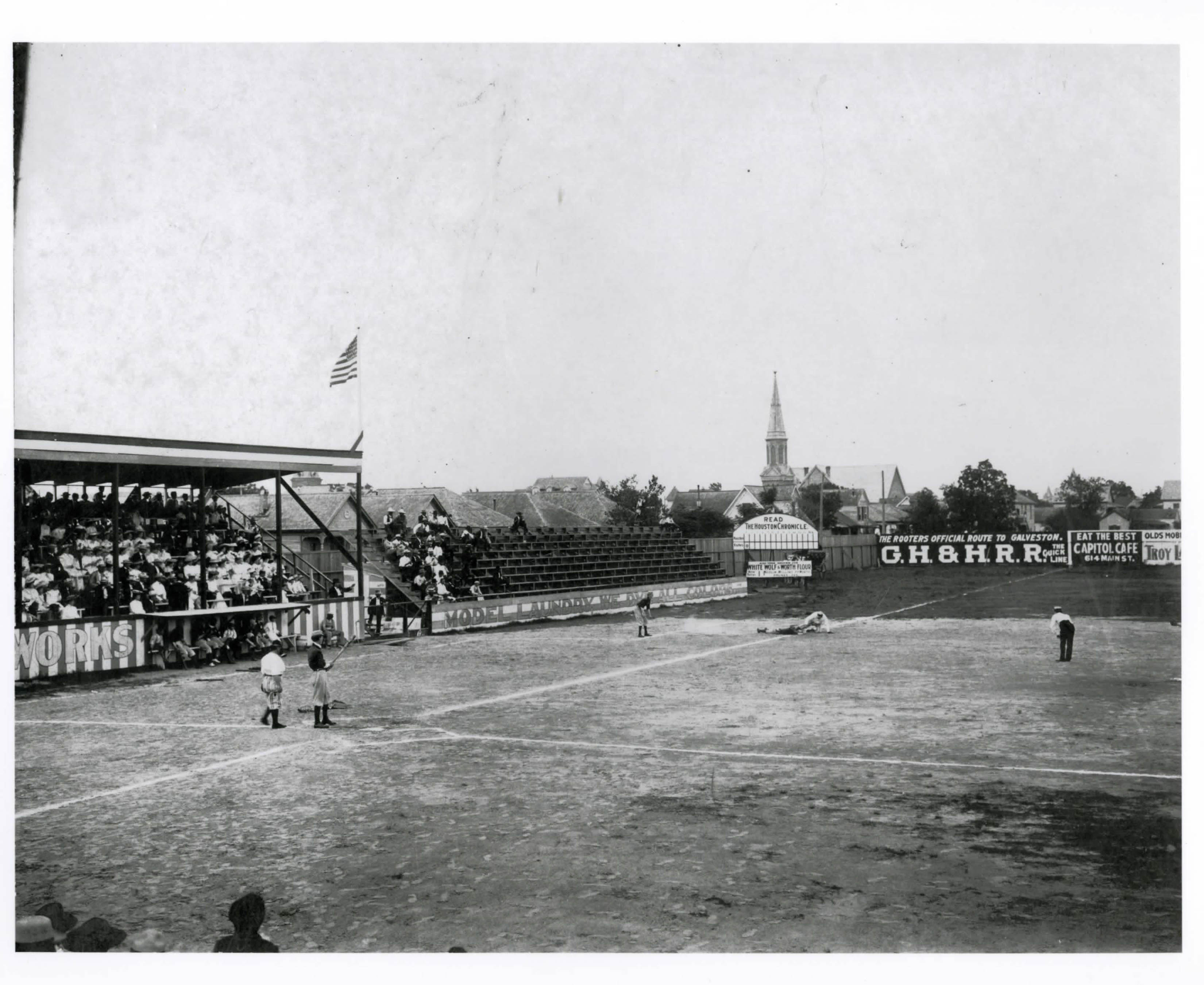
West End Park, Home of the Houston Buffs, 1907-1927. Published by permission of the City of Houston Public Library, Houston, TX.

Thanks to another little article from the Houstorian, some new/old/recycled questions and answers about the Houston Buffs and West End Park are again recycled and now come at us hard as researchers, loudly begging for further exploration. As we move further into our new SABR Chapter major research project, “Houston Baseball, 1861-1961, The First One Hundred Years,” this is the sort of thing that our team will need to explore with effort that goes way beyond quick and easy, incomplete conclusions.

The Houstorian article, for example, concludes that in 1909,  “the (Houston) Buffaloes were part of the St. Louis Browns farm system,” and it seems to be a conclusion based largely on the fact that, by 1910, “the following Buffaloes were playing for the St. Louis Browns: Roy Mitchell (P), Jim Stephens (C), Frank Truesdale (2B), Patrick Newnam (1B), Hub Northen, Joe McDonald, Art Griggs, Dode Criss, Alex Malloy, and Bill Killefer.” From what I was able to confirm through the minor league data files at Baseball Reference.Com, the Houstorian’s conclusion are correct as to the joint participation of most of these players as both Buffs and Browns.

Houston may have had some kind of working agreement with the Browns in 1909. That factor needs further research. It is rash, however, to conclude that the Buffs were part of the Browns “farm system” in 1909. Back then, major league clubs did not own minor league clubs. That kind of ownerships was viewed as sinister to the idea of a level playing field among all big league clubs. Further study of the Browns-Buffs arrangement in 1909 is needed. That’s the only true and safe end we may now touch based on what we know, so far.

Here’s a link to the Houstorian article that stirs up historical information like a first scratch in the ground of artifacts:

http://houstorian.wordpress.com/2009/02/14/100-years-ago-february-14-1909/

If you are a member of SABR, the Society for American Baseball Research, or if you think you might be interested in joining us in the biggest research challenge in Houston Area Baseball History as a new member of SABR, please get in touch with me, Bill McCurdy, @ houston_buff@hotmail.com

We are in the early stages of organizing our research work plan for scouring all available resources that will provide us with the best information we can find on the growth and evolution of baseball in the Houston area from the time of its first organization in 1861 as the “Houston Base Ball Club” through its last season as the minor league Houston Buffs in 1961.” If you have a passion for baseball, time for research, the patience and eyes for studying old newspaper and other public records on microfilm at the library, please consider joining our team. The final product will be a scholarly published historical work on the full history of baseball in Houston prior to the coming of the major leagues in 1962. Profits from this book will be dedicated to the support of SABR and its other programs in the Houston area – and everyone who does the research and writing that makes it possible will get their names credited to this legacy work on a major aspect of Houston and Harris County history.

If you have the time, the passion, and the patience for it, we need your help now.

The Houston Baseball History Project Wants You!