Archive for the ‘Uncategorized’ Category

An April Showers SABR Meeting in Rainy Houston

April 18, 2017

Greg Lucas
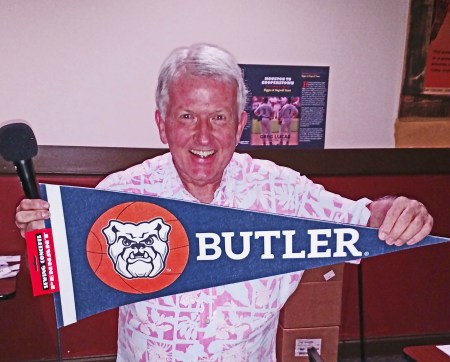
Butler University
Photo by Kevin P. Rosell

Last night was a first for the Larry Dierker Chapter of SABR. Never before in our local history have 9 members walked off from a regular gathering with a pennant for making it all the way through a three-hour meeting, but last night it happened. It really and truly did. And we’ve got the visual evidence here to prove almost all of it, thanks to new and enthusiastic seam-head member Kevin P Rosell, who also was kind enough to take these photos of those receiving their various flags of affinity.

The pennants weren’t actually any sort of reward for endurance. It’s just that we were busier than usual last night. It sort of went like this:

  1. The SABR Analytics March Conference in Arizona Report. New member Kevin P. Rosell attended the conference, and he began the evening with an enthusiastic, few-if-any-stones-left-to-upturn one hour and fifteen minute report  on everything that happened there. Questions about the replacement of human judgment by umpires on balls and strike calls by laser/technical/scientific technology was the hottest button in the discussion barrel.
  2. Greg Lucas Reported on his new book, “Houston to Cooperstown: The Houston Astros’ Biggio & Bagwell Years”. Greg spoke for about twenty minutes. Beyond Larry Dierker’s “It Ain’t Brain Surgery”, followed by “Toy Cannon”, the biography that Jimmy Wynn and I, Bill McCurdy, did of his life and career for McFarland Company in 2010 and then, “Still Throwing Heat”, the book that J.R. Richards did on his life and career with Lew Freedman in 2015, Lucas’s new work on Biggio/Bagwell is only the fourth book in print that focuses on individual Astro players. From what Greg shared, and what we also know of his writing skills, look for this latest book to be well worth the $25 purchase price at both Barnes & Noble, nationwide, and, of course, Amazon.com.
  3. “Catching Casey!” This was a “just for fun” activity. We wanted to give Greg Lucas a chance to catch up with Casey Stengel by allowing him to simply, one-by-one, look at a bunch of college pennants I had purchased for this exercise and match them with members in our SABR meeting group. Each correct identification counted as a “pennant won” – and Greg got to award that pennant that he just won for the right person as their gift. – With a little help, Greg Lucas got it done. Casey Stengel won a monster number of 10 pennants in 12 seasons (1949-60) with the Yankees. Greg Lucas won only 9 pennants, but, cut him some slack, Greg did his work in only 15 minutes. How’s that for efficiency? – Thanks to new “Jim Dandy To The Rescue” member Kevin P Rosell, we also have pictures of them all. Unfortunately, I did not receive the photos of Larry Miggins (Pittsburgh) or Bob Copus (Sam Houston State), but here are 6 of the others I did receive from Kevin by e-mail. The picture up top of Greg Lucas counts as one also. Then there were the 2 photos that didn’t get here. – Those bring Greg’s total pennant captures to 9. This whole “Catching Casey” fun thing took about 15 minutes, as we said, and then, of course, the night concluded with the usual trivia quiz. Mike McCroskey designed the quiz, but wasn’t present to administer it. Forgive me this sin too, but I never even heard who won. I will put my dime down now that it most probably was Tom White, our unbelievably resourceful “Handy Vandy” baseball history answer man.
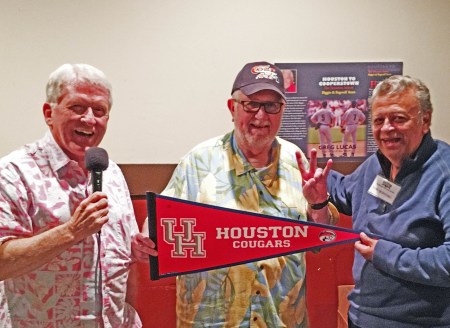
 

Dr. Sam Quintero
University of Houston
Photo by Kevin P. Rosell

Tom White
Vanderbilt University
Photo by Kevin P. Rosell

Chris Chesnutt
Texas A&M University
Photo by Kevin P. Rosell

Phil Holland
North Carolina State University
Photo by Kevin P. Rosell

Peggy Dorrill
James Madison University
Kevin P. Rosell

Bob Dorrill
Miami (O) University
Photo by Kevin P. Rosell

____________________

4/18/2017: Important Addendum to the record of other books written by or about former Colt .45/Astro  players. SABR Colleague Mark Wernick has now added this same information below as a comment on this article, but we felt it was important enough to be brought up top as a serious repair of our previous records on the subject. Thanks, Mark, for your far more thorough listing of books by or about former Houston franchise players:

“Bill, I wish I didn’t have to miss the festivities. It looks like fun times. I have a few more books that maybe could be added to the list of books focusing on individual Colt .45s/Astros players. There’s “Perfect”, by Steven K. Wagner about John Paciorek; “Fields Way”, J.C. Hartman’s book; “Rusty Staub of the Expos” by John Robertson, which does touch upon his time with Houston; “To All My Fans …” by Norm Miller; “Survive to Win”, by Bob Watson; and “The Rocket” by Joseph Janczak, a book about Roger Clemens that also touches on his time in Houston. Russ Kemmerer wrote a book that devotes a chapter to his time with the Houston Colt .45s, and the several bios of Joe Morgan and Nolan Ryan address their time with Houston.” ~ Mark Wernick.

___________________


Bill McCurdy

Publisher, Editor, Writer

The Pecan Park Eagle

Houston, Texas

A Great Fan Story by Gilbert D. Martinez

April 18, 2017

Gilbert D.  Martinez
Independent Writing Contributor
SABR Member
Rogers Hornsby Chapter
Austin, Texas


The Pecan Park Eagle wishes to express thanks to SABR brother Gilbert D. Martinez of the SABR Rogers Hornsby Chapter in Austin for his public story of the trip that he and a friend, Jan Larson, made to Minute Maid Park on the first Astros home game weekend of the 2017 season. We also want to thank Paul Rogers of the SABR Ernie Banks-Bobby Bragan DFW Chapter for bringing this beautiful little story to our awareness so that we could run it here as a column of a beautiful, but unexpected fan experience at the ballpark – and also, how we often don’t realize who may be sitting next to us at random – especially, when we know we’ve been assigned to seats in the other team’s fan section.

We shall let Gilbert tell the story. He does just fine with it:

____________________

Hi, everyone,

Jan (Larson) and I had a chance to watch the Astros take on the Royals on Saturday and Sunday (April 8-9, 2017). We saw good pitching performances by Keuchel and McCullers, but a Gregerson meltdown lost the game for the Astros.

I happened to get free tickets in the Royals section (behind visitor’s dugout) thanks to a colleague at school. My colleague’s son-in-law is director of broadcasting for the Royals, and he left us tickets at the players’ will call window. So I figured we would likely be sitting near Royals fans.

Sure enough, a middle-aged couple in Royals gear sat next to us. “You’re going to spot us four or five runs in the first, right?” the guy says to me. I said no; that we had already given those runs up the night before so it was our turn.

It was the start to some friendly banter during the game.


Nathan “Nate” Karns
6’5″ Right Handed Pitcher
2017 Kansas City Royals


A few innings in, starting pitcher Nate Karns (new to the Royals, formerly with the Nationals, Rays and Mariners) proceeds to throw eight straight balls to start the fifth inning. This prompts a visit from the pitching coach.

So, I lean over to my new Royals friend and say, “Oh, we don’t want you to take this guy out.”

He responds, “He’s my son.”

I said, “Really??!!!” We had a laugh about it, but then Karns’ mother said that watching him pitch was heart-wrenching.

Anyway, the dad shared some stories with me as the game progressed, such as the time Karns (as a Ray) beat the Phillies 1-0 on his home run. http://m.mlb.com/news/article/137827492/nathan-karns-hits-first-career-home-run/

Karns actually pitched very well, but you wouldn’t know it talking to his mom, who apparently thought he struggled. Here is his line from the game: 5.2 innings, 6 hits, 1 run, 1 earned run, 2 bb, 3 k; you be the judge. I tried assuring her that he actually pitched well and she clarified that by his standards, he usually pitches better. Spoken like a true mom.

Karns was on track for the win, but a two-run homer by Marwin Gonzalez off Travis Wood tied the game in the seventh, and a game-tying homer by (of all hitters) Jake Marisnick saved the game in the bottom of the ninth. Astros won the game on a walk-off walk of Gattis in the bottom of the 12th.

~ Gilbert Martinez

____________________

Editor’s Note: Thanks again, Gilbert – and know this too. Anytime you decide to write another baseball story that you think may be interesting to the farther reaches of our not-so-little-anymore SABR world, please drop a direct copy to us here at The Pecan Park Eagle.  We are always looking for good material on our widely shared favorite larger world of baseball and we shall be most happy to boost your story’s circulation at our “love of the game” editorial desk, if it is as timely and well written as this terrific piece.

Just drop me a copy at houston.buff37@gmail.com

~ Bill McCurdy, Publisher, Editor, Principle Writer, Chief Bottle Washer

____________________


Bill McCurdy

Publisher, Editor, Writer

The Pecan Park Eagle

Houston, Texas

Ten Oldest Living Former Colt .45s/Astros

April 17, 2017

Bobby Shantz, Age 91
With the death of Bob Cerv, Bobby Shantz is now the oldest living former player in Houston MLB franchise history.


The Ten Oldest Living Former Members of the Houston Colt .45s/Astros

Until his death on April 6, 2017, Bob Cerv had been the oldest living former member of the Houston Colt .45s/Astros MLB franchise. Had he lived, Cerv would have turned 92 and celebrated the anniversary of his May 25, 1925 birthday next month.

Thanks again to the research we asked of Darrell Pittman in response to an inquiry by St. Louis area reader Emmett McAuliffe, we are now able to present our general readership with a new list of the Ten Oldest Living Former Members of the Houston Colt .45s/Astros. As all may note, the oldest player in our Houston franchise’s history is the same guy who threw the first pitch and won the first game in franchise history. Bobby Shantz may have been a little guy, but he left long shadows of eloquently good service all over big league baseball, and, although his time in Houston was “short”, as well. our memory of him was long.

Thanks again for your yeoman efforts, Darrell Pittman. We simply felt that your findings deserves the column spotlight that their importance to our living presence of local baseball history deserves:

The Top 10 List itself

Oldest Player Birth Date Age on 4/16/17
1 Bobby Shantz 9/26/1925 91
2 Dick Gernert 9/28/1928 88
3 Frank Thomas 6/11/1929 87
4 Don Larsen 8/07/1929 87
5 Bob Lillis 6/02/1930 86
6 Roman Mejias 8/09/1930 86
7 Dean Stone 9/01/1930 86
8 Hal Smith 12/07/1930 86
9 Don Taussig 02/19/1932 85
10 Eddie Kasko 6/27/1932 84


In any context of history, it is important to remember our elders. No matter how rickety, our elders are the only living bridge to others and events that came to be in our area of interest even farther back in time than even they, the elders, can reach. And while they are still here, it would be wonderful to capture, as we can, and while they still are able to produce them, a few first hand witness glimpses of something in the past that we cannot possibly hope to see with our own eyes. Somewhere out there, someone is most probably buried in a New York City metro area cemetery who may know exactly what happened to the real game ball in the 1908 Merkle Boner contest at the Polo Grounds. If so, how did they get all the way off the planet over a lifetime without someone finding out their secret? Who knows? Maybe everybody around them at the time simply assumed that it wasn’t important to ask them anything. Or maybe they just lacked any appreciation for what happened to that old game ball in the first place.

~ The Pecan Park Eagle, April 16, 2017

____________________


Bill McCurdy

Publisher, Editor, Writer

The Pecan Park Eagle

Houston, Texas

Astros Parade – And Please Don’t Fade

April 16, 2017


SEASONS

GREETINGS,

EVERYBODY!


Here’s a fresh wish dancing on a very old tune. Once you’ve completed your back yard Easter Egg Hunts today, and if you are an Astros fan, give a little thought to how true these new lyrics ring:


Astro Parade

Adapted by The Pecan Pecan Eagle

Form the Lyrics to “Easter Parade”

By Irving Berlin


In your Astro bonnet, with all the wins upon it,

You are the grandest player in the Astro – parade.


We’ll be all in clover – and when they look you over,
We’re all – the proudest club fans in – the Astro parade.


On the avenue, Texas Avenue, the photographers will snap you

And you’ll find – that you’ve won – the batting crown again.


Oh, we could write a sonnet – ’bout how our fate spins on it,
By keeping Jose Altuve – in the – Astro parade.


____________________

HAPPY EASTER!
HELLO, SPRING!
WELCOME HOME, BASEBALL!!

____________________


Bill McCurdy

Publisher, Editor, Writer

The Pecan Park Eagle

Houston, Texas

How Far Do We Go with MLB Replay Review?

April 16, 2017

April 15, 2017: Astros catcher Evan Gaddis eyes the ball coming in down and left. The heavy end of the bat is already moving through an arc of space that will miss the ball by five inches. Umpire Scott Barry will call it a foul tip, negating a strikeout that would have ended the inning for the A’s.


In the bottom of the 3rd inning of Saturday’s Astros game at Oakland, the A’s held a 3-0 lead and were threatening to break it open with the bases loaded, two outs, and RHB Ryan Healy facing RHP Lance McCullars with the bases loaded, two outs, and a 3-2 count on the A’s batter.

McCullars dropped a pitch that was dropping low, outside, and probably unhittable, but Healy swing anyway and missed for strike three to end the threat of greater harm to Houston’s rally chances.

McCullars is walking off the mound. What a relief!

Wait a minute! HP umpire Scott Barry says it wasn’t strike three after all. As he eyes Astros catcher Evan Gaddis fumbling in the dirt to pick up the ball he could not contain for a caught strike three, he also carries his visual conclusion a step further. The pitch was a foul tip. It had to have been a foul tip, otherwise, Gaddis would have caught it. Healy’s must have tipped it and made the ball uncatchable.

Oh, really?

If you examine the masthead photo of this exact play, you will see the heavy side of Healy’s bat swinging through the arc of possible contact and missing the coming in, but falling away pitched baseball by a good five-inch wide country baseball mile.

Two pitches later, McCullers struck out Healy swinging for the second time in the same at bat on a similar pitch, but this time, Gaddis caught the ball. And umpire Scott Barry was not disposed again to jump to any further wrong conclusions.

The Astros later rallied from a 5-0 deficit for the second time in three days to take the game with the A’s by a score of 10-6, but what might have happened had the egregiously wrong call in the 3rd inning by umpire Scott Barry been the door opener for a big Oakland inning that may well have squashed any hope for a Houston rally win? For one thing, it certainly would have been a tough watch for the umpire himself, post-game, to see the big part that his perceptual error played in the unfolding of an unjust outcome. That’s for sure.

While I don’t favor the use of chin music audio-metric devices to fine tune when those close ones actually tip a whisker hard enough to earn the survivor an HBP ride to first base, I do think that instant replay could have set Barry’s call straight as dead wrong quite fast – and spared us all the history of allowing another avoidable error to rule the day.

The Old Law of the Jungle Rules Need Some Attention

Most students of the ancient game know that umpires forever have listened for – certain sounds – occurring milliseconds apart – that would tell them which came earliest on a play at first – the sound of the ball hitting the glove for an out – or the sound of a foot hitting the base for a safe call. And, if a home plate umpire couldn’t see the part of actual transaction between the bat and ball from his spot, he could, at least, learn how catchers react to balls that are tipped – especially, the fact that most tipped balls immediately have a good chance of not being caught because of that last second high-speed directional change that such tips cause. – Is this what happened to umpire Scott Barry? – We can’t prove it did, but we think it did, because there wasn’t anything other than the replay video that showed how utterly preposterous the tip call actually was in fact,.

The Quick Glance Addition to Replay Reviews

We don’t need to cover everything at the plate unless we are ready to move into laser system calling of balls and strikes, but we could add a “quick glance” review on plays like the one featured here. – Allow one quick replay glance on things like the errant tip call of today. If the umpire doesn’t see it right away when he looks at the replay, then, he’s free to hang with the original call. Just don’t it ride with it, as the example today clearly  proves, as an obvious unexamined mistake that could unjustly decide the outcome of the game.

____________________


Bill McCurdy

Publisher, Editor, Writer

The Pecan Park Eagle

Houston, Texas

Thanks for the Memories, Mickey Herskowitz!

April 15, 2017


Mickey Herskowitz:
When it comes to great sports writing,
Nobody Does It Better!


Remember when we had really good, entertaining and informative sports writers in the baseball world?

Well, we do. And, as if we needed it, we got a reminder of our singularly great Houston’s Mickey Herskowitz was to that end when he paused last night to comment on our column about the passing of former 1926 Colt .45 Bob Cerv.

There was no one who did it better than Mickey. And that’s still true today. If there were a news rag job out there in today’s mostly ADD on steroids-limited texting market for a real sports writer, Mickey Herskowitz could still be the bomb of visual suggestion he always was, but there ain’t. – And that just all the more underscores the reason we thank him for what he added to our humble Pecan Park Eagle effort to keep the old flame alive here with his commentary on Bob Cerv as a Houston Colt .45. If you didn’t see it, here’s what Mickey Herskowitz wrote as a comment on that column, one that was datelined April 15, 2017 by the Internet time stamp at WordPress:

__________________

“Bill, couldn’t resist sharing an odd, random thought on Bob Cerv. His claim to fame as a Colt .45 was the size of his thighs. He had grown so big and heavy that the equipment man, Whitey Diskin, had to rip up two sets of trousers so he could sew them together to fit over Cerv’s upper legs.

“He was also the only player, certainly up to time, to get thrown out at home trying to score from second on a triple. Al Spangler banged one off the centerfield wall with Cerv perched on second. When he rounded third, Al was just a few steps behind him. He was tagged out easily at the plate. Did I mention in addition to gaining a whole lot of weight, he had lost a whole lot of speed. Best. M.”

___________________

WOW! Do those few carefully scripted words set off an animated version in the mind of that entire silly scene? How slow do you have to be to not score from second on a triple? What was the look on triple-hitter Al Spangler’s face when he rounded third base and suddenly found himself blocked from scoring by the man who had been on second when he hammered his blast down the right field line? What did anybody have to say about the play in the game’s post-mortem comments?

Maybe not much. The Cincinnati Reds already were on their way to a 6-1 dicing of the Houston Colt .45s at Colt Stadium in Houston when the play occurred on July 1, 1962, but their was definitely the possibility of some residual ego-bruising as a result of how things unfolded. How would any of us like to be remembered as the guy who couldn’t score from second on a triple – even when many of us are now at an age in which we could not score from third base on a triple? We’ve got an excuse. Cerv was 37 at the time and had a player’s contract, at least, for one more month beyond this memorable day.  Bob Cerv would be released by the Colt .45s from his last active service in the big leagues on July 30, 1962.

We’ve had neither the time nor the technical access to run down local news coverage of the Spangler/Cerv Disservice, but we did run across an AP report that appeared the following day, July 2, 1962, in the Sandusky (O) Register on Page 16:

Does Player Always Score From Second On a Triple? HOUSTON, Tex. (AP) – Baseball Question: How can a player fail to score from second base on a triple? The Houston Colts furnished the answer Sunday. The incident occurred in the seventh inning in what turned out to be the Houston’s only strong inning against the Cincinnati Reds, who coasted to a 6-1 victory. Houston trailed by five runs as Bob Aspromonte opened the inning with an Infield hit. After Don Buddin struck out. Bob Cerv came through with a pinch single. Aspromonte moved to third and Cerv to second as Frank Robinson bobbled the ball in right field. That brought up Al Spangler, and he sent a line drive screaming into the right field corner for a certain three-bagger, which is what the official scor­er called it. Aspromonte scored Houston’s first run easily, but Cerv, hesitating as he rounded third base, was thrown out at home as he lunged for the plate. “There was a mix-up in signs,” explained Manager Harry Craft. “Billy Goodman (the next batter) thought the umpire called a foul ball, and he flashed the sign for Cerv to hold up. Anyway, it was something like that.” Cerv had little to say. “I’d rather not say anything,” he said.”

“It was just one of those things. I should’ve slid.”

Or maybe he should’ve slud. Whatever. The Pecan Park Eagle greatly prefers Mickey Herskowitz’s treatment of the play. Watching the man with pontoon legs trying to score from second on a ball hit hopelessly far down the right field line, as Spangler, the triples hitter, finally appears on his tail with no prospects for passing the tortoise is a far more legendary and hilariously engaging visual story line.

Here’s the Baseball Almanac box score to the July 1, 1962 game in which the Spangler/Cerv Disservice took place:

http://www.baseball-almanac.com/box-scores/boxscore.php?boxid=196207010HO1

Thanks again, Mickey, and please check in with us more often. And remember too. – Any time you choose to write a guest column for The Pecan Eagle, please know that it shall be most welcomed with humble appreciations by all of us who still miss reading you on a regular basis.

Forever Your Fan,

Bill McCurdy

____________________


Bill McCurdy

Publisher, Editor, Writer

The Pecan Park Eagle

Houston, Texas


Former Colt .45 Bob Cerv Dies at Age 91

April 15, 2017

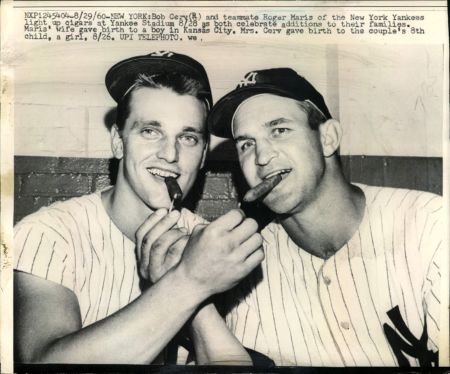
Roger Maris was celebrating the birth of his son in this 1960 photo. – Bob Cerv was celebrating the birth of his eighth child, a girl, at the same time. – Looks like Bob Cerv carried the heavy lumber in the baby breeding arena, even if he doesn’t get an asterisk beside the number on his final total.


Former Houston Colt .45 Bob Cerv passed away at age 91 years and 336 days in Blair, Nebraska on April 6, 2017. He was buried in St. John Nepomucene Cemetery, Weston, NE.

Bob Cerv’s time as a Houston Colt .45 wasn’t much, but Houston was the last stop in his 12-season (1951-1962) MLB career. Dealt to Houston by the Yankees during the 1962 first season of the Colt .45s, Cerv played the last 19 of his 829 MLB games as a left fielder/pinch hitter for the Colts. It was enough time for the BR/TR 37-year old muscular Cerv to also register his last 7 hits, 2 homers, and 3 RBI and bring the final career cap totals on each to 624 hits, 105 homers, and 374 RBI. – His 2 walks and 10 Ks were enough to bring those career totals to 212 walks and 392 strikeouts.

The 7 for 31 batting average of .226 that Cerv achieved as a 1962 Colt .45 paled in comparison to his .276 career batting average for 2,261 times at bat, but it probably helped this good young man to make the decision that it was time to hang up his bats, glove, and dreams.

Bob Cerv always intrigued me as a kid. He broke in with the Yankees in the same rookie class of candidates that accompanied the younger phenom that was Mickey Mantle. It was speculation time among Yankee fans and supporters. 1951 was going to be the last season for Joltin’ Joe DiMaggio, and he had been the guy who took over as the new bright star for the Yankees in 1936, who were then already two years past the career of Ruth and looking at only three more years until their shocking loss of Gehrig. Who would take over now? – If not Mantle, then who? Could it be possible that a guy named Bob Cerv could walk that tall?

For five seasons (1951-56), it wasn’t the mediocre Bob Cerv – and he was traded to Kansas City (1957-60) just in time to hit the single super highlight season of his big league career. In 1958, Bob Cerv hit .305 with 38 home runs for the Kansas City Athletics in 141 games. His 157 hits and 104 RBI also were season highs for his MLB career and, at age 33, Cerv seemed to be finally catching some later years second wind. It didn’t last. He hit 20 HR for KC in 1959, but his BA dropped to .285.

By 1960, the Yankees reacquired Cerv from KC, but, in 1961, the Yankees then shipped Cerv off again; this time to the Los Angeles Angels for 18 games before reacquiring him  – yet again – to their own 1961 roster.

Bob Cerv may have been one of MLB’s earliest rental players.

In 1962, Cerv got into 14 games for the Yankees before they again “Fedexed” him to another club. And this time, it was the Houston Colt .45s.

Then, after 1962, something happened to bar Bob Cerv from returning to the Yankees for yet another tour of limited service.

He retired.

Rest in Peace, Bob Cerv!

We shall also pray that your new deal in the heavens was not touched at all by the New York Yankees front office people.

http://www.baseball-reference.com/players/c/cervbo01.shtml

____________________


Bill McCurdy

Publisher, Editor, Writer

The Pecan Park Eagle

Houston, Texas

 

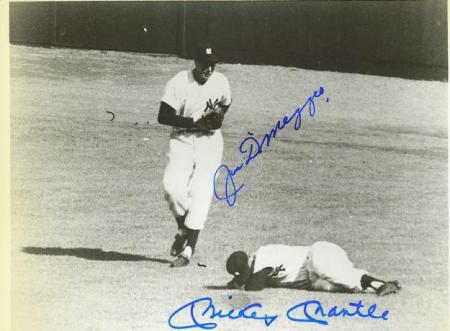
Mantle’s 1951 World Series Injury

April 14, 2017

World Series Game 2
October 5, 1951


The date was October 5th. It happened in the 5th inning of Game 2 in the 1951 World Series at Yankee Stadium. The Yankees were on their way to a 3-1 win that would even their contest with the New York Giants with a 3-1 victory, but their eventual 4-2 Series triumph would not come without a costly injurious player loss.

Here’s how UP Sports Editor Leo H. Petersen described the Series the loss for the next day newspapers.:

Mickey Mantle, 20-year-old Rookie Yankee outfielder, is almost definitely out of the entire series and Manager Casey Stengel announced that Hank Bauer, who replaced him yesterday, would continue to play right field. Mantle’s injury – an astounding piece of baseball drama which occurred in the fifth inning yesterday – was diagnosed as a sever sprain of the right knee.

It all began in the fifth inning when Willie Mays lifted a high fly to right center field. Joe DiMaggio and Mantle both went after the ball and DiMaggio finally camped under it. Mantle, coming fast, from right field suddenly pitched forward and fell flat on his face. At the same instant, DiMaggio caught the ball.

It appeared at first that Mantle had merely dropped to the ground to give DiMaggio clearance to make the catch.

But Mantle lay motionless for seemingly endless seconds. DiMaggio bent over the prone youngster and immediately signaled the Yankee dugout to bring a stretcher.

~ Excerpt from “Hearn Against Raschi as World Series Moves to Polo Grounds Today” by Leo H. Peterson, United Press Sports Editor, New York, Oct. 6 (1951) – (UP) – Valparaiso Vidette Messenger, Valparaiso, IN, Page 6.

One minor correction to the article report is in order. Mickey Mantle was still 19 when the 1951 injury occurred on October 5, 1951. His 20th birthday followed two weeks and one day later on October 20, 1951.

The questions for history would read like a parade of what ifs and what might have beens:

What if the communication between DiMaggio and Mantle had been better – and not predicated upon the need for the kid phenom to never do anything to offend the aging star’s ego in the field?

What if the Yankee Stadium grass watering plan had not included drain structures that could catch a fielder’s cleats and do serious harm?

How much did the 1951 Series ending play for Mantle end up being a major factor in reducing his career speed and durability for an even greater statistical career?

When Mantle had surgery two years later, there was no established procedure to fix a torn anterior cruciate ligament. Does that mean that Mantle played the balance of his career on a torn anterior cruciate ligament? That suggestion is offered in a 2010 biography of Mantle written by Jane Leavy. The orthopedic surgeon who analyzed the case history that Leavy compiled said it was likely that Mantle compensated for the torn ACL with what the orthopedist called “neuromuscular genius.”

All that some religious Mantle fans knew is that they attributed a lot of Mickey’s close losses over time beyond that almost career fatal start to the 1951 “DiMaggio Ego Bow” that tore up one knee at age nearly 20. Forevermore after, every time Mickey was called out at first on a close play, it was chalked up to the DiMaggio play. – Any time that Willie Mays did something faster than Mantle, DiMaggio got the blame there too. The only strong objection I have to Mantle’s performance apologists is the reason offered for his batting average dip to .298 upon retirement after the 1968 season. That one is most certainly not the fault of Joe DiMaggio. Had Mantle’s personal behavior over time been a little more restrained – 0r – if he simply had retired after the 1964 season – Mickey Mantle could have kept his career .300 plus BA and still had enough stripes to have made it into the Hall of Fame.

Just didn’t happen.

____________________


Bill McCurdy

Publisher, Editor, Writer

The Pecan Park Eagle

Houston, Texas
1962: Craft Pulled Out No Rabbits

April 13, 2017

The headline portion of John Daily’s column
New York Times
April 17, 1962


New York Times News Services, 4/17/1962:

Craft Pulled Out No Rabbits

By ARTHUR DAILY

New York Times News Services

NEW YORK (April 17, 1962) – Harry Craft, a novice gunslinger in the rowdy frontierland of the National League, already has three notches on his Colt .45s. The Cubs were shot down three times in a row and sent squirming into the dust with lefthanded salvos.

But Casey Stengel, once the fastest gun in the west, has yet to draw his six-shooter from the holster. His Mets have been picked by everyone to draw a bead on them. The big showdown will take place at the Polo Grounds Tuesday. Craft and Stengel will shoot it out at 90 feet.

Can’t Always Buck Percentages

The Colts and the Mets are the newcomers in the expanded National League. They don’t have much ammunition. That’s why it was such a stunning surprise when three lefties from Houston – Bobby Shantz, Hal Woodeshick and Dean Stone – drilled holes in the Cubs on the first three days of the season. Few were more astonished than Stengel.

* * *

“I don’t understand it,” the Ol’ Perfesser was saying the other day. “It ain’t the same thing but I kin remember one year when the Pirates was loaded with lefty hitters. Let’s see. There was Vaughan, Suhr, Big Waner, Little Waner, the Ketcher and the second baseman whose name escapes me but he lives in Phoenix and sells insurance. As near as I can figger out Pie Traynor was the only righty hitter. Everyone said: lefties will murder ‘em. So thirteen lefties went in against the Pirates which knocked out twelve of ‘em. Ya never know.”

* * *

The Stengel observation was offered Monday to Craft.

“It doesn’t apply to the Cubs,” said Harry. “They have only three lefthanded hitters. Altman, Williams and Brock. You’ve probably forgotten but I was one of the rotating managers of the Cubs and I know all about them. I didn’t pull any rabbits out of hats.

Craft Likes Rotating Managers

“I just went along with the percentages and baseball percentages are the same as gambling percentages. If you persist in bucking them, you go home in a barrel. The record of the Cubs is clear. They lost 33 games to lefties last year and beat only 16. We had three lefties ready. We used them. It’s as simple as that.

“When I was on the Chicago staff, I noticed that the lefties were using us as stepping stones, especially kid pitchers like O’Toole and Sadecki or comeback veterans like Simmons and Mizell. Guys like Spahn you just take for granted. They win against any team.”

Perhaps it was a loaded question but did Craft agree with most baseball experts that Phil Wrigley’s system of running a ball club was inherently unsound? In the Cub scheme of things there is no manager but a rotating squad of coaches, shuttling from the post of head coach to minor league assignments.

* * *

“No,” said the Houston manager emphatically. “I like it. I rotated twice last year to the minors, for two weeks at San Antonio in May and for six weeks to Houston at the end of the season. This makes the kids in the minors feel that the big club is interested in them.

“I’m sure it’s sped up the development of a lot of players. Lou Brock and Ken Hubbs are rookies now but they can’t miss being great stars, even though they’ve leaped all the way from Class B and C. Wait and see.”

~ New York Times News Services, 4/17/1962

____________________

Another subject resource column contribution from researcher Darrell Pittman.

Thanks, as always, Darrell!

____________________


Bill McCurdy

Publisher, Editor, Writer

The Pecan Park Eagle

Houston, Texas
 

1962: Ballpark Goodies and Triadic Tribulation

April 12, 2017

The Triadic Tribulation
– Without it, there is no passion for competition.

Another column by sports writer John Lyons of the Victoria Advocate on Sunday, April 15, 1962 highlights the always amazing low-cost of ballpark food, beer, and souvenir items back in the so-called “good old days,” as it also hits hard on upon certain elements of illusion that are starting to creep into the minds of writers and fans, even in the early going of that first Houston big league season. – The Triad of Tribulation is being firmly set in motion.

In baseball, the Triad of Tribulation starts with our Love of the game. In Houston, our love of the game, was amplified by that first little 1962 team going out there and winning their first three games. And that improbable happening quickly activated the delusion of Hope that this rag-tag new team was capable of winning games at a greater mark in the black than any of us (or common sense) would have thought possible, so early in its life as a big league club. Well, as the record shows, it wasn’t long beyond the date of this 1962 column that we Houstonians were brought back to earth from any possible voyage to the land of great expectations. It would be a few years before the element of Faith – based upon better, longer lived actual experience with regular season winning – would gain its everyday variable place in our MLB lives – and actually make the Triad of Tribulation a regular infrastructural part of our everyday baseball fan lives.

Once in place, the triadic points of Love, Hope, and Faith continue to drive each other in ways that both feed the rush of great expectation and dump the gloom of failed delivery.

Love is the easiest and first point in this trinity to exist. Then comes the always nearby presence of Hope, the next easiest to have and hold. Hope is the aspiration that builds the skeletal structure for expectation. And all that’s needed for expectation to show up is the presence of enough club winning over time during the season to build our Faith in the possibility, then probability, of winning it all. Once all three points are at work, the Triad of Tribulation is in motion. And the biting connection that binds them all starts to do its dance into the long run play of tribulation.

The tribulation here is that, barring a return to those dominant resource days of the old dynastic Yankees, there are 30 MLB teams out there competing with each other every year – and each club has their own relative contact with Love, Hope, and Faith – and most are all within a finger nail grab of expectations that winning will be probable this year. The Triad of Tribulation spins like a top on the fact that only 1 of 30 MLB clubs eligible for the playoffs annually will win their last game as a playoff team.

But don’t misunderstand. The Triad of Tribulation bites, but it is not something we should want to fix. Because, if we did, it wouldn’t be long before the fans stopped going to the ballgames altogether. Are you ready to give up big stakes competition as a tactile form of everyday enjoyment with a bat, ball, and glove?

On the other hand, maybe we should re-think all these participation trophies that youth baseball gives out to all the kids that play organized baseball, regardless of their individually measured contributions to their team’s competitive success. Is that “make sure no one gets their feelings hurt” protection of the kids really preparing them for the world they shall enter someday on their own? Think about it. We certainly didn’t have that protection on the post WWII sandlots of kid baseball.

The subject is certainly worth more than an easy half-baked answer, but a politically correct one contributes only to the spreading malaise idea that suggests that many people today are simply waiting longer to find out what is acceptable before they say anything about what is going on in the world.

Lighten up.

Now let’s move on to the historically referenced material we have before us today.

Thanks again for their contribution to The Pecan Park Eagle, Darrell Pittman. We hope you never grow tired of hearing those words, friend, because your research contributions, especially this week, are deeply, deeply appreciated.

These offerings from Buff Stadium, 11 years earlier than these column story prices for Colt Stadium in 1962 were better, but not by much.

Potato Chips Cost 15 Cents At Houston Colt .45s Games

It costs money to see a big league baseball game.

Using Houston as an example, and the prices there are not as high as in some major league ball parks, the cheapest item is 15 cents. For that amount, you can get a 10-cent cigar, cotton candy, snow cones, a bag of peanuts, a small bag of popcorn, a bag of potato chips, a cup of coffee, a soft drink (small size), and a pop-cycle. Popcorn also sells for 24 cents as does a larger cup containing a soft drink.

Items like Ice Cream bars, Ice Cream sandwiches and Ice Cream sticks go for 20 cents and malts are 30.

Beer ranges from 30 to 40 cents.

Programs, aspirin tablets, and cushions are priced at 25 cents and the cheapest buy in the ball park is a program, which is very informative, full of pictures and information, and is the kind of book that a fan wants to keep all season long.

* * *

As for the food, corn dogs and hot dogs are 30 cents. A hamburger is 40, ham sandwich, roast beef, and cheese sandwiches are 50, a corn beef sandwich is 75 and a ham and cheese is 75. The sandwiches, we have been informed, are served with bread, rye or white.

* * *

At Houston’s opening game on Tuesday afternoon souvenirs were being sold at a fast clip.  They have some attractive and colorful souvenirs and the price makes the average fan whistle in amazement.

Cheapest items at the Souvenir stand are 50 cents for a paper sun shade, a bat key chain, and a picture pack.

They have a great variety of pennants with the names and colors of every team in the National League and they sell for $1.00. That is the price for a plastic bank with the insignia of the Colt .45s, a pen and pencil set, a miniature bat, and an autographed book.

The price for a baseball cap (twill) is $1.50 and for a baseball cap (wool) is $2.00. Also tabbed at $1.50 are Colt rings, Charm bracelets, Ladies’ head scarf, and T-shirts.

A bat bank is priced at $2.00 and so is a super-impact batting helmet.

An autographed baseball sells for $3.00 and that is the price for Sweat Shirts.

A Colt .45 uniform for a little boy is priced at $8.00. That also is the tab for a boy’s warm up jacket. For a man, a warmup jacket sells for $10.00.

* * *

If you drive your car to the ball park, which is located a little better than two miles this side of the Shamrock-Hilton Hotel, it costs you 50 cents to park.

Then to get in the park, the tickets are $3.50 for a box seat, $2.50 for a reserved seat and $1.50 for general admission.

* * *

But if you like your baseball, you’ll enjoy every bit of what you are paying for. It is a bright, big and colorful ball park, and the baseball is big league.

* * *

Just like Riverside Park when Tom O’Connor owned the baseball club, the current batting average of the hitter is flashed as he steps to the plate. And also inning by inning scores of all other major league games are on the big board in center field.

* * *

Houston got away to an amazing start in its major league debut and I wonder just how much a guy could have won if he had wagered that the Colt .45s would win their first three games.

Just about anyone, including myself, would have booked such a wager, however,

Houston’s pitching has been nothing short of sensational.  When Bobby Shantz pitched a five-hitter and Houston won the opener from the Chicago Cubs, 11-2, the more skeptical fans were remarking that this is a great start but he couldn’t expect to get pitching as good as that dished by Shantz.

The Colts follow this up with a pair of 2-0 victories over the Cubs to sweep the three-game series.

On to Philadelphia, the fine hurling continued but Houston lost two games by 3-2 and 3-0.

The Colts play at Philadelphia again today, move to New York to face the Mets Monday and Tuesday, then play At Chicago Wednesday and Thursday.

Friday is an open date, then they return home for nine games opening a three-game series with Philadelphia Saturday, starting a three-game set with the Cardinals on Apr. 24, and then hosting Milwaukee in a three-game stand, opening on Apr. 27.

All of these nine games with the exception of Apr. 22 and Apr. 29, Sundays, will be played at night.

~ John Lyons, Victoria (TX) Advocate, Sunday, April 15, 1962 

____________________


Bill McCurdy

Publisher, Editor, Writer

The Pecan Park Eagle

Houston, Texas