Archive for the ‘Uncategorized’ Category

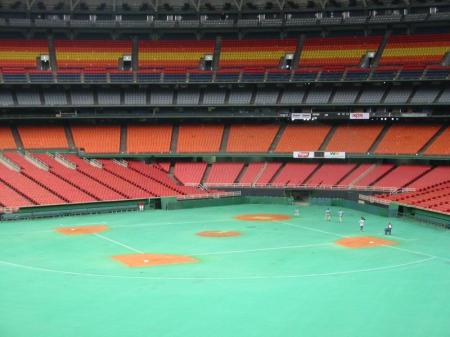
Astrodome Physics Questions

April 27, 2017

When the Astrodome played as a full house, nobody had any trouble hearing the auditory blast of the big scoreboard show.


Houston Chronicle
April 27, 1967


When the Astrodome scoreboard goes off before a crowd of only 12,225 fans, does it really make a sound, or not? And does the body of that small fan group genuinely roar as reported in audible support of what they allegedly hear, or are they simply miming the physical motions of great sound exertion in silent protest and mockery of their dear Astros’ poor play on this first-of-its-kind field of dreams?


____________________

Thanks to Darrell Pittman for sending me the Houston Chronicle “Scoreboard Is Too Rusty” item. It inspired the birth of this modest little “if a tree falls in the forest” parody.

Sometimes I have to write parodies to clear the mind barnacles of other wasted time in thought that gets in the way of writing freely. Thanks again for your patience, everybody.


Bill McCurdy

Publisher, Editor, Writer

The Pecan Park Eagle

Houston, Texas

Mickey Mantle’s Heartbroken Valedictory

April 26, 2017

Retiring Mickey Mantle (L) and Yankees Manager Ralph Houk
Associated Press Coverage of Mantle’s Retirement Conference
As It Appeared in The Joplin (MO) Globe
Sunday, March 2, 1969


MICKEY CALLS IT A CAREER WITH YANKEES

Slugger Retires After 18 Seasons

Fort Lauderdale, Fla. (AP) – Mickey Mantle, at a loss for words, announced his retirement from baseball Saturday before a packed news conference at the New York Yankees’ spring training hotel.

Mike Burke, president of the Yankees, introduced Mantle to reporters, saying that the veteran star “had reached a firm conclusion, and I think its best he tell it to you himself.”

Then Mantle, dressed in a dark blue turtleneck, light blue slacks and checked sports jacket, stepped to the rostrum. But instead of saying anything, Mickey said, “I’m open for questions.”

The first one, of course, was what had he decided.

“I’m not going to play baseball anymore; that’s all I know,” he said slowly. “I can’t play anymore. I don’t hit the ball anymore when I need to. I can’t steal when I need to, I can’t score from second when I need to.”

Mantle said he had talked his situation over with Ralph Houk, manager of the Yankees, Friday night and Burke Saturday morning. “We decided this would be best for me and for the club,” said Mantle, who most of his 18-year career, was one of the most feared sluggers in baseball.

Mantle said he reached the decision after talking with both Houk and Burke.

“Ralph said if he was me, and at this point he wasn’t wasn’t sure what to do, he’d probably call it off right now and that’s what I’m doing,” the outfielder turned first baseman said.

Mantle said his outside business interests, which include a chain of country kitchens and clothing stores, also helped him reach a decision.

“I have to appear at all the kitchen openings and there are about 45 sold right now,” he explained.

Mantle said he had no current plans to remain with the Yankee organization. “But Mike told me if I ever wanted a job, it was available.”

Mantle said he was disappointed he was not a lifetime .300 hitter. He finished at .298.”But I’m very proud of my 18 World Series homers,” he added.

Mantle said his wife was very happy with his decision.

“She’s been asking me to quit for three years,” Mickey related. “I’m planning to get out to the ball park now and then, but I won’t put on a uniform.”

In a prepared text, Mantle said:

“I never wanted to embarrass myself on the field or hurt the club in any way or give the fans anything less than they are entitled to expect from me. I’m not sure I can play well enough to satisfy myself.

“Last fall I still thought I might play another year if I felt well enough in spring training. As the months passed I felt more sure in my own mind that now was the time to end my career as a ballplayer.”

Houk said: “We all know Mantle would have played on any ball team I managed as long as he wanted to and I think we all know that the game is losing a super star.”

Burke said Mantle’s future with the Yankee organization “would depend solely on how much time he has to give. Right now we have left it that he will have a relationship with us and we will have a relationship with him.”

Burke’s prepared statement said:

“This is a sad but inevitable day. We are losing a truly magnificent Yankee and baseball will sorely miss this one of a kind athlete.

“We would have liked him to play another season, of course. Ralph (Houk) and Lee (MacPhail) and I all thought he could make an important contribution on the field and to the spirit of our young club. But we also felt very firmly that this was Mickey’s decision to make and that we must be sympathetic to his situation.”

Asked if the Yankees would retire No. 7, Burke said “Yes.”

Mantle came up to the Yankees in 1951 – the same year another center fielder, Willie Mays, arrived in New York with the Giants. The Oklahoman’s freshman year wasn’t nearly as successful as the ones that followed. He batted just .267 in 96 games and spent half the season in the minors.

But his 13 home runs and 65 runs batted in were the clue to the latent power that Mantle possessed. It was a power that would eventually make him one of the most feared hitters in baseball.

It was in the 1951 World Series against Mays and the Giants that Mantle suffered his first serious knee injury. He tripped over a drainage opening in the Yankee Stadium outfield in the second game had to be carried off the field in a stretcher.

But Mantle came back in 1952, replacing Joe DiMaggio, who had retired, and batting .311 with 23 home runs and 87 RBI. He had nine more .300 seasons, including five straight from 1954 through 1958.

His raw power sent home runs soaring record distances and when he powered one off Washington’s Chuck Stobbs in 1955, an ambitious press agent measured it at 565 feet. That was the start of the tape measure home run.

Mantle won the triple crown in 1956, batting .353 with 52 homers and 130 RBI. He was named the American League’s Most Valuable Player that season and again the next year when he raised his average to .365. He also won the MVP award in 1962.

In 1961, he staged an exciting battle with teammate Roger Maris for the home run crown. Maris finished with 61 that year and Mantle had 54, the highest single season total of his career.

He finished his career with 536 home runs – third on the all time list behind Babe Ruth and Mays. He had 1,509 runs batted in and a .298 career average which was pulled down by .245 and .237 figures in his last two years.

Mantle played in 2,401 games as a Yankee – more than any man in the club’s history. But he never played an entire season. The closest he came was in 1960 and 1961 when he missed just one game each year.

His legs were always tender and, after 16 seasons as an outfielder, Mantle was moved to first base in 1967 in an effort to remove the stress on his legs. He played 144 games in each of the last two seasons – more than any he had managed in any year since 1961.

Mantle played in 12 World Series with the Yankees and holds Series records with 18 home runs, 42 runs scored, 40 runs batted in, 123 total bases, 26 long (extra base) hits, 43 walks, and 54 strikeouts.

He also played in 16 All Star games.

~ AP, The Joplin Globe, Sunday, March 2, 1969, Section C, Page 1.

____________________


Bill McCurdy

Publisher, Editor, Writer

The Pecan Park Eagle

Houston, Texas

Mantle’s Regretful Career Finish

April 25, 2017

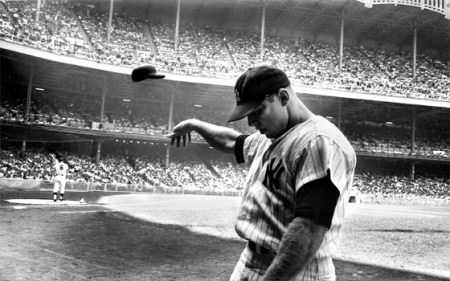
When Mickey Mantle retired after the 1968 season, he was very unhappy that his final season batting average of .237 had dropped his career batting average from .302 to .298. And who could blame him for the dent he put on the Hall of Fame body of his full 18 season (1951-1968) career?

Mickey Mantle’s 1968 season was one of four (1965-68) too many. Had he retired after the 1964 season and The Yankees’ heartbreaking loss to the Cardinals in the World Series, he would have left his injury-riddled 14-season career with an overall batting average of .309 and 454 home runs – and still have been a deserving elected member of the Hall of Fame today. (Mantle would have retired with 2,016 hits in 6,533 official times at bat, had he retired after 1964. He also would have lost only 82 HR from his career total of 536 through 1968. He would have surrender only 82 homers from his 1968 actual finish, had he retired after 1964.)

The four seasons of 1965 through 1968 were the epochal start of the great fall from grace years for the New York Yankees and meteoric Mickey was arguably the bleakest burned out light in their embarrassing descent.  That being said, I’ve only got one thing left to say before I continue. None of us are, or ever were, Mickey Mantle. And for sure, I’m not. We don’t know as fans what it was like to hobble around in the down years that followed the brilliant times he did enjoy earlier – and The Mick was never free from quirky injury or pain, even then. – And, even if we’ve had our own bad experience with alcohol and poor life style choices, we still don’t know what it was like to have mixed those jokers into a deck that also included being saddled with the expectations of being a baseball star at the same time we were enduring the combinations of physical, emotional, and chemical pains that come with being there for anyone, no matter how good they are, who dares to follow in the paths of Babe Ruth, Lou Gehrig, and Joe DiMaggio – even if the guys around you are not quite as great as the supporting casts of the original and earlier versions of “Murderers’ Row”.

Mickey, we hardly knew your pain. The most you ever said to us about the statistical decline from 1965 through 1968 was paraphrasically something along these lines: “If I hadn’t played that last 1968 season, I could’ve, at least, kept my lifetime, plus .300 batting average.

That’s so true, Mick, as this simple little chart shows. Had you not played in 1968, you could have retired with a lifetime .302 batting average and 518 career home runs over 17 (1951-1967) seasons.

Thru At Bats Hits BA HR
  1967 7667 2312 .302 518
  1968 8102 2415 .298 536
– 1968 – 435 – 103 -.004 – 18

Mantle’s 1968 season also had little long-term effect upon his final standing among the career home run leaders either. By playing to his true end in 1968, his 18 homers that season allowed Mantle (536 HR) to pass Ted Williams (521 HR) and Jimmie Fox (524 HR) for 3rd place on the all time list behind Babe Ruth (714) and Willie Mays (660). Today, in 2017, it hardly matters. Mickey Mantle, to this point in the booming days of Earl Weaver-minded baseball, has now slipped to place # 22 on the all-time career home run list.

That’s OK with me. If Jeff Bagwell is good enough for the Hall of Fame with 449 HR on top of his painful injuries – and he for damn sure is – Mickey Mantle is the poster boy super star for that kind of against-all-odds naturally great athlete. His .298 final batting average means nothing to me. It simply did despairing things to the guy who saw .300 as one of the bottom line baseball measurements on greatness.

Alas! Woulda, Coulda, Shoulda doesn’t work for the great ones either.

If only Mickey Mantle had not stepped on that watering grate in the 1951 World Series, he woulda have set base running and phenomenal catch records that coulda turned our amazing baseball memories upside down.

If only Mickey Mantle had gotten some early help with his drinking and bad decision-making, like he shoulda, he might have been the greatest ballplayer of all time by the numbers record of his accomplishments.

Forget about it. Woulda, Coulda, Shoulda ideas are where Mickey Mantle comes closer to being like the rest of us than we shall ever be by the power of the baseball gods to turn back the clock and make any of us like him.

Neither is going to happen. Things are the way they are.

And here’s where we hoi pa loi come together with the great public people of this world. The more we learn to live with what is, in the here and now, changing what he can change, and leaving the rest of the ego stuff that requires either politics or the finessing and control of others to some aspiring end , the easier it is to live with whatever the .298 batting average disappointments in our own lives happen to be. And this philosophy even takes in people like baseball field managers.

As a baseball field manager, all you can really do is be yourself out there in trying to build a working relationship with your players. All you can do in the end, however, is make out the lineups and do the personnel changes that seem to be needed during the game. The rest is up to the players. And you will be the better manager, we think, if you stay focused on what you can do – and not what the players must do to help you keep your job. There’s no doubt about one thing, however. Casey Stengel said it best when he acknowledged that he only became a “genius” as a manager once he took over the stable of talent that lined the roster of the New York Yankees. As the later older manager of the New York Mets, Stengel was returned to beyond worse results than even those he had known during his 1930s career managerial jobs with the Boston Braves or Brooklyn Dodgers. Of the hapless 1962 New York Mets, Casey was finally reduced to asking of his losing record team, a question that’s no doubt come up unspoken by many other managers of bad clubs: “Can anybody here play this game?”

The 1951 New York Yankees were a force.

Mickey Mantle, as the 13-year old kid who remembers you from that 1951 spring training game in which you and DiMaggio and the rest of the Yankees came to town and beat up on my Houston Buffs at Buff Stadium that hot early April Sunday afternoon, I shall remain your fan for as long as I have a forever to recall such things. I still think that you, Willie Mays, Stan Musial, and Roberto Clemente were the four greatest players I ever saw play. You are my “Four Horsemen of the Baseball Affirmation” and I wouldn’t put an order on any of you as the greatest. You were each wonderfully great in your own very specific ways.

Forget .298. It is only the thorn of unresolved regret in the mind of one great player who played, at least, one season too long.

____________________


Bill McCurdy

Publisher, Editor, Writer

The Pecan Park Eagle

Houston, Texas

The 1961 Expansion Draft Picks

April 25, 2017

Who says you can’t go swimming in a baseball pool?


The 1961 expansion draft picks by the Houston Colt .45s and New York Mets probably are best remembered today for the event’s contribution to one of those iconic lines from the Roger Miller C&W songwriter’s big hit of the same year. Just as “You Can’t Roller Skate in a Buffalo Herd”, … “You can’t go swimmin’ in a baseball pool”, especially one as short on talent and a World-Series deep future as this class possessed.

Forget the apparent sight of bargain prices too. The Colts and the Mets were paying good money for bottom-feeder talent in 1961 – and everybody in Houston, at least seemed to know it. We were just sucker-silly glad to have a club that could technically lay claim to major league status, even if Houston were the only one of the two teams to be good enough to finish the 1962 season higher than one original NL franchise club, the Chicago Cubs.

The Cubs, at the end of the 1962 season, were suffering from a 54-year drought in their quest for another World Series championship, and here they were, finishing 9th in 1962 behind the 8th place Colts, and with only the 10th place 120-loss Mets separating them from total ignominy. Little did we all know in the fall of 1962 that the Chicago Cubs were only half way through their 108 year finally concluded drought at the end of the first NL 1962 expansion season.

There are some interesting characters among the original draftees and even some marginally good ones, but no great ones. No one really expected blossoming gods to grow from the “baseball pool” and we were not surprised that our return from this exercise merely lived up to our low-bar expectations.

It still would have been interesting if Carroll Hardy had turned out to be the magical equivalent of Joe Hardy from “Damn Yankees,” but it was not meant to be.

The guys are still worth our positive memories in Houston for the part they played in bringing some of our early big league lore to life from early times. Had he been available, I can’t imagine a pretty good reliever named Moe Drabowsky walking to practice across the sandy cactus lined open space between the spring training barracks and the diamond at Apache Junction – with a pistol – shooting snakes on the way. But I can see our Turk Farrell of the Pool doing it, because he did it that way. Just as Mickey Herskowitz wrote in his Houston Post columns that sewed most of the yarn that blended Richard “Turk” Farrell into a front seat on the earliest canvases of Colt .45 lore.

And it all started with those guys that the club rescued from the baseball pool.

Look ’em over again. Look at how many of them, for both the Colts and Mets, played and were written into team history lore – for better and mostly worse performances by acts of improbable ineptness.

One More Dredge Across the Baseball Pool

Regular Phase, $75,000 per player
Pick Player Position Selected by Previous team
1 Eddie Bressoud IF Houston Colt .45s San Francisco Giants
2 Hobie Landrith C New York Mets San Francisco Giants
3 Bob Aspromonte IF Houston Colt .45s Los Angeles Dodgers
4 Elio Chacón IF New York Mets Cincinnati Reds
5 Bob Lillis IF Houston Colt .45s St. Louis Cardinals
6 Roger Craig P New York Mets Los Angeles Dodgers
7 Dick Drott P Houston Colt .45s Chicago Cubs
8 Gus Bell OF New York Mets Cincinnati Reds
9 Al Heist OF Houston Colt .45s Chicago Cubs
10 Joe Christopher OF New York Mets Pittsburgh Pirates
11 Román Mejías OF Houston Colt .45s Pittsburgh Pirates
12 Félix Mantilla IF New York Mets Milwaukee Braves
13 George Williams IF Houston Colt .45s Philadelphia Phillies
14 Gil Hodges 1B New York Mets Los Angeles Dodgers
15 Jesse Hickman P Houston Colt .45s Philadelphia Phillies
16 Craig Anderson P New York Mets St. Louis Cardinals
17 Merritt Ranew C Houston Colt .45s Milwaukee Braves
18 Ray Daviault P New York Mets San Francisco Giants
19 Don Taussig OF Houston Colt .45s St. Louis Cardinals
20 John DeMerit OF New York Mets Milwaukee Braves
21 Bobby Shantz P Houston Colt .45s Pittsburgh Pirates
22 Al Jackson P New York Mets Pittsburgh Pirates
23 Norm Larker 1B Houston Colt .45s Los Angeles Dodgers
24 Sammy Drake IF New York Mets Chicago Cubs
25 Sam Jones P Houston Colt .45s San Francisco Giants
26 Chris Cannizzaro C New York Mets St. Louis Cardinals
27 Paul Roof P Houston Colt .45s Milwaukee Braves
28 Choo-Choo Coleman C New York Mets Philadelphia Phillies
29 Ken Johnson P Houston Colt .45s Cincinnati Reds
30 Ed Bouchee 1B New York Mets Chicago Cubs
31 Dick Gernert 1B Houston Colt .45s Cincinnati Reds
32 Bob Smith OF New York Mets Philadelphia Phillies
 

Regular Phase, $50,000 per player

Pick Player Position Selected by Previous team
33 Ed Olivares IF Houston Colt .45s St. Louis Cardinals
34 Sherman Jones P New York Mets Cincinnati Reds
35 Jim Umbricht P Houston Colt .45s Pittsburgh Pirates
36 Jim Hickman OF New York Mets St. Louis Cardinals
37 Jim Golden P Houston Colt .45s Los Angeles Dodgers
 

Premium Phase, $125,000 per player

Pick Player Position Selected by Previous team
38 Joe Amalfitano IF Houston Colt .45s San Francisco Giants
39 Jay Hook P New York Mets Cincinnati Reds
40 Turk Farrell P Houston Colt .45s Los Angeles Dodgers
41 Bob Miller P New York Mets St. Louis Cardinals
42 Hal Smith C Houston Colt .45s Pittsburgh Pirates
43 Don Zimmer IF New York Mets Chicago Cubs
44 Al Spangler OF Houston Colt .45s Milwaukee Braves
45 Lee Walls IF/OF New York Mets Philadelphia Phillies

____________________


Bill McCurdy

Publisher, Editor, Writer

The Pecan Park Eagle

Houston, Texas
4/25/1960: Liston TKO’s Harris in 1st Round

April 23, 2017

April 25, 1960, Houston, Texas
Roy Harris Falls for the 3rd time to Heavy Fists of Sonny Liston.
It’s all over in 2:35 of Round One


A long, long time ago – in a City Auditorium that was later better known on the same downtown Houston site as Jones Hall – two strident young college seniors at the University of Houston jogged hastily to the gate at the last minute. Those two young boxing fans and fraternity house roommates – Bob Murphy (accounting) and Bill McCurdy (psychology) – were hustling to get there in time to buy the cheapest five dollar tickets left on sale for a remote telecast of the local fight that was about to start between Sonny Liston of St. Louis (by way of Arkansas) and Roy Harris of Cut and Shoot, Texas. The actual live fight would be going on only a few blocks away at the also-now-defunct Sam Houston Coliseum near City Hall, but those tickets were priced far out of the reach of two broke college boys. Bob and Bill were just hoping for the availability of two remaining SRO ducats for the big fight’s new thing “remote” coverage.

A year earlier, Bob, Bill and a few others from the Phi Kappa Theta frat house had gone to the first local heavyweight “pay-per-view” title fight at Buff Stadium. That incredible knockout of then heavyweight champion Floyd Patterson by Swedish challenger Ingemar Johansson just stirred the boys to try it again. Had they not spent so much debating the value of going at all, they would not have been so late in their arrival for Liston v. Harris. It simply takes longer sometimes for the wiles of compulsion to wear down the reality of limited assets and common sense. And this was one of those times.

Bob and I got into the City Auditorium all right, but the first round already had started. And it looked at first glance at the so-called “big screen” that Roy Harris already had been stopped. Our first sight of Harris found him laying on the canvas with his head and shoulders sticking through the ropes on the left screen side. Then, as we joggled around the standing crowd, looking for a head and elbow-free view, the whole fight unfolded before us in under three minutes. Here’s UPI described it:

“Sonny Liston battered Roy Harris to the canvas three times in the 1st round for an automatic TKO under NBA rules. Liston dumped Harris underneath the ropes for a nine count with a solid left hook, then as Harris got to his feet, shaking his head, Liston decked him for the second time. Once more Harris staggered to his feet after a nine count, and once again Liston landed a vicious left to the chin. Referee Jimmy Webb called it off at 2:35 of the 1st round.” – United Press International

Here’s how the two combatants described their brief, but violent public appearance:

Roy Harris: “It seemed as though he had a foot of reach on me. One time I thought I was half-way across the ring from him and he popped my head back with a jab.” – Roy Harris

Sonny Liston: “I want a shot at the title next, but if I can’t get it, I’ll fight anybody that gets in my way.” – Sonny Liston

On the evening of April 25, 1960, Roy Harris got the message, most concussively, that we would never become the heavyweight champion of the world. Sonny Liston would go on to win and defend the heavyweight crown in 1962 and 1963 with first round knockouts of Floyd Patterson, Liston would then lose his crown in a sixth round KO loss to Muhammad Ali in 1964 and then follow that up with a first round KO loss of hid own to Ali in 1965 to end his last serious challenge as a fighter.  Liston would continue to book and win 15 of 16 money fights through 1970, the year of his death.

If you care to see more than Bob Murphy and I had time to watch on that long ago 1960 night, here’s the YouTube coverage link:


In case you’re wondering, some of us UH “poor boy student fans” did get back to see one more of those early PPV telecasts. If memory serves, it was also staged at Buff Stadium and it featured Floyd Patterson putting the wood on Ingemar Johansson and recapturing his crown as the heavyweight champ.

____________________


Bill McCurdy

Publisher, Editor, Writer

The Pecan Park Eagle

Houston, Texas


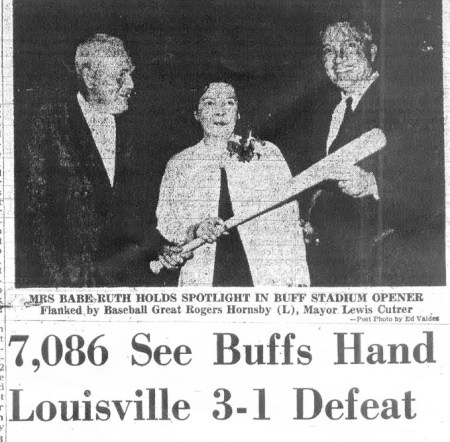
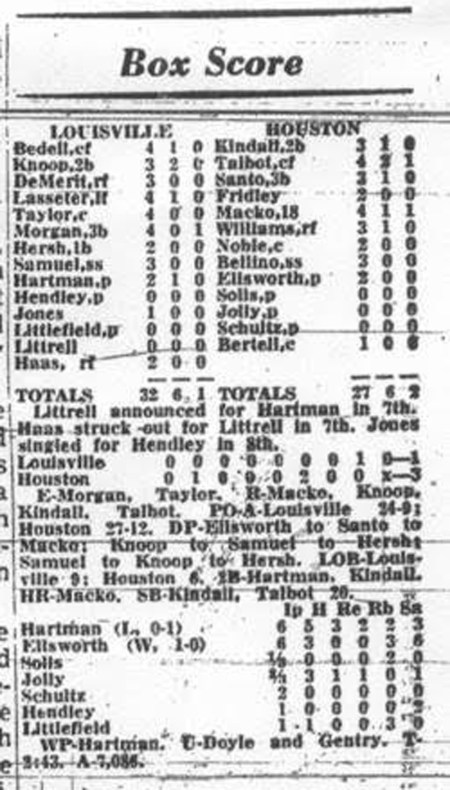
7,086 See Buffs Hand Louisville 3-1 Defeat

April 23, 2017

7,086 See Buffs Hand Louisville 3-1 Defeat

By CLARK NEALON, Post Sports Editor

Houston Post, April 23, 1960

Sharp pitching by Lefty Dick Ellsworth early and by Barney Schultz late produced a 3-1 victory for the Houston Buffs over Louisville’s Colonels in the Busch Stadium American Association nasenall opener before 7,086 paying fans Friday night.

Ellsworth allowed only three hits in six shutout innings before he injured his pitching hand, and Schultz, coming in as the fourth Houston pitcher with the bases loaded and none out in the eighth, pitched his way out of the threatening situation at the cost of only one run to save a bright new night for the Buffs.

JOE MACKO’S SECOND homer of the season in the second inning and a two-run sixth provided the Buffs with their three runs to the delight of a “Babe Ruth Night” gathering that was the biggest opening crowd of the American Association season so far. The Buffs drew 7,483 for their Houston opener last season.

The victory sent Manager Enos Slaughter, who didn’t play because of lingering rib injuries suffered in the season’s second game, away to a flying start as a manager. In fact, Enos probably will settle for the way his pitching changes worked out Friday night during the remainder of his managerial career.

The big one was Schultz, who came to Dave Jolly’s rescue after singles by Bob Knoop, Pinch-hitter Mack Jones and Don Lassetter had filled the bases with nobody out in the eighth inning.

 THE KNUCKLEBALLING righthander retired Bob Taylor on a fly to right with no advance, saw a run score as Bob Morgan forced Lassetter at second but ended the frame by retiring Earl Hersh on a grounder to Jerry Kindall.

Schultz breezed through the ninth in order and fans who had seen the Buffs lose 104 games in 1959 went away happy over a winning start at home, the fourth victory of seven starts and undisputed third place so far in 1960.

An unfortunate failure of the public address system ruined the audio portion of the pre-game ceremonies honoring the memory of Ruth, what with short speeches by Mrs. Claire Hodgson Ruth, the Babe’s widow, and Mayor Lewis Cutrer heard by only a few of the fans. Youngsters of the Babe Ruth League surrounded the diamond and the Buffs and Colonels were lined up along the first and third base lines.

HALL OF FAMER Rogers Hornsby batted, Mayor Cutrer pitched and Chicago Cub Farm Director Gene Lawing caught on the ceremonial first pitch. The Mayor got the first one by “The Rajah” but Hornsby signalled for another and cracked it toward third base.

Moving pictures of Ruth’s last appearance in Yankee Stadium were shown on a screen behind the pitcher’s mound, and recordings of Ruth’s voice and that of the late Lou Gehrig were played. Fred Nahas was master of ceremonies.

Ellsworth, though he was credited with his first victory of the season, had cause to wonder at the fates. First he was felled by a line drive off the bat of Taylor in the third inning on a Buff mound that is rapidly becoming a jinx, what with the injuries to Glenn Crable of the Buffs and Ron Piche of Louisville by batted balls last season.

The ball hit Ellsworth in the stomach. He trapped it there for the out, but went down in a struggling heap. Up after a minute, he stayed in the game, only to leave after another freak injury in the sixth.

ELLSWORTH’S BAT splintered in his hands as he popped out the Amado Samuel at short, injuring Dick’s pitching hand enough to force his departure from the game. However, the injury was believed to be only minor, a slight flesh wound.

ELLSWORTH ALLOWED only three hits, fanned six in his six innings of work.

Each team got six hits in a tight pitching duel, with the Buffs getting their margin of victory in Jerry Kindall’s double, two stolen bases, a wild pitch and an error in the sixth. The defeat ended a four-game winning streak for the Colonels.

Kindall’s blow barely missed being a homer at the very top of the left field fence. Jerry stole third and scored on Bob Talbot’s single. Talbot, who stole two bases and got two hits, swiped second, went on to third on Lefty Bob Hartman’s wild pitch and scored when Taylor’s throw toward third slipped off the side of the catcher’s hand and went into left field for an error.

SLAUGHTER RELIEVED Ellsworth with Lefty Marcelino Solis staring the seventh, but after retiring one man, Solis walked Hersh and Samuel in succession. Quickly, Enos called in Jolly, who responded by fanning Pinch-hitter Eddie Haas and inducing Howie Bedell to ground into a forceout to end the inning. Gene Littrell had been announced as the hitter for Hartmen, but when Slaughter switched to the right-handed Jolly, Manager Ben Geraghty of the Colonels switched to the left-handed hitting Haas.

When Jolly yielded the three hits starting the eighth, Slaughter wasted no time calling on Schultz, with Catcher Dick Bertell relieving Ray Noble to catch the testy knuckle-ball.

Macko’s homer was a line shot over the 342-foot sign atop the triple-deck scoreboard in left-center.

The teams meet in a doubleheader starting at 6:30 PM Saturday at Busch Stadium. Lefty Jim Brewer (0-1) and Al Lary (0-0) are due to work for Houston, with Vic Rehm (1-0) down for one game for the Colonels but Manager Gerahty undecided on who his second choice will be.


____________________

A contribution by independent researcher for The Pecan Park Eagle, Darrell Pittman.

Thank you, Darrell, for another splendid discovery.

____________________


Bill McCurdy

Publisher, Editor, Writer

The Pecan Park Eagle

Houston, Texas

Tom Herman Simply Doesn’t Get the UH Fan Ire

April 22, 2017

Tom Herman
Head Football Coach
University of Texas


“Some of the vitriol confuses me a little bit from the Coog fans considering what we were able to do and accomplish there (at UH) in 23 months and the fun and wins that we had.” – Tom Herman, 4/20/17, in an appearance on “The Proper Gentlemen of Sports” on 790 AM, Houston.

“I sleep so easy knowing that I never once lied to a player, never once lied to a recruit and never once lied to any coaches or administration. Those are the people I care about. Whatever the public thought was happening behind closed doors is really not for me to say. It’s unfortunate people can twist and turn things to fit whatever narrative they’d like it to fit.” – Tom Herman, 4/20/17, in an appearance on “The Proper Gentlemen of Sports” on 790 AM, Houston.

“Some of the vitriol confuses me a little bit from the Coog fans considering what we were able to do and accomplish there in 23 months and the fun and wins that we had,” Herman told co-hosts Matt Thomas and Lance Zierlein. “I sleep so easy knowing that I never once lied to a player, never once lied to a recruit and never once lied to any coaches or administration. Those are the people I care about. Whatever the public thought was happening behind closed doors is really not for me to say. It’s unfortunate people can twist and turn things to fit whatever narrative they’d like it to fit.” – Tom Herman, 4/20/17, in an appearance on “The Proper Gentlemen of Sports” on 790 AM, Houston.

According to the writer in this same Joseph Duarte article from the Houston Chronicle, “Herman always maintained there was (were) a handful of  ‘dream jobs’ he would have to strongly consider, (should offers arise).”

Does that mean that Herman would still have jumped at the UT offer, even if OU, UT and the eight Big 12 dwarf schools had not backed off plans to include UH in their number by canceling plans for expansion last fall. We presume that quick call under those circumstances would have cost Herman the $4-5 million dollar bonus he otherwise stood to bank with UH’s elevation to Big 12 membership. Or did the UH late rebuke by the Big 12 simply happen to clear the way for UT’s “dream job” offer to Herman? It certainly made it easier on several levels for UT to make their play under the circumstances of UH as an outsider than it would have been had UH already been accepted as a conference member. We’ll never know, but that’s the not the point here, anyway.

Our point today is that we are flabbergasted, if possible, over the limited understanding that Tom Herman seems to have for the situation he walked into with fans when he took the Houston job in the first place. He seems shocked by our ire – and actually hurt on some fleet, dismissive level that we don’t seem to appreciate what he did for us in his two seasons (2015-16) as head coach.

Tom! Hello! Tom! Believe me! We loved what you did! We simply didn’t know – on top of the two recent short stays by Kevin Sumlin leaving for Texas A&M and earlier, Art Briles leaving for Baylor – that we were about to get our third, most successful recent coach to stay only as long as it took for his “dream job” to show up and take you away too! Do you not get that? – Or is it that you simply need to remember it differently for your own peace of mind?

We fans weren’t hearing all these big pronouncements from you that you would stay at UH until your “dream job” called you away. We were hearing how much you loved UH and the City of Houston as a place to raise your family. We naively thought that you were here to be our guy, the guy who would fight with us the good fight for a first class opportunity in college football – and a serious shot at the national championship. We weren’t looking for a short time good life, followed by another abandonment, but that’s what we got. – Look at the money we gave you! What do you think all the extra money and bonus money offerings were about? My God! How much money do you need to feel happy and secure. We always assumed that you could get more money elsewhere. We just didn’t think you were wound that way.

“I never lied” honesty can be a deceptive cover for the true reality.

If a coach tells his players after the last game of the season that “I am still your coach,” but he knows (or has a good idea) that a desirable offer from a certain dream university is waiting for him at the airport after the flight back home, you would have to pull out the old Catholic rules governing “mental reservation” to avoid the fact that the coach’s honest first statement was merely a deceptive technicality cover up of the true reality.

Here’s what we fans wish you had said when you arrived at UH

“I’m going to go full burner to give UH all I’ve got to give this job as your new head football coach. As long as I’m treated with honesty, support, and respect, and as long as I see that the university is going the extra mile on facilities and  salaries for the kind of staff we shall need, I may just retire from this place someday. I won’t kid you. Getting into the Power 5 conference level as a school is a must. The chances of UH ever winning a national title as an outsider to that group is almost impossible to conceive. I will help with that fight in every way I can, but I must warn you. I will never put the needs of UH or anyone else above my own family’s needs or my personal health. If ever I am offered a dream job that answers all my needs elsewhere, and it’s one that UH cannot match, I will be open to listening to their offer. Hopefully, that may never happen. If I grow in my attachments to UH over time – as a young guy named Bill Yeoman once did – then I won’t ever have to leave until life takes me from this now sacred ground. This job at UH will have become my dream job. – Thanks for listening. Because now we have no secrets. And you can never say I didn’t plainly warn you.” ~ a might have been introductory statement by Tom Herman on the day he arrived at UH  in 2015 to take over as head football coach.

You never said it to us UH fans, Tom. If you said it that plainly to the UH board or administration, the news never reached us members of the Cougar hoi pal oi. But that doesn’t matter. Telling us straight out was your job, not the school’s.

The Yeoman Model spoiled us.

When Bill Yeoman came to UH as our head football coach in 1962, it was a different world. Those of us who were around at the time got to watch what he did to put UH on the map. By 1965, Yeoman had invented the veer offense, revolutionizing college football. In today’s world he would have been plastered with money to leave for the Valley of Kings, but that didn’t happen. If he turned down some tough offers to stay a Cougar, we never heard. And we didn’t worry about it. He was our guy. And that guy’s brilliance got us better players and eventually, from 1976 to 1995, membership in this last two decades of life that remained for the Southwest Conference. And for that boost, we shall also forever give credit to Coach Darrell Royal of UT for making sure it happened. Now, from 1996 to 2016, we’ve spent the past two decades trying to fight our way back from the new shallow waters of college football with only token moments of new high hope. We don’t want bad coaches; we don’t want mediocre coaches; and we don’t want great coaches who only want to use us as a stepping stone until the “dream job “comes along.

Our Hearts Now Ride with Major Applewhite

We UH fans want Major Applewhite to grow into that UH guy as he takes the reins, even if his UT alma mater comes knocking on his door looking for a new head coach in 3-4 years.

Go COOGS!

____________________


Bill McCurdy

Publisher, Editor, Writer

The Pecan Park Eagle

Houston, Texas

Name That New Area and Wall at MMP

April 21, 2017

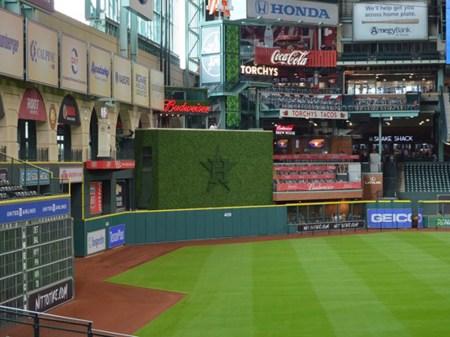
“The H Wall” is the tallest leafy feature in “Jim’s Jungle”!

Look! Like it or not, and it is growing on me as my fears of MMP becoming a band box begin to dissolve through 11 home games in 2017. Only one home run has knocked upon its leafy green exterior in deep center field – and that one by George Springer struck high enough to have cleared the older deeper lower wall behind the former Tal’s Hill area. So, let’s move on to the identity issue here. Just as Tal’s Hill was named Tal’s Hill for the former club president’s suggestion that its original elevation in deep center – along with the playing field flag pole – could provide the “new-in-2000” park with a quirky elevated celebration of the old field challenge of Crosley Field in Cincinnati and a nice architectural touch to the baseball retro-park intention for baseball’s new home in downtown Houston.

The original field design existed for 17 years, but now Tal’s Hill is gone, and center field’s deepest distance has declined from 436 feet to 409 feet.

How’s it look, so far?

So far, so good. Through 11 games, as we’ve just said, only one George Springer home run has dared to ram the high leafy “H” wall in dead center, but that lengthy description is no suitable excuse for a name that might match up with the former Tal’s Hill.

Fans are crawling all around the new botanically inclined edifice in center like so many denizens of a new tree limb culture. They stop on stairways and new hand rails to kill time, socialize, and view the game in the company of new opportunities for food and drink. And they all seem to be smiling and unconcerned about how much time they will be spending at the ballpark – a condition made easier by the 2017 Astros’ early showing that they are a ball club with both the talent and the taste for winning in the new jungle that is Minute Maid Park. Things are looking good.

What have the changes apparently produced?

Minute Maid Park is fast becoming a jungle of baseball and social opportunity. It is a place to watching winning baseball – and, for families and millennials, it is a place to enjoy the company of friends in a park that is becoming an oasis for wireless or in-the-flesh socializing with others. MMP always has been one of the best parks in baseball for the hyperactive fans that enjoy staying on the go – watching the game from various 360 degree spots on the concourse level. As one of the few big league parks that makes full-circle movement by fans on one level without ever losing  sight of the game, MMP ranks among the best – and it just got fan friendlier with the center field modifications. For some of us, who like to sit in one spot, keep score, and play total attention to the game while we are there, these improved mobility factors don’t matter much, but – and this is a mighty big “but” – it’s very possible and most likely probable – that the traditional fans that some of us are is no model for baseball’s fans of the future.

Tomorrow’s Fans

Tomorrow’s fans are not single-minded. They are multi-minded and multi-tasking people. For these reasons, they rarely get together for the exclusive purpose of sharing the rarest wine in the world together – anymore than they would ever go to an MLB game together for the same shared narrow affinity for the game of baseball itself. They attend and return, only to those activities in which they are helped to feel comfortable about feeding their other ongoing mental needs (i.e., texting-connected) at the same time they arrive in physical form to “watch the game.” If that makes no sense to you, and you are young enough to watch this condition grow over the next twenty years, just watch the ways in which the marketing of baseball changes between now and then. What I’m describing here, I think, will make a lot more sense over time. – It will make sense then because wired-mind fans, even among the then elder millennials, will have become the norm for early 21st century “old school” mind sets and social behavior.

What to Name the “H” Wall and Its New CF area?

Because the vine and leaf inclined “H” Wall symbolically well represents the horticultural, heroic, and Houston climate of the new center field area, our vote supports the idea that it’s already named itself. Unless the fan masses come up with a more naturally popular title, let us consider calling  it “The H Wall” – for now and evermore.

As for the newly constructed, people-busy center field leafy area, and in recognition of Jim Crane, the Astros owner who placed the change in motion, the Pecan Park Eagle votes for “Jim’s Jungle” as the only fitting choice. It’s not only forested in center field now. It has become a jungle of fan activity and club opportunity in a powerful meeting of supply and demand.

What do you think?

____________________


Bill McCurdy

Publisher, Editor, Writer

The Pecan Park Eagle

Houston, Texas
The Surviving Members of the Houston Colt .45s

April 20, 2017

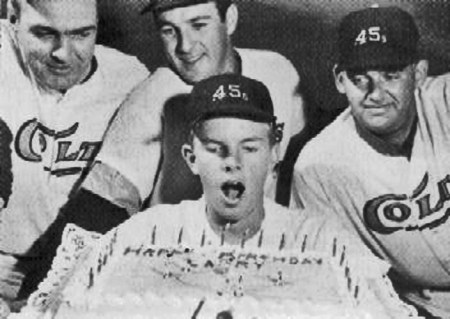
How many kids in history get to celebrate their 18th birthday by striking out the MLB version of Willie Mays? Only one – and his name was and still is – Larry Dierker – who pitched his first game for the Houston Colt .45s on his 18th birthday, 9/22/64. Dierker is the youngest surviving Colt .45.

Today, Thursday, April 20, 2017, there are a total of only forty final survivors among all the men who once played for the Houston Colt .45s in any official season box score time from 1962 through 1964. The oldest, of course, is Bobby Shantz, who also heads the list of oldest among all players to ever perform for the Houston major league club as either the Colt .45s or Astros, but this list of “last living” Colt .45s is much more exclusive. Whereas, we continue to see the addition of numerous new Astros yearly, the club existed as the Colt .45s for only those three initial franchise seasons. Therefore, we chose to focus here on who remains from our originally identified club known as the Houston Colt .45s.

Today we are down to our “Final Forty Colt Forty-Fives” and the youngest of these men just happens to be a fellow that many of us still treasure as a special baseball friend and the namesake of our local Houston SABR group, the Larry Dierker Chapter.

Keep that heart, mind, body, and spirit engaged, Mr. Dierker. – We need you with us as long as possible.

And thank you, Darrell Pittman, for fulfilling our request for this data so quickly. Your ability to also program it for The Pecan Park Eagle in Microsoft Word tabular form as requested simply sweetened the project to this early publication date. On some things, my dear friend, I really don’t know what I’d do without either your help or countless other good intentions. Thank you for being you – a true friend and great baseball guy!

Sincerely,

Bill McCurdy, Publisher

The Pecan Park Eagle

____________________

“Final Forty Houston Colt Forty-Fives” *

Rank by Age Player Houston Years Birth date Age in 2017
1 Bobby Shantz 1962 9/26/1925 92
2 Dick Gernert 1962 9/28/1928 89
3 Don Larsen 1964-65 8/7/1929 88
4 Bob Lillis 1962-67 6/2/1930 87
5 Roman Mejias 1962 8/9/1930 87
6 Dean Stone 1962 9/1/1930 87
7 Hal Smith 1962-63 12/7/1930 87
8 Don Taussig 1962 2/19/1932 85
9 Eddie Kasko 1964-65 6/27/1932 85
10 Carroll Hardy 1963-64 5/18/1933 84
11 Dave Roberts 1962, 1964 6/30/1933 84
12 Al Spangler 1962-65 7/8/1933 84
13 Jim Owens 1964-67 1/16/1934 83
14 Joey Amalfitano 1962 1/23/1934 83
15 J C Hartman 1962-63 4/15/1934 83
16 Don Bradey 1964 10/4/1934 83
17 Jim Golden 1962-63 3/20/1936 81
18 Joe Gaines 1964-66 11/22/1936 81
19 Carl Warwick 1962-63 2/27/1937 80
20 Claude Raymond 1964-67 5/7/1937 80
21 Jim Campbell 1962-63 6/24/1937 80
22 Jim Dickson 1963 4/20/1938 79
23 Bob Aspromonte 1962-68 6/19/1938 79
24 Mike White 1963-65 12/18/1938 79
25 Dave Giusti 1962, 1964-68 11/27/1939 78
26 Ernie Fazio 1962-63 1/25/1942 75
27 Jim Wynn 1963-73 3/12/1942 75
28 Danny Coombs 1963-69 3/23/1942 75
29 Conrad Cardinal 1963 3/30/1942 75
30 Aaron Pointer 1963, 1966-67 4/19/1942 75
31 Jerry Grote 1963-64 10/6/1942 75
32 Larry Yellen 1963-64 1/4/1943 74
33 Dave Adlesh 1963-68 7/15/1943 74
34 Joe Morgan 1963-71, 1980 9/19/1943 74
35 Brock Davis 1963-64, 1966 10/19/1943 74
36 Rusty Staub 1963-68 4/1/1944 73
37 Sonny Jackson 1963-67 7/9/1944 73
38 John Paciorek 1963 2/11/1945 72
39 Steve Hertz 1964 2/26/1945 72
40 Larry Dierker 1964-76 9/22/1946 71

* Note: Players for the Houston Club when it was known as the Colt .45s were on the roster at some time during the three original National League entry seasons of 1962, 1963, or 1964. Players in the table which are shown with Houston beyond 1964 are simply those who continued with the club after their named changed to “Astros” in 1965. Pure “Astro” players who only joined the club after the name change are not included in this list.

Unless we miscounted, 19 of these surviving 40 Colt .45 alumni went on to spend variable future time beyond 1964 as members of the franchise’s 1965 and forward re-named club, the Houston Astros.

____________________


Bill McCurdy

Publisher, Editor, Writer

The Pecan Park Eagle

Houston, Texas
Problem? It’s Game Lengths Plus Attention Spans.

April 19, 2017

Whoops! Did I just outrun your attention span?”


Anyone today who chooses to speak or write into the wind of all those limited attention spans that are out there today is simply asking for it.

Here’s a better way to picture it. – Remember all those great Roadrunner-Wile E. Coyote cartoons of childhood? Their interactions serve us well here as models.

Wile E. Coyote is the presenter. The Roadrunner is the audience that old Wile E. intends to capture.

Every time Wile E. charges after old Roadie, the result is invariably the same. – The moment he seems to be getting there, Roadie shifts into high gear high-speed and is gone in a cloud of dust.

And where does that leave Wyle E.?

Sometimes it leaves the smarter version of Wile E. screeching to a dust-filled blinking spot in the road before he spins over to the Acme Company in search of a new capture trap.

In our model, the Acme Company serves as our symbol for everything from universities to authors to “Leisure Learning” courses on “how to get what you want.”

Most of these programs don’t work, but, like Acme, they always have something new to offer. – And why not? The Wile E. Coyotes of the world keep asking for them.

The not-s0-smart versions of Wile E. Coyote don’t stop when the Roadrunner disappears because, frankly, they are not even aware of his departure. They just keep charging after where they think he is, leaving a dusty trail of their own near the rim of the high plateau where they run.

Worse. The dummy Wyle E.s keep on running past the rim – and for a short distance – they are obliviously running across open sky as though it were solid ground.

Then. Something happens.

Wile E. Coyote senses a slight decline in the altitude of his running path.

The ground is now so light that Wile E. notes the absence of ground contact as he places each pounding foot down in fast speed stride.

A sudden suspicion grips Wile E.’s mind. And his eyes both enlarge to freeze-position as OPEN-WIDE.

Wile E. looks down. The look confirms that he is now running through the open air.

The canyon floor awaits him. – 3,000 feet below.

Sheepishly, he waves us goodbye and falls through the bottom of the screen.

And we look on at the open space he once occupied, only a nanosecond ago.

And what keeps us aflight is never a problem. It’s called movie magic.

And our plight is not at issue here, anyway.

The metaphor speaks for itself:

Presenters and events that pursue audiences in 2017 without regard or awareness for the presence of short attention spans will get what they have coming to them, one way or another.

____________________

Regarding the Physical Changes at Minute Maid Park

After watching the presentation by Astros President Reid Ryan last night during the ROOT Network telecast, I’ve come around to thinking that maybe the ball club has got the right handle on what needs to happen to make people stop worrying about the length of games or silly filler practices like character races or tee shirts slung into the crowd by cheerleader types. As much as I personally miss Tal’s Hill, the changes in center field have created more area that is now devoted to fan exploration, eating, drinking, socializing, and hanging out. We got to see it with our own eyes last night and the fans seemed to be lapping it up. In fact, those very activities probably are the core of things that can really distract people from the cell phones and provide the kind of atmosphere that people associate with “the less time this takes, the better.” It isn’t about less time. It is about how enjoyable is the time that we spend at Minute Maid Park (MMP)? Enjoyable social time between fans is the one thing that MMP can provide that is superior, especially for younger fans, to watching the game on HDTV at home. Plus, throw in all the new ballpark game vista options, and MMP is superior to any bar scene that offers big screen coverage of the same views we can just about all get on home TV now.

____________________


Bill McCurdy

Publisher, Editor, Writer

The Pecan Park Eagle

Houston, Texas