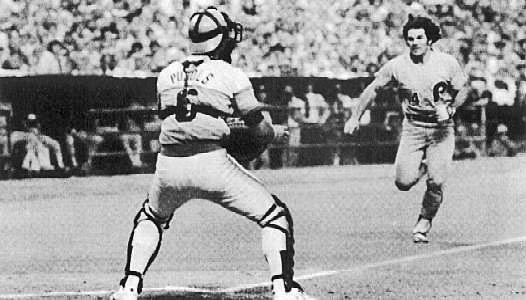
ASTROS CATCHER LUIS PUJOLS PREPARES FOR A PLAY AT THE PLATE ON PETE ROSE OF THE PHILLIES DURING THE 1980 NLCS.
Back in 1980 the Houston Astros played the Philadelphia Phillies in a Best 3 of 5 Games National League Championship Series. The teams came back to the Astrodome in Houston for Games 4 and 5, with the Astros leading the Series 2 games to 1 and needing only one more victory to take the NL pennant and make their first trip to the World Series. It was no lead pipe cinch. The Phillies had been to two modern World Series in 1915 and 1950, but they had yet to win. And on October 11, 1980, the Phils still had some fight left in them.
Game 4, Saturday Afternoon, October 11, 1980, @ the Houston Astrodome: If you were at the game, you probably remember the top of the 4th inning controversy that ultimately went against the Astros. It didn’t cost the Astros the game, but it seemed to set in motion a chain of events that led to one of those famous historic defeats in City of Houston athletic experience.
This “bad news bears” play is best recalled through the eyes of the UPI writer who described it in real time for the newspapers of the following day:
__________________________________________________
Triple Play dropped, Phillies catch up
HOUSTON (UPI) Vern Ruhle insists he caught the ball. Dallas Green says he didn’t. Doug Harvey isn’t sure.
A bizarre double play, which triggered a twenty-minute controversy, occurred in the fourth inning of Saturday’s National League Championship Series game and nearly cost the Philadelphia Phillies a 5-3 triumph over the Houston Astros.
The play came about when Bake McBride and Manny Trillo were on first and second after having singled to open the inning. Gary Maddox, the next batter, then hit a soft, broken-bat line drive which Rule gloved near his left foot. The only question was: Did he catch it or trap it? Even the videotape replays can’t tell for sure.
Harvey put his palms down, indicating the ball was not caught. But Ruhle, knowing he had caught the ball, threw to first to double off Trillo. When first base umpire Ed Vargo’s hand went up into the air to signal an out, Phillies manager Green and a number of players raced to the field to protest.
While they were arguing, Astros first baseman Art Howe ran down to second base and tagged the bag for what he felt should have been an inning-ending double playsince McBride was standing down on third. Second base umpire Jerry Crawford signaled an out and then all bedlam broke loose.
For twenty minutes, the Phillies argued with the umpires and finally, after the umpires converged by themselves and then with National League President Chub Feeney. McBride was waived back to second and the double lay was allowed.
Harvey said the final decision was reached because his view of Ruhle’s catch had been blocked by the batter and that therefore he was relying on the judgment of Vargo and third base umpire Jerry Engel, both of whom Harvey thought had a better view of the play.
“When he (Maddox) made contact, he leaned over and blocked out my view,” Harvey said. “My immediate reaction was that (the) ball was half speed and that it might come up short. Well, I gave a no-catch sign at first.hen I looked up and saw the charge of people coming at m. I immediately called time and conferred with my umpires.
“Ed Vargo who was at first said it was a catch as did Jerry Engel at third. We ruled that the runner at first was out, but that the runner at third could go back (to second) and not be out. I felt that my no-catch call put the runner at second in jeopardy. He went to third base on my call. I felt the runner at first broke mmediately and could not have got back no matter what my call was.
“The jeopardy rule has been in the rule books for a long time. It gives the umpires the power to It gives the umpires the right to correct a mistake if he feels his (unclear or erroneous) call has put the runner in (a) bad position. That’s exactly what happened.”
GREEN, HOWEVER, was adamant that Ruhle never caught the ball.
“We must have been watching different games,” Green said. “What I saw and what they saw were not the same game. It was efinitely a trap. It was neither a double play or a triple play.. It should have been men on second and third and one out.”
Green originally protested the game following the call, but withdrew the protest when the Phillies won. Astros manager Bill Virdon also protested the game on the grounds that (the controversial play) should have been (ruled) a triple pay, but his protest was disallowed by Feeney because the play had no effect on the outcome of the game.
Ruhle said he definitely made the catch.
“As far as I’m concerned, I caught the ball. That’s why I went to first,” Ruhle said. “(Astros catcher) Luis (Pujols) pointed to first. Evidently, there was time for me to go to second too. He (Pujols) was the first one I could see and I figured he could see the play better than I could.
“It was real close as far as me catching it. I reached out as far as I could. It hit the edge of the webbing and came up in my glove. Had I not thought I caught the ball, I would have looked to third base (for a force out).
“Why didn’t they give us the triple play? The play was continuous. You can’t call time out in the middle of a play.”
~ United Press International, Suburban Chicago Daily Herald, October 12, 1980, Page 33.
__________________________________________________
After all the 4th inning hoopla, the Phillies failed to score. Through seven, the Astros held a 2-0 lead, but the Phillies bunched enough hits in the top of the eighth to take a 3-2 advantage, with the Astros tying the game and sending things into extra innings with one run of their own in the bottom of the ninth for a 3-3 tie.
In the top of the tenth, Greg Luzinski of the Phillies double down the left field line to score Pete Rose, who also had to knock over Astros catcher Bruce Bochy to secure the goahead run, Manny Trillo then singled to plate Luzinski with the second Phils run in the tenth. The Phils’ 5-3 lead held up as the final score as the Astros went down in order in the bottom half. The Series was now tied at games a piece,
Game Five, Sunday EVENING, October 12, 1980:
For many Astros fans, deciding Game Five of the 1980 NLCS with the Phillies was just as frustrating as our deciding home Game Six loss to the Mets six years later in the 1986 NLCS.
Moving into the top of the eighth, the Astros had just taken a 5-2 lead in the bottom of the seventh on a three-run scoring frame and Nolan Ryan was taking the mound for the club that was now only six outs away from their first National League pennant.
Everyone in the Dome was energized. The gates of The Promised Land were only two shut-em-down innings away. Nolan Ryan … wait a minute … allow me to re-phrase this sentence the way it actually felt at the start of the eighth …. Nolan “Freakin’ Awesome” Ryan was about to defend us Houstonians from any collapse of heart and good intentions on the homestretch furlongs part of the road to baseball happiness. It just needed to be acted out accordingly.
Didn’t happen!
Before we could sneeze or get our plans settled about where we planned to celebrate, the Phillie marched to the plate in the top of the eighth and filled the bases with three singles off the foreboding arm of the legendary Ryan Express. These nettlesome hits included an infield hit by Bob Boone and a bunt single by former Astro Greg Gross. And they did it all with nobody yet retired as an out.Two Phillies runs crossed the plate when Pete Rose walked and Keith Moreland grounded out. The Astros lead had been trimmed to 5-4 with one out and Phillies runners now on second and third.
A single by Del Unser then tied the game at 5-5 and Many Trillo’s two-RBI triple gave the Phillies a 7-5 lead as the top of the eighth version of the Hindenburg landing in Houston finally wrapped. The Astros had taken a deep penetrating turkey fork to the breast in that late stanza, but they weren’t quite dead. Not yet, anyway.
In the bottom of the eighth, the Astros managed to tie the game at 7-7 on RBI singles by Rafael Landestoy and Jose Cruz. Neither team scored in the ninth and the game went into extra innings at 7-7.
In the top of the tenth, Del Unser and Gary Maddox produced a run that would prove prove to be the finally fatal fork-stab by the Phillies offense off Astros reliever Frank LaCorte. as Dick Ruthven came on in the bottom of the tenth and retired Houston in 1,2,3 order. The Phillies had won their third National League pennant in history.
It would be another 25 years before the near-miss Astros would win their first NL pennant in 2005 and go “0 for 4” against the White Sox in the World Series.
Take Heart.
Have a nice weekend, everybody. And pleasant memories and dreams to you too.
Try to remember: Our day will come. We’ve got to have heart. And we’ve got to believe. Anything less drops us all into the dark abyss that allows for no survivors.
We are Houston. In every way we can be Houston. And we have not built this great city by giving up, but by learning from our mistakes and past disappointments what works and what doesn’t. And by never separating soul from all that’s important to the success of anything that survives and flourishes in Houston.
 The Pecan Park Eagle
May 18, 2014 at 5:20 pm |
On October 6, 1980, I watched the Astros win their last game against the Dodgers to win the West and then the next day flew from Denver to New York to catch a flight to London for a previously planned trip to Europe–just as they began their first game against the Phillies for the National League Championship and a chance to advance to the World Series. After suffering through years of frustration with the Colt .45s and Astros, I was leaving the country on the very day the NL playoff series began. I didn’t find out what happened until later that month when I found a copy of the Herald-Tribune, which showed a photo of the Royals and Phillies. When I returned to New York in December, a cab driver told me the series between Philadelphia and Houston was more exciting than the World Series. So, I was spared the heartbreak.