Archive for 2013

Houston at Christmas: 100 Years Ago

December 20, 2013
Christmas in Houston  ~ 100 Years Ago, 1913 ~

Christmas in Houston
~ 100 Years Ago, 1913 ~

The photo may or may not be exactly from 1913. The goal here is not the precise accuracy of the photo depiction, but looking at how the print media covered Christmas in Houston 100 years ago.

Some things change. Others remain the same.

********************

CHRISTMAS IN HOUSTON, 100 YEARS AGO; DECEMBER 25, 1913

Houston, Tex., December 25, 1913 — The peaceful spirit of Christmas hung over Houston today and directed all the activities of its citizens from the staging of the gorgeous municipal Christmas tree to the giving of the smallest present  that marked the esteem of a friend for a friend. All business houses were closed and even the streets were almost deserted, while the citizens gathered about the family boards and ate of the Christmas turkey or helped the children enjoy their new presents.

Masses were said in all the Catholic churches of the city in the forenoon and in many of the Protestant churches special services were held. In the afternoon the municipal Christmas tree was the feature of the children, while the theaters held large crowds at the matinees. In the evening the streets were almost deserted except for the occasional party of theater goers, the chilling blast that swept the streets making the cozy firs of the homes preferable to the out of doors.

“Municipal Tree” is a Success

After a month of work on the part of a hundred women and expectancy on the part of 4,000 children, the first municipal Christmas tree ever held in Houston is a successful thing of the past, and those who fostered and executed the idea were so encouraged by the sight of so many happy faces gathered together that it is practically assured that the municipal Christmas tree in Houston will become an established event. One woman said today:  “When I saw the happiness portrayed in those thousands of faces I felt amply repaid for the slight services I rendered in making it possible.”

The exercises at the municipal auditorium began at 2:30 o’clock this afternoon with a concert by the Municipal Band, which was enjoyed by a crowd of about 4,000 children and 2,000 grown people. This continued for thirty minutes, when Dr. W. S. Lockhart read a short passage from the Bible and then spoke briefly on the origin and importance of Christmas. This was followed by a duet rendition of “Holy Night” that was very beautiful. The children were then led in singing “America,” to the band accompaniment, following which several motion pictures were shown on the canvas.

Mayor Campbell is Santa Claus

At this juncture, (Houston) Mayor Campbell, who had been deputized to act as Santa Claus, arrived on the scene in a big touring car. Entrance was effected through the big doors on the Capitol avenue side of the auditorium, and a part of the seats had been cleared away, leaving an aisle through which the car was driven to the very center of the building and directly in front of the stage. The car was driven quietly and quickly into the building, and when the children recognized the presence off Santa Claus they gave a tremendous ovation.

After making the children a speech, the Mayor directed the distribution of the 6,000 stockings piled up in front. The arrangement  of the crowd was systematized that when a child left his seat, he marched down to the front aisle, where he was handed his stocking, and then he marched out of the building. All were requested to go out on Capitol avenue, where a moving picture machine was taking a film picture of the happy faces as they emerged with their gifts in their arms.

The Tree and the Gifts

A huge Christmas tree of pine was set deep in the stage and was brilliantly lighted with white, red, and blue, and green lights. The sight of this tree, when the curtain was raised, provoked hearty applause. The gift for the children consisted of a small stocking, filled with fruits and candies. The stockings were made by the ladies of the city and their contents were donated by various merchants.

Child Burns to Death Amidst Christmas Romp

Excited over an examination of her Christmas presents, Edna May Keller, the 12 year old daughter of Porter D. Keller, brushed against a red hot stove this morning when she went to turn the damper, and within a few minutes she was dead as a result of her clothing having ignited and burned almost entirely off her body. The accident happened at her home, 1818 Franklin Avenue, at 11:25 o’clock, just after the child had been playing with some of her new toys.

The child had arisen early and had spent the morning viewing the playthings which had been given her for Christmas, and had called the rest of the family into a room adjoining the one in which was the stove. It was while the family was assembled in there that the stove became overheated, and when the little girl went near it to turn the damper, her clothing ignited. Like a flash she was enveloped in flames, and when a physician arrived he found she was fatally burned, and also had swallowed a quantity of the flames and smoke.

The funeral will be held from the family home at 3 o’clock Friday afternoon (Dec. 26, 1913), Rev. J.L. Gross officiating, and interment will be in the German Cemetery.

Auto Accident Proves Fatal

W.L. Wayland, advertising manager for the Foley Bros. Dry Goods Store, died at noon today at the St. Joseph’s Infirmary from injuries received last night in a collision between an automobile in which he was driving and a wagon of the Houston Transfer Company.

In company with G.H. McCormick, Mr. Wayland was driving out Main Street. At the intersection of Main and Pease, Mr. Wayland was blinded by a street light blinded Mr. McCormick (the 1913 reporter mistakenly used the name of the passenger here. All other writing references here state that Mr. Wayland was the driver) and he (Wayland) did not see the wagon until it was too late to avoid a collision. When he did see the wagon he swerved the car and Mr. Wayland was thrown out, alighting on his head. He was taken to the infirmary and was unconscious until his death occurred.

Wayland lived at 1608 Tuam avenue and is survived by a widow and two children. It is expected that the funeral will be held Friday (Dec. 26, 1913).

100,000 Packages are Mailed

With the (Houston) Christmas rush over. the local postal authorities have estimated that the stamp sales for the five days between Dec. 19 and Dec. 23, inclusive. amounted to $11,865.42.

The heaviest sales were those of Monday (Dec. 22, 1913), which amounted to $3,110.76, when about 30,000 parcels were mailed. It is estimated that approximately 100,000 parcels were mailed during the Christmas rush, and the expediency with which these have been handled has provoked much favorable comment.

It has been found that the average price of the sending of a parcel is about 7 cents, while some have gone for 4 cents, and very few cost more than 15 cents. The method of sending Christmas gifts has been given approval.

~ Galveston Daily News, Friday, December 26, 1913, Page 6 ~

********************

$12,000,000 Store Open for Business

December 19, 2013
The Original Foley's ~ as it appeared on Opening Day in 1947 ~

The Original Foley’s
~ as it appeared on Opening Day in 1947 ~

********************

FOLEY”S in HOUSTON: $12,000,000 Store Open for Business

HOUSTON, TEX, October 21, 1947 (UP) –

The $12,000,000 Foley’s Department Store, hailed as the world’s first new department store in 20 years and the nation’s finest, opened its doors Monday to thousands of impressed Texans and distinguished visitors from all over the country.

Mayor Oscar Holcombe cut the wide ribbon that stretched across the main entrance to the windowless, seven-story Minnesota limestone structure which embodies tomorrow’s merchandising methods.

The ultra-modern store, covering an entire city block, features a five-story parking garage where customers may pickup their parcels which have been transported to the garage by an ingenious system of chutes and conveyor belts.

Fred Lazarus, Jr. of Cincinnati, president of Federated Department stores; Max Levine, Foley’s president, and C.E. Naylor, Houston Chamber of Commerce president, also took part in the opening ceremonies at noon.

… United Press (UP), Lubbock (TX) Evening Journal, October 21, 1947, Page 9

********************

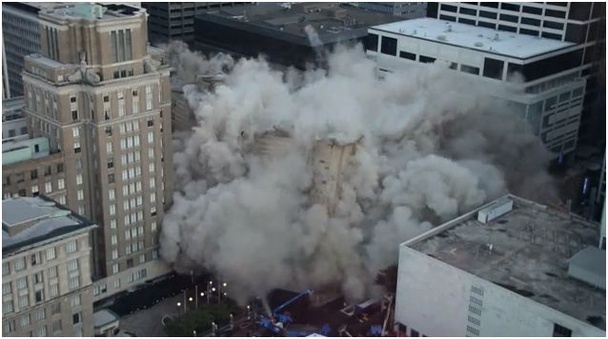
Foley's-Macy's ~ on its last day in 2013 ~

Foley’s-Macy’s
~ on its last day in 2013 ~


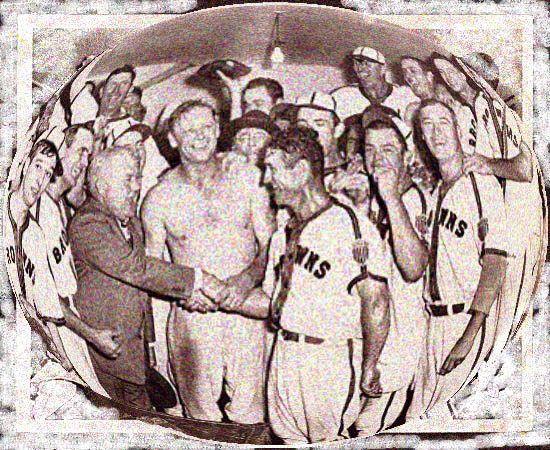
Home Attendance of the St. Louis Browns

December 18, 2013

Back in the day, before there were any residual incomes from television to drive fan interest in the game, baseball had to rely upon gate income and concession sales to cover the cost of very low player and administrative salaries and minimal maintenance of the club’s equipment, uniform, and venue expenses. It helped if an MLB club owned its own stadium.

1944: Just a Dream. Just a Dream. Just a Dream.

1944: Just a Dream. Just a Dream. Just a Dream.

The St. Louis Browns of the American League (1902-1953) did own their own game arena. It was a place known for most of its life as Sportsman’s Park. They also pocketed good side income by serving as landlord to the St. Louis Cardinals of the National League until they sold the place to their highly more successful same-city rivals in 1953, the last year of the Browns’ existence.

It was easy for the Browns to become dependent upon the sale of good ballplayers rather than the attainment of pennants as the unspoken priority plan for economic survival. The club could not draw the fans they needed to pay for a winning team on the field, so, in effect, if not by stated goal, they showcased and sold many of their best talents to wealthy clubs like the Yankees just to pay their bills and stay afloat. As a result, all hope spun as wasted motion in the mud. The St. Louis Browns were going nowhere “up” in the AL standings, except in 1921, when they got there honestly and fell a mere one game short of winning the pennant, and in 1944, when World War II and military draft conspired to leave the Browns with their only pennant winner against inferior competition.

In these 52 annual attendance figures from Baseball Almanac, pay special notice to how bad things got during the Great Depression years. 1935 was their worst year. The Browns drew only 80,922 fans for the season in 1935, To say the least, their per game average of 1,044 fans was both abysmal and unsustainable by today’s financial needs.

It reminds me of pitcher Ned Garver’s favorite line about poor Brownie game attendance during their last generation of air-gasping survival in the years that followed World War II.

“Our fans never booed us,” said Browns pitcher Ned Garver. “They wouldn’t dare. – We outnumbered them.”

St. Louis Browns Attendance1902 – 1953
Year Ballpark Name Attendance

Game Average

Season Total

A.L. Average

1902

1903

1904

1905

1906

1907

1908

1909

1910

1911

1912

1913

1914

1915

1916

1917

1918

1919

1920

1921

1922

1923

1924

1925

1926

1927

1928

1929

1930

1931

1932

1933

1934

1935

1936

1937

1938

1939

1940

1941

1942

1943

1944

1945

1946

1947

1948

1949

1950

1951

1952

1953

Sportsman’s Park (III)

Sportsman’s Park (III)

Sportsman’s Park (III)

Sportsman’s Park (III)

Sportsman’s Park (III)

Sportsman’s Park (III)

Sportsman’s Park (III)

Sportsman’s Park (IV)

Sportsman’s Park (IV)

Sportsman’s Park (IV)

Sportsman’s Park (IV)

Sportsman’s Park (IV)

Sportsman’s Park (IV)

Sportsman’s Park (IV)

Sportsman’s Park IV

Sportsman’s Park (IV)

Sportsman’s Park (IV)

Sportsman’s Park (IV)

Sportsman’s Park (IV)

Sportsman’s Park (IV)

Sportsman’s Park (IV)

Sportsman’s Park (IV)

Sportsman’s Park (IV)

Sportsman’s Park (IV)

Sportsman’s Park (IV)

Sportsman’s Park (IV)

Sportsman’s Park (IV)

Sportsman’s Park (IV)

Sportsman’s Park (IV)

Sportsman’s Park (IV)

Sportsman’s Park (IV)

Sportsman’s Park (IV)

Sportsman’s Park (IV)

Sportsman’s Park (IV)

Sportsman’s Park (IV)

Sportsman’s Park (IV)

Sportsman’s Park (IV)

Sportsman’s Park (IV)

Sportsman’s Park (IV)

Sportsman’s Park (IV)

Sportsman’s Park (IV)

Sportsman’s Park (IV)

Sportsman’s Park (IV)

Sportsman’s Park (IV)

Sportsman’s Park (IV)

Sportsman’s Park (IV)

Sportsman’s Park (IV)

Sportsman’s Park (IV)

Sportsman’s Park (IV)

Sportsman’s Park (IV)

Sportsman’s Park (IV)

Sportsman’s Park (IV)

3,890

5,474

4,078

4,348

5,054

5,407

7,986

4,757

3,163

2,737

2,727

3,230

3,078

1,891

4,250

2,716

1,985

4,991

5,446

4,623

9,259

5,588

6,972

6,012

3,664

3,198

4,409

3,645

1,975

2,326

1,462

1,152

1,497

1,044

1,203

1,578

1,672

1,399

3,072

2,245

3,386

2,803

6,606

6,273

6,749

4,162

4,330

3,496

3,209

3,815

6,694

3,860

272,283

380,405

318,108

339,112

389,157

419,025

618,947

366,274

249,889

207,984

214,070

250,330

244,714

150,358

335,740

210,486

122,076

349,350

419,311

355,978

712,918

430,296

533,349

462,898

283,986

247,879

339,497

280,697

152,088

179,126

112,558

88,113

115,305

80,922

93,267

123,121

130,417

109,159

239,591

176,240

255,617

214,392

508,644

482,986

526,435

320,474

335,564

270,936

247,131

293,790

518,796

297,238

275,807

293,111

378,004

390,094

367,260

424,846

451,421

467,484

408,836

417,439

407,954

440,851

343,449

304,336

431,486

357,357

213,500

456,780

635,538

577,541

609,294

575,324

656,930

648,356

614,073

576,619

527,649

582,809

585,716

485,412

391,654

365,776

470,451

461,001

522,365

591,979

555,711

533,825

679,224

613,995

525027

462,071

599,770

697,553

1,202,648

1,185,759

1,393,762

1,341,331

1,142,795

1,110,334

1,036,737

870,510

Batters who hit HR in 1st MLB times at bat

December 17, 2013
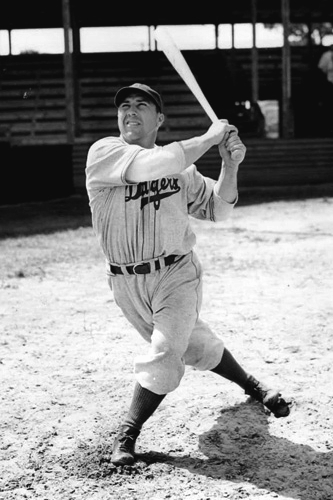
Ernie Koy, Sr. is one of 114 batters who homered in his first MLB time at bat.

Ernie Koy, Sr. is one of 114 batters who homered in his first MLB time at bat.

Our reminder from friend Randy yesterday is the whole impetus behind this data column. Randy had written a reminder comment in response to yesterday’s piece about the first MLB games of 15 great HOF players to remind us that former UT star Ernie Koy, Sr. had once homered in his first 1938 MLB batting appearance for the Brooklyn Dodgers. Well, that’s a rare feat, all right. Only 114 major leaguers have done it and here’s the list of names in chronological order. The chart shows their names, their teams, the dates of their first time at bat explosions, and the number of homers they each compiled in their MLB careers (Thank you, Wikipedia, for doing all the work):

Joe Harrington Boston Beaneaters Sept 10, 1895 3
Bill Duggleby& Philadelphia Phillies April 21, 1898 6
Johnny Bates Boston Beaneaters April 12, 1906 25
Luke Stuart St. Louis Browns Aug 8, 1921 1
Walter Mueller# Pittsburgh Pirates May 7, 1922 2
Earl Averill Cleveland Indians April 16, 1929 238
Clise Dudley# Brooklyn Dodgers April 27, 1929 3
Gordon Slade Brooklyn Dodgers May 24, 1930 8
Eddie Morgan# St. Louis Cardinals April 14, 1936 1
Ace Parker Philadelphia Phillies April 30, 1937 2
Gene Hasson Philadelphia Athletics Sept 9, 1937 4
Ernie Koy Brooklyn Dodgers April 19, 1938 36
Heinie Mueller Philadelphia Phillies April 19, 1938 17
Bill LeFebvre# Boston Red Sox June 10, 1938 1
Clyde Vollmer# Cincinnati Reds May 31, 1942 69
Paul Gillespie Chicago Cubs Sept 11, 1942 6
Buddy Kerr New York Giants Sept 8, 1943 31
Hack Miller Detroit Tigers April 23, 1944 1
Whitey Lockman New York Giants July 5, 1945 114
Eddie Pellagrini Boston Red Sox April 22, 1946 20
Dan Bankhead Brooklyn Dodgers Aug 26, 1947 1
George Vico# Detroit Tigers April 20, 1948 12
Les Layton New York Giants May 21, 1948 2
Ed Sanicki Philadelphia Phillies Sept 14, 1949 3
Ted Tappe Cincinnati Reds Sept 14, 1950 5
Bob Nieman St. Louis Browns Sept 14, 1951 125
Hoyt Wilhelm New York Giants April 23, 1952 1
Wally Moon St. Louis Cardinals April 13, 1954 142
Chuck Tanner# Milwaukee Braves April 12, 1955 21
Bill White New York Giants May 7, 1956 202
Frank Ernaga Chicago Cubs May 24, 1957 2
Don Leppert Pittsburgh Pirates June 18, 1961 15
Cuno Barragan Chicago Cubs Sept 1, 1961 1
Bob Tillman Boston Red Sox May 19, 1962 79
John Kennedy Washington Senators Sept 5, 1962 32
Buster Narum Baltimore Orioles May 5, 1963 3
Gates Brown Detroit Tigers June 19, 1963 84
Bert Campaneris# Kansas City Athletics July 23, 1964 79
Bill Roman Detroit Tigers Sept 30, 1964 1
Brant Alyea# Washington Senators Sept 12, 1965 38
John Miller New York Yankees Sept 11, 1966 2
Rick Renick Minnesota Twins July 11, 1968 20
Joe Keough Oakland Athletics Aug 7, 1968 9
Gene Lamont Detroit Tigers Sept 2, 1970 4
Don Rose# California Angels May 24, 1972 1
Benny Ayala New York Mets Aug 27, 1974 38
Reggie Sanders Detroit Tigers Sept 1, 1974 3
John Montefusco San Francisco Giants Sept 3, 1974 4
José Sosa Houston Astros July 30, 1975 1
Dave McKay Minnesota Twins Aug 22, 1975 21
Alvis Woods# Toronto Blue Jays April 7, 1977 35
Dave Machemer California Angels June 21, 1978 1
Johnnie LeMaster San Francisco Giants Sept 2, 1975 22
Tim Wallach Montreal Expos Sept 6, 1980 260
Gary Gaetti Minnesota Twins Sept 20, 1981 360
Carmelo Martínez Chicago Cubs Aug 22, 1983 108
Mike Fitzgerald New York Mets Sept 13, 1983 48
Andre David Minnesota Twins June 29, 1984 1
Will Clark San Francisco Giants April 8, 1986 284
Terry Steinbach Oakland Athletics Sept 12, 1986 162
Jay Bell# Cleveland Indians Sept 29, 1986 195
Ricky Jordan Philadelphia Phillies July 17, 1988 55
Junior Félix# Toronto Blue Jays May 4, 1989 55
José Offerman Los Angeles Dodgers Aug 19, 1990 57
Dave Eiland San Diego Padres April 10, 1992 1
Jim Bullinger# Chicago Cubs June 8, 1992 4
Jay Gainer# Colorado Rockies May 14, 1993 3
Mitch Lyden Florida Marlins June 16, 1993 1
Garey Ingram Los Angeles Dodgers May 19, 1994 3
Jon Nunnally Kansas City Royals April 29, 1995 42
Jermaine Dye Atlanta Braves May 17, 1996 325
Dustin Hermanson Montreal Expos April 16, 1997 2
Brad Fullmer Montreal Expos Sept 2, 1997 114
Marlon Anderson Philadelphia Phillies Sept 8, 1998 63
Carlos Lee Chicago White Sox May 7, 1999 358
Guillermo Mota* Montreal Expos June 9, 1999 2
Esteban Yan*# Tampa Bay Devil Rays June 4, 2000 1
Alex Cabrera Arizona Diamondbacks June 26, 2000 5
Keith McDonald St. Louis Cardinals July 4, 2000 3
Chris Richard# St. Louis Cardinals July 17, 2000 34
Gene Stechschulte# St. Louis Cardinals April 17, 2001 1
Marcus Thames# New York Yankees June 10, 2002 115
Miguel Olivo* Chicago White Sox Sept 15, 2002 145
Dave Matranga Houston Astros June 27, 2003 1
Kazuo Matsui New York Mets April 6, 2004 32
Héctor Luna* St. Louis Cardinals April 8, 2004 15
Brian Dallimore& San Francisco Giants April 30, 2004 1
Greg Dobbs* Seattle Mariners Sept 8, 2004 46
Andy Phillips# New York Yankees Sept 26, 2004 14
Mike Jacobs* New York Mets Aug 21, 2005 100
Jeremy Hermida*& Florida Marlins Aug 31, 2005 65
Mike Napoli* Los Angeles Angels of Anaheim May 4, 2006 157
Adam Wainwright*# St. Louis Cardinals May 24, 2006 6
Kevin Kouzmanoff*#& Cleveland Indians Sept 2, 2006 85
Charlton Jimerson# Houston Astros Sept 4, 2006 2
Josh Fields* Chicago White Sox Sept 18, 2006 34
Elijah Dukes Tampa Bay Devil Rays April 2, 2007 31
Mark Worrell* St. Louis Cardinals June 5, 2008 1
Lou Montañez* Baltimore Orioles Aug 6, 2008 5
Mark Saccomanno# Houston Astros Sept 8, 2008 1
Jordan Schafer* Atlanta Braves April 5, 2009 11
Gerardo Parra* Arizona Diamondbacks May 13, 2009 30
John Hester* Arizona Diamondbacks Aug 28, 2009 6
Jason Heyward* Atlanta Braves April 5, 2010 66
Luke Hughes* Minnesota Twins April 28, 2010 8
Starlin Castro* Chicago Cubs May 7, 2010 33
Daniel Nava&#* Boston Red Sox June 12, 2010 19
J. P. Arencibia*# Toronto Blue Jays Aug 7, 2010 64
Brandon Guyer* Tampa Bay Rays May 6, 2011 3
Tommy Milone*# Washington Nationals Sept 3, 2011 1
Brett Pill* San Francisco Giants Sept 6, 2011 7
Yasmani Grandal* San Diego Padres June 30, 2012 9
Starling Marte*# Pittsburgh Pirates July 26, 2012 14
Eddy Rodriguez* San Diego Padres Aug 2, 2012 1
Jurickson Profar* Texas Rangers Sept 2, 2012 4

1st Games for 15 Baseball Favorites

December 16, 2013
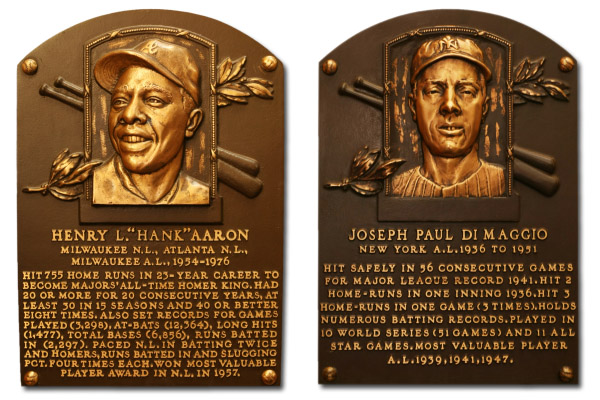
Aaron and DiMaggio: Two of the 15 Greats on My List.

Aaron and DiMaggio: Two of the 15 Greats on My List.

This morning I got to thinking about the big league batters that mattered the most to me when I was both a kid and growing into a young man – and still trying to play baseball at some low-level of amateur competition. I stopped when my list reached the name of someone who was nearly my age contemporary. In my case, that guy happened to be Frank Robinson, who was breaking into the big leagues at age 20 in 1956, the same year that I was 18 and graduating from high school.

When I suddenly stopped, I had a list of 15 names that almost any group of long time fans could have derived in the same five minutes time, given a difference here and there. Without conscious intention, I had come up with a list of names that shared one aspect in common. – They are all members of the Baseball of Fame. As a little exercise in leisurely research, I decided to go to Baseball Almanac and do an uncomplicated documentation of how each of these fifteen greater hitters did in their very first MLB games. Baseball Almanac is good for that sort of quick snapshot work, although, in devising my table for recording the data, I miscalculated. Baseball Almanac box scores don’t give us individual game stats on batter walks and strikeouts. As a result, those columns remain blank in my table, but it is still interesting to review how they each performed in their first chances as big league batters.

For your entertainment and/or edification, here’s how my “fine fifteen” made out individually and collectively in this chronological break=in date table of major hitting stats.

I think you will be able to easily follow who they are from the brevity names I’ve assigned to each for the sake of making this table work. If not, I spell out their names after the table presentation for the sake of bringing other first game facts to light. It helps to always remember that baseball, like life, is a long-season, Any of us can have good or bad time, but it’s how we grow from adversity over time that really determines the quality of our lives.

Here’s the first game day performance picture for each of 15 men who eventually each played good enough to be inducted into the Hall of Fame at Cooperstown:

PLAYER AGE 1st Game AB R H RBI 2B 3B HR BB SO BA
Joe D 21 5/3/36 6 3 3 1 0 1 0 .500
Ted W 20 4/20/39 4 0 1 0 1 0 0 .250
Stan M 20 9/17/41 4 0 2 2 1 0 0 .500
Ralph K 23 4/16/46 4 0 1 0 0 0 0 .250
Jackie 28 4/15/47 3 1 0 0 0 0 0 .000
Duke 20 4/17/47 2 1 1 0 0 0 0 .500
Larry D 23 7/05/47 1 0 0 0 0 0 0 .000
Monte I 30 7/08/49 0 0 0 0 0 0 0 .000
Mickey 19 4/17/51 4 1 1 1 0 0 0 .250
Willie 20 5/25/51 5 0 0 0 0 0 0 ,000
Eddie M 20 4/15/52 3 0 0 0 0 0 0 .000
Ernie B 22 9/17/53 3 1 0 0 0 0 0 .000
Hank A 20 4/13/54 5 0 0 0 0 0 0 .000
Roberto 20 4/17/55 4 1 1 0 0 0 0 .250
Frank R 20 4/17/56 3 0 2 0 1 0 0 .667
TOTALS 51 8 12 4 3 1 0 .235

(1) Joe DiMaggio played left field and was a slugfest participant as the Yankees drubbed the Browns at Yankee Stadium with 17 hits for a 14-5 win.

(2)  Ted Williams was in the lineup in right field for the Red Sox when they opened the season with a 2-0 loss to New York in Yankee Stadium. Boston had 7 hits and Teddy’s double off Red Ruffing was one of them.

(3)  Stan Musial played right field in the second game of a Sportsman’s Park double-header in which the Cardinals edged the Boston Braves, 3-2. Stan’s first hit came off Jim Tobin and it was a double that produced the two-runs needed to produce the one-run difference the Cards needed for the win.

(4) Ralph Kiner broke in as a center fielder for the Pirates on Opening Day in 1946 against the home team Cardinals. The Pirates won, 6-4, but it is unclear as to whom Young Ralph got his first league hit among the several pitchers he faced.

(5)  Jackie Robinson went hitless in what has to be the most publicized first big league game for any player in baseball history. The home Dodgers beat the Braves, 6-4, with Robinson scoring one of the Brooklyn runs. Jackie played most of the game at 1st base, but was relieved late by Howie Schultz.

(6)  Duke Snider was the 3rd Brooklyn left fielder of the day, but he arrived in time to get a single for his first MLB hit and also to score a run that added to the 12-6 final score that favored the Dodgers. Again, no ready information this morning reveals which of several Braves pitchers yielded his first hit.

(7)  Larry Doby was a 7th inning pinch hitter for Indians’ reliever Bryan Stephens in a game at Chicago, That was it for Larry D. as he was retired and the White Sox went on to defeat Cleveland, 6-5.

(8)  Monte Irvin was called upon to pinch hit for Giants starter Clint Hartung of the Giants in the top of the eighth in a game at Ebbets Field his club would lose to the Dodgers, 4-3. Monte probably reached base on a walk, but he could have received a no time at bat charge in one of the three other ways it works to that end, but the box score does not provide us with the whole game story to make that clear.

(9)  Mickey Mantle played right field in his first big league game as the great Joe D. still owned center in his last MLB season.  No clarity again on the first hit pitcher, but Mantle’s home team Yankees defeated the Red Sox on Opening Day.

(10)               Willie Mays was off to his now famous inauspicious start, but he made for it in time. Playing center field on the road in Philadelphia, Willie’s Giants did beat the Giants, 8-5, in MLB debut game.

(11)               Eddie Mathews played 3rd base (where else?) in his Season Opener debut for the Boston Braves, but couldn’t scratch a hit off Preacher Roe of the visiting Brooklyn Dodgers, who beat Warren Spahn, 3-2, to start the season.

(12)               Ernie Banks broke in at shortstop for the Cubs with a hitless performance that would not be the style of his always upbeat career.

(13)               Hank Aaron’s 2 for 4 Opening Day got him off to a good start, but his club lost, 9-8, to the home town Reds.

(14)               Roberto Clemente got his first MLB hit off winning pitcher Johnny Podres of the Brooklyn Dodgers in the first game of a double-header, 10-3.

(15)               Frank Robinson started in left field on Opening Day with a 2 for 3 day that included a double, but no runs or rbi’s.

In general, it is interesting to note that these 15 players were not the .235 average of their collective first game performance. These stars also were mostly power hitters, who would each recover from their first-game goose eggs on home runs to bash hundreds of home runs each over the course of their careers. Can you even imagine what these guys would be worth on today’s MLB market?

The thought chills all reason.

1960: Houston Gets Big League Baseball

December 15, 2013
Monday, October 17, 1960, Houston and New Yoek are both awarded NL baseball expansion franchises. Houston Sports Association Members celebrate (L>R): (1) R.E. "Bob" Smith; (2) Judge Roy Hofheinz; (3)  Unidentified; (4) City Councilman Johnny Goyen; (5) County Judge Bill Elliott; (6) George Kirksey; (7) Craig Cullinan.

Monday, October 17, 1960, Houston and New York City are both awarded NL baseball expansion franchises. Houston Sports Association Members celebrate (L>R): (1) R.E. “Bob” Smith; (2) Judge Roy Hofheinz; (3) Co. Commissioner V.V. “Red” Ramsey; (4) City Council Johnny Goyen; (5) Co. Judge Bill Elliott; (6) George Kirksey; and (7) Craig Cullinan.

On Tuesday, October 18, 1960, the following Associated Press story flooded the nation’s newspapers. Here’s how the San Antonio Express reported the news with their own headline and physical presentation:

*****************************

National Loop Admits Houston, N.Y.

Chicago (AP) – The National League unanimously awarded franchises to Houston and New York City Monday, expanding baseball’s oldest major league to 10 teams for the 1962 season.

It was the first structural change for the National League since 1900.

The resolution on Houston and New York was by Walter O’Malley who, ironically, had moved the Dodgers out of Brooklyn to Los Angeles in 1957, two months after Horace Stoneham had contracted to take his Giants from New York to San Francisco.

“The resolution was enthusiastically accepted,” said O’Malley. “There was no concerted objection although earlier there had been some feeling that along with Houston, the Dallas-Fort Worth territory might be more feasible than New York.”

League President Warren Giles, who said the club owners’ action will be finalized at the major league’s annual convention in St. Louis in December, termed the addition of New York and Houston as a “giant progressive step toward bringing major league baseball to all four corners of the country.”

“This makes us a very solid league geographically,” he said enthusiastically.

“To all intents and purposes,” Giles added, “we are now a 10-team league, with operations beginning in 1962. There are certain specifications the new clubs will have to meet, but I have no doubt they will meet the qualifications. I don’t anticipate any obstacles.”

Giles pointed out that two points must be cleared to pave the way for New York’s and Houston’ entry. First, a rule must be changed to make New York, currently American League territory, available to the  National League. This the NL expects to do as soon as possible.

Second, the Houston Sports Association, recipients of the Houston franchise, must acquire the (minor league) territorial rights from the Houston Buffs of the American Association.

The syndicate representing Houston numbers 13 and includes Craig Cullinan, Jr., George Kirksey, Judge Roy Hofheinz, K.S. (Bud) Adams, and R.E. (Bob) Smith. Cullinan, Kirksey, and Judge Hofheinz were present at the meeting and presented plans of their newly proposed $15 million dollar (Colt) stadium which they said could be ready by the start of the 1962 season.

The New York syndicate, which includes Mrs. Charles Payson, M. Donald Grant, Dwight (Pete) Davis, Jr., William Simpson, and H.H. Walker, Jr., (who) was not represented.

“The Cullinan group must first indemnify the American Association and the Houston club in the AA,” he said. “I understand they’ve already begun negotiations and they’ve assured us that (settlement) will be no problem.”

“Regarding New York,” Giles said, “Commissioner Ford Frick has assured us if we propose a rule to open the New York territory to a National League franchise, and if the American League should opposes it, he will cast the deciding vote in our favor.”

Giles said, however, he was not certain the American League would oppose the return of New York to the National, of which that city had been a member without interruption from 1883 to 1957.

Asked whether the American League, which is to meet Oct. 26, expects to move into Los Angeles, Giles said he did not know.

“We did not discuss the American League,” he said, “but I understand that the Commissioner feels the same way about Los Angeles as he does about New York.”

O’Malley, owner of the Dodgers, said he would not oppose the AL’s reported move into Los Angeles.

“I don’t think it would be so smart of them to move into Los Angeles right now,” he said, “although I would not oppose it.”

“I believe eventually they (the AL) will go to the (West) Coast, but there are other fine cities that would make fine (locations for) major league franchises (besides Los Angeles).”

… excerpt from the San Antonio Express, Tuesday, October 18, 1960, Page 21.

**********************

Contemporary news reports often give us our only clues about the birth of reality and legend in history. Today’s column data suggests, at least, one example for each category:

Reality: The 1962 NL expansion back into New York City simply fanned the AL fires for placing their own franchises in those two gilded west coast markets that were already in play for the NL in LA and SF. The AL was already well on their way into LA, but the NL move into NYC simply greased the skids by eliminating any technical resistance the NL might have otherwise tried to use.  They already had played that card with the support of the Commissioner. The AL was coming to the west coast, all right, and they would not go first to any of the “other fine cities” that Mr. O’Malley had in mind for them, as in “any other place on the west coast, but LA.”

Legend: Judge Hofheinz apparently didn’t build Colt Stadium as an angry response to his difficult and expensive territorial rights settlement with the Houston Buffs. The HSA already had that $15 million dollar stadium plan in place at the time of their franchise award. The Judge wanted Houston fans to lick their chomps in close up observation of the domed stadium that would be going up near them on the prairie south of the Texas Medical Center in Houston.

Thank You Note: Thank you, AstrosTalk, for identifying our third man in the photograph as Harris County Commissioner V.V. “Red” Ramsey.

Beyond the Statistical Case for Keenum

December 14, 2013
Case Keenum, 2011, in his record-shattering year at UH.

Case Keenum, 2011, in his record-shattering year at UH.

While some Texans football fans still wait to see if rookie QB Case Keenum can actually win a game for a demoralized team in the last three games against the probably best NFL team, the Denver Broncos, and two other pretty good ones, the Indianapolis Colts and the Tennessee Titans, I remain one of those who still believes that the young man from UH will get there as a winning starter in the league. The guy just eats lessons and adapts his game better than most I’ve ever seen, for whatever that’s worth.  And it may not be much. I still consider myself first as a baseball fan who watches football in the off-season because there’s nothing else to do, but, given the time, I have this habit of getting into the details of what the diversion game is about and the details of predicting success and failure.

What I’m going by here are Case Keenum’s past and the circumstances of his current trial. Let’s look at the latter aspect first.

The absence of a superior running game, effective pass blocking, the presence of # 8, with his helmet on his head, simply pouting on the sidelines and waiting for his chance to go back in at QB have been big. Throw in the the disastrous losing streak he inherited, poor play in the defensive secondary, undisciplined dumb play and all the penalties that spring from it, an unreliable kicking game – and the QB is almost set up to take the rap for the mistakes of so many others. Throw in the dour inflexible conservatism of our likeable, but media-beleaguered head coach and … well … taking over at QB for the 2013 Texans has been about as easy as planning a book club meeting at a house that’s already on fire. Had Keenum been able to either start the season or take over earlier, for better or worse, as the starter – with no threat of replacement after a bad series, thing could have gone so much better. This is a kid who did some pretty great statement playing with a weighed down chance. – Remember the five great TD catches by Andre Johnson? They came served up by a guy who could have quit last year when he set all those records at UH and didn’t even get drafted. He also could have quit after one year on practice squad and little focus on his own preparation for ever starting.

Case Keenum didn’t quit. He has no “quit” in him. And someday, in spite of the putdowns of his abilities by some of our full-of-themselves electronic and print media egos, some NFL team is going to reap the benefits of his full bloom. We may be looking at the second coming of Drew Brees in Case Keenum.

Now, as for all those collegiate records, do you know what he did? His passing records are mostly held by a statistical landslide. And these are not the distances that come only from a “systems” accomplishment. As an individual player, Case Keenum had three influential head coaches in college: Art Briles, the coach who recruited him went on to do the great things he is continuing to do at Baylor – and that includes taking UH recruit Robert Griffin III with him to Baylor when he left for the Waco job. It was a move that set RGIII on the road to his 2011 Heisman Trophy award. Then came Kevin Sumlin to UH and he and Keenum took the Cougars to its biggest winning season in history in 2011. Then Sumlin left for Texas A&M where, in 2012, he became the 2nd former UH coach in two consecutive years to be responsible for Heisman Trophy winners when Johnny Manzeil won it for himself and the Aggies. Tony Levine became Keenum’s third college coach for one victorious bowl game victory over Penn State at the end of the 2011 season.

Then Case Keenum went to the pre-draft performance trials in the spring of 2012, where he pulled a hamstring, but kept on trying anyway. His timing was apparently slowed enough to cost him a place in the 2012 draft by clubs who were either unaware of his injury or were otherwise simply dismissive that it made any difference in the evaluation of his true potential. Gary Kubiak was not among the totally dismissive group. He signed Keenum for the Texans after the draft and he is the reason that Keenum even has this late season  chance to launch his career in Houston.

Now, let’s look at that college ball data. Here are Case Keenum’s monstrous collegiate passing records:

1) Most pass completions, career

– Case Keenum, 1,546

2) Most passing yards, career

– Case Keenum, 19,217

3) Most games, 300 or more passing yards, season –

14, Paul Smith, Tulsa, 1907

14, Case Keenum, Houston, 2011

4) Most games, 300 or more passing yards, career –
Case Keenum, 39
5) Most seasons, 5,000 or more passing yards –
3, Case Keenum 2008 – 2009 – 2011
6) Most seasons, 4,000 or more passing yards – 
3, Case Keenum 2008 – 2009 -2011 (tied with 4 others)
7) Most passing touchdowns, career –
Case Keenum, 155
Case Keenum got those seven major national records after UH became the only Division I school to offer him a scholarship to play quarterback because of his size. He’s a generously measured six footer – not the 6’5″ prototype of the perfect NFL specimen. Given time to develop, all he does is win.  I just hope that Case develops fast enough to quiet the local naysayers before his shining hour is whisked away to occur in behalf of some other NFL city.
Go get ’em, Case! You can do it! No matter what, winning is the only stat that wins and keeps jobs in the NFL.

Warning, Kids! Don’t Try This At Home!

December 13, 2013

Pecan Park Logo

Somewhere, in the hustle and bustle of technological change and all the abundant news reading that rolls over all of us in indigestibly monstrous portions from all digital and ink print corners by the nanosecond, I missed the Chron.Com story from 2.5 years ago about the part that dear old Pecan Park played in the earliest deployment of the new Super WiFi technology in Houston. Here’s the link to an article from April 2011 that describes the inititation of the project that got started with the strong and able support of Rice University in April 2011.

http://www.chron.com/business/technology/article/Houston-gets-nation-s-first-super-WiFi-hot-1685492.php

I have no idea where the fruits of this early experience have fallen into growth and use elsewhere by now. I just know that we have a wireless system at home that shuts down if you set a bag of groceries down in a way that blocks the WiFi system’s signal blaster – or zapper – or whatever you choose to call it. Like many of you, I have grown into the bane of modernity – as the person who is now totally dependent upon a technology that he still barely understands.

When I was a kid in Pecan Park, back in the late 1940s and early 1950s, we invented a few things on the street, but nothing that would invite any of us to have been renamed as the next Edison or Einstein. Most of our stuff had to do with dangerous, but less than deadly instruments of street warfare. For my best example, we “invented” something we called “The Willow Wand.” – The Willow Wand was made from the last three to four feet of fairly stable, but flexible Willow Tree branch that grew in the McGee’s back yard on Japonica Street, across the street and immediately north of our house – and immediately east of our sandlot base at Eagle Field.

Willow Wands formed out of our perceived need to defend Eagle Field from invasion by interloping gangs of kids from other streets. They worked like this: Warning! Kids, Please Don’t Try This at Home! We Were Stupid Back in the Day! (1) find your willow stick and pick it clean of little leaves and small off-shoots. (2) Form some black soil gumbo mud and roll it in small pieces into balls that were about one inch thick. (3) Find a small rock and insert it into the mud ball. (4) Then insert the mud ball onto the smallest, most flexible end of the stick. (5) Teach yourselves and the younger kids how to whiplash that little mud ball straight and hard-flying off the end of the wand with just the right flick of the wrist once your stick is pointing toward the kid you are trying to hit in protection of your territory. (6) With practice, you hardly ever miss.

We learned better. The hard way. And I’ve told this story before.

Willow Wands were fine until we learned that one of our younger and childless married neighborhood husbands, a machinist named “Harry”, could actually make us a couple of pipe cannons that used Baby Giant firecracker sticks to propel gravel out the end of a long pipe. We got Harry to build these items for us from some scrap materials and we told him it would be a good way to learn about shooting guns. We didn’t tell Harry that we planned to start those lessons just as soon as the Kernel Street kids again tried taking over Eagle Field – which, as luck would have it, took place on the Sunday afternoon following the Saturday we got the cannons and the firecracker power they each required.

The Kernel Street Kids crossed the alley which separated them from Japonica Street and Eagle Field. Lucky for us, we got earlier word that they were coming and already had set up the loaded pipe cannons on the sandlot. Then, when the Kernels came charging at us, we set off both our blasters. One missed, but the other sprayed a shirtless kid in the chest, causing a discharge of blood and a general halt to everything.

It was like time stopped and we all got hung up on “what have we done?” But sooner than we could react, my dad came running out of the house, shouting “STOP!” in all the ways he knew how to express that idea. I don’t know where the other parents were, but dad was the only one who showed up. He gave us all a healthy reprimand for what we had done as he ministered first aid to the one kid who, fortunately, was only scratched from the gravel that hit him.

Dad told us strongly that we didn’t own the field to the exclusion of others. “If you kids have any differences with each other, then settle it right here and now with a game of baseball,” he added. Which we did.

We won, but so what. It didn’t seem to matter after that scary day. The Kernel Street kids joined in with the Japonica-Myrtle bunch after that Sunday – and from that date, we would blossom eventually into the sandlot club that became The Pecan Park Eagles.

Oh yeah, I still got a whipping from dad that night, but that’s more than OK. I had it coming.

I’ll never know what was said to the neighbor who built our cannons for us back then. Maybe nothing. It was a different time and place.

Our Top Ten Sports Carols for Christmas 2013

December 12, 2013

carol18cb

Our Top Ten Sports Carols for Christmas 2013

10) Hark the LA Angels sing; save us from all Pujols swings!

9) I saw daddy kissing Santa Claus – underneath the driveway hoop last night!

8) Deck the Texans in a year of folly: Simply dump Matt Schaub – and we’ll be jolly!

7) All I want for Christmas is – two billion bucks!

6) Frosty the Closer – was a very special man – with an unseen hitch – he could change each pitch – and retire ‘ em with a fan!

5) I dream watched – of a White Christmas! – Turned out to be the Eagles game!

4) Silent Night! Unholy Night! Astros Bats! Swung Left – or Right!

3) A Rod roasting – on an open fire! – Bold truth – nipping at his nose!

2) Jingle Bells! – Jingle Bells! – Jingle All the Way! – That’s the sound – that you’re riches bound – when Scott Boras wins the day!

1) I’ll be home – for Christmas – or my name’s – not Qualls! Please leave bats – and agile cats – and pitchers – more like me. – I’ll be home – for Christmas – at dear Minute Maid! – I’ll be HOME – for Christmas! – And I’m hoping – You’ll be too!

Merry Christmas, Everybody!

Book Your Cooperstown Trip Early in 2014

December 11, 2013
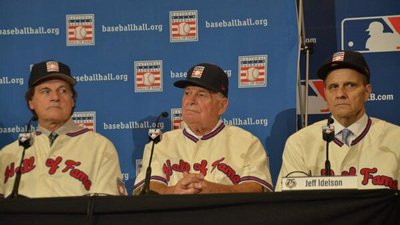
Tony LaRussa, Bobby Cox, and Joe Torre ~ The guys wore their game faces to the HOF induction announcement. ~

Tony LaRussa, Bobby Cox, and Joe Torre
~ The guys wore their game faces to the HOF induction announcement. ~

With the Veterans Committee’s approval of great modern managers Tony LaRussa, Bob Cox and Joe Torre for Hall of Fame enshrinement in 2014, Cooperstown, New York is going to get a little crowded next August on Induction Weekend, and just imagine how it will even spike-hype attendance all the more with the probable inclusion of recently retired 300-game winners Greg Maddux and Tommy Glavine, plus the real possibility this time of Houston’s Craig Biggio!

By adding LaRussa, Cox, and Torre, the Hall of Fame has inserted the numbers 3, 4, and 5 men on the “most games won by a manager” list that may start forever with Connie Mack and John McGraw in the numbers one and two spots on wins.

How man other guys beside Connie Mack are ever going to manage for 53 years in a single lifetime? Mack doesn’t even have a .500 percentage on winning, but his 3,731 managerial wins is still a far spot ahead of everyone else.

Here’s the essential win/loss and pennants/World Series achievement list for each of what, by August 2014, will be The Top Wins List Among Five Hall of Fame Managers:

MANAGER SEASONS WON LOST WIN % PENNANTS WS WINS
Connie Mack 53 3,371 3,948 .486 9 5
John McGraw 33 2,763 1,948 .586 10 3
Tony LaRussa 33 2,728 2,365 .536 6 3
Bobby Cox 29 2,504 2,001 .556 5 1
Joe Torre 29 2,326 1,997 .538 6 4
TOTALS 177 13,692 12,259 .528 36 16

Tony LaRussa went out like the champion he is after the 2011 season that saw his St. Louis Cardinals rally from two “one strike away from defeat” situations in Game 7 conditions to defeat the Texas Rangers. Although he was only 35 games behind the career win total for John McGraw after 2011, La Russa didn’t keep playing the next season. The record second place on this list was his to take. He could have won it easily, even had he been managing the 2012 Astros, but he passed. That wasn’t what Tony LaRussa was about. LaRussa didn’t stay in the game that long – just to nurse personal achievement numbers. He managed the game with all the passion and deftness of a grand chessmaster because he loved the intrigue and the challenge. He also knew that it was better to quit on the mountaintop – and to leave with fans still wanting for more.

Cox and Torre were both in control of things as managers, wily in their own ways, and insanely successful at Atlanta and New York on a regular season basis. Torre, of course, was the most World Series successful of the three new HOF member managers, and Cox won his division so often that fans almost seemed to overlook the fact that his one World Series win in 29 years was a little scarce as a figure on the career accomplishments side.

No matter how else we slice it, the 2014 Induction ceremony is going to be a hot ticket. If you are going, you had better start planning prior to the January writers vote on eligible players.