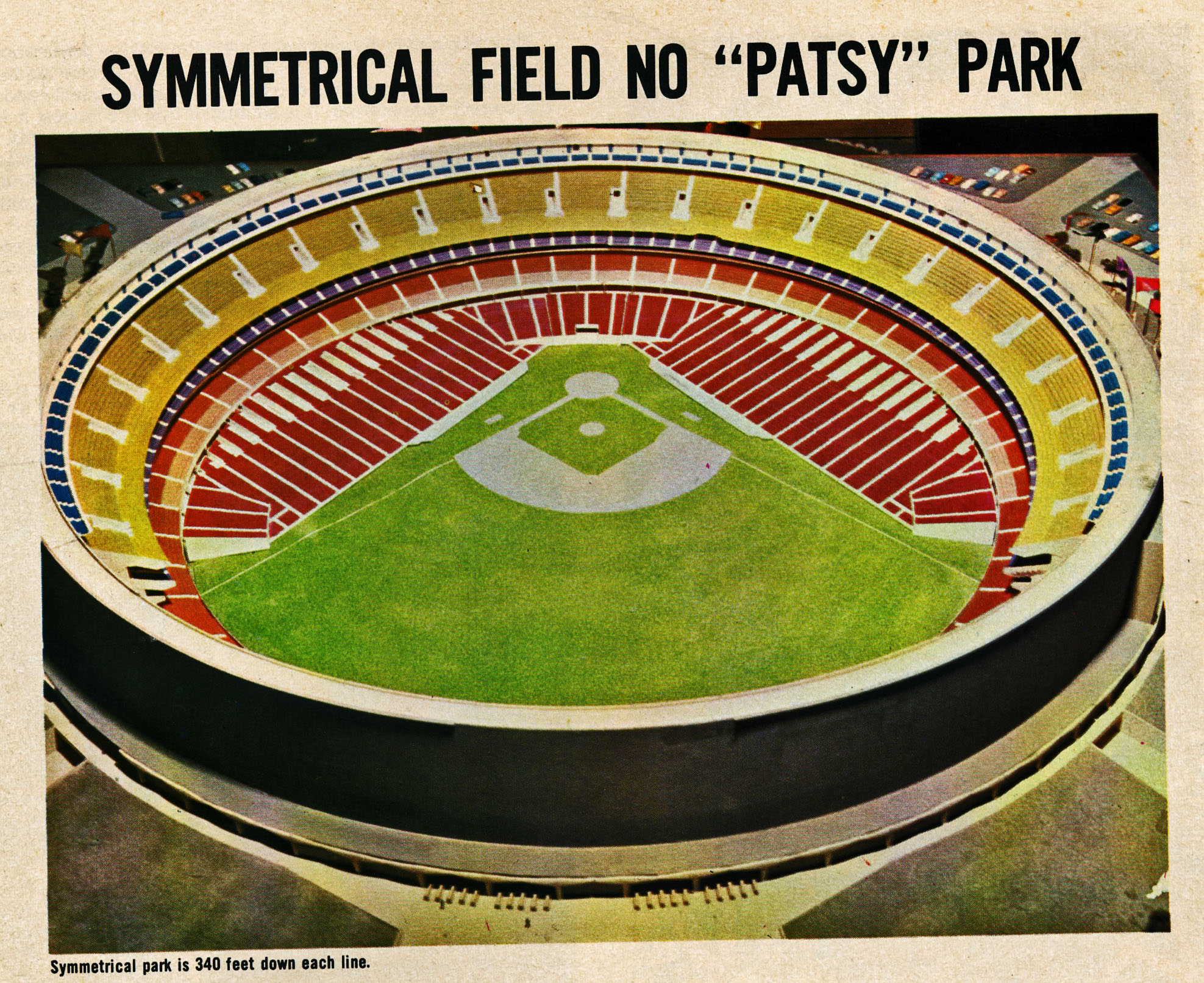
When the Astrodome opened in 1965, there wasn’t any discernible sentimental support for a quirky, retrospective venue for baseball in Houston. People wanted sci-fi level modernity in their new space age stadium construction, a place for economy and multi-level service to the needs of everything from baseball to football to rodeo to Elvis to heavyweight boxing matches to wrestling to basketball to political and corporate conditions to whatever else out there loomed as new and bright and shiny.
The Dome’s built-in adjustable seats were tailor-made for a culture that valued flexible seating capacities and new site lines far above architectural aesthetics or nostalgic connection to the past. Houston was a roaring, rumbling Corvette in 1965. If you were one of the people who drove Houston in those days, all you cared about was getting there fast and first. The brand new Astrodome accurately reflected your self-image too – and to a tee.
It isn’t surprising then that we would find this description of the new ballpark’s baseball dimensions on page 60 of the original game program magazine, “Inside the Astrodome: The Eighth Wonder of the World”:
The Astrodome will be no patsy park for cheap home runs. Anybody who hits a homer in the dome will deserve it. It is one of the most symmetrical parks in the major leagues. The distances are:
Left Field Foul Line – 340 feet
Left-Center Power Alley – 388 feet
Center Field – 406 feet
Right-Center Power Alley – 388 feet
Right Field Foul Line – 340 feet
The fence around the outfield is 17 feet, 11 inches high from the left field line to the left/center where the pavilion seats start. From this point to right/center where the pavilion seats end the height is 13 feet, 10 inches, and the 17 feet, 11 inch height begins again and continues to the right field foul line.
Speculation over whether the ASTRODOME would be a pitcher’s park ora hitter’s haven caused the Houston club officials to consult experts before the stadium was ever opened for an educated prediction. Massachusetts Institute of Technology, Rice University and two sporting goods companies, Spalding and McGregor, concurred that a ball hit over a 406-foot fence would vary less than an inch or two in contrast to one hit in any of the other uncovered major league parks.
Conditions of humidity and temperature will remain constant inside The ASTRODOME at 50% humidity and 74 degrees. The ball will rect the same way inside The ASTRODOME as it would under the same conditions of temperature, humidity and elevation anyplace else.
Gee, that sounds so equally scientific and settled. You might think that those same MIT and Rice brainiacs also could have anticipated that daytime fly balls in the Dome were going to be almost impossible to see, let alone catch, but they didn’t. Or wouldn’t.
Sometimes the human ego gets in the way of our early clear discovery and admission of what is obvious.
 The Pecan Park Eagle
February 4, 2013 at 6:51 pm |
Although the indoor conditions eventually became an advantage to the pitchers (other domes have not), I recoil when people complain about the multipurpose circular design as “cookie cutter”.
Go look at today’s ballparks with the uniformly brick wall behind the catcher and the forest green hard-backed seats on every level and tell me that is not “cookie cutter”. You can’t watch a game on tv and distinguish half the parks from each other because they all look alike (well, other than Miami’s ballpark),
That isn’t to say i don’t like the look but I didn’t dislike the look of the Dome, the Vet, Riverfront or Three Rivers either.
The goal of any venue is to fill the stands as often as possible so the facility makes money. Other outdoor parks of the era had portable stands to change the configurations between baseball and football but, in many cases, it caused poor vision angles because of the quirks of the baseball yard. The Astrodome designed virtually eliminated this so that you were never stuck behind a post or unable to see large sections of the playing field because of the seat you sat in, regardless of the event.