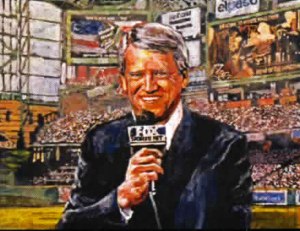
(oil by Opie Oterstad)
Bill Brown, Astros TV Broadcaster, 1987-2012 and counting.
Over the years, baseball broadcasts have changed for the better. Once we kind of weeded our way through the older generation of announcers who only saw television as “radio with pictures,” we began to experience some differential styles that categorically separated those who called the games over radio from those who do the same honors for television.
Here’s the history of baseball broadcasting in a nutshell:
1920: Baseball radio games are first treated as though they are newspaper reports of a five-second old past event that is now being reported live by the eye-witness broadcaster, speaking in the past tense.
Example: “The batter hit the ball to the shortstop, who then threw the ball to first base for the out.”
1920s: Broadcaster Graham McNamee comes along and introduces radio coverage to present tense voice play- by-play reports on the game as each play occurs in real-time. As he does, he brings a sense of connection to the fans that was previously lacking over the radio, but he also incurs the ire of the newspaper icons who resent his quickly soaring popularity. Some of the old egos claim that they wonder what game McNamee was watching when he describes action in the present tense. McNamee should have told his critics: “I’m watching the game that’s going on now because that’s the game our listeners want to hear about as though they were here with us.”
Example: “The batter swings and hits the ball to short; he’s up with it; he throws it to first; and it’s in time for the out!”
1930s: Broadcaster Red Barber leads the way on play-by-play inclusion of color into play-calling.
Example: “The stands are packed today. The folks in the last row of the far away upper bleachers are just a handshake from heaven in their views of today’s game. And there’s a high pop fly into a robin’s egg blue sky above the third baseman. And it’s captured by a very patient third base fellow along the short left field line. Hope he’s able to uncrank his neck from the posture he had to take on that last one.”
1940s: Television comes along, but some broadcasters first treat it as radio with pictures – and they continue to tell fans about things they can see for themselves on camera.
Example: “The pitcher has called for a brief timeout to talk with his catcher. He’s using his glove to cover his mouth and hide what he’s saying. The catcher is tapping him on the chest for some reason. And now the pitcher is turning away and walking back to the mound.”
1950s: Dizzy Dean arrives on the CBS televised “Game of the Week,” introducing fans to the pure “culture-caster” – with Old Diz Dean serving as the southern fried chicken personality on the air. Slaughtered English is in; total attention to the game is out too, when it interferes with the narrative in one of Old Diz’s stories.
Example: “It’s a beautiful day for baseball, fans, just so’s you ain’t too particular about keepin’ up with stuff on the field like the score.”
1960s: Broadcasters like Gene Elston come along, prepared for the game, prepared for the setting, and prepared to deliver their work one way for radio and another for TV. The content would be the same; the broadcast would simply take into account that people didn’t need descriptions of things they could see and in the recognition that sometimes the picture itself was enough.
(Exemplary Scenario: Mike Scott throws a no-hitter to clinch the division title for the Houston Astros on the last day of the 1986 season. The Astrodome crowd on the field swells with happy Astros player celebrants.) Gene Elston’s only comment is iconic. It costs him his job, but it brings him immortality in the annals of baseball broadcasting.
Example: “There it is!”
1980s: Harry Caray is elevated by WGN cable television as the biggest culture-caster of all time as the television voice of the Chicago Cubs. Pronouncing difficult player names is not Harry’s forte, especially after he is a couple of drinks past the seventh inning stretch and another iconic delivery of “Take Me Out To The Ballgame.”
Example: “And the Cardinals are bringing in the Mad Hungarian from the pen to try to put a lid on the Cubs here in the ninth. Most of you know him by his Christian name, Al … HA-ROB-BOW-WOW-SKI!”
1980s to Now and Forever as Long as He Has Gas Left in the Tank: Bill Brown of the Astros carries on in the fine understated style of the greats who came before him in the personages of men like Gene Elston of the Astros, Jon Miller of the Giants and national network play, and the incomparable Vin Scully of the Dodgers. These men all come to mind at my first sweep of the mind. Recently dismissed Astros radio broadcaster Dave Raymond was also on his way to joining their company at the time of his release, in my view, and Greg Lucas, late of the FOX Astros team is in there too as one of Houston’s publicity buried treasures. Greg brings a bright aliveness to everything he does in sports too. I would love to see him go for and get the now unfortunately open job as the Astros radio play-by-play man. Everybody in the community loves Greg already and will quickly rally to hear him pick up on what Dave Raymond was already doing: calling the games as they happen.
All these men share a deep abiding love and knowledge of the game. They come prepared to talk about the records and abilities of the players in each contest they work, and they all call the action as they see it happening, with great consistent accuracy, avoiding blatant “homerism” at every turn of fate or fortune.
Keep it up, Brownie, Lucas, Raymond and Company. You are each creating an example that needs to be seen by those younger members of your field who now come after you. And, of yeah, not just by the way – my two favorite color broadcasters will always be another pair of Astros broadcast veterans: the great Larry Dierker and the now departing intellectual baseball authority and comic, Jim DeShaies.
Break a leg, you guys! – And just keep telling us the truth about what’s going on in the games we watch. If you think we can figure it out for ourselves on TV, your silence will be both accepted and appreciated.
 The Pecan Park Eagle
December 6, 2012 at 2:49 am |
BILL BROWN FINE ANNOUNCER AND CLASS GUY
December 6, 2012 at 5:10 am |
The early tv picture tubes were so small that many still wanted a radio-like description because the ball on the little screen was not easy to follow. Only as camerawork got better and picture tubes got bigger did it seen unnecessary to describe the action to viewers.
Ray Scott was the king of the television minimalists. I remember his football calls on CBS in the 1960s: “Starr…..to Dowler….first down.” You would have thought they docked his pay for every extraneous word he spoke.
December 6, 2012 at 5:14 am |
Loved this article. One of your best, Bill.
December 6, 2012 at 2:53 pm |
Superb.