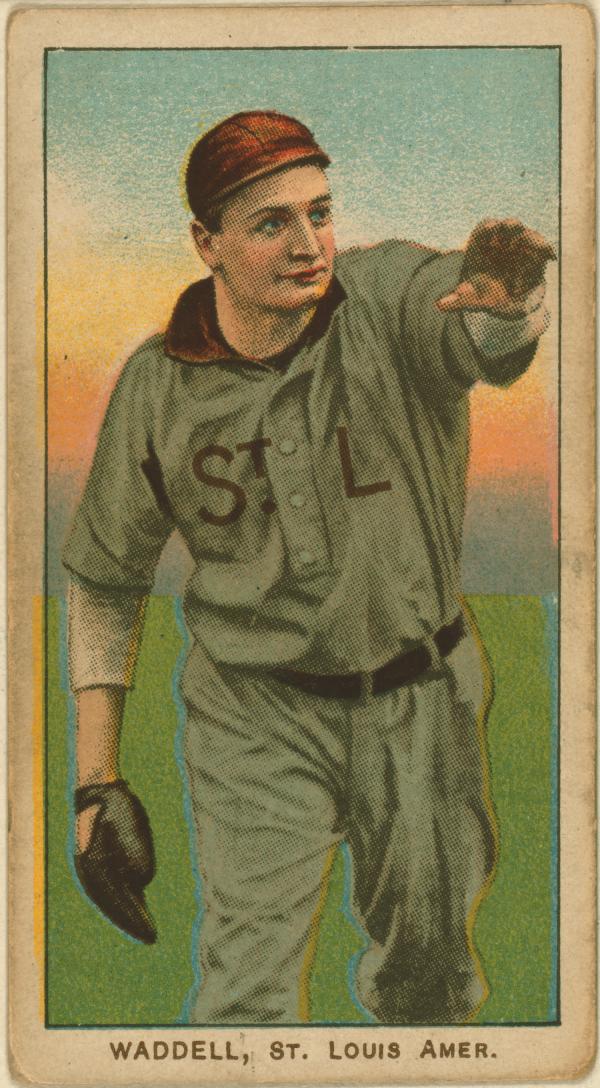
 Long before our awareness of “Attention Deficit Disorder” and the medications that help to control the behavior that spins from this condition, there were people in this world like George Edward “Rube” Waddell, the Hall of Fame lefty pitcher that lit up batters during the first decade of the twentieth century and the American League.
Rube was a virtual savant performer, able to pitch with the best in the world against other greats like Cy Young, Addie Joss, and Walter Johnson and winning far more often than losing against some of the best of the American League.
As we vividly note in Norman Macht’s first volume on Connie Mack, the price a club paid for having the talents of Waddell on their side was the personal behavior of the man himself. Left to his own devices, urges, impulses, attractions, and addictions, Rube was every pound and muscle inch little more than an overgrown child with no control over his distractions from the game of baseball and his contractual obligations to the club. Waddell would sometimes disappear for days or weeks to tend bar somewhere, go fishing, or hang out with new friends he met along the way. He was able to come back because of the talent he brought with him. An average or marginal pitcher would have been finished at the first turn down this “bad actor” lane.
And Rube Waddell had a temper that could frighten anyone, if they pushed the right buttons long enough. On page 322 of Norman Macht’s “Connie Mack and The Early Years of Baseball,” the author describes the Athletics Manager Connie Mack’s lesson in the first decade of the 20th century from Waddell’s temper after the eccentric lefty returned to the club on the heels of being jailed on an assault and battery charge:
“I went after him strong,” Mack said. “I was laying on the words thick and fast and I saw a nasty look come into Rube’s eyes.” Quick as a flash it dawned on me that I had gone too far. Breaking off in the middle of a scorching sentence, I reached out my hand and said, ‘Say, Rube, I had you that time. All that time you thought I was in earnest.’ And do you know that great big fellow who was ready a few seconds earlier to throw me through the door actually broke down and cried.”
Yep. “Anger Management” would have been a good alternative recommendation back then, but there was no such option back in Rube Waddell’s “Turn of the 20th Century” era. Then as now, the jailhouse is still our best option for those fists, knives, or guns people who take out their anger upon others. “Anger Management” only works for people who choose it soberly in calmer moments.
Rube Waddell wasn’t just about anger. His mind and behavior were all over the place, fitting him almost everywhere in the psychiatric lexicon of things. As a psychiatric disorder, Rube Waddell is variously diagnosable all over the psychiatric diagnostic manual dial as a schizophrenic, a bi-polar disorder, a character disorder bordering on sociopathy, an inadequate personality disorder, an alcoholic and/or drug addict, or even a codependent relationship partner.
His behavior often suggested that he was not particularly grounded in reality; he suffered mood swings from out of control highs to down in the depth lows; he sometimes took advantage of people in ways that showed little concern from him about the suffering they had endured from his behavior; he could binge drink for days and weeks; and he probably used other substances that helped him self medicate the difficult feelings he housed.
Rube was famous for chasing fire trucks, supposedly leaving his dugout during games to chase a fire-wagon down the street. I’m not really sure how often this sort of thing happened, but it serves as a good model for the kind of behavior that is typical of some people who suffer from “Attention Deficit Disorder” as a hard level of extreme distractibility from long-term attention to an engagement at hand. A.D.D. people have trouble at work and home because they simply cannot stay focused on what is going on in the moment for very long. A.D.D. seems to derive from some kind of biochemical imbalance which responds well in many people to the kinds of meds we now have available.
There were no efficacious treatment drugs for A.D.D. in Rube Waddell’s time. Rube did what most people still do to medicate themselves. They drink and drug themselves with whatever is available as a mind-altering substance, most often suffering the downside of whatever flows from the loss of impulse control effects that flow from entertainment drinks and substances.
I cannot place old Rube in any category for sure since I’ll never have a chance to meet him in this lifetime, but I will hedge enough to suggest that his two principal issues were “Bi-polar Mood Disorder” with “Attention Deficit Disorder” and that any treatment for him would begin or end with the presence or absence of appropriate medication, administered to a patient who was willing to start his treatment by taking his medication regularly as prescribed. Only then could we move on to the stuff that might have mattered.
I still like old Rube. Waddell is history’s proof that you don’t always have to have peace of mind, relationship sanity, or a full grip on reality to do great things that entertain, but do not bring harm to others.
Tags: Connie Mack, Norman Macht, Rube Waddell
 The Pecan Park Eagle
October 11, 2012 at 3:27 pm |
I may be wrong, but I recall reading an episode where an opposing team hired a pilot when Waddell was suuposed to pitch a big game against them and had the pilot buzz the area just as a means to distract the pitcher. No idea if this is true or if it worked but it sounds like it could have.
No doubt Rube could have never pitched at Shea Stadium which was close to LaGuardia and the air was constantly punctuated with arriving and departing jets.