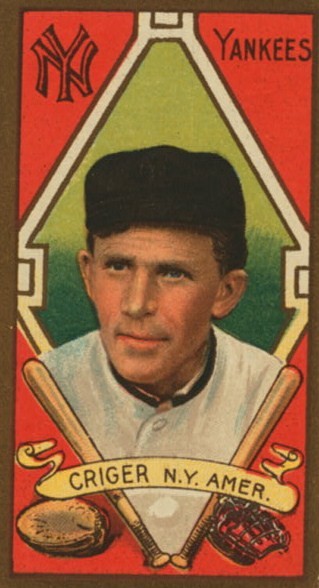
 Lou Criger had a 16-year big league career as a catcher for the Cleveland Spiders (1896-98), St. Louis Cardinals (1899-1900), Boston Red Sox (1901-08), St. louis Browns (1909, 1912), and New York Yankees (1910). He batted only .221 for his career, never getting more than 22 extra base hits is a single season.
Criger was not a hitter, but he more than made up for it as one of the finest defensive catchers of his era and for his reputation as the preferred receiver of the winningest pitcher of all time, Cy Young. Lou Criger was the man behind the plate for most of the big games in Cy Young’s career, including his 1904 perfect game and his 1908 no-hitter.
There was one other notable mark in Lou Criger’s history. As the result of a courageous act of honesty, Lou Criger was granted a lifetime pension at a time when major league baseball was handing out benefit programs to no former players. On page 287 of John Thorn’s “Baseball in the Garden of Eden,” the author writes that the American League’s reward to Criger came as the result of his refusal and prompt report of a gambler’s $12,000 offer to throw the first 1903 World Series for the Red Sox against the Pittsburgh Pirates. The offer represented an amount that as three times as large as Criger’s $4,000 salary from Boston.
“In gratitude,” writes Thorn, “the American League awarded Criger a lifetime pension at a time when no player received postcareer benefits.”
What Thorn’s account fails to show is that none of this action took place immediately. Coverage of Criger’s career in the Baseball Reference Bio Project leaves what happened next to unclarity, One of two things happened: (1) Lou Criger apparently was asked to sit on the bribe attempt as his personal secret while the American League dealt with the issue quietly. Twenty years later, he returns to American League President Ban Johnson and uses his early career honesty as bargaining chip for gaining help with a serious help condition; or (2) Criger simply holds the matter secret from everyone for twenty years and, in 1923, he then goes to AL President Ban Johnson seeking help with the treatment expenses he is going through for tuberculosis.
Either way, Johnson is impressed by Criger’s character and need – and quickly arranges for a life pension. Johnson probably assumes that Lou Criger does not have long to live, but that turns out to be wrong when the old catcher survives another eleven years, finally passing away on May 14, 1934.
The underside of this story is that the gambler who made the 1903 pre-World Series bribe offer to Criger for $12,000 in exchange for “soft pitch” calls was a fellow named Anderson, who had been personally introduced to Lou Criger prior to the first Series by no one less than the biggest sleaze ball character of the era, Muggsey John McGraw, the New York Giants manager – and the same guy who would kill the idea of a second consecutive and voluntary World Series in 1904 between his club and the reigning champions, the Boston Red Sox.
The gambling fix flies swarmed all around some of the game’s biggest stars through the first three decades of the 20th century, but none attracted more attention than John McGraw. It’s too bad old Muggsey never got what he really had coming to him.
Tags: Gambling in Baseball, Lou Criger
 The Pecan Park Eagle
May 31, 2012 at 2:40 pm |
It would not surprise me if the early World Series were regarded by many more as an exhibition and not a true contest, much the way the first two Super Bowls were not held in high regard at the time they were played. In the minds of many, the senior circuit title was the true championship and the World Series was like an add-on.
Thus, it would have been of great appeal to gamblers because the betting public would take the match seriously but the combatants themselves might not. In such case, it would be easier to find players willing to throw the games because, in their minds, their championship was already won and not truly enhanced by a mere exhibition.
Therefore, one could see Criger’s heroism in a different light after the Black Sox Scnadal than before it whiuch might then carry more weight only after one saw the true value of what Criger had done.
May 31, 2012 at 3:52 pm |
Interesting idea from Bob, but the “junior” circuit won the first World Series, and from what I’ve always understood, indications are that at least part of McGraw’s reasons for not playing the 1904 Series was a fear of losing to what, as Bob says above, was perceived as an inferior league.
I think by the time we get to 1919, the Series was very well established as the showcase that it is. However, there is no doubt that the league’s response to the scandal, more than the games themselves in my opinion, brought unprecedented scrutiny of gambling in baseball. So there likely was, as Bob says, a renewed apprecreation of Criger’s earlier actions.
May 31, 2012 at 5:06 pm |
Bill: Good story on Lou Criger. For you info, he is buried in the Evergreen Cemetery in Tucson, Arizona. I found this info in a SABR article about the early players. I located his grave in that cemetery. Walt Kellner, the old Phil. A’s pitcher, is also buried in that cemetery in the veterans section.
June 1, 2012 at 1:40 am |
So right about McGraw. He was also associated with game-fixing scandals in 1908 and 1924.