
Rice Stadium, Houston, 1950-2011, And the Dream Lives On.
What were they thinking?
When the community that was then known as Rice Institute went to work on the plans and funding for what would then become the largest football venue in the State of Texas, short of the Cotton Bowl in Dallas back in 1949, people who were alive and old enough back then had to wonder where this tiny private university, located in a city of an as yet uncounted half million souls, was going to get the fans it needed who could fill the place for five games each fall.
Rice Stadium echoed behind the stadium drive, as did the City of Houston. The Rice Owls had just won the 1949 Southwest Conference Football Championship under venerable Coach Jess Neely and the names of Quarterback Tobin Rote, end/kicker Froggy Williams and lineman Weldon Humble all reverberated to jar open the pocketbooks of hope that a tiny private out-of-pace Ivy League-type school could actually grow to compete with the University of Texas and other larger, sports-richer schools in the State of Texas and the nation over time.
The NFL still mired away in its pre-significance days as this country’s off-season professional sport alternative to baseball and college football still reigned as the king of the oblong ball game. Notre Dame was the New York Yankees of college football and UT was merely one.of several state school versions of the Boston Red Sox, with Oklahoma University making a strong bid for that entire bean town franchise prescription.
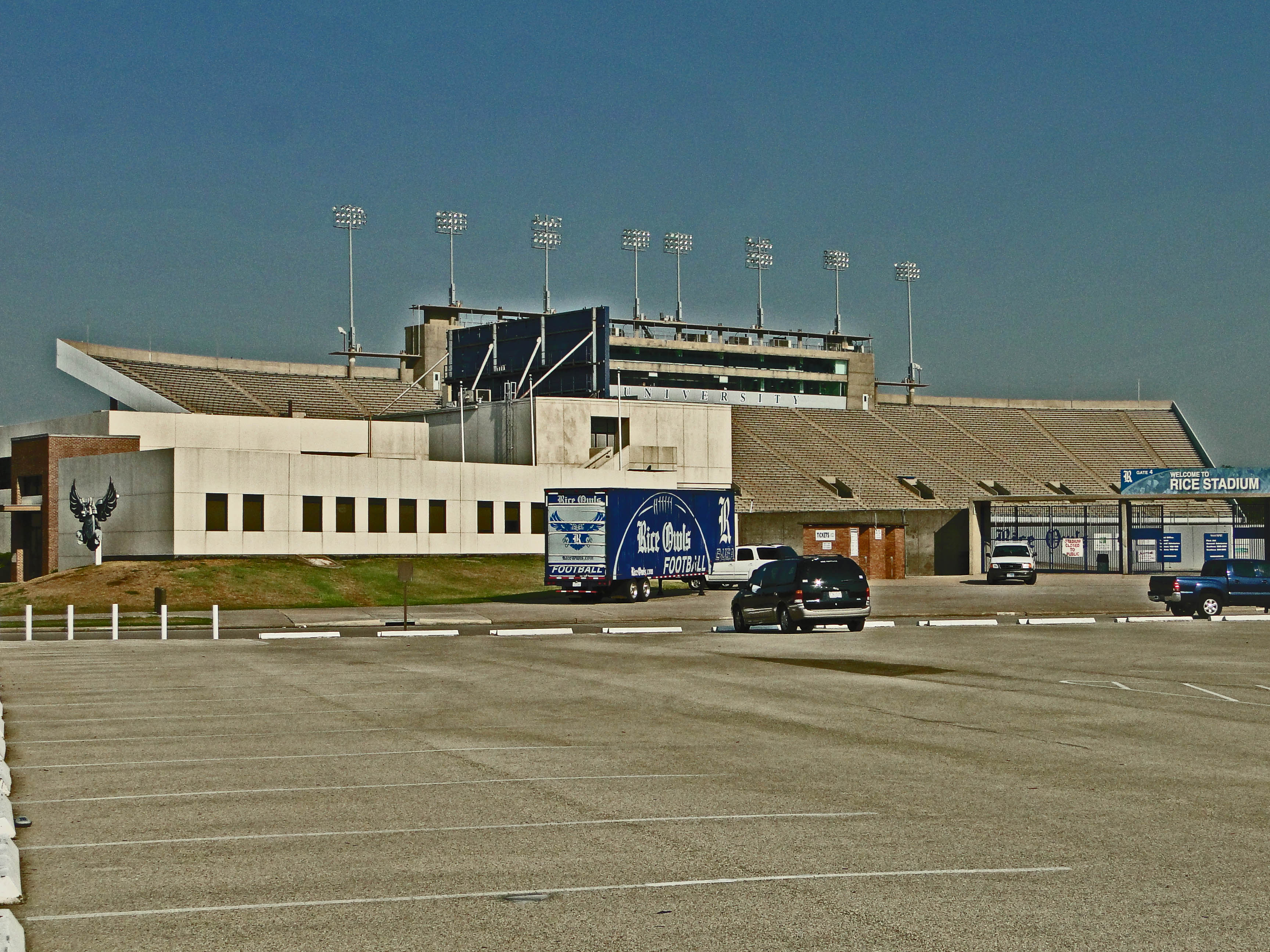
Even then, on the heels of 1949, and all the vivid memories of Froggy Williams plunking his magic field goal kicks more dramatically than Smilin’ Ed McConnell himself, the outlook wasn’t brilliant for the Rice I boys at play – the great ones played here sight unseen – and never could they stay. – Rice failed to own a talent trough – that ran both long and deep – where they could store All American stock – avoiding seasons bleak.
So, for the Rice community of 1949, I guess it came down to that many years later old saying from the movie, Field of Dreams, in 1985: “If we build it, they will come.”
The City of Houston subsidized the project, originally intending it as a venue to serve both Rice Institute and the University of Houston, but to be built on the Rice campus as Houston Stadium. Things change. It became a Rice project and Rice Stadium, opening in 1950, with UH joining Rice as a tenant in 1951.

On October 13, 1951, I made my first trip to Rice Stadium. My dad took me to see Rice play Navy. Our seats were way up there on the north side of the second story east side grandstands and we seemed swallowed up in an ocean of people. Compared to trips to Buff Stadium, it was certainly the biggest crowd I’d ever seen. At least, that’s how I remember it. To cap off the night, Rice won, 21-14.
It was a simpler time, at least, on the level of much recorded public thought and action. People in amateur sports didn’t talk about market shares and revenue streams – nor did they plan too deeply, if at all, about supplemental income possibilities for a venue that could seat 70,000 people. There was no rock and roll in 1949, no big extravaganza sub-culture, no traveling musical shows, other than the ones that Bob Hope took to war zones on a much more limited basis, but there wasn’t any big interest in 1949 behind the idea of staging a Bing Crosby or Perry Como concert.

Rice apparently just wanted a 70,000 seat stadium in case a game of that ticket-selling potential came along, maybe with UT, A&M, Arkansas, or independent Notre Dame. They had to have realized, even then, however, that they weren’t going to get 70K for usual conference foes like SMU, TCU, or Baylor.
They did it, they built beautiful Rice Stadium, but by the mid-1960s, the football program and game attendance had hit the decline that came to a lot of small private schools when network television and big money became the driving force behind college football. For Rice, and every other school that actually required their players to live up to their titles as “student athletes,” the obstacle to big time winning on the national title level were out of reach.
Rice got by without sacrificing their academic integrity. UH played their home games at Rice Stadium from 1951-1964, as did the new professional club, the Houston Oilers from 1965-1967. Both of those tenants moved down the street to the new Astrodome once it opened in 1965, but Rice moved on, playing their games in the emptiest, best sightline-seated stadium in the country. With the first underground level of Rice Stadium invisible to the ground level eye from the outside, you really have to enter the place to get a true feel for its enormity. Then, because it was built for football, you notice that the lower seating goes right down to field level, with very little sideline space between the edge of the stands and the field of play. The lower recession of the field itself alone also assures that even those people on the lower front row are going to have a true perspective on the play action unfolding before them. The designers of Rice Stadium, never lost track of who needs to be comfortable with their place. – It’s the fan. Credit goes to the modernist architectural designers, Hermon Lloyd & W.B. Morgan and Milton McGinty.
The Bluebonnet Bowl played at Rice Stadium from 1959-1967 and again in 1985-1986.
On September 12, 1962, President John F. Kennedy delivered his famous speech behind the launching of the new space program that would come to be known as NASA at Rice Stadium. In 1974, the National Football League played Super Bowl VIII at Rice Stadium, with the Miami Dolphins beating the Minnesota Vikings, 24-7.

Owls Fight!
Today Rice Stadium remains the playing field home of the Fighting Rice Owls, where winning is important, but only if it stands on top of a true “student athlete” program. The Owls play on a field that has been remodeled for the comfort of fans and the safer traction of players on the field. Seating capacity has been reduced to 50,000 by the university’s decision to seal off the end zone seats on both the north and south sides from ticket sales, but there is little threat to Rice running out of room anytime soon. The usual gates for most games of Rice’s C-USA schedule range from 13,000 to 20,000.
The important things are these: Rice University’s football program and beautiful Rice Stadium are both still with us as symbol’s of integrity. The next time they win anything big in football, it will be as they have done it in baseball and a recent national championship. – It will be because they did it with superior effort – and in the right way.
Go Owls! – You guys have been doing Houston proud for as long as I can remember.
Tags: Rice Stadium (Houston)
 The Pecan Park Eagle
August 26, 2011 at 11:54 pm |
Every time I’ve seen that thing I’ve wondered, “What on Earth were they thinking?!?”
Thanks to you, now I know.
August 27, 2011 at 12:59 am |
The base of the stadium is 25 feet below ground level and in the north end zone is a huge sump pump area that pumps the ground water and rain water in the Harris gulley which runs under the campus and medical center and into Sims bayou. When they converted the north endzone parking lot into the grass playing field I designed and installed the first greywater watering system on campus which took this water and watered the grass practice field saying the university $43,000.00/Yr Here is a link to article.
http://www.media.rice.edu/media/NewsBot.asp?MODE=VIEW&ID=7640&SnID=1001963145
Water pipe was run thru at forces water main and not a gas line as stated in the article. We could all use that water now!
Rice stadium was the largest pre-fab construction project at it’s time in the world, done by Brown & Root at cost plus one dollar. here is hoping Rice surprises UT next weekend in Austin.Go Owls
August 27, 2011 at 1:35 pm |
My memories of Rice Stadium were largely as the home field of the Oilers in the mid-60s, including the 1967 season when they won the AFL East division with a terrible offense and a defense that turned turnovers into points on a regular basis.
I have a videotape of the second half of the telecast of the 1967 Bluebonnet Bowl between Miami and Colorado which is all that survived of the tv master in the days before videotape was common.
If you wonder why the Super Bowl was played at Rice Stadium instead of the newer, spiffier Astrodome, the NFL thought the Dome’s seating capacity was too small for their marquee event but it so happened that Houston experienced a cold, dreary day that day in January and the NFL was underwhelmed by the practice facilities at Tully Stadium and the high school field over by Northwest Mall. Pete Rozelle swore the Super Bowl would never return to Houston and, while he was alive, it never did.
August 29, 2011 at 3:58 pm |
Great story, Bill. I heard the classic quote from George R. Brown, who built Rice Stadium in record time. When asked if the stadium would be ready in time for the first game, he said…”is it a day game or a night game?”
Also, the soil from its digging out was used to build the hill at Miller Outdoor Theatre just up the street.
January 1, 2012 at 2:19 am |
ремонт, строительство, декор…
[…]Rice Stadium Dreams « The Pecan Park Eagle[…]…