
Former Site & Same Building for Haenel's Groceries at Myrtle & Redwood near Griggs Road in Pecan Park, Houston, Where Baseball Card Collecting Began for Many of Us in 1950.
Mr. Haenel put those little flat-wrapped baseball cards out there for us to find on the shelf near the single checkout stand of his store in the summer of 1950, which just happened to also be the highest-flying year our Pecan Park Eagles sandlot club would ever know as a competitive, self-starting gang of taking-on-all-comers baseballer specialists.
In 1950, Bowman baseball cards were all we had, al anyone had. For a nickel, you bought five cards and a flat stick of bubble gum that also had enough power to aromatically charge every card in the deck with its unique sugary smell. Open that deck, There are the cards. There’s the pink slab of gum. And there’s that smell. Hold any of the cards up to your nose and the results were always the same. They all smelled like bubble gum.
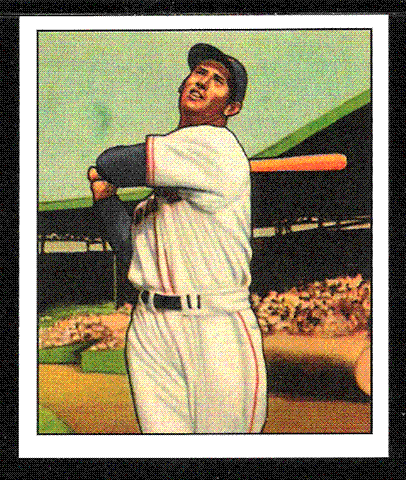
Ted Williams, Bowman Card # 98, 1950.
Even though the price seems pretty cheap today, nickels weren’t all that easy to come by in the summer of 1950. We tried buying Cokes, Pepsis, RC Colas, and Dr. Pepper and selling these for a profit on the streets nearer home, but that didn’t work out too well. It got so hot that we drank up all the profits. Mainly, we had to drum up extra chores that our moms would pay us to do, and that wasn’t easy either since most jobs around the house were already on our “expected to do for free” lists. We did do pretty well on soft drink bottle searches and, one way or another, we managed to keep going back to Haenel’s with out nickels.
There were 252 cards in that 1950 Bowman set and the company had no competition nationally from anyone else. Topps would not hit the card scene until 1951, but by 1955, Bowman would produce its last set before being ought out by Topps, the new king of the industry.
I always preferred the 1950 Bowman to all others. I’m sure that much pf that attraction was due to my younger age, but that wasn’t the whole attraction. A big part was their artistic look. Whereas, the later Topps cards were purely photographic, the 1950 Bowmans were hand-painted images of photos. To me, they just bore a classier superhero look, adding to the powerful auras we already projected upon our distant major league role models.
It also seemed as though Bowman used that hero-worship to play us like so many little squeaky violins. It seemed to work this way: The bigger the star, the harder it was to find his card. I never got a Ted Williams card straight out of the store, for example. I had to trade several others for one. The same happened with Ralph Kiner, who, even though he played for the “Lousy-then-too” Pirates, was also the home run king of his era.
You could find all the Ron Northeys, Wally Westlakes, Ken Heintzelmans, and Clyde Vollmers you never wanted in an average pack. Those were the ones that found their numerously available ways into our bicycle spokes. Even we were not so stupid in 1950 as to waste Ted Williams as a noise maker.
Today, I have one card that remains from my once quite healthy 1950 Bowman collection and it survived by accident, falling its way into a box I’ve since unpacked that contained a number of little mementos from childhood. You guessed it. It’s a Clyde Vollmer.
Tags: Baseball, Bowman Card Collecting
 The Pecan Park Eagle
March 18, 2011 at 2:29 pm |
Great article Bill – brought back a lot of memories for me when I use to buy Topps cards from the 1950’s at Luksa’s Grocery in Rosenberg. I use to mow yards in the neighborhood for $1.00 – and Mr. Luksa would sell me boxes (24 packs) for $1 giving me a little discount because he knew my Dad real well. Those were the days my friend………Larry Dluhy
March 18, 2011 at 9:00 pm |
I’ve got my Dad’s Fifty Bowman and all his other cards matted and
behind light resisident glass-beautiful collection the Fifty Bowmans.
March 20, 2011 at 4:04 am |
I’m very proud of my 1950 Bowman Bobby Shantz rookie card, but I confess I bought it in the 1990s.
Mark