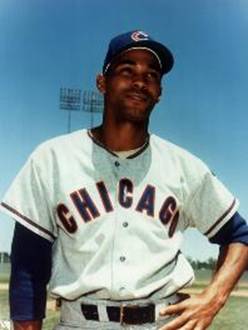
Future Hall of Famer Billy Williams played LF and batted .323 with 26 HR for the 1960 Houston Buffs.
By the time the Houston Buffs settled into their last three years of minor league baseball from 1959 to 1961, the dye had been cast that the city’s real future now rested in the major leagues as one of the new expansion clubs. When former St. Louis baseball great Marty Marion and his group of independent investors then purchased the minor league franchise and ballpark of the Houston Buffs from the St. Louis Cardinals after the 1958 season, it most likely took place with a view toward a future that far surpassed their immediate plans to move the ball club up to the next level with the AAA American Association from the AA Texas League.
The Marion group worked out a minor league player supply group with the Chicago Cubs and agreed to start playing in the American Association in 1959 as the AAA affiliate of the Chicago North Siders. For all the Cardinal fans of the Houston area, the change resulted in quite a culture jolt. No longer would the Buffs be wearing the Cardinal red and deep Navy blue trim of the vaunted and cherished St. Louis NL club.
When the 1959 Buffs took the field on Opening Day 1959, they did so in the Powder blue caps, lettering, and trim on the Cloud white uniforms that were the style of the Chicago Cubs. Even though we Buff fans were told that these guys on the field were our Buffs, and we knew they were, part of our fan souls kept waiting for the “real Buffs” to show up in their Cardinal red gear. It took us a while to adjust. After all, the Buffs had been a Cardinal farm club from the early 1920s. That nearly four decades of Cardinal influence was extremely powerful.
Those three final years of the Houston Buffs were mostly forgettable on the field. Playing first under Rube Walker and then again under former Buffs manager Del Wilber, the 1959 Buffs finished dead last in the five-team American Association West Division with a horrendous record of 58-104. Houston fans seized upon an obvious conclusion: “Buffs, you say? I don’t think so! These guys not only dress like the Cubs! They play like them too!”
The 1959 roster did contain some notables. Future Houston Colt .45 Pidge Browne broke in at first base with a .261 batting average and 12 homers. Former Browns outfielder Jim Delsing played regularly at a low performance level (.233 BA, 4 HR). Delsing is best remembered as the guy who pinch ran for Eddie Gaedel after the little vertically challenged batter (midget) walked in his only plate appearance for the St. Louis Browns on August 19, 1951. – Dave Hoskins, the black pitcher who broke the color line in the Texas League with Dallas back in 1952, also spent a little time pitching for the Buffs as part of his twilight song in baseball.
1960 was the season for memorable names during the Buffs’ Cubs years. Billy Williams played left field for the club, batting .323 with 26 homers on his last minor league stop on the way to his Hall of Fame major league career with the Cubs. Ron Santo played third base in 1960, hitting .268 with 7 homers. The ’60 club also included outfielder Sweet Lou Johnson (.289, 12 HR), outfielder-manager Enos Slaughter (.289, 1 HR in 58 times at bat), plus pitchers Mo Drabowsky (5-0, 0.90) and Dick Ellsworth (2-0, 0.86). The 1960 club did much better, finishing 3rd in now eight-club circuit, but they lost in the first round of the playoffs for the league championship.
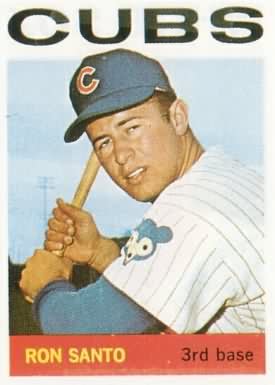
Ron Santo and Billy Williams were the best of the Buffs-Cubs years.
The 1961 last edition of the Houston Buffs went through four managers: Grady Hatton, Fred Martin, Lou Klein. and Harry Craft. Interesting! The Buffs’ last manager, Harry Craft, would also become the first manager of the new major league Houston Colt .45s in 1962.
First baseman Pidge Browne (.250, 9 HR in 62 games) and shortstop J.C. Hartman (.259, 6 HR) both played well enough to join manager Craft on the first voyage of 1962 Colt .45s. The club also included another future Houston major leaguer. Dave Giusti (2-0, 3.00 in 3 games) also pitched a few innings for the last Buffs.
In spite of their 73-77 fourth place record, the 1961 Buffs celebrated their last season by advancing to the finals of the American Association playoffs before losing the crown in six games to second place Louisville.
The big story of the Cubs years, however, was not what happened on the field, but how the Marion group ownership may have affected the future identity of Houston’s major league club. Here’s how I understand it as one who was not intimately involved in the process of the franchise award. I do invite Mickey Herskowitz to weigh in here on this matter as a comment on this column. I would love to see us get it right as we can for history:
The competition between the groups of Roy Hofheinz and Marty Marion for the new major league franchise was heated and unfriendly. When Hofheinz and the Houston Sports Association got the bid from the National League (and I’ve always surmised that HSA was the only group that a serious chance), the Marion group mde HSA pay through the nose for Buff Stadium and the club’s AAA territorial rights.
It’s my understanding from several sources that Hofheinz was so embittered by the Marion group “hold up” that this experience was all he needed to settle a decision that he probably would have made anyway: (1) the new Houston NL club wold not use Buff Stadium while they were awaiting the completion of the new domed stadium off OST and Main. They would build a temporary field there that would allow fans to watch the domed stadium as it progressed under construction. (2) The major league club would not be known as the Houston Buffs, even though there was strong popular sentiment in town for keeping the revered name of the club that had meant Houston baseball from the early years of the 20th century.
Had Marion’s group been awarded, the new NL franchise, I think they would have kept the “Houston Buffs” identity at the major league level, but I have no idea what their stadium plans might have included. I have always thought that the domed stadium plan was always anchored only to the HSA group. More light on all these details is needed.
At any rate, the three years of the Buff’s Cubs era are fairly forgettable on the field. I still can’t believe those guys in the Cubs-look-a-like uniforms really were real Buffs.
Any comments or questions on what really happened between the Hofheinz and Marion groups are most welcome, but please leave them here as public replies – not as private e-mails to me. Everybody needs a chance to get involved in this quagmire.
Tags: Baseball, History, Houston Buffs
 The Pecan Park Eagle
July 8, 2010 at 1:39 pm |
Bill: These were indeed the Fallow Years. Wasn’t Gene Elston the team’s radio play-by-play announcer? If so, he also advanced to the big leagues (although I think he was once a Cubs announcer). Who owns the rights to the name, “Houston Buffs”?
July 8, 2010 at 2:54 pm |
Tony:
“Fallow years” covers this waterfront really well.
And, yes, the great Gene Elston worked the radio broadcasting with partner Loel Passe in 1961 and then the two of them moved on to work with Al Helfer in broadcasting the Colt .45s in 1962.
The rights to the name “Houston Buffs” logically now belong to the Houston Astros. Unless the name was sold separately over the years since then, and I don’t think it was, that name was part of the package that Judge Hofheinz and the Houston Sports Association purchased from the Marty Marion group with their AAA territorial rights acquisition back in 1961.
“The Houston Buffs!” – Hofheinz had the power to keep or kill that venerable name when Houston went big league in 1962. He chose to kill it in favor of making the club over in his own image. How much that decision was piqued by his franchise and money fight with Marty Marion, we’ll probably never know., but I think he would have killed the name “Buffs” anyway. The Judge’s ego matched his genius as a visionary. He wanted to put his own stamp on everything – and that was far more important to him than preserving the Buffs identity.
That’s how I see it.
Bill McCurdy
July 8, 2010 at 3:03 pm |
Lowell Passe (spelling) also moved up. I can remember LP saying
the bases were FOB, meaning full of Buffs.
I was on my honeymoon in Torreon, Mexico and on the way
to the airport I saw a stadium out the window. I had an eerie feeling
I had been in that stadium but it was my first trip to Torreon. Come
to find out, two weeks later Mickey H. wrote an article about Colt Stadium. A wealthy Mexican bought the stadium and had it shipped
and reconstructed in Torreon for his Torreon Lagunas. As they say
Baseball is a funny game, even when it comes to stadiums.
July 9, 2010 at 12:14 am |
It’s my recollection that the last year (’61) the Buffs were independent?
Also, I remember Dan Rather working with Art Mc Gee in the booth, but I’m not sure what year that was.
Brought back a lot of memories!
July 9, 2010 at 4:08 pm |
I too wonder about the major league affiliation for the 61 Buffs. For instance, note the following, which indicates that Bud Zipfel was sent down to the Buffs by the Washington Senators, and then recalled during the year. This has always been a puzzle to me.
“Another player who got his start in the Yankees organization is Bud Zipfel, who was signed by the Yankees in the summer of 1956. Spending 4 years in the Yankees system, Zipfel was selected by the ‘new’ Senators in the expansion draft. Zipfel would spend 2 seasons in Washington. Sent down to Houston when that Texas city was still a minor league outpost prior to the start of the 1961 season, Zipfel would be recalled in late July. He’d appear in 50 games with the Senators playing 1st base, hitting an even .200.”
July 9, 2010 at 4:49 pm |
Tom K:
You and Dr. D. may remember better than I do on this one. It comes back to me now that the Cubs affiliation with the Buffs dissolved after the Williams-Santo 1960 season, most probably in anticipation of the coming major league end to minor league baseball in Houston. The Cubs blanket just fell over the entire period of those three years in my broad-ban memory of the “fallow years.” In my mind, 1959-61 will always seem like the Cub Years, even though the 1961 season had freed the Buffs from that association in their last year of operations. Thanks to both of you for the clarification.
July 9, 2010 at 8:44 pm |
Bill – You may not be wrong in calling the 59-61 Buff years the Cub era. Baseball-Reference.Com definitely lists the Buffs as a Cub affiliate in 1961 and also states the following:
“Like the parent Cubs, the team used a College of Coaches in 1961 with Grady Hatton, Lou Klein, Fred Martin and Harry Craft all managing at times. The Buffs went 73-77 and finished 4th.”
Though, its not always reliable, Wikipedia also says the Buffs were the Cubs AAA affiliate in 1961.
And yet how where the Senators able to send Zipfel to the Buffs in 61 and then recall him? It’s quite a mystery.
July 10, 2010 at 2:33 am |
Tom K:
That information makes sense too. Because of their lame duck status in 1961, it is highly probable that the Buffs had a very loose working relationship with the Cubs in their final season, one that gave room for the Buffs to accept Zipfel from the Senators.
October 23, 2011 at 6:51 am |
ego-w…
[…]The Houston Buffs’ Cubs Years, 1959-61 « The Pecan Park Eagle[…]…
January 6, 2012 at 12:32 am |
Anybody have any color photos for the 1960 or 1961 Buffs? I have always wondered about the team colors for those years. I have seen several black and white photos of players from the 1961 team and I pictured the caps to be navy blue or black with an orange H. At least that is how Iinterpreted the colors to be. Also the front cover of the Buffs program from 1961 was black and orange. The Cubs supplied quite a few players for the Buffs in 1961, but there were also a few that had been signed by the HSA in 1961 on the last Buffs squad. There may have been a few players on loan from other major league organizations also. The 1961 buffs were owned by the HSA so the Cubs colors may have not been used that year. By the way, when the Colt .45s played the Cubs on opening day in 1962 there were six former Buffs in the Cubs lineup that day. Billy Williams (1960), Ron Santo (1960), Dave Gerard (1960 and 61), Barney Schultz (1955, 60, and 61), Jim McKnight (1958, 60, and 61) and Al Lary (1960 and 61). If you look closely at Dave Giusti’s 1962 Topps baseball card you can see the outfield wall of Buff Stadium in the background.
April 17, 2013 at 9:57 pm |
It may have been the Houston Buff Cubs years but Billy Williams was the best hitter to wear a Buff uniform—ever—some of his home runs were monster shots—-Rennie Baker, Jr.
February 7, 2015 at 11:48 pm |
Bill, do you have any pictures of 1959 Buffs pinstripe jerseys? Who wore # 9 in 1959?
May 19, 2018 at 2:49 am |
Loel Passe talked about his twin bro Noel Passe (in radio Buff broadcasts games) i learned nearly all my profane words when Loel
stormed outta the broadcast booth @ KTHT one nite they lost to 0KC circa 1953.
i could swear the Buffs were renamed Rangers during the 2-3 year
interim. i also thought Prentis Browne played for the Buffs in 58 which would make him the only player to have played at all 3 levels.for Houston.
i loved Buff Stadium and loathed Colt “Stadium”