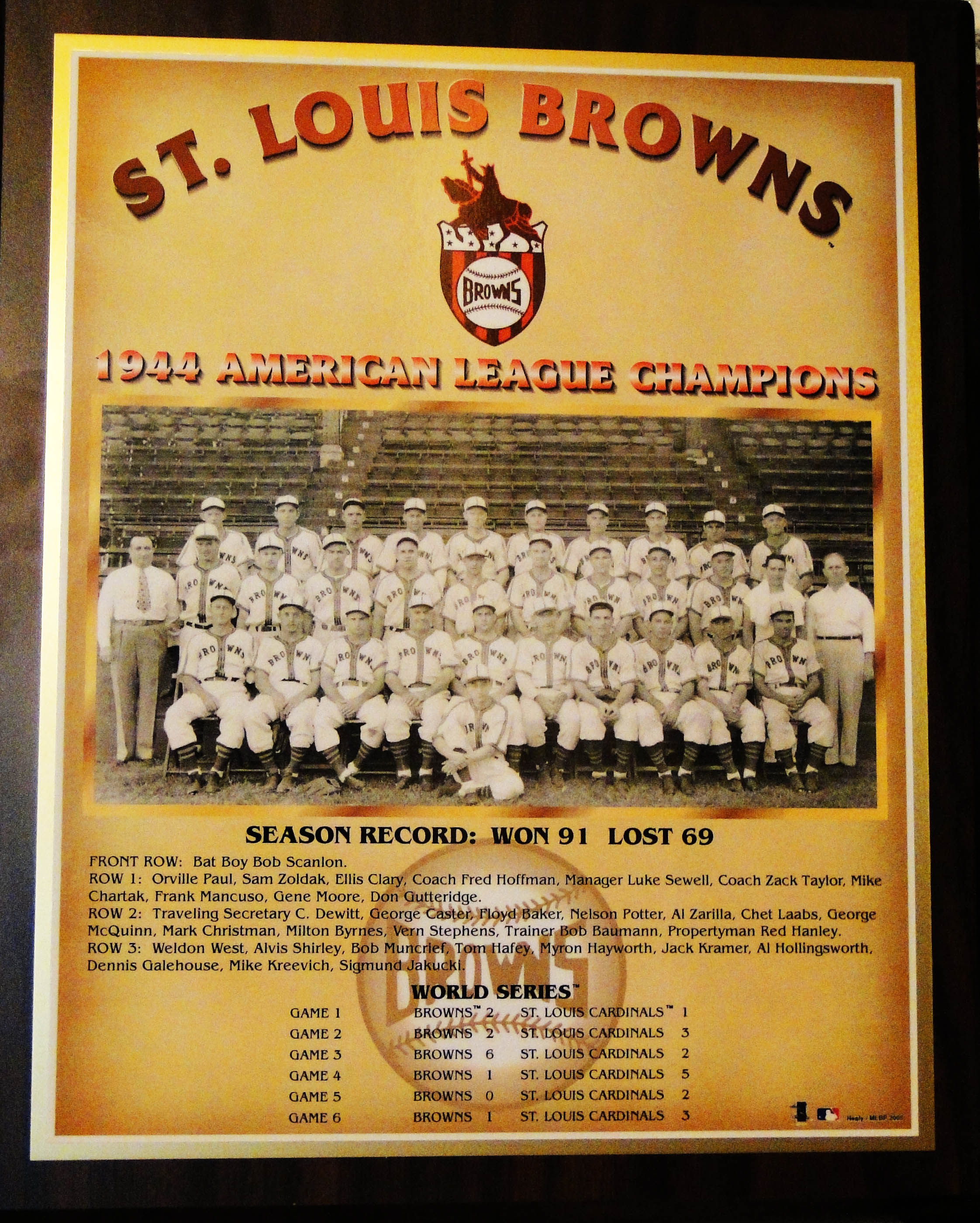
I received this beautifully framed photo narrative of the 1944 St. Louis Browns yesterday as a gift from Ron Pawlik, a buddy I played ball with back in 1951, but only yesterday caught up with again for only the second time in the past year.
Yesterday I attended an alumni luncheon at St. Thomas High School in Houston where, I must note, the natives are quite happy with their still new baseball coach, Craig Biggio. Just in case you haven’t heard, and in only his second season at the helm, Coach Biggio has now led the fighting Eagles to a state high school baseball championship. We can only hope that Craig stays a while before he heeds the big league call to manage somewhere.
Something else happened yesterday to powerfully remind me of how far-reaching the cord of baseball has traveled in my life. Out of the blue, but not really, I ran into Ron Pawlik, a buddy of mine from St. Christopher’s Parochial School in Park Place. Ron was a year ahead of me in school, but we played in the same outfield together one year for the 1951 ever-rambling St. Christopher Travelers. I had seen Pawlik at last year’s alumni luncheon for the first time since 1997, when we held a reunion at old St. Chris, and before that time, I had not seen Ron since his graduation from St. Thomas in 1955.
The short of it is the fact that he gave me that beautiful framed Browns piece displayed here. Ron had been reading some of blog articles over the past year and had become aware of my affinity for the old Browns. I was both shocked and appreciative of his generosity. I really like the Browns piece on ts own merit, but also because it simply helps drive to the surface the realizations I’m trying to express this quiet Saturday morning.
Like a lot of you, the long cord of baseball has been with me forever, often serving as the X factor in whether or not I became friends with, or worked things out with, other human beings that came into my life over time. Once I knew that someone liked baseball, and was sure they understood not to call runs points, umpires referees, or managers coaches, we could overcome just about all other obstacles to working out the parameters of our everyday life relationship.
When I was a kid, growing up in the Houston East End, we were all Houston Buff fans. of course, and almost 100% of the adults I knew were St. Louis Cardinal fans when it came down to supporting a favorite major league club. I too became a Cardinal fan as a result. They were the parent club of my local Buffs – and their roster was loaded with all the Buffs who played good enough to get there.
My admiration for pitcher Ned Garver converted me into a St. Louis Browns fan in 1951, but I now think that change was helped by my need as a kid to rebel against the Cardinal blanket that totally surrounded me. Besides, I didn’t totally abandon my support for the Cards. I just added the hapless Browns as my underdog battling American League club.
By the time I reached St. Thomas High School, I was assigned to a home room that was run by a Basilian priest scholastic named “Mr. Klem.”
Aha! Now there’s a major clue as to the ongoing presence of the baseball cord. Mr. Klem turned out to be the nephew of Hall of Fame umpire Bill Klem, a real baseball guy, and a fan of the New York Giants, his home state club. I had never met a Giants fan previously, but Mr. Klem seemed to be as knowledgeable of baseball as all the Cardinal people I grew up knowing. It made me think that maybe Giants fans weren’t all that bad after all. Besides, Mr. Klem seemed pretty high on his club’s young center fielder, Willie Mays, and of course, 1952 was the year that followed the 1951 Shot Heard Round the World. During Mr. Klem’s religion classes on miracles in our daily lives, we got to hear a lot about Bobby Thomson as a primary example of same.
For some unfortunate reason, I never dated any women that really cared for, or knew much about, baseball. I did have a Freudian theory professor in graduate school at Tulane whose brilliance was matched, and somewhat neutralized by her thick German accent and the upside down Nazi-way she held her lighted cigarette during lectures. I couldn’t find the baseball rope or Freudian string on this period in my life, but I survived.
“You vill learn zee theories of Herr Freud und you vill not be deceived by all zee sick patients who unconsciously or sociopathicly wish to manipulate you, zee doctor, unto seeing zem as honest und trustworthy!”
I survived Dr. Gestapo and the concerted efforts of the formal education process I had embarked upon to change the way I thought, talked, wrote, and viewed life in general, If I was of any help to people who sought me out as clients over my years of practice as a professional counselor, it was because of what I had learned from baseball and from growing up in Pecan Park – and not from some cold burial in the theoretical alien-spirited offerings of Tulane University.
A good friend of mine in New Orleans, a fellow named Donald M. Marquis of Goshen, Indiana, wrote one of the seminal books on the history of jazz in 1979. That book, which is now being made into a movie, is called “The Search for Buddy Bolden,” and it took Don Marquis seventeen years of focused research and investigation into the life of jazz’s first trumpet man before it was finally done.
Where did Don Marquis acquire his patience for the job? Easy. He was a Cleveland Indians fan. If you want something done that takes a ton of patience, hire an Indians fan.
One of my best friends in graduate school at Tulane was Sue Elster-Hepler-Liuzza. Sue was easy to like. She’s a north side Chicago girl who loves the Cubs and, of course, hates the White Sox. I was a little shocked, but not really surprised earlier this week when Sue told me that she never even stepped foot on the South Side until well into her adult years. She also explained that she is typical of many North Siders. They want nothing to do with the South Side or the White Sox. Unfortunately, this knot n Sue’s baseball rope came at a cost. She never got to see the original Comiskey Park in person. By the time she went there, it had been torn down.
My own baseball rope on life trucks on, flaring lessons all the way: (1) The days of our lives are like the games on the schedule of the long baseball season. You win some. You lose some. And you take each day one at a time and go on from there. (2) Whatever you’re doing, keep your eye on the ball. A few of the pitchers we face in everyday life may try to throw a few emery balls at us. (3) Pick a project team of people you know you can trust – and go into combat with them. There aren’t many things you can do out there well alone without help and you probably will need to rely upon people who know their jobs and your expectations of them – ones who will also cover your backside honestly, but still be strong enough to hit you with the truth when you need that feedback most. (4) keep your word. (5) take responsibility for your “E”s, learn from them, and move on. (6) Look for some kind of joy in all you do. (7) Never give up on anything that’s really important to you.
That’s enough for now. And thanks again, Ron Pawlik. And thanks to you too, great wondrously flexible cord of baseball. You keep popping up to remind me where my real education came from in the first place. The Pawlik gift is simply another life reminder:
(8) Loyalty and real friendship are forever.
 The Pecan Park Eagle
June 5, 2010 at 12:57 pm |
Great piece Bill with wonderful analogies. To add to it, I have so many patients, especially as they get older who sit and vegitate- perhaps they are being called out on stikes and never try to hit the ball.
Joe Biundo
June 5, 2010 at 7:55 pm |
Another wonderful essay, Bill….thanks!!!
June 6, 2010 at 6:33 pm |
Your mention of New Orleans made me think of some old neighboorhood bars. Friar Tuck’s, Liuza’s, Cuisamano’s, The Carrolton Street Tavern, and of course Nick’s