Posts Tagged ‘Yogi Berra’

Yogi Who?

March 23, 2012

Yogi Who

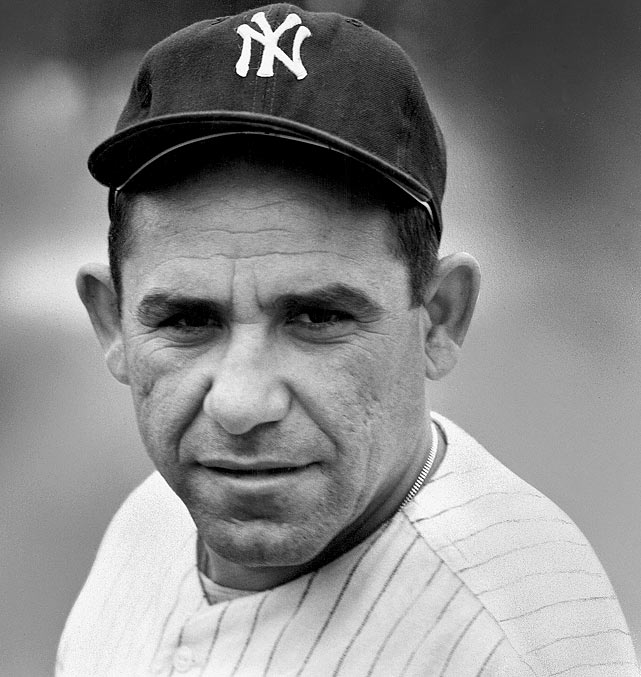
Yogi Berra (c) John G. Zimmerman

Yogi Berra
(c) John G. Zimmerman

Most of you have heard the story of how young Larry Berra of St. Louis, Missouri picked up the nickname “Yogi” on his way to becoming an American sports icon and the only inspiration for the famous cartoon character, Yogi Bear. If you’ve ever wondered who the model yogi was for that divinely inspired identity alteration, I’m right in there with you, but let me warn you before you read even further: I still don’t know – and I’ve never met or read anyone else who apparently does. – That doesn’t mean it isn’t traceable or that we would not discover along the way that someone has quietly made a fairly safe rescue of the truth, but either never published it – or else, they published it too obscurely to be heard.

Let’s review what we know about how the nickname supposedly came about:

Factual Assertion # 1: When Berra was a young adolescent, he and some of his buddies from the Italian neighborhood in St. Louis known as “The Hill” went to the movies together. Since Berra was born on May 12, 1925, that would have put the year at about 1938 to 1940 tops, but I’m betting 1938, when he was just turning 13. We would still need to research all three years.

Factual Assertion # 2: As per usual with this movie period, Berra and friends witnessed a movie newsreel of current events. As a sort of earlier version of television’s “Entertainment Tonight,” these short extra films on world news usually featured and concluded with light stories designed to grab their American audiences into an “aw, look at that” state of attention. On this particular day, the newsreel featured film of a real Nation of India yogi in action (or inaction, to put it more technically.)

Factual Assertion # 3: After the movie, one of Yogi’s buddies (it may have been Joe Garagiola, but I’m not sure) said something like: “Hey! That yogi in the picture show looked a lot like Berra here. From now on, let’s call Larry by a name that fits him better. Let’s call him “Yogi Berra.” Berra apparently didn’t object and the name stuck. He was on his way to becoming Yogi Berra for the rest of his life, even if his mother and father didn’t know about it for quite a while.

Our Question: Who was the actual yogi figure that inspired this transfer of his title young Lawrence Peter Berra of St. Louis?

If you were going to research it, I would suggest these steps:

(1) Do a library/Internet search of what has been written on this subject and proceed to follow up on any questions and contacts discovered.

(2) Talk with Yogi Berra and Joe Garagiola, asap, if possible access can be arranged. Neither is getting any younger. Try to find out all you can about the year of the actual occurrence – and anything else they remember about the actual yogi film clip.

(3) There were only a few studios that did newsreels prior to World War II. Find out who they were – and how much availability you might be able to get for the sake of researching the question. Sometimes the knowledge that you are doing research for history is a turn-key to normally closed doors.

(4) Take whatever you find on film back to Berra, Garagiola, and other surviving members of that movie trip day in long ago St. Louis. Visual evidence sometimes can reawaken memories that are no longer available as conscious thoughts. – The photo of “Yogi Who” shown above is of an Indian mystic from that late 1930s period, but I’ve misplaced my record of his name and the news article I found on him in a search on this same question years ago. I’ve always thought he may have been the inspiration because of his similar facial resemblance to Yogi Berra. *

* Correction: I once had an unidentified photo from a 1930s yogi that strongly resembled this one, but the one I mistakenly used here is Mike Myers, as he appeared in the movie, “The Love Guru.” Frequent contributor Cliff Blau discovered my error and left a correctional comment below, something I always welcome when I get things wrong. The Myers photo was only listed in my files as “Yogi Mystic” – and I had never seen that movie and had failed to recognize the actor in make up in the photo used here. I thought it was the one I never found. – Just another lesson we are never too old to learn or re-learn: Always label your written and photo material accurately – or don’t use it. My apologies.

(5) In the end, if this research project doesn’t hold all your attention, you may want to turn your energies to this less academic research query. It’s one of much greater practical importance, but not nearly as much fun as the Yogi name quest.

Here’s the question: Given the current direction of our American economy, and no matter who wins the presidential election in November, how are we going to keep making a living in 2013?

Barra on Berra

July 17, 2011
The Real Yogi Berra (c) John G. Zimmerman

The Real Yogi Berra
(c) John G. Zimmerman

Recently I read writer Allen Barra’s 2009 biography, “Yogi Berra: Eternal Yankee”, and thoroughly enjoyed it. Barra hit upon the right balance between objectivity and subjectivity in his assessment of the great Yankee Hall of Fame catcher, building needed assessor’s distance through his ability to see the difference between the actual man and the media myth created by sportswriters and advertisers – and yet, Barra still cared enough to dig out the true greatness of Yogi Berra as a Hall of Fame performer and masterful baseball thinker.

Barra supports the reality that Yogi did not say all the wise things he’s credited for saying as funny, but true sounding aphorisms, but that some he did say, some the writers made up, and that most are loaded with the seed of the same great obvious thought from Yogi’s original less catchy words.

Barra’s best example is Yogi’s trademark expression: “It ain’t over til it’s over.” Yogi Berra never said those exact words, of course. What he actually said in the heat of a pennant race during his tenure as manager of the New York Mets was something closer to the cliche thought-line we all know as “the game’s not over until the last man is out.”  That’s not what Berra said either, but it was closer to that old line than it was to his finally most celebrated line. Writers quoted Berra, but they kept changing his words until they morphed, or distilled down, into “it ain’t over til it’s over.” It worked. The seed for this wisdom was contained in Yogi’s original statement. The “it ain’t over til it’s over” version simply rang the public bell with far greater home-spun poetic clarity.

And so the wisdom of Yogi was born with some editorial help from certain writers. From there, it isn’t hard to see how Yogi wisdom assistance extended eventually to include these examples of Yogisms, as cited by Barra in the Appendices of his book:

Example One: During Yogi’s tenure as manager of the Mets, he attended a function at City Hall wearing a lime colored light summer suit. He was greeted by then Mayor John Lindsey’s wife, who exclaimed, “Welcome, Yogi!” – “Say,” she added, “you really look cool today!”

“You don’t look so hot yourself, Mrs. Wagner!” Yogi responded as he smiled and reached out to shake the mayor’s wife’s hand.

Example Two (from a commercial):

Yogi (in barber chair): “That’s why you need that kind of insurance.”

Man in Chair next to Yogi: “What kind of insurance is that, Yogi?”

Yogi: “For when you get hurt. – If you get hurt, and you can’t work, it won’t hurt – to miss work.”

One of my favorite sectors of the book happens late. Barra includes a comparison of some well-known thoughts of Yogi Berra to similar thoughts of some great world thinkers and shakers, The following may be my favorite among those offered – and a good way to lightly salt a Sunday column as over and out and done:

“This is the best of all possible worlds.” – Voltaire.

“Even if the world were perfect, it wouldn’t be.” – Yogi Berra.

.

Yogi

May 29, 2011

Most of you deep blue baseball fans already know the story of how Lawrence Berra came to be known as “Yogi.”

The Real Yogi Berra (c) John G. Zimmerman

The Real Yogi Berra
(c) John G. Zimmerman

Supposedly, he and best friend Joe Garagiola and some of their other buddies from “The Hill” Italian neighborhood in St. Louis went to a movie together back in the 1930s, as was their usual Saturday pattern when the change was available for tickets. . While they were there on this particular day, they saw one of those travelogue features that used be so popular back in the day – the kind of one-reeler narrated by John Nesbitt for a series they called “The Passing Parade.” It was a short subject serial on travel and historic events that ran from 1938 to 1949 and it was was tailor-made for the movie going public back in the pre-home TV days. – I only suggest that guess because I watched enough of these little shows myself down here in Houston during the post-WWII period of that era, I think I even saw the Indian yogi feature that altered Mr. Larry Berra’s identity forever too.

Berra and company apparently saw that one about mystics in India too. It showed a few examples of yogic teachers in India and gave the boys a “blue bayou” (blew-by-you) introduction to yoga and yogi teachers. I can just hear the walking-out-of-the-movie conversation now. It was just kids doing what kids do, but it was an interaction of ideas and words that would set in place the name of a future American icon.

Not knowing the actual names of the Berra buddies involved, I’ll simply have to give two of them fictional Italian first names and report how the conversation among friends plays out in my head. – Just one more note: Until this moment, Berra wa known as “Lawdy” to his friends. They called him “Lawdy’ because that’s the way his name sounded when expressed aloud by his Italian mother Paulina. She could not say “Larry,” the Americanized nickname for males hung with the “Lawrence” formal first name. When she tried to say “Larry,” it simply came out “Lawdy,” so that’s what the buddies chose to call him too. That is, until this date came along.

Here’s the way I hear it coming down. – Four Italian-American boys from The Hill in St. Louis are walking out into the bright July snlight from a  neighborhood movie house in St. Louis, Missouri.  It is 1938. The boys are all about 13-14 years old:

Luigi: “The movie was OK. – I like them Charlie Chan films.”

Lawdy: “Yeah, me too. I like the way they taped back that actor’s eyes to make him look Chinese.”

Joe: (tongue-in-cheek) “You mean to tell me that Charlie Chan ain’t no real Chinese detective, Lawdy? – Well, shoot! You could-a’ fooled me. I guess they got no Chinese actors out there in Hollywood.”

Mario: “I liked the short feature about India best. I liked the way them yogis just sat there, all still-like, just rolling their eyes back into all white cotton-looking balls.”

Luigi: “Yeah, I liked that too – but did you guys see what  I saw? – That one yogi looked just like old Lawdy here!”

Joe: “Oh, my Cardinal crab cakes be damned, Luigi Tomato Face! – You just nailed t! – That Indian yogi guy did – he looked just like our own little bashful Lawdy here! – From now on, let’s get off this hopeless “Lawdy” name and call our man by a word  that really fits him. Come on! Get with me on this one, guys! He’s “Yogi” from now on! – OK? – Yogi Berra!”

Lawdy: “OK by me, you guys,  but, Joe, first you gotta tell me something.- What the heck is a “Cardinal crab cake?”