
Bill Klem invented the "safe" and "out" hand signs.
Even if we hate umpires, the game of baseball could not survive for long without them exerting a real place of fair authority over what happens on the field. They are the judge and jury of everything that happens on the field, from Little League to Major League. Take away that power and the game soon dies.
Before a fellow named Bill Klem came along at the turn of the twentieth century, there was something of a danger to the integrity of the game because baseball had failed to back its officials to the nth degree. A few players got away with two-fisted attacks upon umpires and some umpires even got fired for trying to fine owner’s pet players for assaulting behavior toward them on the field. Top that with the presence of bully managers like John McGraw of the New York Giants and baseball had the potential of making itself over into something that resembled what professional wrestling was to become by the the mid-twentieth century – little more than a sideshow entertainment in which the umpires were little more than a prop in service to the melodrama.
Baseball survived as a legitimate sport and much of the credit has to go to Bill Klem for all he did to build unshakeable support for the umpire’s authority in the game. The issue that got settled is probably best summarized in this heated exchange between the bombastic John McGraw and arbiter Bill Klem. In a rage over one of Klem’s umpiring calls, McGraw lashed out that “I can have your job removed from you over this call!” Klem quickly responded, “If it’s true that you can have my job because you don’t like my call, then I don’t want this job, anyway!”
In an interesting tale of two adversaries, Klem and McGraw actually became close friends over time, often having lunch together when the opportunity presented itself, even though their on-field vitriol continued on the through McGraw’s last 1933 season as manager of the Giants.
McGraw didn’t get Klem’s job and “The Old Arbitrator” held his ground. From 1905 to 1941, he held forth as a major league umpire, becoming the on-field official who developed the universal hand signals for strike/ball, safe/out. and fair/foul. Klem recognized that no umpire had a voice to carry this ongoing heart-of-the -game news to fans throughout any large ballpark so he developed and used, and guided others to use the very signals we still rely upon today to know the result of every action on the field.
Klem also developed the crouching, over-the-shoulder of the catcher view on balls and strikes and the
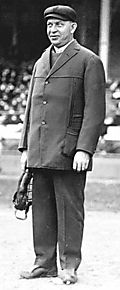
Bill Klem, Hall of Fame Umpire
regular use of chest protectors by plate umpires, plus the straddle view on long balls hit closely down the line. Klem is famous today for getting across his umpiring role as the supreme authority in games with this simple answer to a real game-in-progress question, “Is that ball fair or foul?”
“It ain’t nothing until I call it,” Bill Klem snapped.
Over the course of his 26-season career, Bill Klem worked in 18 World Series. No other umpire has worked more than 10. He also was one of the umpires who worked the first 1933 All Star Game, returning as an umpire in the 1938 All Star Game, as well.
Klem hated the nickname “Catfish” that a minor league manager once hung on him in the heat of the moment. The manager yelled something like, “Hey, Klem! You big catfish! You don’t speak. You don’t smile. You just stand back there like a big old catfish, breathing through your gills!”
The manager got tossed, but the “catfish” name stuck. Legend has it that Klem would toss a player for even whispering the word within earshot of his presence. Klem once even ejected a player when he caught him in the dugout quietly drawing a picture of a catfish.
Bill Klem passed away in 1951 at the age of 77. Two years later, Klem and fellow umpire Tommy Connolly became the first two umpires to be admitted to the Baseball Hall of Fame.
As an aside, my ninth grade home room teacher at St. Thomas in 1952-53 was “Mr. Klem,” a nephew of the famous umpire. When spring came and I played freshman baseball for one of the three feeder teams into our all-star freshman club (I also played for them), I played for the squad managed by Mr. Klem of New York. – He called us the “Giants.”
Funny how history rattles around in sidebar ways sometimes, isn’t it?

 Houston, Baseball, & Other Musings.
 The Pecan Park Eagle