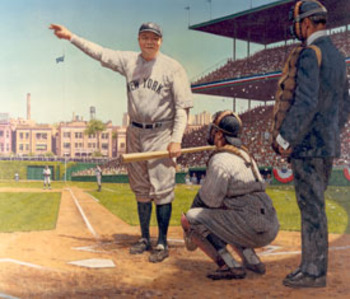
“The problem with calling my shot is not arrogance, but it is bad role modeling. By 2015, they are all going to think they can do it just because I once did!” ~ Babe Ruth.
Yesterday at The Pecan Park Eagle, reader/professional data analyst Andy Biles made his case with some easy to see data support that “Plain and simple – too many strike-outs” had killed the 2015 Astros’ chances for an AL pennant.
As a comment on the same column, long-time respected baseball media broadcaster and author Greg Lucas added an expansion thought about the “K” as a general problem for baseball today:
“Strikeouts are a problem everywhere, but the Astros have been the poster children over the last three years. More pitchers than anytime in the history of the game are throwing FBs at 95 mph or more so it is natural that more are K’ing. However, the object still has to be to cut down on the totals and have smarter at bats. No ball in play guarantee no hits. Balls in play give the offense a chance. Lots of walks and higher OB% are only helpful if someone can make contact, get a hit and drive them in. Waiting for bases loaded walks to score won’t win any pennants.” – Greg Lucas.
From there, it is both easy and obvious – and the case makes itself – that all of the defensive shifting we see in MLB today is nothing less than a direct response to the growing numbers of players who come to bat to pull the ball out of the park or sit down, with small chance of hitting the ball at all – let alone hitting it to the opposite field. They are trying to be Ted Williams when they are not even close to being the “Splendid Splinter”. In irony, these go-for-broke “hit or sit would be bombers” are more likely to be picking up a not so splendid, but much more painful splinter from the benches that support most of their “hit or sit” efforts.
Greg Lucas makes a good point about how much the growing presence of pitchers who throw 95 mph, or better, also buries the hopes of most wannabe sluggers. Add to that thought the fact that many of these new fireballers also now possess the ability to throw gradiently slower change ups that make the challenge of timing the fastball even tougher – especially when this new tougher breed of bigger, stronger pitchers also has one of those fade away sliders or curves that land in the low outside dirt like an irresistible carrot – and result is – there’s far more sitting than hitting.
Some of us are getting tired of 2-1 final scores that often are simply the result of three home runs in which those long balls were part of of 5-hit game in which the other two hits were accidental boomer-swing infield singles – while both teams struck out in double digit totals.
What should baseball do, if anything? Maybe nothing. Maybe something. I’d still like to see MLB leaders seminar or bejabber the snot out of this subject this off-season, and especially before Minute Maid Park brings that center field fence in about 30 feet and completes the shift of our very unique site into a total home run band box and an even stronger invitation to play “hit or sit” ball.
The argument has been expressed that studies have shown bringing the fences in at MMP will not result in a significant increase in homers to center, based upon some study of many current fly balls that were either caught or fell in as extra base hits under current conditions. The flaw in that reassurance is that these studies were of hitters who were mostly trying to avoid hitting fly balls to a foreboding 436 feet away fence. Once the distance is 400-405 feet, and the from the heels guys of 2017 see it, just watch and count the increase in balls hit to dead center that will make it over the new shorter fence. Our money is on a dramatic increase in center field homers – and another reenforcer to the thought – “Just go up there and knock it out of here. If we get enough people going yard, we won’t need any base runners.”
Making a baseball field smaller only encourages “swing-from-the-heels” baseball. Hitters need to see the possibility of a triple somewhere – or else – they may as well join the crowd of trying to reach all of the now very reachable fences.
So, what is a good option?
I’m a great fan of looking for the best adaptability answers first. Hitters who learn to take advantage of those open fields that the new shifts leave could do things: (1) They would break up the “shift” on all hitters who demonstrate the ability to hurt that extreme one side defense: and (2) Such an adaptation could help batters remember that singles or doubles down the opposite field line also count as hits – and they help bring back that rarer commodity known as “the base-runner” to the game.
The other choices all have to do with changing the height of the pitching mound or the distance of the pitching rubber from home plate. In these regards, I am totally opposed to any change that alters the basic comparative conditions that have been almost sacredly protected over time.
The home run would not disappear if we built some parks that were at least 330 feet down the line and allowed dead center to be 415 feet, but I also am not a fan of cookie cutter dimensioning answers either. Our ballpark variability on fence distances are a big part of our game’s uniqueness. I’m cool with Houston’s 315 feet left field Crawford Boxes, but only because of the deeper dimensions that now exist from left to right center.
Finally, maybe it doesn’t need to be a movement. All it takes is for a few smart players, or one team with enough of those guys in roster stock, to see being the first to acting on the vulnerability to the current trend puts you or your club at the head of the class – and starting with learning to hit to the opposite field is the obvious place to start.
The home run isn’t going to disappear with the returned of table-setting base runners. Television would never allow that to happen. Homers are TV’s signature moment. They simply are not the whole game of baseball that makes the diamond drama the closest athletic brother to the game of chess.
 Houston, Baseball, & Other Musings.
 The Pecan Park Eagle