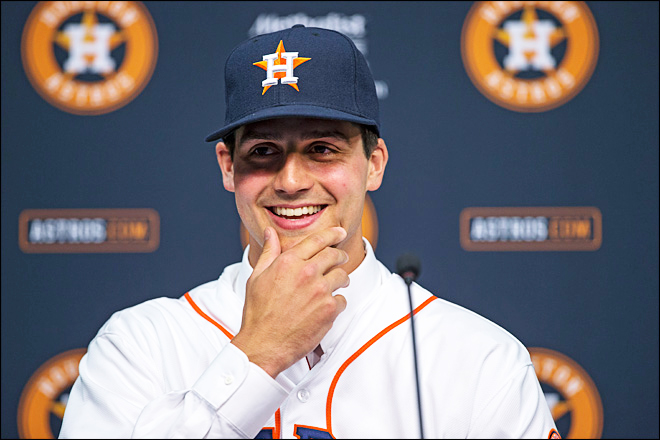
Mark Appel, Pick #1
2013 Amateur Draft
Have you made a big decision that seemed right-as-rain at the moment, but sooner rather than later revealed itself as landmark regret? If not, what planet in the universe are you from?
Well, the autopsies on Stanford pitcher Mark Appel as the first pick of the Houston Astros in the 2013 amateur free agent draft are now rolling in pretty predictably with his late inclusion into a five players for two trade with the Philadelphia Phillies for the purpose of acquiring 25-year old power closer Ken Giles over the weekend and these op/eds will inherently, or specifically, be raising all of the silly, sanguine, sad, and predictable questions that invariably arise from hindsight:
- How much stock can a club place in the stats of high school or college ball as indices of future performance at the professional level?
- How many really good scouts out there possess the intuitive ability to project a prospect’s future performance based on what they see?
- How much is decision-making at the top draft pick level reduced to clubs simply basing their “hopes” on a likable candidate maturing to the level he will need to reach over time with experience and effective coaching?
- How often is disappointment based on the time-discoverable reality that some first picks may already have reached their player growth potential on draft day. These types do not develop further because there really is no dynamic upside beyond where they already are, no matter how teachable they are, or how hard they try.
After the Giles trade, pitcher Mark Appel told one writer that “I can only perform to my God-given ability.” And that statement alone may cover all but two aspects of the truth about Appel. His “God-given ability” may have already peaked on the day the Astros drafted him in 2013. The Astros just didn’t know it.
Had the Astros known, it’s highly unlikely they would have drafted a guy with the first pick, only to include him two years later as a deal-maker addition in a multi-player trade for a highly rated closer.
Had the the Astros also known on draft day 2015, that a kid named Kris Bryant was out there as an alternative to Appel – as one who would be then taken by the Cubs in 2013 and go on to hit .275 and 26 HR in 151 MLB games in 2015, but they didn’t know. Neither did the Cubs.
The larger seminar here goes beyond the unfolding destiny of Marc Appel – or even baseball. The better we get at assessing potential for our own growth, the better our decision-making improves and the lesser we stockpile regrets over “poor” (inadequate) decision-making.
From my own career experience of working with people on issues of growth and change, here is a capsule of words I would use as indicators of potential for change and a high ceiling of performance in some area. None of these qualities are absolute, but they appear too often as change-booster variables to be dismissed. And these are: intelligence, emotional stability, flexibility, the ability to listen, a commitment to learning from experience, and a burning desire to discover and use self-knowledge for self-improvement.
In closing, I am reminded of famous Nolan Ryan scout Red Murff’s story of signing the greater future Hall of Famer from Alvin, Texas. Murff said that he could recognize that young Nolan needed to “fill out” in body weight and muscle growth to become the pitcher he had the potential to be. Murff says he looked at Nolan’s father and saw that the elder Ryan’s rugged muscular build was all else he needed to know about the kid’s potential to sign him for the Mets. – Good work, Red, but I doubt I’d get much argument from you on this closing thought:
Nolan Ryan also possessed all of the “indicators of potential” that I listed earlier.
Good luck to Mark Appel, too! Maybe you will get there in your own time – and maybe we put too much pressure on #1 draft picks to be the human equivalent of energy drinks to our team’s floundering fortunes.
____________________

 Houston, Baseball, & Other Musings.
 The Pecan Park Eagle