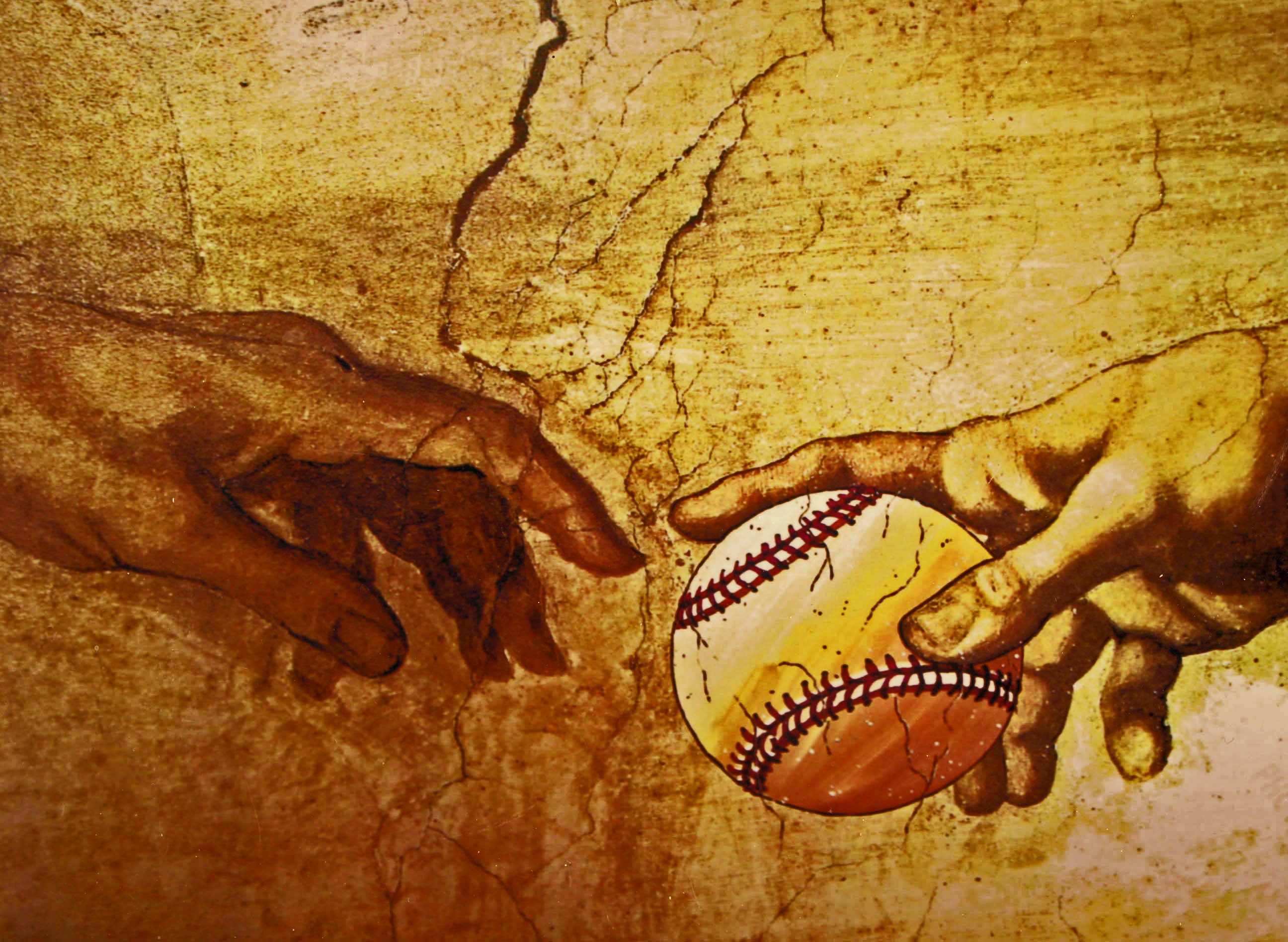
Since God gave us the first “designated pitcher”, what’s wrong with Him also giving us a a new testament from 42 MLB years experience with the old way for a better way to use the “designated hitter” in this century?
The problem with all the DH arguments is that they all start and end on two faulty premises that leave neither the pro or con sides any place to go. Both sides, in small groups or large, come together. Unload. Get nowhere. And then walk away to brood some more. Or else, in the case of old NL enthusiasts, simply stop going to see AL games because they are “not real baseball.” – My 31-year old son, Casey, is a perfect example. Those quoted words are his too. He only has seen one Astros game at MMP since Houston moved to the AL and that was in our first new league season. And that was only because the Astros were playing the Cardinals, Casey’s newly adopted team. As you know, the Cards play in the “real baseball” NL, but even the St. Louisans are compromised when they come to Houston because the AL DH rule is in place here. It was one and done for Casey in 2013, once that fact became abundantly clear in person.
The Two Faulty Premises
Faulty Premise #1: That Baseball is exempt from the rules of change that effect everything else in life. Not so. Baseball had been changing all along. It simply bit into one change by MLB that proved divisive over time when the AL was allowed to separately install the DH while the NL continued to play by the old rules.
Faulty Premise #2: That the DH Rule adopted by the AL in 1974 was the only alternative as the answer to pitchers being a dead spot in the batting lineup. Also not so – and we will hope to make a case for a new use of the DH that actually increases all managerial responsibility for strategically deciding how a roster of players are best used in the interest of winning ballgames. Those who support the current DH rule will no longer be able to sit back and wait for the NL to either “come around” or “be forced” into adopting the current DH rule as the only option for that idea.
There’s got to be a better way and some of us think there is.
Where the Eagle DH Plan is coming from
I’m a born in Beeville and raised in Houston NL guy. Unlike most of my NL-blooded friends, however, I have experienced a couple of epiphanies over the three years that the Astros have been in the AL. Here’s what I now see differently:
(1) The strategic depth of decision-making gravity associated with the NL managerial option to pinch hit for the pitcher is over-rated as a hitting strategy move. Just as often, what seems to happen is that managers will use a pinch hitter as a pitcher-change strategy move. It becomes a way to get an ineffective hurler off the mound on the pretext of there being a greater need to pinch hit for him that outweighs the value of leaving him in the game. That way, the manager doesn’t have to go to the mound and hurt the feelings of a big-headed and/or insecure pitcher by taking the ball out of his hands.
Pinch hitting for the pitcher is no superior strategy move. It’s an easy way for NL genius managers to simply kill two birds with one stone.
(2) With pitchers not hitting in the AL, managers in what we in Houston used to call “the other league” have no easy way out, via a pinch hitter, for removing an ineffective pitcher. If the AL manager takes his pitcher out a batter too late, it’s on the manager’s resume’ – with no easier way out of a close interpersonal encounter via a calculated act of pinch-hitter subterfuge.
The AL manager has to make the pitching change move directly by removing the ball from one guy’s hand and placing it the hand of another. If the very first batter against the new pitcher then gives up a bomb, the fans won’t be saying “too bad we had to remove the first guy for a pinch hitter our last time up.” They will be yelling at the manager: “Why did you put that bum reliever in the game?”
Where we are going with this suggestion
First of all, we need to add that the whole idea came together this afternoon. I needed to write it down now before I lost any of its central points. Parts of it have been growing in my mind for some time, but it wasn’t until I read another specific suggestion by Bob Hulsey at Astros Daily about mid-day this Good Friday that all the parts began to fall in place here.
Bob Hulsey also offers an alternative to the current DH rule that I prefer to what we now have – and it frankly inspired me to take all the governors off our range of choices about the DH. We need to see if reasonable people on both of the current AL/NL polar sides can actually hear something they both would prefer over the current DH we’ve been stuck with for 42 years.
Here’s the specific article link to where I found Bob Hulsey’s DH Plan column this morning at Astros Daily.com:
http://www.astrosdaily.com/column/11302141213fan.html
Here’s where we are going with a far-reaching plan:
(1) First we have to buy into accepting that those two faulty premises I listed at the start are true. Adhering to either of those false premises keeps baseball from moving ahead. Hulsey’s plan fired the final “eureka” at me when this thought later landed: It’s not the DH that’s so bad. It’s failing to see that the DH could be used differently to actually put more strategical options in the hands of the field manager – and truly beyond any range of thought that now exists in either league. And, of course, we have to both see and accept that even baseball has to deal with change over time, but it doesn’t have to be passive, unconstructive change. It can be, and, hopefully, will be change based upon active study and rethinking and putting into action the finer points of everything I’m about to describe as a better way to use the DH.
Keep in mind – the DH is not going away, but it is in sore need of a better plan for its use in the game – and not be continued as a rule that has established a new position for aging hitters who can no longer run, catch, or throw the ball.
The DH should be a “tool rule” and not a “fool rule”!
(2) Those two points I described in “Where the Eagle Plan is coming from” have been germinating in my noggin for quite some time. If you can see what I’m saying, it will be easier to see why I’ve written my ideas for change in the DH in the way you shall see next. The Eagle Plan (just to give it a name) allows the pitcher to hit, if the manager allows him to do so under the new rules, but it also allows the manager to completely use the NEW DH system with pitchers. If the manager wishes to pay the price of not having to bat at all in a normal game in which the pitcher only comes to bat no more than 4 times, it will cost him on multiple DH tool deployments in one game – and he will have to have a depth of players available who can qualify as answers to the need for one individual time at bat per game.
(3) The Eagle Plan separates pitching and hitting decisions about the pitcher completely. The manager will no longer be able to use one to handle the other.
Here is the proposal in rudimentary form:
The Eagle Plan for the DH
(1) The new DH rule will only apply to pitchers. All hitting substitutions for position players shall continue to be governed by the current rules governing pinch hitters.
(2) The pitcher will bat for himself throughout the game, unless the manager decides to use a DH during a specific time that is coming up for pitcher – and then makes that decision known by the DH’s name to the umpire by the time the man batting ahead of the pitcher finishes his time at bat – and before the pitcher takes a single pitch as a batter.
(3) The use of the DH for any single time in the game does not affect the pitcher’s eligibility to continue. He stays in the game, unaffected on the mound by the manager’s decision to use a DH once or multiple times. Only the manager, injury, or ejection can remove a pitcher from the game.
(4) Only roster players who have not been in the game are eligible for service as a DH. Once they have completed a single time at bat in this role, these players are ineligible to return to the game for any further service as a DH or position player. Batting as a DH now becomes a “one and done” time as a batter assignment per game.
(5) If the pitching spot has 4 chances to bat in a single game, the manager has the power to let him use all, some, or none of those opportunities. If the pitcher (whomever it may be at the time the pitching spot comes up) does not bat at all on a 4 batting opportunity night, for example, it is going to cost the manager 4 roster players whose only service to the game will be their one-each times at bat for whomever is pitching at that time.
(6) To repeat for emphasis: Each DH appearance will be by the manager’s choice. The DH must be a fresh, previously unused player – who then makes a “one and done” batting appearance in the game. The pitcher is not removed because the DH bats for him. Unless injured or ejected, he must stay on the mound until the game either ends, or the manager removes him. Any multiple DH appearances beyond the first one are based on the same conditions and effects that applied to the first DH – for as long as eligible players remain on the bench to fill this “ONE APPEARANCE PER PLAYER PER GAME” role – and the manager decides to use them for the DH purpose.
The Good Effects of the Eagle Plan
(1) More Decisions By Managers. Hitting and pitching decisions by the manager are now totally separated. A pinch hitter cannot be used to remove a pitcher on the bubble. Only a DH can bat for a pitcher. Even if a manager has someone left to hit for a pitcher in the bottom of 16th inning, he’s still considered a DH if he bats for the pitcher – and cannot remain in the game to play any position in the field. – The pitcher, of course, will be allowed to continue, if the manager elects to stay with him in the top of the 17th.
(2) More Balance in the Roster. The roster size may stay the same or even increase, but there will be no career-extension positions called the “DH”. With a single time at bat per game limit upon service to that role, clubs will have to shop for bench players who can both hit and add some strength to the needs of defense and base-running.
(3) Flexibility. Unless a manager calls for a DH, it will be business as it always used to be – and still is in the NL. He may allow a great pitching/lousing hitting pitcher to bat for himself the whole game, if he likes. But if that same pitcher is throwing a no-hitter and is coming up in the bottom of the 8th in a 0-0 tie with two outs, the manager doesn’t have to take the guy out of the no-no opportunity. He can bring in an unused bench hitter as a DH and, if that guy brings a couple of ducks home with his bat, the pitcher can still go back out and finish his no-no in what now becomes a 2-0 win, for example.
(4) Both the NL and AL will finally be playing the same game again. NL managers will then have more strategy decisions to make than they ever had previously; and AL managers will have more strategy responsibility for strategy decisions than they do now.
(5) We can stop worrying about some lights out .352 career DH going into the HOF someday without ever having made a “can of corn” catch in the field.
(6) It’s a very simple plan. The only two groups who won’t “get it” are either the same people who think we can take baseball back to what it was in 1973, or those who currently favor the present DH rule – and who also are patiently waiting for MLB Commissioner Manfred to “make the NL an offer they can’t refuse.”
(7) Keep in Mind. The game has changed. It is not going back to what it was in 1973. And the DH is not going away. Now the question is – can we have a better alternative to the current 42-year old MLB DH plan? – Or do we simply pause – as some pout their way to the baseball exit door – while the rest of us wait for MLB to make that DH offer to the NL that they cannot refuse? If the latter happens, the game is then stuck forever with the current elevation of DH to a position filled with the potential for producing 3,000 hit guys who never take a ground ball in the field.
___________________
A Closing Riddle: What if this happens someday? Two 50-year old guys are standing beside each other at the HOF Induction Ceremonies in July of 2037. One is a .310 hitting, 10-year Gold Glove shortstop; the other is a .329 hitting career DH who broke Pete Rose’s total hits record, but never played a single pitch in the field. They are bumped by a stagehand while they are both standing with the other inductees, plaques in hand, facing the crowd. Both drop their plaques at the same time.
Question: What happens next?
Answer: The former shortstop reacts quickly with his left former glove hand, snaring the falling plaque before it touches the floor of the stage. – The old DH simply looks down at his scratched and shattered plaque on the floor. Since he cannot bend over too well, he smiles and asks the old shortstop to help him pick up the pieces.
____________________
3/26/2016: ADDENDUM: CREDIT WHERE CREDIT IS DUE!
This afternoon, Larry Dierker commented on my column the following:
“I suggested this exact rule change in an email to someone (I thought it was you) a year ago. ….” ~ Larry Dierker, 3/26/2016.
I wrote back in response to Dierk’s comment:
“Larry – You didn’t send it to me. I would have written this column a long time ago and given you credit too, had you done so, but I’m glad we agree on an idea that only blossomed in my head over the past 24 hours. …” ~ Bill McCurdy, 3/26/2016.
A couple of hours later, I decided to research my archives for any possible notice from Larry Dierker on this subject – just to double check my memory. Here’s what I found from Larry Dierker in a comment he posted on this subject in response to my column of 9/10/2015. The column was entitled “The Baseball Rules: Should Any Be Changed?”
Larry Dierker wrote: “Eliminate the DH. Worse than the Black Sox Scandal and almost as bad as MLB. In it’s place, the manager can pinch hit for the pitcher any time without removing the pitcher. But the pinch hitter cannot re-enter the game. The union would squawk. Give them a 26th man on the roster. With 13 pitchers (which is ridiculous in and of itself), managers in the only real baseball league (NL) need an extra pinch hitter anyway. ~ Larry Dierker, 9/10/2015.
My apologies, Larry. You deserve the credit too for this idea. I do not remember reading your comment from last September – and I certainly would have given you initial credit for that central part of the plan, had I consciously remembered. If I did read it, I’m sure it rolled around on some subliminal level and found its way into the blitzkrieg of thought that has assailed me on this subject in the last 24 hours. I know for certain that all of the other ideas I expressed here were things that suddenly converged from a long train ride of private thought. The business of separating pitching change and hitting choice decisions with respect to who bats for the pitcher have been with me a very long time.
Now let’s get on to the important point. – How do we get into a plan for putting this kind of idea into play for serious consideration by all of MLB
_____________________

Happy Easter, Everybody!
_______________________
 Bill McCurdy
 Houston, Baseball, & Other Musings.
 The Pecan Park Eagle