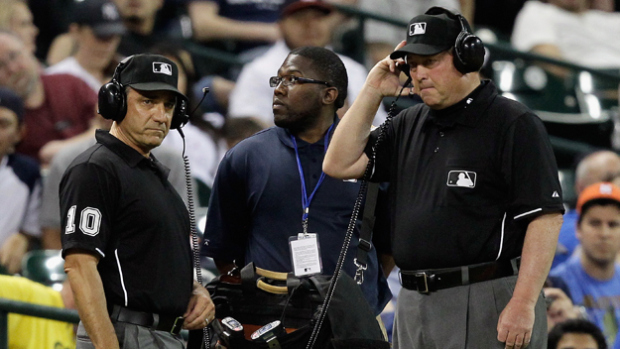
Getting it right with technology gets umpires off the hook of having to be infallible.
It may be the end of “three blind mice” mythology, but so be it. The use of multiple perspective digital replay is streaming accuracy into the game of major league baseball at the same time it loosens the burden of infallibility from the shoulders of the umpires who normally are the final word on every safe/out, fair/foul, yes/no close field play in the game.
The human eye, viewing any incredibly fast close play on the field, cannot possibly “get ’em all right” from one perspective, but, until the new technology made it possible, that has been the burden of the arbiters that are so important to the honest government of our beautiful game from the very start.
Iconic umpire Bill Klem said it best when he described his job calling balls and strikes. “They ain’t nothing until I call them,” Klem said, and he said it exactly right. He said that a pitched ball was neither a ball or a strike until he, the umpire, said it was one or the other. Klem did not say that a pitch was neither a ball or a strike until he saw exactly where it passed, in or out of contact with the strike zone. It’s probably just a matter of time before improving technology and increasing baseball cultural acceptance makes it possible for a batter, more uniformly objective calling of balls and strikes is finally possible. Until then, we will simply have to keep on settling for the reality that human eye calls by umpires on plays involving balls that routinely travel in speeds exceeding 100 mph always are going to be governed by those with mostly good intentions, variable perceptions, and, sometimes enormous egos.
Can we do better than that for the sake of accuracy? You bet. We simply have to embrace the courage to change the things we can change. With the help of the new technology, how we officiate our game of baseball, and all of its instances of inches and nanosecond difference on so many plays, we can vastly improve our ability to “get it right” on plays that sometimes carry with them the power to alter the course of baseball history.
My favorite example of this historical problem goes back to the 1948 American League pennant race in which the Indians, Red Sox, and the Yankees were all chasing each other to the wire for the pennant. The Indians and Red Sox ended up in a dead heat for first place and were then assigned to play a one-game playoff for the AL pennant in Boston for the pennant.. The Indians won the playoff and then went forth to take the Boston Braves in the 1948 World Series for their last MLB experience finishing the season as the last MLB of that year to walk off the field on the last day as a winner.
Red Sox Nation was crushed, of course. Many of them could not help thinking back to an earlier game in the summer at Fenway in which a dubious umpire call effectively handed the game to Cleveland. Had the Red Sox been able to win that June 8th game with Cleveland, there would have been no playoff. The Red Sox would have won the 1948 pennant – and who knows where that altered history might have taken the lore process of the game over the years to come?
On June 8, 1948, Cleveland @ Boston pitted two rookie sensations, Gene Bearden of the Indians and Mel Parnell of the Red Sox squaring off against each other. Scoreless through three innings, playing manager-shortstop Lou Boudreau came to bat in the top of the fourth with Allie Clark on base. On page 17 of “The Season of ’49”, David Halberstam does a great job of describing next what then unfolded:
“With one man on, Lou Boudreau hit a sharp line drive toward the right-field line. In the eyes of almost everyone there the ball hooked foul and into the stands long before it reached the foul pole. A fan who was sitting in foul territory caught the ball and held it up. But in Fenway the stands along the baseline jut out, and Charlie Berry, the umpire covering the play, ran out and somehow called it fair, a two-run home run.”
Boston pitcher Parnell lead his case that the ball was foul with umpire Berry. – “I made my call and it’s a home rune and that’s that,” Berry yelled back in response. Parnell then took his plea to home plate umpire Ed Hurley. “It’s not my call,” said Berry, as he walked away. “Get out of here and pitch,” Berry yelled at Parnell and the game finally resumed amid a torrent of boos, but no further argument.
There was no further score in the game. Cleveland won, 2-0. Maybe they would have won anyway, but that logical possibility quickly fell victim to the far more rambling thoughts of Red Sox fans as to “what might have been”.
Was the Boudreau ball really an obvious foul – or was that perception simply the biased Boston point of view? Who knows? We just know that today’s technology could have saved everyone, including the umpires, from the kind of notoriety that sort of play produces – and it underscores how one significantly dubious or wrong field decision has the power to alter the history of the game.
The Pecan Park Eagle is strongly behind the use of technology in baseball officiating. We don’t mind the extra time it takes to get calls right. We do mind the extra time a player calls for time to either scratch or clear a wedgy.
______________________________

 Houston, Baseball, & Other Musings.
 The Pecan Park Eagle