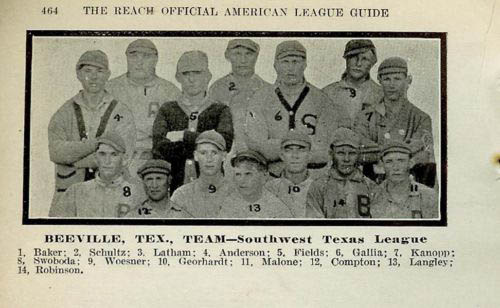
The 1911 Beeville club won the pennant by forfeiture.
In the second year of its brief two-season life, the six-team Class D Southwest Texas League included the Bay City Rice Eaters, the Beeville Orange Growers (managed by future UT baseball great Billy Disch for most of the final part of the season), the Brownsville Brownies, the Corpus Christi Pelicans, the Laredo Bermudas, and the Victoria Rosebuds.
The league was sunk by the weight of its inability to control local gambling and violent fan behavior toward umpires and members of the visiting clubs. As a fitting result, Beeville was finally awarded the league championship when Bay City refused to travel there to play the Orange Growers in the championship series.
In the August 26, 1911 edition of the Victoria Advocate, here’s how one city’s press explained their own Rosebud team’s early withdrawal from the league prior to the end of the season:
********************
ONE AFRAID AND OTHER GLAD OF IT
Bay City does not want to play Beeville for the championship pf the Southwest Texas League, and Beeville seems to be glad of it, for the Orange Growers do not appear to be making any determined effort to meet the Rice Eaters. It is rumored here that both clubs will disband today.
There is some misunderstanding as to the ownership of the silver loving cup that J.K. Greer, a prominent jeweler of this city, gave Brownsville last year (1910) for winning the pennant, as will be noted from the following dispatch from Brownsville:
**********
“President Dickinson of the Southwest Texas League today sent for the silver cup won by the Brownies last year.
“The local management is of the opinion the cup became the property of Brownsville on its winning last year, and the matter is under investigation.”
**********
Victoria withdrew from the Southwest Texas League because it had good reason to believe its finances were being mismanaged.
Because the president of the league was prejudiced against Victoria and plainly showed by his own action and that of the umpires, that he would do all in his power to prevent Victoria from winning the pennant.
Because of the prejudice, which often asserted itself in the worst forms of rowdyism, that existed in most of the other towns against the Rosebuds as a result of their winning ability last year and through fear of them this year.
These, briefly stated, are the reasons why Victoria withdrew from the league, and they are plain and sufficient. …
Now to enlarge upon them:
Each club was required to post $500 with the president of the league as a guarantee that it would remain in the league. Instead of that, most of this money was used by the president to pay the salaries of the defunct Corpus Christi Club, which action did not become known to the rest of the other clubs, except Victoria, until long after it had been taken. The president also used this money in other ways he had no right to, and at the time the Victoria team was disbanded, there was less than $500 of Victoria’s $500 left in the treasury, so the president himself is alleged to have reported.
Most of the umpires were scouts and, in order to help the records of players they wanted to sell, they would give them the benefit of their decisions whenever there was any possible chance to do so. If it were a pitcher they had their eyes on, the batters would be struck out almost in rotation. If it were some other player, he would be allowed to take his base on balls before he would be permitted to strike out; in running the bases he would be safe a block if caught out by a mile and if he himself should touch a baserunner who was safe a mile, he would be out a block. The Advocate is proud to say that no Victoria players were favored in such a manner, but it can name several who were.
After a player on another team had thrown the (game) balls away, and the team had refused to play further, the umpire forfeited a game played with Corpus Christi to Victoria, and upon making his decision the umpire had to be escorted off the field by an officer because of the threatening attitude of the Corpus Christi players. In the face of all this, the president refused to let the forfeit to stand, and made Victoria play the game over. And only one of the offending players received any punishment, and he was let off with a slight fine.
(The Advocate continues its tirade against the unfair league in the article, never citing a single incident that might have been provoked by the angelic Victoria Rosebuds. The “bottom line” here actually seems to fall about two-thirds of the way through this editorial diatribe when the Advocate reviles from the idea that their Victoria team has been accused, in so many words, of cowardice – and that came pretty close to a “quick draw gun fight on Main Street back in 19th century parts of rural southwest and west Texas. Here’s the load-em-up paragraph that could have played out like an old western movie, but did not, as far as we know:)
Because Victoria had the decency to withdraw from such a disgraceful organization, the newspapers in other towns over the circuit refer to it as a “quitter” and to the team as the “Yellow Rosebuds.”
… Victoria Advocate, August 26, 1911, Page 1
********************
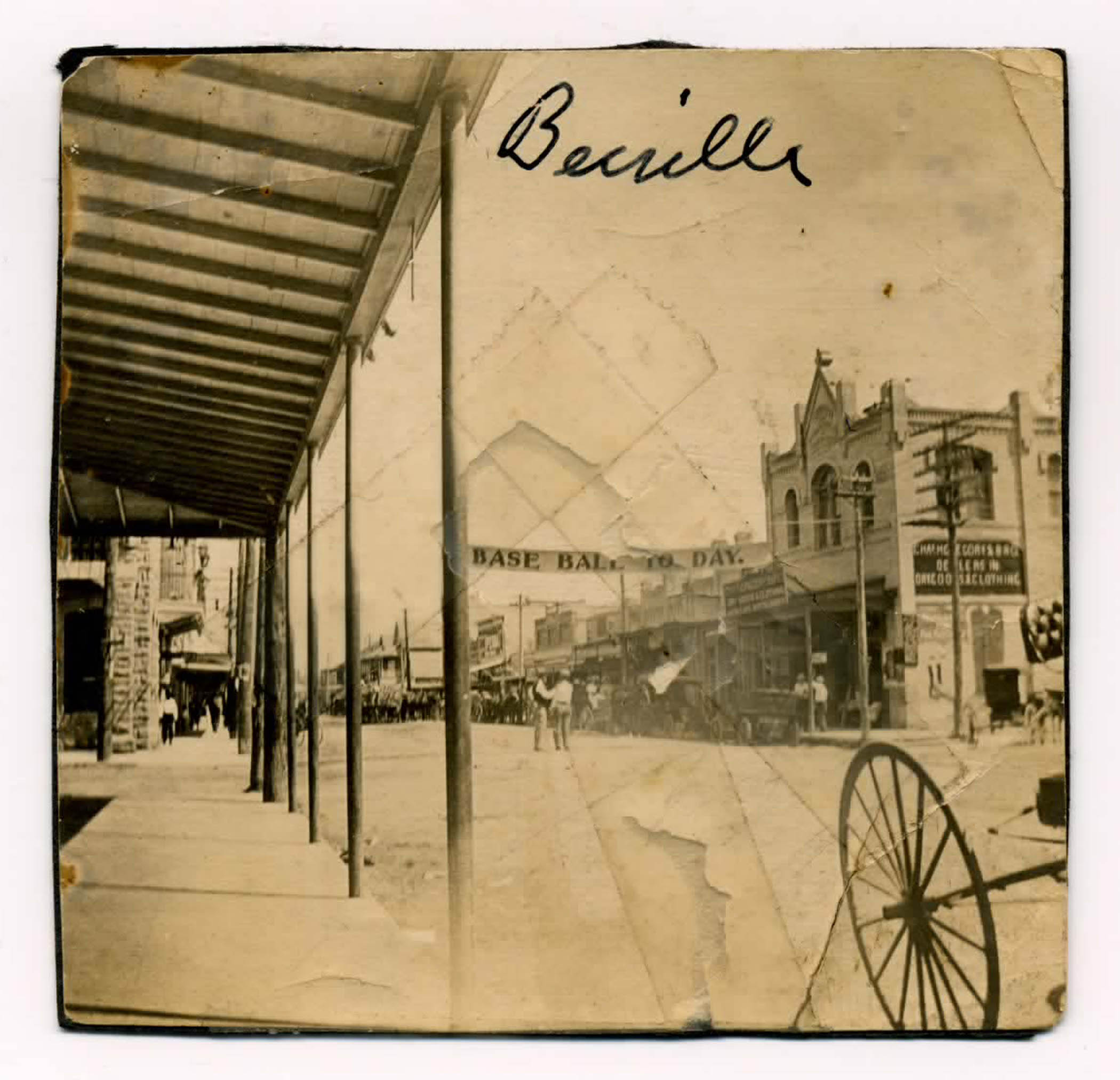
Downtown Beeville on Game Day still looked like a good place for gun fight in 1911, if one was needed. Beeville’s never been short of its share in the distribution of the good, the bad, and the ugly demographics.
Say – who are you calling yellow, you dirty ornery skunk?
 Houston, Baseball, & Other Musings.
 The Pecan Park Eagle