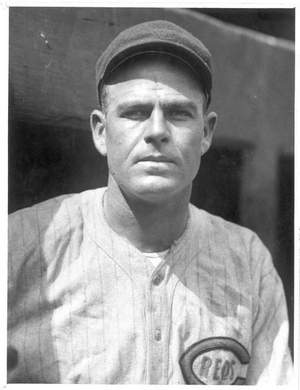
Curt Walker, BL/TR
5’9″, 170 lbs, OF
12 Years, (1919-30)
.304 BA/ .440 SA
I have to begin this piece with an admission of some life-long partiality in my system for Curt Walker of Beeville over Ross Youngs of Shiner. Curt shares Beeville as his birthplace with my late father and me – and he was also very important to my dad as sort of an older brother role model into the world of baseball, including some time they played some town ball in Beeville together, however so briefly, in the early 1930s. Curt was an undertaker in Beeville until his death at age 59 from a heart attack on December 9, 1955.
My dad and Curt Walker were lifelong friends and hunting buddies down in Beeville. He and Dad both enjoyed hanging out in the American Cafe in downtown Beeville, exchanging stories with other locals on baseball, farming ranching, oil, obituaries, and the real straw that served the big drink that was, and still is, South Texas – the subject of rain. Unlike the recent movie title suggests, Beeville was a real country for old men back in the day – and one in which memory snags stopped storytellers dead in their tracks when disagreements would arise over when something may actually have happened in the past.
“Curt Walker loved to derail those discussions when he saw the timeline debate building,” Dad used to say. “That’s when Curt would ask a made up question of the group like, ‘Wasn’t that the year the owls were so bad?’ – That would really derail things as many scrambled to remember when and where they had a problem with owls in Beeville. – It was just a real different time.”
Enough said. That’s the background I bring to the table on today’s subject: Other than play all of his ball for John McGraw’s Giants in New York and die young, what on earth did Ross Youngs of Shiner do that made him more deserving of the Hall of Fame than Curt Walker of Beeville?

Ross Youngs, BL/TR
5’8″, 162 lbs., OF
10 Years, (1917-26)
.322 BA/.441 SA
ROSS YOUNGS was born Royce Middlebrook Youngs in Shiner Texas on April 10, 1897. He played his entire 10 season career (1917-1926) career for John McGraw and the New York Giants, batting .322 with a slugging average of .441, while also compiling a total of 236 doubles, 93 triples, and 42 home runs. Youngs led the National League in 1918 with 49 strikeouts, in 1919 with 31 doubles, and in 1923 with 121 runs scored.
Ross Youngs was highly regarded as a fine defensive center fielder. As a hitter, he also struck out only 390 times in 5,336 total plate appearances for an average rate of only 1 strikeout in every 13.68 trips to the plate.
Curt Walker, on the other hand, struck out only 254 times in 5,575 total plate appearances for an average of only 1 strikeout in 21.95 trips to the plate.
Illness forced Ross Youngs to miss the 1927 season. The malady turned out to be Bright’s Disease, which took his life at age 30 on October 22, 1927. Youngs was selected for induction into the Hall of Fame by the Veteran’s Committee in 1972.
CURT WALKER was born William Curtis Walker in Beeville, Texas on July 3, 1896.He began his big league career in 1919 with a cup of coffee at Yankee Stadium after breaking into professional ball earlier that same season with the Houston Buffs. Walker also played for McGraw and the New York Giants from 1920-21 before moving in-season to the Philadelphia Phillies from 1921-24 and again in season to the Cincinnati Reds from 1924-30 and the balance of his big league career. He also was highly regarded as both a right and left fielder for the Reds on wither side of the great Edd Roush for most of his Cincinnati time.
Walker batted .304 with a .440 slugging average, collecting 235 doubles 117 triples, and 64 home runs. In 1926, he slammed two triples in the same inning in a game against Boston, a rare feat for any season of play.
Youngs may have been the superior fielder, but I’ve never talked to a comparative expert who saw them both play at their best. It’s just a hunch, but even if it’s true, it’s not a factor that says there was a Hall of Fame defensive difference between Youngs and Walker. Their physical images, ages, and stats are also almost identical, even down to their BL/TR preferences, Youngs’ .018 superiority in hitting is more than offset by several dead heat and significantly similar totals – and a decidedly better record by Walker in missing strikeouts, plus adding triples.
I’ve felt since 1972 that Youngs got into Cooperstown on the New York/McGraw/early death sympathy train. Youngs was a good ballplayer, but not a great one. Same is true for Curt Walker, who died at a less shocking older age. Based on his stats and those of Walker, side-by-side, both men deserve the Hall of Fame. By standards of greatness as outfielders and hitters, neither man should be in the Hall of Fame.
The trouble is, and I’m not sure when it started, perhaps, it was with the establishment of the veterans committee, candidates with lesser clout to their resumes than Ross Youngs have been getting into the Hall for years. And how many people would be left in the Hall if we started using some higher standard for measuring greatness and removed everyone in the Hall who didn’t measure up?
This question goes way beyond Ross Youngs and Curt Walker, but they are a good subject opener for further discussion.
 Houston, Baseball, & Other Musings.
 The Pecan Park Eagle