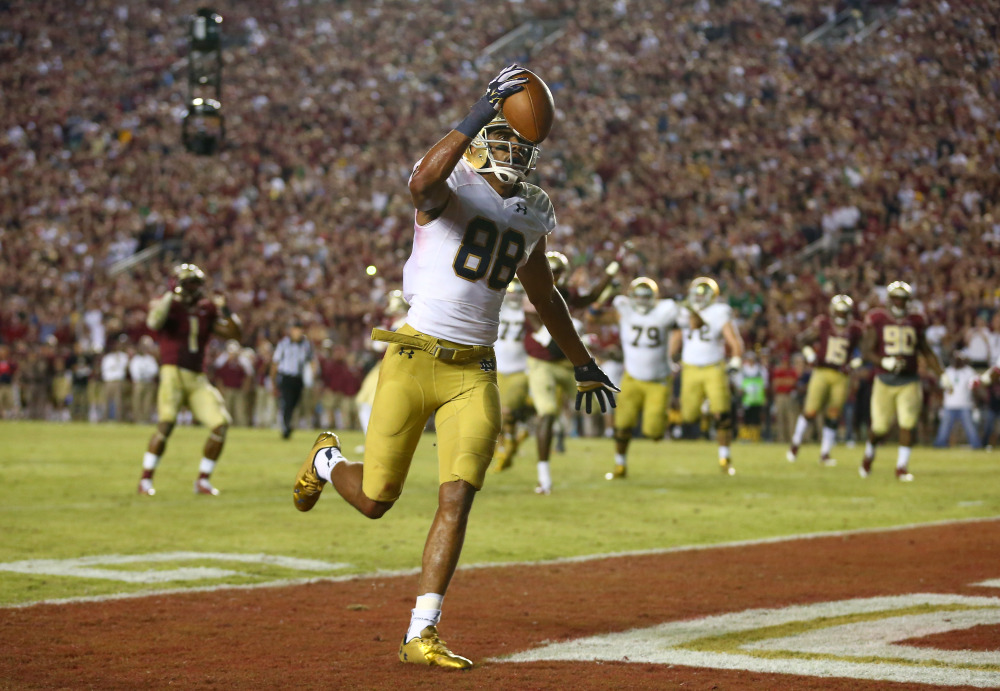
Corey Robinson scores what could have been the winning TD for Notre Dame against Florida State, but it was called back by a confusing offensive pass interference penalty flag with seconds to go. As a result, #2 FSU defeated #5 ND, 31-27.
After watching Notre Dame lose to Florida State Saturday on what should have been another of their “last play miracle wins” because of a murky call of offensive pass interference on what could have been the winning TD pass play at the very end of the game, I’m just all the more glad that the World Series in baseball starts tomorrow night. No regrets here. Baseball-seams red has always been the dominant color of my blood, as I’ve written in these columns ad nauseum for years. I admit to the rabid enjoyment of my UH Cougars in all sports, but that stems from another loyalty-red allegiance as an alumnus that is both immutable and forever – and not in competition with the sandlot-days foundation of my love for America’s Pastime – baseball.
What came through clear in the ND@FSU contest is how often football games are determined in the end on the basis of some flagged rules infraction that might not even have been called by another crew. In this case, ND Coach Brian Kelly apparently was as confused as many of us were for why the call was made. Here’s a link to Coach Kelly’s observations and some good replay action shots of the TD that didn’t stand up as the winning play and the alleged violations that took it away:
http://www.businessinsider.com/notre-dame-penalty-10
That’s way too much subjectivity for me. Baseball, on the other hand, has always been much clearer about its rules for a much simpler and easier to watch game. Pitches or either balls or strike – and that’s the most subjective part of the game there is. Like old icon umpire used to say, “a pitch ain’t nothing until I call it,” but even that area has improved with the inadvertent oversight help from television and the looming threat to umpires that they may someday soon be replaced by laser technology that gets the calls right every time.
Balls in play are either fair or foul. Runners to first or any other bag on a forced play situation are either safe or out – as are any base runners attempting to advance in non-force out situations. Balls hit down the lines are either fair or foul depending on which sides of the chalk line or foul poles they land or pass by – and any ball that hits the line or foul pole is fair. With TV instant replays from multiple angles now in use a check on getting each close call made right, even that formerly troublesome area is clearing up like clouds of a passing storm.
In baseball, it’s simple and getting simpler with technological progress and its use in reviews of questionable calls. In football, it’s complicated because of the expanding rules on how players can make legal contact with each other in this constant collision of very large human beings. In baseball, it’s easy to see when a player makes a mistake called an “error”. In football, we usually only see a yellow flag on the field that tells us that someone in the game has made an error, but we usually have to wait for the referee to tell us what the error was – and who did it. Even then, we often do not remember seeing anything but a collision of bodies on the field.
In general, it’s not hard to get my point here. Baseball simply beats football for simplicity and clarity all over the place. For example, in baseball, (1) you never see a penalty for too many men on the field; (2) ss Yogi Berra once said too,baseball teams don’t win with trick plays; and (3) home runs are not called back because one of the batting team members was simultaneously flagged for illegal use of the hands in the dugout when the ball went yard.
I could go on, but will spare you further groans and eye strain.
Have a nice Monday, everybody!
 Houston, Baseball, & Other Musings.
 The Pecan Park Eagle