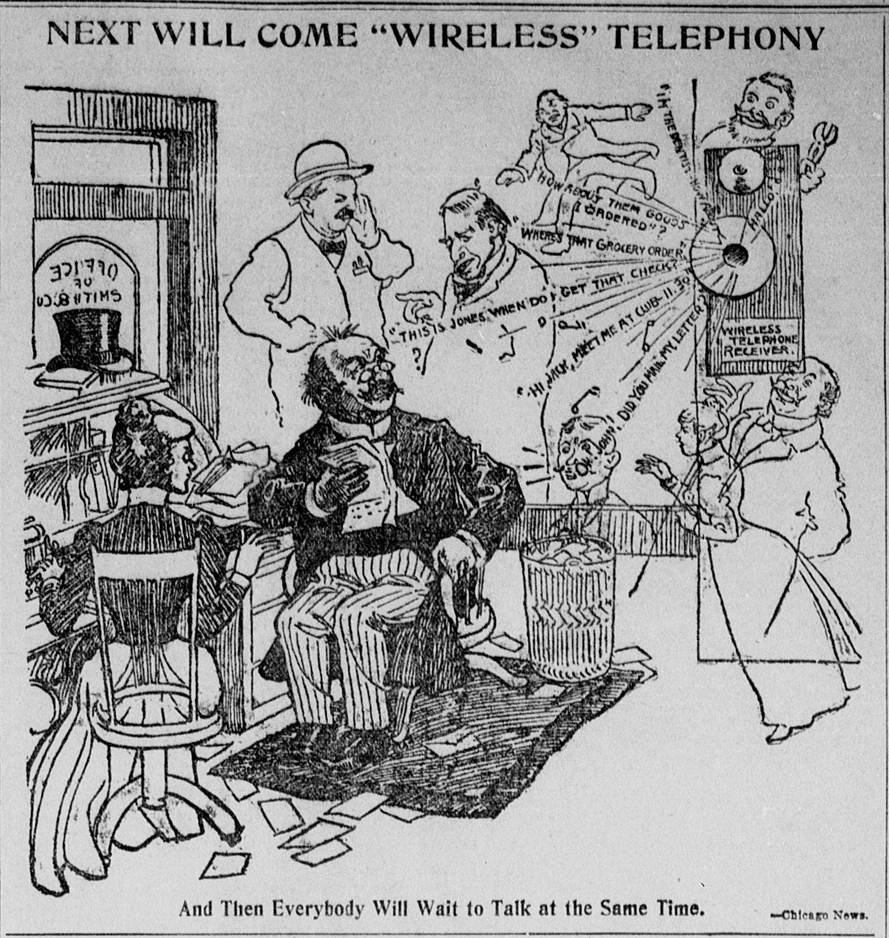
Wireless Telephony? – What will they think of next?
Predicting the future has always been as easy as placing your bets on trends that are already in place and moving and then not having these items knocked away by true future events that we can’t even see coming at the time we open our mouthes. When this thing called radio came along at the turn of the 20th century, it came on the heels of the telegraph and telephone, the first two media of electronic communication that changed the world. Therefore, it was the easiest projected footfall of logic that radio’s next contribution would be to the idea of interpersonal communication between points A and B without the cumbersome attachment of messaging to wires.
With the production of the radio, people could see, even in the early 1900s, the coming of the day in which we would be in touch with each other through wireless electronics. We simply did not have the whole expanding picture that television, the microchip, space satellites, and a little item to be called the World Wide Web in view back then.
What’s interesting to me is that the invention of radio did not come along with an understanding of the media’s value as a broadcast item from the very start. That outreach to massive one-way communication of news was still the purview of newspapers back in those earlier times. It would not be until the 1920s that radio began to come into its own as a broadcast medium for reaching the masses – leaving wireless two-way communication between individuals on a mass level to Dick Tracy and his “two-way wrist radio” in the funny pages.
We’ve certainly unshackled ourselves from landline telephony in the past five years, have we not?
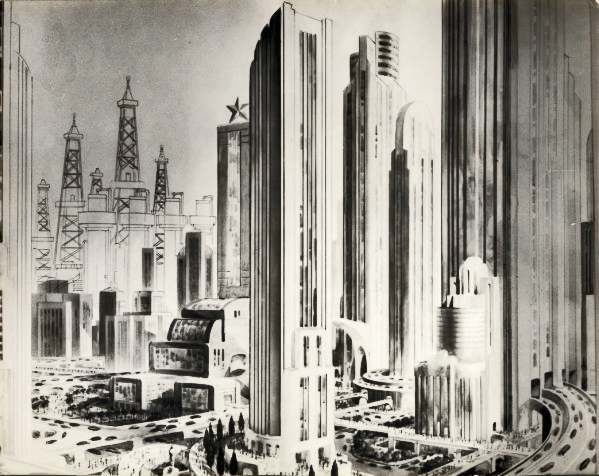
The Houston Post came close to seeing the city’s 1980s future when they published this view of their vision back in the 1920s. They just missed on the allowability of downtown oil drilling, unless those are really buildings designed to resemble derricks.
Earlier Houston projections of the city’s future face have been better than some of those that most of us have seen of New York City. Theirs always include that legion of flying mass transit balloons going in and out of the projected Manhattan skyline – a little item that was never to be for a number of intertwined technological and cultural reasons. Although New York’s predictors got the perpendicular “up” part of their expected growth right too.
If there was any easy trend in place to predict “more to come” about in the 1920s America it was “up, up, and away” for downtown growth in major city areas.
I started my wandering and sometimes wayward professional life of studies in 1956 as a radio and television major at the University of Houston, a school that early on established itself as a leader in the collegiate field by establishing the first public educational TV channel in the USA at KUHF-TV.
Our problem back then was that no one really saw the potential for television. Staff and students alike were all pretty much treating TV in 1956 as though it were “radio with pictures” – and, boy, were we all so very, very wrong!
Oh well, by the year 2050, we should have pretty much cured, or masked over, the presence of ambulatory schizophrenia in the general population by implanting the microchip for two-way wireless telepathy in everyone’s brain. If you then see someone sitting alone on a park bench, and you also witness his or lips move, you won’t know if he’s talking to himself – or else, simply calling home to ask “what’s for dinner?”
Happy futuring, dear friends!
 Houston, Baseball, & Other Musings.
 The Pecan Park Eagle