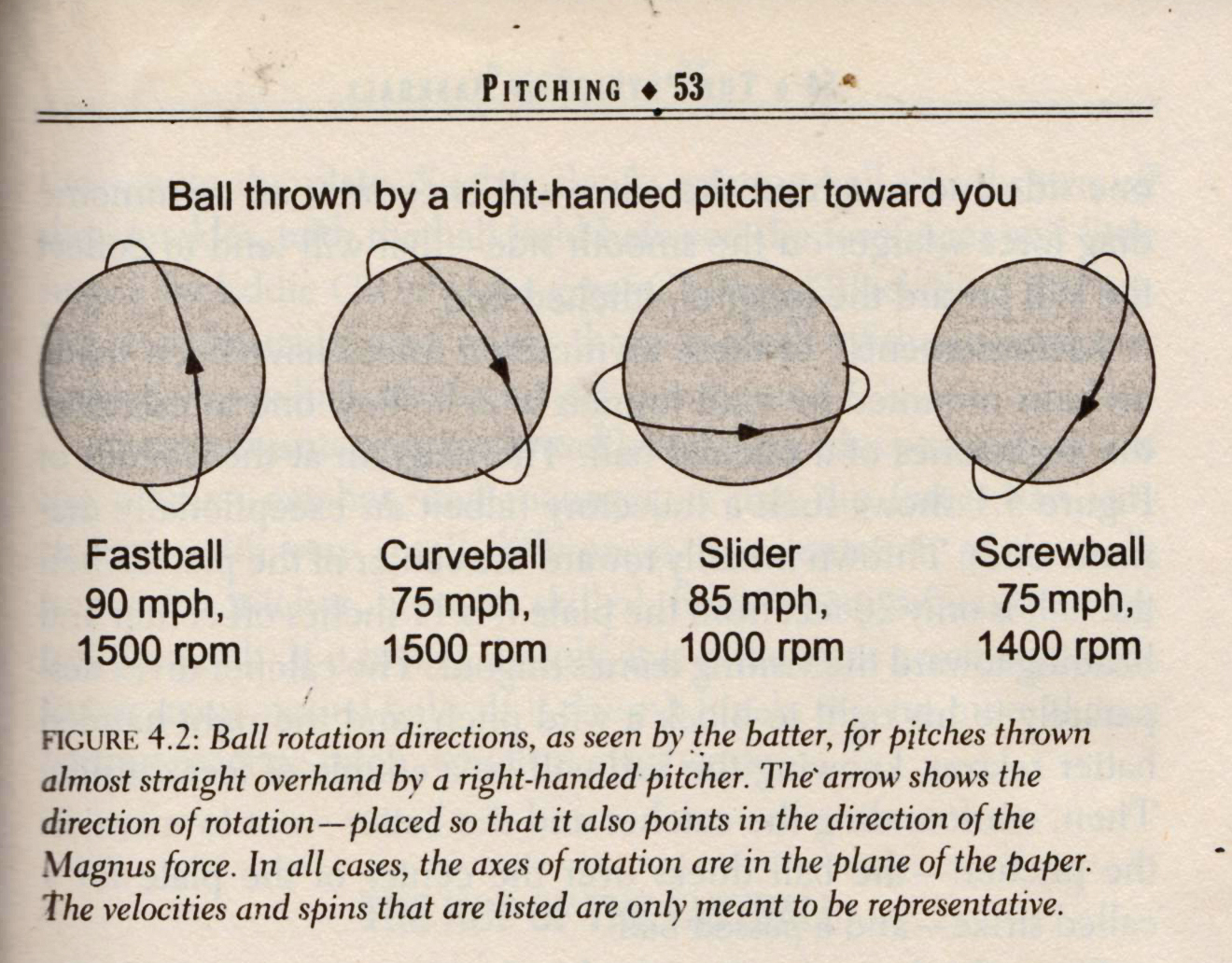
The featured illustration above is a presentational excerpt here from “The Physics of Baseball” by Robert K. Adair, Ph.D.
Stan Musial was no physicist by degree, but he often spoke about hitting in ways that went way beyond the suggestion that he possessed an uncanny ability to see pitches early in the delivery and to know from memory what their direction of spin meant for him by the time they each reached the plate. Musial denied that he could actually see the spin of the ball.
In a 2009 Joint interview for Sporting News Magazine with Musial and Tony Gwynn, both denied that they could see the spin of the ball coming in, but neither may be able to report accurately what great vision and the unconscious mind is picking up in that minuscule lapse of time that it takes for the ball to reach the plate over the course of pitches in the thousands they have each seen as incredible batters. It almost goes without saying that a hitter that understands where the ball is going by its spin, who also senses or sees the ball’s directional spin on an unconscious level, may be processing that information neurologically and be directing him to make almost reflexive adjustments to posture and swing based on where the brain now thinks the ball is going.
The fact that neither Musial nor Gwynn report any conscious ability to see the spin of a pitched ball doesn’t mean they aren’t processing that information subliminally on an unconscious sensory/sight level. And that’s my theory. The TSN article does not address the point.
http://www.sportingnews.com/mlb-news/108638-talking-hitting-stan-musial-and-tony-gwynn
In “The Physics of Baseball”, physics scholar Robert K. Adair goes into detail about the laws governing motion and the action that these various releases of a pitched baseball have to the batters that face them by the time each reaches the plate.
For the featured pitches, as the illustration shows, energy and force builds in the direction of the ball’s spin in a way that causes the ball to break in the direction of the spin by the time it reaches the plate (in this case) from a pitch thrown by a right-handed pitcher to a right-handed batter.
And that’s leaving out all of the other variables of physics that really good pitchers and batters have to learn by trial and error over time of seeing the ball thrown in all these ways in ball parks where little things like local altitude, humidity, game time temperature and wind matter in the successful execution of both hitting and pitching.
Great players don’t have to be physicists to excel at a game which is totally controlled by the laws of physics at its base level, but, like Stan Musial, they have to be really superior on the sensory level to hold the edge over all others. Let’s use Stan Musial as an example here. We could have used Ted Williams or any other Hall of Fame player of noted superior eye sight.
Good pitchers, of course, are not dummies. They know that the batter’s ability to see their grip on the ball or any changes in delivery based upon the pitch that is coming, are advantages they must not give away to the batter, if at all possible. The really smart pitchers also build a pretty good book on the few with “Hall of Fame” conscious or subliminal vision for the early spin – as opposed to all the “cat and mouse” batters who have to rely a lot more on “next pitch guessing” and “Lady Luck” in making bat contact with the ball, where and when it arrives.
Like most, if not all brilliant science writers, Dr. Adair keeps on talking and writing, even when he early to often loses his audience. He still makes some points along the way that enrich our understanding the real base of our game. When a player gets injured running out a triple that turns out to be a foul ball call and a negation of the hit by the umpire, the player remains injured. He’s playing first in line with the laws of physics – and only second in allegiance to the laws of baseball. There are no “do-overs” for broken legs.
We read or listen to brilliant people in the hope of gleaming what we can absorb. Dr. Robert Adair is that kind of source. And he has given us a pretty varied view of the game at its scientific core. He certainly gets my admiration for his easy-to-understand rotation of the ball factor that I have humbly tried to present here in my own language – and we didn’t even get to what he said about knuckle balls.
Addendum: My thanks to Tom Hunter for the inclusion of the material from Sports Illustrated.
One Final Note: Jon Leonoudakis is a wonderful collector of published and verbally expressed baseball quotations. After reading this column today, Jon sent me one he described as an “Apocryphal Musial story”
I knew I’d heard this story before, but could I not reference it to anything prior to hearing from Jon by e-mail. – Thanks, Jon! – You made my day!
According to Jon, the Musial story goes like this:
____________________

“Merry Christmas!”
 Houston, Baseball, & Other Musings.
 The Pecan Park Eagle