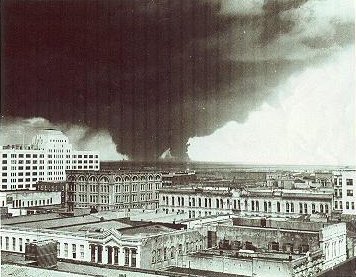
Texas City, April 16, 1947: It wasn’t a day for spear-grass harvesting
As a result of the monster fertilizer plant explosion in West, Texas near Waco yesterday, an article on the Web now reminds us of the fact that this week is also the 66th anniversary of the “Texas City Disaster”, the worst industrial explosion in American history.
On Wednesday, April 16, 1947, a ship loaded with ammonium nitrate docked at the Port of Texas City burst into flames from a worker smoking near the dangerous cargo, unleashing a massive explosion of the ammonium nitrate that killed approximately 576 people, as its force also leveled 1,000 buildings in the little city on the bay north of Galveston.
As a third-grade student at St. Christopher’s Catholic School in southeast Houston, I remember it well. We were maybe 35-40 miles north of where it all unfolded on a day like so many days of tragedy. It was one that started as ordinary and predictable, filled with memories that would have otherwise been lost by now, had it not been for what happened on the larger stage of life that early spring day.
I don’t recall the moment of explosion. Perhaps, it may have happened even prior to the time that school began. I just don’t know. I only recall that by afternoon, we were all aware as we could be as children that something big and bad had happened at Texas City.
In 1947, St. Christopher’s was located on Moline in Park Place, at the point where Broadway and Winkler Drive once came together before there was anything known as the Gulf Freeway or I-45 South. The opening of that great answer to Houston’s transportation needs would open in 1948, eating up most of the byway known as Winkler and forcing St. Christopher’s by eminent domain to start moving its campus a couple of blocks further east up Park Place Boulevard by 1951.
On that Wednesday in 1947, it started with the sound of sirens of vehicles heading south on Winkler. The nuns either had a radio or received a phone call because, at some point, we were told that there had been a “terrible explosion” in Texas City. We were asked to join together in prayer for the people who had been in harm’s way.
It still had not registered as “disaster” by the time we went to recess. Some of my buddies and I had planned to hunt spear-grass at recess, and spear-grass hunting in the spring was important to our mission of having fun. For those who don’t know, “spear-grass” was our term for a kind of wild grass that I’m sure still grows in certain wild spots of land in the Houston east end.
We never developed deep enough into science to learn botanically its precise name, but “spear-grass” bore these attractive qualities: It had a long sturdy stem and a pointed head. If you peeled all the leaves from the stem, it actually functioned (when thrown through the air) like a miniature spear, easily sticking to the pants, dress, shirt, or blouse of an unsuspecting classmate. It even worked in class, if you had the guts to risk getting caught and the stealth to pull it off just as your Dominican nun teacher was turning to write something on the blackboard.
Timing was everything. It took about two seconds for a nun dressed in all those black and white robes and headdresses to make a complete turn to or from the blackboard, plus, you had to figure in how much time it was going to take for her to do her business with the chalk. Then you had to select a target that wouldn’t tell on you, if you got caught. That meant: Don’t throw spear-grass at any of the girls. They always told sister when they knew you did it. And don’t let any of the girls catch you throwing spear-grass at any of the other boys in class either. They would turn you in for that one too.
April 16, 1947 was not a day for spear-grasss harvesting or hunting. By the time we got outside to recess, we could see the large black cloud rising in the sky to our south down the Old Galveston Road. How could something that far away now seem so much closer than it did only a few moments ago. We didn’t know what to make of it, or say about it, but it suddenly was scary real. Several of us just stood in the far playgrounds of our school that day, shielding our eyes from the sun with our hands, watching the black smoke rising on the horizon, and listening to all the sirens of fire trucks, ambulances, and police cars that kept rushing south past St. Christopher’s the rest of the day.
As for the spear-grass sport, I don’t remember much about it after that day. I like to think that maybe I was ready by then to learn that being a minor nuisance to others is not the best way to go in a world that includes really horrendous torments like the Texas City Disaster.
But probably not. I never caught any of life’s major lessons in the air or on first bounce.
Today I just try to bring whatever honest and good I can find, with a sense of humor whenever possible, to wherever I go. If the Pecan Park Eagle ever starts to feel like “spear-grass” to you, just let me know and I will stop flinging it your way.
The prayers and best thoughts of the Pecan Park Eagle go out to the people of both West, Texas and Boston. It’s been a tragic week, but one we shall survive in stronger resolve to overcome all the evil and dangerous forces out there.
 Houston, Baseball, & Other Musings.
 The Pecan Park Eagle