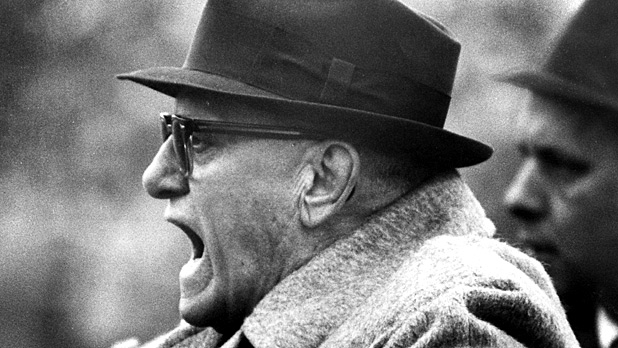
NFL Founder & Chicago Bears Owner/Coach George Halas made no case for himself as a member of the future Baseball Hall of Fame as a member of the 1919 New York Yankees.
Over the long weekend of the Miggins services, I was introduced to a number of people as some kind of expert on baseball history, which I’m not. I just happen to be a guy who loves the history of the game and I have spent my life constantly reading about all aspects of the sport. I probably know more than most by the sheer concentration of effort, but I am certainly no savant memorizer of facts – nor am I any kind of base encyclopedic conduit to a photographic memory of all I’ve read.
It just doesn’t work that way. All I know for sure is – I’m not interested in having to be right about every baseball question that comes along, but I am totally committed to getting everything recorded as right as we can get it – and that includes a couple of mistakes that transpired in conversation between me and a few of the funeral guests on two questions about baseball history. I got the first question answered wrong, but was given credit for a right answer. The second question stumped me, but the after-thought discussion we had following my rebuke of what was passed as the correct answer to the second question suggests that I was much closer to being right in that instance than I was about the first query.
After some chance to research each in Baseball Almanac, here’s the truth about each:
Question # 1: Who holds the minor league record for setting the longest consecutive games hitting streak?
I was given credit for answering “Joe DiMaggio” – the same guy who holds the famous 56-game major league record – and I was told I was right. As it turns out, we were both wrong.
Joe DiMaggio holds the record for the second longest minor league hitting streak with his 61 games as a San Francisco Seal in the Pacific Coast League back in 1933. The longest minor league consecutive game hitting streak record went to 69 games – and it was set by a fellow named Joe Wilhoit of the Wichita Jobbers in the Western League back in 1919. Wilhoit had a brief MLB career of 782 games, but he hit only .257 as a big leaguer.
Question # 2: When Babe Ruth joined the New York Yankees in 1920, he replaced what other famous Hall of Famer as right fielder?
This is a trick question that fails on several levels. When I first heard it Saturday, my answer was “I don’t know,” thrown in as a doubtful towel to my follow-up comment that I always thought that he replaced a fellow named Ping Bodie, no Hall of Fame candidate, for sure.
My questioner said that the answer was George Halas, who played briefly in the big leagues before turning his full attention to bringing the Chicago Bears and the NFL to life as an owner/coach – and going on to enshrinement in the Professional Football Hall of Fame.
Even I knew on Saturday that Halas had not played long enough to have held down any of the 1919 Yankee outfield spots on a regular basis, but all I could do from there was resolve to research it further when I got home.
Which I did.
George Halas played only 12 games with the 1919 Yankees between May 6th and July 5th. He wasn’t even on the roster by season’s end and he played only 6 games in the outfield, batting 2 singles in 22 at bats for a “career” BA of .091. It was a good thing for George that he had some other talent for football.
Babe Ruth replaced no one really in 1920. Technically I was right from memory. The Babe replaced Ping Bodie in center field on Opening Day of the 1920 season, but his 86 games in right field on the season were still second to the 100 games that Sammy Vick put in out there. Ruth also played 32 in left field, 25 in center field, 2 at first base, and 1 at pitcher – while blasting the home run record to smithereens with 54 long balls.
Thank the baseball gods for the ongoing presence of people like Norman Macht, Cliff Blau, Bill Gilbert, Tal Smith, Bob Dorrill, Darrell Pittman, Bob Hulsey, Greg Lucas, Bill Brown, Tim Gregg, Mike Acosta, Tom Kennedy, and our own Early Houston Project’s Mike Vance. As long as we have people of this quality in our midst, the pursuit of abject truth and authenticity in baseball history shall remain relentless. *
* If your name’s not on this short list, please don’t get your feelings hurt. You know who you are – and so do I, if we have met. I simply could not list all of you in one short paragraph. – Keep up the good work.
 Houston, Baseball, & Other Musings.
 The Pecan Park Eagle