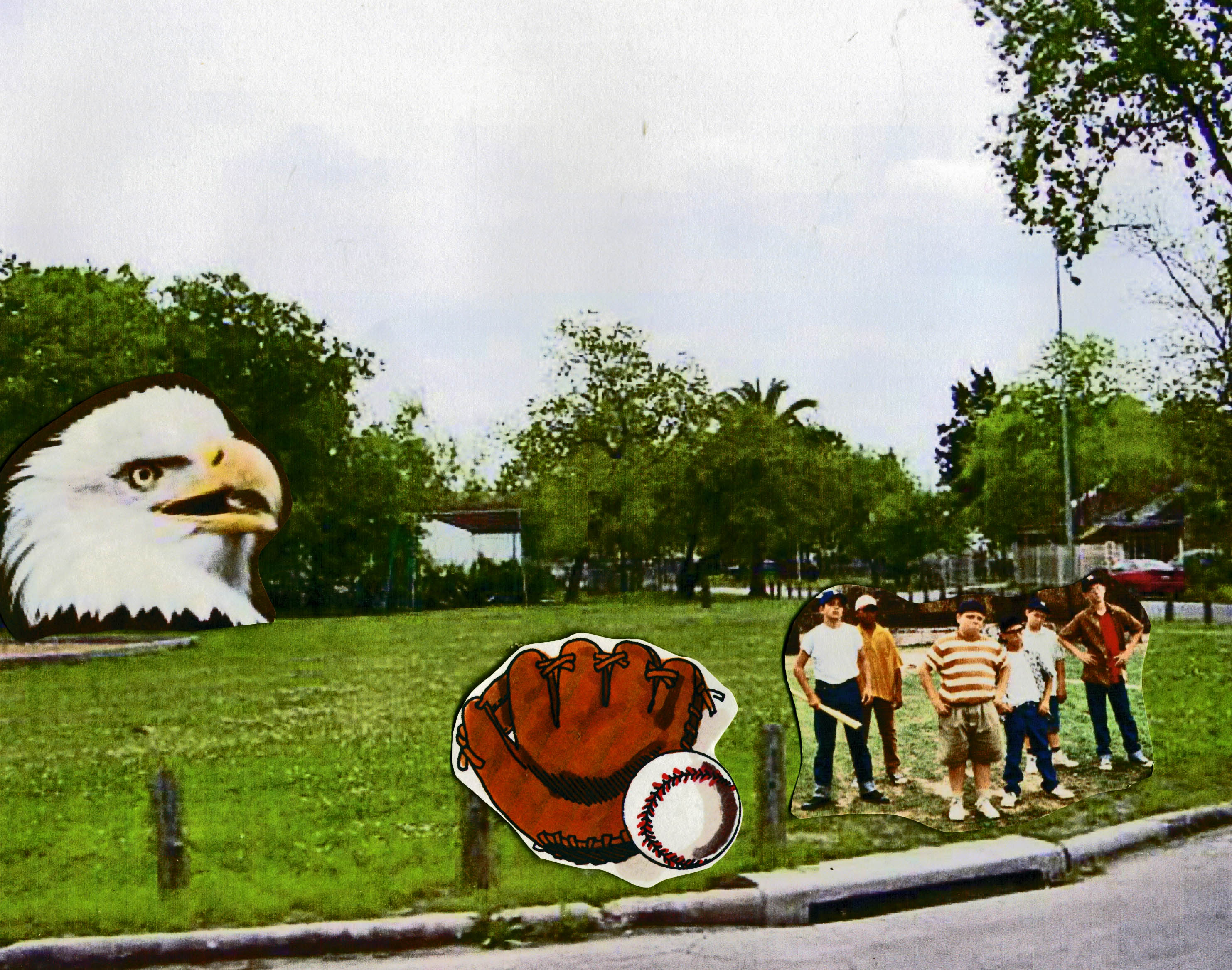
Eagle Field served as the home of the sandlot club we called the Pecan Park Eagles in 1950, before organized ball opened up big enough to handle all of us Houston kids who wanted to play on "real teams." The Eagles were real enough for me. My heart still soars with their blessed memory. - Eagle Field existed on a Houston city lot still operated today as a playground in the east end at the fork-corner of Japonica and Myrtle in Pecan Park near I-45 and Griggs. In 2012, the place now bears the name of Japonica Park - with no reference to the "Eagle Field" identity that we once gave it some 62 years ago.
My primary years on Eagle Field were 1948 through 1952, with 1950 serving as the year we organized the Pecan Park Eagles in reaction to the fact we felt that none of us from the neighborhood had been given a fair shake at the Canada Dry Field tryout for places on the eight first Little League teams set to compete in Houston that season. We weren’t interested in the problems Little League organizers had pleasing very many of us back in 1950. We just knew that none of us had been given much of s chance to show what we could do at their tryout camp. There were only about 500 of us kids, all boys, from all over the city that showed up that day at the tryout scheduled at Canada Dry Field on the Gulf Freeway. So, in short, my buddies and I formed the Pecan Park Eagles in compensation for our disappointment. – And we even had a girl player. Little Eileen Disch could pitch and hit for contact as well as any of her male Eagle teammates.
The culture of Eagle Field was like sandlots everywhere after World War II – and most probably the same as any other group since kids started playing the game in the 19th century. Here are a few of the ghost rules that governed everything, at least, here are the ones that stand out in my memory:
(1) Hind Catcher. Little kids had to prove themselves before they were allowed to take up space on the field. The exception to the rule kicked in on days when several good players were unavailable. On those days, you put anybody who could breathe on the field, just to have enough players to play the game. You figured: If the kid in right field can’t catch it, he can always still run after the ball so we can keep the game going.
Otherwise, the little ones got to play hind catcher. You could have as many hind catchers as you had applicants. In the absence of a backstop, a lot of balls got past the real catcher, who basically played with a glove and no protective equipment. It was the hind catcher’s job to chase the loose balls down the street. On kind-spirited days, we would allow the hind catchers to take a single time at bat in a special extra inning after the game that really didn’t count.
We all started that way, but it worked out. To get in the game, ll you had to do was show you could hit, throw, and catch the ball. If you had a little foot speed, that helped too.
(2) Swing, Batter. Catcher all talked to the hitters on the other team. It was yesterday’s version of today’s trash talk, as the catcher constantly worked on the hitter’s concentration and confidence in the hope of eroding both. “Swing, Batter” is my name for the whole act. Our catchers used that famous call to shaky batters, saying a progression of thoughts that came out something like this as the pitcher wound up to deliver and finally threw the ball: “OK, BATTER … DON’T SWING … DON’T SWING … DON’T SWING …. (then, as the ball arrived, it changed to) … SWING!!!” – Sometimes it worked.
(3) BURN OUT. BURN OUT was a pecking order game you played with those who came to challenge your place in the pecking order of things. The object of Burn Out was to make your partner sorry he had ever agreed to play catch. Both players threw hard as they could. It also helped if you could throw a fast ball that dropped in about three inches from the ground between the other player’s ankles. Burn Out ended when one of the players either said he’s had enough or else, just walked away from making further throws. And things got settled – without a word being said.
(4) GLOVE KICK. It must come naturally from some instinct that flows through the neuromuscular structure of anyone who’s ever tried to steal a few bases or stretch a double into a triple. When you are sliding into a base against a fielder who is showing you the white of the ball in his glove as awaits putting you out, what do you do? That’s right! – You kick his glove! Pop that ball out of the web to make sure you’re safe. Until fielders get old enough and good enough to stop showing the white of the ball on a slide to the runner, the glove kick is a runner’s best friend.
(5) STEAM ROLL I learned this one the hard way. It’s why you don’t stand in the baseline any longer than necessary when you take a throw at first base. In fact, it’s better that you never stand there, if possible. During my first try as a first baseman, a rather large building of a kid with legs ran over me at first like a steam roller. I literally saw stars. I had to regain consciousness before I could continue playing, but I did. They had to tell me that the put out on “Sluggo” still stood since I held on to the ball in spite of the collision, but you could not have proven it by me.
(6) HIDDEN BALL The world’s oldest baseball trick was standard procedure in its use on little kids of 6 to 8, just breaking in from hind catcher and used to taking orders. It taught the little kids to stop listening to their elders and the lesson unfolded like this: Let’s say you have a little kidding running at first base. If you are the first baseman, you walk to the mound to talk with the pitcher, but you come back to first with the ball hidden in your glove. The little kid doesn’t know that you have the ball, but he’s giving you this smug smile that says, “You can’t get me. I’ve got my left foot on the base and right foot point toward second.”
Then you throw the kid a mental curve, knowing that he’s just coming up from hind catcher duty and used to taking orders. “Hey, Kid,” you say, “somebody’s going to break a leg stepping on that rock up the baseline toward home. Ho dig it out and throw it out-of-the-way.” Still eager to please and fit in, the little kid does as you say. – And when he leaves the base, you tag him out with the ball.
Had that one pulled on me. And then later, I pulled it one little kid, but couldn’t do it twice. It felt too much like a dirty trick, unless, of course, you pulled it on someone who was old enough to know better. Then it was good baseball. – We learned this “situational ethics” thing early on the Eagles.
(7) Phantom Ball. Long before any of ever read anything about the phantom ball tricks of the 19th century, we figured out on Eagle Field that sometimes you may be able to fool a few enemy base runners with a phantom baseball throw. We worked it against team that the go ahead run in the form of a man on third when our catcher called time to speak with the pitcher at the mound. While he was there, the catcher his the real game ball in his glove and started walking toward the plate. When he got back and turned around, the pitcher yelled at the catcher to throw him the ball, The catcher turned his mitt over, exposing the ball to all, including the runner down the line at third.
The catcher then turned the glove over again, hiding the game ball from sight, as yelled something like an apology for his absent-mindedness back to the pitcher, During this distraction, however, the catcher was secretively pulling out another ball with brown paper taped around it. Then he pulled his glove up to mask the fact he was about to throw this other ball, and not the game ball, back to the pitcher. The game ball remained hidden in the pocket of the catcher’s mitt.
By intention, the catcher released a high errant throw of the ringer-ball over the pitcher’s head. The runner at third came home on the basis of that image where he was promptly tagged out by our adroit catcher. Much arguing ensued, but the put out was allowed to stand as the third out of a game we eventually also won by a single run. It was probably an illegal play by 1950, but we thought it was legal – and back in 1950, what we thought was so often made it so. – Come to think of it. Some things haven’t changed much since then.
Long Live the Pecan Park Eagles! – Every now then, I have to dig up their memories and feel that soar into summer on the sandlot again.
Please bear with me.
 Houston, Baseball, & Other Musings.
 The Pecan Park Eagle