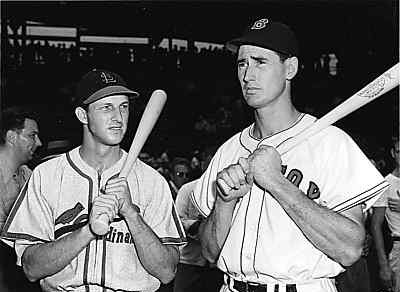
My Two Greatest Hitter of All Time: Stan Musial & Ted Williams.
My Post World War II (1946-1960) MLB All Stars
There will be no one group of nine that fills the bill for all of us on this one. These are just my picks, the stars that lit nights and guided the best and worst summer days of my growing-up years in Houston, with nothing more to help me keep up with them all but the Houston Post, The Sporting News, the Mutual Game of the Day on radio, DIzzy Dean and the TV Baseball Game of the week, and some very early and primitive long distance reporting by the first evening sports announcers at TV channels 2, 11,, and 13.
If you were around at the time, you will have your own choices – and we would like to hear who they are in the comment section of this column. There are no right or wrong answers here – just differences based on factors of personal preference, but, as Bum Phillips was wont to always say: “I’ll be happy to put my guys on the field to play “”yurn” any day of the week.
Here are my starting nine. They are all Hall of Famers, but that was just a common thread that easily fell into a stitch pattern through my entire nifty nine. In the old days, at least, the Hall of Fame didn’t miss often on awarding the signature of greatness to the folks who deserved it, based on their performances on the field. Mine are these:
Pitcher: Bob Feller. He came right out of WWII and won 26 games in 1946. The post war years were not his best, but he could still win big and get you the innings and fan people too. He certainly played well enough to get my long distance attention.
Catcher: Roy Campanella. Roy was the first black MLB catcher and the steady heart of those great post-war Dodger teams in Brooklyn. He could hit with pop and a high catcher average – and he has an arm that runners respected mostly as a stop sign on spurious stealing attempts.
1st Base: Stan Musial. In my book, the only “wrong” answer in this exercise will come when somebody submits a lineup that does not include “The man somewhere – either at first or in the outfield. As a kid, he was easily the best all-around hitter that I ever saw in person, even if those Musial performances were generated in spring training against our Houston Buffs. Musial’s 1948 NL batting title year, won by the .376 batting average that sprang from 230 hits and 39 homers, left the greatest impression on my 10-year old mind.
2nd base: Jackie Robinson. Robinson was my guy from the start of that 1947 year that saw him break the color line and then go on to steal home in the World Series against Yogi Berra. Robinson followed Musial ’48 by taking the 1949 NL batting title with 203 hits that produced a .342 mark. Although he played variously in the field, I’m putting him down as my second sacker, even at the cost of passing on another favorite, a little guy named Nellie Fox.
3rd base: George Kell. The MBS radio Game of the Day must have been partial to the Tigers and Red Sox because it seems like those two teams kept popping up all the time on the air, and maybe even more so when Kell played in first Detroit and then Boston. Kell had no power, but, oh Lardy, could he hit. His .343 mark won the 1949 AL batting title. As a fielder, we was no Brooks Robinson, but he was smooth enough to get the ever done at one of baseball’s toughest positions.
SS: Ernie Banks. Hard as it was for me to pass on Phil Rizzuto, Pee Wee Reese, Marty Marion, Chico Carrasquel, and Luis Aparicio, I had to go with my partiality for shortstops that don’t hit like shortstops – and few represent that model any better than Ernie Banks. Ernie’s 44 HR and .295 BA in 1955 were clearly antithetical to our usual expectations at short. It was only after time moved beyond our current era of reference and into the 1960s that we would discover Ernie’s secret. He could hit for power and average because he was really a first baseman.
LF: Ted Williams. In my book, Teddy Ballgame and Stan Musial are the two greatest pure hitters for average and power that ever lived. I cannot pick one over the other. Rogers Hornsby had better career stats and a similar reputation from the right side of the plate, but the Rajah didn’t have to trade his bat for plane, guns, and bullets in two wars on his slightly more peaceful run on greatness, as was the case with Ted – and Stan also lost time to military service,
CF: Willie Mays. He was simply the arguably greatest five-tool center fielder to ever play the game. His iconic “catch” in the 1954 World Series is sufficient testimony to the fact. Mays lost his only potential challenger to the title of best center fielder ever when he personally dumped a dink fly to right center at Yankee Stadium in Game Two of the 1951 World Series. Another rookie named Mickey Mantle destroyed a knee on the play when he pulled up to avoid collision with center fielder Joe DiMaggio on the catch and managed to trap his heel in a drainage grating in the turf to set up the damage. Had Mantle not lost a lot of speed as result of that injury, and also been forced to play the balance of his career in pain, Mays would’ve had a formidable challenger for the honor.
RF: Mickey Mantle. He was simply a man who was great in spite of unfortunate injuries and a lifetime of serious addictions and bad habits. I’ll take him on my team and how could I not? I thought he was great from the time I first saw him homer against my Houston Buffs in April 1951. On that day, DiMaggio still owned center field for the Yankees and the 19-year old Mantle played right field.
Those are my picks, folks. How about yours?
It’s Saturday morning. Merry Christmas shopping too.

 Houston, Baseball, & Other Musings.
 The Pecan Park Eagle