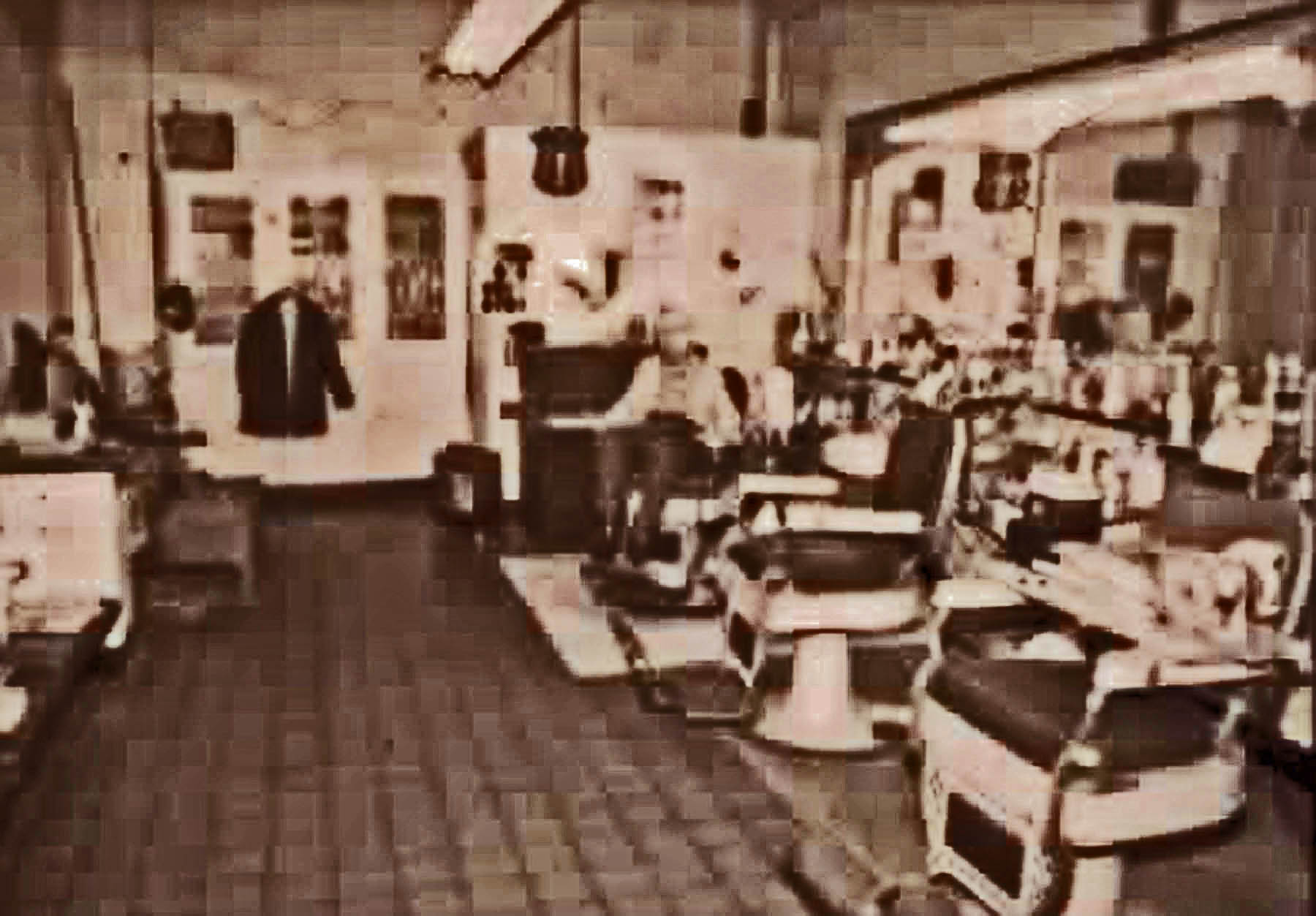
Ralph Whittington’s Barber Shop, Beeville, Texas, Circa 1910-1980 (roughly).
I’m in no position to confirm the specifics of Ralph Whittington’s exact age or period of service as a barber in my birthplace of Beeville, Texas, but I do know he was around early to cut the hair of my late father as a child, and Dad was born in 1910, and also around until either the late 1970s or early 1980s to cut my hair on those trips to Beeville with my folks and really need a haircut. (I grew up in Houston from age 5, but Mom and Dad moved back to Beeville during my junior year in college.)
Walking into Ralph’s Barber Shop was the equivalent of stepping through a worm hole into a place of the past that never changed. Ralph was always the same. And so was his shop. The place wreaked from the fragrance of sweet tonics that the cowboys and ranchers preferred, both as after-shave lotions and hair compression mixtures. Located next door to the downtown Washington Street main drag movie house, The Rialto, Ralph’s chairs were packed on Saturday market day gatherings of men wearing khaki shirts and pants with their sweat-stained tan-colored work Stetsons.
“Have you gotten any rain over at your place lately?” was most often the question of the day. And most often, in the dry, hot-as-Hades-in-summer climate of the upper Texas Gulf Coast above Corpus Christi, the answer to that question was either a resounding silence or an occasional smile of “Yep, about an inch fell, but I could use a whole lot more.”
The way I always heard it from Dad, Ralph Whittington was there in his shop six days a week for about seventy per cent of the 20th century. He closed on the traditional Mondays that barbers always used to take, but God and his family alone only knows what he did with that precious time off. Also the way I heard it, Ralph Whittington never traveled any further than 16 miles from his own birth home in Beeville during the 90 some-odd years he was breathing the air of this earth. That’s enough distance to get you to Pettus in the north, Papalote to the south (I think),Berclair to the east, and a good start on Three Rivers to the west.
I never met anyone beyond the shears and scissor members of his family. Ralph was a small, soft-spoken man, one with the ability to help keep a conversation going without saying much on his own. It’s a social quality that good barbers used to universally share with bartenders. They each knew how to listen. Unlike today’s stylists, the old-time barbers were not filling the air with commercials for new hair care products. Vitalis and Wild Root Cream Oil were usually all you needed to cure and calm whatever ailed your freshly cut hair.
And barbers didn’t spend thirty minutes cutting the heads of bald men for the sake of justifying a fifty to seventy-five dollar fee that today’s style experts charge. Bald guys paid the same four to six bits (50 cents to 75 cents) as everyone else, but they also got the bonus of a quicker finish to their stays with Ralph.
In time, I came to think of Ralph as though he were more like the calendar or clock that each hung on his shop wall than he was anything like all the hot-shot change salesmen in my world from those earlier times in my life. His range of thought was always the same, even though the hours of each day flowed steadily by. His smile never varied either, even though the days of the months and years flew off the calendar as they always once did in the old really classic black and white movies of the 1940s.
Ralph Whittington was just one of those figures who lived out his life as a reliable, friendly symbol of his era. He didn’t live by the clock. He was of the clock itself, and so he shall always be remembered – til the end of time.
Thank you, Ralph, and all you other old-time barbers. Thank you for just being there when America needed a good, quick, affordable haircut.

That was Ralph Whittington’s Barber Shop, in the similar more narrow building that was once just to the right of the Rialto Theater on Washington Street in Beeville.
 Houston, Baseball, & Other Musings.
 The Pecan Park Eagle