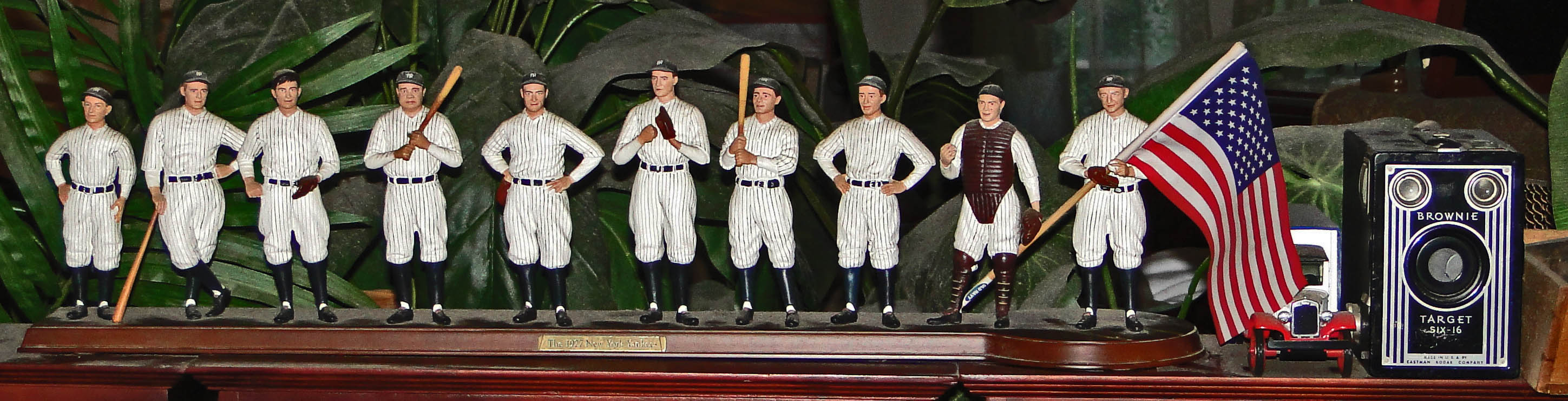
The 1927 New York Yankees
We remember them indelibly, even though none of us were alive or old enough in 1927 to have seen them play and retained, as ancient survivors along a ridiculously long life span, any visage of the power that befell our eyes back in the halcyon days of jazz and baseball. They were collectively revered as the killers of the baseball, the slaughter kings of the game. They were, and still are, Murderers’ Row.
Playing in their 25th year of life, and from their fifth season of residency in the original Yankee Stadium, the ’27 Yankees rolled to their fifth American League pennant with a record of 110 wins, 44 defeats, and a winning percentage of .714 that was good enough for a 19 game final finish over the 2nd place Philadelphia Athletics.
Their 110 Yankee wins in 1927 broke the 105 American League wins record established by the Boston Red Sox in 1912. The ’27 Yankee AL wins mark stood until the 1954 Cleveland Indians broke it with a 111 final wins tab.
The ’27 Yankees went on to crush the Pittsburgh Pirates in the World Series in a four-game sweep. Since then, the Pirates community has been forced to live with the writers’ tale that their Pittsburgh quest for a 1927 World Series title was lost from the time they watched Ruth and Gehrig take batting practice prior to Game One.
The 1927 Yankees and Babe Ruth forever have been a touchstone of sanity for me about all the good things that swept my heart and soul into the game of baseball as a kid. Whenever I’ve had a week of disenchantment with the peripheral egos that control the game today, I heal with some refocus on the players and teams that built my sandlot dream in the first place. For me, those visions always began with the 1947 Houston Buffs and the 1927 New York Yankees. Today I’m taking the Yankee cure.
Left to right among the Murderers’ Row figures you see above you in the sculpture model photo, here is the manager and starting lineup for the 1927 New York Yankees, including their ages that season. All data here is derived from that great fountain of baseball numbers, Baseball Reference.Com:
Miller Huggins, Manager, Age 49. Miller Huggins posted a .265 BA over the course of his 12-season (1904-1916) career as an MLB 2nd baseman. He began his managerial stint with a 5-year run as mentor of the St. Louis Cardinals (1913-1917) before moving to the helm of the New York Yankees and a 12-season (1918-1929) tenure in which his clubs won 6 pennants and 3 World Series titles. – Miller Huggins died early from pyaemia, a blood abscessing disease, complicated by the flu, on September 25, 1929. It was a devastating loss to his club and the entire baseball world.
Hall of Fame: Miller Huggins was inducted into the HOF by the Veterans Committee in 1964.
1927 Salary for Miller Huggins = Not reported at Baseball Reference.Com
1) Earle Combs, CF (BL/TR), Age 28. As a lead off man, Combs led the AL in 1927 with 725 plate appearances and 648 official times at bat. He also lead the AL with 231 total hits and his triples were the most for any player in the league. He also batted .356 and racked up a .414 OBP. With a 12-season (1924-1935) all Yankee career BA of .325.
Hall of Fame: Earle Combs was inducted into the HOF by the Veterans’ Committee in 1970.
1927 Salary of Earle Combs = $ 10,500 (Michael Haupert research of HOF contracts)
2) Mark Koenig, SS (BB/TR), Age 22. A reliable defensive guy with good abilities at moving runners along at the plate, Koenig batted .285 in 1927, just a tad above his 12 season (1925-1936) career BA of .279. Koenig had 150 hits and an OBP of .320.
Hall of Fame: Mark Koenig is not a member of the HOF.
1927 Salary of Mark Koenig = $ 7,000 (Michael Haupert research of HOF contracts)
3) Babe Ruth, RF (BL/TL), Age 32. 1927 was the signature season for the arguably greatest player in the history of baseball. That was the year that the Babe broke his own 1921 record of 59 HR in a single season by blasting the number 60 into the iconic walls of the games greatest remembered digits. Babe Ruth didn’t simply break home run records. He hit more home runs than some whole teams did in a single season. The number 60 hung as the benchmark for greatness in power hitting through my entire childhood, and it only fell with that ascendantly rising 61* that Roger Maris would later blast in the first longer season of 1961. – In 1927, Ruth also led the AL with 158 runs scored, 137 walks, 89 strikeouts, a .486 OBP, a .772 slugging average, 1.258 OPS, and an OPS + of 225. – Also, thanks to his teammate, Lou Gehrig, Ruth had 192 hits and 164 RBI in 1927, but had to bow to the other Yankee super star for team leadership in those categories. – Speaking of iconic numbers, Babe’s 714 career homers stood as the most for a single career until Hank Aaron passed them in 1974. – With a lifetime BA of .342 also, the 22-year career of Babe Ruth (1914-1935) wrapped with his election to the HOF in 1936 among the first class inductees of the new hall of honor that would not formally open until 1939. Amazingly, 11 of the 226 voting writers in 1936 did not vote for Babe Ruth. This fact only reinforces the recognition that ignorance and arrogance are not an invention of the current generation. – Long live Babe Ruth and the blood lust bats of Murderers’ Row!
Hall of Fame: Babe Ruth was elected to the new Hall of Fame’s first induction class in 1936 when 215 of the 226 voting BBWAA members selected him.
1927 Salary of Babe Ruth = $ 52,000 (Michael Haupert research of HOF contracts)
4) Lou Gehrig, 1B (BL/TL), Age 24. The iron horse led the AL in 1927 by playing in 155 games, hitting 52 doubles, 175 RBI, and adding a .467 OBP. His .374 BA placed him high among the leaders and his 47 HR trailed only the other man who was even close, Babe Ruth. Gehrig closed his 17 year career (1923-39) a deathly ill man, but not before he had established the longest streak of consecutive games played at 2,130 and a total career record of 493 HR and a .340 BA. – When news of Lou’s illness got around, a special vote was convened and Lou Gehrig was inducted into the HOF.
Hall of Fame: Lou Gehrig was elected to the Hall of Fame in 1939.
1927 Salary of Lou Gehrig = $ 8,000 (Michael Haupert research of HOF contracts)
5) Bob Meusel, LF (BR/TR), AGE 30. The 6’3″ Bob Meusel is the guy who hit behind Ruth and Gehrig and still managed to pick up 103 RBI on the year. He batted .337 and registered a .393 OBP and a .510 SA. Over the course of his 11 season career (1930-1930), Meusel hit .309 with 1,067 career RBI. Bob’s best season for HR power was 1925 when banging out 33 was exceptional work for all but one man. The mere mortal Meusel still managed to hang ’em up with credit for 156 HR by retirement day.
Hall of Fame: Bob Meusel is not a member of the HOF.
1927 Salary of Bob Meusel = $ 13,000 (Michael Haupert research of HOF contracts)
6) Tony Lazzeri, 2B (BR/TR), Age 23. “Poosh ‘Em Up, Tony” batted .308 with 18 HR in his second season as a young Yankee in 1927 and he hit .292 over the course of his 14 year (1926-1938) career. He also had a banner year in a non championship season for the 1929 Yankees when he batted .354 and again hit 18 HR on the year. Tony had four seasons in which he hit 18 homers, but he never got any higher. His 178 career HR were still a warning to foes that relief did not exist in the bottom half of the ’27 Yankees lineup.
Hall of Fame: Tony Lazzeri was inducted into the HOF by the Veterans’ Committee in 1991.
1927 Salary of Tony Lazzeri = $ 8,000 (Michael Haupert research of HOF contracts)
7) Joe Dugan, 3B (BR/TR), Age 30. “Jumpin’ Joe” Dugan was the 7th man in the order and even he hit .269 with an OPS of .683. For his 14 year career (1917-1931), Dugan hit .280 with a career OPS of .689 and he was an excellent fielder and probably the biggest character in residence among the 1927 titans of baseball. His best season at the plate came earlier when he hit .322 for the 1920 Philadelphia Athletics.
Hall of Fame: Joe Dugan is not a member of the HOF.
1927 Salary of Joe Dugan = $ 12,000 (Michael Haupert research of HOF contracts)
8) Pat Collins, C (BR/TR). Age 30. Pat Collins hit .275 with an OPS of .825 in 1927. His better days with the stick occurred earlier in his career when he caught for the great St. Louis Browns contenders of the early ’20s. Collins hit .307 for the great 1922 Browns that came within one game of beating the Yankees out of a pennant and he followed that with a .315 BA mark for the 1924 Browns. – Collins and Brownie pitcher Urban Shocker were so good for the Browns, in fact, that you might get what happened to them for aggravating the Yankees. The Yankees acquired them from the cash-starved Browns to herald a pattern of dealmaking that we haven’t seen the end of to this day. – As for Pat Collins, he did quite well for himself as a member of the Bronx crew. He retired with a .254 career BA from a 10-season career (1919-24, 1926-29).
Hall of Fame: Pat Collins is not a member of the HOF.
1927 Salary of Pat Collins = $ 7,000 (Michael Haupert research of HOF contracts)
9) Herb Pennock , P (BB/TL), Age 33. Herb Pennock was 19-8 with a 3.00 ERA as only one of several fine pitchers for the 1927 Yankees. For his 22-season career (1912-17, 1919-34), Pennock won 241 games and lost 162, good enough for a lifetime ERA of 3.60.
Hall of Fame: Herb Pennock was inducted into the Hall of Fame by the BBWAA in 1948 with approval on 94 of the 121 votes cast that year.
1927 Salary of Herb Pennock = $ 17,500 (Michael Haupert research of HOF contracts)
That’s it for now, except to add the obvious: You have to be good to play or stay with the Yankees, but if you do play there, and you also do well, as in World Series well, it won’t hurt you later when you are up for the Hall of Fame.
1927 also was the season that helped the reticently inclined Lou Gehrig learn that he had to do a better job in 1928 of negotiating his new contract.
 Houston, Baseball, & Other Musings.
 The Pecan Park Eagle