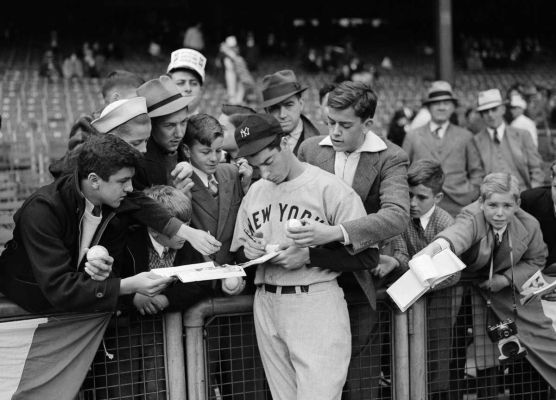
1941: Joe DiMaggio signing autographs during his famous 56-game hitting streak.
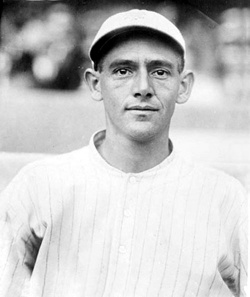
Joe Wilhoit
69 Minors Games
1919
The consecutive games hitting streak records for all of baseball are less famous than they really should be. We already know that Joe DiMaggio, the holder of the famous 56-game MLB mark from 1941, also did even better with San Francisco of the Pacific Coast League in 1933 when he hit safely in an amazing 63 straight games, but that wasn’t even the record. A fellow named Joe Wilhoit hit safely in 69 games for Wichita of the Western League in 1919. And get this – original Houston Colt .45 outfielder Roman Mejias hit safely in 55 straight games for Waco in the 1954 Big State League season.
Then there’s the quite famous Joe DiMaggio major league mark of 56 games – the one that many feel will never be broken by the way the game is played today. – What made Joe D. so special that his most famous record wasn’t even as great as the one he set eight years earlier at the minor league level? All I can offer is my humble opinion on what makes for a good streak hitter. I’m not sure that anyone can explain why the MLB record is now seen as unbreakable beyond the fact that the game has changed and that a streaking hitter today would probably be stopped by design before he got there.
Joe DiMaggio had an incredible batting eye – and that statement is right in there with the note that the sun rises in the east and sets in the west. Everyone on this list of MLB 30 consecutive game hitting streaks has or had a great batting eye. Although their batting styles vary greatly in many instances, none are pure mashers who either strike out, or else, blast the ball into space. A few had great power, but most did not. They all had incredible batting eyes, at least, for the seasons of their streaks.
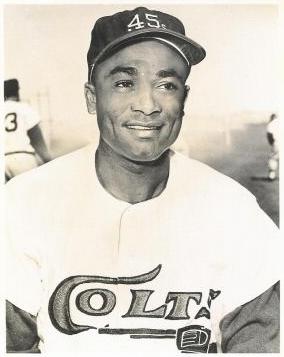
Roman Mejias
55 Minors Games
1954
What they each shared was the ability to see pitches earlier and for longer periods of time. It was enough of an edge to have a better idea about what was coming and where it was landing – and whether or not it was hittable. My guess too is that they mostly shared an ability to adjust their bat movement and to – hit the pitch where it came in – and to “hit it to where they ain’t” on the defensive side.
It isn’t too hard to see why a great “seeing” hitter like Ted Williams never made this list. He didn’t adjust. If a pitched ball was two inches out of the strike zone, but still hittable, he didn’t swing – and he characteristically pulled everything to right. Lou Boudreau’s “Ted Williams Shift” to right was nothing less than a tribute to Teddy Ballgame’s intransigence on this matter of ego. Right field was his, or so he thought. He wouldn’t tap the ball to left, even if the other team gave him the whole territory on a fielders-free basis. I’m not sure how often Ted actually took advantage of the shift, but it certainly wasn’t often enough to constitute a successful adjustment.
Joe DiMaggio, on the other hand, was a tenacious opportunist when the other team gave him an intentional or accidental advantage of open field. He also found a way on fourth trip hitless game times a bat to find a pitch intended as a virtual ball four pass and lace it down the line for a streak-saving double. In fact, as you may recall, when Indians third baseman Ken Keltner stopped a ball racing down the line near third and turned it into a ground out end to “the streak” at 56 games, that was pretty much what DiMaggio was hoping to achieve one more time.
To sum it up, it takes good seeing eye qualities on pitched balls, an ability to adjust one’s hitting style, plenty of courage, and a whole lot of blind luck of one type or another to put together a really long hitting streak. As for stopping a hitting streak by design, a really good pitcher can stop you anytime he chooses to throw you truly unhittable pitches – or simply give you an intentional pass or hit you with a duster each time you come to bat. Fortunately, game integrity and the pitcher’s ego work against a supremely obvious attempt to stop any streak by pitching totally away from a batter – but I’m betting some club today would be willing to try it.
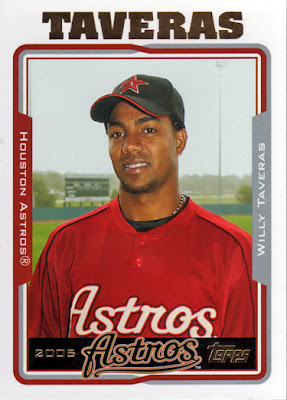
Willie Taveras
30 MLB Games
2006
Some streaks are freaky. They build upon a player having certain abilities like speed that other teams don’t recognize in time to stop an individual’s run up the players’ record mast. With a little ability, the speed to run out normal ground ball outs, and the luck that spawns from a surprised defense, a guy like former Astro Willie Taveras made the list. In 2006, Taveras ran his shock-streak all the way to 30 games before he was finally stopped. It was enough surprise-time to leave Willie Taveras tied with a gazillion others, including the great Stan Musial, at 35th place.
Thanks again to the beautiful presentation work they do at Baseball Almanac, here’s how the 30 consecutive games list for MLB hitting streaks through the late part of the 2013 season looks this morning:
Major League Hitting Streaks (Prepared by Baseball Almanac)
Players With At Least 1 Hit in At Least 30 Consecutive Games
| Rank | Year | Name | Team | League | Games |
|
1. |
1941 |
New York |
AL | 56 | |
|
2. |
1896-1897 |
Baltimore |
NL | 45 | |
|
3. |
1978 |
Cincinnati |
NL | 44 | |
|
4. |
1894 |
Chicago |
NL | 42 | |
|
5. |
1922 |
St. Louis |
AL | 41 | |
|
6. |
1911 |
Detroit |
AL | 40 | |
|
7. |
1987 |
Milwaukee |
AL | 39 | |
|
8. |
2005-2006 | Philadelphia | NL | 38 | |
|
9. |
1945 |
Boston |
NL | 37 | |
| 10. | 1896-1897 | Gene DeMontreville | Washington | NL | 36 |
|
11. |
1895 |
Louisville |
NL | 35 | |
|
|
1917 |
Detroit |
AL | 35 | |
| 1924-1925 | George Sisler | St. Louis | AL | 35 | |
|
|
2002 |
Florida |
NL | 35 | |
| 2006 | Chase Utley | Philadelphia | NL | 35 | |
|
16. |
1938 |
St. Louis |
AL | 34 | |
|
|
1949 |
Boston |
AL | 34 | |
|
|
1987 |
San Diego |
NL | 34 | |
|
19. |
1893 |
New York |
NL | 33 | |
|
|
1907 |
New York |
AL | 33 | |
|
|
1922 |
St. Louis |
NL | 33 | |
| 1933 | Heinie Manush | Washington | AL | 33 | |
|
|
2011 |
Atlanta |
NL | 33 | |
| 23. | 1922-1923 | Harry Heilmann | Detroit | AL | 32 |
| 1996-1997 | Hal Morris | Cincinnati | NL | 32 | |
| 25. | 1885-1886 | Jimmy Wolf | Louisville | AA | 31 |
| 1899 |
Philadelphia |
NL | 31 | ||
|
|
1906 |
Cleveland |
AL | 31 | |
|
|
1924 |
Washington |
AL | 31 | |
| 1965-1966 | Vada Pinson | Cincinnati | NL | 31 | |
|
|
1969 |
Los Angeles |
NL | 31 | |
|
|
1970 |
Atlanta |
NL | 31 | |
| 1975-1976 | Ron LeFlore | Detroit | AL | 31 | |
|
|
1980 |
Minnesota |
AL | 31 | |
| 1999 | Vladimir Guerrero | Montreal | NL | 31 | |
|
35. |
1876 |
Chicago |
NL | 30 | |
| 1895-1896 | Dusty Miller |
Cincinnati |
NL | 30 | |
|
|
1898 |
Cincinnati |
NL | 30 | |
|
|
1912 |
Boston |
AL | 30 | |
| 1922-1923 | Charlie Grimm | Chicago | NL | 30 | |
| 1927-1928 | Lance Richbourg | Boston | NL | 30 | |
| 1929-1930 | Sam Rice | Washington | AL | 30 | |
|
|
1934 |
Detroit |
AL | 30 | |
|
|
1950 |
St. Louis |
NL | 30 | |
|
|
1980 |
Kansas City |
AL | 30 | |
|
|
1989 |
Chicago |
NL | 30 | |
|
|
1997 |
Cleveland |
AL | 30 | |
|
|
1997 |
Boston |
AL | 30 | |
|
|
1998 |
Baltimore |
AL | 30 | |
|
|
1999 |
Arizona |
NL | 30 | |
|
|
2003 |
St. Louis |
NL | 30 | |
|
2006 |
Houston |
NL | 30 | ||
|
|
2007 |
New York |
NL |
30 |
|
| 2009 | Ryan Zimmerman | Washington | NL | 30 | |
| 2011 | Andre Ethier | Los Angeles | NL | 30 | |
|
Rank |
Yearn |
Name |
Team | League | Games |
 Houston, Baseball, & Other Musings.
 The Pecan Park Eagle