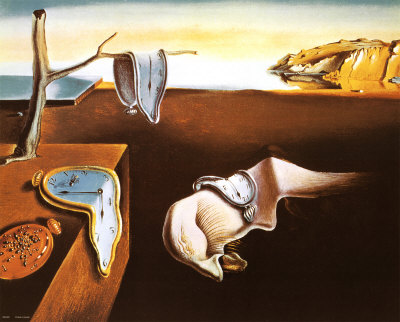
"The Persistence of Memory" by Salvador Dali (1931).
Somewhere out there, in the far reaches of space, light images of yesterday’s life on Earth are only now reaching the vantage point of perspective that is available over light years-measured time at that far-removed-from-us point in linear distance from our planet. We cannot presently capture those images to see what yesterday looked like here, but we, of course, already have that view of other worldly pasts coming to us constantly from stellar bodies that either exist or once existed in those same faraway regions of the universe.
In other words, if we had the ability to capture those images from afar, we could finally get a good high-definition video of Abraham Lincoln delivering “The Gettysburg Address”. Solving that issue would be far easier that finding the answer to our greatest barrier, material travel and image transmission over linear time. By the time we got the equipment out there and received the images it captured back here, we would all be long gone by a few million generations from today.
Unless some of our mathematical and quantum physics geniuses are able to solve the practical problems surrounding matter and energy transmission beyond the speed of light, we shall stay stuck with that one grainy picture of Lincoln from afar at Gettysburg that was taken in real-time on November 19, 1863 in low light by a photographer named John B. Bacholder. Other harder to identify photos occasionally surface, but so far, the Bacholder long shot is the only confirmed of Lincoln on the speakers’ platform from that day.
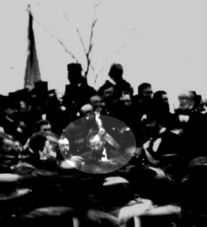
The figure in the stovepipe hat, just right of the steeple, is Lincoln.
Taking photos in 1863 was technically tough and expensive to do. Bacholder had trouble with his camera that day and the one shown here is all he got. In 2010, this would have been one for the digital delete pile. Back then, it was the best the man could do in that given time and place. Even the Bacholder photo has its detractors, but that’s a subject for another day. The subject today is really “time” and how we experience it in our personal lives. Maybe something is a lot more important to our experience of time than developing a way to get better photos of Lincoln.
Here’s what I mean: I’m 72 now and, as some of you other elders also realize, perspective changes over time. Time also sometimes confirms things we’ve always suspected. In that regard, I have one personal example I’d like to try to share with you here too.
From the time I was kid, feeling my most immortal self, another thought kept crowding in:
One of these days, if you live so long, you’re just going to wake up an old man. It really isn’t going to take so long. We are all only here for a blinking of the eye on Father Time’s face and then we are gone.
That creeper idea prevailed. It didn’t mean that I just sat around, waiting to wake up old. I’ve spent my life as I continue to live it, growing in appreciation and bonding with the people and passions I really love, trying as best I’m able to learn from my mistakes, and living each day with as much gratitude and appreciation for the fact that this beautiful “here and now” is again available to me for one more day.
Bobby Doyle was a blind pianist and composer here in Houston back in the 1950s and 1960s. I don’t even know what happened to him since then, but I do know that I enjoyed his work around town back in the day that Kenny Rogers was still around here as a member of the Bobby Doyle Trio. One line from a Bobby Doyle song that better sums up my point today in a lot fewer words than I’ve already used goes simply like this:
“Life’s only what we make it, so take it, and make it beautiful.”
So, no matter how long it feels it took you to reach your present age, do what you can now to take today and make it beautiful. You can do it, no matter what. We all get sand in our sandals every once in a while, but if we just keep walking in a here-and-now right direction, one filled with love and passion for who we are, who we’re with, and what we do, the clouds go away – and the sun comes out.
Have a great Monday, everybody!
 Houston, Baseball, & Other Musings.
 The Pecan Park Eagle