Posts Tagged ‘Houston’

Seems Like Old Times.

February 8, 2010

Buff Stadium in Middle Right of Gulf Freeway, Early 1950s.

It was located four miles east of downtown Houston. When its first Opening Day came around on April 11, 1928, many Houstonians still grumbled over the fact that Buffalo Stadium, the new baseball home of the Houston Buffs had been built so far out in the sticks from the city. West End Park, after all, had been right there on Andrews Street, off Smith, near where almost everybody lived back in the booming 1920s. The old park may have found its way to some  dilapidation and it may have offered  inadequate seating capacity, but it was close. And close counted for something back in the pre-freeway days.

The city had rallied to the travel problem by making sure that rail service to the new ballpark from downtown was easy to use. Union Station, the current home site of Minute Maid Mark, in fact, was one primary place to catch the ballgame  train that went out to Buff Stadium on what was then known as St. Bernard Avenue in 1928. That same thoroughfare is called Cullen Boulevard these days. It’s been Cullen so long now that hardly anyone alive still remembers it by its earlier identity.

Buff Stadium was the brain child of Cardinals General Manager Branch Rickey. Buffs President Fred Ankenman oversaw the ballpark’s construction in 1927-28, bringing in the project on budget at a cost of $400,000 much harder dollars then the kind we see today. Mr. Rickey even came down from St. Louis on the train to attend the 1928 grand opening of the new ballpark in Houston and he brought Baseball Commissioner Kenesaw Mountain Landis with him. Judge Landis was most impressed too, pronouncing the new Buff Stadium as the finest new minor league baseball park in America.

Landis’s favorable impressions were important to Rickey. Rickey hoped to soften the old man’s heart from the idea that major league ownership of minor league clubs was bad business for the local community. The original 8,000 seat Buff Stadium stood as a symbol of progress and improvement in Houston minor league baseball under Cardinal ownership. To some extent, Rickey had accomplished his mission in bringing Landis to Houston in April 1928. Nothing ever really cured the contentious relationship between these two men, as Rickey would learn years later when Landis freed Pete Reiser and a few others from reserve clause capture by the St. Louis Cardinals, but that’s a story for another day.

Look at the Houston skyline in the picture. The Gulf and Esperson buildings were still the icons of Houston architecture in the 1950s – and that freeway and its rascally pal roadways had only begun to play their role in Houston’s massive spread to the hinterlands.

The Houstonians of 1928 thought that the four-mile trip to Buff Stadium from downtown was a major expedition. Today we drive four miles just to reach a Whataburger or rent a DVD movie. So where’s all this progress we keep talking about?

Remembering the North Main!

January 31, 2010

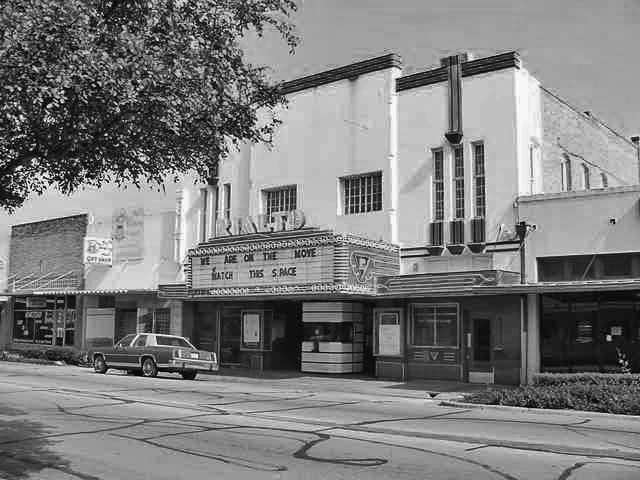
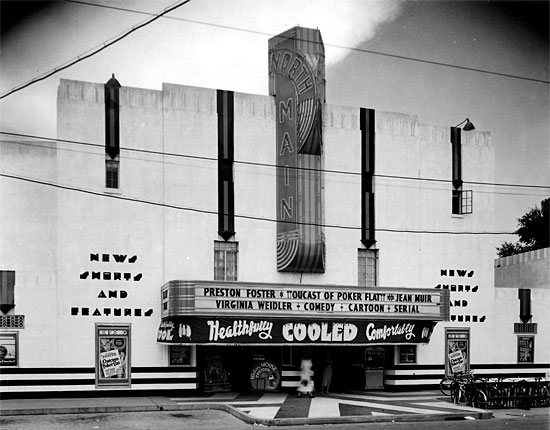
The North Main Theatre in Houston Opened for Business on Christmas Day 1936.

Like most people from my generation, neighborhood theatres, movies, and the heroes and stories we found there golden. They all etched their indelible ways onto the forever-hoping character of our American souls. For me, the first place to do that was the Rialto Theatre in Beeville, Texas, the little South Texas town where I was born. It didn’t have a lot of time to work its magic. We moved to Houston on my fifth birthday, December 31, 1942.

In my case, the job passed on to the North Main (1943), the Studewood (1944), and the Avalon (1945-56), with some considerable help to the latter from the Broadway, OST, Wayside, and Eastwood. And this roll call doesn’t even take into account all the other neighborhood suburban theatres and downtown big and fancy  houses that we also frequented. Prior to the coming of television to Houston in 1949, especially, movies were our windows on everything that ever happened, will happen, could happen, or should happen. Indeed, they were our visual gospel.

The Rialto Theatre in Beeville, Texas Opened for Business on August 19, 1922

My earliest memories of the North Main are like some kind of carnival dream. Unless my memory is tricking me again, I seem to recall a dwarf couple that operated a popcorn stand just outside the theatre on the sidewalk. I wasn’t used to making level eye contact with older people, but that was the deal with these folks and me. I thought they were Munchkins.

Dad worked a light of night shifts at Brown Shipyard in those days so Mom would walk me and my younger brother John from our little duplex on Fugate to the North Main and sometimes the Studewood, which was actually much closer. I recall walking south on North Main to the movie house of the same name one night when gun shots rang out across the street. A cop was chasing a man down the street and either missing every time, or else firing over the running man’s head on purpose. We never saw or learned the outcome of that little Houston chase scene, but we would see it again in a few hundred movies to come.

At age five, I fell in love with John Wayne and “The Flying Tigers” (1942) at the North Main Theatre. We didn’t see the movie until 1943, but I guess we saw it three or four times while we could find it there and elsewhere – and then, over the years, I continued to watch it every chance I found when it started making the late show television movie circuit.

Words fail to adequately convey the power I felt from those snarling teeth of the tiger fighting planes as they zeroed in on the warrior ships of the Imperial Japanese Air Force, especially when an angry John Wayne pushed the button on a shot of cold steel vengeance over the loss of his own men. Pilots bled from the mouth when they were hit. It was the first memory I have of what appeared to be credible death scenes.

Prior to “Tigers,” I had seen numerous movies in which actors were shot in their  tuxedos and still managed to drop dead on carpeted floors without making a mess for the investigation that was yet to come by William Powell as “The Thin Man.” “Tiger” casualties weren’t that neat. They dropped real blood when they died.

Or so it seemed.

Long before Clint Eastwood, "The Flying Tigers" knew how to settle old scores without losing their cool.

I’m curious. Did movies affect your early impressions of life too? And did you also have a John Wayne or “Flying Tigers” model, or any kind of model, that shaped your early ideas about how things are – or should be?

If so, I’m hoping you may be willing to leave your thoughts with us here as a comment on this topic. Memories of the North Main or other theatres are also most welcome – and, if anyone can help me clear up the reality of my North Main dwarf memories, I would especially appreciate your help.

Meanwhile, have a nice Sunday – and try to stay warm.

The Sicilian Joy of Patrenella’s!

January 29, 2010

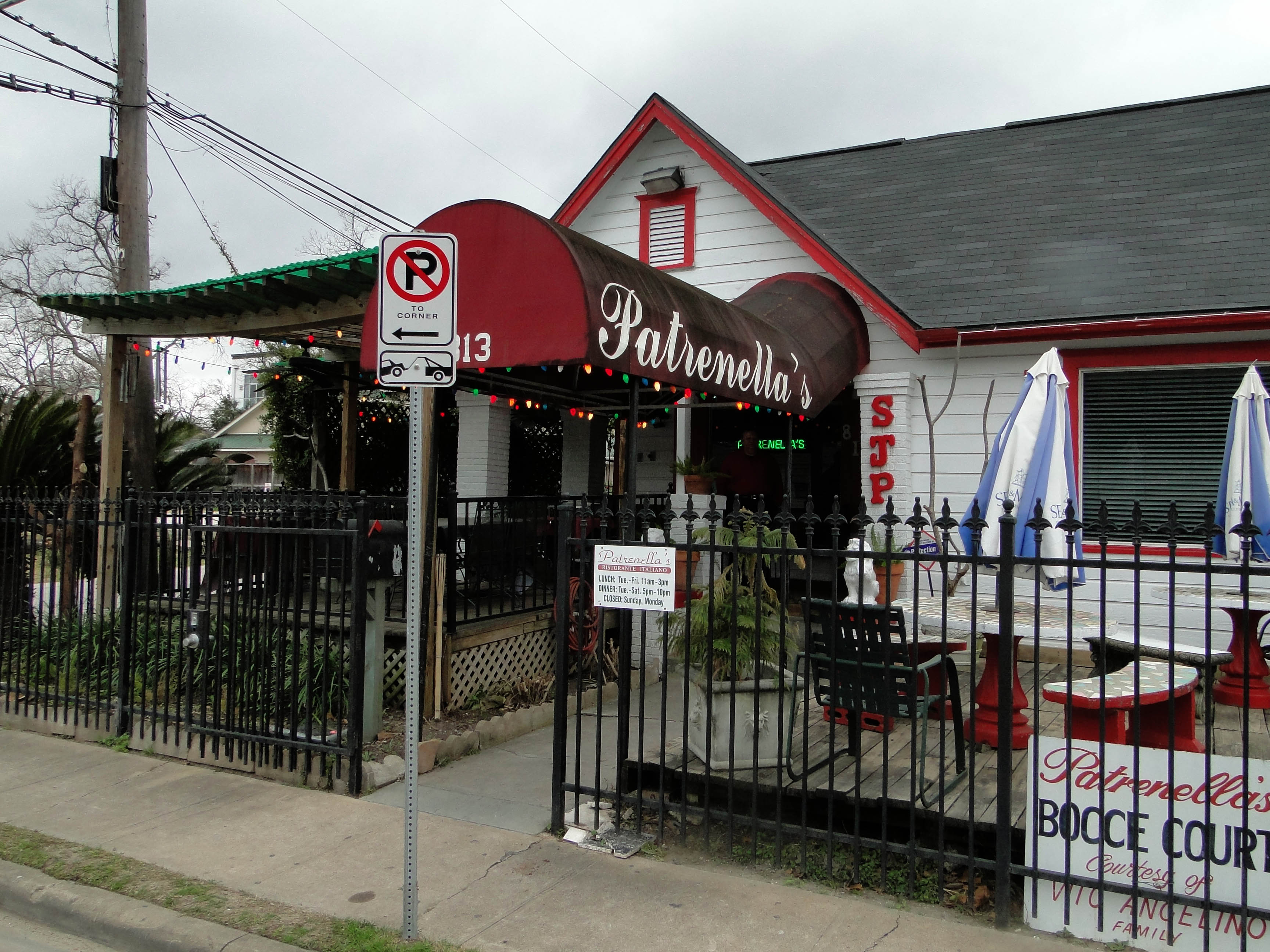
Patrenella's and the best authentic Sicilian cuisine in Houston is located at 813 Jackson Hill, at the corner of Jackson Hill and Barnes, just one block south of where the street "Ts" into Washington Avenue. NOTE: Patrenella's has its own Bocce Court too.

Sammy Patrenella, 75, and his Patrenella’s Ristorante Italiano are both Houston classics. If you have never tried Sammy’s classic Sicilian fare, you really owe it to your palate to do so. Come for the food and stay for the joy. You will be dining in a place built on the love of family, friends, and the best, most truly delicious Sicilian food in Houston when you do.

The menu includes the best beef, chicken, and seafood offerings that come to mind from the mention of any Italian food dishes, all prepared according to ancient family recipes and served with the freshest vegetable fare, pasta dishes, marinara sauce, and special oil seasonings that the veteran diner comes to expect from the true artists of Italian cooking. Patrenella’s isn’t simply good enough for Houston. It is a place that could easily hold its own with the best Italian places in The Hill section of St. Louis. Patrenella’s also bakes its own bread and offers some of the most delicious pizza in town as well. It contains its own small bar and offers all the right options of good wine to go with all the right foods for those who choose the fully European experience in dining.

In spite of its royal good taste choices in food and drink, Patrenella’s is laid back and casual in the way most Houstonians prefer their dining out experiences. Coat and tie or sporting casual wear are welcomed equally at “Sammy’s Place.”

Patrenella’s is open for lunch, Tuesday through Friday, from 11:00 AM to 3:00 PM, and for dinner, Tuesday through Saturday, from 5:00 PM to 11:00 PM. No lunch service is available on Saturdays and the restaurant is fully closed on Sundays and Mondays. For evening reservations, simply call 713-863-8223.

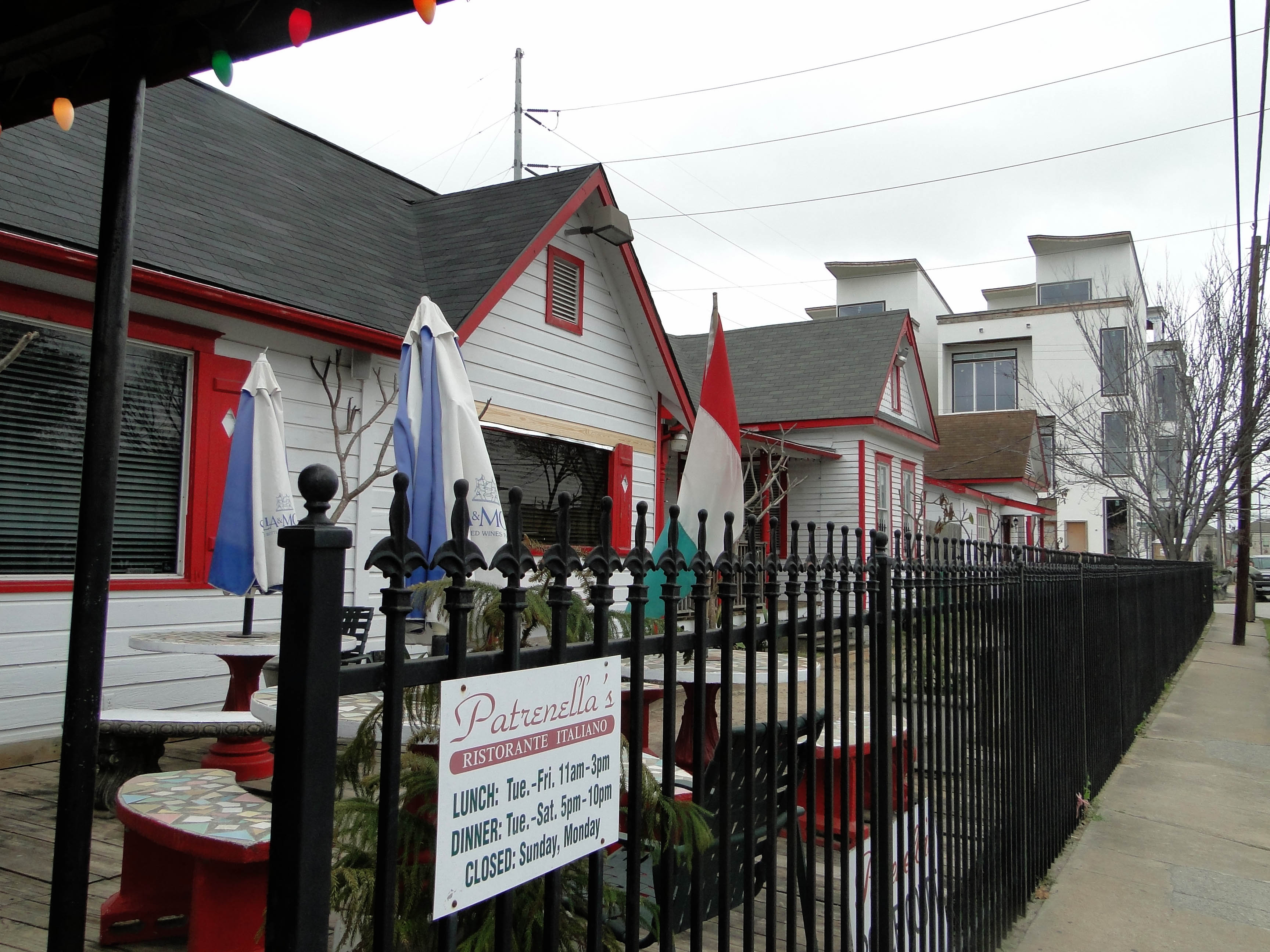
The Patrenella family home from 1938 is now the front door on a chain of three houses that owner Sammy Patrenella has strung together as the new home of his restaurant since 1991!

The story of Patrenella’s Ristorante Italiano is best told by Sammy Patrenella himself. You will find these same words on the back cover of his menu. They are written to explain the old photo featured above this section in today’s article. The original of this photo hangs proudly with other family mementos at Sammy’s Place.

Here are Sammy’s words:

“In 1938, my father, L.L. Patrenella, built this house in which you can now enjoy the food and hospitality of our family. After immigrating to Houston from his native Sicily, he started a grocery store in this neighborhood; it stood a mere block away. He and my mother, Nita, live behind the store. They were always cooking Italian recipes and giving samples away to the customers. I’ve always had a dream for a restaurant that would carry on the traditional good tastes and love of my mother and father. So, my wife, Josephine, my son, my daughters and I have uniquely renovated this house in which I was raised. We have kept it consistently dedicated to the ambiance of the historic Heights and Sixth Ward. The warmth and the great cuisine of the traditional Italian kitchen is presented to you by three generations of the Patrenella family. Please come by and enjoy.” – Sammy Patrenella.

Sammy's childhood home and two others have been linked since 1991 as the site of Patrenella's Ristorante Italiano. Safe parking is no problem in this gentle old Houston neighborhood.

When three-year old Sammy and his family first moved into their new house at 813 Jackson Hill in 1938, a Houston Chronicle human interest spotlight story described the new family home as “modern throughout.” Sammy says he later asked his mom what that meant. She told him, “Of course, it was modern throughout. The house even had an ironing board built straight into the wall.”

Thank you, Mama Petronella! We doubt that many women from the year 2010 equally share your enthusiasm for such conveniences as built-in ironing boards.

"When the moon hits your eye like a big pizza pie, that's amore!"

A friend recruited this robotic version of a famous entertainer as a gift to Sammy Patrenella a few years ago. Dino has held forth as the host of Sammy’s bar area ever since his arrival from New Orleans. The joy of life and the spirit of giving oozes from the walls of this happy place in ways large and small. This little Dean Martin “Mini-Me” simply fell into the mood of the place.

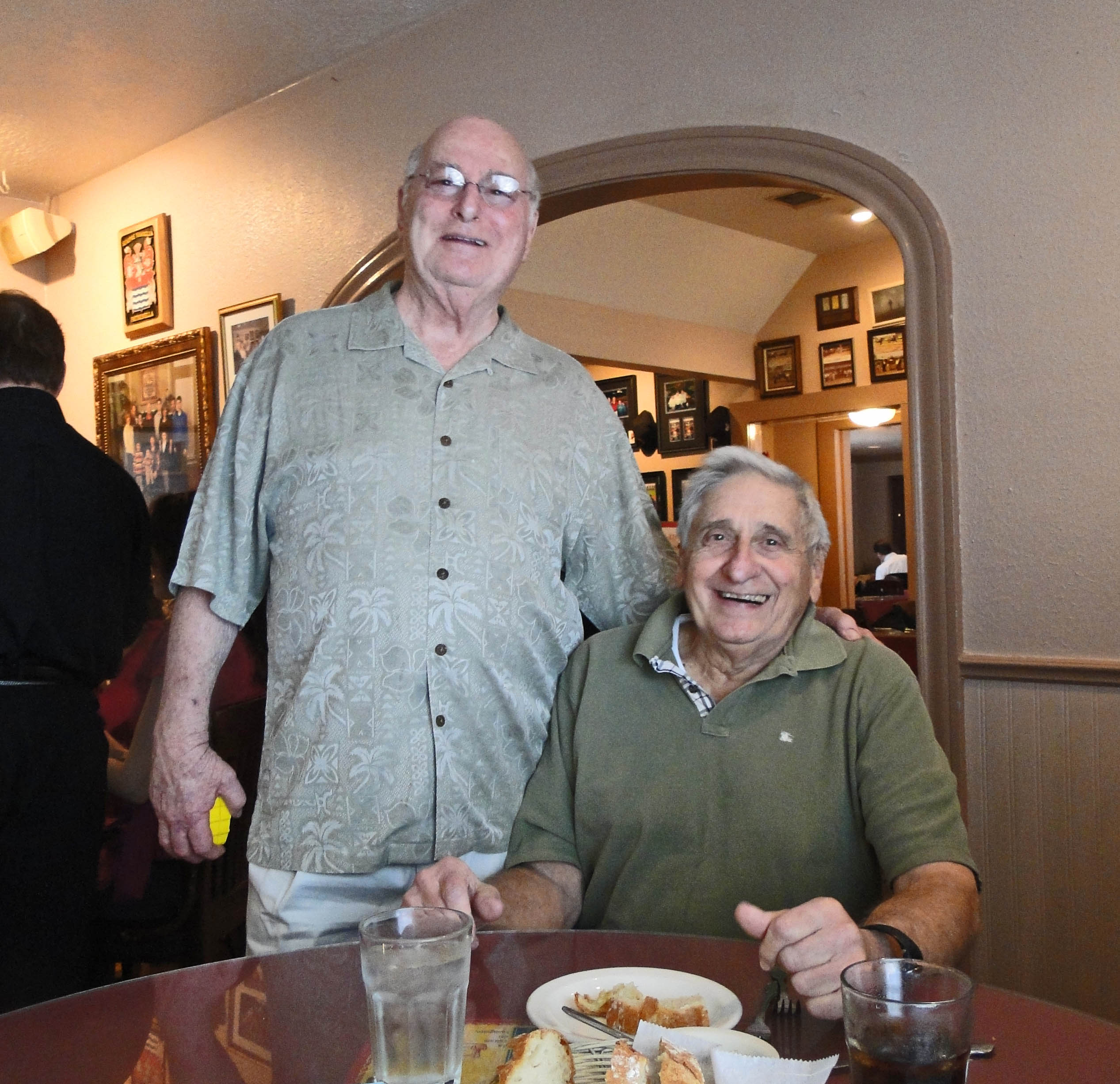
Sammy Patrenella (L) and Houston consigliere Richard Coselli.

The smile on Sammy’s face is as big as his heart. The smile you are receiving here from our last featured photo of Sammy greeting his luncheon guest and lifelong friend and fellow St. Thomas High School graduate Richard Coselli reaches out as an invitation for you to stop by sometime and also partake of the joy that is dining at Patrenella’s.

Let me put it this way: The Goombahs above are making you a dinner offer that they each hope you will not refuse. Life’s too short to miss out on the joy of this world’s best food and greatest company.

Have a terrific Friday, everybody!

A Short Ride on Houston’s First Rail System.

January 28, 2010
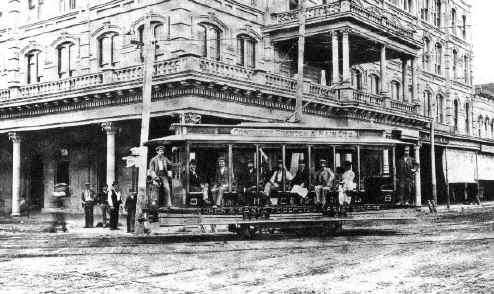
"Car 8 was built as one of the original 12 cars to inaugurate electric service in June of 1891." - As with all other photos & text used in these column pictorials, this material is courtesy of Steve Baron, Houston Streetcar History Pages.

“Car 8 was built as one of the original 12 cars to inaugurate electric service in June of 1891.” – As with all other photos & text used in these column pictorials, this material is courtesy of Steve Baron, Houston Streetcar History Pages @ http://members.iglou.com/baron/

From its 1836 inception, people saw Houston’s long range potential as a seaport because of its access to the Gulf of Mexico via Buffalo Bayou and Galveston Bay. As the port idea grew in the 19th century, it wasn’t long before incremental improvements to the waterway route over time led to the formal christening of the Houston Ship Channel in 1914. Over this same economic time frame, Houston grew exponentially as a shipping center for cotton, cattle, and that newly found nearby commodity known as oil.

The thing that made it all come together was rail, local and long distance tracks that moved both people and products around town and out of state or country. Had it not been for the invention and growing ecopolitical punch of the spontaneous combustion engine industries, Houston and other developing western cities would have stayed with rail and grown quite differently, but as we know, that is not what happened. A short run at our first local history with rail is still a fun and factually packed trip to take.

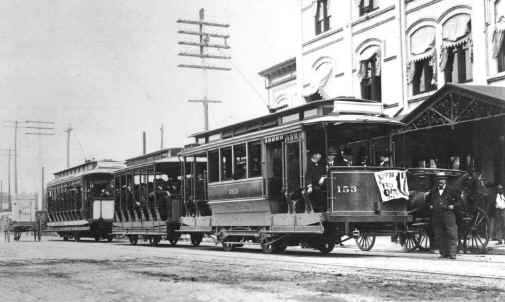
"Posed in front of Grand Central Depot (Southern Pacific lines) are brand new "California" car 153, trailer 33, and an 1896-built nine-bench open car.   Such was public transit in Houston in 1902.  Sic transit gloria mundi!" - Courtesy, Steve Baron.

“Posed in front of Grand Central Depot (Southern Pacific lines) are brand new “California” car 153, trailer 33, and an 1896-built nine-bench open car. Such was public transit in Houston in 1902. Sic transit gloria mundi!” – Courtesy, Steve Baron, http://members.iglou.com/baron/

Houston’s first mule-drawn streetcars began service in 1868.  On May 2, 1874, the  Houston City Street Railway began mule-powered operations on Travis Street, marking the true beginning of organized rail service in Houston. By 1889, a competing company, the Bayou City Street Railway began operations. It will later be absorbed by the Houston City Street Railway.

On June 12, 1891, the first local operation of electric streetcars began. In 1892,  the Houston Heights line also opened.  For several years thereafter, it operated as a separate company.

In 1896, a court-ordered receivership forced the sale of the Houston City Street Railway. It was reorganized by its new owners as the Houston Electric Street Railway. In 1901, following another receivership, the street railway was sold to investors associated with the Stone & Webster firm of Boston, Mass.  It was reorganized this time as the Houston Electric Company.
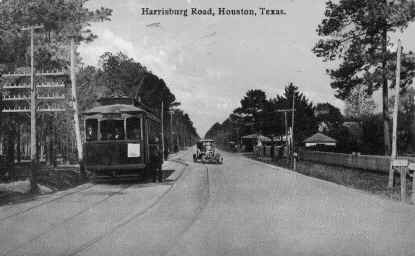
"The Harrisburg line was opened to streetcar traffic in 1908, and this postcard view was made not long after.  The car is a double-truck semiconvertible design, the mainstay of the fleet during this period." - Courtesy, Steve Baron.

“The Harrisburg line was opened to streetcar traffic in 1908, and this postcard view was made not long after. The car is a double-truck semiconvertible design, the mainstay of the fleet during this period.” – Courtesy, Steve Baron, http://members.iglou.com/baron/

By 1908, the Harrisburg line opened from downtown to Houston’s growing east end. By 1910, the Bellaire line opened to the west from South Main along the lazy country lane that is now the car-clogged boulevard  we know as the Holcombe-Bellaire continuum. My mom spoke often of how she and my maternal grandparents took the street car south from their home in the Heights back in the 1920s to visit relatives in Bellaire. “By the time we transferred way out South Main to the Bellaire line,” Mom said, “it already felt like we were way out in the country. Now we’re getting ready for a rail ride through the woods. There wasn’t anything out there back in the 1920s. Then, when, you finally got to Bellaire, there wasn’t much there either, except for relatives and a few strange folks that we didn’t know.”

On December 5, 1911, the Interurban route to Galveston opened. The Galveston-Houston Electric Railway operated as a separate company from HECo., but it too remained under the ownership and control of the parent company. By 1911, public service companies were sensitive to the need for obscuring any kind of expansion that might begin to look to federal authorities like a monopoly. That ball would stay in economic play forevermore, except for periods of obvious disregard.
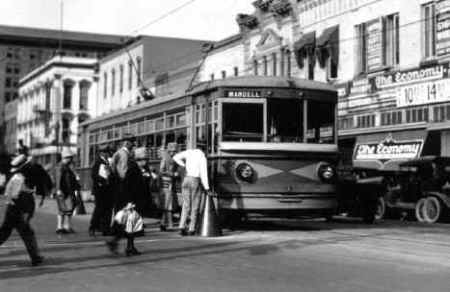
"A busy downtown scene in the late 1920's finds car 416 on the Mandell line, preparing to head outbound to the Montrose district.  These cars, built in 1927, were the last series of streetcars ordered by the Houston Electric Co.  (There were two later experimental cars, but that's another story.)" Courtesy, Steve Baron.

“A busy downtown scene in the late 1920’s finds car 416 on the Mandell line, preparing to head outbound to the Montrose district. These cars, built in 1927, were the last series of streetcars ordered by the Houston Electric Co. (There were two later experimental cars, but that’s another story.)” Courtesy, Steve Baron, http://members.iglou.com/baron/

The downtown shot of this Mandell Line car also features the newer kid on the block in the far ight hand corner. The automobile was making its presence felt big time in Houston as the city rolled through the Jazz Age on its way with the rest of the country to the Great Depression.

The appeal of cars always was the fact that they weren’t tied to fixed route travel by tracks. Their growing affordability and the bountifulness of cheap gas made them a growing-in-popularity alternative to rail travel. Since 194, some individual attempted to use their cars as public transport “jitney” service upon open and fixed routes. These were finally banned by City Council in the early 1920s in favor of public busses. On April 1, 1924, the first Houston bus route, on Austin Street, began operations in Houston in the wake of a city referendum outlawing jitneys.

The 1930s saw the growth of bus service and private automobile use. By the end of the decade, the streetcar and interurban rail lines were dead. On October 31, 1936, the last run of the Galveston-Houston interurban line clattered its way north and south between the two cities. The section that served people from downtown to Park Place, however, continued under HECo. operation until 1940.

On June 9, 1940, the Houston Electric Company took its last run with electric rail streetcars. The final two routes to give way to automobiles and busses were the lines serving Pierce and Park Place. Even by this time, local highly placed politicians and real estate entrepreneurs were beginning to plan freeways that would both “solve” the growing congestion problem of increasing auto travel and more privately and quietly help certain individuals invest and profit from planned growth to the far-reaching suburbs that they also would create from the recent earlier purchase of cheap land on the nearby prairies woodlands.
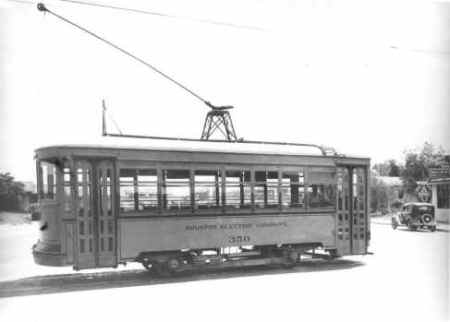
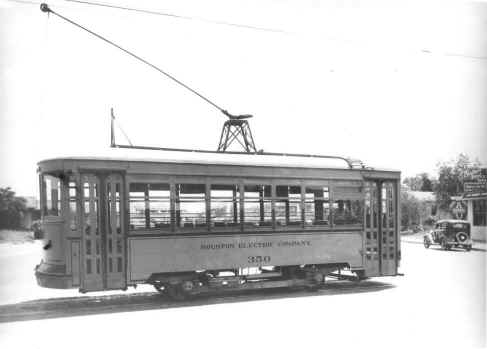
"A 1930's view of one of Houston's single-truck Birney cars.  Built in 1918, this was one of several cars that were modernized in the company shops, changing them from double-end to single-ended, and installing full length doors with inside steps." - Courtesy, Steve Baron, website: (http://members.iglou.com/baron/)

“A 1930’s view of one of Houston’s single-truck Birney cars. Built in 1918, this was one of several cars that were modernized in the company shops, changing them from double-end to single-ended, and installing full length doors with inside steps.” – Courtesy, Steve Baron, website: (http://members.iglou.com/baron/)

Once again, in 2010, the inner, older, and more compact center of Houston is being best served practically by new rail service. The far-reaching Houston, the one that grew from the ambitions of the few and the addiction of us all to the automobile, is now unserviceable by any single form of mass public transportation – nor are we inclined in Houston to want to use public transportation as anything other than an occasionally quaint reminder of our long ago past.

It is what is. And we are what we are. Take me out to the ballgame, but let’s use your car or mine.

For a complete look at the magnificent work that historian Steve Baron has done on the history of rail transportation in Houston, please do yourself a favor and check out his website, Houston Streetcar History, at http://members.iglou.com/baron/

Gone But Not Forgotten Houston Eateries.

January 15, 2010

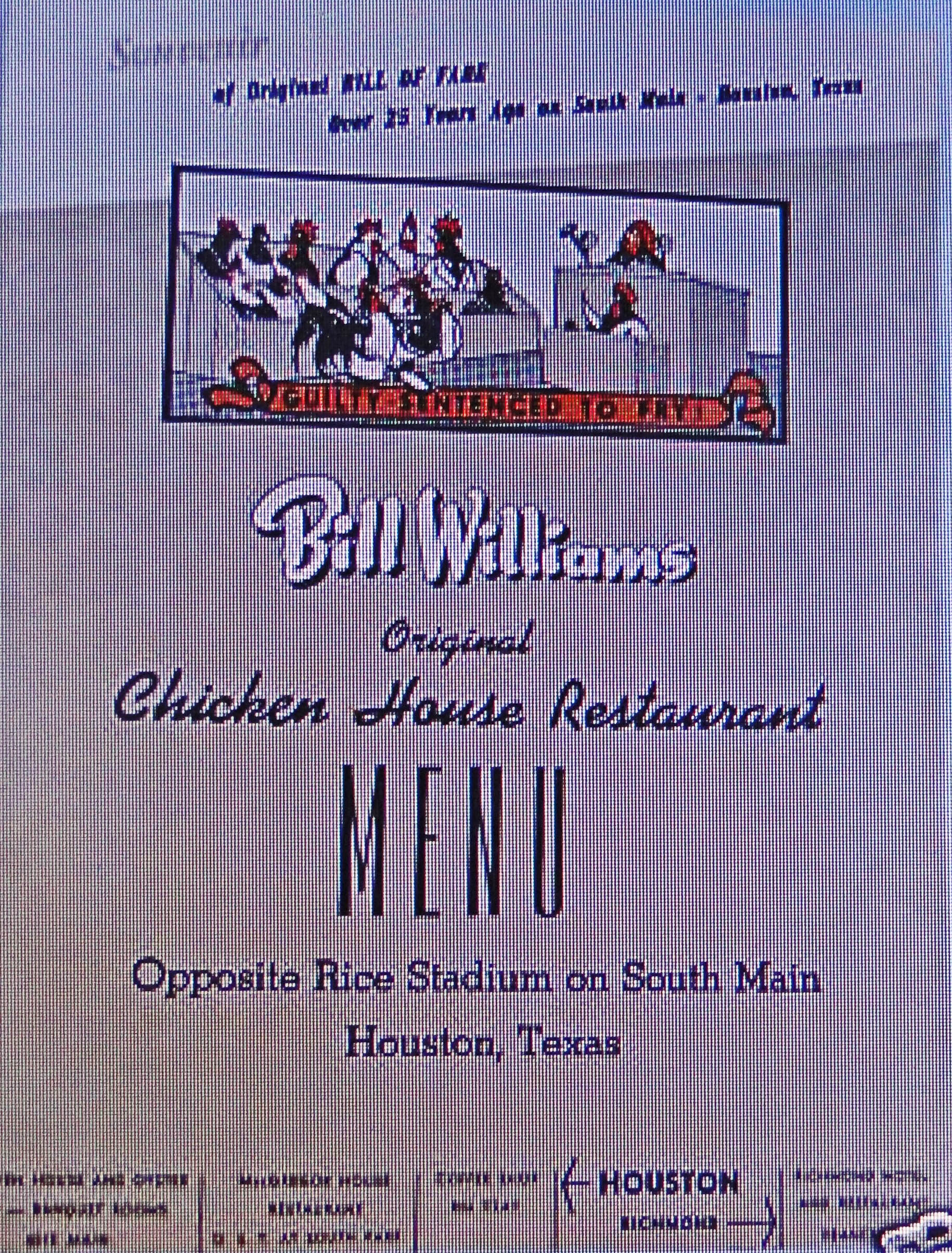
Bill Williams Chicken House. We haven’t exactly forgotten the Bill Williams Chicken House that used to advertise chicken fried “savage style” with the neon image of a Native American brave (formerly Indian warrior) squatting and cooking over a campfire. In fact, I’ve mentioned the place here in the past.  Today I simply ran across an old restaurant menu that recently went to auction on Ebay. Based upon what we can see in the photo, the menu had to be from the 1940s at the latest. It advertises “BWCH” as “opposite Rice Stadium on South Main.” That means it was produced during the period in which Rice still used the old Rice Stadium on South Main as their football venue. Football moved to the “new” 70,000 seat Rice Stadium in 1950.

It’s an interesting graphic. A chicken is on trial. We must presume that the bird was charged with being plump, juicy, and delicious because the heartless chicken judge and jury have just found him guilty and “sentenced (him) to fry.” The Internet piece also notes the availability of soft drinks, coffee, and iced tea available at nickel and dime size prices. Iced tea today in most Houston restaurants probably costs more than a whole fried chicken meal for two at Bill Williams back in the day.

Of course, I always have to mention her when it comes to Bill Williams memories, I’ll never forget the fortune-teller robot woman in the glass box near the door. For a dime or so you could have your fortune read before you walked out the door after a Bill Williams chicken dinner. I should have listened to her. I think she’s was trying to tell me: “Cut back on the fried food, boy! One of these days, your pipes are going to clog!” Professional buildings surrounding the Texas Medical Center swallowed Bill Williams years ago. They didn’t even pause long enough to fry him savage style.

Weldon’s Cafeteria. Heading north from Bill Williams, we wind our way to my all-time favorite cafeteria back in the 1940s and 1950s. Weldon’s served the most delicious chicken and dumplings I ever tasted outside my mom’s own kitchen. Weldon’s was located on the site and in the same building that later housed the Massey Business College for years. I’m not sure what’s there now.

Kelly’s Steakhouse. Just up the road and barely south of downtown on South Main, we had Kelly’s Steakhouse, one of best early steakhouses I ever visited as a kid. I’m not sure how Dad swung it, but he took us there once in a blue moon on Sundays. I can’t recall what’s there now in 2010.

Bill Bennett’s Grill. Thanks to fellow St. Thomas High School Class of 1956 classmate A.J. Garney for opening the memory door on this favorite haunt. Wow! How could I have forgotten. In our trip up South Main, we turn right on Pierce and head to LaBranch. At LaBranch near St. Joseph Hospital, we turn right again and take another right at Jefferson (now St. Joseph Parkway) and there it is on the left: Bill Bennett’s Grill. As A.J. so fondly recalls, Bill Bennett’s served these great homemade all-you-can-eat biscuits and practically everything else that could be grilled or fried – and at the modest prices we could all afford as high school guys out there on the original rock-n-roll boogie trail. I’m not sure when Bill Bennett’s closed, but it came down when TXDOT acted to use that space for that section of the downtown freeway we now call the Pierce Elevator. Oh well. It was great while it lasted – as were we and the times of our youth. Thanks for the memories, AJ!

If you can think of any other places that have breezed through the sieve of my memory bank about the 1940s or 1950s, please let me know what they are and what you remember of them. As always, I’ll do what I can here to help Houston remember what we’ve lost or given up in the name of progress over time.

Frank Liuzza: Houston Says Goodbye to a Good Man.

January 5, 2010

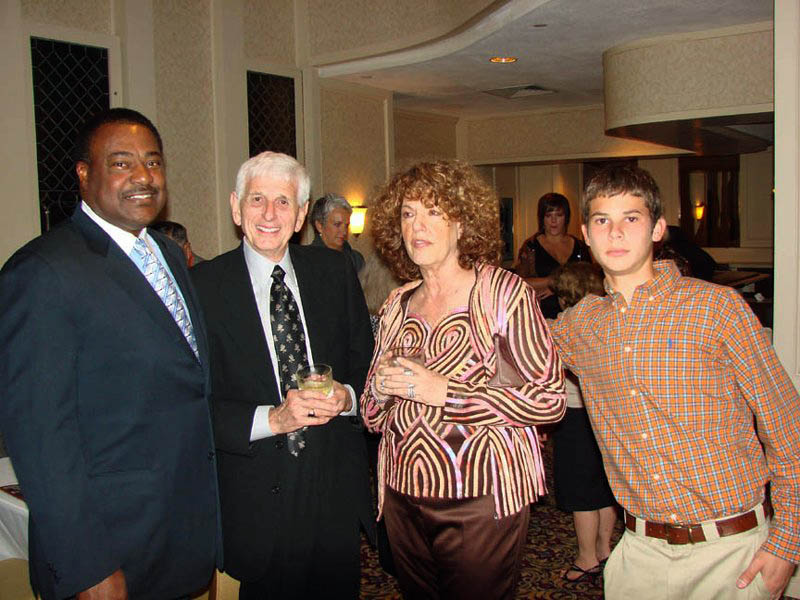
At the 2007 Texas Baseball Hall of Fame Banquet: Former Big Leaguer Don Baylor; Houston Black Buffs Founder Son, Frank Liuzza; Dr. Sue Hepler-Liuzza, Spouse; & Frank Liuzza Grandson, Randall Taliaferro.

Houstonian Frank Liuzza died in St. Luke’s Hospital this past Saturday, January 2, 2010, at the age of 80. With his passing, Houston surrendered one its genuinely caring citizens. Frank was  a man of great integrity, outspoken honesty, and clear passion for life, family, true friendship, the history of this city, the arts, music, and everything that had anything to do with fast cars.

Like his father, John Liuzza, and his uncle, James Liuzza, before him, Frank loved the great game of baseball. He was a fine hitting and fielding lefty first sacker for St. Thomas High School, St. Thomas University, and the University of Texas in the years immediately following the end of world War II. He had hopes for a professional career, but those were dashed by injury and a greater call to military service duty with the U.S. Army during the Korean War. After the war, Frank used his undergraduate degree work in accounting at the University of Houston to embark upon a successful lifetime career as a commercial real estate broker.

In the short late-in-life time I knew Frank Liuzza as a personal friend, and he was just that, a true friend, I learned how driven he was personally by the business life  and everyday living experiences of his Italian immigrant grandfather and family in the Houston fifth ward. Frank had an outstanding head for detail, great respect for the work ethic, total loyalty to the idea of family, and complete love for everyone before him and after him in the Liuzza family bloodline, from grandfather to grandson.

Frank Liuzza and I bonded as friends in 2007 on the wings of circumstances that now still ring like the plotline of a twilight zone story. All you may need to know to more fully appreciate the tale is this fact: All of my adult life, or so it seems, I’ve been looking for documentation on an old Negro League baseball club that once existed here as the “Houston Black Buffs.” All I’d been able find through the early fall of 2007 were a few scattered box scores and game action reports from the Houston newspapers of the 1930s.

Then one day, in the fall of 2007, I received a phone call from a former Tulane University graduate school friend and colleague, Dr. Sue Hepler. We probably had not talked in fifteen to twenty years and our relationship had nothing to do with baseball. Sue had just wanted to reach out and see how I was doing. Even she had no previous idea of how my recent years have become so immersed in the fields of baseball writing and research. We are both mental health field professionals by trade.

When Sue learned of my baseball passion, she said, “You know, Bill, the funny thing is, I’m married to a guy here in Houston whose family once owned a local black baseball team. I think they were called the Houston Black Buffs.”

You could have knocked me over with that proverbial feather.

Dr. Sue Hepler-Liuzza was married to Frank Liuzza, whose father and uncle founded the Houston Monarchs (later known as the Black Buffs) in 1924. The family owned the club through its final straw year of 1954, when Frank Liuzza himself came home from Korea in time to close the books on an era that had ended.

I was Board President of the Texas Baseball Hall of Fame back then. We recognized Frank Liuzza and his family history with the Houston Black Buffs at our November 2007 banquet. And that’s how Frank and I met – and how the history of the Houston Black Buffs came out of the shadows.

I last saw Frank Liuzza in September 2009, when we both went over to TV Channel 55 to record some material for Houston baseball and community history with Mike Vance, one of our local media’s foremost historians. Even though we didn’t see each other often or know each other for long, I will miss Frank Liuzza as the good friend and great Houstonian he truly was.

Footnote: This article was published by The Pecan Park Eagle blog on WordPress.Com on Tuesday, January 5, 2010. It is dedicated, henceforth, to the deserved and lasting memory of Mr. Frank Liuzza and also equivalently to the ongoing, soaring soul of his life partner, Dr. Sue Hepler-Liuzza.

Oscar Holcombe: The Plastic Man of Houston Politics.

December 29, 2009

Oscar F. Holcombe was an absolutely amazing Houston politician. Had he lived to celebrate the December 31st birthday that he shares with me and God knows how many others, he would need 121 candles to torch each of his

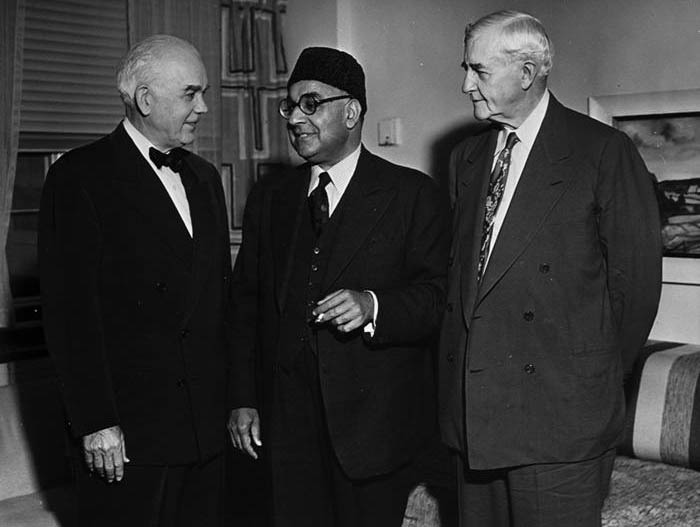
Houston Mayor Oscar F. Holcombe, Pakistani Prime Minister Ali Khan, & Houston Power Mogul Jesse Jones, 1950.

earthly years. Born in in Mobile, Alabama on December 31, 1888, Holcombe’s family moved to San Antonio when he was very young. After growing up in the Alamo City, Holcombe moved to Houston at age 18 and started making a living in construction. Holcombe married Mary Grey Miller on May 3, 1912. They had one daughter.

By age 26, he had formed the O.F. Holcombe Company as his own construction business. He was on his way to using his business savvy and political contacts as a pathway to riches as one of Houston’s new millionaires.

In 1921, Holcombe entered politics and was elected for his first term as Houston’s mayor. He would end up serving as Houston’s mayor for 22 years, but over 11 non-consecutive terms across four decades. He was the most resilient politican in Houston’s history, adapting to changes in the times and rarely losing his broad appeal in the face of fast growing and changing Houston voter demographics. Holcombe was a soft spoken business-oriented conservative who advocated and believed strongly in the city’s physical expansion of its georgraphic boundaries and in the growth and maintenance  of public services like libraries, adequate sewage, and the development of a superior municipal auditorium for special shows and functions downtown.

Holcombe’s mayoral terms extended from 1921 to 1929; from 1933 to 1937; from 1929 to 1941; from 1947 to 1953; and from 1956 to 1958.

During the early 1960s, Houston renamed the section of Bellaire Boulevard east of Southside Place which runs through the Texas Medical Center, as Holcombe Boulevard. In the late 1980s, the municipality of West University Place also renamed Bellaire Boulevard as Holcombe Boulevard within the space of its jurisdiction.It was a fitting tribute to a man who had personified the Houston boomtown spirit as clearly as it had been drafted by local mover and shaker Jesse Jones. Holcombe was the man to have in office whenever Houston leaders wanted to get some new development deal done and under construction. His actions invited a hoarde of reform candidates along the way, including the late Roy Hofheinz, but people always seemed to come back to Holcombe, even after they threw him out for a term or two.

Was Holcombe dishonest? I can’t say. All I can tell you from what I recall and have since read more about is that he was a superlative politician. Does that help answer the question?

As for sports, Holcombe was was mayor during the time that Buff Stadium was built and opened four miles to the east of downtown Houston in 1928. He fell time-short of being in office when Houston won their battles for major league baseball and football, but I think he supported those goals in general, even if he did not support the personal gain that passed to his old rival Roy Hofheinz through baseball. During the great “bigger is better” era of  Houston shaker thought, Holcombe favored “bigger and wider” as goals that were good for Houston – and quietly profitable for those that did the actual financing and building of growth and expansion.

Oscar F. Holcombe passed away in Houston on June 18, 1968 at the age of 79.

Getting Around Houston Prior to 1952.

December 14, 2009

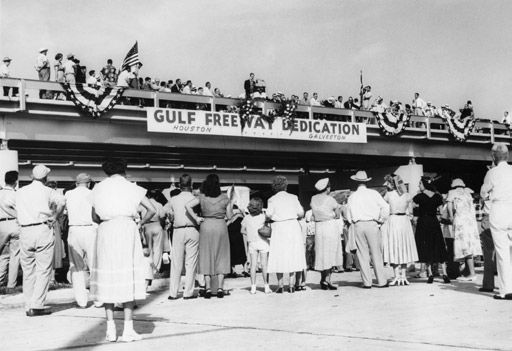
Prior to it;s August 1952 Opening, Houstonians referred to this answer to all our local travel problems as "The Super Highway"!

Our hopes didn’t fly for long, but there was a brief time in the late summer of 1952 that Houstonians thought that we had solved our local transportation problems for all time.  Under construction since 1948, the Gulf Freeway opened in August 1952 as the four-lane (two each way) clear shot passage from downtown Houston as a fifty-mile bullet car path to Galveston Island. All we had to do was to climb into our cars, enter the freeway, push the petal to the metal, and zoom on down to the Gulf of Mexico without ever stopping for a single traffic light.

It seemed too good to be true. Getting around this city of 490,000 souls without traffic would soon enough be an issue of the past in 1952. Of course, the fact that Jesse Jones and the Lamar Hotel “Good Ole Rich Boys Developers Club” had already bought up most of the land between Houston and Galveston and other boondocks places that could be turned into new housing subdivisions never occurred to most of us as the real motivation behind the construction of the Gulf, Southwest, Katy, Eastex, North, and Baytown freeways that soon enough spiderwebbed Houston like a form of concrete Kudzu vines. By 1965, we were hopelessly tied to freeways and the use of personal automobiles in this town. For a city as spread out as we had become, nothing les than the personal automobile could give many Houstonians the flexibility they needed to travel around and do business. Those who could’ve been served by trains to stationary work places were kept on the freeways too as the Texas Department of Transportation moved in to buy up usable rail lines and take them out in favor of freeway expansions like the recently completed I-10 route west into Katy.

The Gulf Freeway in 1956 wasn't wide enough to handle what was coming.

This past summer, I was coming back from an appointment far out the Gulf Freeway during the rush hour hour when I ran into a totally stopped up block of traffic in the old Gulfgate Mall area next door ro my old Pecan Park neighborhood. I thought, “Why not?”

I got off the freeway at Woodridge and took Redwood to Griggs, Griggs to 75th, 75th to Lawndale, Lawndale to Telephone, Telephone to Leeland, and Leeland to downtown. The whole detour took me no more than 15-20 minutes, just as it did in the old days prior to freeways. Then it dawned on me. We didn’t really have traffic jams back in the days prior to August 1952, but we did have a lot of really very   inconvenient red lights that today seem to run just fine with proper timing. We were sold on freeways as a route that wouldn’t stop us. We just didn’t understand that our impending glut of the freeways with increasingly necessary additional cars would stop us dead in our tacks without any red lights on our freeways. By the time I reached downtown using the old way, I could’ve still been siting out there on I-1o and Telephone via the freeway.

Oh well, what’s done is done. I’m just left thinking about all the old travel routes we once used to fan into our neighborhoods from downtown prior to the freeways. To travel east, you took Navigation, Harrisburg, or Leeland. To head south, you wanted Almeda or South Main. To head west, you had many choices, starting with Buffalo Drive (now Allen Parkway) to Shepherd and from Shpehred north and south to the western paths of Westheimer, Alabama, Richmond, Bissonnet (used to be Richmond Road), Memorial, Washington, Hempstead Highway, and Old Katy Road. To go north, the most obvious route was North Main, but you could also take Houston Avenue, Heights Boulevard, Fulton, Jensen, or Irvington as other options among the most travelled routes.

Regardless of your direction from town in 1950, you could be home inside of a one to eight mile trip. It was pretty simple stuff, this travelling, til we committed to the freeways. Now we’re back and looking for ways to living closer to work downtown so we don’t have to use the freeways we once built to escape the same scene we seek to recapture today.

Our problem is not the freeways. Our problem is that we once bit into the idea that freeways were our answer. Now we can’t make them go away. For one thing, we are hooked on having to using them. For another, the freeways have too much money and power behind them now to ever disappear.

Have a nice week, everybody!

The Chicken Shack: A Memory Jogger of the 50’s Culture..

December 10, 2009

The Chicken Shack was an East End institituion back in the 1950s. I don’t remember much about the South Main location, nor did I know that the place was a Texas chain of some sorts back in the pre-big chain era of places to eat out. People mainly ate at home during the 1950s. Restaurants, cafes, drive ins, and other kinds of away-from home eateries were all special in their own rights, and some, like our East End Chicken Shack location at the corner of Telephone and Wayside were honestly downright held close to institutional status by their favorite local patrons.

The Chicken Shack was renowned for its “chicken fried chicken.” As opposed to “chicken fried steak,” “chicken fried chicken” had that sweet and greasy chickeny flavor that so many of us artery-clogging galoots of that era preferred with our french fries and creamy apple pies. Man! It’s a wonder that any of us survived our culture of misinformation on what was good for us.

Want some real fun? Go shirtless all summer in the sun! Want to stop those mosquito bites? Run behind that neighborhood DDT spray truck and rub that foggy smelling dew into your bodies! As you do, say goodbye to the little critters! Not sure if your shoes fit? Stick those little feet in the store’s foot x-ray machine! See for yourself how much room you have inside your current shoes for your toes! Want a healthy meal when you can’t get a good one at home because Mom is too sick to cook again tonight? Come on down to the Chicken Shack! Anything on the menu should fix you up just fine with that “stick-to-your-ribs” goodness people came to expect from one of their favorite away-from-home eating places.

Of course, we avoided certain unhealthy practices back then too. Whenever we practiced baseball or football in the early and late summer, we took salt tablets and drank no water. That made a lot of sense. Only babies and mama’s boys needed water at practice when they turned blood-red in the face and started vomiting in dry heaves on the smoldering summer grass! Those of us who were ready, made it through steady!

When we awoke to the biological messages of adolescence that seemed to overnight change and drive how we thought about the opposite sex, everything in general, and fun in particular, we simply put sex out of our minds in the consoling knowledge that we could always pick it up again one day, once we were actually married to someone really gorgeous and we were only yielding to that powerful new drive for the sake of having children.

We didn’t waste time talking with adults about what we wanted to do with our lives when we grew up, nor did we talk with our parents or counselors about what was important about love and relationships between men and women. We just played ball and drove around in our cars as we also knuckled down in school, as best we could, for the sake of getting the right answers and making good grades. If we really wanted to learn about love and relationships, we listened to the lyrics from songs sung on the radio by entertainers Frank Sinatra and Nat King Cole. Those guys were much more eloquent on the subjects of love and marriage than our parents ever dreamed of being.

We didn’t get lost in drugs either. We had beer and whisky to get us by legally without ever breaking the law. That is, as long as there was somebody around of legal age to do the actual buying for us, or we could find a merchant who could do a wink-purchase sale to honest, well-intentioned minors who were just trying to have a little fun.

We didn’t need adults to set up “self esteem building” experiences for us. We just assumed that it was up to each of us to either get something done or be written off as worthless. That seemed pretty fair to me as I look back on it now. The idea, or even the phrase “self esteem,” were neither topics nor words that even came up for discussion back in the day. It was up to each of us to either make something of our lives or else, fall by the wayside.

We must have done something right back then. Look how healthy and well adjusted so many us turned out to be.

Welcome to the Hall of Lame!

December 8, 2009

Former manager Whitey Herzog and former umpire Doug Harvey were voted into the Baseball Hall of Fame yesterday by the Veterans Committee. They each garnered 13 votes, the minimal number required for approval of older candidates from this group of veteran selectors.

Herzog missed induction status by a single vote the last time. This time, one of his former players, Ozzie Smith, was a new member of the voting group. You do the math.

Herzog is not one of my favorites as a pick for the Hall of Fame, but what do I know? Maybe six pennants and a World Series victory as manager is enough to punch the ticket. Maybe it made a difference that he sometimes did some “creative” thing, you know, like put a pitcher in right field for a couple of batters rather than remove him from the game and lose him for the rest of the struggle that day. Gee! If that’s what did it, Al Hollingsworth of the old Buffs and half the other managers in the old Texas League ought to be inducted too. With those 19-player rosters of that minor league era, Texas League managers of the 1950s were constantly placing pitchers in right field for a batter or two, just to keep them available for a return to the mound.

This comment is  nothing deeply personal against Whitey Herzog. I just think his induction is typical of how a lot of new members get into the Hall these days. They go through long periods of being almost totally off the radar screen. Then, all of a sudden, a sympathy article comes out, questioning why they were overlooked. Then several years of “near miss” unfold as the public becomes more and more aware again of the old forgotten figure. In effect, induction moves from merely being a sympathetic emotional issue into one that now has political arms and legs working to get that person into the Hall. Whitey Herzog is only the latest example of how that works. It starts with sympathy, moves to empathy, and concludes with the completion of a successful poltical movement.

In that light, I’d like to set in motion a question of my own, about someone whom I think is truly deserving. If Whitey Herzog can reach the Hall of Fame, how can we continue to overlook Larry Dierker? Oh sure, Herzog bagged six pennants and a World Series ring, but look what Dierker did. – Larry led the Astros to 4 playoff appearances in his 5 years as manager (1997-2001) and, while he never reached the World Series, he threw a no-hitter as a pitcher (1976) and posted a 20-win season (1969) and wrote two very thoughtful books on baseball after his retirement from the field. And did I mention the facts too that he also came out of a two-decade other career stint as a baseball tv analyst and baseball historian, just to manage the Astros in the first place?

I’d  like to get some sympathy started for Larry Dierker as an overlooked Hall of Fame candidate right here and now! Are you with me? We’ll worry about how we get the right people added to the Veterans Committee later. Right now, we just need more articles of awareness to Larry’s Dierker’s lonely  plight.

Think: Larry Dierker deserves to be in the Baseball Hall of Fame! It’s a cryin’ shame he’s been overlooked until now!