Posts Tagged ‘Houston’

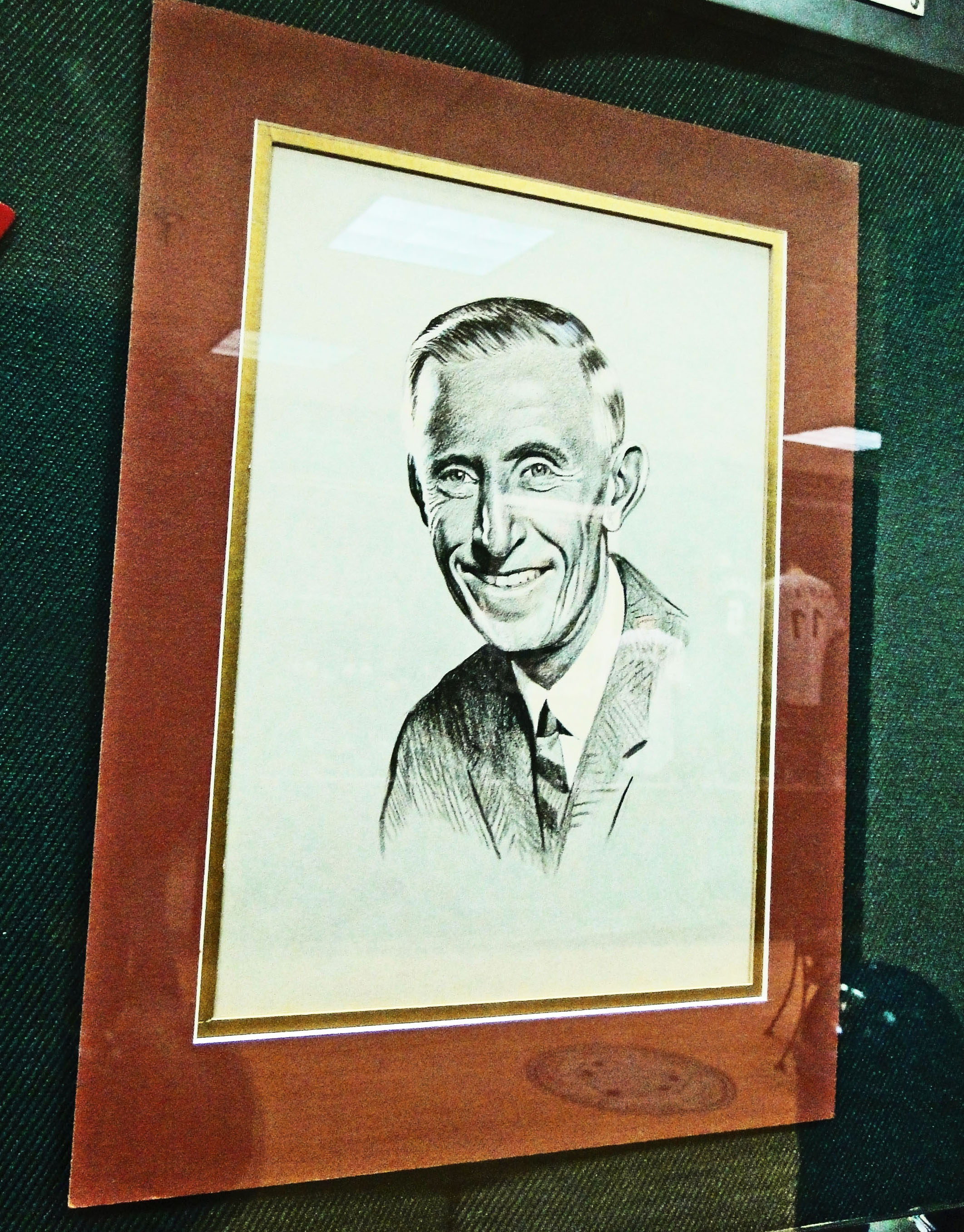
Clark Nealon: Houston Sportswriter DeLuxe.

May 2, 2010

Clark Nealon: He wrote what he saw.

The late Clark Nealon was a Houston sportswriter back in the time of honest reporting on the games themselves. He didn’t write to gain his readers’ accolades or ire. He wrote to tell us what he saw – what we would have seen, had we been at the particular game he was covering. The difference between Clark Nealon and today’s “pay attention to me” writers was the proverbial difference between night and day. Clark didn’t hit the pings on his typewriter keys just to get people writing into the editor about his wiseacre commentary. He wrote to give us as accurate and down-to-earth an account as he could about the specific game in progress.

I missed the privilege of ever meeting Clark Nealon in person during his lifetime, but it’s hard to have grown up having breakfast with his writings without feeling as though he were a member of the family, anyway. I grew up going to Buff Stadium as often as possible,  The rest of the time, I got to fill in the blanks from radio accounts by broadcaster Loel Passe and by the game stories in the Houston Post written by Clark Nealon. Those two men talked and wrote their way into the kitchen table conversations of Buff fans all over Houston.

There is a nice exhibit on the late Clark Nealon at the new and revived Houston Sports Museum at Finger Furniture on the Gulf Freeway. Check it out when you visit the place. I’m not for sure by any specific dates when Clark Nealon started, when he retired, or when he passed away. I only know that he did a great job while he was here and that he is sorely missed today. It was fun reading the work of someone who actually knew something about the sport he was covering – and who could write on sports without throwing his ego in the way of everything he did, as is more often the case in today’s fast-food mentality of Internet electronic sports coverage.

We also have Clark Nealon to thank for being the significant mentor to the funniest, most literate and educational  writer to ever cover sports in Houston, the great Mickey Herskowitz. The fact that both men later found honor by admission to the Texas Baseball Hall of Fame comes as no surprise. Both were consummate professionals as everyday beat writers and each is richly deserving of our fondest Houston Buff memories. Today the attention is simply focused on Nealon.

Thank you, Clark Nealon, for teaching me much about baseball – and for making breakfast about yesterday’s sports action an interlocked experience for as long as I can remember.

Addendum: I just discovered at mid-morning that David Barron has written a nice account of the Houston Sports Museum reopening at Finger Furniture on the Gulf freeway for today’s Sunday, May 2, 2010 Houston Chronicle Sports Section. Way to go, David!

Check it out.

UH Honors Alumnus Richard Coselli and Others.

April 27, 2010

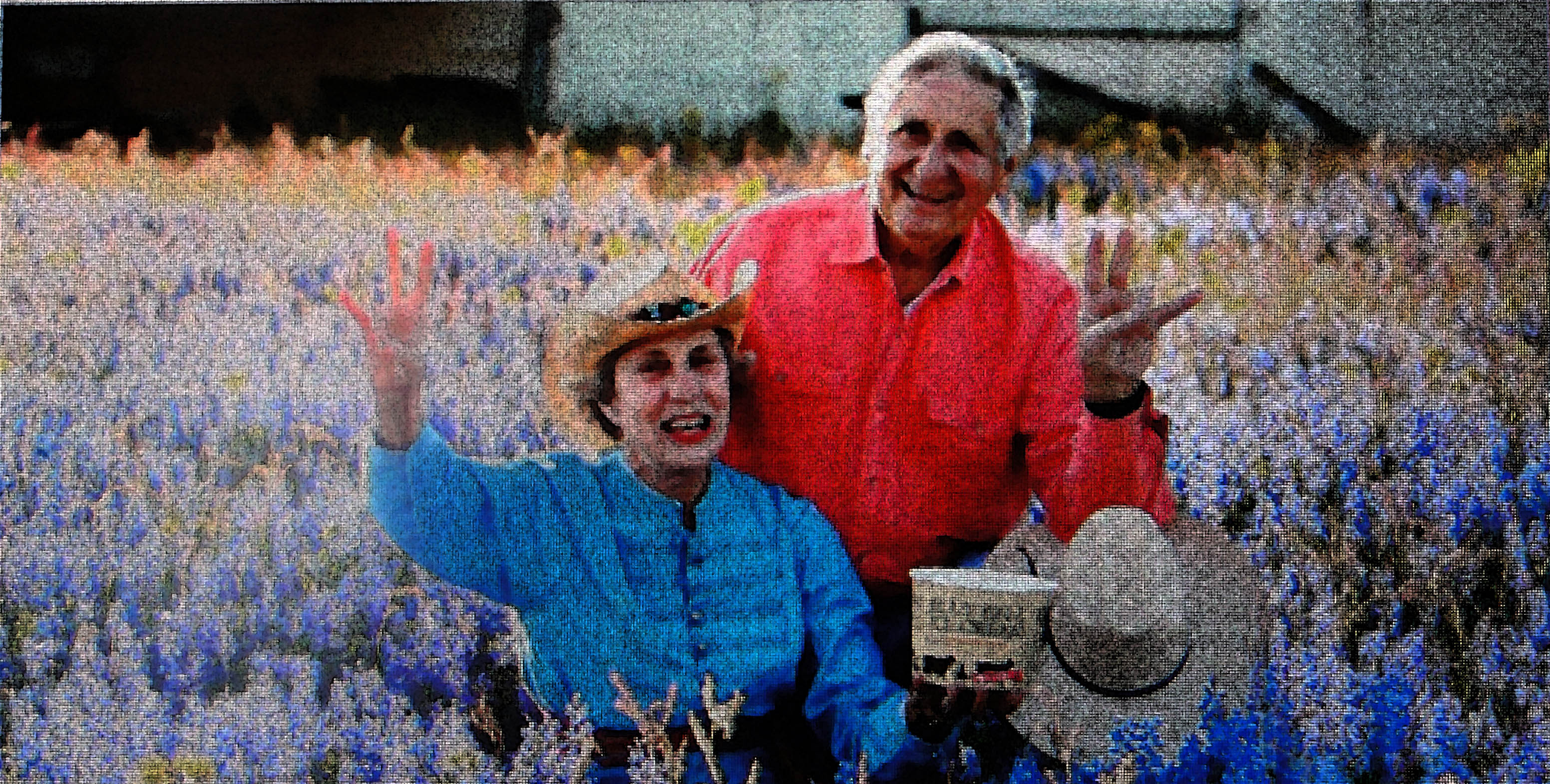
UH Grads Mary Jo & Richard Coselli, At Home in Chappell Hill.

For five years, 2004 to 2009, it was my great pleasure to work along side attorney Richard Coselli as volunteers in service to the Texas Baseball Hall of Fame. As Board President from 2004 to 2008, and as President Emeritus through the crack of doom since 2008, but now retired from active service, it remains my fondest hope that the TBHOF will still someday find its home in the form of a physical presence that Houstonians and fellow Texans will be proud to embrace as worthy of its fully stated mission statement for preserving Texas baseball history.

Mr. Richard Coselli was the major person who helped us organize this effort as a legal entity from 2004 through 2009, even providing us with the use of his own office board room for our periodic meetings. We could not have done it all without him. Richard Coselli just happened to have been the exact person we needed during our transitional years in Houston. He was a native Houstonian and a man who loved baseball. Put that all in the basket with his intellect, experience, wisdom, and senses of balance and humor, and we could not have found a better counsel of service to a cause that remains to this day – one that shall always be larger than the whims, aims, needs, or desires of any single person at the helm of leadership. Although Richard Coselli, yours truly, and most others of us from our original formative group are now gone from direct connection to the TBHOF, I think I speak for us all when I say that we still hope for the best and that the organization will survive these hard economic times and find a way to flourish and grow in the future along lines that are governed by integrity of purpose and stable financial support.

Richard Coselli is no newcomer in service to this community. I could not begin to list all the things that both he and his wife, Mary Jo Coselli, have done for Houston, but the two University of Houston graduates continue to do a great many things.

I first became acquainted with Richard Coselli’s contributions while we both were students at UH more than a half century ago. Richard was slightly older than me back then – and still is, for that matter. Funny how that works. – Anyway, we never met back in the 1950s, but I was very aware of his work in organizing the original Frontier Fiesta at UH, the largest campus college show on earth, one that grew big enough to gain a write-up in Life Magazine – a publication from back in the day that spread the good word  in those primitive pre-Internet times that something big was happening in Houston. Ironically, even though I worked on the Frontier Fiesta myself, Richard Coselli and I never met until we both fell into involvement with the Texas Baseball Hall of Fame move to Houston in 2004. I had been a volunteer member of the TBHOF’s selection committee since 2001, but I didn’t wade into the deep water of its work until 2004, when Greg Lucas of Fox Sports and I agreed to head up a move of the organization’s headquarters from Dallas to Houston. Richard Coselli soon came on deck as our legal advisor.

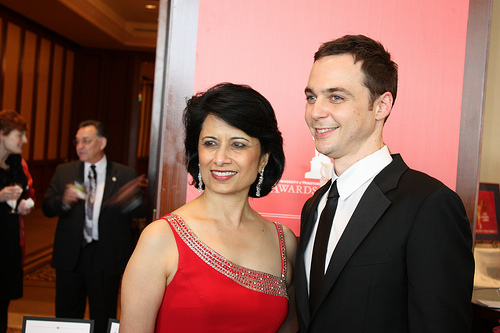
Last Friday night, April 23, 2010, the University of Houston honored Richard Coselli (BS ’55, JD ’58) as one of eleven distinguished alumni who have made enormous contributions to the benefit of UH over the years. The occasion was marked by a formal dinner party, hosted by the UH Alumni Association and addressed by UH Chancellor and President Renu Khator.

President Renu Khator & Jim Parsons (BS '96) of TV's Big Bang Theory.

Richard Coselli was denied the opportunity of being the funniest man on the dais Friday by the presence of fellow honoree Jim Parsons. A 1996 UH graduate, Parsons is having a pretty good run these days on television as the star of the hit comedy show called “The Big Bang Theory,” but that is OK too. Our UH people come in all ages, shapes, and sizes across a diverse line of differential talent.

Richard Coselli simply brings a quartet of elements to the table of any enterprise that money cannot buy. Their names are intelligence, loyalty, honesty, and integrity.

Congratulations, Richard! It’s good to know that our university has now officially recognized what a lot of your friends have known for years. You are the kind of person that has made the University of Houston and the City of Houston the great places they each are.

“In Time” is our UH motto. In time, UH has now finally recognized one of its own for all he has done in service to the greater good of the university community. Congratulations again, my friend. You deserve every ounce and inch of credit that flows from this much larger measure.

Historic Houston Streets: Just To Name a Few.

April 20, 2010

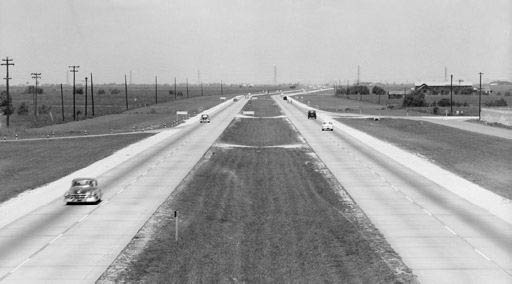
Gulf Freeway 1952: Two Lanes North. Two Lanes South. Who could ask for anything more?

A few light years ago, a fellow named John Churchill Chase wrote an entertaining book on the origins of street names in New Orleans. Entitled “Frenchmen Desire Good Children and Other Streets of New Orleans,” the book was a popular hit in the Crescent City, where colorful events and the names of its roads and avenues usually sparked of mystery and adventure. Heck! During the time I worked for Tulane Medical School in the mid-1960s, I lived in Pirate Alley. Hard to top that one for color anywhere.

Now a fellow named Marks Hinton has written a book about the history of Houston street names. It’s called “Historic Houston Streets: The Stories Behind the Names.” It’s not nearly as extensive or colorful as the New Orleans book, but so what? We’re Houston. We were never the home of famous buccaneers like Jean Lafitte. We are what we are – and it’s still interesting to know how we got some of the street names we still use. The book falls far short of explaining many that I personally would like to know about, but let’s take a quick look at some of the bigger ones it covers.

Crawford: Today this north-south downtown street is most famous as the namesake of the seats that sit perched a mere 315 feet down the left field line at Minute Maid Park. These so-called Crawford Boxes are all that stands between a right-handed batter’s home run swing and Crawford Avenue or Street that lays just beyond the Minute Maid Park exterior. It was always called Crawford Avenue when I was a kid, but today I hear and read a lot of references to it as Crawford Street. Pick which you like better, I guess. At any rate, Crawford was named for Joseph Tucker Crawford, a British agent who was sent to Houston to evaluate the developing situation in the newly formed Republic of Texas back in 1837. According to Hinton, Crawford’s mission wasn’t to explore ways of making Texas a British colony, but to see how Texas could usefully help block America’s expansion westward. So, what it comes down to is this: Crawford came here to try to get Texas to help England throw a monkey wrench into the American Manifest Destiny and our city’s pioneer leaders ended up naming a major downtown street for him. Go figure. Or else use this little known information as a part of a local parody of “Take Me Out to the Ballgame.”

“…Buy me a seat in the Crawford Box; that guy came here an American Pox.”

Cullen Boulevard. It is the main street at the University of Houston and it once served as the main drag beyond the right field line at Buff Stadium on the Gulf Freeway. Most people know this one, but it bears repeating for the sake of remembering one of Houston’s greatest philanthropists. Hugh Roy Cullen is the namesake person here. Cullen was the wildly successful oil man who gave millions to Houston charities over the years – and especially to the University of Houston, Baylor University, and most of Houston’s major hospitals. They threw away the mold for generosity when Mr. Cullen departed this world years ago.

Kirby Drive. Named for John Henry Kirby, a very successful 19th century Houston lumberman and capitalist, this is the street that runs directly beside the Reliant Stadium-Astrodome complex in a very appropriate way. In 1895, when professional baseball was struggling for a breath of fresh sustaining life in Houston, Kirby headed up a small group that established the “Houston Baseball Association” to keep the city on its feet in the new Texas League. The “HBA” capitalized the Houston baseball club with $3,000 in operating funds and installed Kirby as its first president. Because of Kirby, early professional baseball in Houston survived the turn of the 19th into the 20th century and set all in motion for the long banner life of the Houston Buffalos through 1961.

Westheimer Road. Named for Michael Lewis Westheimer, who immigrated from Germany to Houston in 1859, the namesake here was a diversified buusiness entrepeneur who bought and developed a 640-acre tract of land west of Houston. If you know Houston, you’ve already heard enough to get where this is going. Most famous locally for his Westheimer Transfer and Storage Company, Westheimer Road followed from here where Mr. Westheimer went, becoming to this very moment the other major artery alternative to Memorial Drive and the Katy Freeway as the major corridor to  Houston’s forever expanding western growth. Memoril, of course, is assigned as a name to honor all men and women who have given their lives in defense of this nation; Katy Freeway and old Katy Road before it were named for the little city they once approached to the west of Houston.  That same Katy, Texas was swallowed long ago as one of Houston’s present and major bedroom communities.

Gessner. August Gessner also migrated from Germany to the United States in 1886. He fought in the Spanish-American War with Teddy Roosevelt and later built a monument to the Rough Riders in Puerto Rico before coming to Houston and establishing himself in business as a cabinet-maker. Years later, when Harris County built a north-south way that covered a lot of ground on the then unincorporated west side, they needed a name. Longtime Commissioner Squatty Lyons raised his hand and offered something like the following, “Hey! I went to school with this nice guy named Gessner. We could name it for him. His family are all good people.”

Sometimes it is who you know that matters, but I would like to see us do more to name our city streets for people who have made some particular contribution to the city. Holcombe Boulevard was a great pick, deriving its name from longtime former Mayor Oscar Holcombe, a politician who stood up to the Ku Klux Klan back in the 1920s, loosening their hate-mongering control of things and freeing Houston for future growth. We’ve also named a number of streets for Houstonians who served in World War I. The later wars could use a little better presence on the naming list.

Hey. All that’s good. I’d just like to see us make better use of street-naming as a way of remembering the many others who have made significant contributions to the history of the city.

For example, Allen Russell, the 1946-1952 President of the Houston Buffalos who really put our city on the map for major league baseball expansion, tops my list of people who are most deserving of a  significant street name. I’m sure we have others in the fields of sport, education, business, space, and the arts who are just as deserving too. In fact, if you have a favorite candidate for a Houston street name, please list it below with a brief statement of why you think that person deserves the mention.

At any rate, the little reference book on local street nmes is a fun read for Houstonians. One of its sidebar features is a display of interesting street intersections. Someplace in town, the streets of “Mutiny” and “Bounty” intersect. We may not have much of a local histroy in piracy (excluding mention of some closely similar practices in the oil industry), but we do apparently have some recollection of major conflict on the high seas, even if quite a bit of it was fictional in content.

The least we might do is to get rid of that practice of allowing developers to build new neighborhoods with all those cute-sounding similar names that just make it easier for our postal service to fail us. Know what I’m talking about? Try sorting the mail for a neighborhood that includes Westwick, Wickwild, and Wild West, for example. I think I made up the “Wild West” street, but you get the idea. We do have a Wilcrest, a Wickchester, and a Wilchester  that are all  pretty near each other. Maybe it’s time to finally simplify the things that can be simplified.

Ticket to Yesterday.

April 17, 2010

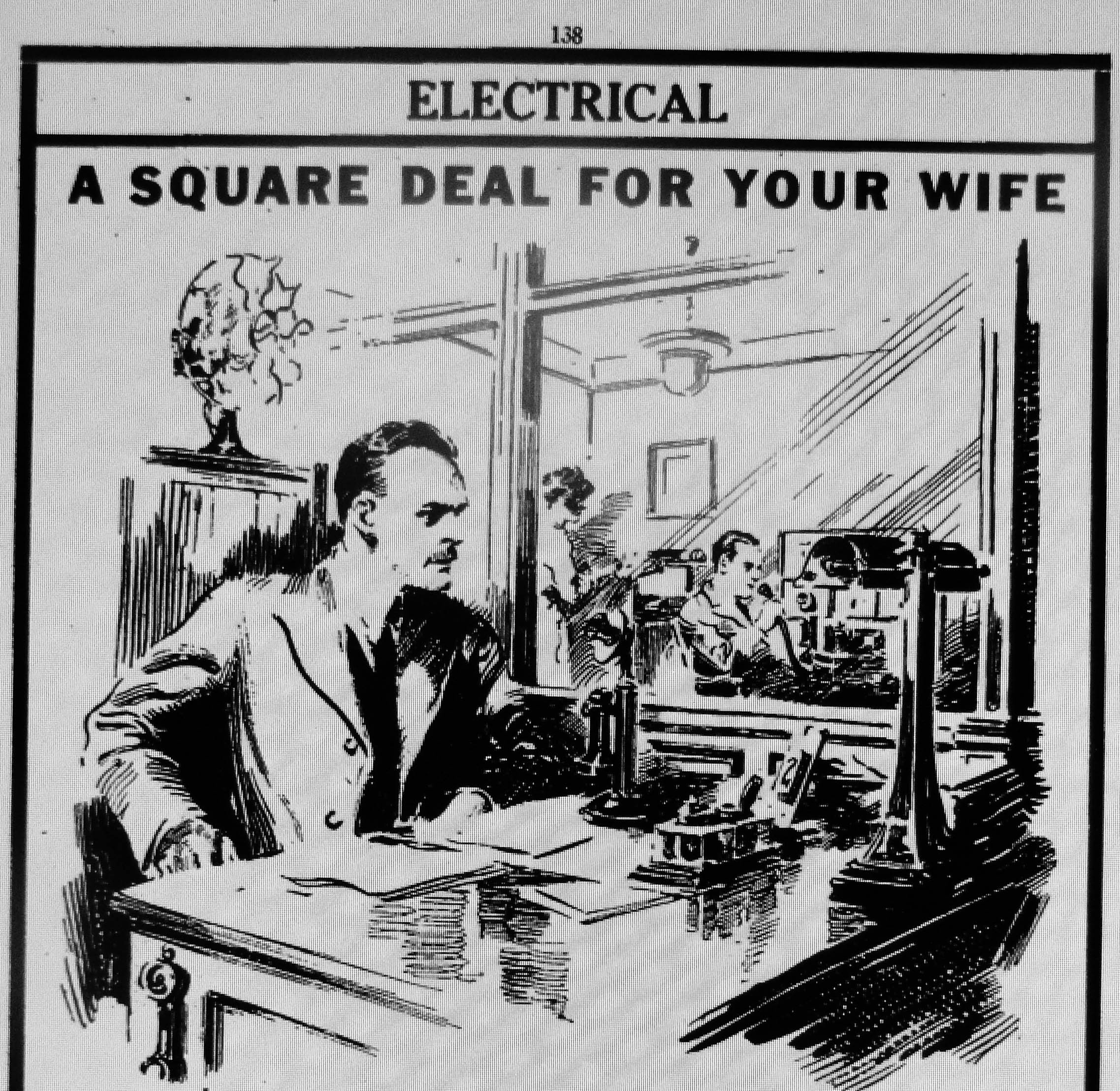
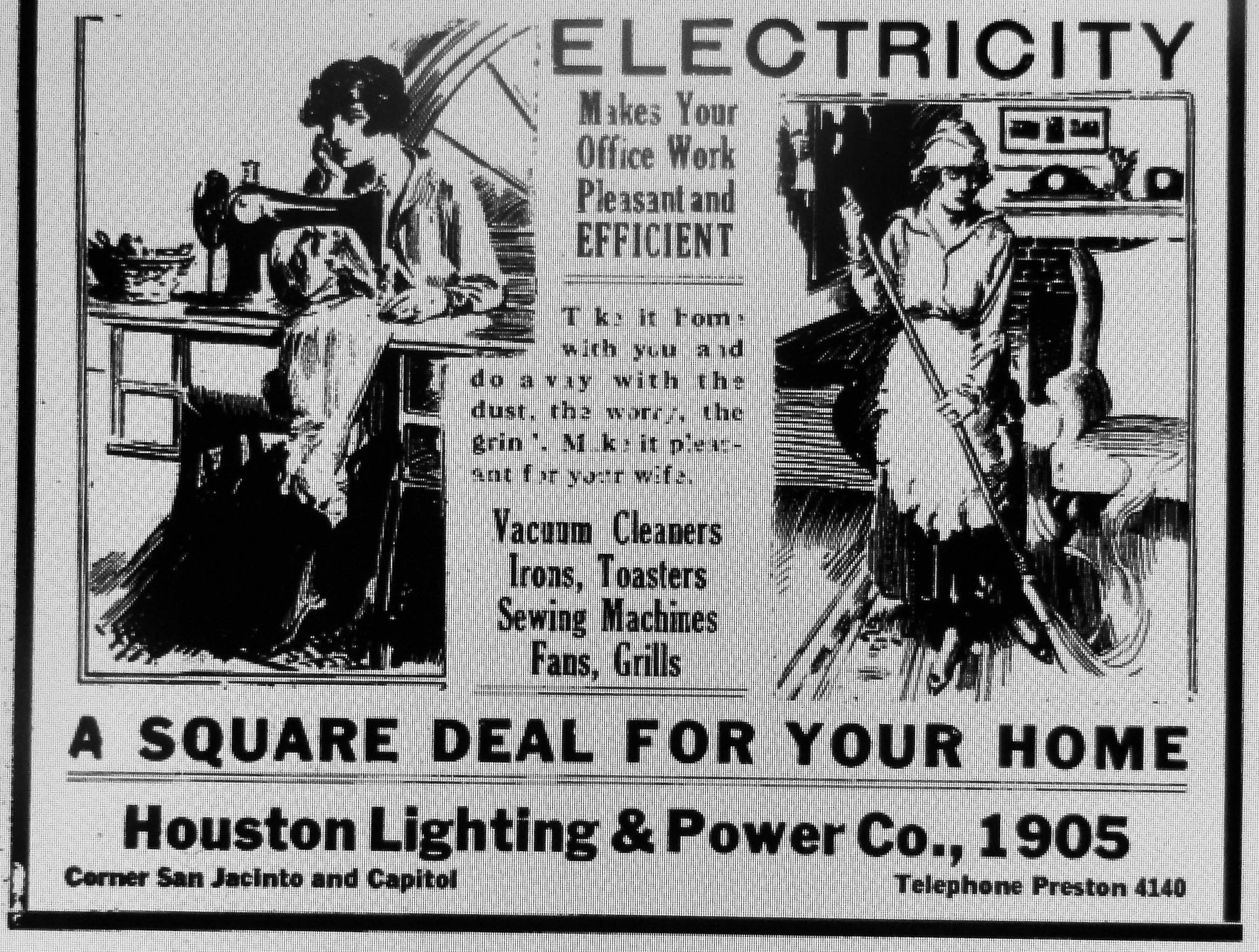
Excerpt from 1919 Houston City Directory, Part One.

Excerpt from 1919 Houston City Directory, Part Two.*

* The small print above reads: “Take it home with you and do away with the dust, the worry, the grime.  Make it pleasant for your wife.” Houston Lighting & Power Company (now Reliant) was located at San Jacinto & Capitol back then and their telephone number was Preston 4140.

This 1919 advertisement for the Houston Lighting & Power Company goes on to extol the modern  conveniences of those new applainces that were then available, but only to those businesses and families that subscribed to the provision of electrical power for the office and home. Such items as vacuum cleaners, irons, toasters, sewing machines, fans, and grills were all then listed as items that any family should want to have live and running back in the post World War I days of life in Houston, There was no mention of radio and air conditioning, Those luxuries were an eye blink and another world war away from widespread popularity and dependency – and forget television, microwave ovens, and the Internet. Those convenient consumer addictions were several amusement and comfort-hungry generations down the road.

Now, in 2010, it’s only possible for me to be sharing this story because of our ready and taken-for-granted-until-Rita-and-Ike dependency upon the everyday  availability of electricity here in Houston. Boy! Did those two monsters of nature ever take us quickly back instantly to the everyday realities of our steaming hot and humid way of life in Houston back in General Sam’s day!

All of this commotion here too is just my way of sharing the news with those of you who don’t already know that our wonderful Houston Public Library system has now made several ancient Houston city directories available to all of us online for the first time. Now we are helped again with our local research by the library’s constantly moving efforts to make our work easier and freer of physical trips downtown to the archives for everything.

For those of us involved in local baseball research, the availability of these sources dating back to the Civil War era are a monumental gain for all of us non-funded research people who would otherwise have to schedule time for going downtown, and paying for gas and parking, simply to look up an antiquated street address. Now we shouldn’t have to do that on many occasions.

The danger of these ready resources is similar to the risks we all face in local reasearch. You will find so many items of distraction from your original purpose that you will need to stay focused on why you are doing a particular search. (One of these days, I’m going to have to go back and try to learn more about that bar I found in downtown Houston back in the 1890s. They called it the “Two Orphan’s Saloon.” What a great name for a turn of the 20th century watering hole.)

Here’s the link that will get you to the general site where all the directories are online.

http://digital.houstonlibrary.org/cdm4/browse.php?CISOROOT=%2Fcitydir

Thank you, John Civitello, for letting me know about the availability of this incredible resource. And have a nice weekend, everybody – especially if you plan to spend it in search of Houston’s history.

Tod Herring: Terror of the East End.

April 7, 2010

Tod Herring, As Many of Us Older East Enders Remember Him.

If you grew up male in the Houston East End in the years following World War II, you knew who Tod Herring was by reputation, if not from painful personal experience. He was the meanest dog on any block for miles and none of us who grew up in his territory are likely to ever forget him. I was reminded of Tod yesterday when jack Murphy, an old St. Chistopher’s Catholic School buddy wrote to remind me of Tod’s once dominant terror upon our collective unconscious.

In Herring’s case, “collective unconscious” bears a more literal meaning than the definition intended by Dr. Carl Jung. With Tod, “collectively unconscious” would have been the probable group outcome for six average guys who tried to take on the biggest bully in Pecan Park and environs by themselves with no back-up plan.

Here’s what Jack Murphy said to me in his e-mail:

“Bill, if memory serves, the absolute official start of summer (in the East End) was marked by the reopening of the bathtub sized Mason Park Pool and the annual attempted drowning of yours truly by Tod Herring and his Southmayd (Elemenery School) gang of pagans.”

“Brother Bill (Murphy) always came to my rescue and the St. Christopher Catholics lived to drown another day while Tod went on to become the Texas Heavyweight champion and a sometime drinking companion.” – Jack Murphy

Jack Murphy’s memories of Tod Herring are a lot more personal than mine. They were each older than me, a fact that us younger eyewitnesses to street mayhem always quietly celebrated. Being younger and smaller than Tod Herring bought you a degree of invisibility in his presence. Tod always seemed more aware of those guys who were just as big or bigger than him, especially if they showed any kind of attitude that suggested they thought they were hot spit. On the physical and psychological planes, Tod Herring lived simply as the dominant alpha male – one main guy who wasn’t going to take any spit from anyone, especially from those who also thought they were more deserving of his top position in the pecking order of life on the East End streets.

The first time I saw Tod Herring in action was sufficiently convincing to me. Several of us were walking home from the Pecan Park school bus when we came up upon Tod getting into a screaming match with some other guy about his size. All of a sudden, the two guys are squaring off with double fists, and making this little circular look around each other.

Tod Herring

All of a sudden, the argument and fight are over with one blow to the jaw from a Herring right hand to the other fellow’s face. The other guy dropped to the sidewalk like a dead pigeon. He was out cold. The fairly ripped Tod Herring stood over him for a second or two and then just walked away. He never spoke or even acknowledged the presence of the rest of us before he walked away like Mr. Cool. I guess our cloaks of invisibility were working pretty good. And the other guy didn’t die. We helped him up as best we could. He then walked quietly away in the other direction from Herring, and also in a state of not saying much, if anything, to us onlookers.

My awareness of Tod Herring sort of dimmed after I finished the 8th grade at St. Christopher’s Catholic School and started commuting across town to St. Thomas High School. Herring and most of my Pecan Park neighborhood pals had headed for Milby High School. I’m not sure how Todd Herring got along in high school, but I can’t imagine it being much different from anything we had seen up to that point. My next awareness of Herring surfaced during my undergraduate years at UH (1956-60). I started reading about Tod Herring in the Houston Post as an up and coming heavyweight boxer.

That recognition of him as a boxer, left me with only four more freeze frame pictures of Tod Herring’s life to come as I went my own way through the early adult years:

(1) Fighting the Former Heavyweight Champ. On May 14, 1965, Tod Herring of Houston fought former heavyweight champion Floyd Patterson in Stockholm, Sweden. Patterson knocked out Herring in 40 seconds of the third round, pretty much ending whatever hopes the former Houston bad boy still had for winning the title. I never thought much of Patterson prior to that fight, but that KO of Herring changed everything. Anyone who could knock out Tod Herring had to have something special going for him.

(2) Tod Herring Charged with Killing a Man in a Bar Fight. I have no dates for this memory or for any of the rest. It happened sometime in Houston in the early years that followed the end of Herring’s boxing career. Herring was charged with killing a man with his fists over some kind of bar argument. The prosecution argued that Herring’s professional background as a boxer even made his fists a “deadly weapon.” (Heck! A lot of us non-lawyers from the East End could have testified to that assertion.) At any rate, Tod was sentenced to the penitentiary, apparently going there with a drinking problem that wasn’t that easy to arrest.

(3) Tod Herring in Recovery. Sometime around 1980, I read in the Houston Post that Tod Herring was now out of prison and living a clean and sober life again back in the East End. The article even featured a great smiling photo of Tod Herring, swinging a golf club out in the sunshine of the Glenbrook Country Club, as Herring also bubbled with gentle praise for the lessons of recovery. He sounded nothing like the archetypical bogeyman that many of us grew up fearing. I was happy for him. He had family around him and they all seemed to love and support him in his recovery.

(4) Tod Herring is Dead. Not too many years later, I picked up the paper one day and learned that Todd Herring had passed away suddenly – from a heart attack, I think. I have no idea if Tod had been able to stay out the grip of his addictions since the time of that earlier feel-good article or not. He was just gone now. Gone again and this time for good. He was also gone again from my mind until my memory of him was reawakened in the e-mail from Jack Murphy.

What’s the lesson here? I’m not sure. Maybe it’s simply that even the monsters of our childhood memories are not all bad and terrible sometimes. Sometimes they are, but other times, they are just human beings who found a deeper way to get lost from love.

God rest your soul, Tod Herring, wherever you may be.


Sandlot Days: Making Do with What We Had.

April 2, 2010

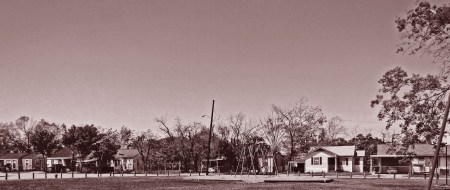
"Eagle Park", Japonica@Myrtle, Houston, Texas.

For a lot of us who grew up back then, the years following World War II were not even close to the cornucopian basket that others have known in this land of the fatted calf. In East End regions of Houston like Pecan Park, we had to make do with whatever we had – or repaired – or built – or simply imagined our way into use as tools in the art of play.

Sometimes our imaginations got us into trouble. And street war games became a ripe arena for a number of mistakes we made in pursuit of authenticity. One time, for example, about six of us caught hell for the unauthroized requisition of eggs from our home refrigerators for use as hand grenades. Another time, my little brother John used a real grenade casing that our Uncle Carroll had brought us from World War II and heaved it through the open window of slow driving car that was passing by the front of our house.

The driver of the car turned out to be a veteran. The sudden presence of the grenade on the seat next to him provoked screams of PTSD horror I shall never forget – and neither will brother John. The man stopped his car down the street and came running back to our house with mayhem in his eye. Fortunately for John, our dad came rushing out of the house to intervene and to administer a “whipping” that I’m sure John has never forgotten. I’ve never seen Dad so mad – except on those occasions when he was equally mad at me for some stupid thing I did.

“Now you stay out of the street and never let me catch you throwing hand grenades again!” Dad ordered.

“What if I run out into the street and get killed by a car? Then what are you going to do?” John asked.

“II’ll probably be so mad you disobeyed that I will whip you anyway!” Dad answered.

I later got a whipping like that for a far worse offense. That was the time I asked a machinist neighbor to build us some working pipe guns that we could use to ward off invasion at Eagle Park from the kids on Kernel Street. We didn’t explain our true purposes in wanting the guns. We said we needed them for target practice, but that was never our true goal.

I’ve written about this gun incident before. My dad caught us in the act of firing these weapons at the Kernel kids and took them away. Then he made us Japonica-Myrtle Eagles settle our differences with the Kernel kids in a game of baseball. Then he whipped my posterior in a way that left me virtually buttless. It was one of those corner-turning experiences from childhood that would have gone a very different route had it not been for the presence of the greatest hero in my life, my dad.

At Eagle Park, we made do with what we had. The gloves we did have were hand-me-downs from dads and older brothers. The balls we used were most of the time those cheapos that flattened out on one side with the first solid contact smack of the bat. The few good baseballs that we captured at Buff Stadium stayed in play for as long as we could hold them together with black electrical tape. Even the best of all  baseballs could not hold up for long against the skinning they each took with the one-block skip and roll down concrete streets as a result of mighty hits one way – and catcher misses the other.

To cut down on the damage to balls from catcher misses, and mainly to have a ball retriever, we created a tenth defensive position we called the “hind catcher.” We would not have needed a hind catcher nearly so often if we had been blessed with a backstop, but that was a piece of equipment we didn’t have at Eagle Park.

The hind catcher stood about ten feet back of the catcher. It was his or her job to stop an balls that got past the catcher, or else, chase them down Japonica Street and get them back in as soon as possible. It was job we always gave to the youngest, most naive kids, the one who were trying to earn their way into the actual game. We stressed to our hind catcher recruits that those who stopped balls most often and went after the loose ones the fastest had the best chance of breaking into the everyday game on the field.

It was a popular job among the little kids. Sometimes we would even have a hind-hind and a hind-hind-hind catcher out there backing up the hind catcher. At the end of the day, or as some kids had to go home early from the field, all our hind catchers moved into the actual game and got to bat – at least once.

The system worked for us. It’s how we all started.

Bat preservation also presented certain challenges. Since all our bats back then were also old and always wooden, they eventually cracked and became useless without repair. We nailed and taped our bats back together too, looking for every last hit we could ring out of each sacred bludgeoning weapon that still stood moderately straight in our baseball war chest. A bat had to break totally in half before we gave up on it for all time.

As for bases, we used what we could find. We never had permanent bases at Eagle Park. Garbage can lids  worked for home plate, but they sure expanded the strike zone. We used everything from decaying hunks of sidewalk curb concrete to tee shirts for our actual bases.

On those days we couldn’t field eighteen players for a regular game, we played “Work Up.” It was just baseball with fewer players and a slightly different goal. You had three to four batters in Work Up. The object was stay at bat as long as possible. If the defense got you out, all the fielders rotated from 9 to 1, with the number 1 fielder, the pitcher now going in to bat. The number 2 catcher now moving to pitcher, etc. You, of course, moved to the number 9 right field position to try to do what game says, “work up” to becoming a batter again.

Another popular game for a small number of players was “Flies and Rollers.” In this game, one player hit fungos to the other players in the field. The first fielder to successfully handle either three flies or nine rollers, without a miscue, got to replace the fungo stick batter, who would now take the field.

Somehow we survived. A big part of that “somehow” was the fact that we all mostly had parents who cared; we lived in neighborhoods where other parents could and did intervene and deal with issues of bad judgment and miscreant kid behavior; and the world was still safe enough for us kids to go out there and work things out on our own.

A lot of us didn’t have much back then, but we neither thought of ourselves as poor or entitled to everyday salvation at the expense of the community. Our parents taught us that jobs were the answer to financal needs and that you simply didn’t buy things you could not afford. We learned to make do with what we had.

We did OK, even if a very important part of our little world was being  held together most of the time by electrical tape.
Phi Slama Jama Remembered.

March 14, 2010

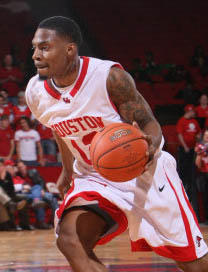
Akeem Olajuwon (34) & Clyde Drexler (22) Both Became Top 50 NBA Greats.

When the featured photo of today’s article on the University of Houston Cougars was taken during the 1982-84 run of Phi Slama Jama, Hakeem was missing an “H” in his first name and Clyde had a lot more hair on his later famous bald pate. Olajuwon was two to three years into his pro career as a Houston Rocket before he bothered to correct the media that his first name was spelled “Hakeem” and not “Akeem.” Clyde’s hair style change simply ook care of itself with the help of time and Mother Nature.

Houston Post sportswriter Tommy Bonk gave those great UH men’s basketball teams of the early 80’s the nickname of Phi Slama Jama in an article he wrote about the team on January 6, 1983. It caught on like a gasoline fire as a description of the basketball winning conflagration that rolled on behind Olajuwon, Drexler, and their brethren in the World’s Tallest Fraternity. By the 1983-84 season, with Drexler already gone early to Portland of the NBA, the Cougars were even wearing Phi Slama Jama stitched into their uniform game jackets. The sky seemed to be their only limit and Coach Guy V. Lewis seemed a shoo-in for the National Basketball Hall of Fame.

The Cougars made it to the Final Four all three years of their roaring reign, but never quite got to the brass ring on the NCAA marry-go-round. In 1982, the Coogs lost to North Carolina and Michael Jordan in the semi-finals. Then came 1983 and the national championship that got away. The Cougars led North Carolina State most of the way in the low-scoring final game of the NCAA tournament at Albuquerque, but a late decision by Coach Lewis to hold onto the ball and an eight-point lead backfired. There was no shot clock in 1983 and teams could sit on the ball all night if they had both the ability and the will to do so.

Th Cougar effort backfired when the Jim Valvano-coached Wolf Pack fouled the errant shooting Cougars into surrendering the lead with missed shots at the free throw line. Then, with time running out and the game tied at 50-50, NCS inbounded a pass that Lorenzo Charles stuffed to take a 52-50 championship victory right out of Houston’s expected grasp. The UH Cougars lost their most famous bid for a national basketball championship. The Cougar loss in 1983 also halted a 26-game winning streak and left UH with a final record for 1982-83 of 26-2. The way they lost, unfairly or not, has so far been the factor that has kept a career-record deserving Coach Guy V. Lewis out of the Hall of Fame. As a Cougar alum, it makes me sick to even think about the far-reaching pain of the NC State loss and its long-range bearing on UH.

Clyde Drexler left the Cougars early after 1983, but Olajuwon was quickly joined by fellow All American star Michael Young for a return to the Final game in 1984. This time, however, the contest was not so close as the Cougars went down at the hands of Patrick Ewing and the Georgetown Hoyas. Still, the Cougars were there for three years in a row. Other than UCLA, not many other university clubs can make the same claim.

I was reminded of Phi Slama Jama by the Houston Cougars’ victory over the UTEP Miners in the final game Saturday of the Conference USA tournament. Now playing under Coach Tom Penders, the Coogs had to win games for four days in a row to pull it off, with that final 81-73 win over UTEP giving UH their first trip to the NCAA Tournament since 1992.

These Cougars are not to be confused with Phi Slama Jama, but they are quick, they are spirited, they hustle, they ride their hearts hard, they play as a team of brothers, and they never give up. It will be of passionate interest to Cougar fans to see how far UH goes from here in the tournament. No one is expecting a 19-15 club with a closing conference tourney table run of four wins to take the national championship, but it will be fun preparation for next season to find out how much gas they have left in the tank for this year’s business.

Aubrey Coleman of UH is the nation's top NCAA men's basketball scorer for 2010.

The nation’s leading scorer, Aubrey Coleman, had an off-day for UH Saturday with only 13 points, but teammate Kelvin Lewis lit up the UTEP Miners at the Tulsa-site tournament court with a 28 point contribution to pick up the offensive slack for his basketball brother.

UH 2010 may not be close to Phi Slama Jama by attribution, but they are doing pretty well since Coach Penders dubbed them as the “DMW” (Dead Men Walking) team in Game One of the tourney, These Cougars are a “Band of Brothers.” They may not win again this season, but who knows? The DMW gang has had  nothing more to lose since losing a week ago last Saturday to a 9-20 Tulane club in the final game of the regular season.

For the record, the UH miracle run played out this way in four consecutive days:

Wed., March 10: UH 93 – East Carolina 80.

Thu., March 11: UH 66 – Memphis 65.

Fri., March 12: UH 74 – Southern Miss 66.

Sat., March 13: UH 81 – UTEP 73.

As a result of this week’s hard-earned miracle win in the C-USA championship tournament, all things are now possible. The Cougars have won for themselves a NCAA tourney dance card as a 2010 Cinderella club. And you’re never a pumpkin in this old world until you start turning orange and soggy.

Wait a minute! I’m feeling something! – How’s my complexion?

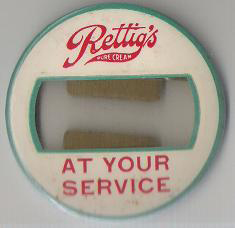
Rettig’s Ice Cream was Hmm! Hmm! Good!

March 3, 2010

Retttig’s at 1900 Milam Made & Sold Ice Cream on a Wholesale & Retail basis.

The sign above says it all. If you need more of a visual reminder, check out these copyright protected photos of what used to exist at the 1900 block of Milam in downtown Houston from the 1920’s forward for about thirty years. (You may have to cut and paste the following website address to see them.)

http://www.sloanegallery.com/historic_houston_texas_vintage_r.htm

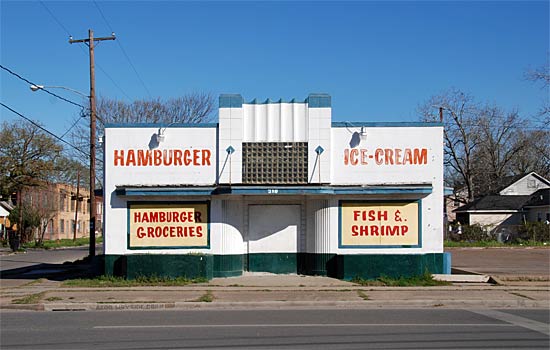
Rettig’s produced some delicious ice cream in several tasty flavors. They eventually got around to opening several neighborhood stores around Houston that they called Rettig’s Heap-O-Cream. Here’s a photo of the one I remember best at 210 Wayside. The old store building remains, but is now all boarded up, as though it were waiting for a comeback that is now never going to happen.

Rettig’s Heap-O-Cream, Once Upon a Time at 210 Wayside.

Things always change, but the great taste of delicious ice cream remains popular to the palate even though it now must battle with new health information, common sense, and the politically correct forces of the Dr. Oz types who want to move all of us hard-core sugar addiction cases to a far healthier, more boring way of life.

Thanks for the memories, Rettigs!

A Walk on the West Houston Wild Side.

February 18, 2010

For many of us in Houston these days, the walking/jogging tracks are our primary venues for physical exercise. Bear Creek Park on Eldridge has been my home field for over twenty years with  an occasional few laps at Thomas Hershey Park on Memorial Drive thrown in every once in a while to break the spell.

Over the years, it seems to me that we regulars have been seeing a lot more wildlife on the walking paths than we once did. Wild deer standing around the paths at dusk in the spring and fall, however, have been regular sights for years at Bear Creek. Snakes in the springtime and rabbits all year-round are also no big news, anymore, any more so  than the sight of raccoons, possum, buzzards, vultures, cardinals, and a wide variety of other indigenous wild birds.

It’s just that lately we’ve been getting an increase in the sporadic sighting, especially at Hershey, which trails for great distances along side Buffalo Bayou, of more exotic predators like wolves, coyotes, and most recently, a cougar.

I wouldn’t want to meet up with any of those last few guys on any walking trail anywhere, but it’s possible that any of us might one of these days. The wildlife refuge beyond Addicks Dam has been so stirred up in recent years by the incredible residential and commercial growth west in Katy and north around Little York that it isn’t hard to figure why we are seeing more wild life moving inward upon us. They aren’t being pushed away by Houston’s growth. They seemed to getting squeezed from the perimeters to move back into some of the neighborhoods in the Memorial Drive area to look for food.

Sometimes that food source is the family pet, so keep your eyes open to what’s going on around you. It’s one of the prices we have to pay with our relentless willingness to mess with Mother Nature.

In The Big Inning …

February 10, 2010

Houston's Baseball Tree Was Not Without Buffaloes Forever.

In the 1861 beginning of Houston “Base Ball”, there were no Buffaloes, no paychecks, and no players. Organized several weeks beyond the Texas secession from the Union, base ball had to wait for the end of the Civil War before it really took off as the most popular sport in town, but the seeds of love for the game had been planted early.

Contrary to popular theory, Houston already knew about baseball prior to the Civil War. It was not one of those southern cities that only learned about baseball through the experiences of returning Confederate veterans who had been exposed to the game as prisoners of war.

Remember. Houston’s founders, the Allen brothers, came here from New York in 1836. They brought with them other New Yorkers and they continued to attract new settlers from the northeast section of the country that was already involved in the evolution of baseball. For all we know, the first Houstonians may have been playing some kind of baseball from the very start, and certainly from beyond the 1845 date of the Cartwright-rules game that came into fashion on the Elysian Fields of New Jersey. It is most unlikely that the founding group that met in the upstairs room above J.H. Evans Store in Market Square on the night of April 16, 1861 had never played a single game of base ball on Houston soil prior to that evening.

If only F.A. Rice were here for five to ten minutes borrowed time from his eternal tour of eternity beyond the grave, he could clear up  lot of questions for us. F.A. Rice was the man the new HBBC elected as their first president on that now documented date of the group’s formation. He could clear up so much for us with even a few nods of the head. Unfortunately, that’s not how this thing works.

All we know for sure from that little newspaper clipping about the April 1861 foundation of the Houston Base Ball Club is that organized interest in the game existed in Houston at least as early as the beginning of the great Civil War.

Unfortunately, the graves and their occupants cannot be summoned to help us flesh out most of the unreported details.