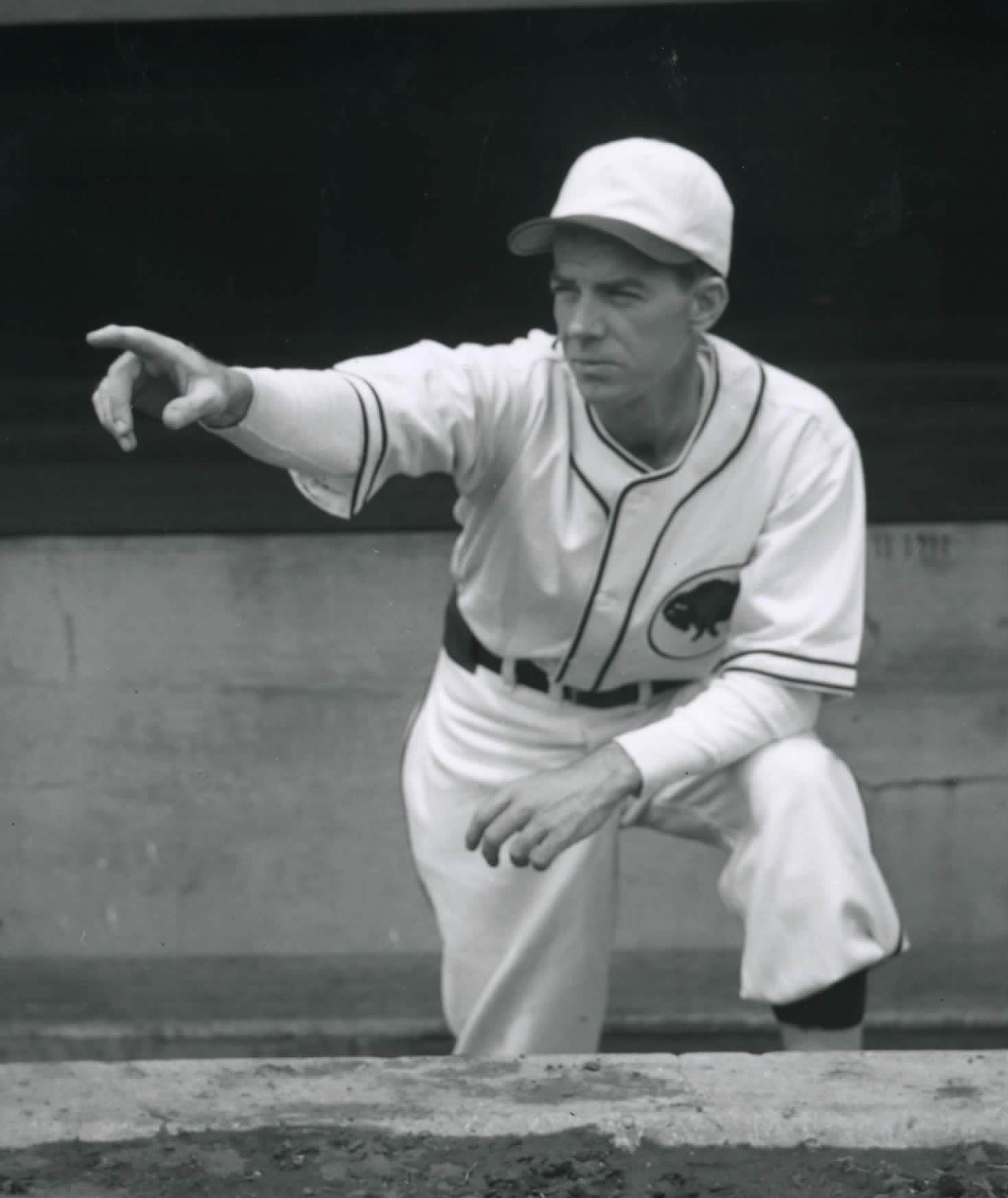
1947 Manager of the Dixie Series Champion Houston Buffs and former Buffs player Johnny Keane. His worst career move proved to be the one he took after leading the 1964 St. Louis Cardinals to the World Series title.
Thanks to 9 new contributions from Bill Hickman (SABR National & Cubs Fan), plus confirmation of one of those on Herman Franks that actually came in fifteen minutes earlier from John Watkins of our research team (and a descendant of former Buff and Cardinal Watty Watkins), our list of Houston minor league team players who went on to become MLB managers to what may be our complete total at 23 confirmed names. As always, while data collection is still open, the Early Houston Baseball Research team remains open to the addition of any other names we may have missed.
Our appreciation to both contributors for these valuable listings in this very interesting Houston Baseball area of fact. John Watkins is already on our list of research contributors. He is now joined by Bill Hickman – and anyone else who submits a confirmed name in this category that all our efforts have so far missed.
Sometimes getting it right means giving a search long enough to get it complete. Even though I think we have now cleared the bases on this one, as project research director, I’m leaving this one open for now – just in case.
Here is the updated list of 23 Houston team player names, followed by their year(s) of service as a Houston minor league team player in parentheses, followed by a dash to the names and periods of service as manager of specific big league clubs, plus brief data on (WSC) “World Series Championships” and other pennant years, if any:
Houston Minor League Team Players Who Became MLB Managers:
01) Bill Joyce (1889) – New York Giants (1896-98)
02) Johnny Kling (1896) – Boston Braves (1912)
03) Tris Speaker (1907) – Cleveland Indians (1919-26) / 1920 WSC
04) Jewel Ens (1920) – Pittsburgh Pirates (1922-25)
05) Jim Bottomley (1921) – St. Louis Browns (1937)
06) Ray Blades (1921-22, 1929) – St. Louis Cardinals (1939-40); Brooklyn Dodgers (1948, one game)
07) Eddie Dyer (1923) – St. Louis Cardinals (1946-50) / 1946 WSC
08) Joe Schultz (1932, 1939) – Seattle Pilots (1969); Detroit Tigers (1973)
09) Don Gutteridge (1934) – Chicago White Sox (1969-70)
10) Johnny Keane (1934-37, 1946-48) – St. Louis Cardinals (1961-64) New York Yankees (1965-66) / WSC 1964
11) Walter Alston (1937) – Brooklyn Dodgers (1954-57); Los Angeles Dodgers (1958-76) / WSC 1955, 1959, 1963, 1965; MLB Pennants: 1955, 1959, 1963, 1965; 1966; 1974.
12) Herman Franks (1937) – San Francisco Giants (1965-66); and Chicago Cubs (1977-79)
13) Bob Scheffing (1937) – Chicago Cubs (1957-59); Detroit Tigers (1961-63)
14) Danny Murtaugh (1940-41) – Pittsburgh Pirates (1957-64, 1967- 76) /1960, 1971 WSC
15) Bill Norman (1941) – Detroit Tigers (1954-55)
16) Solly Hemus (1947-49) – St. Louis Cardinals (1959-61)
17) Mel McGaha (1948-49, 1952) – Cleveland Indians (1962); Kansas City A’s (1964-65)
18) Del Wilber (1949) – Texas Rangers (1973)
19) Vern Rapp (1950) – St. Louis Cardinals (1977-78)
20) Earl Weaver (1951) – Baltimore Orioles (1968-86) / 1970 WSC; 1969, 1970, 1971, 1979 AL pennants
21) Ken Boyer (1954) – St. Louis Cardinals (1978-80)
22) Harry Walker (1956-58) – Pittsburgh Pirates (1965-67); Houston Astros (1968-72)
23) John McNamara (1952) – Oakland A’s (1969-70); San Diego Padres (1974-77); Cincinnati Reds (1979-82); California Angels (1983-84, 1996); Boston Red Sox (1985-88); Cleveland Indians (1990-91); One AL Pennant with Boston Red Sox (1986)
Look at these men and their involvement in some of the most memorable games in baseball history:
Johnny Kling was the great catcher for the Cubs in the infamous 1908 “Fred Merkle fails to touch 2nd base on what would have been the game-winning hit for the Giants against the Cubs. His “bonehead put out” on a protested post-game force play by Cubs 2nd baseman Johnny Evers resulted in a replay of the game and a win by the Cubs that gave them the NL pennant in their last 1908 World Series championship year.
Tris Speaker managed the 1920 Indians during their WS win over the Brooklyn Dodgers. That was the series of the famous unassisted triple play by Cleveland Indians 2nd baseman Bill Wambsgans.
Eddie Dyer managed the 1946 WS champion Cardinals in a series that was highlighted by the “mad dash to score from first” by Enos Slaughter of the Cardinals in the deciding game.
Johnny Keane managed the 1964 Cardinals to one of the most incredible pennant comebacks over the “Pholdin’ Phillies” – then he led them to a dramatic seven game series win over Mickey Mantle’s last WS ride with the New York Yankees – and then it all culminated by Keane quitting the Cardinals and taking over as manager of the Yankees for 1965. The move proved to be one of the worst career decisions in baseball history.
Walter Alston collected enough World Series rings to decorate a Christmas tree, but his biggest moment has to be 1955, when he led the Brooklyn Dodgers to their first and only World Series title with a win over the New York Yankees.
Finally, Danny Murtaugh managed the 1960 Pittsburgh Pirates to a seven game World Series title? How did he do it in the final clutch situation of the final game? – Can you spell M-A-Z-E-R-O-S-K-I-?
And those are just the moments and events that jump off the page in my mind. Others may evoke their way to the foreground in your favorite recollections.
The essence of this data speaks for itself. The people and processes of the game who stand for major success have a deep and broad record of passing through Houston as a historic baseball town.
Baseball was never a lately discovered afterthought to football, no matter how important football and the Houston Texans are today. – It was the other way around.
But that’s OK. Some things change. Others remain the same. There will always be those of us among the many who first or only prefer baseball to everything else in life this side of God and family. If that’s our obsession, so be it. It’s where our lives and where our souls come alive. It is a happy place that none of us are willing to give up in a world which disappoints on so many other levels.
We, the fans of the game, are also the stewards of baseball’s history and its basic contributions to goodness in our lives as the “sweet spot of joy.” That is why the subject of this column is important to the Early Houston Baseball History Project.”
There is no research fact that is too arcane to pursue, if it contributes, even as a nail, to holding together the house of history.
 Houston, Baseball, & Other Musings.
 The Pecan Park Eagle