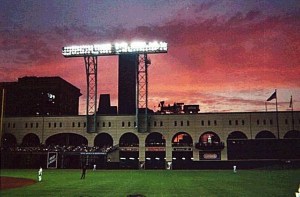
 Ten seasons deep into its life as a baseball venue, the place that began as Enron Field at Union Station before its reputationally redemptive transformation into Astros Park, and then Minute Maid Park, is alive and well – and building surface patina by the layers-worth on its quirkiness as yet another one-of–a-kind home to Houston baseball. That tradition of uniqueness in Houston is steeped in the six major parks that have served as home to our professional baseball warriors since 1888.
1) Houston Base Ball Park (1888-1906). The forerunner of West End Park at 601 Andrews Street and Smith Avenue, south across the street from the lustre of local history that is Antioch Baptist Church, HBBP is about 90% certainly the same forerunner site of the 2,500 seat ballpark that followed it in service. HBBP seated about 300 people on wooden bench stands, but it offered few amenities we see as necessary today for enjoyment at the game. The problem for research here is nailing down something from one of the agate-type newspaper stories of its time that clearly notes its location beyond doubt. From my research of the real estate plattes from that era, I cannot see any other place in the near downtown area that would have served its purpose as well as the long open field on Andrews. That site is now part of the Allen Center, but no city plaque exists to mark it as the cradle of Houston’r professional baseball history. (Houston real-time base ball birth goes back to April 1861, when the first Houston Base Ball Club was formed in the room above J.H. Evans’s Store on Market Square. As soon as we are able to confirm the precise location of Mr. Evans’s Store, we will be able to petition the City of Houston to mark that spot too as the real birth site of baseball in Houston.
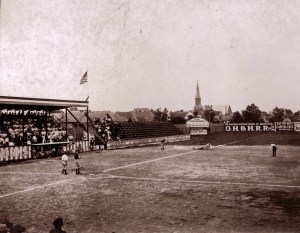 2) West End Park (1907-1927). For twenty-one seasons, for sure, the 2,500 seat wooden grandstand ballpark near downtown served as the home of the Houston Buffaloes of the Texas League. Rookie Buffs center fielder Tris Speaker helped cristen the place in 1907 with some dazzling play in the cavernous outfield while also leading the Texas League in hitting that year with a .314 batting average. During this same two-decade period, a young man from Austin named Fred Ankenman gradually took over running the Buffalo stampede into local hearts as chief executive under local ownership and later as President under the club’s ownership from the early 1920s by the major league St. Louis Cardinals. West End Park was a nice place, but it was never big enough to house the future plans of the fellow that ran the Cardinal operation – a fellow named Branch Rickey, the man who served as the genius of minor league farm team design and hands-on micromanager of all moves pertaining to Cardinals baseball. After the Cards won their first World Series over the New York Yankees in 1926, Rickey and Ankenman acquired a parcel of land on the rail lines that flowed east from downtown Houston. They built a $400,000 jewel of a ballpark on what was then called St. Bernard Avenue. That street later was renamed as Cullen Boulevard. The ballpark they built there was christened as Buffalo Stadium on April 11. 1928. Ironically, Union Station, at the corner of Texas and Crawford, was one of the principle places that fans caught the trains and street cars for transportation in the afternoons to Buffalo Stadium on game days.
 3) Buffalo/Buff Stadium (1928-1952); Busch Stadium (1953-1961). Subtract the three lost years in which the Texas League was closed down during World War II (1943-45) and “Buff Stadium” was home to Houston baseball for 31 active seasons from 1928 to 1961. I’m, of course, absorbing those few final seasons in which the place was technically renamed as “Busch Stadium” into that figure. Most of us diehard Buff fans never accepted that name change in the first place.
Seating 8,000 people originally, Buff Stadium eventually expanded down the left field line to handle as many as 11,000 seated fans – with a total gate potential of over 13,000 when the outfields were roped off to accomodate a standing room only crowd. A 1951 spring exhibition game betwen the Buffs and the New York Yankees with DiMaggio and Mantle playing in the same outifield drew well over 13,000 – and that standing-in-left-center-field gate inscluding my dad, my brother, my best pal, and me. The pictures in my mind from that day still cry out for development. I shall forever regret not having my camera with me on that storybook day.
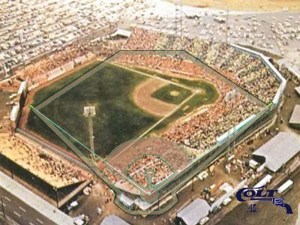 4) Colt Stadium (1962-64). It was never intended as anything more than service as a temporary home for Houston’sn new major league club, the Colt .45’s – and it’s just as well. The place that many of fans called “The Skillet” was tough enough during the work week night games, when Houston’s vampire squad mosquitoes feasted upon this congregation of human flesh and blood, but it was worse than Dante’s Inferno on weekends under the direct fiery blaze of the sun. With no overhead protection, and with the surrounding parking cement reflecting all that heat back up into the humidor-like confines of Colt Stadium, people dropped like flies at daytime weekend games. For those conditions, the short-lived Colt Stadium earned a place in baseball history. It forced the ball club to seek permission for night baseball on Sundays, something that had been unheard of previously due to all the blue law notions about the role of baseball on the Lord’s Day, anyway. Attedance at Sunday night games in Houston was so improved that it led to other clubs playing games at that night time slot also. It wasn’t long before televised Sunday Night Baseball became a fixture among the viewing habits of fans.
We have Colt Stadium to thank for that little ripple on the wall of history.
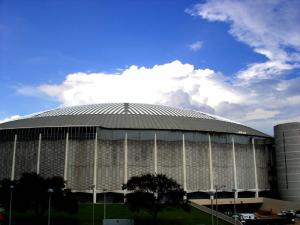 5) The Astrodome (1965-1999). Judge Roy Hofheinz dubbed it as ” the eighth wonder of the world” once he renamed the Harris County Domed Stadium as “The Astrodome” – the new home of the newly renamed Houston Astros. Looking back now, I have to admit to something that I think almost all of us experienced back then in those more innocent and far less jaded days of big change. – The idea of a domed stadium just blew us all away. We could not imagine any ballpark that could be built to protect the game from weather – that wouldn’t also interfere with the flight of most high-arching fly balls.
As it turned out, it wasn’t fly balls hitting the roof that presented a problem. It was the outfielders being able to see fly balls as they flew into the camaflauge of the ceiling beams and roof-side window lights that was their new background. You hard core fans know the rest of this story. The Astros painted the ceiling windows to make it easier for fielders to see the flight of high batted fly balls. That action killed the grass and led to the introduction a new articial surface material called Astroturf – and many other changes from that point forward.
For, at least, the third new stadium in a row, Houston had produced venues that led to broader change; Buff Stadium became the model for the construction of upscale ballparks in minor league cities; Colt Stadium led to Sunday Night Baseball; and the Astrodome led both baseball and football to the use of Astroturf as a field covering.
Unfortunately, the Astrodome also became the “cookie-cutter” model for multi-purpose venues that would principally serve as home to both baseball and football as a cost-reducing incentive on the side of promoting public support for professional sports. Similarly dimensioned stadiums soon opened in St. Louis, Pittsburgh, Philadelphia, and Cincinnati. None of these other places had roofs, but New Orleans soon enough built a second domed stadium for football that vould have been used for baseball too, if the city had possessed a big league club.

6) Minute Maid Park, 2000-2009 & Counting. Our current downtown ballpark represents Houston’s commitment to the retropark, baseball only, or principally baseball, movement that began in Baltimore during the early 1990s. As such, MMP came to life bearing certain quirky features of three great ballparks from baseball’s early years. I like them all, but let’s parade them out there for those who may not have noticed the lineage on these particular features. (a) The Polo Grounds: Although the dimsensions of MMP are not as extreme, the short porches on the foul lines and the deep center field distance is remindful of the much steeper rectangle that governed the flight of baseballs in the old Polo Grounds in upper Manhattan. Many people who quickly notice the short distance down the line at MMP are not so quick to note that dead center in MMP is 35 feet further away than it was at the Astrodome. (b) Fenway Park: The distance down the left field line at MMP is the same 315 feet that governs the same area at Fenway Park in Boston. We don’t have a “Green Monster” wall in left, but we do have a pretty tall manual scoreboard there (another retro feature that makes playing the ball off the wall) anything but routine. That “Crawford Boxes” seating area has become one of the great places to watch baseball too. I’ll take it over the cookie-cutter wall and seating area in left field at the Astrosome any day of the week. (c) Crosley Field. We have Astros President of Baseball Operations Tal Smith to thank for the elevaed hill shown in the picture at left. “Tals Hill,” as its aptly called, is a double throwback to a feature that had been built into Crosley Field (then known as Redland Field) when it was built in 1912. Instead of leveling the field up to street height when they finsished the field, they simply covered the last few feet as a gradually climbing, fifteen degree incline to the street. Someone back there saw one of two advantages to this feature. In the days prior to warning tracks, the incline gave fielders a buit in message that they were nearing collision with a fence. The second use of the hil was to provide graduating sight lines for fans standing in the outfield during SRO games. Tal remembered the left field hill feature from his early days with the Reds organization and spoke out in favor of its inclusion in the new Houston ballpark. Thank goodness, he did. The Hill – and the on-the-field flagpole that Tal also suggested – are two of the most enjoyable features at Minute Maid Park. In the decade they have been in place, they have ended no careers – and they have produced some of the best catches we’ve ever seen.
 Minute Maid Park is a monument to baseball uniqueness among all other sports. As many fine writers have pointed out, ad nauseum, baseball isn’t controlled by the clock. Theoretically, a game could go on from here to eternity, if the score remains tied at the end of each full inning. It also doesn’t play out on an even gridiron, as does football. Baseball plays out on whatever field fits the reality of the community it serves – and you cannot blame your losses on the field of battle – unless you are just a loser looking for another easy excuse for your own failures.
For example, in one of my last years of adolescent baseball glory, I played a number of games in a center field area that I shared with a pretty good sized oak tree. I’d like to blame the oak tree for my lack of success that season, but I cannot. The oak tree had no surprisingly agile moves out there in deep center. Unfortunately, neither did I.
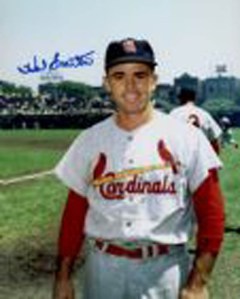
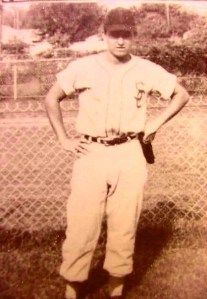
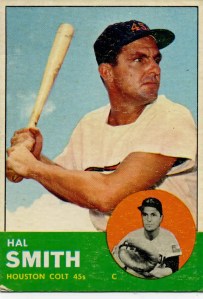 Houston Baseball”s two Hal Smths were always being confused for one another. It didn’t help clarity much that they played ball in the same era and, worse, that they played the same position and both batted right handed. I’ve forgotten how often the same statement would come up from different friends at games during the 1962 first seson of the Colt .45s: “Oh yeah,” they’d say, “I remember that guy at catcher, that Hal Smith. He played for the Buffs a few years back.”
 Houston, Baseball, & Other Musings.
 The Pecan Park Eagle