 “Little Joe” Presko didn’t have much trouble with his height while he was toiling in vain as a righhanded starting pitcher for the hapless 1950 Houston Buffs. The Buffs made it all the way to the Texas League cellar that year in spite of people like “Little Joe” and his 16-16 record with the 3.14 ERA. Joe also hit with some authority for the ’50 Buffs, slamming 3 HR on the season, a rare feat for any Houston pitcher back in the day. All the while he was here, however, Presko’s reported height and weight stood firm at a constantly reported 5’9″ and 165 lbs. Iconic Buffs radio announcer Loel Passe even called him “Little Joe” – and that description sure worked for me. At age 12 during the 1950 season, I noticed that Presko was one of the few Buffs who stood barely taller than me. I only reached 5’11” at full growth, eventually, but I achieved most of that height very early.
By the time Joe Presko reached the big leagues in 1951, we started reading these occasional reports from national and St. Louis sources that he was six feet tall. I had to wonder a little in private amusement over these reports if major league baseball really did bring about that kind of three-inch growth spurt in a man who was due to turn 23 on October 7, 1951? I don’t know. Baseball Almanac continues to report 6’0″ as Joe Presko’s height while other Internet sites list him variably at 5’9″ or 5’10”.
Regardless of the height mystery, the true baseball measurement of Joe Presko was about his ability as a cool and steady little pitcher who handled game pressure with an ability to pitch smart with finesse. Over the course of six years and 390.2 innings pitched in the big leagues with the St. Louis Cardinals (1951-54) and Detroit Tigers ((1957-58), Presko only struck out 202 batters, but he also only walked 188.
Signed by the Cardinals at age 19 out of his Kansas City, Missouri home town, Presko complied a 16-8, 2.70 ERA record for Class C St. Joseph in 1948. He followed that good work with a 14-9, 3.18 ERA mark with the 1949 Class A Omaha team. That background brought Joe Presko to Class AA Houston for the 1950 season.
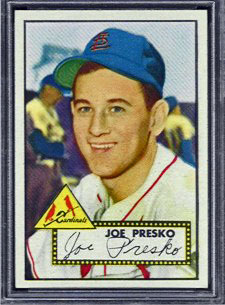 Presko enjoyed his best season in the big leagues in his rookie 1951 year. He won 7, lost 4, and posted a 3.45 ERA over 12 starts and 3 relief jobs. In his four seasons with the Cardinals, he won 24 and lost 36. His two seasons with Detroit would later add only one win and one loss to his career MLB record.
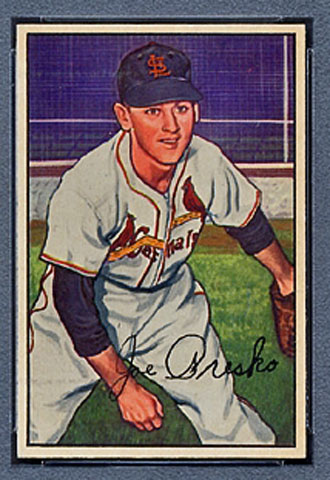 Joe Presko pitched one more minor league season following his last year as a major leaguer with the 1958 Tigers. He pitched for two AAA clubs in that 1959 season. He was 4-5 at Charleston and 0-3 at Toronto.
After baseball, Joe Presko returned to Kansas City. He stayed close to baseball for years there as a coach in the American Legion baseball program. Future big league pitching star David Cone was one of the kids that Joe Presko coached in Legion ball.
Litte Joe Presko will be 81 in less than a month. As an old fan from his 1950 Houston season, I just want to say this much: “Joe, the real long and short of it is this. – Your abilities were good enough to buy you six years in the big leagues. That’s more major league time than most aspiring ballplayers ever see. I also want to add this thought from the still vivid memory of your once 12-year old fan. – Thanks for making the 1950 Buff season a little less painful. Whenever you took the mound at Buff Stadium, we Buff fans, at least, knew that we had a chance to win. Hope you are well – and Godspeed to you and yours!”
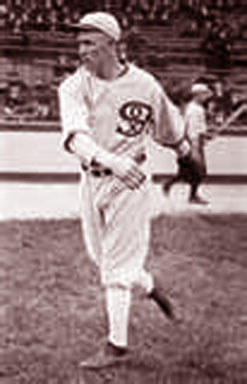
 The great 1931 Houston Buffs will always be remembered as the club that served as Dizzy Dean’s showcase and launching pad to his Hall of Famous baseball career with the fabulous Gashouse Gang, the 1934 St. Louis Cardinals. Dean (far left) posted a 26-10 record with a lights out 1.57 ERA with the ’31 Buffs.
 By the time the young man from Sancti Spiritus, Cuba arrived here in 1951 as a member of the Houston Buffs pitching staff, the 26 year old righthander was already drawing favorable comparisons to the great big league Cuban hurler of the 1920s, Adolfo Luque of the Cincinnati Reds. Rubert had stormed onto the scene in 1946, going 13-6 with a 1.72 ERA for the Class C West Palm Beach club. – He then bettered that mark with the same team in 1947 by pumping his record up to 23-12 1ith a 1.76 ERA. Want more? Rubert went over to Class C Tampa in 1948 and pulled off a 22-7 record with a 2.11 ERA.
 That’s “Black Mike” Clark and the bust of Eddie Kazak showing up in this cropping from a team photo – and they were just two of the guys who helped Octavio Rubert and the ’51 Buffs make their day in the baseball sun a mostly happy one. The party was only spoiled by Houston’s six-game loss to Birmingham in the Dixie Series. Our excuse? A mysterious stomach illness hospitalized Vinegar Bend Mizell and made him unavailable for the Buffs’ Series cause at crunch time.
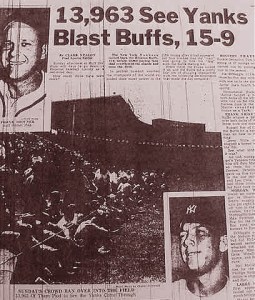 Sunday, April 8, 1951 was the date of the most memorable game I ever watched at old Buff Stadium – and it didn’t even count in the standings. It didn’t have to count, except in the heart of play we witnessed that day – and in the pictures it imprinted upon the minds of the record crowd of 13,963 fans who attended that hot and sunny spring afternoon exhbition game.
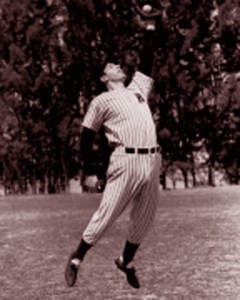 I watched every single nuanced thing DiMaggio did in the field – and I loved it when he had to run over near us for a fly ball. He was close enough for us to hear the ball pop leather on the catch many times. I even thought we made eye contact once.

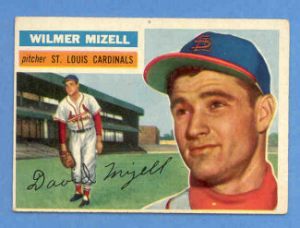 The young man they were already calling Vinegar Bend Mizell arrived in Houston with the Buffs in the spring of 1951, heralded full bore as the lefthanded second coming of Dizzy Dean from twenty years earlier. Buff fans, sportswriters, club president Allen Russell, and the parent team St. Louis Cardinals all hoped the “Lil Abner Look-n-Sound-Alike” would turn out to be everything his growing legend screamed out that he was going to be: a sure-fire and consistent twenty game wins per season superstar and future Hall of Famer. Mizell wasn’t quite the young braggart that Dean had been, but he opened his mouth enough to create words that some writers ran to type as promises for use as future nails, should he fail to deliver.
 Mizell was critical to the success of Houston’s 1951 Texas League pennant drive, posting a 16-14 record that wasn’t altogether his fault on the short side of his wins to losses ratio. The club just had one of those seasons in which they often had trouble giving Mizell the offensive support he needed to take the win. His 1951 Earned Run Average of 1.96 still spoke volumes about his bright future as a prospect.
 I had the good fortune of finally meeting Wilmer David Mizell when we were seated together at the same table at the banquet hall for the Spetember 1995 “Last Round Up of the Houston Buffs.” I had a chance to ask him if the squirrel hunting story were true. “Did you like the story?” Mizell asked me in return?” “Oh yeah! I always loved it!” I told Mizell. “In that case, it was absolutely true!” Mizell shot back with a wink and a smile.
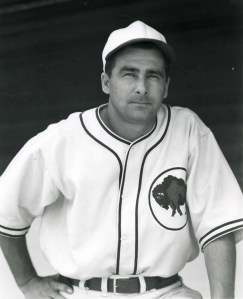 The late Eddie Knoblauch is a classic example of the currently popular axiom that “perception is reality.”Some of his fellow teammates, as well as Dutch Meyer, his manager at Dallas in the early 1950s, seem to think that Eddie had all the ability in the world to have moved on up to the big leagues over the 1938-1955 course of his career, but that he just lacked the will to crank it up to that level. If so, why not? One old teammate, armed by the cloak of anonymity in 1998 Dallas newspaper artile suggested that the money differential between minor leagie and major league pay back in the day simply wasn’t big enough to motivate Eddie Knoblauch.
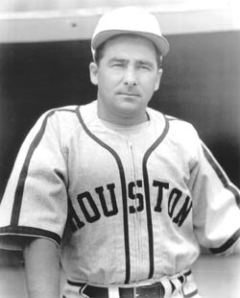 Eddie Knoblauch garnered 391 career doubles and 117 career triples. He also scored 1,420 runs.
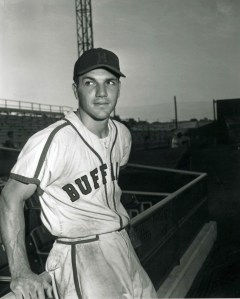 Ken Boyer was neither the first nor the last of the baseball playing Boyer boys. He was simply the best of the six brothers who ventured into the arena of the professional over the two decades that followed World War II. The Alba, Missouri native was also just one among the pack of the fourteen kids born to the rural Boyer family who discovered baseball as a way up and out to the larger world when he began his career with Class D Lebanon in 1949. Ken started as a pitcher, going 5-1 with a 3.42 ERA in ’49, but he also did something else that first year that distracted the parent Cardinal organization from seeing his future on the mound. He hit .455 for the season. Once Boyer’s pitching record slipped to 6-8 with a 4.39 ERA in 1950 with Class D Hamilton, while his battting average stayed up there at .342, the Cardinals felt that they had to keep the guy in the lineup as a position player. Ken made the transition just fine as a third baseman for Class A Omaha in 1951. He batted .306 with 14 HR and 90 RBI before going into the service for two two years (1952-53) during the Korean War. Ken Boyer resumed his career in 1954 as a third baseman for the Houston Buffs. His career took off like a rocket. Batting .319 with 21 homers and 116 runs batted in for the ’54 Buffs, Boyer led the club to the Texas League championship – as he also launched his own career to the major league level in 1955.
 John Hernandez was the star lefthanded battting and throwing first baseman of the 1947 Texas League and Dixie Series Champion Houston Buffs. After an early acquisition from Oklahoma City in 1947, Hernandez did very well in Houston. His .301 batting average, 17 home runs, and 78 runs batted in were a big part of the reason the Buffs enjoyed one of their finest seasons of all time that year, and that doesn’t even take into account his defensive contributions with the glove. The guy was a sweet fielding wizard at his position.
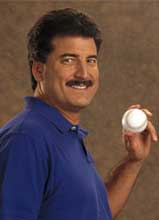 John Hernandez’s son Keith grew up to be one of the greatest defensive first baseman in major league history. Keith Hernandez’s 11 straight gold glove awards is a mjor league record. He also wan’t too shabby as a hitter either, leading the National League in hitting in 1979 with a .344 average at St. Louis. Keith Hernandez also was a leading force on two World Series ball clubs, the 1982 St. Louis Cardinals and the 1986 New York Mets. What a lot of people don’t know is that Keith Hernandez always used his dad as his anchor man coach for helping him straighten out anything that was getting in the way of his best game, and that assistance covers a lot of ground in this instance.
 We just returned last night from a two-day train trip to Lake Charles, but that’s a story for another day. This morning I want to tell you about another ex-Cardinal and former Buff pitcher who also just happened to be a good friend. His name was George “Red” Munger, a name that won’t be lost to the memories of anyone who was around during all those 1940s years of great Cardinal teams. Red Munger just happened to be a big part of that success. The native Houstonian and lifelong East Ender was smack dab in the middle of that zenith era in Cardinal history, even though he lost all of 1945 and most of the championship 1946 season to military service. Red still managed to return in time to make his own contributions to the Cardinals’ victory over the Boston Red Sox in the 1946 World Series.
 achieved some great, but unsurprising success in service baseball. He was just too good for the competition he faced at that rank amateur level. Once Red obtained his second lieutenant’s commission and was assigned to developing the baseball program at his base in Germany, he just stopped playing in favor of full time teaching. He even said that he had no heart for pitching or hitting against competitors who were too young, too green, and too unable to compete against him.
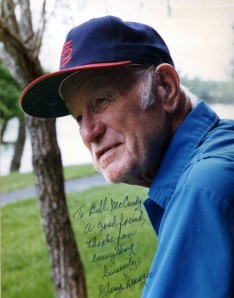 After baseball, Red Munger worked as a minor league pitching coach and also as a private investigator for the Pinkerton agency. He later developed diabetes and passed away from us on July 23, 1996 at age 77. I took that last picture of him in the 1946 Cardinals replica cap on a visit to his home, about two weeks before he died. Red gave me that cap that he wore in the picture at left on the same day. I have treasured it ever since.
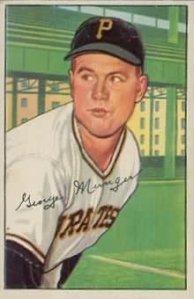 Red Munger enjoyed watching position players with strong arms and then imagining how effective they might be as pitchers. His favorite subject that last summer of 1996 was Ken Caminiti – and this was long before all the disclosures about Ken’s mind-altering and performace-enhancing drug abuse. Red Munger just liked the man as a gifted athlete. Caminiti fit the bill on what Red Munger was looking for in pitching potential. “Give me a guy with a strong arm and I can probably teach him the other things he needs to know about pitching. I can’t teach a guy how to have a strong arm – and as far as I can see, no one else can do that either beyond telling him to work out and hope for the best. As far as I’m concerned in the matter of good arms, you’ve either got one or you don’t.”
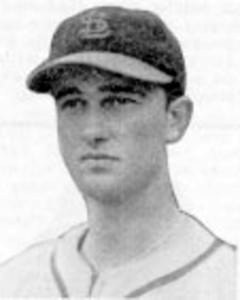 From the late 1920s through the early 1950s, the St. Louis Cardinals operated a farm system that pretty much resembled the good and growing business of a fabled Hempstead, Texas watermelon grower. – Everything they harvested came out tasting sweet – with very little hassle from unwanted seeds.
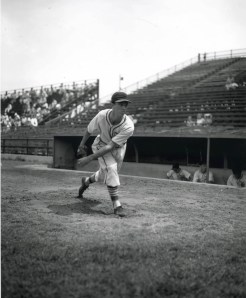 Back with Houston in 1941, the now 20-year old lefty showed that he had little left to prove in the minor leagues, even at his still tender age. In 1941, Pollet posted a 20-3 record for the Buffs and a league leading ERA of only 1.16. In all of Texas League history through 2008, only Walt Dickson’s 1.06 ERA, also posted with Houston back in 1916, beats the 1941 mark of Howie Pollet. Pollet also led the Texas League in strikeouts in 1941 with 151. The Buffs again won the Texas League straightaway race, this time by 16.5 games, but they lost in the first round of the playoffs for the Texas League pennant.
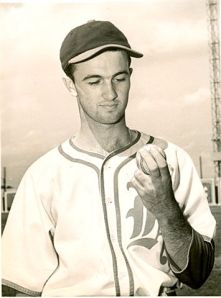 After baseball, Howie Pollet returned to his adopted home of Houston and went into the insurance business with his former Buffs and Cardinals manager, Eddie Dyer. He even returned to baseball one year to serve as pitching coach for the Houston Astros. He was only age 53 when he died of cancer in 1974. Sometimes the good guys who arrive early also make an early exit. Baseball and Houston were the poorer from the early passing of the great Howie Pollet, but we’re glad we had him while we did.
 Houston, Baseball, & Other Musings.
 The Pecan Park Eagle