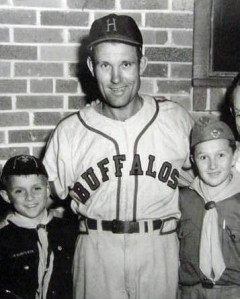
Posts Tagged ‘Houston Buffs’

Houston Buffs: The Boyer Boys!

September 25, 2009

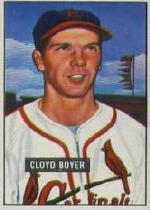
Cloyd Boyer 002 Cloyd Victor Boyer, Jr. was the eldest of three brothers who all played professional baseball up through the major league level. Born in Alba, MO on September 1, 1930, Cloyd pitched in parts of 14 minor league and 5 major league seasons from 1945 to 1961. Two of those seasons for the 6’1″, 188 lb. right hander included service with the 1948 (16-10, 3.15 ERA) and 1953 (4-2, 2.73) Houston Buff clubs. Boyer was a pitcher with a good variety of variable speed options and fair control. He gave up a lot of hits per game (8.6 per innings, career), but he also was effective in getting batters to put playable outs on the field. Over the course of his entire career, he won 137 games and lost 120, recording a minor league career ERA of 3.52. After his active career concluded, Cloyd managed in the minors on five scattered year occasions from 1963 through 1989. He then retired from baseball to his native area of southwestern Missouri.

Two others among the several rural Boyer brothers also followed older sibling Cloyd down the pro ball trail, and the second of those also passed through Houston on his way to becoming one of the top 3rd basemen in the National League for several years. Ken Boyer (born 5/20/1937 in Liberty, MO) played 15 seasons in the big leagues, mainly for the St. Louis Cardinals,  from 1955 through 1969. He batted .287 with 282 career home runs over the major league haul. He also led the 1954 Buffs to the Texas League crown with a pretty good minor league stick (.319 BA, 21 HR, 116 RBI).  As a big leaguer, Ken appeared in 11 all star games and also played a critical hiting role in the 1964 Cardinals World Series victory over the New York Yankees. Sadly, we lost Ken Boyer o cancer on 9/07/1982 at the age of 51.

Ken Boyer 001 The youngest of these three ballplaying brothers was Clete Boyer, who was born on 2/08/1937 in Cassville, MO. Clete was also a right handed hitting third baseman with superior defensive skills. When Clete and Ken faced off against each other in the 1964 World Series as rival third basemen for the Yankees and Cardinals, it was a mighty big day back in southwestern Missouri. – Clete played most of his career for the Yankees and Braves, finishing his major league career with a .242 BA and 162 HR (1955-71.) He never made it to Houston as a player for the Buffs, Colt .45s, or Astros, but we would have loved having him on our resume too.

Somewhere out there, there must be a few other families with kids who are good enough to do as well as the Boyers.  All we baseball fans can hope for is that they aren’t already lined up to pursue careers in football or basketball first. Clete Boyer 001

Buff Stadium: The Fair Maid Moon!

September 24, 2009

Fair Maid 001

Some of us called it “The Fair Maid Moon.”  By evening game time at Buff Stadium during the Post World War II last days of Houston’s minor league history (1946-61), the old bread bakery sign hung faithfully, and lovingly, and hopefully too, in the summer night sky. Suspended in full view of Buff fans, and hanging like an ascending astral body, just above the left center field fence line, and even though it never actually moved, the neon-lighted Fair Maid sign always seemed ready to take off in celebration of the Buffs  across the Houston evening air. What is sent to us in compensation for its own lack of movement was a fragrance usually reserved for the baker man himself.  The aroma of freshly baking bread came wafting into the stands at Buff Stadium like clockwork, peaking appetites, and probably boosting hot dog and hamburger sales many times over President Allen Russell’s wildest dreams.

Fair Maid 004

The photo that yields this typical glimpse of a night at Buff Stadium reveals through the above crop-shot that that season  of its taking had be wither 1956 or 1957. Those were the only two times that the league included Austin, Dallas, Fort Worth, Houston, Oklahoma City, San Antonio, Shreveport, and Tulsa. From a larger copy of this shot than I am able to include here, I can give you this rundown on the three line scores on display: Dallas @ San Antonio, San Antonio leads 1-0 through 6 innings; Fort Worth @ Austin, Austin leads 7-2 through 3 innings; Tulsa @ Shreveport, game is tied 4-4 though 4 1/2 innings. That leaves Oklahoma City, playing in the field, against Houston, the home club. I can’t tell you the score because we cannot see the Buff Stadium home scoreboard in far left field.

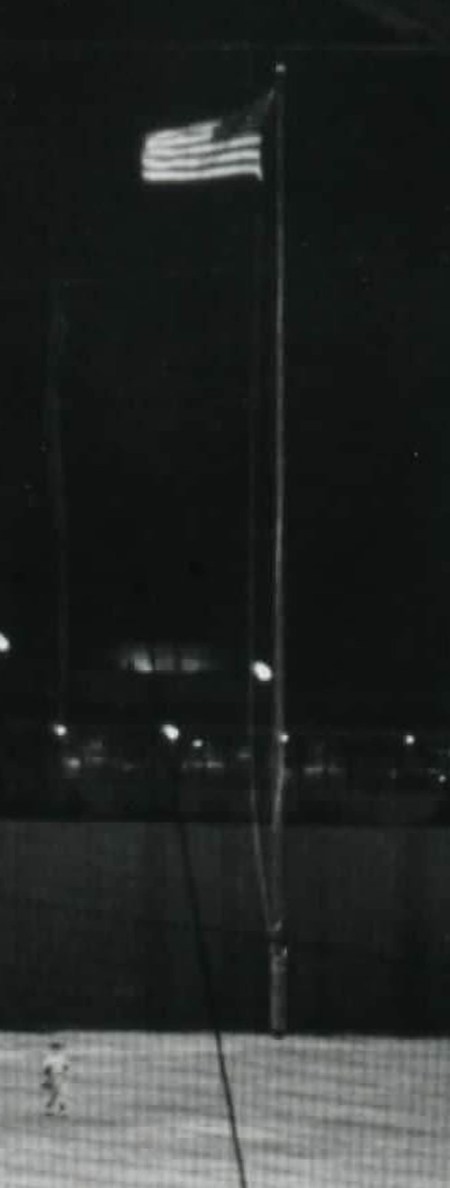
Fair Maid 005 Dead center field in Buff Stadium was 424 feet from home plate. and the outfield pasture also included a free-standing flagpole of some considerable similarity to the one that now resides in Minute Maid Park. It was located about five feet in from the outer wall, but there was no hill to climb.

Note the prevailing wind that typically blew the flag from right to left as the breeze came across the right field fence from the gulf.

Fair Maid 006

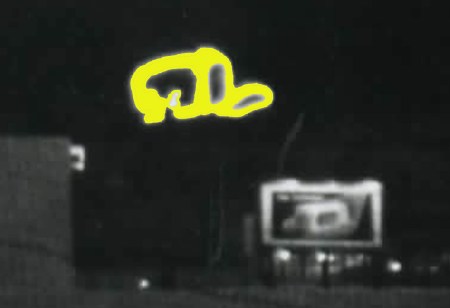
That’s the Fair Maid Moon close up, hanging low in the sky behind Buff Stadium from its perch above the Fair Maid Bakery, a long two blocks north of the ballpark at the corner of Leeland and Cullen and burning much brighter than its product image on the billboard to its right. The happy face of an old friend, even in a photograph, is a mighty comfort that peels away so much loss over time. I thank you for being there again today, old friend.

Good night again, Fair Maid Moon, wherever you now are. The memory of your fragrance tells us, heaven’s not far. – Buff Stadium and Heaven, they were once and always, and forevermore they remain the same, the place we once both planted and harvested the seeds and fruits of our fondest baseball dreams about hope and possibility in a once more beautiful world.

Aaron Pointer: A Man for All Seasons.

September 23, 2009

HBHC POINTER 1 Aaron Pointer (Batted Right/Threw Right; Outfield) has to be one of the best examples of how life sometimes arms certain people with talents that could take them in several varied directions, but all the while, these opportunities are rising and falling constantly with how the individual makes and uses the decisions he or she finally decides to take responsibility for putting into motion.

Born in Little Rock, Arkansas on April 19. 1942, but raised in Oakland, California, Aaron Pointer was the son a of a preacher man and his wife, the Reverend Elton and Sarah Elizabeth Porter. Aaron’s older brother Fritz was also a gifted amateur athlete who grew up to be a college English professor and published author. Aaron’s younger sisters, Ruth, Anita, Bonnie, and June stormed the entertainment world from the early 1970s forward as the fabulous Pointer Sisters.

Pointer served as President of the Student Body at McClymonds High School, where also excelled in baseball, football, and basketball. McClymonds in Oakland just happens to be the same school that also gave the world Bill Russell in basketball and Frank Robinson in baseball.  After his high school graduation, Pointer entered San Francisco University on a basketball scholarship, with an understanding that he would also be allowed to play baseball. A chronic sore arm knocked Pointer out of his plans to continue baseball as a pitcher at SFU. Aaron was still good enough as a position player to attract the attention of the Houston Colt .45s as an outfield prospect. He signed with Houston in 1961 for a bonus of $30,000 and was assigned to Class D Salisbury  and what turned out to be a memorable season.

HBHC POINTER 2Aaron Pointer batted .402 in 93 games for Salisbury (132 hit for 329 at bats) in 1961 for 19 doubles, 14 triples, and 7 home runs. By breaking the /400 mark, Pointer became the last professional baseball player to exceed that magic mark over a full summer of play. (Rookie League and Mexican League marks are not considered as data on this achievement trail.) At season’s end, Pointer was called up to the 1961 AAA Houston Buffs in time to also hit .375 ( 3 for 8 ) in four games.

After 1961, Aaron Pointer would never again have another lights out year over the course of his nine-season, mostly minor league career.

On September 271963, he was part of an all-rookie lineup that remains  on record as  the youngest lineup in MLB history, with an average age of 19. Joe MorganRusty Staub and Jim Wynn were the only three players that went on to great careers from that group of promising rookies.

By breaking in with the 1963 Colt .45s and then coming back with the 1966-67 Astros, Aaron Pointer also placed himself in a quietly unique category for former Houston Buffs. Aaron Pointer, outfielder Ron E. Davis, and pitcher Dave Giusti are the only three professional baseball players who actually performed for Houston under all three of their identities as Buffs, Colt .45s, and Astros. Giusti’s distinction is slightly greater in this regard as the only last former Buff from 1961 who also played for the first Colt .45 club in 1962 and the first Astro club in 1965. Pointer did not join the Colt .45’s until their second season (1963) and did not play either for the Astros until their second season (1966). Davis also missed the first Astros year, but arrived in time to play parts of three seasons as an Astro (1966-68).

Pidge Browne, Jim R. Campbell, Ron E. Davis, Dave Giusti, and J.C. Hartman were the only five last Buffs (1961) who also played the next year as first-season Colt .45s (1962), but four of these men, all but Giusti, were gone by the time the club became the Astros in 1965. As mentioned above, Pointer also became a Colt .45, but not until the 1963 season. Ron E. Davis, as mentioned, rejoined the club in 1966 during their second season run as the Astros.

After being traded to the Chicago Cubs organization in 1968, Aaron Pointer spent all of 1969 at Tacoma. He finished that season with a career batting average of .272. He  then played three mediocre seasons in Japan and, at age 30, he retired from baseball. Returning to his adopted  home in Tacoma Washington, Pointer went to work for the Pierce County Parks and Recreation Department, supervising their athletics programs. He started officiating high school football games , eventually working himself into a new career as an NFL game official from 1987 to 2003.  He now serves as a member of the Board for the Tacoma Athletic Commission.

In June 2008, Aaron Pointer was inducted into the Tacoma Hall of Fame.

What a life path! – Godspeed, Aaron Pointer! And may your senior days be mellow and bright!

Ben Steiner: Houston’s “Lil Perfesser”

September 22, 2009

Ben Steiner We called him our “Lil Perfesser.” We had no idea that second baseman Ben Steiner actually had played a smidgen of games with the real “Lil Perfesser” of the Boston Red Sox, the great Dominic DiMaggio back in 1946. All we knew is the guy seemed to look the part of a really smart middle infielder when he joined the Houston Buffs after the start of the 1951 Texas League season. At a listed 5’11” and 165 pounds, he looked much lighter, like a guy who needed a paper weight to help him hold his ground at second base on those windy gulf breeze nights at Buff Stadium.  Part of his scholarly look is abandoned in this crop shot of Steiner from the ’51 Buffs team photo by virtue of the fact he either chose, or was asked, to remove his glasses for the shot. You may be able to see that he is holding them, and with the natural look simply leaving him looking less professorial and a lot more like the 30 year old career minor leaguer he really was by the mid 20th century.

That being said, little Ben Steiner turned out to be a quiet difference-maker for the 1951 Houston Buff Texas League champions. Even as kids we could see how intuitive Steiner seem to be about knowing where to play the field against certain batters in specific game situations. He had good mobility and fair speed anyway, but his ability to place himself in just the right spot for batted balls was his real strength in anchoring the middle game defense of the ’51 Buffs.

Ben Steiner batted left and threw right, of course. He was a second baseman, born in Alexandria Virginia on July 28, 1921.  Steiner attended North Carolina State, but didn’t play ball while he was there. Signed by the Boston Red Sox, he broke in as a shortstop with Class C Canton in 1941, hitting a healthy .296 in 49 games before finishing with Class B Greensboro, and batting only .206 in eight games. Still, his defensive play and aptitude shone through early. Steiner stayed with Greensboro in 1942, hitting .234 in only 71 games, again at shortstop, but helping him get ready for some very productive full-time action over the next couple of years. Based on his limited arm strength, Steiner was switched to second base in 1943, launching him into position to do his best.

Steiner batted  .292 in 138 games at second base for Class A Scranton in 1943. He followed that season in 1944 with one of is two best offensive years, batting .316 for Class AA Louisville with a .404 slugging average in 149 games.  That good year bought Ben a ticket to the show in 1945, where he broke in with the Red Sox on April 17, 1945, going .257 in 78 big leagues before being sent back down to Louisville, where he only hit .216 over 44 games to conclude the ’45 season.

1946 saw Steiner going 1 for 4 in three games with Boston before being shipped off to AAA Toronto for a full season (.238 in 106 games).

After he was dealt to Detroit before 1947 rolled around, Steiner made one game appearance for the Tigers before he was shipped to AA Atlanta and what was his best offensive season on record. Ben Steiner batted .316 with a .430 slugging average in 125 games for AA Atlanta in 1947. Steiner was acquired by the Cardinals after 1947. He spent the next three seasons on assignment to their AAA Columbus club, as his BA dipped each year(1948-50)  from .283 to .266 to .244.

After Ben Steiner finished the ’51 Buffs season at .262 and 30 years of age, he hung them up for good. Apparently his intuition for how to play batters also applied to his assessment ability on where he stood with his  baseball future. Fortunately for the Houston Buffs, Ben Steiner saw his way through the 1951 championship season.

Ben Steiner passed away in Venice, Florida on October 27, 1988 at the age of 67. We have a hunch that Ben knew where he stood on broader matters when that day came, as well.

Bob Boyd: Houston’s Jackie Robinson.

September 18, 2009

BoydBob2625.72_HS_NBL When Cecil Cooper was named manager of the Houston Astros in late 2007, the fact that he’s black was not covered by the current media as even an interesting footnote to the fact that it then had been a little more than fifty-three years since Houston saw it’s first black baseball player take the field to play for a racially integrated Houston sports team. – Think about it. From the time Houston “welcomed” it’s first black baseball player to the time it saw its first black manager in baseball, fifty-three years and three months had passed.

Thursday, May 27, 1954 shall forever remain a special date in my personal memories of the Houston Buffs. That was the date that Bob “The Rope” Boyd made his debut as a first baseman for the Houston Buffs in old Buff Stadium. (They called it Busch Stadium by then, but I stood among those who never bought into the name change when August Busch bought the St. Louis Cardinals and all their organizational holdings, including the Houston Buffs and the ballpark, a year earlier in 1953.)

Buffs General Manager Art Routzong had purchased the contract of Boyd from the Chicago White Sox about a week earlier than his debut in an effort to help the club make their eventually successful run at the 1954 Texas League championship. That was quite a club, one that also featured a rising future Cardinal star at third base named Ken Boyer.

Bob Boyd would prove to be the hitting and defensive specialist that the club needed to anchor the right side of the Buffs infield as strongly as young Boyer held down the left side. Boyd hit .321 for the ’54 season and he followed that production with the ’55 Buffs by posting a .309 mark.

It all started on a night of great change in the face of Houston sports.

I was drawn to the ballpark that 1954 twilight eve as a 16-year old kid who wanted to see Bob Boyd break the color line and, hopefully, have a good first night for the Houston Buffs. TheBob Boyd 003 fact that I had just started to drive by that time and needed a good excuse to borrow the family car also factored into the equation. When I borrowed the car, I told my dad why I needed to be there at the ballpark that night. I wanted to see Bob Boyd play for the Buffs as the man who broke the color line in Houston.
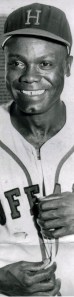
Although I had grown up in segregated Houston, I was blessed with parents who taught love and acceptance over hate, even though they also had been raised with that blind acceptance of segregation as the way of life. Whatever it was, my parents held beliefs that left the door open for me to actively question the unfairness of segregation and to also embrace Jackie Robinson as a hero when he broke the big league color line in 1947.

No one in the family or the neighborhood wanted to go with me that night, so I went alone. I also bought a good ticket on the first base side with a little money I had earned that week from my after-school job at the A&P grocery store. I also had to buy a dollar’s worth of gas as my rental on the use of dad’s car.

There were only about 5,000 fans at the game that night and almost half of them were the blacks who were then still forced to sit separately in the “colored section” bleachers down the right field line.

The atmosphere was contrasting and electric. The so-called “colored section” fans were rocking from the earliest moment that Bob Boyd first appeared on the field in his glaringly white and clean home Houston Buffs uniform to take infield with the club. While we felt the rumble of all the foot stomping that was going on in the “colored section,” only a few of us white fans stood to show our support with the understated and reserved applause that we white people always do best at times when more raw-boned enthusiasm would have been better.

“Enthusiasm” evened into a loud foot-stomping roar from all parts of Buff Stadium when Bob Boyd finally came to bat in the second inning for his first trip to the plate as a Houston Buff and promptly laced a rope-lined triple off the right field wall. Even those whites who had been sitting on their wary haunches prior to the game rose to cheer for Bob Boyd and his first contributions to a Buffs victory, and, whether they realized it or not, to cheer for another hole in the overt face of segregation in Houston.

Here’s a taste of how iconic sports writer Clark Nealon covered it the next morning in the Houston Post:

“Bob Boyd Sparkles in Debut As Buffs Wallop Sports, 11-4”

by Clark Nealon, Post Sports Editor

“Bob Boyd, the first Negro in the history of the Houston club, made an impressive debut Thursday night.

“The former Chicago White Sox player banged a triple and a double and drove home two runs as the Buffs pounded the Shreveport Sports, 11-4, and Willard Schmidt recorded his sixth victory without a defeat.

“Before one of the largest gatherings of the year – 5.006 paid including 2,297 Negroes – the Buffs started like they were going to fall flat on their faces again, got back in the ball game on bases on balls, then sprinted away with some solid hitting that featured Dick Rand, Kenny Boyer, and Boyd.

“Rand singled home the two go ahead runs in the first, added another later. Boyer tripled with the bases load for three runs batted in and Boyd tripled in a run in the second and doubled in another to start a five-run outburst in the fourth that settled the issue. …

” … Boyd was the center of attention Thursday night, got the wild acclaim of Negro fans, and the plaudits of all for his two safeties and blazing speed on the bases.”

Yes Sir! Yes Maam! May 27, 1954 was a big day in Houston baseball, Houston sports in general, and a moment of positive change in local cultural history. So was Tuesday, August 28,Bob Boyd 002 2007, the day that Cecil Cooper made his debut as a manager for the Houston Astros, a day for change, but it had nothing to do with race. Cecil just didn’t get here quite as loudly and, for reasons that have nothing to do with race, he also may leave soon, just as quietly, but maybe not. Maybe the Astros won’t unload all of the 2009 Astros’ failures on the back of their skipper.
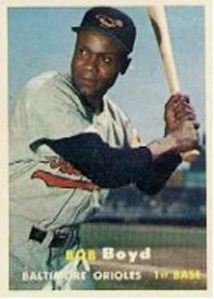
In Houston baseball and general sports history, there was only one Bob Boyd. By the time professional football and basketball arrived here, integration was already a part of the total team package. The job of proving that race should not be a factor never had to ride again on the back of one individual player. Bob Boyd already had unlocked, opened, and oiled that gate for all who have come after him – and he did it all back in 1954.

After the 1955 Buffs season, Boyd’s performance at AA Houston earned him a second shot at the big leagues with the Baltimore Orioles. Bob had made a promising start with the Chicago White Sox (1951, 1953-54), but now. after Houston, the now 29-year old lefthanded first bagger seemed primed for a really fine major league career.

In 1956, it was time for Bob Boyd to shine in the big leagues, indeed!

Bob Boyd roped off full season batting averages of .311, .318, and .309 in his first three Oriole seasons (1956-58). His 1959 full season average dropped to .265, but he bounced back in 1960 to hit .317 in 71 games for Baltimore. Boyd played one more limited time season in 1961 for Kansas City and Milwaukee, completing his 693-game big league career with a total batting average of .293 with 19 home runs over nine seasons. Bob Boyd played three more seasons in the minors after 1961 (1962-64) and then retired completely as an active player. Interestingly too, most of Boyd’s last three  years were spent in the minor league farm system of the then baby new National League Houston Colt .45s at San Antonio and Oklahoma City.
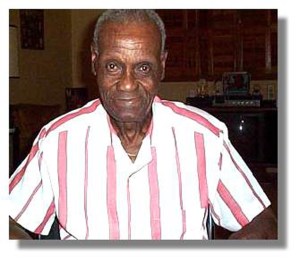
Bob Boyd 001 Following his far better than average baseball career, Bob Boyd returned to his home in Wichita, Kansas, where he worked without complaint as a bus driver until he reached retirement age. Bob died in Wichita at age 84 on September 27, 2004. Today, the man who started his career with the Memphis Red Sox (1947-49) of the Negro Leagues is honored as a member of the Negro League Hall of Fame and also the National Baseball Congress Hall of Fame. Hopefully, we shall always continue to remember and honor Bob Boyd and all others who took the first step toward changing things that needed to change. Bob Boyd did his job with grace, dignity, and tremendously unignorable ability.
Heroes: My Personal Mount Rushmore!

September 17, 2009

Solly Hemus 010

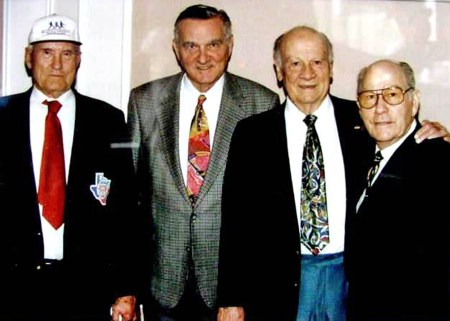
Jerry Witte …  Larry Miggins … Frank Mancuso … Solly Hemus! From left to right, that’s the order of these four men in this 1998 photo from the Houston Winter Baseball Dinner. Sadly, two of the men shown here, Jerry Witte (2002) and Frank Mancuso (2007), are gone now on the date of  this 2009 writing. God rest their souls as those of us who loved them keep their memories alive as best we are able.

Those four men could have comprised a carving of my own personal Mount Rushmore of early baseball heroes. During the era of my kid fan days at old Buff Stadium in Houston over the post World War II zenith years of minor league baseball, these were the guys whose play, whose very names, mind you, just worked upon me electrically, drawing me to the ballpark like so many magnets – and as as often as possible.

As I wrote only yesterday, Jerry Witte (Buffs, 1950-52) was the “Darth Vader Comes Home to the light” figure of the group. When Jerry joined the Buffs in 1950, after first slugging the bejabbers out of our pitching staff during his 1949 fifty home run year for the Dallas Eagles, and if there had been a Darth Vader around back then to conjure up as an image, that is exactly how it felt to me as a 12 year old kid when I got the news that June 1950 summer morning of Jerry Witte’s assignment to the Buffs by the parent Cardinals. I was so excited I couldn’t even finish my breakfast. I had to hit it outside to the sandlot, asap, so I could start talking up a trip to nearby Buff Stadium with my fellow members of the Pecan Park Eagles club. We all just knew that that the big righthanded slugging first basemann Jerry Witte was going to turn out to be the Buffs’ version of Babe Ruth – which he pretty much did in 1951 when his 38 homers led Houston to the Texas League pennant.

Larry Miggins (Buffs, 1949, 1951, 1953-54), the hard-hitting righthanded left fielder wasn’t around in 1950, but he returned in 1951 to power-team with Jerry Witte as the duo of sluggers who would pace the Buffs’ offenseive charge on the ’51 pennant. Whereas Witte polled those Ruthian Rainbow shots, Miggins laced those Gehrig Guidewire homers that simply roped their ways over the fence – as they did on 28 separate occasions off the Irish spring wrist action swinging of the Gaelic slugging prince. Miggins was even known to sing prior to some games as part of special event programs at Buff Stadium, warbling out a beautiful Irish tenor version of such classics as “When Irish Eyes Are Smiling.” I consider myself lucky today to include Larry Miggins among my special handful of dearest old friends in the world – and that friendship extends to his lovely wife Kathleen and the whole very large Miggins family.

Frank Mancuso (Buffs, 1953) arrived last as a Buff but he got here first in my mind, long before baseball. You see, we lived just don’t the street on Japonica in Pecan Park from Frank’s mother all the while I was growing up. My mom used to take Frank’s mom shopping with her. So, when someone who was practically a neighbor, vis-a-vis his mother, joined the Buffs, it was almost as though one of our own Pecan Park Eagles finally had made it onto the Buffs roster.  What a thrill it was seeing Frank behind the plate as a Buffs catcher, and not wearing one his former foe uniforms from San Antonio or Beaumont. The fact that Frank Mancuso had only nine years earlier played in the only World Series ever engaged by the 1944 St. Louis Browns simply made his Homeric return home all the merrier. Frank Mancuso went two for three for the Browns as a pinch hitter in the 1944 World Series. How many other clubs in the 1953 Texas League season could brag that they had a .667 career World Series hitter in their lineup for the season? (Frank Mancuso also had an older brother Gus who played more than a little ball as a big league catcher for the St. Louis Cardinals and the New York Giants.) After baseball, Frank Mancuso served the East End admirably for thirty years as a member of the Houston City Council.

Solly Hemus 009

Solly Hemus (Buffs, 1947-49) was always special with me from the standpoint that he was the George Washington of my personal Rushmore, my first ever baseball hero when I first ever discovered professional baseball (thanks to my dad) in 1947. They called him the “Little Pepperpot” when he was playing second base for the ’47 Houston Buffs Texas League and Dixie Series champions – and it was his fiery play that led the Buffs to one of the most successful years in their rich minor league history. My early affinity for Solly Hemus undoubtedly fed upon the fact that he wasn’t really any taller than my dad, who had aso been a fiery amateur player in my native Beeville, Texas before our move to Houston during World War II. Dad also threw right and batted left, as did Solly – and it was dad who first took me to Buff Stadium when I was age 9 – just in time to promote my falling in love with Buff Stadium and baseball, ’til death do us part. – When I first had a chance to really meet Solly Hemus at the 1995 Last Round Up of the Houston Buffs, I found him almost quietly shy and reserved, and not at all like the fiesty public personna that he developed as a player and manager, thanks to some differences in his playing character, and with some considerable distorting help from the media about his true character. The more you get to know Solly, and I still do not know him that well, the more you get to see how much good he does for others while also doing everything possible to avoid recognition or get credit attention for his actions. – In my  adult understanding of heroism, Solly Hemus ranks at the head of the hero class, but his other three friends and former teammates in our first photo rank right up there with him in their own personal commtments to right action over recognition-striving as the real goal of genuine philanthropy.

Anytime someone else also wants to carve a monument to these four honorable men, just give me a call. We’ll even add former Buffs President (1946-53) Allen Russell to the center of this mix in the name of fairness and balance. I was just focusing on players today, but Allen Russell belongs up there too for all of his contributions to Houston baseball for decades.

Just get me a rock that’s big enough. I’ve got the tools to get the job done.

Jerry Witte: A Man of Love and Loyalty!

September 16, 2009

HBF - WITTE 1B

Yesterday I wrote about the three major villains of my Houston Buffs during the post World War II years. I also pointed out that all or any of the three bad guys, Russ Burns, Les Fleming, or Joe Frazier, could’ve been wiped clean of that dark designation had they simply done one thing – that is, to have signed or been traded to the Buffs for the sake of finishing their careers as Houston Hometown Heroes. – It didn’t happen, not with these three guys.

There was a fourth villain in this group, however, and he was far worse than all of the others because of his prodigious ability to slam monster-like Ruthian home runs, blows that exploded local hope like one of those mushroom cloudy atomic bombs we’d all witnessed in wild-eyed fear in the movie theatre newsreels.
And his name was Jerry Witte.
Jerry Witte had cracked out 46 homers at Toledo in 1946. The “46 in ’46” had landed him a late season call up by the parent club St. Louis Browns, but that didn’t work out too well for Jerry at age 31. After another bad start with the Browns in’47, Jerry found himself back at AAA Toledo for the balance of the season.
After the ’47 season, Witte was dealt to the Red Sox, who assigned his contract to their AAA Louisville club. Owner Dick Burnett of the Dallas Eagles then acquired Jerry Witte as one of the veteran bonecrushing players he pulled together for his ’49 Dallas Eagles.
The ’49 Eagles broke fast from the gate, crumbling every foe that came up on the schedule until a couple of things began to happen. – Their veteran players ran out of gas – and their pitchers failed miserably. The club of villains fell miserably Still, in 1949, Jerry Witte crushed 50 home runs in the Texas League and, to me at least, it seemed as though he hit them all against our Houston Buffs. Our ’49 Buffs had little hope, anyway, but what they did have was quickly stomped into the dirt beneath the grass at Buff Stadium by a predictable barrage of homers that flew off the bat of the slugging right handed hitting first baseman.
After the ’49 season, Dallas sold the contract of JerryWitte to the St. Louis Cardinals, who in turn then assigned the former Eagle AAA Rochester. Due to an overstocking of younger first basemen at Rochester and Witte’s desire to play in a warmer climate, Jerry was reassigned to play for the ’50 Buffs on June 11, 1950. As I said in the 2003 book on his life and career that we wrote together, “A Kid From St. Louis,” learning in the Houston Post the next morning  that Jerry Witte was now a Houston Buff was roughly the emotional equivalent to me of learning that Darth Vader suddenly had been dealt to the forces of the light. My favorite enemy had been instantly transformed into my biggest life hero.
Jerry Witte and I wouldn’t really connect personally until the September 1995 Last Round Up of the Houston Buffs, but we quickly made up time for all the years we lost.  Jerry Witte and his wonderful wife Mary are both gone now, but I shall both love and miss each of them forever. They were like second parents to me – and their seven lovely daughters became like seven sisters, as well. There’s nothing I would not do for any of them, if it were  in my power. They are all just such good souls – the kind we need more of in our harvest of American people.
Jerry and Mary Witte were both down-to-earth midwesterners who retired in Houston after Jerry’s three seasons with the Buffs (1950-52). All seven of their lovely daughters are quite accomplished people professionally, but all have retained that basic one-two punch of integrity that once flowed so readily from their mom and dad: (1) say what you mean, and (2) do what you say.
May the memory and the values of Jerry and Mary Witte live on forever in the middle of our everyday lives. Such is the stuff of real heroes – that the practice of love for and loyalty to others always outweighs all ambitions to use other people for selfish  personal gain. You don’t befriend people because of how useful they may be to you. You befriend people because it’s the right way to be – in a world where heroes really aren’t just determined by the names on their uniforms, but by the actions of the people who wear them.

The Villains of Buff Stadium.

September 15, 2009

BG Russ BurnsFirst of all, allow me to make one fact perfectly clear. I love Lance Berkman as a baseball player, and especially as a Houston Astros baseball player. He’s one of our guys, one of our Houston heroes in a game of local loyalty that cries out for the constant presence of both good guys and bad guys.
That being said, and on some visceral level that takes me all the way back to my East End childhood days at Buff Stadium, I can’t stand the way Lance turns every runner who reaches first base into the opportunity for a little informal union hall meeting at the company rec room bar. Every time he smiles and starts a congenial conversation with one of “the enemy,” I wonder how that is registering with the kids who watch the game. Are we now giving the kids the idea that friendship, good sportsmanship, and nurturing the enemy are more important than holding our  opponents in contempt and winning the game? If so, what’s baseball and the world in general coming to?

Maybe things are just changing. When I was a kid at Buff Stadium in post WWII Houston (and on the sandlots too), we needed the other team to be our enemy, while we were playing the game, at least, and sometimes for slightly longer periods. We needed to see the Buffs as “the good guys” and the other team as “the bad guys.” It just made the play a little more exciting when we could see winning the game as the triumph of good over evil, and of justice prevailing over inequity. Lance’s fetish for fraternizing with players from the other team, and he’s not the only Astro who does it, just makes me feel, even at my advanced age, that the whole gang from both sides is going out for pizza after the game.

It’s a bell that doesn’t ring well in my baseball head – and I don’t think I’m alone in that regard. I don’t think Commissioner Bud Selig likes it either. I’ll always feel that the sight of Barry Bonds running out to carry Tori Hunter off the field after the latter robbed the former of a home run with an unreal All Star Game catch a few years ago was one of the flashpoints on Selig taking steps to make the All Star Game more competitive. I don’t like the steps he took, but I think I do understand why he took them.

During my baseball salad days, three names stand out as the Trinity of Villainy among Buff foes. All three men shared in common the facts that none of them ever played for Houston – and that all three men played for at least two other Texas League clubs at variable points in their baseball careers. We never found ourselves beyond their threat in Houston – and we also suffered some disappointing summer nights because one, or another, or the other managed to come to bat in the 7th, 8th, or 9th inning and typically crack something like a three-run homer to steal a beautifully pitched winning game away from the likes of Buff pitchers Al Papai, Octavio Rubert, or Vinegar Bend Mizell. It was very tough when that would happen to my 10 to 12 year old psyche.  Anytime that  any of the bad guys crashed an unanswered late inning home run, I’d start to feel sick. First I’d go home madder than a young buffalo bull (and mind you, this was back in days prior to our social concern about the availability of children’s ental health services) and just lay there in bed for hours, wide awake, listening to the monotonous roar of the attic fan and seeing that homer fly over the wall again in my mind, every time I closed my eyes.

BG Joe Frazier

I finally had a coach who picked up on this tendency in me. He taught me what we in Houston have all heard Craig Biggio say 10,000 times during his career: “When the game’s over, you just have to put it behind you and move on. There’ll be another game tomorrow.”

That worked for me, but it’s important to note what Coach Frank Veselka did not say. He did not say – Don’t worry about it. It doesn’t really matter who wins.

Of course it matters who wins! Otherwise, why play the game it all? And it does matter how you play the game. We all have to learn how to not go nuts when we lose.

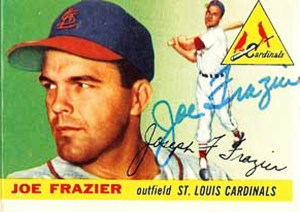
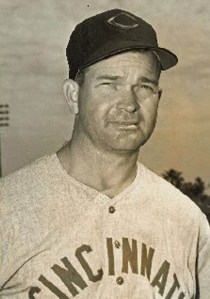
The three bad guys who almost drove me nuts by their late inning hits (usually home runs) against the Buffs were Russ Burns, (BR/TR, OF) who played for Beaumont, Tulsa, Dallas, and Ohlaoma City; Les Fleming (BL/TL, 1B) who played for Beaumont, Dallas, and Shreveport;  and Joe “Snake” or “Cobra Joe” Frazier (BL/TL, 1B) who played for Oklahoma City and San Antonio.

Thanks to fellow SABR colleague Bill Hickman, I now have a photo Russ Burns (far right). Do you see how mean he looks. I felt he lived to put the hurt on Houston.                             BG Russ Burns 2

BG Les Fleming Les Fleming, as you can readily see from the old Cleveland cap he is wearing (far left), got some big league time with the Indians. He sort of looked like the Bluto/Brutus character from the Popeye cartoons. In fact, I think that’s why I became a big Popeye fan as a kid. When Popeye was beating up Bluto for Olive Oyl, I felt he was also beating up on Les Fleming for all of us Buffs fans. – The third guy, however, was unquestionably my most hated Buffs bad guy enemy. Joe Frazier approached the plate in the late innings pretty much in the style that his nickname suggests. He just slithered up there as Buff fans hissed their contempt for his presence on our turf.
Hisses from the fans didn’t bother Joe Frazier. He was just as coldblooded in the clutch as his nickname suggests. And he was pretty darn effective when it came to finding that right field wall in time to put the big hurt on our Buffs at the absolutely worst moment.

If you want more details on these three careers, check out each of these men at Baseball Reference.Com:

RussBurns: http://www.baseball-reference.com/minors/player.cgi?id=burns-001rus

LesFleming: http://www.baseball-reference.com/players/f/flemile01.shtml

JoeFrazier: http://www.baseball-reference.com/players/f/frazijo01.shtml

The only thing that any of these men could’ve done to escape my memory of each as villains would have been to end up their playing careers on the roster of the Houston Buffs. None ever did. I guess they had no “good guy” blood in them.

That being said, I’m wondering if any of you today have any players you consider to be, or to have been, villains of our Houston Astros. If so, I wish you would leave a comment about them in the reply section that follows this posted article.

Thanks. And have a good day. Unless you are an enemy.

Al Hollingsworth: Fiery Manager of the ’51 Buffs!

September 14, 2009

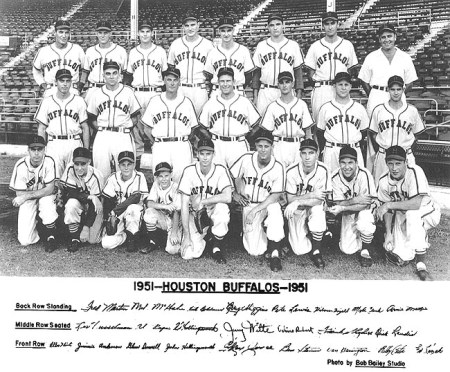
Al Hollingsworth 001’51 Houston Buffs Manager Al Hollingsworth wasn’t exactly your shy and retiring type. When something happened on the field that caused Al to take exception with an umpire’s ruling, Buff fans could count on Hollingsworth to walk (or rage) out of the dugout and go make his own personal opinion abundantly clear to the men in blue.
Sometimes Al got to go home for the rest of the night after one of these discussions. Other times he caught luck and got to stay and watch the rest of the game. Either way, he could be counted on to return to the Buffs’ bench from one of these meetings with a mouthful of shredded blue gabardine pants seat fabric hanging from his snarling teeth.

At age 13, I think I heard every single word for the first time that you’re never supposed to say in anger (or any other time, for that matter) falling, or belching with fire, from the lips of Al Hollingsworth at Buff Stadium at variable points during the 1951 season at Buff Stadium.  Man! Could old Al ever “cuss up a storm” at the drop of a hat – and every umpire’s call against the Buffs in a tight game situation was just such a falling of the old fedora!

Buffs 1951

The ’51 Buffs responded pretty well to their fiery leader. They ran away with the Texas League straightaway championship with a 99-61 record that was good enough for a 13.5 game lead over the second place San Antonio Missions. Then they whacked the fourth place  Beaumont Roughnecks, 4-2 in games, in the first round of the playoffs before polishing off San Antonio in the full championship round by a four-game sweep.

The Buffs then lost the Dixies Series in six games to the Birmingham Barons, but the reasons for that loss went more to injuries and the unavailablity of star lefty Vinegar Bend Mizell due to a mysterious stomach ailment than anything else, including the temperament of their skipper. It must be conceded that Al’s temper was helped to the explosion point  by the presence of rival Texas League manager Bobby Bragan at the home opener in Birmingham, which also happens to have been Bragan’s home town in the off-season back then.

One of the local Birmingham writers asked Bobby Bragan if he felt the Buffs were a pretty good team. Bobby’s answer flowed along the lines that the Buffs “ought to be good. The Cardinals pretty much put all their AAA talent in AA Houston this year. (Here it comes!) – Any manager could win the Texas League pennant with that kind of talent stacked in his favor.”

From what I heard from Jery Witte, one of his former players, Al Hollingsworth really went through the roof when he read the words of his always testy rival mentor Bragan.  I have a pretty good idea of what Big Al most likely said about the comment, but I won’t write it out here. If you weren’t raised in a glass bubble, you can probably figure it out for yourself.

Al Hollingsworth 003

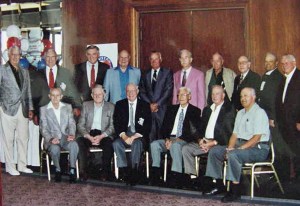
I never got to meet Al Hollingsworth personally until the Last Round Up of the Houston Buffs at the Westin Galleria on Sunday, September 24, 1995. By this time, Al Hollingsworth was 87 years old, physically frail, and living in retirement in Austin. He was quiet, polite, gracious, delightful to be around, and really thrilled to be in the presence of his former players, old baseball buddies, and former Buffs President Allen Russell – even if it were just for that one final time.  (If you can see him. that’s Al in the front row, 3rd  from the right). Of the old Buffs shown in this photo, only three remain alive in September 2006. Those would be Larry Miggins (3rd from left, top row), Solly Hemus (3rd from left, top row), and Russell Rac (far right, top row).

Al Hollingsworth passed away at home the following spring at age 88. The date was April 28, 1996.

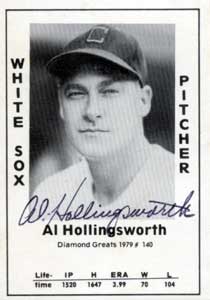
Al Hollingworth had an active playing career that spanned from 1928 to 1947.  His best minor league season as a lefthanded pitcher was 1941, when he went 21-9 with a 3.17 ERA for AAA Sacramento. He was 70-104 with a 3.99 ERA over eleven seasons in the majors (1935-40, 1942-46) with the Reds, Phillies, Dodgers, Senators, Browns, and White Sox. He was a member of the 1944 St. Louis Browns, the only club in that franchise’s history to reach the World Series.

Al Hollingsworth managed the Buffs from 1951 through the middle of the 1953 season when he was replaced by Dixie Walker. In spite of his human frailties with temper, he was a “man’s man” manager who handled the development of young pitching prospects very well. His most exemplary student? Look no further than Wilmer “Vinegar Bend” Mizell, the kid from Alabama that started out as the touted lefty version of the great Dizzy Dean. He didn’t make it to that level, of course, but that was no fault of the great teacher he had at Houston.

God bless you, Vinegar Bend, and all the other Buffs of the Last Round Up, Al Hollingsworth! I will always treasure that day of the reunion as one of my grandest baseball memories.

Allen Russell: The Believable Barnum and Bailey of Buffs Baseball!

September 12, 2009

Marr WIcker Hawn That’s Houston Buffs President Allen Russell in the business suit and hat at the far left of today’s featured first photo. He’s showing some kind of report in early 1950 to St. Louis Cardinal coaches Runt Marr (next to Russell) and Freddy Hawn (far right). That’s Kemp Wicker, the first of two managers who commanded the Good Ship Buffalo at the start of the ’50 season wearing the “Houston” jersey. Little Benny Borgmann would soon replace Wicker and manage the Buffs for most of their ride into the Texas League cellar that most inglorious year, but that kind of field performance disaster never stopped Allen Russell. It simply provided a different kind of marketing challenge.
Bill Veeck wasn’t the only organized baseball promoter who would try almost anything that worked to draw fans to the ballpark. He was just the most creatively famous owner/president to do it – and he also did it at the major league level. Allen Russell could hold his own with just about anybody in baseball when it came down to bodacious ingenuity – and the 1950 season provided him with one of his brightest and coolest moments of gate-rattling chutzpah – and Allen wasn’t even Jewish!

Late in the 1950 season, when it became apparent that the Buffs had been shortchanged on the minor league talent distribution by the parent Cardinals that year, Russell decided he needed to do something unique in the interest of pumping the gate a little bit on the way to a crippled attendance finish. What he chose to do wasn’t totally unique. The rival Fort  Worth Cats had tried it briefly in 1949, but Russell forged onward, anyway, after talking his club into going along with the gimmick. The Buffs said “OK”, but they gave their consent to the plan with some considerable reservation.

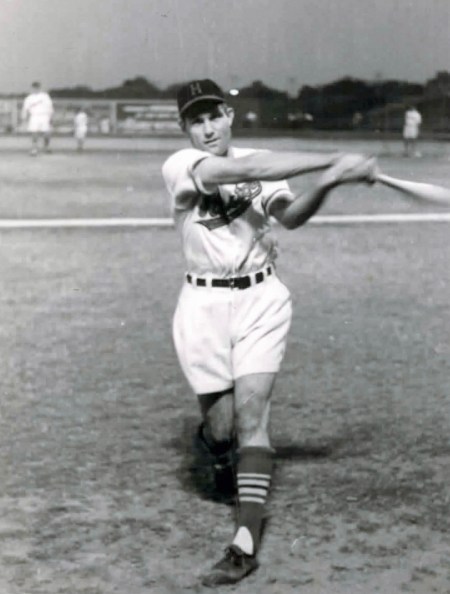
Jerry Witte in ShortsAs modeled in the photo by the Buffs’ sluggung first baseman Jerry Witte, the Buffs agreed to wear shorts, as I also covered in a recent article. The ostensible reason given for this change was that the Buffs wanted to do all they could to make sure their players were made as comfortable as possible in the searing, humid Houston summer heat.
A lot of fans weren’t concerned with the comfort problems of a team that was already well on its comfortable way to a dead last finish, but that was not Russell’s concern. If he couldn’t give them winning baseball without the Cardinal home club’s help, he could at least provide the fans with something with the gawk-value of grown men playing baseball in short pants, that a fan had to buy a ticket to see.

“Players who aren’t comfortable losing should either find a way to win or be given a ticket down to Class A Omaha!” was a fairly typical conservative fan attitude, but that didn’t stop the short pants experiment.

The blousy short pants created a short term curiosity spike in attendance, but that thrill soon wore thin. Fans don’t like watching losers and short pants don’t make it more OK in the long run. Besides, the players hated the extra easy mosquito bites and sliding strawberry wounds they were getting from the goofy looking sawed-off uniform pants. Seeing all these things for himself, Allen Russell soon restored the Buffs to regular long pants before season’s end – and the Buffs marched on to a last place finish like real men.

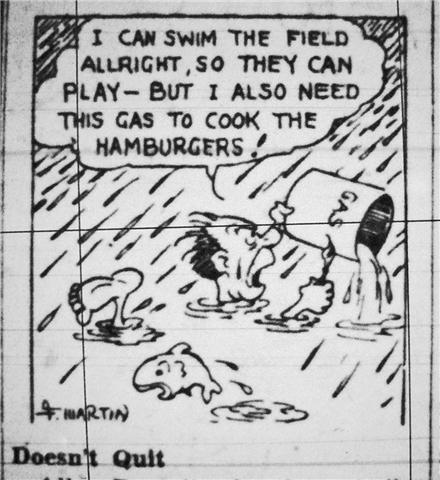
During his eight seasons as Buffs President (1946-53), Allen Russell was largely responsible for a major growth in attendance at Buff Stadium for Houston Buff Texas Leaue games. Throw in the extra facts that this was arguably the halcyon era of baseball game attendance popularity. From 1946 through about 1953, the year that TV and a diversification of other leisure time interests pretty much changed everything  – baseball held the stage for a bull market run at new attendance records. All a city needed was a promoter like Allen Russell to make it happen – and easy access to the ballpark. Houston built their first freeway right past Buff Stadium in 1948 and the old ballpark was still very accessible to the bus lines and middle class neighborhoods that surrounded the place. Russell took advantage of every break that swung his way – and he also  pretty much declared war on rain-outs and the loss of income they produced. Russell would get out there on the field himself and pour gasoline into all standing waters on the infield and then set it on fire. He would literally burn the water off the field before he ever called a game because of rain. If he could’ve stopped the rain from ever falling on game days with a little voodoo ceremony, he probably woul d have done that too.

Allen Russell & Rain In 1946, the year that Russell took over as Buffs President, the Buffs drew 161,000 fans and the major league St. Louis Browns drew 526,000. The very next year, 1947, the Buffs outdrew the Browns by 326,000 to 282,000. By 1948, the Buffs again won the gate battle, 401,000 to 336,000. The Browns edged a bad Buffs team in 1949 by 271,000 to 254,000, but an 8th places Buffs club in 1950 still edged a 7th place Browns club by 256.000 to 247,000. The Buffs won again in 1951 by 333,000 ro 294,000 By 1952, St. Louis was reaping the benefits of Bill Veeck’s second year at the Browns helm. The Browns outdrew the Buffs by 519,000 to 195,000 in 1952 – and they edged them again in 1953, the last year of the Browns, by a 297,000 to 204,000 count.
In spite of the lapses in his twofinal  Buff seasons, Russell had made his point before leaving Houston to take over running the nearby Beaumont Exporters. The St. Louis Cardinals even considered moving to Houston prior to the 1953 season because of some serious ownership problems, but that possibility was quashed by the purchase of the club by August Busch and the Budweiser Beer Company.

After 1953, it would be the Browns who moved from St. Louis, but that relocation would not be to Houston. It would be to Baltimore. Still, Allen Russell supplied the original rachet for others who would now pursue major league baseball for Houston with great passion and political savvy. They would succeed seven years later when Houston was awarded an expansion club franchise in 1960 to start playing in 1962.

Now we just need to make sure we remember the man who made it all possible. His name was Allen Russell and, as far as I’m concerned, he’s also the real father of major league baseball in Houston.


********************

Bill McCurdy

Principal Writer, Editor, Publisher

The Pecan Park Eagle