Born November 3, 1911 in St. Louis, Johnny Keane accepted his first minor league managerial job just prior to the start of World War I. – No, wait! – It wasn’t really that early. It just 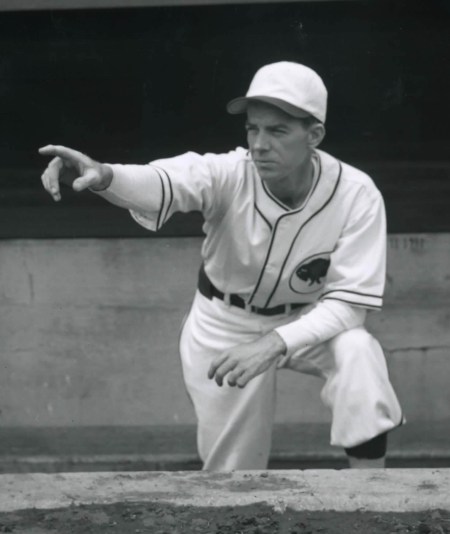 seems that way. His 17-year minor league playing career (1930-41, 1946-48) as a pretty good hitting middle infielder, however, quickly revealed an even greater talent for leadership. At age 26, Keane was awarded his first managerial assignment from the parent Cardinals as Manager of the Class D Albany, Georgia Travelers. Johnny promptly rewarded the Rickey organization’s judgment of him by reeling off two consecutive first place league pennant winners in Albany in both 1938 and 1939.
Over the course of his 17 seasons as a manager in the St. Louis Cardinals minor league system (1938-41, 1946-58), Keane won 4 league championships and lost 8 other playoff appearances. He had a losing record in only 5 seasons. His winning touch in the minors (1,357 wins, 1,166 losses) finally won him a place on the coaching staff of the Major league Cardinals in 1959, where he remained until he replaced Solly Hemus as manager on July 6, 1961. It is a note of irony that Solly Hemus had first played for Johnny Keane when the latter led the 1947 Houston Buffs to the Texas League title and Dixies Series championship.
In Johnny Keane’s fourth year at the Cardinal helm, he came under fire as the Cardinals seemed to be fading in the stretch of the 1964 National League pennant race. It soon became the worst kept secret in town that the club planned to bury Keane’s St. Louis managerial career at year’s end.
A funny thing happened on the way to the funeral.
With some considerable help from Phillies manager Gene Mauch and his misuse of pitchers, the NL’s 1st place Philadelphia club pulled the arguably biggest el foldo job in history over the last two weeks as the Cardinals got hot neough to catch them at the wire for the National League pennant. Now the talk of firing Keane went dark as he then led the club to an exciting seven-game World Series victory in 1964 over the fabled frequent Big Show flying New York Yankees.
Now, before Cardinals owner August Busch could disengage his foot from the brake pedal on a policy reversal and offer Keane a new contract extention with the Cardinals, the New York Yankees and Johnny Keane had a notice of their own, one that called for a quick media conference. The Yankees announced that they were firing Yogi Berra and hiring Johnny Keane as their new manager for 1965.
I suppose Keane found some revenge for the Cardinals’ lack of faith in him through this move, but further validation of his abilities as a mentor would be unavailable in New York. The talent bank at New York was pretty much bankrupt by 1965 as the once great Mickey Mantle played out in emptiness the four bad last seasons of his career. They were the years that never should have been. All Mantle did from 1965 to 1968 was roughly drop his career batting average below .300 lifetime while adding a few meaningless home runs to his already assured Hall of Fame career, but Keane would not be around long enough to see even half of that period of demise.
After leading the Yankees to a 77-85 record and 6th place finish in 1965, Keane and the Yankees got off to a horrendous 4-16 start in 1966, prompting yet another exercise in the Yankees’ quick trigger finger response policy. On May 7, 1966, the Yankess fired Johnny Keane, replacing him with former Yankee manager Ralph Houk.
Johnny Keane’s managerial record had come to an end at sge 54. He went back to his home in Houston and private business, but that didn’t last long. On January 6, 1967, Johnny Keane suddenly passed away from a heart condition at age 55. Whoa again! Less than three years after winning the National League Manager of the Year Award, Johnny Keane was gone.
Johnny Keane was loved by the old time baseball community members in Houston who remembered him as either a fellow player or manager. I use the past tense here because most of those who remember Johnny Keane are also now gone. He was a long-time winner with a quick and fast memory for what appeared to him as acts of short term, underhanded disloyalty.
As a manager, Johnny Keane did the five things that I think any winning manager must do: (1) he was a good judge of talent; (2) he managed his pitchers well; (3) he treated his players with respect; (4) he publicly covered for his players; and (5) he took responsiiblity for the outcome of his own decisions. He apparently did not, however, adjust to the change in cultures he experienced when he moved from the Cardinals to the Yankees. As a disciplinarian, his style worked with Cardinal youngesters and veterans there who knew him well. When he moved to New York, however, the proud Yankees did not like the little man who apparently came there to tell the proud Yankees what to do. The Yankees read his authoritative style as disrepect for their proud heritage and ability. Going from the laid-back style of Yankee legend Yogi Berra to the more militant mode of outsider Keane didn’t help matters either. Besides, many of the Yankees felt that Yogi had gotten a raw deal in the post-1964 World Series firing and weren’t about to be open to taking on the man who had defeated them as the Cardinal mentor. As a result, Johnny Keane either never had or quickly lost control of the Yankees in 1965. There was no way that the situation could hold up for a second full year after the club’s horrible 1966 start.
Johnny Keane’s signature was one of the few autographs I ever collected directly as a kid. It was about 1950 and Keane was actually playing in one of those post-season “All Star Games” that President Allen Russell liked to stage at Buff Stadium. Keane and some of his random teammates were having a beer in the clubhouse at game’s end when they opened the door for us kids to greet the players coming out. All I had was a scoring pencil so I grabed a loose paper cup and tore it open flat for Johhny to sign, which he did. – Wish today I had saved it. I used to think back in 1947 that Johnny Keane was the smartest man in the world and, who knows, maybe he was.
Johnny Keane had an ancient Buffs connection. He played a few games for the 1934 Buffs, then returned for three full seasons as a player from 1935-37, batting .265, .272, and and .267. He even had a few times at bat during his three (1946-48) managerial years with the Buffs. Somewhere along the way, Johnny Keane fell in love with Houston and made it his adopted home town – and I’m glad he did. I just wish he could’ve hung around longer, but it was not to be.
 Willard Brown was one of those older, out-of-the-shadows players who glanced his way through organized baseball during the early days of its desegregation. He got there in time to leave one very indelible mark, but not early enough to use all of his abilities in their prime form, and not late enough to find any real place for himself in the major leagues among a more receptive crowd of accepting white teammates. No indeed. An older Willard Brown got there playing for a team that still overflowed in 1947 with some old school white racists.
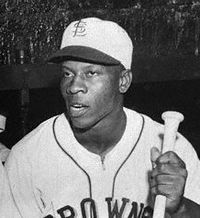 hitting .179 in 21 games with the Browns, Willard Brown left the big leagues and returned to the familiar confines of his more comfortable life among the Monarchs in Kansas City. That winter of 47-48, Brown went to Puerto Rico and batted .432 with 27 homers and 86 RBI in only 60 games, earning for himself yet another nickname as Ese Hombre or – “That Man”.
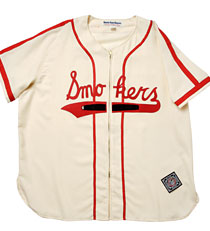 Among all the great controversial names ever assigned to minor league baseball clubs, I have to go with the Tampa Smokers as my all time favorite venture into the future of political incorrectness. Of course, it came about in the early twentieth century, during the era in which Tampa, Florida was reknowned for its cigar products, but that kind of explanation probably cuts little ice with the 2009 Surgeon General or his/her legion of anti-smoking lobbies. As a puritanical culture, we still aren’t that forgiving of people found guilty of past addictions, even those that once held their ground as the social norm. I was a smoker for a long, long time, and although I wouldn’t recommend it today to any young person that wants to save his or her lungs, I never became one of those holier-than-thou ex-smokers who enjoyed either beating-up-on or lauding-my-abstinence-over those folks who still smoke. Anyone who really ever went through breaking the tobacco habit, I think, will not soon forget what it was like to be trapped there. It was the toughest bad habit that I ever had to break, bar none, and I didn’t get out early, easy, or without God’s Help. That’s how I see it, anyway.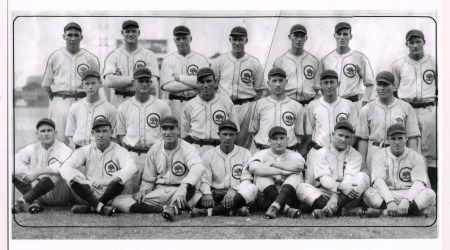
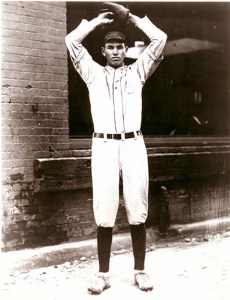 Dizzy Dean (age 21, BR/TR, 26-10, 1.53 ERA): Dizzy was brilliant and Houston loved him. His 26 wins and 303 strikeouts led the Texas League in 1931 and his 1.53 ERA tied him with Whitlow Wyatt of Beaumont for the lowest mark in the league.
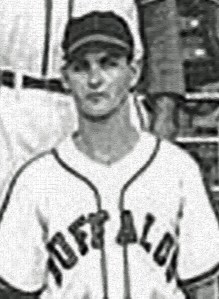 The 1951 Texas League Champion Houston Buffs didn’t finish 13 1/2 games in first place by accident. Like most good teams, they had a pitching staff that got them there. Fortified by knuckleball ace Al Papai (23-9, 2.44), lefty rookie phenom Vinegar Bend Mizell (16-14, 1.96), veteran righty Fred Martin (15-11, 2.56), Mike J. Clark (10-7, 2.78), relievers Dick Bokelmann (10-2, 0.79) and Jack Crimian (1-2, 0.90), the ’51 Buffs needed few other pieces to be as about as complete a staff as any winning club could ever hope to unfold, but they had that extra “umphh” arm too!
 Rubert had a blind and wandering left eye. I always thought it was just an abnormality in his natural eye, but teammate Larry Miggins says it was actually a glass eye, one that Rubert could actually manipulate in the socket as he saw fit while he worked the mound. The stories are quietly legend about how Rubert used the eye to hold first base runners close to the bag. An unsuspecting opponent could reach first base and be fine as per normal – until he started to take his lead on Rubert. Then he’d look over to the mound and see the pitcher in the stretch position, but also looking straight at him.
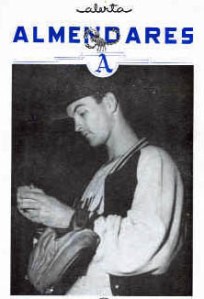 The 6’0″ , 160 lb. Cuban also enjoyed several good seasons with Almendares in the Cuban Winter League prior to the 1959 government takeover by Fidel Castro. He was inducted into Cuban Baseball Hall of Fame in Miami, Florida in 1997. That organization went into into some kind of suspended status following 1998 due to political tensions between Cuban-American residents and their homeland of origin, but it’s still quite a statement about the abilities of Octavio Rubert that he even got there.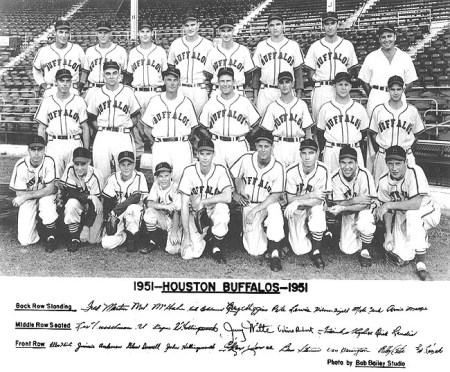
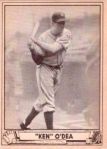 Sometimes I’m reminded of certain former members of the Houston Buffs by the e-mails I get from people with a special interest in same. Yesterday I received a request for research assistance from a fellow named Ken Hogan, a guy whose doing background work right now for what he describes as a “booklet” on a cousin who played for the Houston Buffs in 1933, a BL/TR catcher named Ken O’Dea.
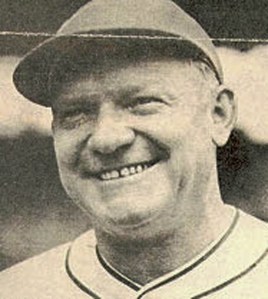 So, how does a guy get a nickname like “Tomato Face?” Let us count the ways he may have earned it honestly from the baseball culture, especially back in the old days.
 The six foot tall, 164 pound stringbean righthander named Jack Dalton Creel was born on April 23, 1915 in a little place called Kyle, Texas. From 1938 through 1953, Creel amassed a fifteen season record of 179 wins, 157 losses, and an earned run average of 3.37 Throw in the 5-4, 4.74 W-L, ERA record he recorded in his one 1945 season with the St. Louis Cardinals and you’re looking at a pretty fair country resume’ for a fellow who played it all out during one of baseball’s most heavily talented personnel eras.
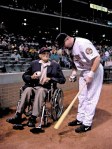
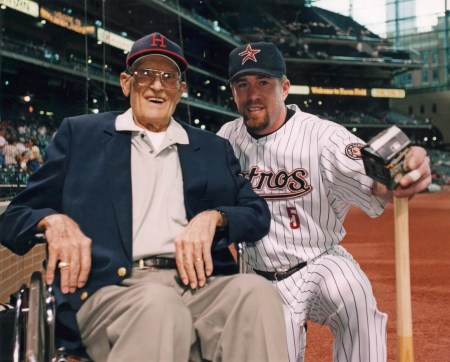
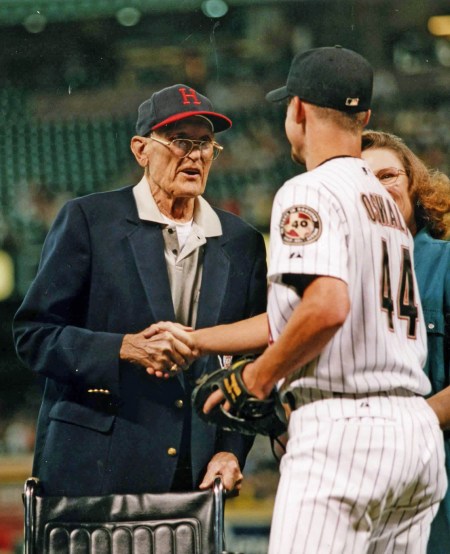
 A few years ago now, my best friend and all time greatest baseball hero got to throw out the first pitch at an Astros game in the place we now call Minute Maid Park. The date was Friday, August 3, 2001. My late friend and hero was a fellow named Jerry Witte.




 Houston, Baseball, & Other Musings.
 The Pecan Park Eagle