Posts Tagged ‘Houston Buffs’

Seems Like Old Times.

February 8, 2010

Buff Stadium in Middle Right of Gulf Freeway, Early 1950s.

It was located four miles east of downtown Houston. When its first Opening Day came around on April 11, 1928, many Houstonians still grumbled over the fact that Buffalo Stadium, the new baseball home of the Houston Buffs had been built so far out in the sticks from the city. West End Park, after all, had been right there on Andrews Street, off Smith, near where almost everybody lived back in the booming 1920s. The old park may have found its way to some  dilapidation and it may have offered  inadequate seating capacity, but it was close. And close counted for something back in the pre-freeway days.

The city had rallied to the travel problem by making sure that rail service to the new ballpark from downtown was easy to use. Union Station, the current home site of Minute Maid Mark, in fact, was one primary place to catch the ballgame  train that went out to Buff Stadium on what was then known as St. Bernard Avenue in 1928. That same thoroughfare is called Cullen Boulevard these days. It’s been Cullen so long now that hardly anyone alive still remembers it by its earlier identity.

Buff Stadium was the brain child of Cardinals General Manager Branch Rickey. Buffs President Fred Ankenman oversaw the ballpark’s construction in 1927-28, bringing in the project on budget at a cost of $400,000 much harder dollars then the kind we see today. Mr. Rickey even came down from St. Louis on the train to attend the 1928 grand opening of the new ballpark in Houston and he brought Baseball Commissioner Kenesaw Mountain Landis with him. Judge Landis was most impressed too, pronouncing the new Buff Stadium as the finest new minor league baseball park in America.

Landis’s favorable impressions were important to Rickey. Rickey hoped to soften the old man’s heart from the idea that major league ownership of minor league clubs was bad business for the local community. The original 8,000 seat Buff Stadium stood as a symbol of progress and improvement in Houston minor league baseball under Cardinal ownership. To some extent, Rickey had accomplished his mission in bringing Landis to Houston in April 1928. Nothing ever really cured the contentious relationship between these two men, as Rickey would learn years later when Landis freed Pete Reiser and a few others from reserve clause capture by the St. Louis Cardinals, but that’s a story for another day.

Look at the Houston skyline in the picture. The Gulf and Esperson buildings were still the icons of Houston architecture in the 1950s – and that freeway and its rascally pal roadways had only begun to play their role in Houston’s massive spread to the hinterlands.

The Houstonians of 1928 thought that the four-mile trip to Buff Stadium from downtown was a major expedition. Today we drive four miles just to reach a Whataburger or rent a DVD movie. So where’s all this progress we keep talking about?

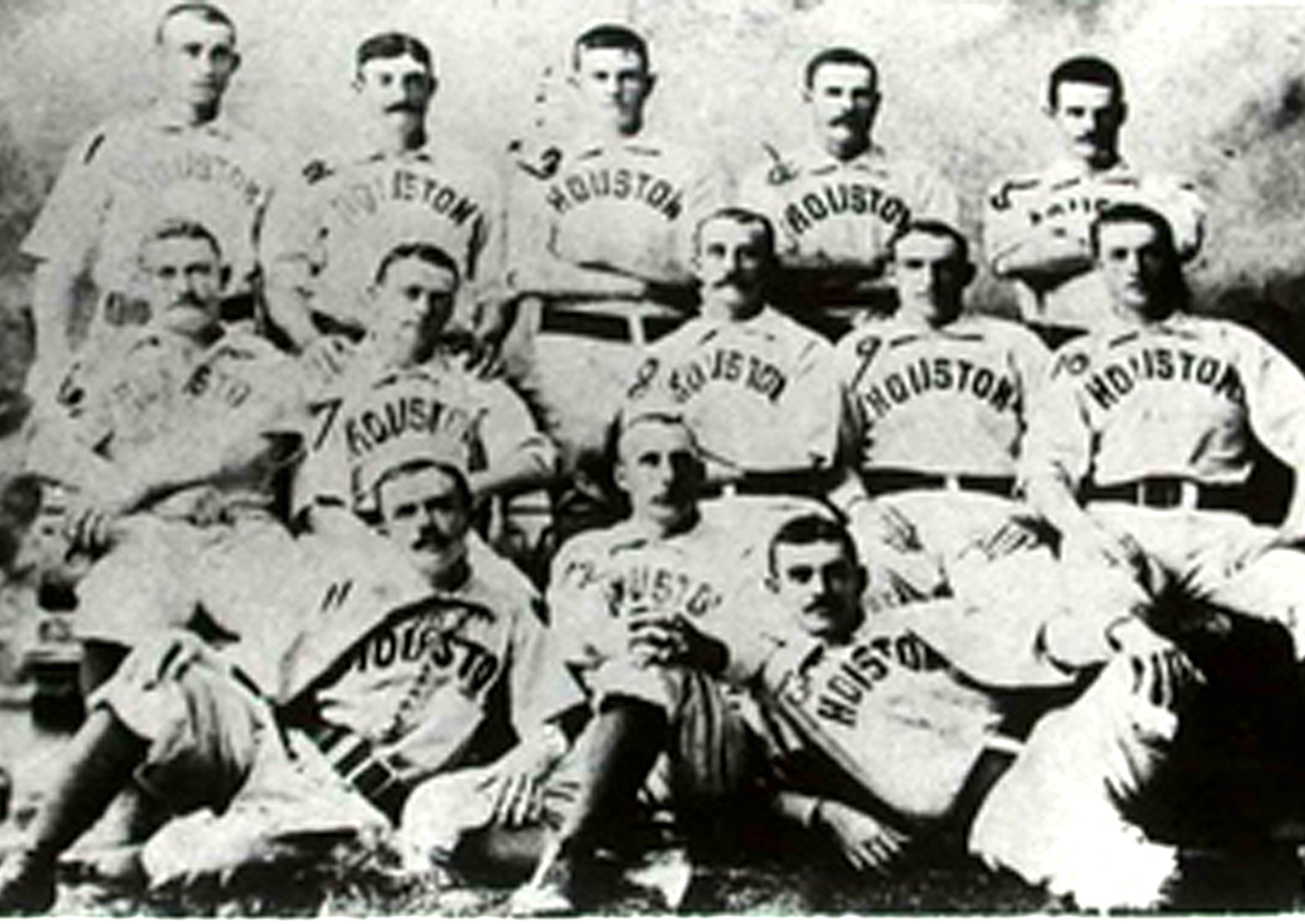
1914 Houston Buffs: Texas League Co-Champs.

February 7, 2010

I especially love doing a baseball story on Super Bowl Sunday morning!

The 1914 Buffs at Union Station. Today they would be standing on the 3rd base line of Minute Maid Park in downtown Houston, Texas.

The 1914 Houston Buffaloes won 102 and lost 50, good enough to tie the Waco Navigators as the almost endlessly arguable co-champions of the Texas League after s series of post-game protests between the two clubs left them knotted in a first place tie with the same regular season record. Unfortunately, in the middle of all the legalese, ego, and other technical in-fighting, a playoff suggestion to settle the matter never broke out. As a result, the two were left to swarm on a tie that would be debated back and forth forever. Here’s the best summary I can provide you from the bit of fuzzy explanation left to us by the leaague’s erstwhile historian Willam Ruggles in “The History of the Texas League” from 1950.

Waco had been trying all summer to have one Houston win thrown out on a technicality. In a June 26th first game of a doubleheader at Houston, Austin trailed 9-1 at the end of seven innings. The visitors agreed to call the game then for the sake of saving daylight for the second contest, even though Texas League rules at the time dictated tat all first games of a DH must go nine frames to be official. The game was protested by Waco and, on September 7th, Texas League President W.R. Davidson threw the game out as a win for Houston, but he did not provide for any replay of the contest as prescribed by the rules at that time. Had the win not been taken away, Houston could have tied Waco with the same record.

Never fear. Houston got that tie, but they did it in the same way that Waco put a hole in Houston’s pennant hopes. They protested and won a verdict against Waco for using a new player too late in the season, as described by the Texas League roster rules for 1914. The win stripped Waco of a win and left them tied with Houston for the Texas League pennant. Perhaps the idea of a playoff between Houston and Waco was thwarted by the fear of further protests over whatever might have happened in an additional game.

The books closed on 1914 with Houston and Waco both finishing at 102 wins and 50 losses.

1914 was another quirky year in the Texas League. Last place Austin’s ownership was chastised early in the summer for not trying hard enough to win and for the frivolous firing of good players who may have been making too much money to please Austin owner Quebodeaux. The roster had a revolving door that almost spun its way out of control. “We tell ’em hello in the morning,” said Austin pitcher Ross Helms, “and we kiss ’em goodbye at night,” he added.

At one point, Austin lost 31 games in a row, a figure that also turned out to be their season win. The Capitol City boys finished last in the Texas League in 1914 with a record of 31 wins and 114 losses.

The only common ground that this article shares with the Super Bowl is this one: If someone wants to know who won the Texas League pennant in 1914, the only safe answer is this one:

Who dat?

Houston Baseball’s 1st Pennant Had to Pause.

January 27, 2010

The 1889 Houston Mud Cats Brought Our Town Its First Flag.

As we have written recently and often over the years, baseball faced a lot of obstacles getting started in Houston and Texas during the late 19th ccentury. Scheduling problems, competitive imbalance between the really good and really bad teams, building a pattern of regular game attendance among fans who were not yet accustomed to that idea, the poor condition of fields and playing venues, the absence of “revenue stream” thinking, the scarcity of “revenue streams period” beyond gameday gate tickets and minor food concession sales, poor club projections on operating expenses, player abandonments from clubs that delayed paydays, the general inadequacy of financial backing, and the limited availability of really talented players all fed into the problem.

In many ways, all these factors fed into the 1889 second season of the Texas League. 1889 proved to be the year for Houston’s first professional baseball pennant, but it was a flag that came with some administrative resistance and quite a bit of tarnish to the cloth of our city’s first glorious flag of victory. The way things turned out, 1889 was as much a victory over financial dragons as it was a win on the field of play.

The 1889 Houston Mud Cats of the second-season Texas League finished their year with a record of 54 wins, 44 losses, and a winning percentage of .551. John McCloskey, the man remembered today by most historians as the “Father of the Texas League,” served as the fiery playing manager of the Houston Mud Cats.

Our town’s team nickname changed often in the early years. Houston had been the Babies/Red Stockings in their first year not-so-good start with the new Texas League in 1888. The 1889 re-christened fish club, however, proved they were anything but “bottom feeders.” The Mud Cats soared to Houston’s first baseball and professional sports crown of any kind.

Led by the inspirational spark and upbeat personality tempo of John McCloskey, Houston did great on the field of play, but they still almost lost their  first title on a technicality. The club had never paid their league membership dues in full for the 1889 season. Those unpaid dues were only a part of the financial landslide that soon came avalanching down upon Houston in early August of 1889.

Because of these massive money problems, and in spite of their comfortable game performance lead in the Texas League, the Mud Cats decided to resign from play on August 9, 1889. Three days later, on August 12, 1889, the whole Texas League collapsed under a pile of debt – and in realistic respect for the fact that dwindling attendance offered no hope for recovery.

When Houston then moved to accept the temporarily fallen league’s designation as the official champions of 1889 because of their record through the date of total collapse, they ran into a little hitch. As for earning it, the Texas League office and other clubs had no problem with the fact that Houston had proved themselves champions in actual game play, but league officials still withheld the championship award until Houston agreed to pay its late membership dues to the league office.

Once Houston scrambled around for the cash and paid the late dues money, the city got its first pennant.

How glorious is that memory?

Johnny Grodzicki: Another Buffs Might-Have-Been!

January 21, 2010

For of all sad words of tongue or pen, the saddest are these: ''It might have been.'' - John Greenleaf Whittier.

At 6’2″ and 200 pounds, Johnny Grodicki (BR/TR) was another of those young Houston Buff arms from the 1930s who might have been something had fate broken a little differently. It just wasn’t to be.

Grodzicki arrived in Houston late in 1936 at age 19 after registering a 16-12 record for New Iberia of the Evangeline League, a place that saw the start of many future great Cardinal pitchers. Howie Pollet and ed Munger both got their starts there.

Grodzicki got into three games for ten innings of work with the Buffs in 1936, picking up a single loss as his only Texas League mark in that first year, but hopes were high in St. Louis for his success at Houston in 1937.

Grodzicki’s fastball had good heat and his curve was decent enough. As often happened, his problem was control. In 244 innings of work for the 1937 Buffs, Grodzicki walked 174 batters. He still finished the season with a great record of 18 wins against only 11 losses and he complied an attention-getting earned run average of only 2.88 for a Houston club that finished in 7th place with a 67-91 record.

Young Grodzicki also starred in the 1937 Texas League All Star Game at Buff Stadium. In only the second game of its kind in league history, an overlow crowd of over 8,000 Houston fans showed up that day to watch the North and South All Stars square off against each other. Grodzicki came into the game in the fourth inning, bringing form and focus with him. He proceeded to imitate the earlier accomplishments of major league great Carl Hubbell by striking out six of the best hitters in the North lineup as his first item of business. The hitters, all of whom carrying .300+ batting averages with them into the game, included Homer Peel, Red Harvel, Joe Bilgere, Lou Brower, Norman McKaskill, and Ed “Bear Tracks” Greer.

1938 saw Grodzicki post a 12-21 record for a 5th place Houston Buffs (74-84) club. His innings of work increased to 269 and his walks dropped to 169, but his ERA ballooned to 4,25.

1939-1940 saw Grodzicki moving up the Cardinal chain for two seasons at Rochester where he compiled a total record for two seasons of 11 wins and 10 losses. In 1941, “Grod” moved over to Columbus for a record of 19-5, 2.58 ERA and his best season record in professional baseball. His success at Columbus earned Grodzicki a late season call-up to the parent St. Louis Cardinals where he posted a 2-1 record and a drop-dead gorgeous ERA of only 1.35 in 13.1 innings of work.

Then came World War II and a hiatus from the game that finished the future of Johnny Grodzicki. In his first season back, 1946, “Grod” worked only four innings, recording no record, but posting a 9.00 ERA for the Cardinals. In 1947, Johnny worked only 23.1 innings for the Cards, posting a record of 0-1 with an ERA of 5.40. Aging, injury, and ineffectiveness, plus four years of war rust wouldn’t go away. They were collectively the end of Johnny  Grodicki’s stock as a prospect. After 1947, he would never again darken the doorway of an MLB clubhouse.

Twelve years after his first arrival, Johnny Grodzicki returned to the Houston Buffs in 1948 as a an old 31-year old minor league veteran. “Grod” did OK in limited action as a 6-5, 2.05 ERA starter/reliever in 88 innings. Coming off their 1947 Dixie Series championship year, the ’48 Buffs under manager Johnny Keane were only an 82-71 3rd place club. “Grod” was starting to be a fit for mediocrity.

1949 saw Grodzicki go 4-5 for the Buffs before moving up to Rochester again for a 2-1 mediocre finish. Johnny Grodzicki continued to plod his way through the minors for three extra seasons of unremarkable achievement before hanging it all up after 1952 at the age of 36. He finished with a career minor league record of 108 wins, 83 losses and an ERA of 3.65

Johnny Grodzicki passed away in retirement at the age of 83 on May 2, 1998 in Daytona Beach, Florida. As a faded away former minor league prospect, he was the living embodiment of “what might have been.” With a little more control, a tad bit more of good luck contact with the right mentor who never showed up in reality, and with a lot less wear and tear from World War II, who knows what might otherwise have become of Johnny Grodzicki?

Johnny, we hardly knew you.

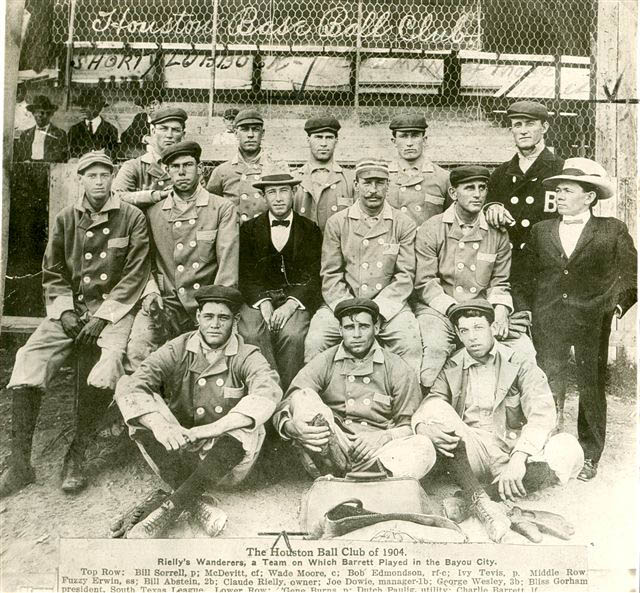
The 1904 Houston Wanderers.

January 20, 2010

The Buffs Called Themselves the Houston Wanderers Back in 1904.

As I hope you could glimpse from the piece I recently wrote here on the start of the Texas League, baseball didn’t exactly get off to a seamless start in Houston or any other Texas city back in 1888. Teams and season schedules sometimes folded like a House of Cards when the going got tough. Unstable lineups led to unstable results; unstable results led to unstable attendance;  unstable attendance led to players not getting paid on time; missed paydays led to teams failing to keep their travel commitments for road games; abruptly canceled games drove fans away; and lost fans meant lost teams. It wasn’t very pretty, especially at the start.

By 1902, the Texas League had recovered sufficiently to reorganize, but Houston was not among the clubs that came together for another go at playing a full season. In 1903, Houston joined with Galveston, Beaumont, and San Antonio to form the four-team South Texas League as competition for the four-club Texas League group of Dallas, Fort Worth, Paris,/Waco, and Corsicana. For the first time in 1903, our local baseball team was known as the “Houston Buffalos.”

The 1903 Buffs were followed by a one-season identity hiccup. The 1904 club changed their name to the “Houston Wanderers” for that single season. By 1905, the club had gone back to “Buffalos” and they never looked elsewhere again for a better moniker. From 1905-1942, 1946-1961, our boys would be known as the Houston Buffs in the South Texas League, the Texas League, and the American Association.

After the 1906 season, the two competing state circuits settled their differences and reorganized the Texas League that continues to exist from 1907 through 2010. The 1904 Wanderers finished with a 66-59 record (.528), or only good enough for a third place spot in a four club league. Claude Rielly was the club owner by this time. The 1904 Houston Wanderers  featured the league’s leading hitter (Bob Edmundson, .340) and the league’s winningest pitcher (Clayton Robb, 26 wins). In fairness, we note that Robb won some of those game for Beaumont before he was traded during the season to Houston. Robb also finished in a tie for most wins with Baldo Luitich of Galveston/Beaumont. Luitich also bagged 26 South Texas League wins in 1904. Add one more local leader. Houston’s Bill Sorrells led the 1904 Texas League in strikeouts with 243.

Yes, Houston club owner (and sometimes manager) Claude Rielly really spelled his name “ie” rather than the conventional “”ei”, but that’s not surprising. The rules that governed the early years of professional baseball had nothing to do with following guidelines like “i after e, except after c”. The early baseball founders made up their own rules and boundaries, sometimes taxing their full faith and credit investment in the public’s trust in the integrity of the game. The only rule they could not suspend is the one that governs the bottom line: If you don’t make money over time, you have to fold your tent and go away.

For Houston, the 1904 Wanderers were simply another step in the right direction. They played all the games they were scheduled to play, and they finished the season without crashing their payroll commitments to their players. 1904 Houston club leader Claude Rielly understood a basic tenet about baseball in particular and business in general. That is, before you can hope to expect profitable “success,” you better be able to spell “infrastructure solvency.”

Houston Buffs: Ted Wilks.

November 17, 2009

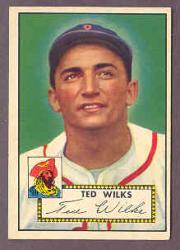
Right hander Ted Wilks broke into baseball with the 1938 Houston Buffs. His 3-5 record with an ERA of  2.74. He pitched well enough that rookie season to earn a promotion that same year to Rochester, where he posted a 4-2 mark with an ERA of 3.94. A subtle difference in how he was used at Houston and Rochester was nothing less than a career harbinger on things to come. Here in Houston, Ted was primarily a starting pitcher; at Rochester, Wilks saw most of his mound action in relief.

The following three seasons saw Ted Wilks back in Houston for more seasoning. He went 14-15 with a 2.60 ERA in 1939; 13-10 with a 2.51 ERA in 1940; and 20-10 with a 2.50 ERA for the 1941 Buffs. All three Buff clubs (1939-41) finished in first place; the ’40 club also won the league pennant playoffs; and Ted Wilks was a big part of that Buff era of success.

After going 12-9, 2.41, for the ’42 Columbus Redbirds and 16-8, 2.66, for the same club in ’43, Ted Wilks finally joined the big club in St. Louis in time to help the 1944 Cardinals take another world Series crown with the streetcar series win over the same hometown Brown of the American League. Wilks was used pretty evenly in 1944 as a starter and reliever (21/15), going 17-4 with another sub-three ERA of 2.64 on the season.

In his eight seasons as a Cardinal (1944-51), Ted Wilks won 54 games against only 20 losses, posting a sub-three ERA on three separate occasions. It was early during this period that he moved from split duty as a starter-reliever to recognition and exclusive use as one of the top relief pitchers in the game.

On June 15, 1951, the Cardinals traded Ted Wilks, Bill Howerton, Howie Pollet, Joe Garagiola, and Dick Cole to the Pittsburgh Pirates in exchange for pitcher Cliff Chambers and outfielder Wally Westlake.

Wilks went 8-10 in two seasons with the Pirates (1951-52) before he was again dealt away, this time  to the Cleveland Indians on August 18, 1952, along with shortstop George Strickland for infielder Johnny (General Hospital) Berardino, minor league pitcher Charlie Sipple, and $50,000 cash. By this time, Wilks was was pretty much out of gas for major league ball. He posted no decisions in his two partial seasons with Cleveland (1952-53) and he finished his major league career working only 15 1/3 innings in the American League city.

Ted Wilks finished his total career working four poor seasons of minor league ball (1953-55: Indianapolis; 1956: Austin) before retiring for good. He finished up with a career minor league record of 91-65, 2.70 for 10 seasons – and a career major league record of 59-30, 3.26. Ted wilks posted 46 saves as a major leaguer. The “save” stat for his minor league work is not readily available.

Like a number of ballplayers whose careers passed through Houston, upstate New Yorker Ted Wilks adopted Houston as his post-career home town. He died here in Houston in 1989 at the age of 73 and he is buried in the East End at Forest Park Cemetery on Lawndale. His final resting place is only two miles from where he first took the mound as a Houston Buff in 1938.

Rest in Peace, Prince Ted, but stay ready to come into the game whenever old St. Peter dials your number.

Houston Buffs: Danny Murtaugh.

November 16, 2009
20090830pg_murtaugh_330

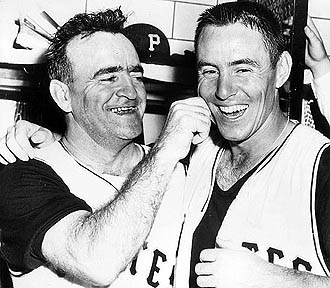
Murtaugh (L) & Mazeroski were all smiles after Game 7 in 1960!

Danny Murtaugh started out his baseball career as a tough-nosed 20-year old infielder from Chester, PA for the 1937 Cambridge Cardinals of the Class D Eastern Shore league. He batted .297 in his rookie season, following that year with a .312 mark in his second round with the ’39 Cambridge club in the St. Louis Cardinals farm system. He played shortstop his first season; second base his second year. At 5’9″ and 165 pounds, Danny had the right body type and low center of gravity for a middle infielder. More importantly, he had the right kind of aggressive attitude as a critical playmaker.
After batting .255 and .326 in a split-season performance for Columbus and Rochester in 1939, Murtaugh joined the 1940 Texas League Champion Houston Buffs of the Texas League. This time around, Danny played third base, batting .299. The following season, Danny Murtaugh returned to the 1941 Buffs as a second baseman and batted .317 in 69 games. His performance was good enough to get him dealt to Philadelphia (NL), where Danny broke into the big leagues with as a “good field, seldom hit” second baseman (.219) who also reached base often enough to lead the National League in stolen bases with 18.
Murtaugh then improved steadily with the Phils, batting .241 in 1942 and .273 in 1943. Military service got the call in 1944-45. Danny returned in 1946, but, after a handful of at bats with the Phils, he was dealt back to the Cardinals and assigned again to Rochester. This time he excelled, hitting .322 over the road of a whole season.
Dealt next to Boston (NL) in the off-season, Danny again picked up a hand scoop of at bats with the Braves before he was assigned to AAA Milwaukee, where he again did well, batting a “Punch and Judy” .302 in 119 games.
Then Danny Murtaugh acquired his lasting identity. He was dealt to the Pittsburgh Pirates, where he played second base for four seasons (1948-51). In the two seasons he played over 100 games for the Pirates, Murtaugh batted .290 in 1948 and .294 in 1950. He finished his nine major league season career in 1951 with a total batting average of .254 and a strong reputation for tough, heads up baseball savvy.
Danny Murtaugh’s ability earned him a four-year assignment by the Pirates as a minor league manager for New Orleans (1952-54) and Charleston (1955). He continued to play ball a little in 1952-53, wrapping up his nine season, 901-game minor league career with an impressive .297 batting average.
Danny Murtaugh began the memorable phase of his career when he took over as manager of the Pittsburgh Pirates in 1957. For eight consecutive years (1957-64), Danny Murtaugh steadied the Pirates and led them in 1960 to their first pennant since 1927 and first World Series title since 1925. Who among us fans with blood flowing in our veins will ever forget Bill Mazeroski’s dramatic and iconic home run that gave the Pirates a freak-out, walk off victory over the New York Yankees in extra innings at Forbes Field in Game Seven back in 1960?
Pittsburgh’s administration never forgot the moment either. They brought Danny Murtaugh back three additional times as manager in 1967, in 1970-71, and one more time in 1973-76. He guided the Pirates to a second World Series title on his watch in 1971.
I’ve never read anything from anyone in the Pittsburgh organization back in those days that ever reflected badly on Danny Murtaugh as a manager. He really comes across as a never-give-up winner who believed in the value of solid fundamentally sound baseball and the importance of players psychologically leaning into the game with an attitude toward winning as the only acceptable outcome. It was the same attitude that some of us in Houston got to see in person through one of his former players who became a manager here and elsewhere. In his own quiet way, Bill Virdon exuded that same winning Murtaugh attitude. One doesn’t have to be a loudmouth screamer to be totally dedicated to winning.
Sadly, we lost Danny Murtaugh early. He passed away at his home in Chester, PA in 1976 at age 59. Happily, Danny spent most of his last year on earth doing the thing he did best: managing the Pittsburgh Pirates.

Houston Buffs: “Boke Knucklemann”

October 30, 2009
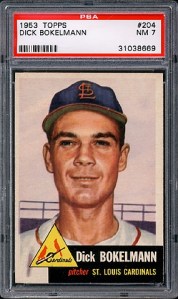
53Topps204Bokelmann

AKA (TO ME) AS BOKE KNUCKLEMANN!

Dick Bokelmann was Boke Knucklemann! When I was a kid, I tried writing fictional action stories and I always used real people as models for my heroes and main characters. That’s how former Buffs pitcher Dick Bokelmann got to be “Boke Knucklemann.” It happened during the red hot Houston Buffs championship season of 1951. Even though I only wrote for my eyes only, I somehow picked up on the idea that a writer couldn’t use an actual name of a real person in his writings, but that changing the name enough to capture the model’s identity without using his actual name made it OK.

Like his real life namesake, Knucklemann pitched for the Buffs, but when he wasn’t pitching, he was fighting crime on the streets of Houston – knocking out bank robbers with knuckle balls that he carried with him in a bag as his weapon of choice. Well, they weren’t exactly knuckle balls while they were still in the bag, but that’s what they were destined to become – once the good guy  “Bokeymann” got through throwing them.

Boke would run up on a robber coming out of a bank with his gun in one hand and his bag of loot in the other. Boke always stopped running toward his man once he got about 60′ 6″ away and then stare him down to a frightened halt. Then he would reach into his ball bag and pull out a weapon that he unleashed as a knuckler, one invariably heading straight for the robber’s face.

Long before Cassius Clay ever thought of it, these pitches of Boke Knucklemann carried with them the powers to both “dance like a butterfly and sting like a bee.”  I always tried to convey these ideas in my 13-year old descriptions of all those “good rallies past evil” moments of final redemption. Although I burned or threw away all my original stories long ago, the big moment always went something like this:

“Gypsy Joe Stalinovich stalled in the doorway of the First National Bank on Main Street as he saw the athletic figure of Boke Knucklemann racing toward him. As Boke stopped some short distance away, Gypsy Joe also froze, with his gun in the left hand and his bag of loot in the right. Coming toward him hard was a bobbing, weaving baseball, which his eyes attempted to closely follow in flight. Suddenly, with his peepers now crossed in locked tracking mode on the incoming white meteor, there’s a loud SPLAT sound as Joe takes it right between the baby blues! – Cartoon butterflies encircle the evil Gypsy Joe’s injured cranium as he falls face flat forward to the pavement for one of the easiest robbery arrests in HPD history. Gypsy Joe’s message is one he’d like to pass on to all other mean and evil Houston crooks: ‘The Bokeymann will get you if you don’t watch out!'”

So, folks, I got a lot out of watching Houston Buffs baseball back in the day, and, thankfully, I was realistic enough back then to spare the public my adolescent storytelling efforts. The point of sharing that literary history with you now is simply to make this point: Those guys weren’t merely my baseball heroes. They also were my inspiration for heroic central casting and my writing character models.

The real Dick Bokelmann was a good enough pitcher in reality to actually need no additional superhero alter ego. As a knuckle balling reliever for the 1951 Houston Buffs in 27 of the 30 games he worked, Bokie won 10 and lost 2 as he complied an incredible ERA of 0.74 over 85 innings of work.

Born 10/26/26 in Arlington Heights, Illinois, the recently turned 83-year old Dick Bokelmann posted a career minor league mark of 66-51, with a 3.21 ERA, from 1947-54. He spent four partial years with the Buffs (1950-53) while spending part of that same time with the parent club St. Louis Cardinals (1951-53). Bokie’s Cardinals/Big League mark was 3-4 with a 4.90 ERA.

It is also true that it was two men, Houston Buff knuckleballers Al Papai and Dick Bokelmann,  who prepared me to be a fan of Joe and Phil Niekro a few years later. It was an easy jump to make. I don’t think I’ve ever met a knuckleballer that I didn’t really like.Every one of them has been a remarkably individual and high integrity human being.

Houston Buffs: Black Mike Clark!

October 27, 2009

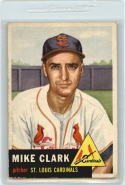
Mike ClarkWordWeb defines mediocre as (1) moderate to inferior in qualty; (2) lacking exceptional quality or ability; or (3) fair to middling in quality. This morning I may just as quickly have arrived at three ways of looking at my PC with its wonderful VISTA system, but I’m not. I’m really talking about an ancient baseball pitcher whose ability to rise above what his record said about his mediocrity to be the man on the mound in critical games was a critical memory for my once intense days as a kid fan of the Houston Buffs.

Such a rise-above-it-all man was righthander Black Mike Clark of the 1951 Houston Buffs. You’ve probably read my reference to him in an earlier piece I did on the ’51 club. Mke acquired his nickname from Buffs radio broadcaster Loel Passe, who picked up on the black glare and matching mound personality that burst forth from the deeply receding dark eyes of this mn who took control in so many critical games.

Mike was a stopper. Mike could start a game and stop a losing streak as easily as he could come in late and stop a rally. He had a good fastball, a tricky slow-breaking pitch, an ability to climb the ladder and work the corners, and a physical presence on the mound that just exuded that old gunfighter confidence that some guys show the world about themselves. Mariano Rivera has it today. Brad Lidge does not. Does that paint the picture clearly enough?

At crucial moments, Mike Clark was our Mariano Rivera.

Of course, back then, I wasn’t looking at Mike Clark as rising above the norm whenever he came to the Buffs’ needed rescue. At age 13, I just thought he was great – not  good as Mizell, but great in his own way, all the same.

Clark only posted a 10-7 win-loss mark in 1951, but his ERA was a very nice and light 2.78. I don’t have the information at my finger tips, but I’m willng to bet you that most, if not all his ten wins came in crucial, killer games, while most, if not all, the seven losses came in games that really didn’t seem to matter at the time.

Mike Clark’s second year with the 1952 Buffs was even more successful personally. At 9-5, with a 1.90 ERA, Clark was now pitching for a last place club, but still fnding the inspiration to give it his best shot. Clark’s ’52 Buff year came on the heels of an early season demotion from the parent club St. Louis Cardinals after he posted a 2-0 record there that unfortunately came with a 6.04 ERA.

In 1953, Mike Clark was again returned to Houston after going 1-0 with a 4.79 ERA at St. Louis. That second return of Mike Clark to the minors made me wonder: “What’s a guy have to do to be good enough to stick in the big leagues?” This answer came back in my own mind:  “I guess he has to be a lot more like Wilmer “Vinegar Bend” Mizell.” That made sense. Even I knew that Mike Clark was no Wilmer Mizell.

Mike Clark was only 2-2 with a 6.62 ERA for the floundering ’53 Buffs. The next season he went 13-9 with a 4.29 ERA for the champion ’54 club, but part of that record was achieved after the Buffs traded him to Beaumont, another Texas League rival.

Clark hung around the Texas League for another four seasons (1955-58) at Beaumont and Austin. He started the ’59 season with Dallas, one of the newly promoted Texas cities now playing in the AAA American Association. Dallas dealt him back to Houston, the other new AAA club, before season’s end, but Mike Clark’s career was done in ’59. With both Dallas and Houston, we was only 1-3 with a 3.66 ERA to retire upon. At age 37, Clark was done.

Signed by the St. Louis Cardinals as an amateur free agent prior to the 1940 season, an 18-year old Michael John Clark (DOB: 2-12-22) of Camden, New Jersey broke into pro ball with Class D Hamilton of the 1940 PONY League, where he spotted his first year with a not-much-to-write-home-about mark of 3 wins, 4 losses, and an inflated ERA of 7.77. He spent the heart years of World War II (1943-45) in the military, but he never gave up his baseball dream. Over the course of his 17-year career (1940-42, 1946-59), Mike Clark compiled a minor league record of 163 wins, 147 losses, and an ERA of 3.56. As a major leaguer, he finished undefeated at 3 wins and 0 losses, and with an ERA of 5.31.

According to Baseball Reference.Com, Mike Clark is still alive. And I think he still lives in New Jersey. At age 87, he remains one of the few unbeaten pitchers in major league history.

Eddie Dyer: Lots of Bang for Mr. Rickey’s Buck.

October 26, 2009

Eddie Dyer Iconic General Manager Branch Rickey of the St. Louis Cardinals had a three-pronged plan for helping himself. (1) He had a deal with club owner Sam Breadon. He got to keep a percentage of the net profits on the club’s operations, which meant, of course, that the less he paid out in personnel salaries, the more he got to keep for himself, as long as the club kept on winning. (2) He counted on the reserve clause and a loaded pipeline of talented players in the farm team system, players with no choice in baseball beyond the Cardinals, to keep him supplied with game-winning material. (3) He needed a few key people in the organization who were capable of doing more than one essential task at one time for the lowest salary he could work out with them for the price of a single employee’s salary.

Branch Rickey hit the jackpot when he met and signed a young pitcher/1st baseman/outfielder/baseball thinker/field manager/accountant/front office businessman named Eddie Dyer.

Born October 11, 1899 in Morgan City, Louisiana, Eddie Dyer’s family moved to Houston when he was still a kid, and he grew up among us as another “got here fast as I can” Houstonian with a talent and love for the game of baseball. After high school, he attended and played baseball at Rice, where he caught the attention of Branch Rickey and the Cardinals. This was around the same time that Mr. Rickey was surreptitiously taking control of the Houston Buffaloes for the Cardinals through a straw man purchaser for the sake of avoiding censure from Commissioner Landis, who thought that major league club control of minor league teams was bad for baseball.

Signed as a right handed pitcher, the Cardinals assigned Dyer to Syracuse of the International League to sharpen his skills.  Dyer’s progress was slow and mediocre. For the next five years, Eddie shuffled back and forth between the Cards and some of their top farm clubs, trying to break through as a more consistent winner. He seemed to be getting things together in 1927 when, again with Syracuse, he won his first six games before running into one of those life-changing events. An arm injury tagged Dyer with his first loss, but that was the small deficit. That 1927 arm injury ended Eddie Dyer’s pitching career.

From 1928 forward, Eddie Dyer became a Cardinals farm club manager, also continuing his playing career as an outfielder through the 1933 season he split between Greensboro and Elmira. Here’s where the Rickey touch/Dyer ability really started coming together. Wherever he went for the Cards as a manager, Dyer also served as business manager or club president – and all for the same money. What a deal!

In 1937-38, Eddie Dyer pulled leave as a manager, taking over in 1938 as Supervisor for Cardinal Farm Team Operations in the Southern and Southwestern Regions of the United States. He returned for three years (1939-40) as Manager of his home town Houstons Buffs . It turned out to be an impressively successful run, one that that would vault Dyer even higher up the Cardinal ladder of managerial plans in the years immediately following World War II. Dyer led the 1939-41 Buffs to three consecutive first place finishes in the Texas Leage, averaging 102 runs per season. His 1940 Buffs club also won the playoffs for the pennant, but then lost the Dixie Series to Nashville in five games. In 1942, Dyer moved up to the then AA Columbus (O) Redbirds of the American Association, finishing first and also winning the league pennant playoff series.

During World War II (1943-45), Dyer performed admimistrative duties for the Cardinals as Farm System Director in 1943 and then spent a couple of years (1944-45) taking care of his personal businesses in Houston. Then, when Cardinals Manager Billy Southworth suddenly departed St. Louis to take over the helm for the Boston Braves after the ’45 season, the wheel passed to Eddie Dyer to take over as Manager of the St Louis Cardinals in 1946. – What a timely move that turned out to be.

With all the big stars returning from military service, Eddie Dyer led the 1946 Cardinals to a first place tie with the Brooklyn Dodgers for the National League pennant. The Cardinals then took the flag by winning the first two games of  a best two of three games series with the Dodgers. They then faced off with Ted Williams and the Boston Red Sox in that “one for the ages” World Series in which Enos Slaughter’s “mad dash” run-scoring, game and Series-deciding tally from first base in Game Seven became one of the iconic moments in World Series history.

Dyer kept the Cardinals close again in 1947 and 1948, but lost out in the end as second place finishers to the Dodgers and Braves. When the Dyer-led Cards again narrowly missed in 1949, finishing only a game back of the Dodgers, things looked bleak. With Branch Rickey now guiding the Dodgers, the Cards no longer had the talent jam in their system that they once enjoyed. Dyer knew that too. He had worked every phase of the Cardinal operations over the years and really needed no “handwriting on the wall” to tell him what was coming soon. If anything, in fact, Eddie Dyer’s next actions were the writer of things to come for the St. Louis Cardinals.

After finishing the 1950 season in 5th place, Eddie Dyer resigned as manager of the Cardinals and retired to tend his considerable business interests in Houston. Dyer was involved in insurance, real estate, and oil. Marty Marion would take over as Cardinals Manager in 1951, but neither he nor any of the many who followed him would have the answer to winning it all again anytime soon. The Cardinals would not win another World Series until another Houstonian, Johnny Keane, got them there for that thrilling seven-game triumph over the New York Yankees in 1964.

Eddie Dyer’s retirement years in Houston were productive – and presumably content. Sadly, Eddie Dyer suffered a stroke in 1963 and then passed away in Houston on April 20, 1964 at age 65. Part of his legacy will live on as a tribute to Branch Rickey. The great Branch Rickey couldn’t have done it quite as renumeratively in baseball without the help he received from people like Eddie Dyer, but, of ourse,  it took a man like Rickey to recognize from early on what he had on his hands in the kid from Houston that he signed out of Rice (now University) Institute back in 1922.