Posts Tagged ‘Houston Astros’

Is Andy Pettitte Done?

January 17, 2011

Milo Hamilton Interviews Andy Pettitte, some time during his Astros sidebar days.

Spring training 2011 is coming on like the dawn, but General Manager Brian Cashman of the New York Yankees is once more on hold for a decision from star lefty pitcher Andy Pettitte of Deer Park, Texas. The 6’5″ greatest winning pitcher in Yankees post-season play is again saying he may retire to be closer to his family and, this time, it sounds as though he may actually mean it. It could still turn out to be a way to avoid the monotony of spring training with a late signing, but we shall have to wait and see. Quit now or keep it up, the man has performed pretty darn well through 2010, no matter what happens next.

Over the course of sixteen seasons (1995-2010), Andy Pettitte has fired a regular season career mark of 240 wins against only 138 losses, with an ERA of 3.88 and 2,251 strikeouts. Although he has registered only two 20-win seasons, Andy has been consistently in the high to mid teen range on season wins over the course of things. Over the long playoff haul with numerous winners, even during his three Thomas Wolfe-ian Houston sidebar/sidetrack seasons as an Astros (2004-2007), Pettitte compiled a wonderful record of 19 wins, 10 losses, and an ERA of 3.83. in his (count ’em) eight World Series appearances, Andy Pettitte has registered a winning mark of 5 wins against 44 losses with a 4.08 ERA.

Along the way, Pettitte also has pitched in three All Star Games (1996, 2001, 2010),

Sadly, Andy Pettitte is a Houston area guy who wanted to come home when he signed with the Astros in 2004, after nine seasons in the The Bronx. It almost worked out. Then (and here’s where we only have public information to go by), after three years as an Astro, Andy couldn’t get more than a one-year contract offer from Houston at another of those times he was supposedly thinking about retirement, That changed when his old Yankee club came back to him with a two-year offer at better money to return to New York.

In the four seasons he’s marked into Yankee Career II (2007-2010), Pettitte has chalked up another 54 wins. Do you think the Astros might have been able to use that “54” productivity over the same course in time? Oh well. It wasn’t to be.

My memory of Andy Pettitte as an Astro will always be framed by the belief that he really wanted to be here. That isn’t true of every ballplayer who ends up with your club, nor is it always important, except in the sense that caring makes bonding and long haul commitments easier to generate. Sometimes, opportunity alone is the main attraction to signing with a club. Opportunity and matching performance can get it done in the short run of a brief contract for most players – and the same formula may even work for a few guys, long-term. It’s just undermining to the interests of a player who wants long-term commitment when he feels the club is only interested in him short-term at a cut-rate price.

I cannot help but feel that Andy Pettitte took the Astros’ one-year, low ball salary offer as a sign of disinterest back in 2007 – and that he then took the Yankees’ two-year, bigger bucks offer as a sign of come home to New York, where you are really wanted. – What else are we to think? Andy took the Bronx bucks.

I do think Andy really felt he was home for good during the time he actually played for the Astros. My signature memory of Andy Pettitte as an Astro came about while he sitting in the dugout. I’ll never forget the look on his face when Albert Pujols of the Cardinals hit that infamous bomb off Brad Lidge in Game Five of the 2005 NLCS game at Minute Maid Park. Andy was sitting on the home club bench when it happened – and as the camera zeroed in on his face for a closeup. In the real-time that the Pujols homer was happening, we got to see this unfolding expression on Andy’s face: First, the eyes get really big as the face drops to an open-mouthed, slack-jawed position. Then the lips start moving, ever so slowly, but the un-hearable words they speak are unmistakable: “OH. MY. GOD.”

As in all things over those three years (2004-2006), Andy Pettitte’s Pujols reaction was pure Astro. He had come home to play, but like Nolan Ryan before him, it wouldn’t be possible for Andy to stay forever. And he won’t be back as a player because, as everyone either already knows, or soon enough gets to find out: You can’t go home again.

That’s life.
1986 NLCS Game 6: A Sacher Masoch Revisitation

December 15, 2010

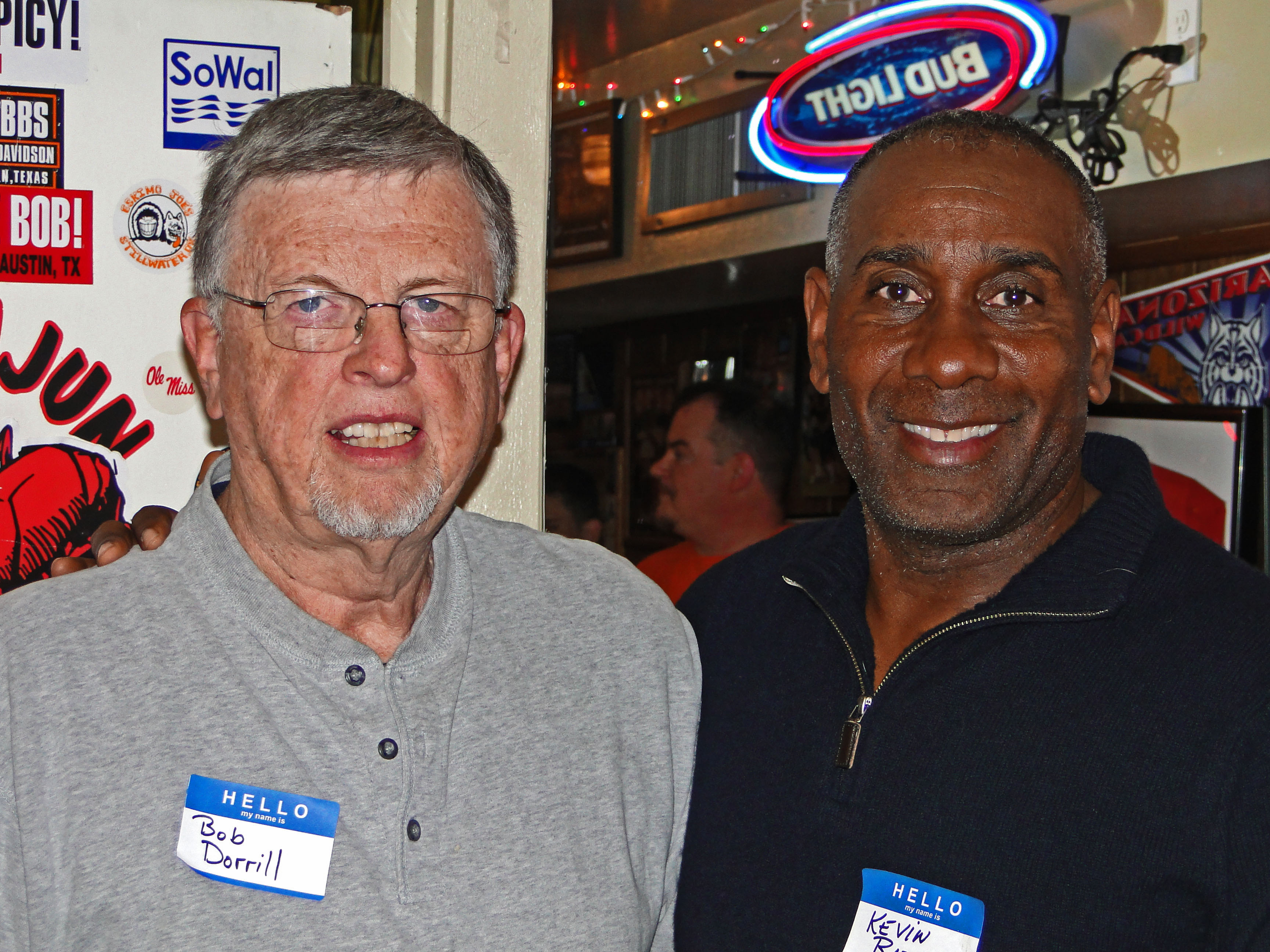
Former Astros Kevin Bass spoke at Houston SABR Meeting on 12/14/10. (The talk took place at the Ragin’ Cajun on Richmond. SABR Leader Bob Dorrill is on left.)

Former Astros Kevin Bass regaled about 25 members attending the December SABR meeting of the Larry Dierker Chapter at the  Ragin’ Cajun restaurant on Richmond last night. He took us all through his career, from his wide-eyed wonderment years as a rookie with the Brewers through his playing days as a seasoned, accomplished veteran. After all that, his first big question of the night (from Mike McCroskey) was: “How did you feel when you struck out to end the 1986 NLCS Series for the Astros in the 16th inning of Game 6 to give the 1986 National pennant to the New York Mets?”

Bass most probably was thinking: “Thanks a lot, fella. No one’s ever put me on the spot about that not so happy moment in my playing days until now.” Kevin Bass handled it fine, never showing any signs that it has remained an open wound. To the contrary, Bass says it was the great learning moment in his playing career. I’ll have to paraphrase what I head him say about striking out swinging on a too low and outside curveball from Mets reliever Jess Orosco to end the game:


Kevin Bass fans to end Game 6 of the 1986 NLCS as a 16-inning, 7-6 loss by the Astros to the Mets in the Astrodome.


“I went up to the plate just sure that I was going to either drive one in the gap to tie the game or hit one out to win it all. p against the crafty old lefty Jesse Orosco, that was a bad time to lose my focus and be out of the moment of what was going on. He killed me with slow outside curves that would have put me on first with a walk, had I not been so dedicated to swinging at whatever came up there. The tying run was on second base, but I couldn’t think out anything. The fact that Jose Cruz was hitting behind me just didn’t even occur to me. It was the stupidest at bat of my career, but it taught me that a batter has to stay grounded in the moment and not get ahead of everything with his own dream about what he alone was going to do.

Kevin Bass may have made the last out in Game 6 of ’86, but he did not lose this game alone. For starters, even Kevin Bass says that Astros manager Hal Lanier seemed to lose his season-long intensity and grip on the club once the Astros reached the Playoffs. According to Bass, Lanier just seemed to accept getting to the Playoffs as good enough as he started making moves that even the players questioned. Bass cited Lanier’s use of lefty Jeff Calhoun late in the game when he had Jimmy Deshaies available in the pen. We will never know if that would have mattered. There is always second-guessing when a club loses a close big game – and some of that second-guessing takes up residence forever.

As you probably recall, lefty Bob Knepper had pitched the Astros into the top of the ninth with a 3-0 lead with the Mets’ leadoff left pest Lynny Dykstra coming to bat. Bass in right and Cruz in left had pulled way back to prevent against extra base hits in the gap. For some inexplicable reason, however, center fielder Billy Hatcher didn’t get the message. He remained in his preferred shallow spot, about 20-25 feet behind second base.

When Dykstra then connected on a high arching fly ball to the right-shaded side of center, everybody who also wasn’t paying attention to Hatcher previously, and that seems to include about everyone in the park, assumed it was going to be the routine fly out it should have been, but wasn’t. Hatcher could not get back on the ball and Dykstra wound up with a leadoff triple.

A single by Mookie WIlson then scored Dykstra and a double by Keith Hernandez plated Wilson. With the Astros now only leading by 3-2, Knepper was done. Remember: the Astros entered this game down 3 games to 2, A win would tie the Series and set up Mike Scott with an opportunity to win it all at home for the Astros. Iron Mike had already won the only games the Astros had taken against the Mets and made them look silly in the process, The last thing the Mets wanted was Game 7 in Houston versus Mike Scott.

Dave Smith replaced Knepper in the 9th, but he promptly walked Gary Carter and Daryl Strawberry to load the bases. Ray Knight then poked a sacrifice fly to score Hernandez and tie the game at 3-3. Smith then struck out Danny Heep, but the Mets had surfaced as alive and kicking, After the Astros went down scoreless in their half, the game moved to xtra innings, tied at 3-3.

Still tied going into the top of the 14th, the Mets plated a go-ahead run when Wally Backman singled in Daryl Strawberry on a pitch from the Astros’ Aurelio Lopez, but that was all they could get when Mookie Wilson struck out with the bases loaded.

With one out in the bottom of the 14th, Billy Hatcher unloaded his now iconic homer to left to tie the game at 4-4 and send it forward into yet further extra stanza of action.

The Mets took the next lead off Lopez and the Astros in the top of the 16th when Strawberry doubled and came home on a single by Knight. That’s when manager Lanier brought in Jeff Calhoun, and not Jimmy DeShaies, to take over the pitching.

Calhoun promptly tossed up two wild pitches, scoring Knight from third on the second one. Backman then walked, moved up to second, and then scored on a single by Dykstra. That was it was the Mets, but they now went into the bottom of the 16th with a 7-4 lead and needing only three more Astro outs to claim the 1986 National League pennant.

Things got exciting again, if only for last fleeting Astro moment.

With one out, Davey Lopes drew a pinch hit walk off Mets reliever Jesse Orosco. He then moved to second on a single by Billy Doran. Billy Hatcher then singled to score Lopes and reduce the Mets’ margin to 7-5.


Ancient Jess Orosco was often rumored to have served under General Santa Anna at the Battle of San Jacinto. Maybe not, but he did pretty good in the Battle at the Astrodome.


After another out, Glenn Davis singled to score Doran, reducing the Met margin to only 7-6, as he also advanced the tying run by taking second base on the play at the plate. Now comes Kevin Bass to the plate with two outs, the tying run on second, and a chance for Houston heroism on an iconic level.

Not to be.

After fouling off a couple of unhittable low outside curves, Bass looked really bad on the one he missed completely. And the 1986 season for the Astros was over. Done. No more.

Astro players and fans have all since put that cry baby to bed and moved on. Baseball isn’t an easy game, but neither is life. And sometimes happen that don’t seem fair, but they happen anyway. And none of us escape them all, eventually.

As my dear old dad used to say in times of disappointment and bad news, and this line of was unintentionally straight out of the Cole Porter songbook:

“It was just ne of those things.”

We didn’t win in 1980 or 1986, but we came close in 2004 and even reached the Big Top in 2005 before we walked away with “Close, but no cigar!” as our pennant script until the day finally comes when the Houston Astros dance on top of the baseball world.

Thank you, Kevin Bass, for stirring up a lot of memories and for lighting again that eternal flame of hope for something better down the line by staying in touch with what we are doing and not doing in the here and now. Your talk was a reminder that today is where the work of tomorrow gets done.

I’ll stop on my adaptation of a Yogi expression to this point:

“It ain’t over til we start living like it’s over!”


Some Hot Stove Ramblings

December 11, 2010

Ryan Rowland-Smith (12-17, 4.57 ERA) (2007-2010)

The trade and free agent signings are not big these days in our little part of the baseball world, but then we did not expect them to be. With the club recovering from other salary misadventures and the franchise now up for sale, Astro fans can pretty much expect things to proceed along this line for the foreseeable future.

The good news is that the club now seems totally dedicated to shoring up its developmental program at the minor league level and it is aggressively working to draft young players who are both good prospects and sign-able free agents. It doesn’t do any good to draft players if they aren’t good prospects or you just can’t sign them, anyway. I don’t have this year’s record handy, but if memory serves, the Astros did well in 2010 by signing most of their young free agent draftees.

Now the Astros come home from the Florida winter meetings by signing lefty Ryan Rowland-Smith as another competitor for the fifth spot in the rotation for 2011. The club also took two pitchers, Aneury Rodriguez and Lance Pendleton, from the winter meeting Rule V draft of minor league players not protected by the 40-man roster,  Those latter two guys will also be likely competitors for the number five-spot in the rotation.Veteran Nelson Figueroa is the holdover favorite to win the job, but we will have to wait through spring training to learn about these other guys.

Besides all that speculation, it’s early. A lot can happen between now and then. Who knows what Ed Wade may be forced to do to make room for that better hitting middle infielder he says he’s looking for.

As for Rowland-Smith, all I know about him is what I’ve very recently read, I’ve never seen him work. Even in this big package, get-all-the-teams-on-tv high-tech era, Seattle remains about as far off my big league radar screen as teams can get, All I know is that the guy has some command issues and that last year he really plummeted, going 1-10 with a stratospheric ERA of 6.75.

Let’s hope the Aussie-born portsider who turns 28 in january is “recoverable” under Astro manager Brad Mills and that “recoverable” is measured at a level that is greater than his 5-3, 3.42 ERA best year of 2008. The Astros need more help than that best season marker suggests is forthcoming. Rowlnd-Smith will need to bring his best game to the final results side of far more than eight decisions in 2011 to be of real help.

Our club motto for 2011 should be a realistic match for the times: Don’t expect the moon by June – or anytime soon! This club is going to be better than 2009 because of the personnel changes that have freed the team to rebuild with lighter expectations on the club’s chances for a quick route back to the World Series moment of 2005.

A World Series isn’t going to happen with Roy Oswalt and Lance Berkman leading the way. Those guys are gone. Forever. They aren’t even coming back for a twilight lap season. If they ever do, take it as a definite sign that the Astros of that moment have converted to a burlesque version of baseball success and that they are then and there no longer serious about winning.

Patience and a passion for baseball, even in leaner times, are going to be key qualities that Astro fans need to have for the foreseeable future. We’ve lived with these traits forever, so, hopefully, we can spring them activation again. If we start seeing our best young players disappearing via trade on a regular basis, as they regularly do in Pittsburgh, then we shall need to pull the cord and get off the baseball bus, but I really don’t see that happening here. And whoever buys the club needs to understand that facet of Astros fandom: We will not settle for a losing ball club indefinitely. We are not Pirate-like fans.

As for the current club, I like Jason Castro at catcher, Brett Wallace at first, Jeff Keppinger at second, Chris Johnson at third, Carlos Lee in left (as the only place left he fits), Gold-Glove winner Michael Bourn in center, and Hunter Pence in right. I also prefer  Clint Barnes or Angel Sanchez at shortstop over Tommy Manzella gets my vote. I’ll take the better bats over the better glove, but no hit route, for now, As for the pitching, I’m content, for now, to let time and spring training sort that out for us. I do wish that something could happen to cure that “Bad Wandy” character that still shows up too often when Senor Rodriguez takes the mound. “Bad Wandy” is the only guy standing in the way of “Good Wandy” earning a contract with more numbers on the salary line.

The winters are long for some of us baseball fans. Unlike Rogers Hornsby, some of us have a little trouble just staring out the window, waiting for spring, We have to talk and write out our hot stove league thoughts and speculations.

Care to join me? Please leave your own questions or thoughts here as a comment on how the 2011 Astros season looks to you, so far. The rest of us would like to hear it.

Cardinal Berkman: And Other Forgettable Images

December 5, 2010

Cardinal Berkman may distort Astro Memories.

The thought of Jeff Bagwell or Craig Biggio ever donning the uniform of another MLB club, especially the flaming red digs of the St. Louis Cardinals is beyond the pale. Now Lance Berkman comes along and signs with the rival Cardinals and its almost as bad.

Never mind the fact that Lance wanted to come home to Houston after his unfortunate brief stay in The Bronx, but he was turned away at the gate by Ed Wade, the man who now answers the door at Minute Maid Park, this town’s version of the Emerald City in Oz.

“But I want to speak to Drayton,” cried Lance.

“Nobody speaks to Drayton these days, Lance,” answered Wade, “not nobody, no how, no way. – Unless, of course, you are prepared to present a buyer’s offer for the club, the  door to Mr. McLane’s private chambers are now closed to any discussion of all other baseball business.”

Well, in all fairness to all parties, the outcome of Lance Berkman’s recently abortive attempt to come home again wasn’t quite that ludicrous or severe. There simply wasn’t any room on the Astros roster for the aging star under the atmosphere of the current rebuilding program. As General Manager Wade put it somewhere, every at bat the club might give to Berkman now would be one less growth at bat opportunity for newcomer Brett Wallace. The club needs to find out if Wallace is the man at first in the future or not. And the club cannot accomplish that aim by giving away all those at bats to Lance Berkman as he plays out the downside of his career.

Now, does Berkman’s signing by the Cardinals set up this familiar headline script? “MAN’S ONCE-UPON-A-TIME BEST FRIEND COMES HOME AS MAD DOG TO BITE FORMER OWNER!”

You bet it does, but it’s short term, maybe for 2011 only, if Berkman and the Cardinals even get through the entire season together. Age-related injury or a performance level that falls totally off the table could limit or end Berkman’s play in 2011, even though we certainly don’t wish that upon him. Chance are, for a while, at least, a late game at Minute Maid Park may indeed  be lost on a late inning gapper hit by Berkman – or by a left-handed, opposite field pop into the Crawford Boxes by the man with the Jay Leno chin.

It’s part of the game and we shall all survive it – as we did in the past with the return of Rusty Staub as a Montreal Expo, the return of Joe Morgan as a Cincinnati Red, the return of Jimmy Wynn as a Los Angeles Dodger, and the brief  return of Larry Dierker as a St. Louis Cardinal.

Let’s not forget too that there is another returning player visit by a former Astro blue-blood coming up in 2011. This one didn’t happen in 2010 because of the schedule, but it no doubt will happen next season, almost assuredly. And this one could be painful for several years to come.

A picture is worth a thousand words:

Roy Oswalt

The Skeeters Are Coming to Sugar Land in 2012

December 2, 2010

Artist Rendering: The $40 million, 7,000 seat Sugar Land Stadium set to open in 2012 as the 70-home games per season base of the independent Atlantic League "Skeeters".

It’s official! The new independent league baseball club down in Sugar Land finally has a name that matches our area to a “T”. The Sugar Land Skeeters will begin play in the fairly-new-itself independent Atlantic League in 2012.

The Atlantic League started play in 1998 as direct result of a conflict that popped up within organized baseball. When the New York Mets objected to owner Frank Boulton’s decision in the late 1990s to move his Albany-Colonie Yankees to Long Island because of the former’s claim to their minor league territorial rights in that area, Boulton bolted from organized baseball to form his own small independent circuit and made the move anyway.

From the start, the new Atlantic League was modeled after the old Pacific Coast League. They played more games, they signed a large number of superior ability players, and they dedicated themselves to building small, but first class ballparks for their various clubs. The thirteen year result of this effort now finds the previously all eastern seaboard circuit expanding into the Houston area in 2012 with the start of the new Sugar Land Skeeters operation.

Here’s a brief look at the league membership as it stands with the 2012 inclusion of new clubs here and in Loudoun, Virginia. Each new club is preparing to play a 140-game home and road games schedule in 2012. Sugar Land is the first of four-to-six clubs that will be created to form a new Western Division of the league:

Current Atlantic League franchises

Team Names (Years Founded/Joined League)

Freedom Division

Lancaster (PA) Barnstormers (2003/2005)

Road (no home) Warriors (1998/1998)

Somerset (NJ) Patriots (1998/1998)

York (PA) Revolution (2006/2007)

Liberty Division

Bridgeport (CT) Bluefish (1997/1998)

Camden (NJ) Riversharks (1999/2001)

Long Island (NY) Ducks (1998/2000)

Southern Maryland (MD) Blue Crabs (2006/2008)

Future Teams

Loudoun (VA) Hounds (2010/2012)

Sugar Land (TX) Skeeters (2010/2012)

Sugar Land Stadium. The City of Sugar Land is building the 7,000 seat capacity venue that will house the new baseball club. With an estimated price tag of $40 million, the stadium will not be funded with general fund tax dollars, however, $30 million dollars will instead be paid for with a portion of sales tax revenues that may only be used for economic development purposes. The $10 million dollar balance will come from Opening Day Partners, a Lancaster, Pa.-based ballpark developer that owns and operates several minor league baseball teams, including the new operation in Sugar Land. The stadium will be located on a 21-26 acre tract, northeast of the Highway 6 and Highway 90A intersection.

Field Personnel. The club has yet to sign any players, but players with ig league and high league experience and potential will be in the signing sights of Skeeter scouts. The field manager could end up being someone with a recognizable local name too. Former Astros Terry Puhl and Norm Miller, plus former Astros manager Hal Lanier have all been mentioned as possible managerial candidates.

Astros & Skeeters. The Skeeters are not a threat to the Astros, but they are capable of stoking further interest in professional baseball among people who never drive downtown to see a more expensive major league game. In fact, some of these people may now be stimulated to go see a major league game for the first time as a result of their experience with the Skeeters. It will be up to the Astros to produce a club and and a plan that makes that marketing connection a harvest of attracted new interest in baseball.

The worst thing the Astros might do here would be to treat the new Skeeters club as though it didn’t exist. Who knows? Maybe the Astros will one day have a AAA or AA club operating in some near region like Sugar Land, Katy, or The Woodlands. – It sure would simplify certain player reassignments during the long season, would it not? And, if the Astros happened to own these particular clubs too, it would make for even more lucrative opportunities to treat the home base fan population with an ongoing look at coming attractions.

Those are just my thoughts. All I know for sure while we’re waiting to see if the Sugar Land operation can succeed in the Houston area is that I will be out there to see some games, if they actually do start playing. The lure of night baseball in the small ballpark under open skies is just irresistible – even in the heat of Houston summers – and even with Skeeters on the loose.

Will Jeff Bagwell Reach The Hall of Fame in 2011?

December 1, 2010

A bad shoulder stopped Jeff Bagwell at 449 HR through 2005.

I thought of five different ways to ask the question that needs to be asked about Jeff Bagwell’s chances for the Baseball Hall of Fame. All are important – and all will remain in play – even if we don’t get to them sufficiently in one column. I would also very much like to know what you guys think as comments upon this article and subject.

Here’s my fairly quick dance through the questions:

(1) Does Jeff Bagwell belong in the Hall of Fame? Based upon his hitting and slugging accomplishments, relative to others, plus his prowess in the field at first base,  he would get my vote, if I had one.

(2) Will Jeff Bagwell make it into the Hall of Fame on his first 2011 ballot listing as an eligible candidate? It’s hard to say. There are thirty-three candidates on that list and a couple of those names fell only a handful of votes short of the 75% support-level needed for election in 2010. Long-time candidate Bert Blyleven and second year man Roberto Alomar are expected by many, including yours truly, to have the best two shots of becoming the Class of 2011.

If no one fans the fires of “guilt by association” in the direction of Jeff Bagwell as a slugging member of the steroids era, Bagwell could make it into the Hall too on his first try as a third 2011 inductee choice above all the other candidates. I really don’t see any of the other candidates making it next year.

(3) How big is the steroids cloud over the Hall of Fame elections of this decade? From what I see, it’s pretty big for now and the foreseeable near years to come, whether it’s talked about or not. It’s already kept the late and reluctant steroid-use confessor Mark McGwire out of the Hall through 2010 when all of his HR-hitting accomplishments alone should have put him into the Hall on the first ballot; and, it isn’t likely that demonstrated steroids-use liar and first ballot candidate Rafael Palmiero is going to fare any better.

Jeff Bagwell has consistently denied any steroids use during his career, or ever, but he still happened to have bulked up his body during an era in which it turns out that many of his contemporaries were also doing so with considerable chemical assistance. Only yesterday I was talking with another writer from Boston who independently brought up that quiet suspicion about Baggy.

As one who trusts the word and character of Jeff Bagwell, I don’t believe, or want to believe, that he ever used steroids for purposes of healing or performance enhancement. He says he didn’t and I am willing to go with that statement as the truth.

The problem is – not everyone is gong to give Jeff Bagwell the benefit of trust in this matter and here’s why that’s important. A Hall of Fame candidate doesn’t have to admit to steroids use, or be caught lying about it, to  get hurt by the voters. All he has to do is to be splashed by the fall-out from that era. The 1990’s were also a decade in which a number of players started pushing iron in the gym for the main sake of becoming stronger hitters. It isn’t fair that those guys who accomplished that aim honestly should be lumped into the same cloud with the steroids abusers, but that’s the way life often goes. It isn’t always fair.

Please comment on Jeff Bagwell’s candidacy for the Baseball Hall of Fame – or any other issue raised by this column, or in your own mind, about the impact of the steroids era on Jeff’s chances.

The main question is: Do you think Jeff Bagwell belongs in the Baseball Hall of Fame?

For a list of all the candidates and a little more detail about the voting, check out this link:

http://www.canada.com/sports/newcomers+eligible+hall/3904485/story.html

.

Astros Farmhand Dedicated To Duke Baseball

November 28, 2010

Ryan McCurdy

Some of you will recall the column I wrote for The Pecan Park Eagle earlier this past summer, shortly after the Houston Astros signed a young catcher out of Duke University named Ryan McCurdy.

McCurdy left college play after his 2010 graduation with a record for athletic/academic excellence and a reputation for great playing dexterity and defensive accomplishment.  In four seasons as a starter at Duke, McCurdy  excelled at three positions.He started at second base man during his freshman season, then moved over to third base for his sophomore and junior years. Then, as a senior, McCurdy picked up the so-called “tools of ignorance” for the first time to play catcher for the very first time in his young life s an organized baseball player.

As a catcher, all McCurdy did was play error-free ball while throwing out 19 runners attempting to steal. These results made sense. During his four complete seasons at Duke, McCurdy committed only 19 errors in 865 career chances for a defensive success percentage of .978. All 19 of McCurdy’s errors occurred during his freshman and sophomore years. He made no errors in the field as a full-time starter again during his junior and senior seasons.

What else, you ask? The guy was tough for the hard-throwing “K” boys, striking out only 44 times in 820 college career plate appearances. He als posted a career on base percentage (OBP) of .397 and set a Duke and Atlantic Coast Conference (ACC) career record for HBP (hit by the pitcher) first base reaches with 69. As a throw in on his brains credit, McCurdy earned All-ACC Academic Baseball Team honors twice and also made the ACC Academic Honor Roll three times.

https://thepecanparkeagle.wordpress.com/2010/07/07/astros-sign-mccurdy/

After signing with the Astros, the Tampa, Florida native McCurdy played in only 20 games at the Rookie League and Class A levels, going 4 for 37 and .148 batting average in a handful of break-in season times at bat. The real test at the professional level for young Ryan McCurdy lays ahead of him. The book on his intelligence, character, and dedication to Duke University baseball is already in.

During this off-season, McCurdy has agreed to serve as a volunteer member of the coaching staff at Duke until its time to leaving for his own 2011 spring training obligations to the Houston Astros farm system.


Even if we didn’t share the same last name, I’m pulling for Ryan McCurdy to make it all the way to the starting job as catcher for the Houston Astros someday. Traits like character and intelligence don’t necessarily have to accompany athletic ability for a young guy to make it to the majors, but it sure doesn’t hurt to find them in the field general position of catcher, especially. The great Brad Ausmus and young Jason Castro of our current Astros roster are both good examples of those types as well. Come on, Ryan McCurdy, let’s get it going. There’s room in Houston for both you and Mr. Castro.

A Message from Drayton McLane, Jr.

November 23, 2010

Drayton Clarifies His Work Ethic

I received an e-mail from Drayton McLane, Jr. yesterday. Drayton appreciated most of what I had to say in my column of last Friday, “A 1st Goodbye to Drayton McLane,” but he understandably wanted to take a swing at the legend of his work habits and expectations that I had dredged up for inclusion in my comments.

If you carefully read and fairly digest everything Drayton says here in a few well chosen words, it all makes perfect sense as a genuine correction of his legendary reputation as a boss whose shadow looms long and large over double-time work days at the ballpark. Those things aren’t always driven by some kind of central slavedriver. They may happen too because of one’s personal ethics, psychological needs, and something that rolls on wheels inside the heart of a person that takes its beat from a particular “love of the game” – and whatever the game happens to be.

As one who independently works long and crazy hours in behalf of those goals and projects that fire the passions of my own heart, what Drayton is talking about here makes perfect sense to me, but none of us see our own movements in this world quite as others do from the other side of our outer skin. Drayton deserves the space to speak for himself in this matter.

Here’s the message from Drayton McLane, Jr. to me of 11/22/2010. I am reprinting it here in the hope that it helps to better clarify Drayton’s personal relationship to work and his Astros administrative employees.

If nothing else, it certainly clarifies Drayton’s perspective on the issue of his work disposition:

Bill,

Thank you for the thoughtful blog.  I must confess that I am guilty of an elevated work ethic, but I must clarify that it is exaggerated that I expect my employees to work 12-18 hours a day.  During the season when there is a home game, they might come in around 9:30 a.m. and some of them stay until the game ends.  They do this because they have a high work ethic, enjoy their job, and they take pride in customer service.  That’s why we have very little turnover, and an overabundance of people trying to get their foot in the door.  We have great people who truly care about the fan experience and they deserve the recognition.

Thanks as always for your support!

Drayton

A 1st Goodbye to Drayton McLane

November 20, 2010

No One Else Will Ever Walk Quite as Tall in These Boots!

As our entire little baseball world knows by this time, Saturday morning, Drayton McLane, Jr. has now announced that he is putting the Houston Astros up for sale after eighteen years of family ownership. The news came officially at a press conference conducted personally by Drayton yesterday at Minute Maid Park in downtown Houston.

That press conference itself speaks volumes. This was no corporate announcement, no impersonal and cold statement about an impending change in control of our National League baseball club, and no basis for concluding that this change will be one for the better. No, this press conference was conducted by the flesh and bone, mind and spirit, body and soul owner and leader of the Houston Astros, the one and only Drayton McLane. Jr.

There will never be another Drayton McLane, Jr. in Houston’s baseball future – and there may never be another individual face and voice that speaks so strongly and visibly for the ownership of the Houston Astros. Given the general cost of things these days, and the current flow of ownership patterns, the next “face” of the Houston Astros is most likely to be the talking head of some corporate or syndicated group and be subject to a number of controls that presently do not not impinge upon the public utterances of Mr. McLane.

We are going to miss Drayton McLane, Jr. as Houstonians in ways that have yet to register this early in the game of change. For me, it is close to a feeling of saying goodbye to a distant old friend upon the early news of his impending retirement.

Drayton and I are close in age. We were in college separately at Baylor and Houston back in the 1950s, coming of age in different Texas cities under different economic circumstances, but both invested in the values of that earlier period, even though we were not destined to meet until much later in life.

I met Drayton McLane, Jr. in 2004, while I was involved as a volunteer in a project that pertained to the preservation of Texas baseball history. Drayton was both engaged and supportive of our goals and even took it upon himself to address a number of historical preservations at Minute Maid Park that are very important to the story and legacy of the Houston Astros. The retirement of Larry Dierker’s uniform #49, Jimmy Wynn’s #24; Jeff Bagwell’s #5, and Craig Biggio’s #7 have all taken place on Drayton’s watch since the club moved downtown in 2000.

It is our hope that the club’s unofficial plans to create an onsite museum honoring local baseball history will continue in some form in spite of the now impending sale of the franchise. Such a move would send a strong message to whomever the new buyers turn out to be that Houston is a city that cares about its history with the game – and that this historical cord is the real binding force behind our fans’ abilities to offer strong support for the Astros. Kill that caring – and a new owner could be left with only casual fan support during pennant-contending seasons only.

I think of Drayton McLane, Jr. as a remote friend. We don’t travel in the same social circles, nor do we inter-commerce, but we each are products of the same earlier Texas era, and we both care about history, Houston baseball, and particularly, the Houston Astros. That’s a lot of common ground to cover. When I hear from Drayton by e-mail, with a comment about something I’ve said or written, it’s always welcomed and invariably upbeat.

During his eighteen year ownership period (1992-2010 & counting), Drayton McLane, Jr. has taken the Houston Astros into their new downtown ballpark at Union Station (2000) and presided over the club’s first and only pennant and World Series appearance (2005). He has received praise and criticism, both for being a tightwad and also a spendthrift with certain players, but he has never surrendered his contact with the fans in the ballpark and his salesman’s encouragement that we are all responsible for making Houston a champion.

Stories of Drayton’s expectations for his employees are now the stuff of legend. Word on the street is that game days were times in which anyone with any hopes of “moving up” often showed up at the ballpark at dawn and stayed until midnight. However exaggerated that claim may have been, the disappearance of certain Astros employees over the years suggests that burnout and attrition cleared several names from the administrative “prospect” list.

It occurs to me that buying a major league sports franchise is a lot like getting yourself elected President of the United States. Both are apparently instant routes to public hatred – and you may find yourself condemned in both cases for what you do and what you fail to do. The difference-maker is that the owner of a sports franchise finds redemption in winning a championship. Winning the World Series would make all Houston Astro fans happy.

American presidents, on the other hand, don’t have a single thing they could deliver that would make everyone happy. Even if we had full employment, a robust economy, no racism, and affordable health care, there would still be large groups of people out there, unhappy about something.

Well, we aren’t losing a president, nor an owner who delivered that “one-win-pleases-all” World Series victory, but we are losing the only owner whoever got us to a World Series, and I, for one, am going to miss him.

Take care, Drayton, and please stay in touch. Your personal welfare remains important to many of us.


Post-Season Career Pitching Leaders

October 12, 2010


Andy Pettitte's 19 Post-Season Wins Leads Pack!


The fact that active New York Yankees lead the field in career post-season pitching wins and best earned run average should come as no small surprise. Andy Pettitte’s 19 career wins through today, 10/12/10, is now 4 better than John Smoltz with room to grow as the Yankees wait on the winner of this evening’s game between Tampa Bay and Texas to see who they will be facing in the 2010 ALCS. Either way, Andy is virtually guaranteed a shot at becoming the first “20-game winner” in post-season career total win history.

Except for one contaminating win by Pettitte  as a Houston Astro int 2005 NLDS, Andy’s career win record is all the rest – pure Yankee in its achievement alloy. Some feel that Andy Pettitte may be pitching himself into serious Hall of Fame consideration by his longevity success in the post-season, but it’s hard for me to see how he could get there and pass over several peers and one particular predecessor who built comparable or better records on the season stat career level.

Pettitte has 240 career regular season wins through 2010. Retirees Greg Maddux (355 wins), Roger Clemens (254 ip), Tom Glavine (305 wins), Randy Johnson (303 wins), Tommy John (288 wins), Bert Blyleven (287 wins), Jim Kaat (283 wins), Mike Mussina (270 wins), Jamie Moyer (267 wins), Jim McCormick (265 wins), Gus Weyhing (264 wins), Jack Morris (254 wins), Jack Quinn (247 wins), Dennis Martinez (245 wins), and Jack Powell (245 wins) are the others not currently in the Hall of Fame who have more career regular season wins than Andy Pettitte. (The last time anyone poked him with a stick, Jamie Moyers also remained an active player.)

Making a Hall of Fame case for Andy Pettitte above most of these others would be a long shot in my book. I’m still unhappy that Bert Blyleven has been passed over as long he so far has.

At any rate, the career leaders in post-season wins and lowest post-season ERA are as follows:

CAREER POST SEASON WINS BY INNINGS PITCHED LEADERSHIP BOARD

1. Andy Pettitte (19 wins in 256.0 ip)

2. John Smoltz (15 wins in 209 ip)

3. Tom Glavine (14 wins in 218.1 ip)

4. Roger Clemens (12 wins in 199.0 ip)

5t. Greg Maddux (11 wins in 198.0 ip)

5t. Curt Schilling (11 wins in 133.1 ip)

7t. Whitey Ford (10 wins in 146.0 ip)

7t. Dave Stewart (10 wins in 133.0 ip)

7t. David Wells (10 wins in 125 ip)

10t. Catfish Hunter (9 wins in 132.1 ip)

10t. Orlando Hernandez (9 wins in 106 ip)


Mariano Rivera's 0.72 ERA may fall lower very soon!


CAREER POST-SEASON ERA BY INNINGS PITCHED LEADERSHIP BOARD

1. Mariano Rivera (0.72 ERA in 136.2 ip)

2. Harry Brecheen (0.83 ERA in 32.2 ip)

3. Babe Ruth (0.87 ERA in 31.0 ip)

4. Sherry Smith (0.89 ERA in 30.1 ip)

5. Sandy Koufax (0.95 ERA in 57.0 ip)

6. Christy Mathewson (0.97 ERA in 101.2 ip)

7. Monte Pearson (1.01 ERA in 35.2 ip)

8. Blue Moon Odom (1.13 ERA in 39.2 ip)

9. Eddie Plank (1.32 ERA in 54.2 ip)

10. Bill Hallahan (1.36 ERA in 39.2 ip)

The fact that post-season leadership in both categories is controlled by active members of the current New York Yankee pitching staff should come as no small surprise. The better you are, no more you win, the more chances you get to even see the post-season. I know it doesn’t always work out that way, but it seems to work that way in The Bronx more often than it does anyplace else – and that winning history goes all the way back to Col. Jacob Ruppert, the early 20th century owner of the New York Yankees who put up the money and attitude that made “The House That Ruth Built” even possible in the first place. One of his legacies is that the record books are now crowded in 2010 with the accomplishments of Yankee players over time.

Like ’em or not, the “Damn Yankees” understand championship totals on a whole other higher level from everyone else. While we hold on to the hope for “one in Houston someday,” the Yankees are looking for another one, possibly as early as November 2010.

So, when we look at the individual accomplishments of both Andy Pettitte and Mariano Rivera in the post-season, we are forced to remember too that winners produce championships – and championship teams produce record-breakers and holders.

We don’t have to be as big as New York to succeed in Houston, but our vision and our planning needs to be every ounce and inch as large as the state of mind and action that has placed these two active Yankee pitchers on the leader board as mere by-products of their Yankee team success.