Posts Tagged ‘History’

My 21st Century Dawn Team (2001-2010)

December 23, 2010

Ichiro Suzuki: Poster Boy for my 21st Century Club.

Today marks the fifth era MLB all-star team of this coverage. Previously, and in this order, we have gone through the (1) post-World War II (1946-1960); early 20th century (1900-1945); (3) afternoon 20th century (1961-1985); and (4) 20th century night train (1986-2000) clubs. All these teams and your comments are published here in The Pecan Park Eagle under separate posts over the past few days.

We will pick up the 19th century club later, but today’s 21t century club, to date, brings us up to the moment for now as we unplug here long enough to put the finishing touches on Christmas preparations. If you have the time, please post your comments of agreement or disagreement with my selections in the commentary section that accompanies this column.

Thank you, and if we do not meet again tomorrow, please accept my best wihes for a safe and happy holiday season!

Enough said. Here’s My 21st Century Dawn Team (2001-2009):

RH Pitcher: Roy Halladay

LH Pitcher: Andy Pettitte

C – Joe Mauer

1B – Albert Pujols

2B – Robinson Cano

3b – Chipper Jones

SS – Derek Jeter

LF – Manny Ramirez

CF – Torii Hunter

RF – Ichiro Suzuki


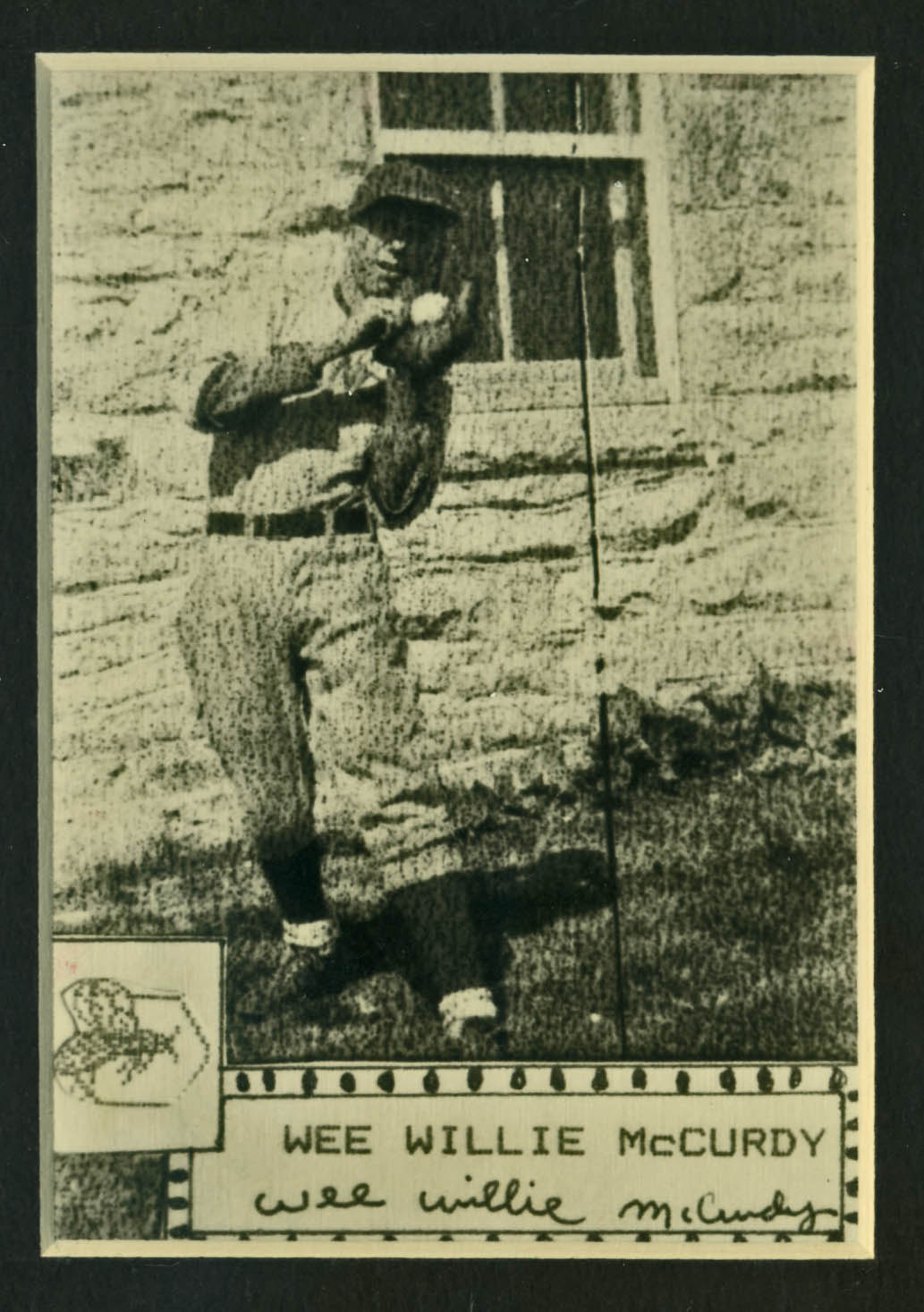
And Before We Go … Happy 100th Birthday to My Late Father, “Wee Willie McCurdy!”

Dad was born in Beeville, Texas on December 23, 1910. He also died there on July 7, 1994 at the age of 83, exactly five weeks following the sudden and unexpected death of my mom. Dad was doing fine until Mom died. Once she passed, he just seemed to shutdown and go, I still miss both of them, especially near their December birthdays and Christmas time. Mom was a South Texas girl, born on December 5, 1915 in Kenedy, Texas. She had a stroke on their 58th wedding anniversary, May 30, 1994, and died four days later on June 3rd at the age of 78.

Dad never played professional ball, but he was a pretty steady 5′ 6″, 135 pound, BL/TR outfielder for the St. Edwards Broncos in Austin back in the late 1920s and then for a few years of town ball with the Beeville Bees/Blue Jays. As I’ve written here earlier, my first memory was of Dad fielding a base hit in right field at the fair grounds field in Beeville and making the throw in to second base. I was about two years old at the time and it was also my first, but hardly the last, impression of baseball.

Dad never had his own baseball card so, years go, I made the one of him you see here from his old St. Edwards photo. He didn’t say much, but he smiled when I gave it to him. That was enough for me. I only I wish I could have done more in life, while he was still here, to let him know how much I loved him. Among so many other intangible gifts I received from my dad, baseball ws a big one. He’s the man who taught me the rudimentary rules of the game and encouraged my own participation in the sport. For that gift alone, I am now years deep into the business of working on the expression of my gratitude.

Happy 100th Birthday, Wee Willie McCurdy! Hope you’re still playing and following the game, wherever you may be. Just know that wherever that is, as always, my love still reaches out to you this morning as fast as a line drive rope off the left field wall.

My 20th Century Night Train All Stars (1986-2000)

December 22, 2010

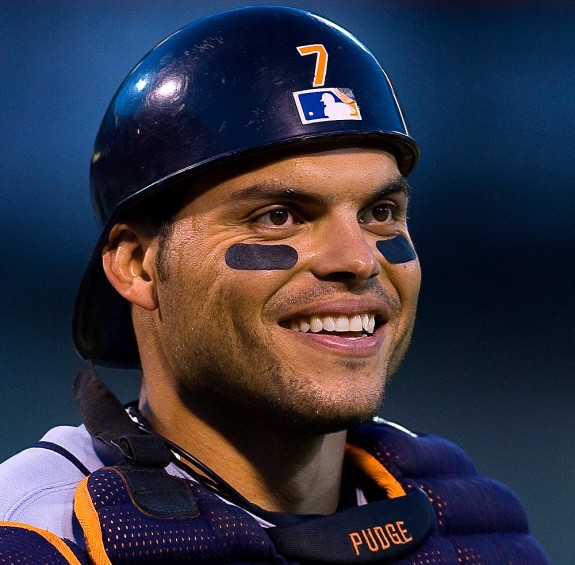
Ivan "Pudge" Rodriguez is my Night Train All Star Catcher.

The 20th century went out with a bang of talent that was some near time later found suspect of using performance-enhancing substances. I passed on one of the three most famous of these (Mark McGwire) in favor of another (Barry Bonds), but not because of the steroid cloud. In spite of his lights out years in 1998-1999, McGwire’s performance during the whole period here was not up to snuff with the overall hitting job turned in by Bonds from 1986 to 2000.

As per usual, feel free to agree, disagree, or modify my picks the way you see it. I will always listen – and maybe even change one or two of mine, if you make me a strong enough case for so taking that action. If my disagreements hold up to your objections, you will know it here by the fact that nothing will change on “my ballot.” But so what? Our opinions belong only to us. Ever try to cash one at the bank?

Just one note. I left “DH” off the selections chart yesterday because it is a position that exists only in the American League. Informally, I will say here that there i someone from this era who deserves, at least, an unofficial nod, even on something as minor as this era appraisal. – Hail to Edgar Martinez, the arguably most famous and effective DH of all time. This era was also his time to shine.

Here are my Night Train (1986-2000) 20th Century All-Stars:

RH Pitcher: Roger Clemens

LH Pitcher: Tom Glavine

C : Ivan Rodriguez

1B: Frank Thomas

2B: Roberto Alomar

3B: Wade Boggs

SS: Barry Larkin

LF: Barry Bonds

CF: Ken Griffey, Jr.

RF: Tony Gwynn

Please note that I have recovered some considerable memory of the American League in this era. It’s because we have now entered an era in which the American League deserves to be better remembered.

That’s it from me. Let’s hear from you.

MY EARLY 20TH CENTURY (1900-1945) MLB ALL STARS

December 20, 2010

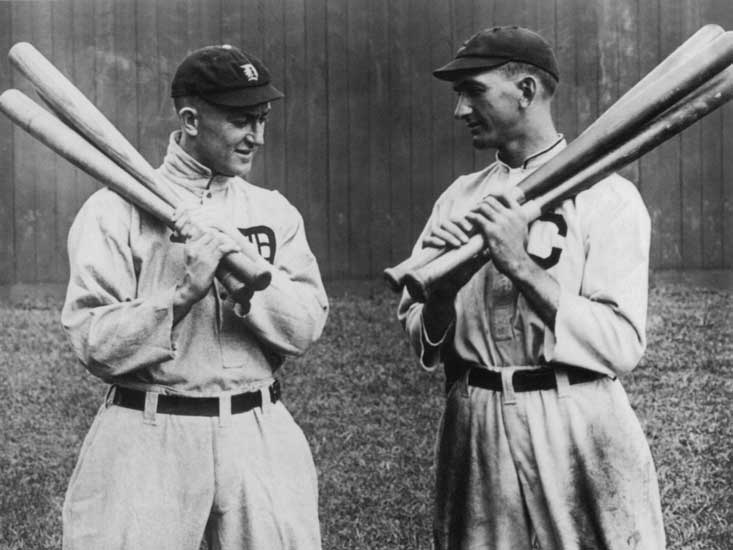
TY COBB (L) AND SHOELESS JOE JACKSON WERE EASY CHOICES FOR ME.

That Post World War II (1946-1960) MLB all-star exercise of a couple of days ago was so much fun that I thought I’d do another, and this one goes back into an era of even more pristine clear choices among players that few, if any of us, ever saw play in person. In spit of anything you might think, I am not among the personal witness crowd. Even us baseball Methuselahs don’t go back that far. I’m talking about an all-star team that covers the early 20th century, starting with the 19th century 1900 formation of the American League through the last year of World War II, 1945.

Any advantage on selection-making among us members of the older group here is that we have two resources to draw upon for making our picks: (1) the vast bibliography and statistical analysis sites available to all; and (2) the childhood stories we heard about these men from our father and grandfathers.

I did learn something from all of you who wrote me or The Pecan Park Eagle about your own choices for the Post WW II all-star group: (1) your preponderant choice of Warren Spahn over my Bob Feller choice convinced me that we need the freedom to pick one righty and one lefty as our preferred pitcher. If I had to do it over again I’d still pick Feller as my righty because of my long since-childhood affection for him, but I too would add Warren Spahn as my lefty guy for that era. (2) It’s better to not repeat the Feller pass on this earlier all-star group. With Feller, I took him as my starter for the post-war era in spite of the fact that most of his great years came earlier. That really wasn’t fair. The new suggested rule on this one is: Try to pick players who did most of their best work during the era in focus. That rule will keep me from picking Sy Young as a pitcher since he  won 367 of his 511 wins prior to 1900. Had the rule been in mind-place earlier, I would have chosen Robin Roberts as the righty on my post war group.

Here, without further comment, are my starting ten for the early 20th century team (1900-1945). If you need statistical/literary support for these, those materials are easily a mere Google away from your fingertips as you read:

Pitcher (R): Walter Johnson

Pitcher (L): Lefty Grove

Catcher: Mickey Cochrane

1st Base: Lou Gehrig

2B: Rogers Hornsby

3B: Pie Traynor

SS: Honus Wagner

LF: Shoeless Joe Jackson

CF: Ty Cobb

RF: Babe Ruth

As you did the last time, please register your agreement or disagreement with my choices in the comment section below. There’s not as much room for variance here as there was on the post war squad, but some does exist. To make my picks, for example, I had to pass over a few guys named Christy Mathewson & Grover Cleveland Alexander (RHP), Rube Waddell (LHP), Bill Dickey (C), George Sisler (!B),  Nap Lajoie, Eddie Collins, & Frankie Frisch (2B), Jimmie Foxx & Jimmy Collins (3B), Rabbit Maranville (SS), and Tris Speaker, Harry Heilmann, & Al Simmons (OF).

Every player on my club (except for the banned Joe Jackson), as well as the others of reference, are members of the Hall of Fame. That “HOF” status is the universal thread that unites all, but Shoeless Joe. The reason Joe Jackson isn’t there in the HOF is because of his expulsion from baseball as a result of his alleged participation in the 1919 World Series fix. Most of the time, I think of Joe as a Hall of Famer, anyway. My tendency to do that even influenced me to first write here that all of my all-stars were Hall of Fames. Then I heard from good SABR friend Bill Hickman with the reminder that Joe is not really an official member and I made the correction I am recording here. Still, in my own mind, Joe Jackson is innocent of all charges in the White Sox scandal until proven guilty – and also a Hall of Famer based on his game day production over the years he played through 1920.

Your picks don’t have to be Hall of Famers, but they probably will be, anyway, unless you also choose Shoeless Joe or one his also banned seven Black Sox brothers for your own lineup. In the early 20th century, the Hall of Fame did a pretty good job of picking up the people who deserved the honor.

I know it’s only four days until Christmas Eve, but happy early baseball all star hunting, anyway!

My Post World War II (1946-1960) MLB All Stars

December 18, 2010

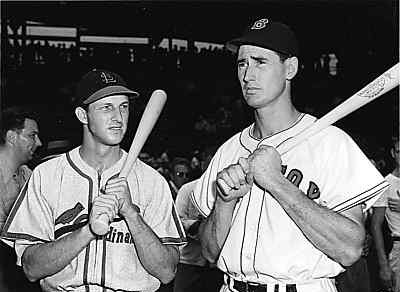
My Two Greatest Hitter of All Time: Stan Musial & Ted Williams.

My Post World War II (1946-1960) MLB All Stars

There will be no one group of nine that fills the bill for all of us on this one. These are just my picks, the stars that lit nights and guided the best and worst summer days of my growing-up years in Houston, with nothing more to help me keep up with them all but the Houston Post, The Sporting News, the Mutual Game of the Day on radio, DIzzy Dean and the TV Baseball Game of the week, and some very early and primitive long distance reporting by the first evening sports announcers at TV channels 2, 11,, and 13.

If you were around at the time, you will have your own choices – and we would like to hear who they are in the comment section of this column. There are no right or wrong answers here – just differences based on factors of personal preference, but, as Bum Phillips was wont to always say: “I’ll be happy to put my guys on the field to play “”yurn” any day of the week.

Here are my starting nine. They are all Hall of Famers, but that was just a common thread that easily fell into a stitch pattern through my entire nifty nine. In the old days, at least, the Hall of Fame didn’t miss often on awarding the signature of greatness to the folks who deserved it, based on their performances on the field. Mine are these:

Pitcher: Bob Feller. He came right out of WWII and won 26 games in 1946. The post war years were not his best, but he could still win big and get you the innings and fan people too. He certainly played well enough to get my long distance attention.

Catcher: Roy Campanella. Roy was the first black MLB catcher and the steady heart of those great post-war Dodger teams in Brooklyn. He could hit with pop and a high catcher average – and he has an arm that runners respected mostly as a stop sign on spurious stealing attempts.

1st Base: Stan Musial. In my book, the only “wrong” answer in this exercise will come when somebody submits a lineup that does not include “The man somewhere – either at first or in the outfield. As a kid, he was easily the best all-around hitter that I ever saw in person, even if those Musial performances were generated in spring training against our Houston Buffs. Musial’s 1948 NL batting title year, won by the .376 batting average that sprang from 230 hits and 39 homers, left the greatest impression on my 10-year old mind.

2nd base: Jackie Robinson. Robinson was my guy from the start of that 1947 year that saw him break the color line and then go on to steal home in the World Series against Yogi Berra. Robinson followed Musial ’48 by taking the 1949 NL batting title with 203 hits that produced a .342 mark. Although he played variously in the field, I’m putting him down as my second sacker, even at the cost of passing on another favorite, a little guy named Nellie Fox.

3rd base: George Kell. The MBS radio Game of the Day must have been partial to the Tigers and Red Sox because it seems like those two teams kept popping up all the time on the air, and maybe even more so when Kell played in first Detroit and then Boston. Kell had no power, but, oh Lardy, could he hit. His .343 mark won the 1949 AL batting title. As a fielder, we was no Brooks Robinson, but he was smooth enough to get the ever  done at one of baseball’s toughest positions.

SS: Ernie Banks. Hard as it was for me to pass on Phil Rizzuto, Pee Wee Reese, Marty Marion, Chico Carrasquel, and Luis Aparicio, I had to go with my partiality for shortstops that don’t hit like shortstops – and few represent that model any better than Ernie Banks. Ernie’s 44 HR and .295 BA in 1955 were clearly antithetical to our usual expectations at short. It was only after time moved beyond our current era of  reference and into the 1960s that we would discover Ernie’s secret. He could hit for power and average because he was really a first baseman.

LF: Ted Williams. In my book, Teddy Ballgame and Stan Musial are the two greatest pure hitters for average and power that ever lived. I cannot pick one over the other.  Rogers Hornsby had better career stats and a similar reputation from the right side of the plate, but the Rajah didn’t have to trade his bat for plane, guns, and bullets in two wars on his slightly more peaceful run on greatness, as was the case with Ted – and Stan also lost time to military service,

CF: Willie Mays. He was simply the arguably greatest five-tool center fielder to ever play the game. His iconic “catch” in the 1954 World Series is sufficient testimony to the fact. Mays lost his only potential challenger to the title of best center fielder ever when he personally dumped a dink fly to right center at Yankee Stadium in Game Two of the 1951 World Series. Another rookie named Mickey Mantle destroyed a knee on the play when he pulled up to avoid collision with center fielder Joe DiMaggio on the catch and managed to trap his heel in a drainage grating in the turf to set up the damage. Had Mantle not lost a lot of speed as  result of that injury, and also been forced to play the balance of his career in pain, Mays would’ve had a formidable challenger for the honor.

RF: Mickey Mantle. He was simply a man who was great in spite of unfortunate injuries and a lifetime of serious addictions and bad habits. I’ll take him on my team and how could I not? I thought he was great from the time I first saw him homer against my Houston Buffs in April 1951. On that day, DiMaggio still owned center field for the Yankees and the 19-year old Mantle played right field.

Those are my picks, folks. How about yours?

It’s Saturday morning. Merry Christmas shopping too.

Santa Toys That Went Away

December 17, 2010


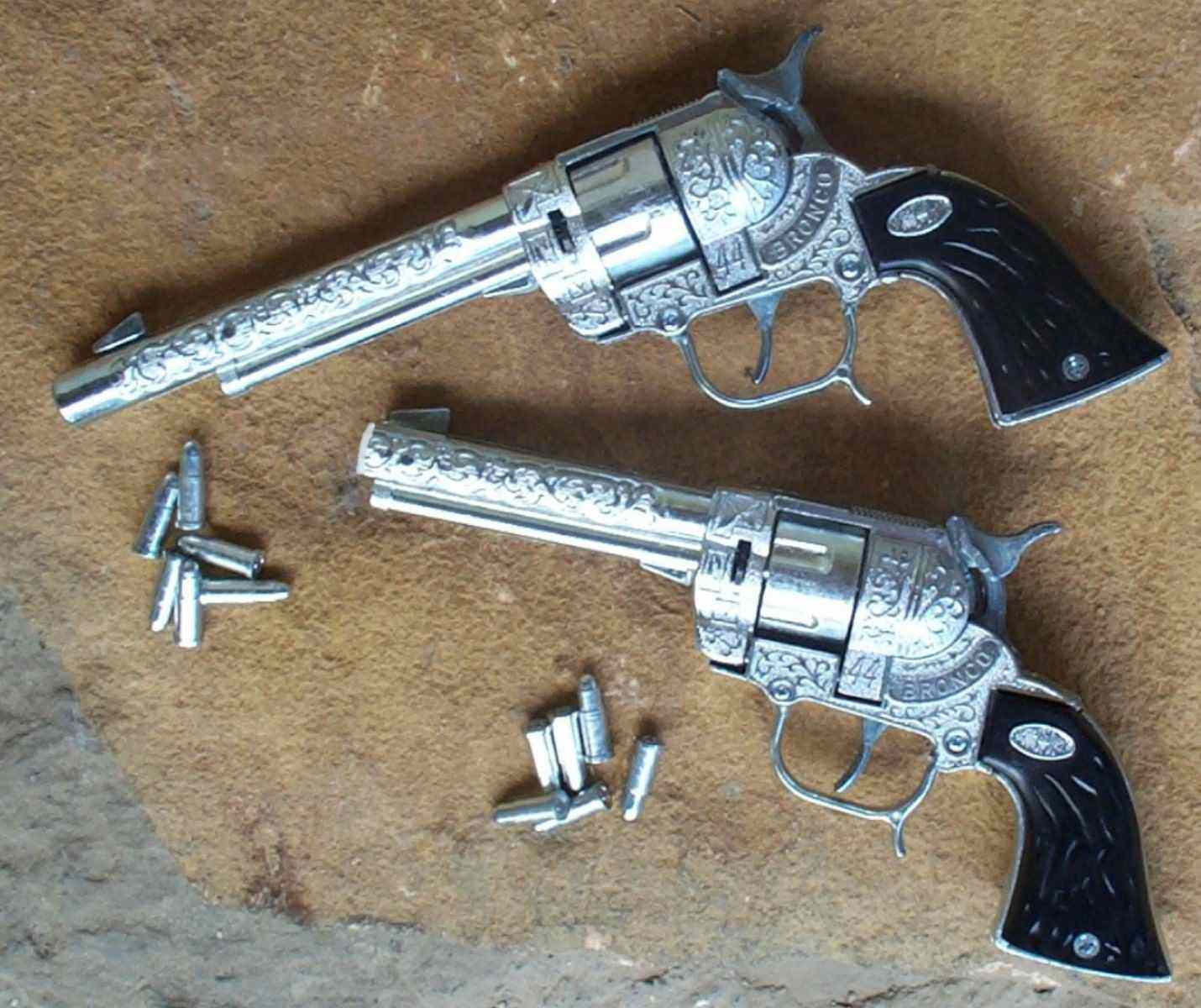
Cap Guns were our treasures as kids of the post WWII era.


With Christmas coming up faster than some of us can finish shopping, a few of my thoughts turn to the toys that went away from the shopping lists of Santa and our parents in the post World War II years. I’m not all that sure about changes in the girl toys, but there seems to be a major turnover in the toys for boys that are out there.

Exploding cap six-guns and rifles that all of us pre-teen boys down to ages 3 or 4 had to have back in the day seem to have vanished completely from the toy shelves. I guess today’s more violent world, one in which some real kids run around with real guns, pretty much precludes the opportunity for playful gun fights. In 2010, holding up anything that looks like a gun is also a good way to get yourself shot by the police. There was a story this week about a young man who was shot dead when he held up a detached garden hose nozzle and pointed it at the police when they came to check out a neighbor’s 911 call that the man was walking around the yard with a gun in his hand. It’s pretty easy today to see how that might happen. And also pretty scary. The threat of violence in our world today is always only a few seconds and a wrong turn on the streets away. That leaves no room for gun play as child’s play. Not in this world.


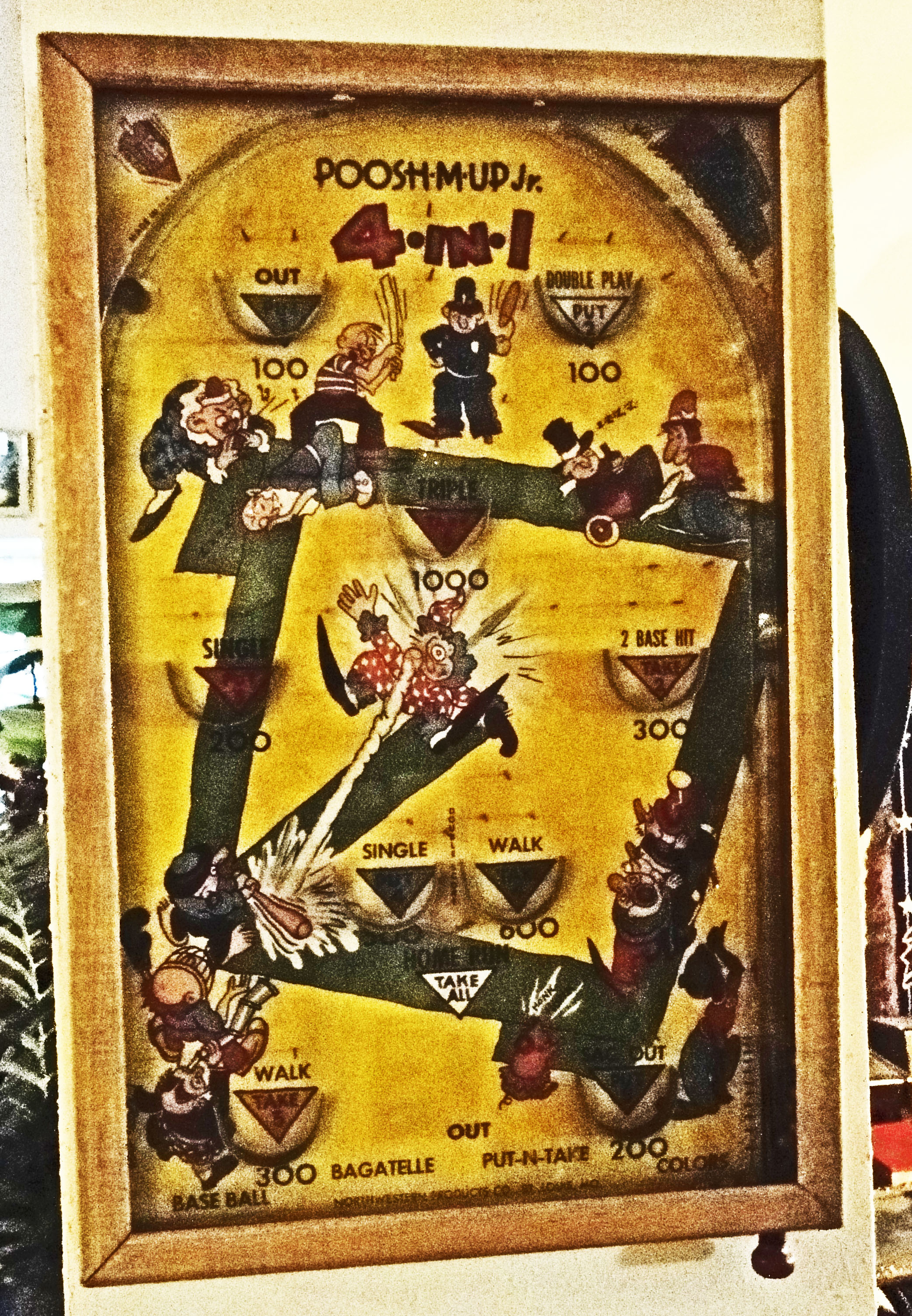
I was a pin ball wizard at the baseball part of this game.


Once upon a time, I got to the proficiency point of pretty much being able to call my shot on home runs in this little Christmas present pin ball game shown in the picture. The one in the picture is the exact model I played, way back in the late 1940s. Of course, we all know what happened to pin ball games and just about every other sports game involving pin balls, dice, or playing cards. Specific computer programs  and game company technologies have pretty much taken over the gaming world, for now and forever.

Too bad, There was some considerable mechanical skill required in the game of pin ball – and it was all something we developed over thousands of pulls and releases on the firing knob at different forces that taught us where the little silver  ball probably was going to end up.

Those too were the days my friend. Again, we thought they’s never end.

Perhaps, some of  you readers will also be able to comment on the differences you see in the Christmases you recall from your own personal “old days” in comparison to the ones that kids are having now. All I know for sure is – Christmas has changed in so many ways.

Let us hear from you.


Farewell to Rapid Robert

December 16, 2010

Bob Feller WAS "Take Me Out To The Ballgame"

“Nobody lives forever and I’ve had a blessed life. I’d like to stay on this side of the grass as long as I can, though. I’d really like to see the Indians win a World Series.” – Bob Feller, September 2010.

Bob Feller died in a Cleveland hospice yesterday, December 15, 2010, from the lingering weakness of his recent  pneumonia bout and the acute effects of his progressive leukemia, a disease he has been fighting through chemotherapy since its diagnosis in August of this year.

The death of Feller takes away the arguably greatest Cleveland Indian of all time. There was a fellow named Tris Speaker who put in some quality seasons as a playing manager for the Tribe, even leading the men from the banks of Lake Erie to a World Series title in 1920. Speaker, however, played a few very productive years for the Boston Red Sox before coming over to Cleveland and then even finished with the Philadelphia Athletics.

Bob Feller was all Cleveland Indian, all the way. For eighteen seasons (1936-1941, 1945-1956) Feller compiled a career record of 266 wins, 162 losses, and Earned Run Average of 3.25, with 2,581 career strikeouts thrown in to boot. He won at least 20 games in six seasons over three different decades.

Rapid Robert (that’s what they called him, as you probably know) lost three seasons to true grit military service (1942-1944) when he joined the Navy on December 8, 1941, the day after Pearl Harbor. Unlike a lot of ball players, Feller didn’t grab a military baseball uniform to improve his new groups’ fleet team. He served as a gun captain on the USS Alabama for three years, earning many medals and commendations for his performance under fire.

Feller marked his best win total season in his second season back from the war wen he won 26 game for the 1946 Indians. Two years later, Bob was a 19-win contributor to the most recent Cleveland World Series champions, the 1948 Indians. He had enough gas in the tank to register one last 20-win season by going 22-8 for the 1951 Indians. Three years later, now older and surrounded by an incredibly talented group of pitching teammates, Feller still managed to kick in a 13-3 record for the 1954 Indians and one more pennant for Cleveland.

Bob Feller's fastball once won a race with a quarter horse.

Bob Feller was all about amazement. He had a fastball to rival the speed of the great Walter Johnson before he was even 18 years old. In fact, Feller broke into the big leagues as an Indians reliever on July 19, 1936. On August 23, 1936,  a full two months prior to his 18th birthday, he made his first big league start. By then, Bob had proved to the Indians that he was already too good to ever see a single day in the minor leagues.

Feller’s accomplishments and records are almost too many to list in this brief discouse, but among his impressive stats are these: (1) The man pitched in 570 regular season games, completing 279 of the 484 games he started; (2) He led the American League in strikeouts seven times; (3) He pitched three no-hitters, including the only opening day no-no, and he also pitched twelve (12) one-hitters; and (4) In 1946, he pitched 36 complete games and 10 shutouts; the different era 2010 Indians only recorded 10 complete games and 4 shutouts as a complete staff.

The Cleveland Indians retired Bob Feller’s #19 in 1957, the first year following his last season as an active player. He was inducted into the Hall of Fame in 1962 during his first year of eligibility.

Bob Feller pitched in a special era for exceptional greatness on the mound. Four of his late 1940s, early 1950s pitching teammates, Bob Lemon, Early Wynn, Satchel Paige, and Hal Newhouser also later made it to the Hall of Fame. (Thank you, Mark Rejmaniak and Bob Dorrill, for your assistance in helping me thaw the brief brain freezes on accurate reporting of this whole Cleveland HOF pitching class from that 1948 to 1956 Cleveland Indian era.) And not just “by the way,” Bob Feller also played with four position players who made it on merit to the Hall of Fame too; center fielder Earl Averill played with Feller during the 1930s, and center fielder Larry Doby, second baseman Joe Gordon, and shortstop Lou Boudreau were leading forces of support behind that great array of Indian pitchers near the mid-century mark. What a talent ride those post World War II Indians enjoyed. And Bob Feller was the ancient superstar light that guided the team from his youthful days in the Great Depression through the last season of Eisenhower’s first term as President.

Baseball’s Bob Feller of Van Meter, Iowa was everything to the City of Cleveland that the NBA’s LeBron James of Akron, Ohio chose not to be. Feller was Mr. Cleveland Sports. Forever. Loyal. Committed. And dedicated to the idea of staying alive long enough beyond age 92 in the hope of seeing his beloved home town Indians win another World Series title. He didn’t make it, but it wasn’t because of any lack of character and heart. Bob Feller had both. And that’s how I will always choose to remember one of my heroes from all those MBS Network, Mutual Game of the Day radio broadcasts of big league baseball back in the early 1950s. You could hear the force and passion of Bob Feller’s fastball over the radio, even down here in the boondocks territory of a place called Houston, Texas.

Much to my delight, but now tempered by saddened sense of irony with the passing of Bob Feller, I had an opportunity to speak in August 2009 before a crowd that included Hall of Famers Bob Feller, Sparky Anderson, Robin Roberts, Phil Niekro, Joe Morgan, and Ozzie Smith. The occasion was the 2009 Joe Niekro Knuckle Ball at Minute Maid Park, where I had been  asked by Natalie Niekro to recite a poem I had written in honor of her wonderful dad, the late Joe Niekro.

It was an awesome humbling experience to perform anything in the presence of these men and so many other distinguished people from the local and national baseball communities. All I could do is turn the energy and grace crank over to God and give it my best shot. And so I did, for better or best effort. There was no room open for failure that night, and God flew me through on angel wings to make sure it did nor happen. I shall always be grateful for the way it turned out.

Now, a little more than a year and a third later, three of those Hall of Famers who came here to honor Joe Niekro in support of the Joe Niekro Foundation’s work against brain aneurysms are all gone. In addition to Bob Feller, we’ve also have lost Sparky Anderson and Robin Roberts since August 2009.

“Nobody lives forever …” … not Hall of Fame pitchers … nor World Series Champion managers of teams from both major leagues … nor little people, like most of the rest of us. All we can do, as I wrote yesterday, and much earlier in the day that Bob Feller unexpectedly left us, “Life ain’t over till we start living like it is.”

Rapid Robert Feller never gave up on life. He went down to his last day, still hoping to live long enough to see his beloved Indians win another World Series. Now the hope of Bob Feller has to live on in the hearts of all living Indian fans.

Only people die. Hope lives forever, even when its bearer dies. All it needs is some other being to pick it up and live in its behalf until the dream is realized.

Goodbye, Bob Feller. Cleveland will miss you. Baseball will miss you. And we fans will miss you too.

Analog: Hope breathes on for the Cleveland Indians. True Cleveland fans will not give up Bob Feller’s hope for the Tribe because that one also has belonged to a multitude of Indian fans for longer than any of us can remember.

Just as a World Series crown will eventually come to us fans of the Houston Astros, Cleveland will have their day again too. Someday.

You gotta believe! Otherwise, nobody cares when the Bob Fellers of this world pass away – and fans stop going to ballgames. It’s the trinity of faith, hope, and love that keeps even the game of baseball alive and growing. Bob Feller died yesterday, leaving us a legacy of three virtues to carry forward. For me, it’s the power and importance of Feller’s Legacy that I’m feeling today. Can you feel it too?

We all need to pick it up and allow it to revitalize our own faith, hope, and love of the game and it’s not that hard to do. Just open your mind and heart, The triple treat legacy of Bob Feller will swoop right in and do all the work for you. It’s as easy as living the lyrics to “Take Me Out to the Ballgame.”

See you at the ballpark, baseball fans!

1986 NLCS Game 6: A Sacher Masoch Revisitation

December 15, 2010

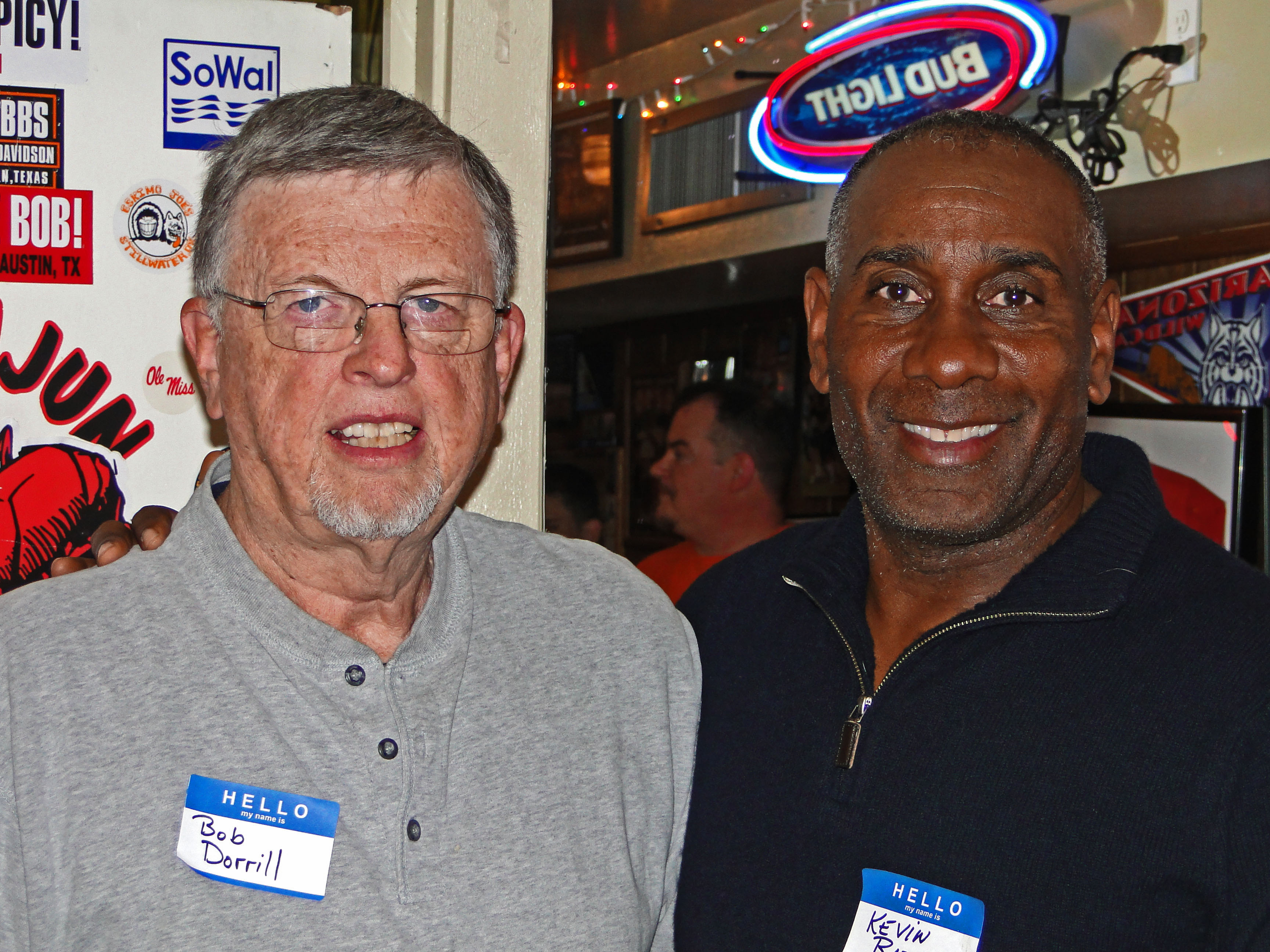
Former Astros Kevin Bass spoke at Houston SABR Meeting on 12/14/10. (The talk took place at the Ragin’ Cajun on Richmond. SABR Leader Bob Dorrill is on left.)

Former Astros Kevin Bass regaled about 25 members attending the December SABR meeting of the Larry Dierker Chapter at the  Ragin’ Cajun restaurant on Richmond last night. He took us all through his career, from his wide-eyed wonderment years as a rookie with the Brewers through his playing days as a seasoned, accomplished veteran. After all that, his first big question of the night (from Mike McCroskey) was: “How did you feel when you struck out to end the 1986 NLCS Series for the Astros in the 16th inning of Game 6 to give the 1986 National pennant to the New York Mets?”

Bass most probably was thinking: “Thanks a lot, fella. No one’s ever put me on the spot about that not so happy moment in my playing days until now.” Kevin Bass handled it fine, never showing any signs that it has remained an open wound. To the contrary, Bass says it was the great learning moment in his playing career. I’ll have to paraphrase what I head him say about striking out swinging on a too low and outside curveball from Mets reliever Jess Orosco to end the game:


Kevin Bass fans to end Game 6 of the 1986 NLCS as a 16-inning, 7-6 loss by the Astros to the Mets in the Astrodome.


“I went up to the plate just sure that I was going to either drive one in the gap to tie the game or hit one out to win it all. p against the crafty old lefty Jesse Orosco, that was a bad time to lose my focus and be out of the moment of what was going on. He killed me with slow outside curves that would have put me on first with a walk, had I not been so dedicated to swinging at whatever came up there. The tying run was on second base, but I couldn’t think out anything. The fact that Jose Cruz was hitting behind me just didn’t even occur to me. It was the stupidest at bat of my career, but it taught me that a batter has to stay grounded in the moment and not get ahead of everything with his own dream about what he alone was going to do.

Kevin Bass may have made the last out in Game 6 of ’86, but he did not lose this game alone. For starters, even Kevin Bass says that Astros manager Hal Lanier seemed to lose his season-long intensity and grip on the club once the Astros reached the Playoffs. According to Bass, Lanier just seemed to accept getting to the Playoffs as good enough as he started making moves that even the players questioned. Bass cited Lanier’s use of lefty Jeff Calhoun late in the game when he had Jimmy Deshaies available in the pen. We will never know if that would have mattered. There is always second-guessing when a club loses a close big game – and some of that second-guessing takes up residence forever.

As you probably recall, lefty Bob Knepper had pitched the Astros into the top of the ninth with a 3-0 lead with the Mets’ leadoff left pest Lynny Dykstra coming to bat. Bass in right and Cruz in left had pulled way back to prevent against extra base hits in the gap. For some inexplicable reason, however, center fielder Billy Hatcher didn’t get the message. He remained in his preferred shallow spot, about 20-25 feet behind second base.

When Dykstra then connected on a high arching fly ball to the right-shaded side of center, everybody who also wasn’t paying attention to Hatcher previously, and that seems to include about everyone in the park, assumed it was going to be the routine fly out it should have been, but wasn’t. Hatcher could not get back on the ball and Dykstra wound up with a leadoff triple.

A single by Mookie WIlson then scored Dykstra and a double by Keith Hernandez plated Wilson. With the Astros now only leading by 3-2, Knepper was done. Remember: the Astros entered this game down 3 games to 2, A win would tie the Series and set up Mike Scott with an opportunity to win it all at home for the Astros. Iron Mike had already won the only games the Astros had taken against the Mets and made them look silly in the process, The last thing the Mets wanted was Game 7 in Houston versus Mike Scott.

Dave Smith replaced Knepper in the 9th, but he promptly walked Gary Carter and Daryl Strawberry to load the bases. Ray Knight then poked a sacrifice fly to score Hernandez and tie the game at 3-3. Smith then struck out Danny Heep, but the Mets had surfaced as alive and kicking, After the Astros went down scoreless in their half, the game moved to xtra innings, tied at 3-3.

Still tied going into the top of the 14th, the Mets plated a go-ahead run when Wally Backman singled in Daryl Strawberry on a pitch from the Astros’ Aurelio Lopez, but that was all they could get when Mookie Wilson struck out with the bases loaded.

With one out in the bottom of the 14th, Billy Hatcher unloaded his now iconic homer to left to tie the game at 4-4 and send it forward into yet further extra stanza of action.

The Mets took the next lead off Lopez and the Astros in the top of the 16th when Strawberry doubled and came home on a single by Knight. That’s when manager Lanier brought in Jeff Calhoun, and not Jimmy DeShaies, to take over the pitching.

Calhoun promptly tossed up two wild pitches, scoring Knight from third on the second one. Backman then walked, moved up to second, and then scored on a single by Dykstra. That was it was the Mets, but they now went into the bottom of the 16th with a 7-4 lead and needing only three more Astro outs to claim the 1986 National League pennant.

Things got exciting again, if only for last fleeting Astro moment.

With one out, Davey Lopes drew a pinch hit walk off Mets reliever Jesse Orosco. He then moved to second on a single by Billy Doran. Billy Hatcher then singled to score Lopes and reduce the Mets’ margin to 7-5.


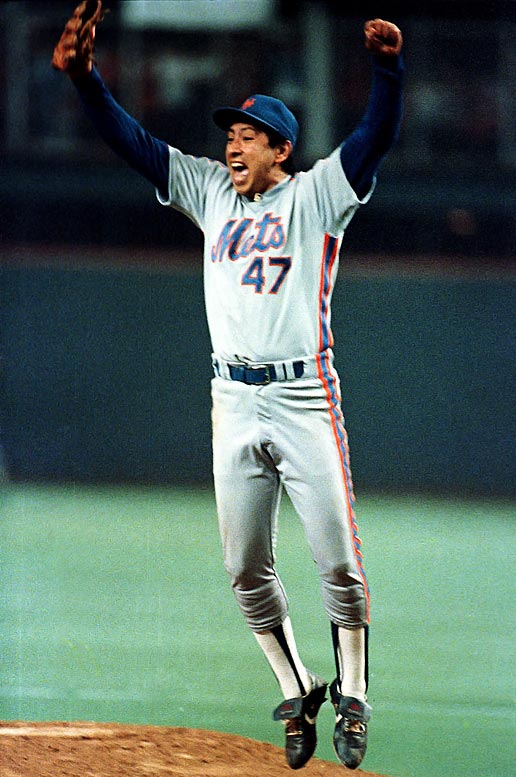
Ancient Jess Orosco was often rumored to have served under General Santa Anna at the Battle of San Jacinto. Maybe not, but he did pretty good in the Battle at the Astrodome.


After another out, Glenn Davis singled to score Doran, reducing the Met margin to only 7-6, as he also advanced the tying run by taking second base on the play at the plate. Now comes Kevin Bass to the plate with two outs, the tying run on second, and a chance for Houston heroism on an iconic level.

Not to be.

After fouling off a couple of unhittable low outside curves, Bass looked really bad on the one he missed completely. And the 1986 season for the Astros was over. Done. No more.

Astro players and fans have all since put that cry baby to bed and moved on. Baseball isn’t an easy game, but neither is life. And sometimes happen that don’t seem fair, but they happen anyway. And none of us escape them all, eventually.

As my dear old dad used to say in times of disappointment and bad news, and this line of was unintentionally straight out of the Cole Porter songbook:

“It was just ne of those things.”

We didn’t win in 1980 or 1986, but we came close in 2004 and even reached the Big Top in 2005 before we walked away with “Close, but no cigar!” as our pennant script until the day finally comes when the Houston Astros dance on top of the baseball world.

Thank you, Kevin Bass, for stirring up a lot of memories and for lighting again that eternal flame of hope for something better down the line by staying in touch with what we are doing and not doing in the here and now. Your talk was a reminder that today is where the work of tomorrow gets done.

I’ll stop on my adaptation of a Yogi expression to this point:

“It ain’t over til we start living like it’s over!”


Our Hermann Park/Rice Legacy

December 6, 2010

This iconic statue of General Sam Houston has marked the entrance to Houston's Hermann Park since 1925. It was designed and constructed by Italian-born Texas sculptor Enrico Filberto Cerracchio for $75,000 in post World War I dollars.

A legacy is only as valuable as the care it receives from its recipients. So far, the 1914 gift of land for a park and medical center south of downtown Houston by early local philanthropist George H. Hermann seems to be surviving as valuable to the City of Houston beyond anyone’s earliest 20th century dreams.

Were it not for the 445-acre donation of land by Hermann, and the adjacent earlier donation of acreage and endowment funds to the contiguous west of the park for the start of Rice (Institute) University in 1912 from funds donated by another local giver, William Marsh Rice, the southern exposure of this city’s non-zoned real estate might have grown as nothing more than a hodge-podge of homes, business, and billboards, the way much of our city grew until we awoke from what we were doing. That kind of force for conservancy wasn’t necessary south and immediately west of General’s Sam’s statue. The gifts of Messrs. Hermann and Rice had set a legacy in motion that the people of 20th century Houston had gratefully accepted, developed, and improved.

The Texas Medical Center south of Hermann Park is now the arguably finest in the world. The art, civic, and science museum district immediately north of Hermann Park is now one of the finest in the nation, if not the entire world – and these all flow further north through the reviving mid-town redeveloping residential area and into the traditional downtown/uptown (depending on your point of view) business district that also now preserves classic structures like the iconic Gulf and Esperson Buildings, the ancient LaCarafe Building on Market Square, while also serving as the promotional environment for the growth of the classical performing arts, major league baseball, and professional basketball. Throw in downtown also as the home of the central branch in one of the finest library collections and systems in the nation.

Houston values culture. Houston has class. And the seeds of it all may have been the early donations of two men named Hermann and Rice. These gifts to the people just seemed to set in motion an appetite and an attitude about learning, preservation, beauty, and accomplishment that permeates the air of our community to this very early dawn in the 21st century.

The future of Houston is right over there, just beyond the dawn. All we have to do to make our best future most likely is to lean into tomorrow by living fully today and in total respect for the many personal and community gifts of our storied local past.

How long has it been since you’ve visited the zoo, attended a concert at Hermann Park, checked out the Science Museum, visited the Houston Museum of Fine Arts or one its many local exposition cousins, or simply taken a continuing education class through the Rice University Adult Studies program?

Well, maybe it’s time you did something along those lines. We keep the legacy alive through our personal participation in whatever’s available. And we’ve got a lot of worthwhile stuff filling our cups of opportunity to the brim here in Houston. It’s up to each of us to either use it or lose it.


.

America in Color: 1939-1943

December 4, 2010

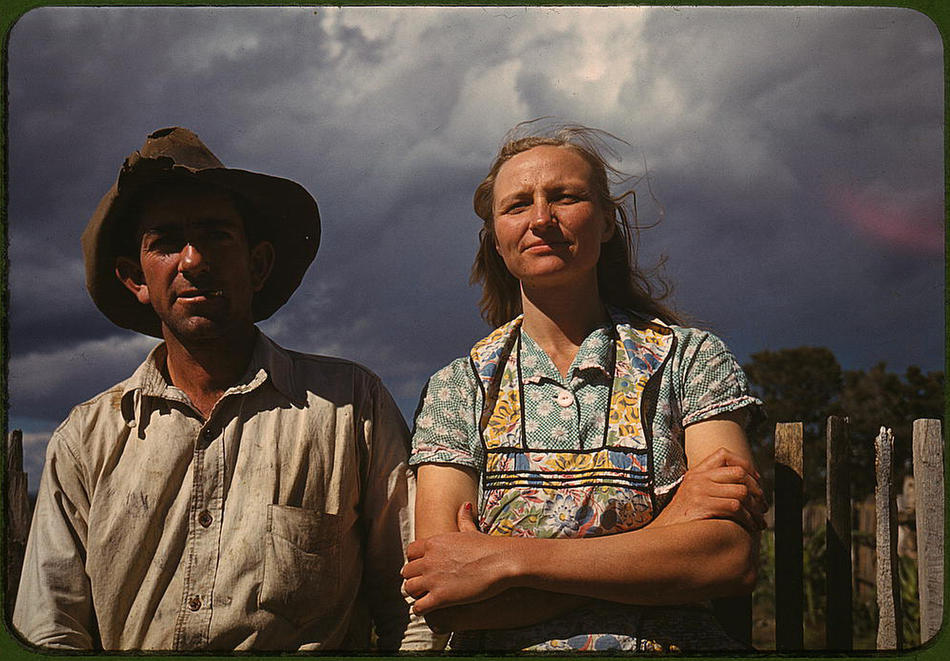
Faro and Doris Caudill, homesteaders. Pie Town, New Mexico, October 1940. Reproduction from color slide. Photo by Russell Lee. Prints & Photographs Division, Library of Congress

We have my old friend and St. Thomas High School classmate Pat Callahan to thank for these beautiful photographs making their appearance in The Pecan Park Eagle today. Patrick, my man, thank you for all of us.

Today’s column is a visual feast. Just click on the link below and be whisked away to the Denver Post collection of rare Library of Congress photos depicting everyday American life in color during the latter years of the Great Depression-Early World War II era, from 1939 into 1943. Their beauty is in their full color depiction of an America that used to be, but no longer is. In some ways, that’s good. Poverty and racism are never pretty – and both need to be fought commonly as depredations of the human spirit that they each are.

Poverty is not the absence of money. It is the absence of opportunity. Racism simply guarantees that the absence of opportunity for some people over time will not lead to a crying out for same, but as a calling out for entitlement and rescue with money, If granted as living subsistence relief only through publicly funded social programs, the suffering new political constituency group gets to keep the spiritual poverty that came with the racist limitations of their previous mental or legal slavery to a prejudicially suppressed life without any real opportunity. In other words, remove opportunity long enough – and people don’t stop being hungry – it’s just that many of them forget what they are really hungry for. They grow up settling for rescue and relief from the public soup kitchen because that’s all they ever known or been taught to know.

But there’s something else here too in these photos. – To me, it’s an America still bonding close to the ground on family, shared labor, and community connection to others – and not to selfish consumerism
or addiction to technological distractions, like texting devices, or this one I’m using now, the Internet. Even in color, the people are not living at the brim of frilly material things that surround most of us in 2010, but they are not impoverished either by the absence of money.
Check out the photos. Get lost in another world of America’s yesteryears. Enjoy. Reflect. Connect with what you see in the images that follow. Then, here’s a game you can play that may be both helpful and kind of fun: Pick out a photo that might help you with your own perspective on life in 2010, if you could magically go back and personally experience the 24 hours of that particular photo day with the subjects, scenery, or activity that unfolds in that particular picture. Have fun. Here’s the Library of Congress collection link now hosted by the Denver Post:

http://blogs.denverpost.com/captured/2010/07/26/captured-america-in-color-from-1939-1943/2363/

Starting Nine for the Houston Natives: A Work in Progress

December 3, 2010

Who should take the field for the Houston Natives?

Latest Change Now Updated Below, 12/04/2010: All one has to do to qualify for this club is be born in Houston. We forgot about Curt Flood, who was born her, but grew up in Oakland, CA. Thanks to the memory of Mike McCroskey, we have now added Flood to the outfield as a replacement for the now departing Steve Henderson, Left Field (11/18/1952) (Jack Yates HS) (.280 BA, 68 HR, 79 SB). I still don’t see even Curt Flood replacing Michael Bourn defensively in center field, but he definitely is an upgrade from Henderson.

============================================

Here’s a project for all of us, but thanks to early contributions of Dr. D. (Will Rhymes at 3B) and Shaun Bejani (Joel Youngblood at 3B) and the partial return of my own earlier absent memory (Craig Reyn0lds at SS), we, at least, now have all nine positions filled.

A lot of good ballplayers have come out of Houston over the years. Maybe it’s time we tried to put together our choices for the best starting lineup of native Houstonians that this city has ever produced. Off the top of my head, I came up with six players that would be my choices, but I had struck struck out on names for three positions until the names of Rhymes, Youngblood, and Reynolds came streaming back into the bright of day.

Can you think of anyone who might be better suited to play any of the nine positions with greater skill and production? It’s not always as easy as it looks – and sometimes we assume that a player is a Houston native when he really isn’t. Wayne Graham would have been a natural thought for 3rd base, but he wasn’t born in Houston. Neither were Roger Clemens or Andy Pettitte. Those famous Houstonians were born in Ohio and Louisiana, respectively.

Some players were either born nearby Houston – or else, they simply became so identified with Houston that we all mostly assumed that the were  born here too. Watty Watkins is a good example. He was a Houstonian, all right. He just wasn’t born here. Others include people like pitcher Josh Beckett, born in Spring, Texas, and fabled Houston high school pitching phenom David Clyde, born out of state,

I don’t have time to research every question that comes to mind to me here, so, I thought some of you might enjoy searching with me for the best lineup of native Houstonians we can put together, The guys I’ve listed are my choices for those spots, but some of you may have other nominees. I considered a few at pitcher, but I chose Red Munger over either Scott Kazmir or Woody Williams because I basically felt that good old Red Munger was better than both of those guys put together.

Send in your comments and let’s see what we can build together. Meanwhile, here’s what I’ve come up with for starters:

Incomplete Starting Lineup for the Houston Natives

(1) George “Red” Munger, Pitcher (10/04/1918) (Sam Houston HS) (77 W-56 L, 3.83 ERA)

(2) Frank Mancuso, Catcher (05/23/1918) (Milby HS) (.241 BA, 5 HR, 2 SB)

(3) James Loney, First Base (05/07/1984)  (Elkins HS) (.288 BA, 55 HR, 353 RBI)

(4) Will Rhymes, Second Base (04/01/1983) (Lamar HS) (.304, 1 HR, 19 RBI) *

(5) Joel Youngblood, Third Base (08/28/1951) (Austin HS) (.265 BA, 80 HR, 422 RBI)

(6) Craig Reynolds, Shortstop (12/27/1052) (Reagan HS) (.256 BA, 2 HR, 58 SB)

(7) Curt Flood, Left Field (01/18/1938) (Oakland Tech HS, Oakland, CA) (.293 BA, 85 HR, 88 SB)

(8) Michael Bourn, Center Field (12/27/1982) (Nimitz HS) (.263 BA, 11 HR, 173 SB)

(9) Carl Crawford, Right Field (08/05/1981) (Jeff Davis HS) (.296 BA, 104 HR, 409 SB)

Have a nice Friday, everybody – and Happy Houstonian Hunting too!

* Will Rhymes was suggested by Dr. D.