Posts Tagged ‘History’

A Tale of Two World Series Rings.

October 16, 2009

I’m not really sure when major league baseball clubs started handing out World Series rings to the members of their winning teams, but I do recall reading somewhere  that the 1927 New York Yankee players received special wrist watches for their slightly other-planet accomplishments. By the 1940’s, however, the practice of awarding especially designed World Series rings had taken over, and probably had been in place for several years.

Circumstances recently put me in contact with images of two different rings from two very different eras. The pictures speak fairly well for themselves about one measure of how much things have changed over the time.WS RING SLB 1944

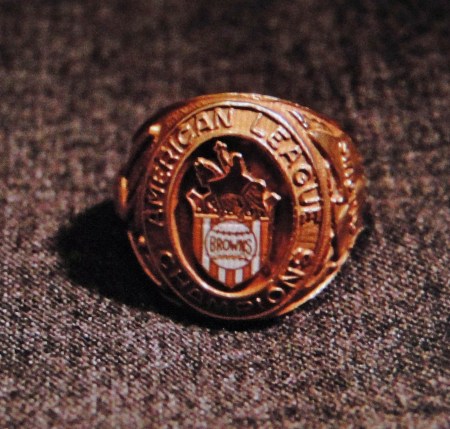
The above shot of a 1944 St. Louis Browns World Series ring came to me from Wayne Williams of Colorado, one of my friends in the St. Louis Browns Historical Society. Wayne got it from a guy who somehow acquired it somewhere in the wide, wide world of memorabilia collecting. It supposedly belonged originally to the team doctor. The gold ring bears the Browns’ crest and it contains no rare jewels on its scaled-to-everyday-wear sized body.  The Browns lost the ’44 World Seris to their hometown rival Cardinals, four games to two. The ring was properly inscribed for what it was, an “American League Championship” ring. Since the Browns only won this single time over the entire course of their 52-year history (1902-53), the 1944 ring is especially meaningful as the triumph of patience over self pity.

2008 Philadelphia Phillies World Series Ring

2008 Philadelphia Phillies World Series Ring

WOW! Look at that recent Phillies World Series ring on my finger in the above photo! My hands aren’t that big, but the size of this thing made me feel like a Hobbit or something. The ring belongs to Gene Diaz, Director of Media Relations for the Houston Astros. Gene was a long-time employee of the Phillies organization before accepting the upgrade spot he now holds down for the Astros. Gene brought the ring with him to a presentation he made at  our September 2009 SABR meeting downtown at Molly’s Pub. In contrast to the “plain and simple” Browns ring, the Phillies ring brings new color and definition to the phrase “big and fancy.” It’s golden oversized body feels more like a bowling ball that you soon wish to put down before it takes your whole arm away, but it glitters while you wait for relief. I think it contains 103 diamonds, one for each of however many games the Phillies actually won in 2008. -What do they do to top this thing if the Phillies win it all again this year?
 
What if these two clubs actually squared off against each other at Time Warp Field to play a World Series against each other? We’d have that delicious match up that nobody ever dreams of, the 1944 Browns versus the 2008 Phillies! – Oh well! Based upon ring design differentials, and what we can  know of speculatively about a pairing of these two clubs from a talent standpoint, I would venture this prediction about the outcome of a best four of seven Series:
 
Blingville 4 – Bluesville 0.

A Playoff Memory: Texas League, 1951.

October 13, 2009

The Shaughnessy Playoff System is the invention of Frank Shaughnessy, the General Manager of the minor league Montreal Royals back in the early ’30s as a device for giving the top four teams in an undivided league a chance to play each other for the league championship in an established format of games. The system was first deployed after the 1933 baseball season in the International League. It soon spread in popularity throughout baseball and into other sports as a way to create broader support among fans of several teams at season’s end. In other words, the post-season playoff system spread the hope and pumped the gate as though it were an offer that could not be refused.

The most common schedule format was to pair the Number 4 team against the Number 1 team – and the Number 3 team against the Number 1 team in Round One. With home team advantage going to the higher rank team, a best four games of seven series in each case determined which two teams advanced to Round Two, or league championship series – with the highest ranked team from the regular season again receiving the home club advantage in the scheduled of a final series based on the best four wins of seven format.
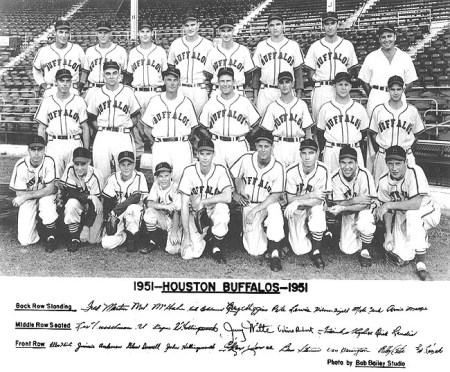
Buffs 1951

Here’s how the 1951 Houston Buffs made out in the Texas League Playoffs and the Dixie Series Championship that followed. The Buffs finished first in 1951 with a record of 99-61. They opened as hosts to the Beaumont Roughnecks, who tied with the Fort Worth Cats for fourth place place with records of 84-77. Beaumont won the nod as a playoff team by defeating Fort Worth, 4-2, on the road in s one-game playoff for the number four slot in the Shaughnessys. – The third place Dallas Eagles (85-75) took on the second place San Antonio Missions (86-75) in the other first round game. For purposes of brevity, we will only follow the Houston path here.

ROUND ONE, GAME ONE: BEAUMONT @ HOUSTON, Tuesday, 9/11/51:  When Vinegar Bend Mizell came down with a mysterious sore throat and had to be hospitalized at nearby St. Joseph’s, manager Al Hollingsworth of the Buffs started veteran righthander Fred Martin. Beaumont Manager (and future first manager of the Houston Colt .45’s) Harry Ctaft started former Buffs star Clarence Beers. – Beers beat the Buffs, 4-1, as catcher (and future Buff) Frank Mancuso led the Roughnecks with three key hits.

Beaumont led Houston in the Series, 1 game to none.

ROUND ONE, GAME TWO: BEAUMONT @ HOUSTON, Wednesday, 9/12/51: Righthander Octavio Rubert starts for Houston, but he is quickly knocked out. Things look bad, but reliever Jack Crimian comes in to hold the Buffs close as the they chip away at a 4-0 Beaumont lead. With the bases loaded and two outs in the bottom of the 8th, Jerry Witte enters the game as an aging and tired pinch hitter. Witte singles to left center, plating two runs that put the Buffs ahead to stay by 5-4.

Beaumont and Houston are tied, 1-1, in games won.

ROUND ONE, GAME THREE: HOUSTON @ BEAUMONT, Friday, 9/14/51: With Mizell still in the hospital, knuckleball ace Al Papai starts for Houston against Beaumont’s Hal Schaeffer. Papai loses a pitching duel by the score of 1-0.

Beaumont leads Houston, 2-1, in games won.

ROUND ONE, GAME FOUR: HOUSTON @ BEAUMONT, Saturday, 9/15/51: Still no Mizell. The troubled Buffs turn to the  right hander Loel Passe nicknamed Black Mike Clark because of his deep-set eyes and matching dark mood. Clark black moods Beaumont, shutting them out, 2-0, to square the Series and guarantee its return to Houston.

Beaumont and Houston are tied games won, 2 games each.

ROUND ONE, GAME FIVE: HOUSTON @ BEAUMONT, Sunday, 9/16/51: With Mizell still out, Fred Martin starts again. He holds Beaumont down as Houston rips through several Beaumont pitchers. Jerry Witte leads the Buffs’ hitting attack by going 3 for 5 with a homer. Buffs win, 7-4.

Houston now leads Beaumont in the Series, 3 games won to 2.

Meanwhile, San Antonio has defeated Dallas in seven games and awaits the winner between Beaumont and Houston.

ROUND ONE, GAME SIX: BEAUMONT @ HOUSTON, Monday, 9/17/51: There is no day off as the Series shifts back to Buff Stadium. Ocatvio Rubert of Houston and Hal Schaeffer of Beaumont hook up in a pitchers’ duel that goes into the bottom of the 8th tied at 1-1. Larry Miggins breaks it up with a two-run homer shot over the left field wall off Schaeffer to put the Buffs ahead to stay by 3-1. Jack Crimian comes in to put Beaumont down in the ninth and the Buffs have advanced to the final round.

Houston wins the Series with Beaumont, 4 games to 2.

ROUND TWO, GAME ONE: SAN ANTONIO @ HOUSTON, Tuesday, 9/18/51: Al Papai mystifies the Missions by the consecutive final score of 3-1. Larry Miggins again homers. This time, it’s a no-doubter to far left field that provides the final tally of the evening.

Houston leads San Antonio in games won, 1-0.

ROUND TWO, GAME TWO: SAN ANTONIO @ HOUSTON, Wednesday, 9/19/51: Mike Clark starts against Hoot Gibson of San Antonio. Paced by Jerry Witte’s two-run double, the Buffs jump Gibson for a 3-0 lead in the bottom of the first. With some late relief help again from Jack Crimian, the Buffs hold on to take a 4-3 second victory over San Antonio at Buff Stadium. I was there for that one. My dad’s boss invited dad and me to see the game with him from his first base line box and I was in “Buff Heaven.” It was my first experience with a playoff game and the Buffs won!

Houston leads the Series in wins, 2 games to 0.

ROUND TWO, GAME THREE: HOUSTON @ SAN ANTONIO, Thursday, 9/20/51: With Fred Martin again filling in for the still ailing Mizell, the Buffs crush the Missions, 11-5, at Mission Stadium. They are standing in the pennant’s doorway.

Houston leads San Antonio in the Series, 3 games won to none.

ROUND TWO, GAME FOUR: HOUSTON @ SAN ANTONIO, Friday, 9/21/09: Houston defeats San Antonio to complete a four-game sweep on their ride to the Texas League pennant. 5-3 is the final score as Jerry Witte’s 3-run homer in the 6th inning  provides the winning margin. Octavio Rubert and Jack Crimian hold down the Missions one final time.

Houston wins the Series and the Texas League Championshp, four games won to none, over San Antonio.

By winning the Texas League pennant, the Buffs qualified to play the Birmingham Barons (83-71) the Shaughnessy Playoff winners of the Southern Association crown in the Dixie Series. The Dixie Series had been established in 1920 as the southern higher minor league equivalent of the World Series. In the years it was played (1920-1942, 1946-1958), the Dixie Series always featured the winners of the Texas League against the winners of the Southern Association.

Houston participated in eight Dixie Series contests, winning in 1928, 1947, 1956, and 1957 – and losing in 1931, 1940, 1951, and 1954. So, now that I’ve let the cat out of the bag, what happened in 1951? For one thing, Mizell got sick again. For another, they played pretty good baseball in Brimingham too, and the Barons caught Houston when they were dead tired. Here’s the gist of it, by game:

DIXIE SERIES, GAME ONE: BIRMINGHAM @ HOUSTON, Thursday, 9/21/09:  An overflow crowd of 11,343 showed up at patriotic banter-covered Buff Stadium. In the pre-game, Buffs President Allen Russell even brought in a band. They played “Dixie” in honor of Brimingham – and “The Eyes of Texas” in honor of Houston.

Jimmy Pearsall, George Wilson, and Marv Rackley were the Barons’ big guns; famous major league vagabond Bobo Newson and Mickey Haefner were their top pitchers; and Red Marion (Marty’s brother) was the Birmingham manager.

Vinegar Bend Mizell was back, but Hollingsworth declined to start him in Game One. Octavio Rubert got the nod to face lefty Mickey Haefner of Birmingham. – The barons blast Rubert all over the place. Pearsall and Rackley both go  four for four, and Jerry Witte of the Buffs cracks  two doubles, but to no avail. Birmingham wins the opener, 7-3. Haefner picks up the win; Rubert is tagged early and ends up with the eventual loss.

Brimingham leads the Dixie Series in games won, 1-0.

DIXIE SERIES, GAME TWO: BIRMINGHAM @ HOUSTON, Friday, 9/22/09: Vinegar Bend Mizell finally starts  for the Buffs against Ralph Brickner of the Barons. Second baseman Ben Steiner scores the only run of the game in the bottom of the first, coming home from second base on a sharp single up the middle by Buffs center fielder Roy Broome. Mizell just dominates the Barons today, striking out 14 and allowing only four hits in pacing the Buffs to a 1-0 victory

Birmingham and Houston are tied in Dixe Series games won, at one each.

DIXIE SERIES, GAME THREE: HOUSTON @ BIRMINGHAM, Sunday, 9/30/09: 16,681 fans  mostly Birmingham fans show up for Game Three to watch Fred Martin of Houston square off against the legendary Bobo Newsom of Birmingham. The game is scoreless until the top of the 6th, when Roy Broome triples and Eddie Kazak is then walked intentionally by the Bobo to set up a double play situation with Larry Miggins coming to bat.

Mr. Miggins has other plans. He launches a deep home run over the wall in left field to give the Buffs a 3-0 lead that will hold up as the final score, with a little relief help from Mike Clark.

Houston leads Birmingham in Dixie Series games won, 2 to 1.

DIXIE SERIES, GAME FOUR: HOUSTON @ BIRMINGHAM, Monday, 10/01/51: Al Papai of the Buffs faces Jim Wallace of the Barons in Game Four. It’s another pitcher’s duel, but Jim Wallace of the Barons breaks it up in the late innings with a home run that gives Birmingham a 3-2 win.

Houston and Birmingham are tied in Dixie Series games won at two a piece.

DIXIE SERIES, GAME FIVE: HOUSTON @ BIRMINGHAM, Tuesday, 10/02/51: Birmingham home-boy Bobby Bragan, manager of the Fort Cats, creates a minor stir when he tells a local newspaperman that Hollingsworth and the Buffs should win because they are playing AA ball with AAA talent. Hollingsworth is briefly enraged by Bragan’s remarks, but quickly gets back to the business at hand. – Mizell starts for Buffs again against Brickner.  Going into the bottom of the 6th, Mizell is in command of a 2-0 lead and looking good when, suddenly, he gets sick on the mound and has to be taken out. It’s never known from there if his illness was a new one – or just a flare up of the old one that kept him out of most of the post-season. All we know for sure is – his second illness proves fatal to the Buffs. With Mizell out of the game, Birmingham tees off on relievers Fred Martin and Jack Crimian for a 4-3 rally win over the Buffs.

With the Series going back to Houston, Birmingham leads in games won, 3 to 2.

DIXIE SERIES, GAME SIX: BIRMINGHAM @ HOUSTON, Thursday, 10/04/51: Black Mike Clark  gets the nod to face Mickey Haefner as the Dixie Series moves back to Buff Stadium. Unfortunately, Haefner picks this date to pitch the greatest game of his career. Haefner has a perfect game going for him through seven innings and enough runs to win the game and Series, but he tires in the eighth. The Buffs get to Haefner for two runs and three hits, including a double by Jerry Witte, but its too little, too late. Haefner puts a cap on the ninth and Birmingham wins the 1951 Dixie Series, four games to two over our Houston Buffs.

I heard the last out on my bedside Philco radio. When we lost, I turned it off and skipped the post-game comments of Loel Passe for the first time in history. All I wanted to do was quietly cry myself to sleep, which I did. I didn’t read the sports pages the next morning or even talk about the game or series. It was another two weeks before I picked up the morning paper again. I wanted to make sure that Clark Nealon and the other writers were done with baseball and were now covering football. I didn’t want to hear about or discuss the Buff’s’ loss with anyone. I would use football to take my mind off the hurt until spring, when it was time for the real game to take over the land again with all the new hope it always brings.
Ode to Prince’s Drive Inn

October 1, 2009

PRINCES 02

PRINCES 01

When the long day’s done, when nostalgia seaps through, there’s still time left, for a burger and brew, at the one place in town, that’s pulled Houston  through – the Depression, the wars, and the freeways.

“Fit for a King,” don’t mean a thing, if it ain’t got that fling, that original sauce bling, that seeded bun sting, that all crisply tells us, “you’re eating at Prince’s tonight!”

 From 1934, through the ’80s or so, your good taste in burgers, was all we could know, of a meal that was laid out, quite perfectly so,  in a kitchen just this side of heaven. 

With rings on the side, as the onions were fried, you charmed us with carhops and Elvis. – We flocked to your gate, and we always stayed late, but the smooching was hard on the pelvis. 

On South Main you were royal, to your subjects so loyal, and you soon built a thousand locations. – Then hitting them all, ‘came our gist of it all, as our favorite on-the-go avocation. 

You closed down for a while, but you came back in style, with a plan for the new generation.  No carhops this time, just burgers sublime, and a dab of the ’50s, in sweet spiritual decoration.  

And now that you’re back, with a storefront or two, it’s still nice to taste, a great burger from you, but I still have to ask, ‘fore the clock on me, gently, I hope – just slips me away too:

“Who is that beautiful girl whose carhop cutout figure now hangs on the wall of your Briar Forest place? I remember her from the old days, but I never got her name!”

Hal Smith, Catcher: A Tale of Two Smittys!

September 29, 2009

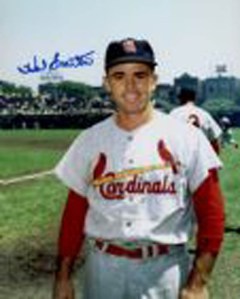
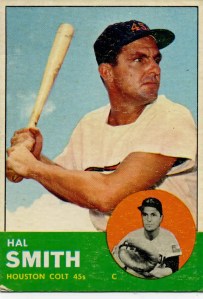
smith hal rsmith hal wHouston Baseball”s two Hal Smths were always being confused for one another. It didn’t help clarity much that they played ball in the same era and, worse, that they played the same position and both batted right handed. I’ve forgotten how often the same statement would come up from different friends at games during the 1962 first seson of the Colt .45s: “Oh yeah,” they’d say, “I remember that guy at catcher, that Hal Smith. He played for the Buffs a few years back.”
“No,” I’d have to answer, “this is not the same Hal Smith. This is the other Hal Smith, the one that got one of the big home runs for Pittsburgh in the 1960 World Series!”

“Oh,” they’d usually reply. “You mean that guy for the Pirates wasn’t the same Hal Smith who used to play for the Buffs?”

If this conversation had been part of an Abbott and Costello routine, this would have ben the point where I went to the big question of the day, “Who’s on first?”

Instead of going the Abbott and Costello way, let’s just try to get these two Hal Smith straight and apart for whom they each actually were. To that end, we’ll go the use of middle name initials to help keep their two identities separate and apart:

Hal R. Smith (Harold Raymond Smith) (BR/TR, 5’10.5″, 185 lbs.) was born June 1, 1931 in Barling Arkansas. – Hal W. Smith (Harold Wayne Smith) (BR/TR, 6’0″, 195 lbs.) was born December 7, 1930 in West Frankfort, Illinois. Both were catchers.

Hal R. Smith played for the Houston Buffs of the Texas League over the course of two seasons (1954-55). He batted .259 with 5 homers and 39 runs batted in for the ’54 Buffs and .299 with 8 HR and 67 RBI for the ’55 Buffs. 1955 concluded Hal R. Smith’s six season minor league career (1949-50, 1952-55). Hal R. Smith the next six seasons catching for the St. Louis Cardinals (1956-61), returning briefly with the Pittsburgh Pirates in 1965 for three hitless times at bat.

Hal R. Smith’s little time as a Pirate in 1965 didn’t help keep him straight from Hal W. Smith in the public mind. The Pirates were Hal W. Smith’s old team during the 1960 World Series – and that was the season in which Hal W. Smith’s home run in Game Seven kept Pittsburgh alive for Bill Mazeroski’s winning walk-off homer against the New York Yankees.

Hal R. Smith never played for Houston’s major league Colt. 45s or Astros. His career major league record with St. Louis (and three at bats with Pittsburgh) included a batting average of .258, 23 home runs, and 172 RBI. Hal R. Smith also maintains a website that includes much more information about his personal life and career. Here’s the link:

http://halsmithcards.com/bio.html

Hal W. Smith was an original 1962 original club Houston Colt .45! In fact, he caught the first pitch ever thrown in a Houston major league game and it happened at Colt Stadium on April 10, 1962. Bobby Shantz was the Houston pitcher in that landmark moment; future Hall of Famer Lou Brock was the Chicago Cubs lead-off batter.

Hal W. Smith batted .235 with 12 HR and 35 RBI for Houston during the first big league season. He returned to the Colt .45s in 1963 for limited duty action, batting .241 with 0 homers and 2 RBI. Over a 17-season professional baseball career (1949-64), Hal W. Smith played all or parts of 10 seasons as a major leaguer for Baltimore, Kansas City, Pittsburgh, Houston, and Cincinnati. His career major league totals include a batting average of .267, 58 HR, and 323 RBI.

Hal W. Smith came to Houston in the 1961 first player draft stocking of the New York Mets and Houston Colt .45s, but he never really went away from the place in Texas that became his home, even though he played two final seasons of pro ball beyond his stay in Houston after the 1963 season. Hal W. Smith and his wife now live in retirement near Houston in Columbus, Texas.

Like most good catchers and pitchers, Hal W. Smith had a memory for hitters’ weaknesses, even among those foes he had faced many years ago. I ran into Hal W. Smith at a 2004 baseball banquet in which I was signng “A Kid From St. Louis,” the book I had written with the late Jerry Witte, a slugging first baseman for the 1950-52 Houston Buffs. Hal W. Smith had played for Beaumont of the same Texas League in 1952 and he remembered Jerry Witte’s weak spot.

“I knew how to get him out,” Hal W. Smith offered, “You threw him a high inside fastball. He’d swing at it and miss just about every time. Couldn’t lay off of it. – You never threw him the same pitch low and outside. He had these long arms that allowed him to go out there and get those low ones out of the zone and send ’em on a long golf ball ride, far over the left field wall.”

Amazing! Almost as amazing as the hope that this little article will now help people keep the identities of Houston baseball’s two “Hal Smith catchers” separate and apart.

TECH WIN MOVES UH UP TO #12 IN AP POLL!

September 27, 2009

TTG 092609 06

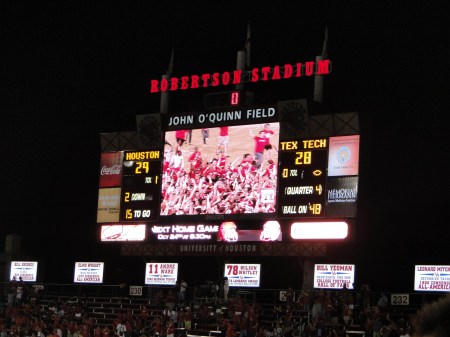
By now you have read or heard that the University of Houston Cougars came storming back across the pages of a Hollywood scripted comeback victory over the Texas Tech Red Raiders at Robertson Stadium on the UH campus last night. With exactly 49 seconds left in the game, junior quarterback Case Keenum slithered four yards up the middle on a keeper play, hurling himself into the end zone for what proved to be the winning score of 29-28. A two-point try then failed for UH, but the Cougar  kids managed to hold off the longest near-minute on record, one that could have, but didn’t, put Tech in position for a game-winning field goal.  Red Raider hopes died on the wings of a Hail Mary pass down the field from “Yosemite Sam” Potts to anybody running down field in a white jersey. The ball got batted away by the UH defenders on about the 12-yard line and the game was done
TTG 092609 03

This was an important game for UH, we fans and alumni, and the City of Houston. The record sellout crowd of 32,000 plus may have seemed like nothing by comparison to the crowds that jam Memorial Stadium in Austin, for best nearby example, but the figure was big relative to the plan for building support at UH for a new, much larger venue for football. Such a facility is vital to UH plans for building its way back into national contention as a first tier level athletic program.

TTG 092609 02

When UH first entered the Southwest Conference back in 1976, the Cougars did something that initially made, but eventually broke their highway to NCAA Football Heaven. The Cougars tied for the conference football championship that year and subsequently won or tied for three of four championships in football over the course of their first four years in the SWC. The highlight on UH’s successful mistake was going to Austin on a beautiful Saturday afternoon in 1976 and promptly whacking Darrell Royal’s last UT Longhorn squad by a score of 30-0. To make matters worse, the UH student body also brought a large banner that they unfolded early on in the stands at Austin. It simply read: HOUSTON IS THE UNIVERSITY OF TEXAS!”

Big mistake! The poor, but inspired cousins from the east should never have insulted their rich and powerful relations in Austin on the same day they chose  to also smite them and all their legends on their home field of battle. (See David v. Goliath for historical precedent. Even David knew when to keep his mouth shut.) As a result, there was little question from early on that the ancient powers of the old SWC were then loaded to the bear with buyer’s regret over the decision to take UH into the fold. It was also no small wonder, years later, that UH was among those schools who were left out of the move to the Big 12, along with Rice, TCU, and SMU after the Southwest Conference folded. At the same time, UT, A&M, Tech, and Baylor were invited to join the new Big 12 Conference.

Why would the Big 12 take three of the established public school powerhouses, but leave out UH in favor of weak-in-football, private school Baylor? It’s too bad that former Governor and Baylor alumna Ann Richards isn’t around to help explain that one. With the help of late Lieutenant Governor Bob Bullock, I’m betting those two wonderful Texas pundits could quickly clear up any questions we might still have on “Baylor in – Houston out” in the Big 12 move.

To their credit, Texas Tech stands out as the only member of the Big 12’s former SWC four schools who will dare to continue scheduling UH in football. The others may prefer to explain their UH scheduling snubs as strictly an economic issue, but we at UH prefer to believe that it’s more about them making sure that they don’t do anything to help UH use those game opportunities as a device for getting back on all four Cougar paws in the facility, recruiting, and program respect roles race.

If UH keeps winning, time will tell what the truth is. In the meanwhile, keep on keeping on: EAT ‘EM UP, COOGS!

TTG 092609 07

With a record of 3-0 that now includes two wins over respected Big 12 opponents, UH has moved up after this weekend’s results from 17th to 12th in the AP Top 25 Poll. The incredible game played by Cougar Quarterback Case Keenum also deservedly has catapulted the UH junior into the pack of those outstanding candidates for the 2009 Heisman Trophy. Check out the poll for yourself and have a nice week.

http://sportsillustrated.cnn.com/football/ncaa/polls/ap/

Houston: A Grocery Store Memoir.

September 26, 2009

Haenel's Groceries

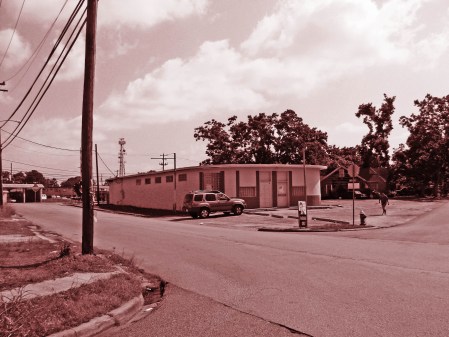
Once upon a time, about 1950, this now fairly abandoned site at the corner of Myrtle and Redwood in Pecan Park thrived as Haenel’s Grocieries, one of the many small family-run grocery stores that threaded their way all over the Houston East End. In fact, Haenel’s was located directly across the street on the Redwood side from Graves’ Groceries. There was room enough for both little stores, in spite of the nearby competitive presence of larger grocers, like Weingarten’s, Henke & Pillot, Piggily Wiggiily, A&P, and Minimax.

Right around the corner from Haenel’s and Graves was the Griggs Road Butcher Shop, where they sold only fresh cuts of meat from beef cattle, chickens, and pigs. You could also buy fish there, sometimes, but special fish markets stores also took care of those items for most people.

Saturday was the big day for family shopping back in that era. Most people didn’t have time to shop fully during the week because of work schedules and limited shopping hours. Most stores opened from 8 AM to 8 PM. Monday through Saturday, with all stores being closed on Sundays. Some of the smaller stores, like Haenel’s, even shut down at 6 PM, Monday through Thursday. So, since most families only had one car that dad used for work during the week, and mom was busy watching kids and fixing meals during the week, most of the family shopping for a whole week pushed toward Friday nights and, especially, all day Saturday.

As a veteran checker, sacker, and stocker at the A&P on Lawndale near 75th, all I can tell you is that there was nothing quite like a Saturday morning at the grocery store back in 1954-56 era I worked the trade. In so many ways, it was the most enjoyable job I ever had – and also the most challenging.

Starting pay back then was  50¢ per hour as a “package boy” (sacker) – with a raise to 75¢ possible upon one’s promotion to checker. That wasn’t bad for the times. Some customers tipped 25-50¢ for help with a heavy load of groceries. What was bad for us was the lesson in economics we faced with promotion. By getting a raise to checker status, we also lost money by losing the opportunity for tips.

One Saturday morning, as I was contemplating my lost income to my checker promotion, an elderly woman customer stopped me as I was walking away from my register on break. It was a case of best/worst timing for the question she shouted my way. “Young man,” screetched the woman, “can you tell me where this store keeps its all day suckers?”

“Well, you’re talking to one of them,” I replied.

Unfortunately, our store manager in 1955-56, Mr. Wright was coming around the aisle just in time to hear both parts of our brief exchange. I received a severe lecture for trying to be funny on the job and summarily ordered to finish the afternoon “mopping the slop” all the rest of the day at the freight dock behind the store. At the end of the day, Mr. Wright wanted to know if I still thought that my  grocery store job was a place for funny business. What could I say? Short of “take this job and shove it,” there was nothing funny about “mopping the slop” for several hours in 100 degree temperatures, but I was too stubborn to let Mr. Wright run me off from a job I sorely needed. And I also saw his humorless point and learned more about working with uptight, authoritarian bosses at the A&P than I would ever see anywhere else. It’s also why I’ve spent most of my adult life, as much as possible, self-employed.

Nearing Christmas of 1954, I convinced my previous A&P manager, Mr. Dodgen, that some seasonal music owuld help sales by putting customers in the right buying spirit. Mr. Dodgen allowed me to bring down a record player and put on a little Bing Crosby Christmas album that belonged to my parents. It played very well over the loudspeaker system, bringing praise to Mr. Dodgen from customers – and looks of managerical approval to me. I thought, “Oh Boy! I’ve finally done something that’s going to help me around here!”

Then, one day, Mr. Dodgen had to be out of the store for a district meeting. We used the opportunity to remove Bing Crosby and started playing Little Richard at the A&P. When Mr. Dodgen came back earlier than expected, rock and roll was still blasting away, but the customers didn’t seem to mind. In fact, some of the younger mothers were even bopping in the aisles – and our little adolescent task force didn’t mind that action at all.

Mr. Dodgen was no music expert. If he were, he wouldn’t been down at the A&P, approving checks, but even he knew that some change had taken place in his absence.

“That doesn’t sound like Christms music to me!” Mr. Dodgen said.

“”No, but look at how happy the customers are, sir!” I replied.

Mr. Dodgen looked, smiled, and walked away. After that time, it didn’t matter what we played. We had music in the store. And I’ve always guessed that we may have been the first in Houston to do so.

The store Christmas party of 1954 couldn’t have happened in 2009. Once the store closed, several days before Christmas, all of us employees were invited to stay and help celebrate the season with Mr. Dodgen and our other bosses. Beer and hard liquor was available to everyone, including those of us who were only 16.

Well, everyone ended up grossly overserved and, for me, it was my first experience with having way too much to drink. It was also my first opportunity to slide into a level of thinking that can only come from alcohol or similar mind-altering chemicals. We decided that it would be a good idea to take an unopened bottle of Jim Beam bourbon and stuff it into one of the turkeys we had on sale at the meat counter. My companions and I carried out this immature act – and then spent the next two days waiting to see who actually ended up purchasing our “bonus surprise bird.”

Someone did buy the loaded bird, but we failed to see it happen. Then we started worrying that such a customer might actually bring the loaded bird back to the A&P and start complaining. That didn’t happen either. We never knew who got the bird. We just knew that we were lucky. Had it become public, a lot us could have gotten the bird from A&P. As I matured, I always worried that we may have passed on the loaded bird to someone who was looking for a sign from Heaven that they needed to stop drinking. Hell! What we passed on was the Devil’s green light. All I can say now is – I’m sorry for any real harm we may have caused by our immaturity.

I still loved the camaraderie with my co-workers – and I loved my favorite customers. Fifty-five years later, I still see their faces in the check-out line of my mind, as they waited for me to manually ring up their groceries and make change, using little more than my ability to do addition and subtraction in my head. Hey! I had to have something going for me! Without mathematical accuracy, I wouldn’t have been able to keep my job.

I might have survived at A&P without change, anyway, had Mr. Dodgen remained our manager, but not with Mr. Wright around. Mr. Wright needed to know that everyone at A&P understood that there’s nothing funny or enjoyable about selling groceries. I didn’t get that lesson, but I did learn a lot about taking personal responsibility for my behavior from Mr. Wright. He turned out to be a pretty cool old school guy afer all.

Houston Buffs: The Boyer Boys!

September 25, 2009

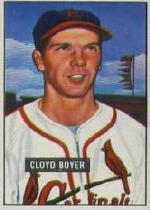
Cloyd Boyer 002 Cloyd Victor Boyer, Jr. was the eldest of three brothers who all played professional baseball up through the major league level. Born in Alba, MO on September 1, 1930, Cloyd pitched in parts of 14 minor league and 5 major league seasons from 1945 to 1961. Two of those seasons for the 6’1″, 188 lb. right hander included service with the 1948 (16-10, 3.15 ERA) and 1953 (4-2, 2.73) Houston Buff clubs. Boyer was a pitcher with a good variety of variable speed options and fair control. He gave up a lot of hits per game (8.6 per innings, career), but he also was effective in getting batters to put playable outs on the field. Over the course of his entire career, he won 137 games and lost 120, recording a minor league career ERA of 3.52. After his active career concluded, Cloyd managed in the minors on five scattered year occasions from 1963 through 1989. He then retired from baseball to his native area of southwestern Missouri.

Two others among the several rural Boyer brothers also followed older sibling Cloyd down the pro ball trail, and the second of those also passed through Houston on his way to becoming one of the top 3rd basemen in the National League for several years. Ken Boyer (born 5/20/1937 in Liberty, MO) played 15 seasons in the big leagues, mainly for the St. Louis Cardinals,  from 1955 through 1969. He batted .287 with 282 career home runs over the major league haul. He also led the 1954 Buffs to the Texas League crown with a pretty good minor league stick (.319 BA, 21 HR, 116 RBI).  As a big leaguer, Ken appeared in 11 all star games and also played a critical hiting role in the 1964 Cardinals World Series victory over the New York Yankees. Sadly, we lost Ken Boyer o cancer on 9/07/1982 at the age of 51.

Ken Boyer 001 The youngest of these three ballplaying brothers was Clete Boyer, who was born on 2/08/1937 in Cassville, MO. Clete was also a right handed hitting third baseman with superior defensive skills. When Clete and Ken faced off against each other in the 1964 World Series as rival third basemen for the Yankees and Cardinals, it was a mighty big day back in southwestern Missouri. – Clete played most of his career for the Yankees and Braves, finishing his major league career with a .242 BA and 162 HR (1955-71.) He never made it to Houston as a player for the Buffs, Colt .45s, or Astros, but we would have loved having him on our resume too.

Somewhere out there, there must be a few other families with kids who are good enough to do as well as the Boyers.  All we baseball fans can hope for is that they aren’t already lined up to pursue careers in football or basketball first. Clete Boyer 001

Buff Stadium: The Fair Maid Moon!

September 24, 2009

Fair Maid 001

Some of us called it “The Fair Maid Moon.”  By evening game time at Buff Stadium during the Post World War II last days of Houston’s minor league history (1946-61), the old bread bakery sign hung faithfully, and lovingly, and hopefully too, in the summer night sky. Suspended in full view of Buff fans, and hanging like an ascending astral body, just above the left center field fence line, and even though it never actually moved, the neon-lighted Fair Maid sign always seemed ready to take off in celebration of the Buffs  across the Houston evening air. What is sent to us in compensation for its own lack of movement was a fragrance usually reserved for the baker man himself.  The aroma of freshly baking bread came wafting into the stands at Buff Stadium like clockwork, peaking appetites, and probably boosting hot dog and hamburger sales many times over President Allen Russell’s wildest dreams.

Fair Maid 004

The photo that yields this typical glimpse of a night at Buff Stadium reveals through the above crop-shot that that season  of its taking had be wither 1956 or 1957. Those were the only two times that the league included Austin, Dallas, Fort Worth, Houston, Oklahoma City, San Antonio, Shreveport, and Tulsa. From a larger copy of this shot than I am able to include here, I can give you this rundown on the three line scores on display: Dallas @ San Antonio, San Antonio leads 1-0 through 6 innings; Fort Worth @ Austin, Austin leads 7-2 through 3 innings; Tulsa @ Shreveport, game is tied 4-4 though 4 1/2 innings. That leaves Oklahoma City, playing in the field, against Houston, the home club. I can’t tell you the score because we cannot see the Buff Stadium home scoreboard in far left field.

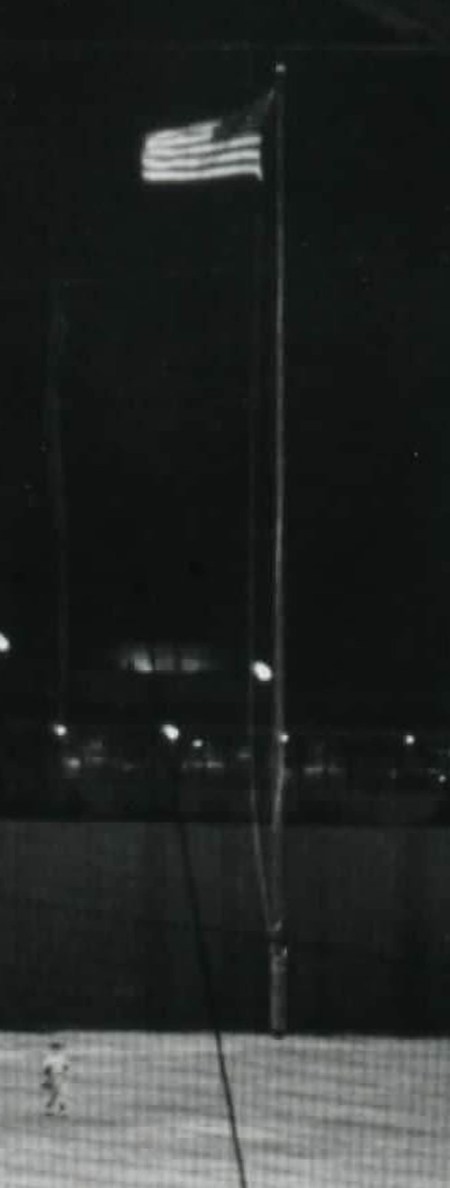
Fair Maid 005 Dead center field in Buff Stadium was 424 feet from home plate. and the outfield pasture also included a free-standing flagpole of some considerable similarity to the one that now resides in Minute Maid Park. It was located about five feet in from the outer wall, but there was no hill to climb.
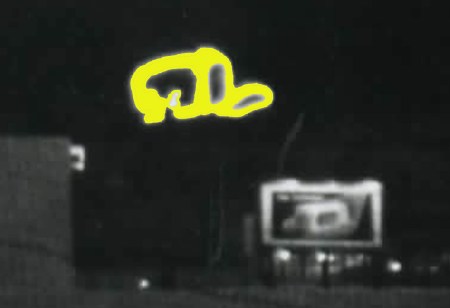
Note the prevailing wind that typically blew the flag from right to left as the breeze came across the right field fence from the gulf.

Fair Maid 006

That’s the Fair Maid Moon close up, hanging low in the sky behind Buff Stadium from its perch above the Fair Maid Bakery, a long two blocks north of the ballpark at the corner of Leeland and Cullen and burning much brighter than its product image on the billboard to its right. The happy face of an old friend, even in a photograph, is a mighty comfort that peels away so much loss over time. I thank you for being there again today, old friend.

Good night again, Fair Maid Moon, wherever you now are. The memory of your fragrance tells us, heaven’s not far. – Buff Stadium and Heaven, they were once and always, and forevermore they remain the same, the place we once both planted and harvested the seeds and fruits of our fondest baseball dreams about hope and possibility in a once more beautiful world.

Aaron Pointer: A Man for All Seasons.

September 23, 2009

HBHC POINTER 1 Aaron Pointer (Batted Right/Threw Right; Outfield) has to be one of the best examples of how life sometimes arms certain people with talents that could take them in several varied directions, but all the while, these opportunities are rising and falling constantly with how the individual makes and uses the decisions he or she finally decides to take responsibility for putting into motion.
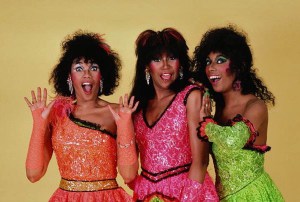
Born in Little Rock, Arkansas on April 19. 1942, but raised in Oakland, California, Aaron Pointer was the son a of a preacher man and his wife, the Reverend Elton and Sarah Elizabeth Porter. Aaron’s older brother Fritz was also a gifted amateur athlete who grew up to be a college English professor and published author. Aaron’s younger sisters, Ruth, Anita, Bonnie, and June stormed the entertainment world from the early 1970s forward as the fabulous Pointer Sisters.

Pointer served as President of the Student Body at McClymonds High School, where also excelled in baseball, football, and basketball. McClymonds in Oakland just happens to be the same school that also gave the world Bill Russell in basketball and Frank Robinson in baseball.  After his high school graduation, Pointer entered San Francisco University on a basketball scholarship, with an understanding that he would also be allowed to play baseball. A chronic sore arm knocked Pointer out of his plans to continue baseball as a pitcher at SFU. Aaron was still good enough as a position player to attract the attention of the Houston Colt .45s as an outfield prospect. He signed with Houston in 1961 for a bonus of $30,000 and was assigned to Class D Salisbury  and what turned out to be a memorable season.

HBHC POINTER 2Aaron Pointer batted .402 in 93 games for Salisbury (132 hit for 329 at bats) in 1961 for 19 doubles, 14 triples, and 7 home runs. By breaking the /400 mark, Pointer became the last professional baseball player to exceed that magic mark over a full summer of play. (Rookie League and Mexican League marks are not considered as data on this achievement trail.) At season’s end, Pointer was called up to the 1961 AAA Houston Buffs in time to also hit .375 ( 3 for 8 ) in four games.
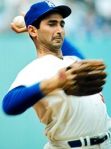
After 1961, Aaron Pointer would never again have another lights out year over the course of his nine-season, mostly minor league career.

On September 271963, he was part of an all-rookie lineup that remains  on record as  the youngest lineup in MLB history, with an average age of 19. Joe MorganRusty Staub and Jim Wynn were the only three players that went on to great careers from that group of promising rookies.

By breaking in with the 1963 Colt .45s and then coming back with the 1966-67 Astros, Aaron Pointer also placed himself in a quietly unique category for former Houston Buffs. Aaron Pointer, outfielder Ron E. Davis, and pitcher Dave Giusti are the only three professional baseball players who actually performed for Houston under all three of their identities as Buffs, Colt .45s, and Astros. Giusti’s distinction is slightly greater in this regard as the only last former Buff from 1961 who also played for the first Colt .45 club in 1962 and the first Astro club in 1965. Pointer did not join the Colt .45’s until their second season (1963) and did not play either for the Astros until their second season (1966). Davis also missed the first Astros year, but arrived in time to play parts of three seasons as an Astro (1966-68).

Pidge Browne, Jim R. Campbell, Ron E. Davis, Dave Giusti, and J.C. Hartman were the only five last Buffs (1961) who also played the next year as first-season Colt .45s (1962), but four of these men, all but Giusti, were gone by the time the club became the Astros in 1965. As mentioned above, Pointer also became a Colt .45, but not until the 1963 season. Ron E. Davis, as mentioned, rejoined the club in 1966 during their second season run as the Astros.

After being traded to the Chicago Cubs organization in 1968, Aaron Pointer spent all of 1969 at Tacoma. He finished that season with a career batting average of .272. He  then played three mediocre seasons in Japan and, at age 30, he retired from baseball. Returning to his adopted  home in Tacoma Washington, Pointer went to work for the Pierce County Parks and Recreation Department, supervising their athletics programs. He started officiating high school football games , eventually working himself into a new career as an NFL game official from 1987 to 2003.  He now serves as a member of the Board for the Tacoma Athletic Commission.

In June 2008, Aaron Pointer was inducted into the Tacoma Hall of Fame.

What a life path! – Godspeed, Aaron Pointer! And may your senior days be mellow and bright!

My All Time Jewish All Stars

September 21, 2009

My All Time Jewish All Stars

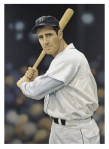
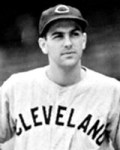
Sandy KoufaxHank_GreenbergLou Boudreau

At the risk of writing anything these days that moves along ethnic lines, I’m still proud to present my all time Jewish All Stars in a starting lineup. It wasn’t that hard to pick these guys out. Most of the older ones were also players that I followed as a kid and young man without regard for their race, color, or creed. I mean, really! How tough is picking out three Hall of Famers at pitcher, first base, and shortstop, a catcher who was brilliant enough also to have served in the dual role of spy for our government in team trips to Japan prior to World War II, a third baseman who whacked the American League silly for ten seasons, a nifty ex-Dodger in center field, a slugging nobody’s fool in left field, and two more recent stars in right field and second base? Geez Us! This one was a piece of cake. – Yeah, I know. Boudreau’s mother alone was Jewish, but if she was good enough for Lou, she’s certainly good enough for the rest of us in making Lou a qualified member of this special club.

The other thing I like about this club? You can put ’em on the field everyday and never have to worry about anybody doing anything dumb.

That being said, here they are:

Ian Kinsler, 2b

Lou Boudreau, ss

Al Rosen, 3b

Hank Greenberg, 1b

Sid Gordon, lf

Shawn Greene, rf

Cal Abrams, cf

Mo Berg, c

Sandy Koufax, p

Oh yeah, here’s my one back-up hedge. If Berg can’t go at catcher, or if he has other work to do that he might not be free to discuss with the rest of us, I’ll have Brad Ausmus  lined up to take over behind the plate without missing a beat – and probably adding a little on defense too.